
- Home
- »
- Communications Infrastructure
- »
-
Software Defined Data Center Market Size Report, 2033GVR Report cover

Software Defined Data Center Market (2026 - 2033)
Size, Share, & Trends Analysis By Component (Solution, Services), By Solution, By Deployment (Public, Private, Hybrid), By Enterprise Size (SMEs, Large Enterprises), By End Use, By Region, And Segment Forecasts
Market Size, 2025
$90.5BMarket Estimate, 2026
$106.9BMarket Forecast, 2033
$370.7BCAGR, 2026–2033
19.4%Software Defined Data Center Market Summary
The global software defined data center market size was valued at USD 90.5 billion in 2025 and is projected to grow from USD 106.9 billion in 2026 to USD 370.7 billion by 2033, at a CAGR of 19.4% from 2026 to 2033. The market in North America dominated with a revenue share of 38.2% in 2025. North America, particularly the United States, hosts the world's largest concentration of hyperscale data centers operated by cloud providers and technology companies.
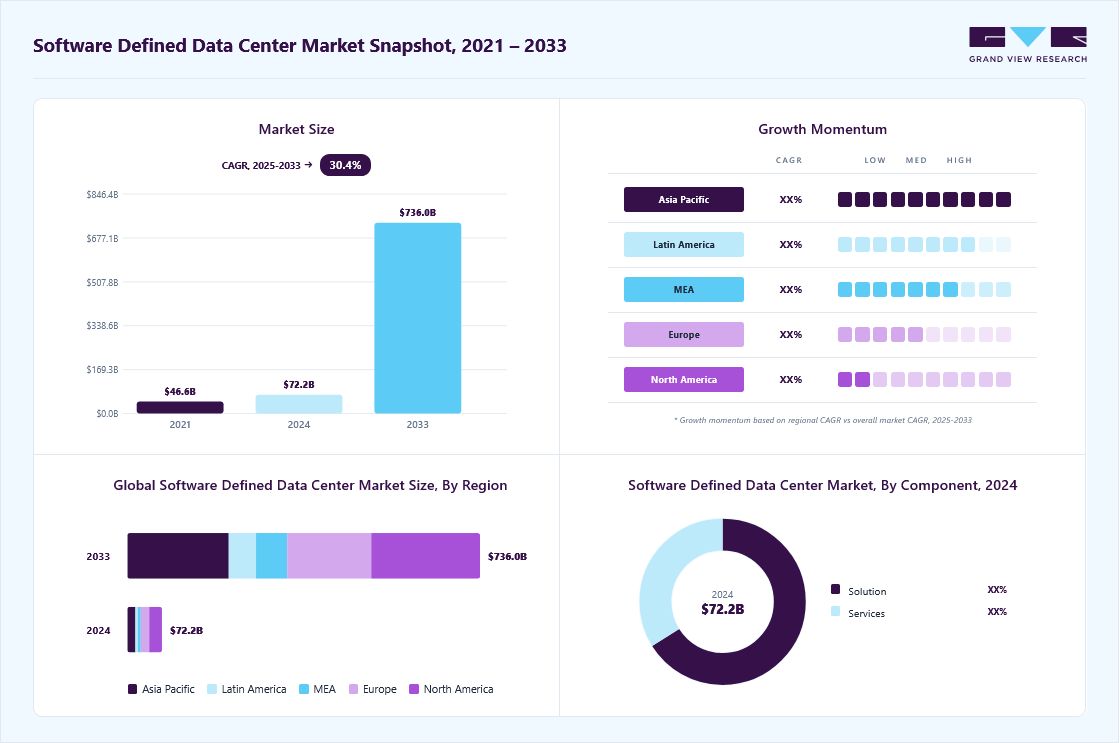 Source: Grand View Research, IR Documents, Primary Interviews, Paid DatabasesTo learn more about this report,
 Download Free Sample Report
 Key Market Trends & Insights
- By component: Solution segment dominated the market, with a revenue share of 65.3% in 2025
- By solution: Software-defined compute (SDC) segment held the largest market share of 35.6% in 2025
- By deployment: Public segment held the largest market share of 49.0% in 2025
- By enterprise size: Large enterprises segment held the largest market share of 57.1% in 2025
- By end use: IT and telecom segment held the largest market share in 2025
Regional Highlights
- Largest regional market: North America (38.2% revenue share, 2025)
- Fastest-growing regional market: Asia Pacific (highest CAGR, 2026-2033)
- By country: The U.S. held the largest market share in 2025.
Market Size & Forecast
- Market size in 2025: USD 90.5 Billion
- Estimated market size in 2026: USD 106.9 Billion
- Projected market size by 2033: USD 370.7 Billion
- CAGR (2026-2033): 19.4%
Three ways to get this report
Buy it, customize it, or ask a question.Ask an Analyst
A direct answer, usually in 1 working day
- AccessReport author, directly
- Reply timeWithin 1 working day
- No sales callDirect answer only
- FormatEmail reply
- CostFree, no cost
Get the Full Report
What the study covers
- FormatsPDF · Excel · Dashboard
- Timeline2026–2033 annual, 2025 base
- Coverage20+ countries, 5 regions
- Companies10+ key players profiled
Customize the Report
20% free customization
- IncludeCountries, segments, points
- TailorTo your product definition
- ExtendDeeper competitor detail
- OrA fully bespoke study
- Turnaround5–10 working days
Growing demand for cloud services, AI applications, and digital platforms is driving investments in software-defined compute, storage, and networking solutions that improve scalability, automation, and resource utilization across large-scale facilities. Enterprises across industries are shifting from traditional data centers to software-defined environments to improve automation, reduce hardware dependency, and increase resource utilization. With cloud computing, AI/ML workloads, and big data analytics requiring highly flexible and programmable infrastructure, software defined data center (SDDC) solutions are becoming vital.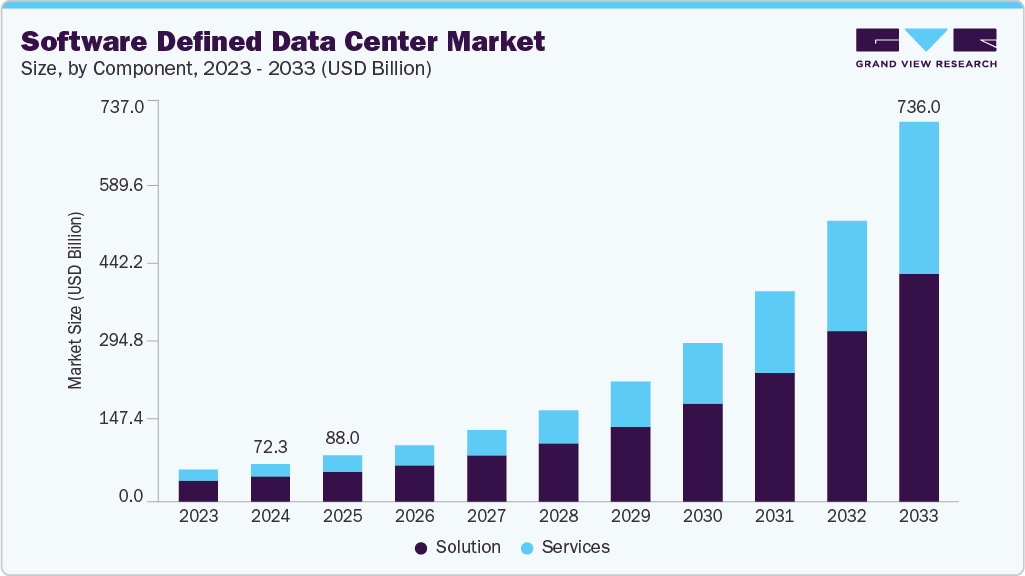 To learn more about this report, Download Free Sample Report
 Moreover, organizations are adopting DevOps and continuous delivery models that rely on dynamic provisioning of compute, storage, and networking resources, capabilities that are native to SDDC frameworks. The rapid proliferation of edge computing and hybrid cloud strategies, which require a consistent and centralized approach to managing distributed IT environments, contributes to market growth. SDDCs offer seamless integration across public and private cloud platforms by abstracting hardware components and managing them via software-defined policies. This enables organizations to manage workloads across on-premises and cloud environments with better control, security, and visibility. Moreover, advancements in virtualization technologies and the adoption of containerized applications using Kubernetes and Docker further support the demand for SDDC architectures.
Cybersecurity and compliance pressures are also propelling the SDDC market forward. Software-defined infrastructures offer enhanced automation and orchestration capabilities that improve disaster recovery, fault tolerance, and policy enforcement. This is crucial in regulated industries such as finance, healthcare, and government, where data integrity and access control are mission-critical. Gigamon’s 2025 Hybrid Cloud Security Survey reveals breach rates have jumped to 55%, up 17% year-over-year, as AI-generated attacks increasingly strain hybrid cloud environments. The study surveyed over 1,000 IT and security leaders across six countries.
In addition, the emergence of AI-driven monitoring tools within SDDC platforms allows for proactive infrastructure management, helping reduce downtime and operational costs. As organizations look to future-proof their IT ecosystems, SDDC's ability to deliver agility, automation, and operational efficiency will continue to fuel its adoption globally.
Market Dynamics
The software defined data center market is experiencing robust growth as organizations increasingly modernize their IT infrastructure to support cloud computing, digital transformation, artificial intelligence (AI), and data-intensive workloads. SDDC solutions virtualize and automate compute, storage, networking, and security resources, enabling enterprises to improve infrastructure agility, optimize resource utilization, and reduce operational complexity. The growing adoption of hybrid and multi-cloud environments is driving demand for centralized management platforms capable of orchestrating workloads seamlessly across on-premises and cloud infrastructures. Additionally, increasing investments in hyperscale data centers, edge computing deployments, and software-defined networking (SDN) technologies are encouraging organizations to transition from hardware-centric architectures to software-driven infrastructure models. The rapid expansion of AI, machine learning, and high-performance computing workloads is further accelerating the need for scalable and automated data center environments that can dynamically allocate resources based on business requirements. Furthermore, rising cybersecurity concerns are promoting the adoption of software-defined security, micro-segmentation, and zero-trust architectures within SDDC environments to strengthen data protection and regulatory compliance. The increasing popularity of hyperconverged infrastructure (HCI), Infrastructure-as-Code (IaC), and AI-driven operations (AIOps) is also enhancing automation, operational efficiency, and infrastructure resilience. As enterprises continue to prioritize digital innovation, cloud-native application deployment, and intelligent infrastructure management, demand for Software Defined Data Center solutions is expected to grow steadily across industries worldwide.
The growing need to improve infrastructure agility, optimize resource utilization, and support rapidly expanding digital workloads is a major driver for the software defined data center market. Organizations across BFSI, healthcare, telecommunications, retail, manufacturing, and government sectors are increasingly adopting software-defined compute, storage, networking, and security solutions to modernize legacy data center environments. As hybrid cloud strategies, multi-cloud deployments, artificial intelligence (AI), machine learning, and data-intensive applications gain momentum, enterprises require highly automated infrastructure platforms capable of dynamically provisioning and managing resources. Additionally, the expansion of hyperscale data centers, edge computing deployments, and Infrastructure-as-Code (IaC) practices is accelerating demand for centralized, software-driven infrastructure management solutions.
High migration costs remain one of the most significant barriers to the adoption of software defined data center (SDDC) solutions. Transitioning from traditional hardware-centric data center environments to fully software-defined architectures requires substantial investments in virtualization software, network modernization, storage upgrades, management platforms, and cybersecurity solutions. Organizations often need to replace or reconfigure legacy infrastructure, migrate critical workloads, and redesign operational processes to support software-defined operations. In addition, implementation projects frequently involve consulting services, system integration, employee training, and temporary downtime risks, which further increase overall costs. Many enterprises also face challenges ensuring compatibility between existing applications and new software-defined platforms, leading to additional customization and testing expenses. Small and medium-sized businesses, in particular, may struggle to justify the upfront capital and operational expenditures. As a result, concerns about return on investment, migration complexity, and potential business disruption can slow SDDC adoption despite its long-term benefits.
The rapid growth of AI-driven infrastructure, edge computing, and hyperconverged infrastructure (HCI) presents significant opportunities for the software defined data center market. Enterprises are increasingly deploying AI and machine learning workloads that require scalable, automated, and software-managed infrastructure capable of supporting high-performance computing and GPU-intensive environments. At the same time, the expansion of edge data centers driven by 5G, IoT, autonomous systems, and real-time analytics is creating demand for centralized management and orchestration platforms. The continued adoption of hyperconverged infrastructure, software-defined networking (SDN), software-defined storage (SDS), and AIOps solutions further enables greater automation, operational efficiency, and workload flexibility. Additionally, growing investments in hyperscale cloud facilities, digital transformation initiatives, smart manufacturing, and next-generation enterprise applications are creating substantial opportunities for vendors to deliver advanced SDDC solutions that enhance scalability, resilience, and business agility.
Analyst Perspective
The software defined data center market is driven by the rapid expansion of hybrid and multi-cloud environments, AI and machine learning workloads, edge computing, hyperscale data centers, and infrastructure automation. As organizations seek greater agility, resource optimization, cybersecurity, and support for data-intensive applications, SDDC solutions are evolving into integrated platforms that unify compute, storage, networking, security, and orchestration. Competitive advantage will increasingly depend on integrating AIOps, SDN, SDS, software-defined security, HCI, Kubernetes, and multi-cloud management. Rising adoption across BFSI, IT and telecommunications, healthcare, government, manufacturing, retail and e-commerce, and energy, along with growing demand for AI-ready data centers, GPU computing, 5G-enabled edge infrastructure, and zero-trust security, will further drive market opportunities.
Component Insights
Based on component, the solution segment led the market with the largest revenue share of 65.3% in 2025 and is expected to grow at the significant CAGR over the forecast period, driven by the rising need for agile, scalable, and cost-effective IT infrastructure to support modern digital transformation initiatives. Enterprises are increasingly adopting SDDC solutions to automate data center operations, enhance resource utilization, and reduce reliance on hardware-centric environments. The surge in hybrid cloud deployments, growing demand for unified management of computing, storage, and networking through software, and rising security concerns are further fueling adoption.
The service segment is anticipated to grow at the highest CAGR during the forecast period due to the increasing complexity of deploying and managing software-defined environments. This complexity drives demand for specialized consulting, integration, and support services. Organizations often lack the in-house expertise required to design and implement SDDC architectures efficiently, prompting them to rely on third-party service providers.
Solution Insights
Based on solution, Software-defined Compute (SDC) segment led the market with the largest revenue share of 35.6% in 2025, driven by the need for flexible and policy-driven allocation of computing resources across virtualized environments. As businesses scale workloads across on-premises and multi-cloud platforms, SDC enables seamless workload portability, dynamic provisioning, and improved performance efficiency. The increasing adoption of containerized applications, DevOps practices, and microservices architecture also propels demand for SDC to support rapid deployment and scalability.
The software-defined networking (SDN) segment is expected to grow significantly during the forecast period due to the growing need for intelligent, programmable, and agile network infrastructure that can adapt to dynamic workload requirements. As enterprises embrace distributed applications and real-time data processing, SDN facilitates granular traffic control, automated provisioning, and improved network visibility, enhancing overall efficiency and security. The rising frequency of cyber threats and east-west traffic within data centers is also encouraging the adoption of SDN for its centralized policy enforcement and micro-segmentation capabilities.
Deployment Insights
Based on deployment, public segment led the market with the largest revenue share of 49.0% in 2025, driven by the increasing preference of enterprises and SMEs for cost-effective, scalable, and on-demand infrastructure offered by public cloud providers. This model significantly reduces capital expenditure and eliminates the need to maintain physical data centers, making it attractive for businesses seeking faster time-to-market and global reach. The expansion of public cloud ecosystems with native SDDC offerings, coupled with improved regulatory compliance capabilities and high service availability, is further encouraging adoption.
The hybrid segment is expected to grow at a significant CAGR during the forecast period as organizations seek to balance control, performance, and flexibility by combining on-premises infrastructure with public cloud resources. This model supports data sovereignty, legacy system integration, and customized workload placement, which are critical for regulated industries and large enterprises. The rise of data-intensive and latency-sensitive applications also drives demand for hybrid environments that allow localized processing while leveraging cloud scalability.
Enterprise Size Insights
Based on enterprise size, large enterprises segment led the market with the largest revenue share of 57.1% in 2025, fueled by the need for centralized management of vast and complex IT infrastructures that span multiple locations and business units. These organizations prioritize digital transformation and operational efficiency, which SDDC enables through policy-driven automation, reduced manual intervention, and improved resource optimization. Large enterprises also benefit from the enhanced scalability and interoperability, which supports rapid expansion and integration of emerging technologies.
The SMEs segment is expected to grow at a significant CAGR during the forecast period due to the increasing availability of affordable, scalable, and easy-to-deploy SDDC solutions tailored for smaller IT environments. SMEs are embracing SDDC to overcome IT staff and budget limitations while enhancing agility, uptime, and application performance. Adopting cloud-native technologies and SaaS models enables SMEs to access enterprise-grade infrastructure capabilities without large capital investment.
End Use Insights
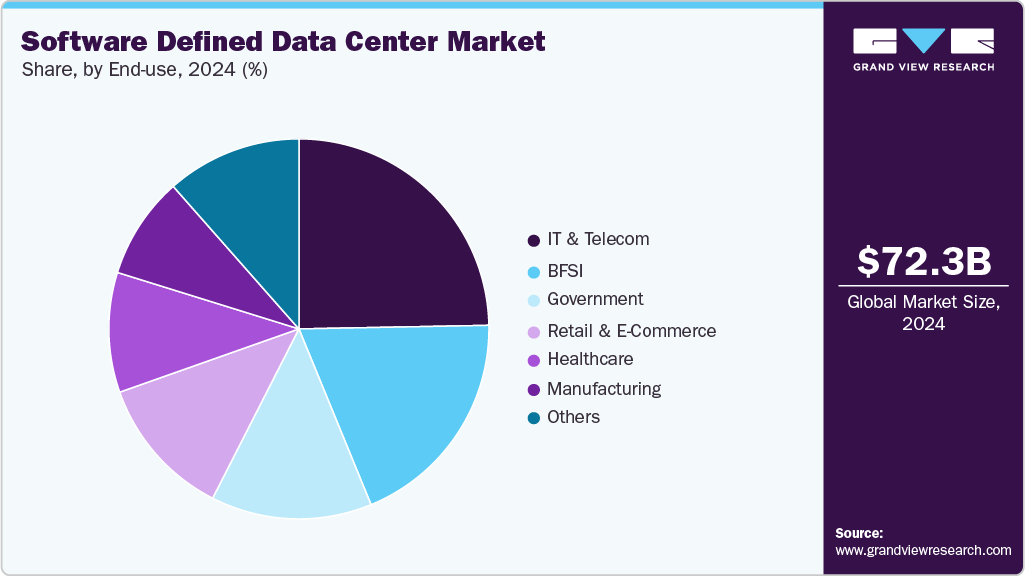
Based on end use, IT and Telecom segment led the market with the largest revenue share of 25.1% in 2025, driven by continuous demand for high-speed data processing, ultra-low latency, and scalable infrastructure to support services such as 5G, IoT, and cloud computing. Telecom operators leverage SDDC to virtualize network functions (NFV), streamline service delivery, and reduce operational complexity. In the IT industry, SDDC supports rapid innovation cycles and agile development environments by enabling programmable infrastructure and automated provisioning.
 To learn more about this report, Download Free Sample Report
 The healthcare segment is expected to grow at a significant CAGR over the forecast period as medical institutions increasingly adopt digital health records, telemedicine, and AI-driven diagnostics, all requiring secure, scalable, and high-performance IT infrastructure. SDDC enables healthcare providers to efficiently manage large volumes of sensitive patient data while ensuring regulatory compliance with standards such as HIPAA. The ability to quickly scale computing resources to support imaging, genomics, and real-time analytics is particularly valuable in clinical environments.
Regional Insights
North America dominated the software defined data center market with the largest revenue share of 38.2% in 2025, driven by the region’s early adoption of cloud-native architectures, the dominance of hyperscale data center providers, and the rapid integration of AI and analytics in enterprise infrastructure. The presence of leading technology vendors and aggressive investments in 5G and edge computing infrastructure have accelerated the shift toward software-defined environments.
 To learn more about this report, Download Free Sample Report
 U.S. Software Defined Data Center Market Trends
The software defined data center market in the U.S. held the largest share in the North America region in 2025, due to the growing demand for automation in IT operations (AIOps). Autonomous data center management is a key growth driver. Enterprises are increasingly leveraging AI and machine learning to optimize data center performance, reduce human intervention, and enable predictive maintenance capabilities that align directly with the principles of SDDC.
Europe Software Defined Data Center Market Trends
The software defined data center market in Europe is anticipated to register considerable growth from 2026 to 2033, as the drive toward green and energy-efficient data centers is significantly influencing the adoption of SDDC. Environmental sustainability policies under the EU Green Deal are pushing enterprises to consolidate resources, minimize hardware usage, and improve energy efficiency, benefits provided by software-defined infrastructure.
The UK software defined data center market is expected to grow rapidly in the coming years, owing to rising demand for digital resiliency in the financial services, insurance, and healthcare sectors. Moreover, the growing reliance on private 5G networks and edge computing in manufacturing and logistics is fueling the adoption of SDDC platforms that can orchestrate resources at the network edge.
The software defined data center market in Germany held a substantial market share in 2025 due to the strong adoption of Industry 4.0 standards and the country's emphasis on high-performance computing (HPC) in the automotive and engineering sectors. The need for ultra-reliable, secure, and software-driven infrastructure to manage real-time data across manufacturing floors encourages SDDC deployment.
Asia Pacific Software Defined Data Center Industry Trends
The software defined data center market in Asia Pacific is anticipated to grow at the highest CAGR of 21.1% during the forecast period due to rapid urbanization, rising internet penetration, and the boom in e-commerce and fintech ecosystems. Emerging economies such as India, Indonesia, and Vietnam are investing heavily in digital infrastructure to support their growing digital economies.
Japan software defined data center market is expected to grow rapidly in the coming years, driven by accelerated cloud migration strategies among traditional enterprises, particularly in the banking and manufacturing sectors. The push for automation in the face of a declining IT workforce and the need for business continuity during natural disasters is motivating companies to shift to programmable and resilient data center infrastructure.
The software defined data center market in China held a substantial market share in 2025, due to the government initiatives such as the New Infrastructure plan and heavy investments in AI, big data, and smart manufacturing, which are propelling the demand for next-generation data center solutions, including SDDC. The country’s growing domestic cloud market, dominated by players like Alibaba Cloud and Huawei Cloud, is integrating SDDC to offer agile, customizable infrastructure services to enterprises.
Key Software Defined Data Center Company Insights
Key players operating in the software defined data center industry are VMware, Inc., Microsoft, IBM Corporation, Hewlett-Packard Enterprise Development LP, and Dell Inc. The companies focus on various strategic initiatives, including new product development, partnerships & collaborations, and agreements to gain a competitive advantage over their rivals. The following are some instances of such initiatives.
-
In May 2025, Hewlett-Packard Enterprise Development LP expanded its HPE Aruba Networking portfolio by launching the Aruba CX 10K distributed services switches. Featuring integrated AMD Pensando DPUs, the switches offload network and security tasks from CPUs, freeing up compute resources for intensive AI workloads. This enhancement aims to boost efficiency and scalability in modern data center environments.
-
In April 2025, through strategic collaboration, Dell Inc. launched its PowerFlex software-defined storage solution integrated with the Nutanix Cloud Platform (NCP) and Nutanix Cloud Infrastructure (NCI). The partnership between Dell and Nutanix was announced last year; the joint solution is now commercially available. Dell Inc. aims to support NCP and Nutanix’s native hypervisor, AHV, in a scalable, two-tiered architecture, bringing increased flexibility and performance to enterprise hybrid cloud deployments.
Key Software Defined Data Center Companies:
The following key companies have been profiled for this study on the software defined data center market.
- Cisco Systems Inc.
- Citrix Systems, Inc.
- Dell Software Inc.
- Hewlett-Packard Enterprise Development LP
- IBM Corporation
- Microsoft
- NEC Corporation
- Oracle
- SAP SE
- VMware, Inc.
Competitive Benchmarking
Category
Operating Strategies
Competitive Edge
Weakness
Established Players (VMware by Broadcom, Microsoft, Cisco Systems, Hewlett Packard Enterprise, IBM, Oracle)
- Established players focus on delivering comprehensive Software Defined Data Center (SDDC) platforms that integrate software-defined compute (SDC), software-defined networking (SDN), software-defined storage (SDS), virtualization, orchestration, automation, security, and hybrid cloud management capabilities. Their strategies emphasize hybrid and multi-cloud enablement, AI-driven infrastructure operations (AIOps), hyperconverged infrastructure (HCI), edge computing, zero-trust security, and centralized workload management.
- These companies benefit from large enterprise customer bases, extensive global channel networks, mature technology ecosystems, strong R&D capabilities, and deep expertise in virtualization and data center infrastructure. Their ability to provide end-to-end infrastructure management, integrated security, scalability, and support for mission-critical workloads makes them preferred partners for large enterprises, cloud providers, and government organizations.
- High implementation costs, complex deployment requirements, and dependence on legacy infrastructure can slow adoption. Organizations may face challenges related to vendor lock-in, licensing complexity, interoperability limitations, and lengthy migration processes. In addition, maintaining and upgrading large software-defined environments often requires specialized expertise and significant operational investment.
Emerging Players (Platform9, Rafay Systems, Diamanti, Maxta, StorMagic)
- Emerging players focus on cloud-native infrastructure, software-defined networking innovation, Kubernetes-based infrastructure management, edge computing, lightweight virtualization, and disaggregated data center architectures. Their strategies emphasize simplified deployment, automation, flexible subscription models, open-source integration, multi-cloud management, container-native operations, and software-driven infrastructure optimization.
- These companies offer greater flexibility, faster deployment, lower upfront investment, and innovative cloud-native architectures. Their solutions often provide simplified management, strong Kubernetes integration, open APIs, multi-cloud compatibility, and scalable subscription-based pricing models. Their agility enables rapid product innovation and quicker adaptation to evolving enterprise infrastructure requirements.
- Limited brand recognition, smaller customer bases, and lower financial resources may restrict their ability to compete against established vendors in large-scale enterprise deployments. They may face challenges related to global expansion, enterprise support capabilities, ecosystem development, customer trust, regulatory compliance requirements, and integration with complex legacy IT environments.
Software Defined Data Center Market Report Scope
Report Attribute
Details
Market size in 2025
USD 90.5 billion
Estimated market size in 2026
USD 106.9 billion
Projected market size by 2033
USD 370.7 billion
Growth rate
CAGR of 19.4% from 2026 to 2033
Base year for estimation
2025
Historical data
2021 - 2024
Forecast period
2026 - 2033
Quantitative units
Revenue in USD billion and CAGR from 2026 to 2033
Report coverage
Revenue forecast, company ranking, competitive landscape, growth factors, and trends
Segments covered
Component; Solution; Deployment; Enterprise Size; End Use; Region
Regional scope
North America; Europe; Asia Pacific; Latin America; MEA
Country scope
U.S.; Canada; Mexico; Germany; UK; France; China; Japan; India; South Korea; Australia; Brazil; Saudi Arabia; South Africa; UAE
Key companies profiled
Cisco Systems Inc.; Citrix Systems, Inc.; Dell Software Inc.; Hewlett; Packard Enterprise Development LP; IBM Corporation; Microsoft; NEC Corporation; Oracle; SAP SE; VMware, Inc.
Customization scope
Free report customization (equivalent up to 8 analysts' working days) with purchase. Addition or alteration to country, regional & segment scope.
Pricing and purchase options
Avail customized purchase options to meet your exact research needs. Explore purchase options
Global Software Defined Data Center Market Report Segmentation
This report forecasts revenue growth at the global, regional, and country levels and provides an analysis of the latest industry trends in each of the sub-segments from 2021 to 2033. For this study, Grand View Research has segmented the global software defined data center market report based on component, type, deployment, enterprise size, end use, and region:
-
Component Outlook (Revenue, USD Billion, 2021 - 2033)
-
Solution
-
Services
-
-
Type Outlook (Revenue, USD Billion, 2021 - 2033)
-
Software-Defined Compute (SDC)
-
Software-Defined Networking (SDN)
-
Software-Defined Storage (SDS)
-
Others
-
-
Deployment Outlook (Revenue, USD Billion, 2021 - 2033)
-
Public
-
Private
-
Hybrid
-
-
Enterprise Size Outlook (Revenue, USD Billion, 2021 - 2033)
-
SMEs
-
Large Enterprises
-
-
End Use Outlook (Revenue, USD Billion, 2021 - 2033)
-
BFSI
-
IT and Telecom
-
Government
-
Healthcare
-
Manufacturing
-
Retail and E-commerce
-
Others
-
-
Regional Outlook (Revenue, USD Billion, 2021 - 2033)
-
North America
-
U.S.
-
Canada
-
Mexico
-
-
Europe
-
UK
-
Germany
-
France
-
-
Asia Pacific
-
China
-
India
-
Japan
-
South Korea
-
Australia
-
-
Latin America
-
Brazil
-
-
Middle East & Africa
-
UAE
-
Saudi Arabia
-
South Africa
-
-
Research Methodology
The software defined data center market figures in this report are based on a proven research process that combines executive interviews with secondary research from proprietary databases, company filings, and recognized regulatory and institutional sources. Market size is built through value-chain sizing - reconciling supply-side and demand-side estimates - and triangulated with bottom-up and top-down approaches. Every estimate passes multiple levels of expert validation before publication, with each software defined data center segment quantified using the revenue-capture definitions in the table below.
Segment Definition
Segment - Component
Revenue capture definition
Solution
Solutions comprise the software platforms and technologies that virtualize, automate, and centrally manage data center resources, including compute, storage, networking, security, and orchestration functions. These solutions enable organizations to build agile, scalable, and software-driven IT environments.
Services
Services include consulting, implementation, integration, migration, training, support, and managed services associated with deploying and maintaining software-defined data center environments. Service providers help organizations design, optimize, and manage SDDC infrastructures.
Segment - Solution
Revenue capture definition
Software-Defined Compute (SDC)
Software-Defined Compute refers to the virtualization and abstraction of computing resources such as servers, processors, and memory from underlying hardware. It enables dynamic allocation of computing resources to applications and workloads through centralized software management.
Software-Defined Networking (SDN)
Software-Defined Networking is a networking architecture that separates the network control plane from the underlying hardware infrastructure. SDN enables centralized network management, automated traffic control, improved network flexibility, and faster deployment of services.
Software-Defined Storage (SDS)
Software-Defined Storage abstracts storage resources from physical storage hardware and manages them through software. SDS enables automated provisioning, scalable storage management, improved utilization, and policy-based data storage across diverse environments.
Others
This segment includes complementary software-defined technologies such as software-defined security, infrastructure orchestration platforms, automation tools, hyperconverged infrastructure software, monitoring solutions, and data center management applications.
Segment - Deployment
Revenue capture definition
Public
Public deployment refers to SDDC environments hosted on public cloud infrastructure operated by third-party cloud service providers. Organizations access software-defined resources over the internet on a shared, subscription-based model.
Private
Private deployment refers to software-defined data center infrastructure dedicated to a single organization and hosted either on-premises or in a private cloud environment. It provides greater control, customization, security, and regulatory compliance.
Hybrid
Hybrid deployment combines private and public cloud infrastructures within a unified software-defined environment. It enables organizations to move workloads seamlessly between environments while balancing performance, security, scalability, and cost considerations.
Segment - Enterprise Size
Revenue capture definition
SMEs
The SMEs segment, with respect to the number of employees, generally includes organizations employing between 10 and 999 employees.
Large Enterprises
The Large enterprises segment, with respect to the number of employees, typically comprises organizations employing more than 1,000 employees for multinational corporations.
Segment - End Use
Revenue capture definition
BFSI
The Banking, Financial Services, and Insurance (BFSI) sector utilizes SDDC solutions to support digital banking, transaction processing, regulatory compliance, cybersecurity, disaster recovery, and scalable financial services infrastructure.
IT and Telecom
IT and telecommunications organizations deploy SDDC solutions to manage cloud services, network virtualization, data-intensive applications, 5G infrastructure, and large-scale digital service delivery environments.
Government
Government agencies use software-defined data centers to modernize public sector IT infrastructure, improve service delivery, strengthen cybersecurity, support digital governance initiatives, and enhance operational efficiency.
Healthcare
Healthcare organizations leverage SDDC solutions to manage electronic health records, medical imaging, telemedicine platforms, clinical applications, and sensitive patient data while ensuring compliance and high availability.
Manufacturing
Manufacturers adopt SDDC solutions to support smart factories, industrial automation, Industrial IoT (IIoT), predictive maintenance, digital twins, and real-time production analytics.
Retail and E-commerce
Retailers and e-commerce companies utilize SDDC technologies to manage omnichannel operations, customer analytics, online transactions, inventory systems, and scalable digital commerce platforms.
Others
This segment includes industries such as education, transportation, energy and utilities, media and entertainment, logistics, hospitality, and professional services that use software-defined data centers to enhance IT flexibility, scalability, and operational performance.
Estimation Model
Layer
Question
Analysis
SDDC Demand Layer
Who requires Software Defined Data Center solutions?
Identify organizations requiring software-defined infrastructure to improve agility, scalability, automation, security, and resource utilization. Key adopters include hyperscale cloud providers, colocation operators, telecom companies, BFSI institutions, healthcare organizations, government agencies, retailers, manufacturers, educational institutions, and large enterprises undergoing digital transformation.
Infrastructure Modernization & Cloud Adoption Layer
Which organizations deploy SDDC solutions?
Evaluate adoption of software-defined compute (SDC), software-defined networking (SDN), software-defined storage (SDS), hyperconverged infrastructure (HCI), and software-defined security across enterprises. Analyze investments in hybrid cloud, multi-cloud, private cloud, edge computing, and virtualization technologies.
Digital Transformation & Automation Investment Layer
Who actively invests in SDDC technologies?
Analyze investments by cloud service providers, hyperscale operators, telecom companies, BFSI organizations, healthcare networks, government agencies, retailers, manufacturers, and technology enterprises. Measure spending on virtualization platforms, data center automation, orchestration software, AIOps solutions, SDN platforms, SDS platforms, and cloud management tools to identify key adopters and investment trends.
Monetization Layer
How much revenue is generated?
Quantify revenue generated from software licenses, subscription-based cloud management platforms, virtualization software, orchestration tools, software-defined networking and storage solutions, consulting services, implementation services, managed services, maintenance contracts, and support offerings. Evaluate recurring revenue models and enterprise software subscriptions.
Delivered Customizations
This report has been delivered with the following In-depth customizations
Client Request
Customization Delivered
Value Adds
Regional Software Defined Data Center Adoption & Data Center Modernization Assessment
Analyzed regional adoption of Software-Defined Compute (SDC), Software-Defined Networking (SDN), Software-Defined Storage (SDS), hyperconverged infrastructure (HCI), virtualization technologies, hybrid and multi-cloud deployments, AI-ready infrastructure, edge computing investments, hyperscale data center expansion, automation initiatives, and data center modernization programs across North America.
Helps infrastructure vendors, cloud providers, investors, system integrators, and enterprise IT leaders identify high-growth regional markets, prioritize expansion strategies, optimize infrastructure investments, and capitalize on emerging software-defined infrastructure opportunities.
Competitive Benchmarking & Software Defined Data Center Innovation Assessment
Assessed SDDC portfolios, virtualization platforms, SDN and SDS capabilities, cloud management solutions, AIOps technologies, software-defined security frameworks, Kubernetes integration, multi-cloud orchestration capabilities, ecosystem partnerships, pricing models, acquisition activities, and go-to-market strategies of leading and emerging SDDC providers globally.
Helps stakeholders benchmark competitors, identify technology gaps, evaluate strategic partnerships and acquisition opportunities, strengthen product differentiation, and develop effective competitive positioning strategies in the evolving software-defined infrastructure landscape.
Hybrid Cloud & Multi-Cloud Infrastructure Transformation Assessment
Analyzed enterprise adoption of hybrid cloud, multi-cloud, private cloud, and public cloud architectures. Evaluated workload migration trends, cloud management requirements, orchestration platforms, Infrastructure-as-Code (IaC) adoption, and cloud-native application deployment strategies driving demand for SDDC solutions.
Helps organizations optimize cloud strategies, identify infrastructure modernization opportunities, improve workload portability, and enhance operational efficiency through software-defined infrastructure deployments.
Frequently Asked Questions About This Report
The global software defined data center market size was valued at USD 90.5 billion in 2025 and is estimated at USD 106.9 billion for 2026.
The solution segment led with a 65.3% revenue share in 2025, while services segment is the fastest-growing segment.
The software-define compute (SDC) segment led with a 35.6% revenue share in 2025, while software-define networking segment is the fastest-growing segment.
The public segment held the largest share (over 48.0%) in 2025, and is the fastest-growing segment.
Some key players operating in the software defined data center market include Cisco Systems Inc., Citrix Systems, Inc., Dell Inc., Hewlett Packard Enterprise Development LP, IBM Corporation, Microsoft, NEC Corporation, Oracle, SAP SE, VMware, Inc.
The global software defined data center market is expected to grow at a CAGR of 19.4% from 2026 to 2033, reaching USD 370.7 billion by 2033.
The Software Defined Data Center (SDDC) market is experiencing significant growth driven by the increasing demand for scalable and agile IT infrastructure to support digital transformation initiatives. Enterprises across industries are shifting from traditional data centers to software-defined environments to improve automation, reduce hardware dependency, and increase resource utilization.
North America dominated with 38.2% revenue share in 2025.
Asia Pacific is the fastest-growing region over the forecast period.
About the Author(s)
Communications Infrastructure Research Team
Technology · Communications InfrastructureThis report was authored by the communications infrastructure research team at Grand View Research - comprising two research analysts, one senior research analyst, and one industry expert - with specialized expertise in the communications infrastructure segment of the technology industry. All findings are based on proprietary technology databases, executive interviews, and regulatory analysis, subject to internal peer review prior to publication.
Last Updated:
Speak to Analyst

Customize this report to your needs - add regions, segments, or data points, with 20% free customization.
Or view our licence options:


ISO 9001:2015 & 27001:2022 Certified
We are GDPR and CCPA compliant! Your transaction & personal information is safe and secure. For more details, please read our privacy policy.


