
- Home
- »
- IT Services & Applications
- »
-
Software Testing Market Size And Share Report, 2026-2033GVR Report cover

Software Testing Market (2026 - 2033)
Size, Share & Trends Analysis Report By Testing Type, By Service Model, By Testing Platform, By Testing Method, By Deployment, By Business Model, By End Use Industry, By Region, And Segment Forecasts
Market Size, 2025
$49.4BMarket Estimate, 2026
$52.7BMarket Forecast, 2033
$93.2BCAGR, 2026–2033
8.5%Software Testing Market Summary
The global software testing market size was valued at USD 49.4 billion in 2025 and is projected to grow from USD 52.7 billion in 2026 to USD 93.2 billion by 2033, at a CAGR of 8.5% from 2026 to 2033. The market in North America dominated with a revenue share of 35.3% in 2025. The global software testing industry has established itself as a vital pillar of the technology industry, supporting the delivery of reliable, high-quality software across enterprises worldwide.
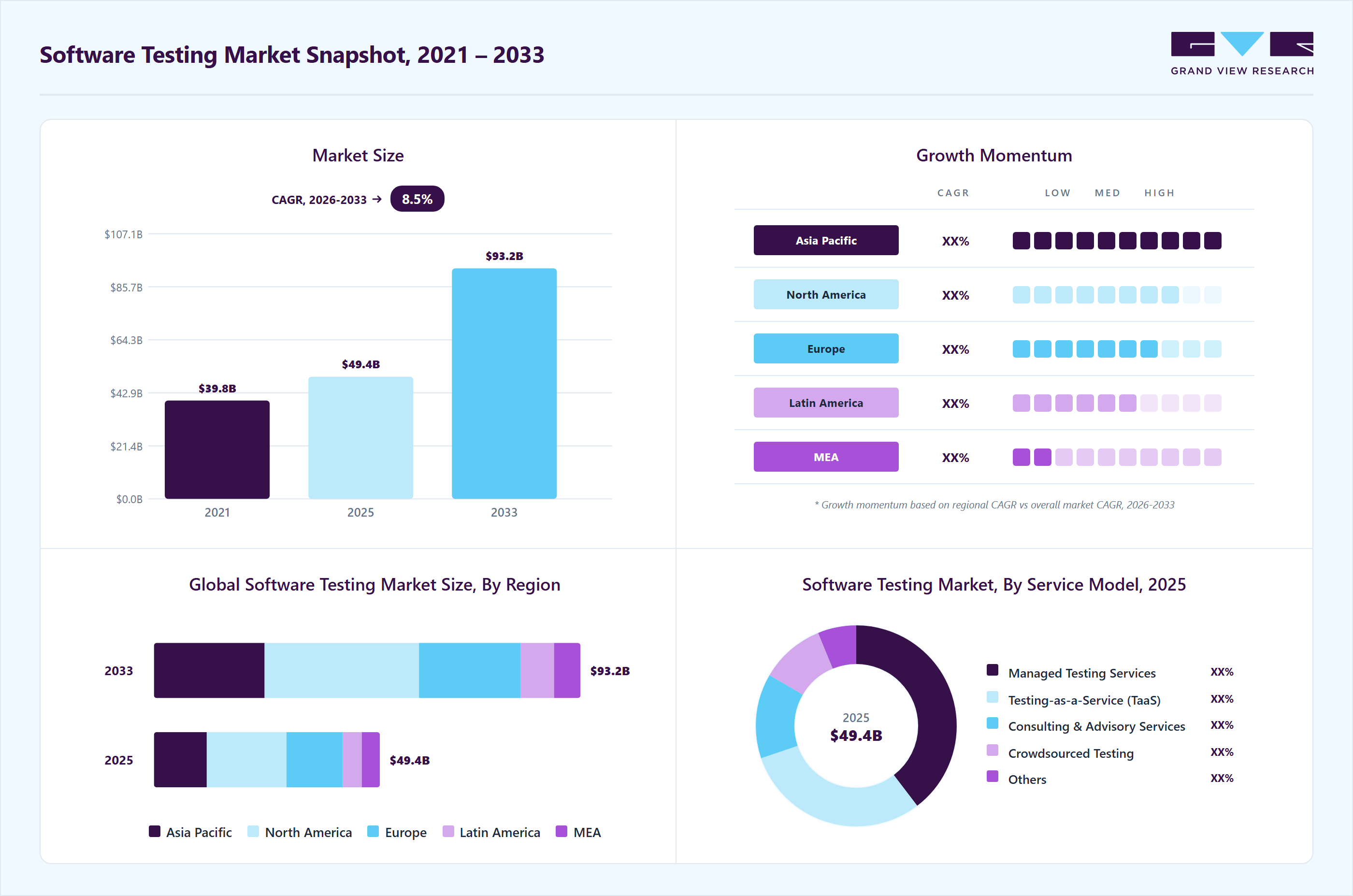 Source: Grand View Research, IR Documents, Primary Interviews, Paid DatabasesTo learn more about this report,
 Download Free Sample Report
 Key Market Trends & Insights
- By testing type: Functional testing segment held the largest market share of 52.7% in 2025.
- By service model: Managed testing services segment held the largest market share in 2025.
- By testing platform: Web-based segment held the largest market share in 2025.
- By testing method: Automation testing segment held the largest market share in 2025.
- By deployment: Cloud segment held the largest market share in 2025.
Regional Highlights
- Largest regional market: North America (35.3% revenue share, 2025)
- Fastest-growing regional market: Asia Pacific (highest CAGR, 2026-2033)
- By country: U.S. held the largest market share in 2025
Market Size & Forecast
- Market size in 2025: USD 49.4 Billion
- Estimated market size in 2026: USD 52.7 Billion
- Projected market size by 2033: USD 93.2 Billion
- CAGR (2026-2033): 8.5%
Three ways to get this report
Buy it, customize it, or ask a question.Ask an Analyst
Analyst response in 1 business day
- AccessReport author, directly
- Reply timeWithin 1 working day
- No sales callDirect answer only
- FormatEmail reply
- CostFree, no cost
Get the Full Report
What the study covers
- FormatsPDF · Excel · Dashboard
- Timeline2026–2033 annual, 2025 base
- Coverage20+ countries, 5 regions
- Companies10+ key players profiled
Customize the Report
20% free customization
- IncludeCountries, segments, points
- TailorTo your product definition
- ExtendDeeper competitor detail
- OrA fully bespoke study
- Turnaround5–10 working days
The market expansion reflects the growing reliance on software applications across sectors, from finance and healthcare to retail and manufacturing. Organizations are increasingly recognizing software testing not merely as a quality checkpoint but as an integral part of the development lifecycle, enabling faster releases while minimizing risks associated with defects and downtime.
 To learn more about this report, Download Free Sample Report
 Several key factors are propelling the software testing market forward. The rapid adoption of artificial intelligence and automation tools is streamlining testing processes, reducing manual effort, and improving the accuracy of early issue identification. Cloud migration and the widespread use of DevOps and continuous integration/continuous deployment practices are further accelerating demand, as they require scalable, on-demand testing environments. Additionally, rising regulatory compliance requirements, heightened cybersecurity focus, and the complexity of modern applications driven by microservices, mobile platforms, and AI integrations are compelling businesses to invest in robust testing solutions. These elements, when combined, enable shorter development cycles without compromising product reliability or user experience.
In line with these evolving market dynamics, strategic industry developments are reinforcing the importance of advanced testing capabilities. For instance, in March 2026, OpenAI’s planned acquisition of Promptfoo reflects growing demand for advanced AI testing within the software testing market. The integration will strengthen security, evaluation, and compliance capabilities in enterprise workflows. By embedding automated testing and governance features, the platform will help organizations identify risks early and deploy reliable, secure AI systems at scale. This move highlights the industry’s shift toward AI-powered testing tools that address emerging challenges in generative AI applications, demonstrating how leading technology firms are integrating advanced testing capabilities to maintain quality amid rapid innovation. Such developments signal broader market momentum, where testing is evolving from reactive validation to proactive, intelligent quality assurance.
In conclusion, the software testing industry is well-positioned for sustained growth as digital transformation deepens across industries. Businesses that embrace these advancements will gain a competitive edge through higher efficiency, reduced costs, and superior software performance. With ongoing technological progress, the sector promises continued opportunities for innovation, making strategic investment in testing capabilities essential for long-term success in an increasingly software-driven economy.
Market Dynamics
The software testing market is experiencing strong growth as organizations adopt AI-powered testing solutions to improve software quality, reduce testing time, and accelerate release cycles. Businesses are under pressure to deliver applications faster while maintaining reliability and performance across complex digital environments. AI-enabled testing technologies, including automated test generation, predictive analytics, intelligent defect detection, and self-healing automation, are helping organizations enhance testing accuracy while lowering manual effort. As enterprises continue investing in digital transformation, cloud applications, and agile development practices, demand for advanced software testing platforms is expected to rise significantly.
For instance, in April 2026, UiPath and Deloitte expanded their partnership to strengthen testing automation capabilities using agentic AI technologies. The collaboration integrated AI-driven test generation, self-healing execution, and analytics into Deloitte Ascend and UiPath Test Cloud, helping organizations improve test coverage, speed software releases, and increase automation efficiency. Such developments highlight how AI-based testing innovation is becoming a major growth driver for the software testing market. As organizations increasingly prioritize faster software delivery and higher application quality, AI-enabled testing solutions are expected to support continued market expansion.
The increasing adoption of automation in software testing has improved testing speed and efficiency, but maintaining automated testing frameworks remains a significant challenge for organizations. Modern software applications undergo frequent updates to user interfaces, workflows, APIs, and application logic, leading to automated test scripts breaking and requiring continuous modification. Companies adopting continuous integration and continuous deployment (CI/CD) practices often face additional pressure to keep testing environments stable and their automation frameworks up to date. This creates higher operational costs, increases resource requirements, and reduces the expected efficiency gains from testing automation investments.
The issue becomes more critical as enterprises develop cloud-native applications, adopt microservice-based architectures, and rapidly evolve digital platforms. Testing teams frequently spend substantial time fixing unstable scripts, managing false-positive results, and updating test cases rather than focusing on quality improvement and innovation. These maintenance challenges can slow software delivery timelines and reduce overall return on investment from software testing solutions. As software ecosystems become complex, reducing the maintenance burden of automation will remain essential to supporting long-term growth in the software testing market.
Market Concentration & Characteristics
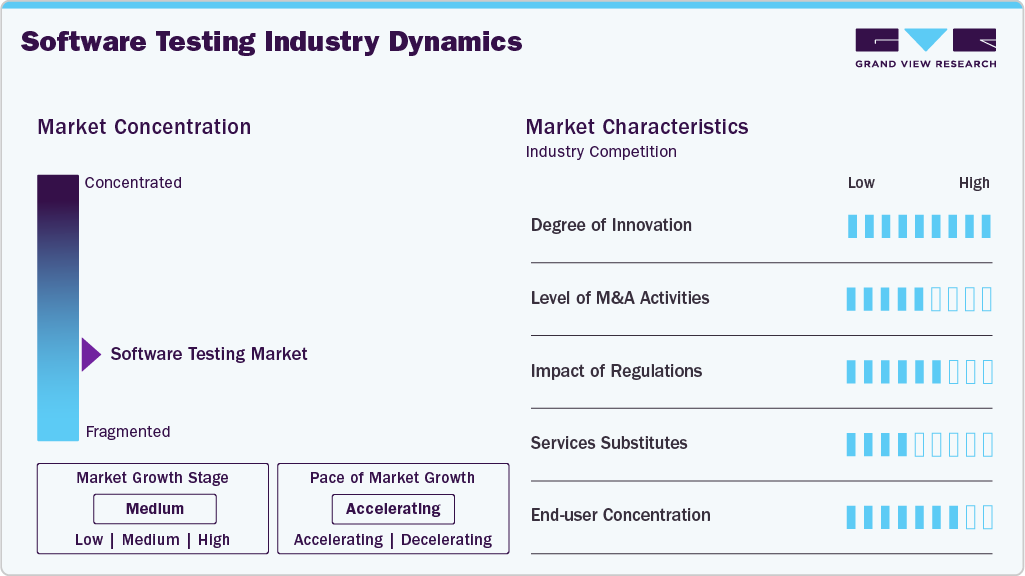
The Software Testing Market is moderately fragmented, with the presence of established technology companies, specialized software testing vendors, cloud testing platform providers, and emerging AI-driven automation companies competing across industries. The market is witnessing strong growth, and the pace of expansion is accelerating as organizations continue increasing investments in digital transformation, cloud adoption, DevOps practices, and agile software development. Businesses are placing greater emphasis on software quality, faster deployment cycles, and customer experience, creating sustained demand for advanced testing solutions. Continuous innovation in automation technologies is also strengthening competition and supporting long-term market expansion.
 To learn more about this report, Download Free Sample Report
 The market is characterized by a very high level of innovation, driven by artificial intelligence, self-healing automation, cloud-based testing environments, and intelligent analytics. Merger and acquisition activity remains moderate as companies strengthen their technology portfolios and expand service capabilities. Regulatory influence is becoming increasingly important, particularly in highly regulated industries such as banking, healthcare, and government sectors, where software quality and compliance requirements are critical. While manual testing and internal quality assurance teams provide some level of service substitution, advanced automation capabilities continue to improve market adoption. Demand is also supported by strong participation from large enterprise customers across industries, creating stable growth opportunities while maintaining competitive market dynamics.
Testing Type Insights
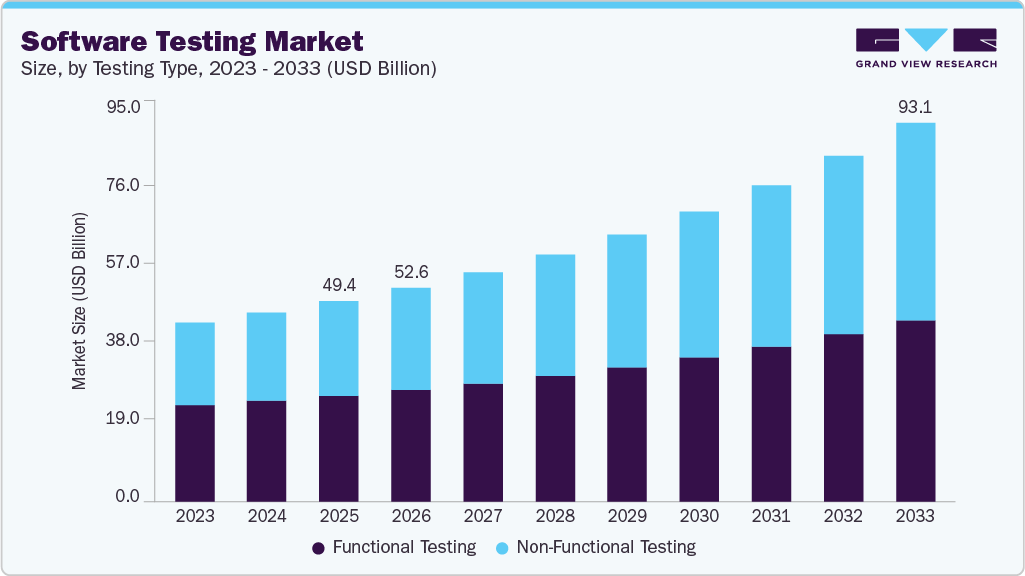
The functional testing segment dominated the software testing industry, accounting for a 52.7% revenue share in 2025, as it focuses on validating whether applications perform according to defined business requirements and user expectations. It is widely adopted across industries to ensure that core features, user interfaces, integrations, and workflows operate correctly before deployment. The increasing complexity of enterprise applications drives the growth of this segment, the rapid adoption of agile and DevOps practices, and the rising demand for high-quality digital experiences across web, mobile, and cloud platforms. Organizations are placing greater emphasis on early-stage validation and continuous testing to reduce defects, minimize rework, and accelerate release cycles. As businesses continue to prioritize customer satisfaction and operational reliability, functional testing remains a foundational component of quality assurance strategies, supporting consistent application performance and strengthening overall market demand.
The non-functional testing segment is anticipated to grow at a significant CAGR during the forecast period. As digital platforms become more complex and user expectations continue to rise, organizations are increasingly focusing on validating how systems behave under real-world conditions, including high traffic loads and potential security threats. The growing adoption of cloud computing, mobile applications, and distributed architectures has further intensified the need for robust non-functional testing to maintain system reliability and protect user data. Additionally, regulatory requirements and the rising cost of system failures are encouraging enterprises to invest in advanced testing tools and automation for continuous monitoring and optimization. As a result, the segment is expected to witness steady growth, supported by its critical role in delivering seamless user experiences and ensuring long-term operational stability.
Service Model Insights
The managed testing services segment dominated the software testing market, accounting for the largest revenue share in 2025. This segment involves end-to-end management of testing activities, including test planning, execution, automation, and quality assurance, allowing companies to focus on core business operations while ensuring consistent software quality. The growing complexity of applications, rapid release cycles driven by agile and DevOps practices, and the need to optimize costs are prompting enterprises to adopt managed services models. Additionally, the integration of advanced technologies such as automation and AI into testing processes is enhancing service delivery and improving defect detection rates. As businesses continue to prioritize faster time-to-market and reliable user experiences, the demand for managed testing services is expected to rise steadily, positioning this segment as a key contributor to the overall market growth.
The Testing-as-a-Service (TaaS) segment is anticipated to grow at a significant CAGR during the forecast period. TaaS enables businesses to access a wide range of testing services through cloud-based platforms without the need for heavy in-house infrastructure, making it particularly attractive for companies aiming to optimize costs and improve scalability. The growing adoption of agile and DevOps practices has further strengthened demand, as continuous testing becomes essential for faster release cycles and improved software quality. Additionally, advancements in automation and cloud technologies are enhancing the efficiency and accessibility of TaaS offerings, allowing organizations to streamline testing processes while maintaining high standards. As digital transformation continues across industries, the TaaS segment is expected to play a crucial role in supporting efficient, scalable, and cost-effective software quality assurance strategies.
Testing Platform Insights
The web-based segment dominated the software testing industry, accounting for the largest revenue share in 2025, driven by the growing shift toward cloud-enabled, browser-accessible solutions. These platforms provide flexibility, scalability, and ease of access, allowing testing teams to collaborate in real time without the need for complex on-premise infrastructure. As organizations continue to adopt agile and DevOps practices, web-based testing tools support continuous testing by enabling seamless integration with development pipelines and faster deployment cycles. The growing demand for remote work capabilities, along with the need to reduce operational costs and improve testing efficiency, is further accelerating adoption. Overall, the segment is expected to witness steady growth as enterprises prioritize accessibility, speed, and integrated testing environments to support modern application development.
The mobile-based segment is expected to grow at the fastest CAGR over the forecast period, driven by the rapid proliferation of smartphones, mobile applications, and diverse operating environments. As organizations increasingly prioritize mobile-first strategies to enhance customer engagement, ensuring seamless performance, usability, and security across various devices and platforms has become essential. This has led to growing demand for mobile testing solutions that support real-time testing, automation, and compatibility across multiple operating systems and screen configurations. Additionally, the rise of agile and DevOps practices is driving the adoption of continuous testing, further accelerating the adoption of mobile-based testing platforms. Overall, the segment is expected to witness steady growth as businesses continue to invest in delivering high-quality mobile experiences while minimizing application failures and performance issues.
Testing Method Insights
The automation testing segment dominated the market, accounting for the largest revenue share in 2025. Automation testing involves the use of specialized tools and scripts to execute test cases, enabling continuous testing across complex applications and reducing reliance on manual intervention. This approach is particularly valuable in agile and DevOps environments, where frequent code changes require rapid validation to maintain quality. The growing adoption of cloud-based platforms, artificial intelligence, and continuous integration practices is driving the demand for automation testing, as these technologies enhance test coverage and improve defect detection efficiency. As businesses focus on accelerating time-to-market while ensuring reliable software performance, automation testing is expected to play a critical role in strengthening quality assurance strategies and supporting sustained market growth.
The AI-augmented / autonomous testing segment is expected to grow at a significant CAGR over the forecast period. By leveraging artificial intelligence and machine learning, this method supports self-healing test scripts, intelligent test case generation, and predictive defect analysis, reducing dependency on manual intervention and improving overall test coverage. The growing complexity of modern applications is driving its adoption, the need for faster release cycles in agile and DevOps environments, and increasing pressure to maintain high software quality with limited resources. As organizations continue to prioritize digital transformation and automation, AI-driven testing is expected to play a critical role in enabling continuous testing and accelerating time-to-market, thereby strengthening its position as a key enabler of next-generation software quality assurance.
Deployment Insights
The cloud segment dominated the software testing industry, with the largest revenue share in 2025. Cloud testing enables scalable, on-demand access to testing resources, enabling teams to run tests more efficiently across multiple environments without significant upfront hardware investment. This flexibility supports faster development cycles and aligns well with agile and DevOps practices, where continuous testing is essential. A key factor driving this segment is the growing adoption of cloud-native applications and microservice architectures, which require dynamic, distributed testing capabilities. Additionally, the ability to integrate automated testing tools within cloud platforms enhances test accuracy and reduces time-to-market. In conclusion, cloud deployment is becoming a preferred approach in software testing, offering cost efficiency, scalability, and improved collaboration, thereby helping organizations deliver high-quality software at speed.
The on-premise is expected to grow at the fastest CAGR during the forecast period. This model involves hosting testing tools and infrastructure within an organization’s own facilities, allowing greater customization and tighter integration with existing systems. Its adoption is largely driven by industries such as banking, healthcare, and government, where sensitive data handling and strict compliance requirements make external hosting less preferable. Additionally, enterprises with legacy systems often find on-premise solutions more compatible with their established architectures. While cloud-based testing is gaining traction due to its scalability and cost advantages, the on-premises segment maintains steady demand as businesses seek secure, controlled testing environments. As a result, this segment continues to play a vital role in the broader market, particularly for organizations with complex regulatory and operational needs.
Business Model Insights
The B2B segment dominated the software testing market, accounting for the largest revenue share in 2025, as enterprises rely on external vendors and specialized service providers to ensure the quality, security, and performance of their software applications. In this model, testing services are delivered by dedicated firms to business clients across industries such as banking, healthcare, retail, and manufacturing, enabling organizations to focus on core operations while leveraging expert capabilities. The growing complexity of digital ecosystems, along with the rapid adoption of cloud computing, agile development, and DevOps practices, is driving demand for scalable, continuous testing solutions in the B2B space. Additionally, the need to reduce time-to-market while maintaining high reliability standards is prompting businesses to invest in advanced testing tools, automation, and third-party partnerships. As a result, the B2B segment continues to expand steadily, supported by increasing digital transformation initiatives and the strategic importance of delivering seamless user experiences in a competitive business environment.
The B2C segment is expected to grow at the fastest CAGR during the forecast period. In this segment, delivering a seamless and reliable user experience is critical, as even minor defects can lead to customer dissatisfaction, negative reviews, and loss of brand loyalty. As a result, organizations are increasingly investing in comprehensive testing practices, including usability, performance, and security testing, to ensure consistent functionality across devices and platforms. The rapid growth of digital consumption, rising user expectations, and intense competition in consumer-facing industries are key factors driving demand for high-quality testing solutions. Consequently, the B2C segment continues to play a significant role in shaping the market, as businesses prioritize user-centric quality assurance to maintain engagement and sustain long-term growth.
End Use Industry Insights
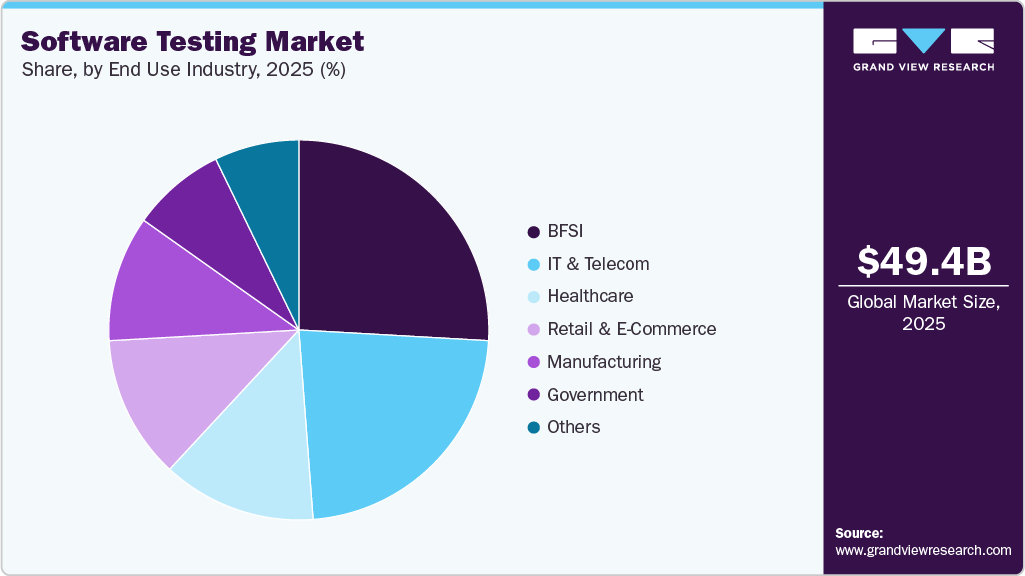
The BFSI segment dominated the market, accounting for the highest revenue share in 2025, driven by its critical need for accuracy, security, and regulatory compliance. Financial institutions rely heavily on complex digital platforms for transactions, customer management, and risk assessment, making robust testing essential to ensure system reliability and data integrity. The increasing adoption of digital banking, fintech innovations, and cloud-based services has further accelerated the demand for advanced testing solutions, including automation and performance testing, to support seamless user experiences and real-time processing. Additionally, stringent regulatory requirements and the rising threat of cyberattacks are compelling organizations to invest in continuous testing and security validation. As a result, the BFSI sector remains a key market growth driver, with a strong focus on enhancing operational resilience and customer trust.
 To learn more about this report, Download Free Sample Report
 The healthcare segment is projected to grow at a significant CAGR during the forecast period, driven by the increasing digitization of patient care, administrative processes, and clinical systems. Healthcare organizations rely on robust testing practices to ensure the accuracy, security, and compliance of applications such as electronic health records, telemedicine platforms, and connected medical devices. The growing emphasis on regulatory adherence, data privacy, and patient safety is encouraging providers to adopt advanced testing solutions that can identify defects early and minimize operational risks. Additionally, the integration of emerging technologies, including cloud computing and AI-driven diagnostics, underscores the need for continuous, automated testing. As the industry continues to evolve toward more interconnected, data-intensive environments, software testing is becoming essential for enabling reliable system performance and building trust among patients and stakeholders.
Regional Insights
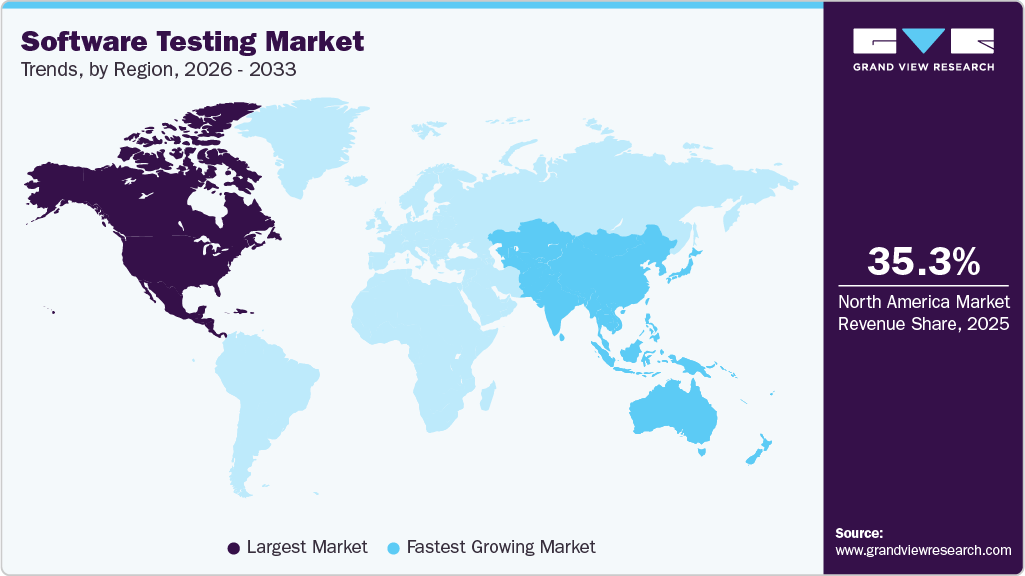
The North America software testing market accounted for the largest global revenue share of 35.3% in 2025, supported by the region’s strong presence of advanced technology ecosystems and early adoption of digital transformation across industries such as finance, healthcare, retail, and manufacturing. Organizations in the region are increasingly integrating testing into the software development lifecycle as a continuous process to ensure quality, security, and faster time-to-market. The growing use of cloud computing, agile and DevOps practices, and AI-driven testing tools is significantly enhancing testing efficiency while reducing manual effort. Additionally, stringent regulatory requirements and rising cybersecurity concerns are prompting enterprises to invest in robust, reliable testing solutions. As businesses continue to prioritize seamless user experiences and operational resilience, the market is expected to maintain steady growth, driven by innovation and the increasing complexity of modern software environments.
 To learn more about this report, Download Free Sample Report
 U.S. Software Testing Market Trends
The software testing industry in the U.S. is expected to grow significantly at a CAGR from 2025 to 2033. Organizations are embedding testing throughout the software development lifecycle to ensure faster releases, improved user experience, and reduced operational risks. A key factor driving this market is the rapid integration of artificial intelligence and automation into testing processes, which enhances efficiency, enables predictive defect detection, and minimizes reliance on manual efforts. Additionally, the growing shift toward cloud-native applications and DevOps practices is accelerating the demand for continuous and scalable testing solutions. As businesses continue to prioritize quality assurance as a strategic function, the U.S. market is expected to maintain its upward trajectory, driven by innovation, regulatory requirements, and the need for resilient digital systems.
Europe Software Testing Market Trends
The Europe software testing industry is anticipated to register considerable growth from 2026 to 2033. Across sectors such as financial services, automotive, and healthcare, businesses are prioritizing continuous testing to enable faster, more reliable software delivery. A major factor shaping this market is the region’s stringent regulatory landscape, particularly regarding data privacy and security, which compels enterprises to adopt robust, compliant testing frameworks. At the same time, the shift toward cloud-native architectures and the growing use of AI-driven automation are enabling more scalable, efficient testing processes. This combination of regulatory pressure and technological advancement is positioning software testing as a critical enabler of business continuity and customer trust, thereby sustaining consistent market growth across Europe.
The UK software testing market is expected to grow significantly during the forecast period. Organizations are increasingly prioritizing software quality to ensure a seamless user experience and regulatory compliance, particularly under strict data protection frameworks such as GDPR. A key driving factor is the rapid shift toward cloud-based applications, agile development practices, and DevOps integration, which require continuous and automated testing to accelerate release cycles while maintaining reliability. Additionally, the growing use of artificial intelligence and automation tools is enhancing testing efficiency, reducing manual effort, and enabling early defect detection. The expansion of e-commerce platforms and mobile applications further drives the demand for performance and security testing services. As businesses continue to invest in digital transformation and customer-centric solutions, the market is expected to maintain a positive growth trajectory, driven by innovation, compliance needs, and the increasing complexity of software systems.
The Germany software testing market held a substantial share in 2025. A key driving factor is the rapid shift toward Industry 4.0 and connected systems, in which companies are integrating IoT, cloud platforms, and AI-driven applications into production environments, creating a critical need for continuous, automated testing to ensure system reliability and cybersecurity compliance. Additionally, Germany’s strict data protection regulations and quality standards are driving organizations to invest more in advanced testing solutions, particularly in performance, security, and compliance testing. The rising adoption of agile and DevOps practices is further accelerating demand for real-time testing capabilities within development cycles. As enterprises continue to modernize legacy systems and deploy complex digital infrastructures, the market is expected to maintain a stable growth trajectory, driven by the need for high-quality, secure, and efficient software performance.
Asia Pacific Software Testing Market Trends
The Asia Pacific is expected to grow at the highest CAGR over the forecast period, driven by the region’s rapid digital transformation and expanding technology ecosystem across countries such as China, India, and Southeast Asian economies. Organizations are increasingly investing in advanced testing solutions to support large-scale adoption of cloud computing, mobile applications, and enterprise platforms, ensuring performance, security, and user experience in highly competitive markets. A key driver is the surge in digital payment systems and super-app ecosystems, particularly in India and Southeast Asia, where high transaction volumes demand continuous testing to ensure reliability, scalability, and regulatory compliance. Additionally, the growing presence of global capability centers (GCCs) and outsourcing hubs in the region is accelerating demand for automated and AI-driven testing services to improve efficiency and reduce time-to-market. As businesses continue to prioritize agile and DevOps practices, the market is expected to expand steadily, supported by increasing quality assurance needs and the region’s evolving digital infrastructure.
The Japan software testing market is expected to grow significantly during the forecast period. Enterprises in sectors such as automotive, electronics, and financial services are increasingly investing in advanced testing solutions to ensure reliability and compliance in complex software systems. A key driver is Japan’s rapid adoption of automation and AI-driven testing tools, particularly in response to the growing demand for connected devices, autonomous vehicles, and Industry 4.0 initiatives, where even minor software defects can pose significant operational risks. Additionally, the shift toward cloud-based platforms and agile development practices is encouraging continuous testing throughout the software lifecycle. In conclusion, the market is expected to expand consistently as organizations prioritize high-quality, secure, and efficient software performance to support innovation and maintain global competitiveness.
The software testing market in China held a substantial revenue share in 2025, supported by the country’s expanding digital economy and rapid adoption of advanced technologies across industries such as finance, e-commerce, manufacturing, and telecommunications. As China based enterprises accelerate cloud migration, artificial intelligence integration, and large-scale digital platform development, the demand for high-quality, secure, and reliable software has increased significantly. A key driver is the stringent regulatory environment for data security and privacy, particularly under policies such as the Personal Information Protection Law (PIPL), which requires organizations to adopt rigorous testing practices to ensure compliance and minimize operational risks. Additionally, the growing complexity of applications, especially in super apps and fintech ecosystems, is driving the adoption of automated, AI-driven testing solutions to improve efficiency and reduce time-to-market. In conclusion, the market is expected to continue expanding as businesses prioritize software quality, regulatory compliance, and seamless user experience to remain competitive in China’s fast-evolving digital landscape.
Key Software Testing Company Insights
Key players operating in the software testing industry are Checkmarx Ltd.; HCLTech; Qualitest; Capgemini; IBM Corporation; andHCL Technologies. The companies are focusing on various strategic initiatives, including new product development, partnerships & collaborations, and agreements to gain a competitive advantage over their rivals. The following are some instances of such initiatives.
-
In May 2026, Inflectra’s launch of Rapise 9.0 highlights the growing role of AI-driven automation in the software testing market. The platform introduces self-healing web tests, intelligent visual validation, and enhanced AI integration, reducing manual effort and improving test reliability. These capabilities support faster, more resilient testing processes across dynamic application environments. This development is expected to accelerate the adoption of AI-powered testing solutions, driving efficiency and reducing maintenance costs across the market.
-
In March 2026, KaneAI introduces a GenAI-native testing assistant that enables test creation, debugging, and management using natural language, reducing dependency on coding. It enhances automation with intelligent test generation, self-healing, and seamless integration across workflows, enabling faster, more efficient QA processes in the software testing industry. This innovation is expected to accelerate the shift toward conversational and AI-driven testing platforms, improving accessibility and productivity in the market.
-
In August 2025, Lab49’s partnership with TestMu AI (formerly LambdaTest) focuses on advancing AI-driven software testing for financial services. The collaboration enables AI-based automation, self-healing test execution, and real-time quality insights to improve efficiency, reduce operational risk, and accelerate the delivery of digital platforms across enterprises in the market. This development will strengthen the adoption of AI-powered testing solutions, improving speed, accuracy, and scalability across the market.
Key Software Testing Companies:
The following key companies have been profiled for this study on the software testing market.
- a1qa sp. z.o.o.
- Accenture
- Capgemini
- Cigniti Technologies
- Cognizant
- HCLTech
- IBM Corporation
- Infosys
- QASource, Inc.
- Qualitest
- Tata Consultancy Services
- TestingXperts Limited
- Tricentis
- Wipro
Competitive Benchmarking
Operating Strategies
Competitive Edge
Weaknesses
Mature Players: Accenture; Capgemini; Cognizant; HCLTech; IBM Corporation
- Focus on AI-driven testing, cloud testing, DevOps integration, and end-to-end quality engineering services.
- Expand capabilities through partnerships, acquisitions, and industry-specific testing solutions.
- Strong global customer network and large-scale delivery infrastructure.
- Broad technology capabilities with integrated consulting, cloud, cybersecurity, and testing services.
- Complex organizational structures may slow innovation implementation.
- A large enterprise focus can reduce flexibility for smaller customer requirements.
Emerging Players: a1qa sp. z.o.o.; Cigniti Technologies; QASource, Inc.; Qualitest; TestingXperts Limited
- Invest in intelligent automation, AI-enabled testing, and specialized quality assurance capabilities.
- Focus on niche testing expertise, including performance testing, test automation, and digital quality engineering.
- Greater agility and faster adoption of advanced testing technologies.
- Specialized testing capabilities help differentiate services in competitive markets.
- Smaller global delivery footprint compared to major IT service providers.
- Higher dependence on testing services creates greater exposure to market competition and pricing pressure.
Software Testing Market Report Scope
Report Attribute
Details
Market size in 2025
USD 49.4 billion
Estimated market size in 2026
USD 52.7 billion
Projected market size by 2033
USD 93.2 billion
Growth rate
CAGR of 8.5% from 2026 to 2033
Actual data
2021 - 2024
Forecast period
2026 - 2033
Quantitative units
Revenue in USD billion and CAGR from 2026 to 2033
Report enterprise size
Revenue forecast, company share, competitive landscape, growth factors, and trends
Segments covered
Testing type, service model, testing platform, testing method, deployment, business model, end-use industry, and region
Regional scope
North America; Europe; Asia Pacific; Latin America; MEA
Country scope
U.S.; Canada; Mexico; UK; Germany; France; China; India; Japan; Australia; South Korea; Brazil; UAE; Kingdom of Saudi Arabia; South Africa
Key companies profiled
a1qa sp. z.o.o.; Accenture; Capgemini; Cigniti Technologies; Cognizant; HCLTech; IBM Corporation; Infosys; QASource, Inc.; Qualitest; Tata Consultancy Services; TestingXperts Limited; Tricentis; Wipro
Customization scope
Free report customization (equivalent to 8 analysts working days) with purchase. Addition or alteration to country, regional & segment scope.
Pricing and purchase options
Avail customized purchase options to meet your exact research needs. Explore purchase options
Global Software Testing Market Report Segmentation
This report forecasts revenue growth at the global, regional, and country levels and provides an analysis of the latest industry trends in each of the sub-segments from 2021 to 2033. For this study, Grand View Research has segmented the software testing market report based on testing type, service model, testing platform, testing method, deployment, business model, end use industry, and region:
-
Testing Type Outlook (Revenue, USD Billion, 2021 - 2033)
-
Functional Testing
-
Unit Testing
-
System Testing
-
Integration Testing
-
User Acceptance Testing (UAT)
-
Others
-
-
Non-Functional Testing
-
Performance Testing
-
Security Testing
-
Usability Testing
-
Others
-
-
-
Service Model Outlook (Revenue, USD Billion, 2021 - 2033)
-
Managed Testing Services
-
Testing-as-a-Service (TaaS)
-
Consulting & Advisory Services
-
Crowdsourced Testing
-
Others
-
-
Testing Platform Outlook (Revenue, USD Billion, 2021 - 2033)
-
Mobile-based
-
Native Mobile App Testing
-
Cross-platform Mobile Testing
-
Mobile Device Testing
-
Mobile Performance Testing
-
Mobile Security Testing
-
-
Web-based
-
Web Application Testing
-
Browser Compatibility Testing
-
Web Performance Testing
-
Web Security Testing
-
Progressive Web App Testing
-
-
-
Testing Method Outlook (Revenue, USD Billion, 2021 - 2033)
-
Automation Testing
-
Manual Testing
-
AI-Augmented / Autonomous Testing
-
-
Deployment Outlook (Revenue, USD Billion, 2021 - 2033)
-
Cloud
-
On-premise
-
Hybrid
-
-
Business Model Outlook (Revenue, USD Billion, 2021 - 2033)
-
B2B
-
Enterprise Application Testing
-
B2B Platform Testing
-
Integration Testing Services
-
API Testing Solutions
-
-
B2C
-
Consumer Application Testing
-
User Experience Testing
-
Mobile App Testing
-
E-Commerce Testing
-
-
-
End Use Industry Outlook (Revenue, USD Billion, 2021 - 2033)
-
BFSI
-
IT & Telecom
-
Healthcare
-
Retail & E-Commerce
-
Manufacturing
-
Government
-
Others
-
-
Regional Outlook (Revenue, USD Billion, 2021 - 2033)
-
North America
-
U.S.
-
Canada
-
Mexico
-
-
Europe
-
UK
-
Germany
-
France
-
-
Asia Pacific
-
China
-
India
-
Japan
-
South Korea
-
Australia
-
-
Latin America
-
Brazil
-
-
Middle East & Africa
-
UAE
-
Saudi Arabia
-
South Africa
-
-
Delivered Customizations
This report has been delivered with the following In-depth customizations
Client Request
Customization Delivered
Value Adds
Region-Specific Software Testing Market Analysis for Asia Pacific
- Added detailed country-level analysis for China, India, Japan, South Korea, and Australia.
- Included regional growth drivers, cloud testing adoption trends, and AI-based software testing developments.
- Provided market sizing and forecast data specific to the Asia Pacific industries.
- Helped identify high-growth regional opportunities.
- Supported market entry and expansion planning strategies.
- Improved understanding of region-specific competitive dynamics.
Additional Key Player Coverage in Software Testing Market Report
- Expanded competitive landscape section by adding emerging AI-driven testing vendors and niche automation solution providers.
- Included company profiles, product capabilities, strategic developments, and innovation benchmarking.
- Enhanced competitive intelligence for strategic decision-making.
- Improved vendor evaluation and partnership identification.
Country-Specific Local Player Assessment for the Germany Software Testing Market
- Added country-level software testing service providers and local automation platform companies operating in Germany.
- Included local market trends, enterprise demand patterns, and competitive positioning analysis.
- Supported localization and country expansion strategies.
- Improved visibility into domestic competition.
Frequently Asked Questions About This Report
The managed testing services segment held the largest revenue share in 2025, while the Testing-as-a-Service (TaaS) segment is the fastest-growing.
The web-based segment held the largest revenue share in 2025, while the mobile-based segment is the fastest-growing.
Automation testing segment held the largest share in 2025, while the AI-augmented / autonomous testing segment is the fastest-growing.
The cloud segment held the largest revenue share in 2025, while the on-premise segment is the fastest-growing.
The global software testing market size was estimated at USD 49.4 billion in 2025 and is expected to reach USD 52.7 billion in 2026.
The global software testing market is expected to grow at a compound annual growth rate of 8.5% from 2026 to 2033 to reach USD 93.2 billion by 2033.
The functional testing segment led with a 52.7% revenue share in 2025, while the non-functional testing segment is the fastest-growing.
Some key players operating in the market include a1qa sp. z.o.o.; Accenture; Capgemini; Cigniti Technologies; Cognizant; HCLTech; IBM Corporation; TestingXperts Limited; Infosys; QASource, Inc.; Qualitest; Tata Consultancy Services; Tricentis, Wipro and Others.
Factors such as increasing software complexity due to cloud, AI, and microservices adoption, rising cybersecurity threats, and the need for secure, reliable applications, and growing adoption of Agile and DevOps, requiring continuous testing and faster releases.
About the Author(s)
IT Services & Applications Research Team
Technology · IT Services & ApplicationsThis report was authored by the it services & applications research team at Grand View Research - comprising two research analysts, one senior research analyst, and one industry expert - with specialized expertise in the it services & applications segment of the technology industry. All findings are based on proprietary technology databases, executive interviews, and regulatory analysis, subject to internal peer review prior to publication.
Last Updated:
Speak to Analyst

Customize this report to your needs - add regions, segments, or data points, with 20% free customization.
Or view our licence options:


ISO 9001:2015 & 27001:2022 Certified
We are GDPR and CCPA compliant! Your transaction & personal information is safe and secure. For more details, please read our privacy policy.


