
- Home
- »
- Paints, Coatings & Printing Inks
- »
-
Solvent Borne Coatings Market Size Report, 2026-2033GVR Report cover

Solvent Borne Coatings Market (2026 - 2033)
Size, Share & Trends Analysis Report By Type (One Component, Two Component), By Application (Automotive, Industrial, Printing Inks, Other Applications), By Region, And Segment Forecasts
Market Size, 2025
$43.1BMarket Estimate, 2026
$44.7BMarket Forecast, 2033
$60.8BCAGR, 2026–2033
4.5%Report Overview
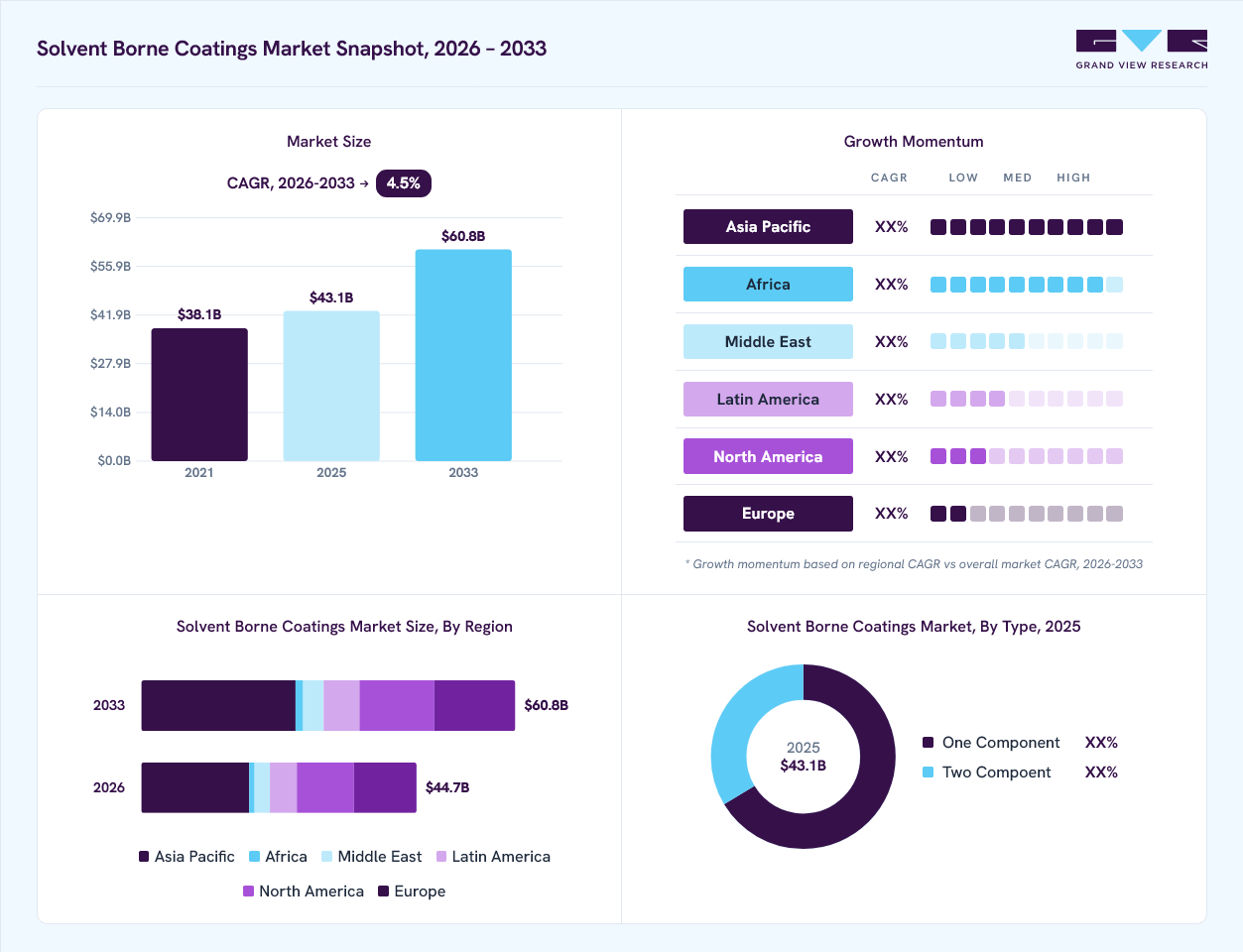
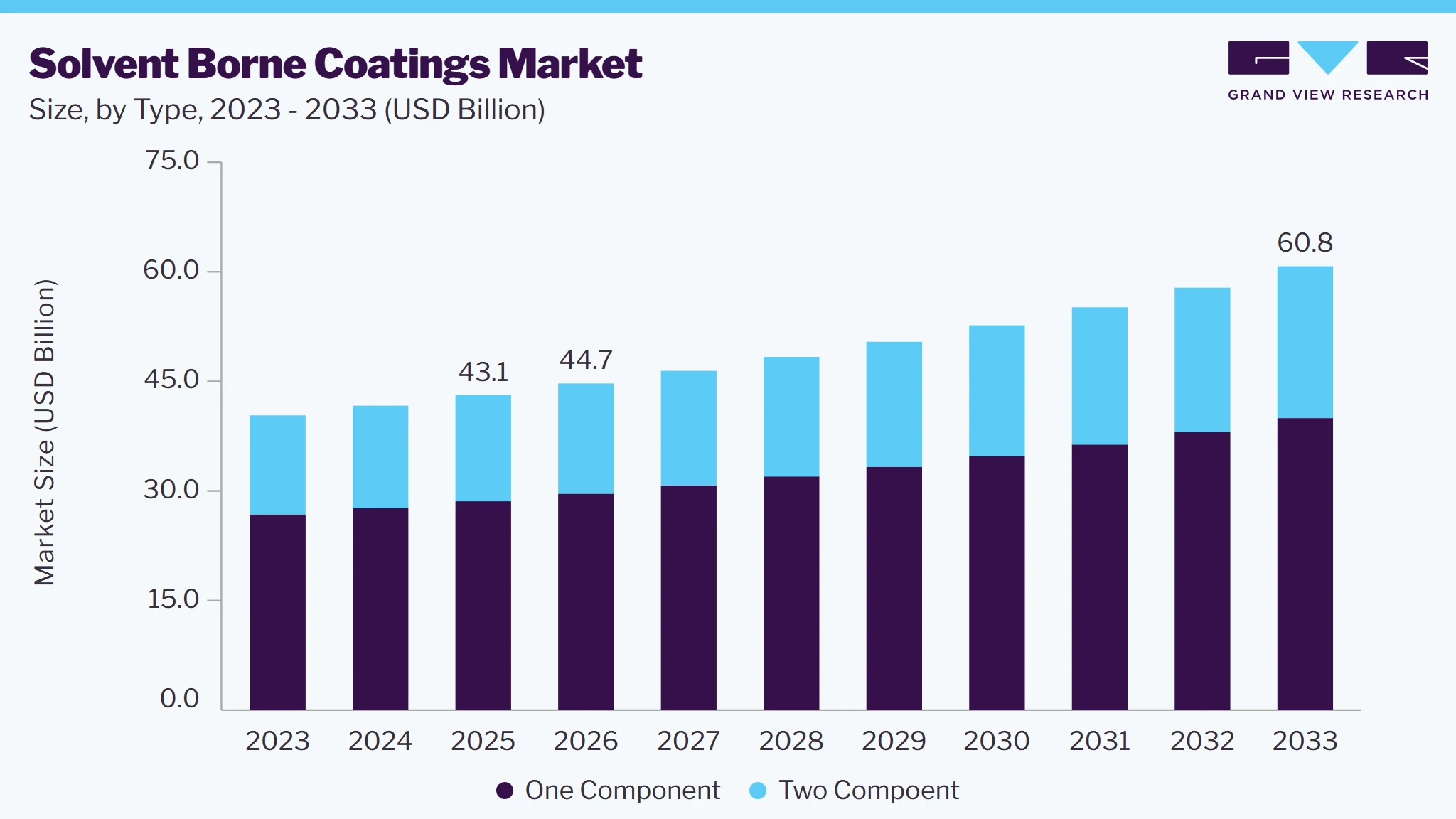
The global solvent borne coatings market size was valued at USD 43.1 billion in 2025 and is projected to grow from USD 44.7 billion in 2026 to USD 60.8 billion by 2033, at a CAGR of 4.5% from 2026 to 2033. Asia Pacific dominated the market, accounting for a revenue share of 38.9% in 2025. This growth is attributed to the ability of these coatings to produce high-quality finishes. Solvent-borne coatings have excellent adhesion properties, which produce a durable finish that is resistant to corrosion, abrasion, and weathering. These coatings are also known for their ability to produce a smooth and glossy finish that enhances the appearance of the substrate.
 Source: Grand View Research, IR Documents, Primary Interviews, Paid DatabasesTo learn more about this report,
 Download Free Sample Report
Key Market Trends & Insights
- By type: One component segment dominated the product segment with a market share of 66.3% in 2025.
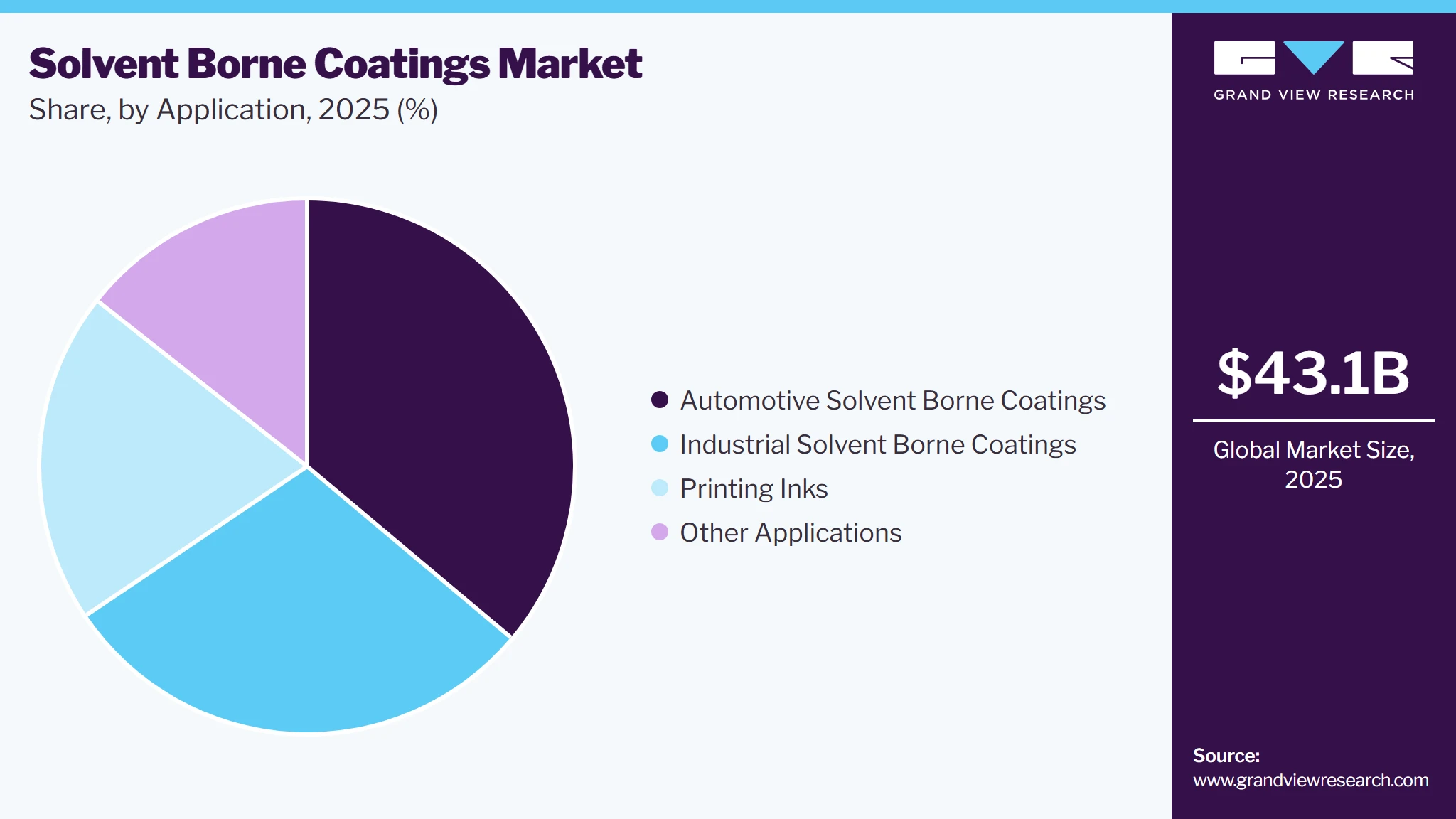
- By application: Automotive solvent borne coatings segment projected the largest share of 36.1% in 2025.
Regional Highlights
- Largest regional market: Asia Pacific (38.9% revenue share, 2025)
- By country: China held the largest share in 2025
Market Size & Forecast
- Market Size in 2025: USD 43.1 Billion
- Estimated Market Size in 2026: USD 44.7 Billion
- Projected Market Size by 2033: USD 60.8 Billion
- CAGR (2026-2033): 4.5%
Three ways to get this report
Buy it, customize it, or ask a question.Ask an Analyst
Analyst response in 1 business day
- AccessReport author, directly
- Reply timeWithin 1 working day
- No sales callDirect answer only
- FormatEmail reply
- CostFree, no cost
Get the Full Report
What the study covers
- FormatsPDF · Excel · Dashboard
- Timeline2026–2033 annual, 2025 base
- Coverage20+ countries, 5 regions
- Companies10+ key players profiled
Customize the Report
20% free customization
- IncludeCountries, segments, points
- TailorTo your product definition
- ExtendDeeper competitor detail
- OrA fully bespoke study
- Turnaround5–10 working days
Solvent borne coatings can be used on a variety of surfaces, and they offer good resistance to weathering and corrosion. They are also resistant to UV radiation and can withstand fluctuations in temperature and humidity, making them ideal for outdoor use. Additionally, the rising application of solvent-based coatings for industrial and architectural purposes, owing to their various beneficial properties such as lower drying times and better functionality in open & humid conditions, is anticipated to drive product demand over the forecast period.
 To learn more about this report, Download Free Sample Report
However, some of these solvents can be volatile organic compounds (VOCs), which can have negative environmental impacts. For this reason, many countries have introduced regulations that limit the use of VOCs in products, including solvent-borne coatings, which is hindering the growth of the product market.
The U.S. is a major consumer of the product in North America, with a revenue share of 53.1% in 2022. The growth of the product market during the forecast period can be attributed to the increasing demand for solvent-borne coatings in the construction and automotive industries in the country. These coatings are used for surface protection, surface preparation, resistance to corrosion, and to improve the appearance of automotive vehicles and infrastructure.
The construction sector in the U.S. is experiencing notable growth, driven by positive market fundamentals for commercial real estate, a strong economy, and increasing state and federal funding for institutional buildings and public works. For instance, in March 2020, the U.S. government announced a USD 2 trillion investment as part of its coronavirus response, aimed at developing infrastructure, including hospitals, roads, and others. All these factors are expected to contribute to the growth of the product market.
Market Dynamics
The solvent borne coatings market is experiencing stable growth owing to its widespread use in automotive, industrial, marine, aerospace, and protective coating applications. These coatings offer superior adhesion, durability, corrosion resistance, and excellent performance under harsh environmental conditions. Rising infrastructure development, increasing industrial manufacturing, and growing demand for high-performance coatings continue to support market expansion. Furthermore, technological advancements in resin formulations and increasing investments in industrial projects are creating long-term growth opportunities.
The increasing production of passenger vehicles, commercial vehicles, railways, and aerospace equipment is driving demand for solvent borne coatings. These coatings provide superior weather resistance, corrosion protection, and long-lasting finishes, making them suitable for vehicle bodies, components, and industrial equipment. Rising investments in transportation infrastructure and vehicle manufacturing continue to boost market growth.
Growing investments in automotive manufacturing facilities and increasing production of passenger vehicles, commercial vehicles, and heavy-duty transportation equipment are further supporting market growth. In addition, rising demand for protective coatings for railway infrastructure, aircraft components, and heavy machinery is creating new opportunities for solvent borne coating manufacturers. Their ability to deliver reliable performance under demanding operating conditions makes them a preferred choice for applications requiring long service life and consistent protective properties.
The increasing adoption of waterborne and powder coating technologies is limiting the growth potential of the solvent borne coatings market. Industries are gradually transitioning toward environmentally sustainable coating solutions that generate lower volatile organic compound (VOC) emissions and help manufacturers comply with tightening environmental regulations. As sustainability becomes a greater priority across industrial value chains, demand is steadily shifting toward coatings with reduced environmental impact.
Advancements in waterborne and powder coating technologies have significantly improved their durability, finish quality, and application performance, enabling them to compete with traditional solvent borne coatings across a wider range of applications. Many end-use industries, including automotive, construction, furniture, and consumer goods, are increasingly investing in these alternative technologies to reduce emissions and meet corporate sustainability targets. This transition is expected to intensify competitive pressure on solvent borne coating manufacturers over the forecast period
The growing development of marine infrastructure and offshore energy projects is creating significant opportunities for the solvent borne coatings market. Ships, offshore platforms, ports, storage terminals, and coastal facilities require high-performance protective coatings capable of withstanding continuous exposure to moisture, saltwater, chemicals, and extreme weather conditions. Solvent borne coatings remain widely used in these applications because they provide excellent corrosion resistance, strong adhesion, and long-lasting protection in aggressive operating environments.
Increasing investments in global shipbuilding activities, offshore oil and gas exploration, and renewable energy projects such as offshore wind farms are expected to further strengthen market demand. Governments and private operators are also allocating substantial resources toward the maintenance and refurbishment of aging marine assets, creating sustained demand for protective coating systems. As marine operators continue to prioritize asset durability, operational reliability, and reduced maintenance costs, solvent borne coatings are expected to maintain strong growth opportunities in this specialized application segment.
Analyst Perspective
The global solvent borne coatings market is positioned for steady growth, driven by increasing demand from the automotive, industrial, construction, marine, and infrastructure sectors. Solvent borne coatings continue to be widely used where superior adhesion, corrosion resistance, chemical resistance, and long-term durability are essential. Their ability to deliver high performance finishes under demanding environmental conditions makes them a preferred choice for protective and industrial coating applications despite the growing adoption of alternative coating technologies.
Type Insights
One component segment dominated the product segment with a market share of 66.3% in 2025. This is attributable to the fact that one-component solvent borne coatings consist of a single component that does not require the addition of catalysts or hardeners and requires minimal preparation before application. The one-component system is typically a resin that is dissolved in a solvent, along with additives, pigments, and other components necessary for the desired coating properties. Unlike a two-component or multi-component coating system, one-component systems do not require mixing of different components just before application.
One-component systems can be found in different types of coatings such as automotive, industrial, and architectural. Their applications are mainly in situations where a fast-drying, low-cost coating that needs minimal surface preparation is required. These are generally used in less demanding environments such as painting of household items or garden furniture, exterior walls, and indoor cabinet doors, where long-term durability is not of utmost importance.
The two-component system segment is anticipated to witness strong growth over the forecast period. These are commonly used for demanding applications that require high performance, durability, and resistance to various environmental factors. These systems are composed of two components, a resin and a hardener/catalyst, which are mixed just before application. The first component, the resin, is composed of a polymer and solvent. It provides the pigment with a binder for adherence and stability on the substrate, forming a film that encapsulates it and protects it from environmental factors. Resins used in two-component systems include epoxy, polyurethane, polyester, and vinyl esters.
Application Insights
Automotive solvent borne coatings segment projected the largest share of 36.1% in 2025. This strong demand is attributed to the superior adhesion, corrosion resistance, and durability of solvent-borne coatings, making them a popular choice among automotive manufacturers. They are used for vehicle exterior and interior paint jobs. They provide a durable and long-lasting finish, which can withstand the harsh environmental conditions that vehicles are exposed to.
 To learn more about this report, Download Free Sample Report
Clear coatings are used to provide additional protection to the painted surfaces of a vehicle. They enhance the gloss and color of the paint, increase the durability of the finish, and keep the underlying surface from fading or oxidizing over time. Thus, they play a critical role in maintaining the quality and longevity of vehicles, protecting them from harsh environmental factors.
The printing ink industry is projected to expand significantly in the coming years. The coatings utilized in printing inks possess robust adhesion, even flow, and leveling qualities, making them applicable to an array of surfaces, including paper, plastic, metal, and more. These coatings are popular and reliable due to their exceptional performance and durability. They can be altered to meet specific requirements, such as particular colors, opacity, gloss, and film thickness. They play a crucial role in enhancing print quality features such as color intensity, resolution, and contrast.
Regional Insights
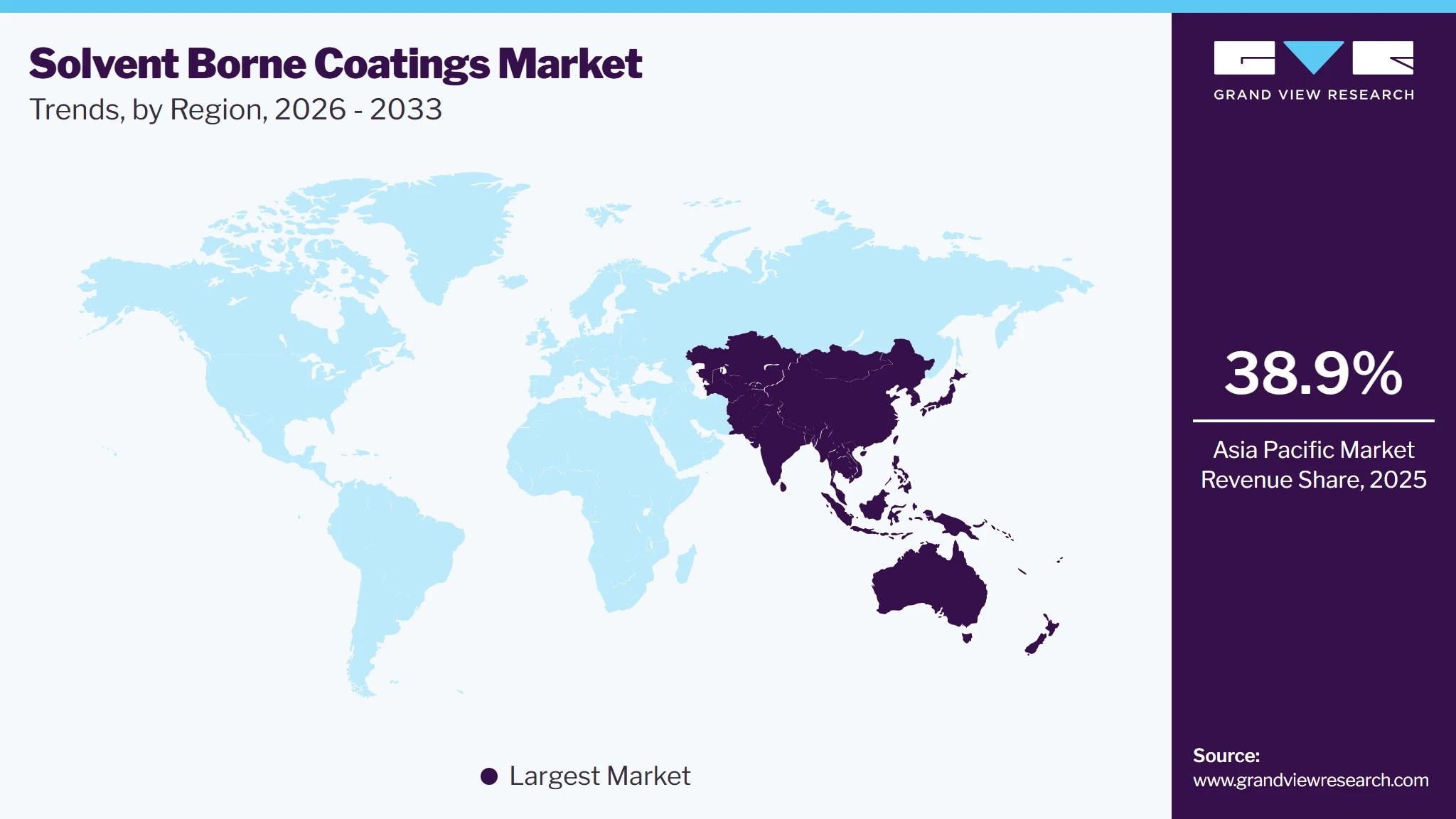
Asia Pacific accounted for 38.9% of the solvent borne coatings market revenue in 2025, making it the largest regional market. This is attributable to the rising construction activities and growing demand from the automotive sector in the emerging countries of the region, such as India, Japan, and South Korea. In addition, the product has significant potential for use in various end-use sectors due to the ready availability of raw materials and less stringent laws regarding VOC emissions when compared to North America and Europe. China held the highest market revenue share in Asia Pacific in 2025.
 To learn more about this report, Download Free Sample Report
The solvent-borne coatings market in Japan is expected to witness strong growth, owing to the presence of leading automobile manufacturers including Toyota, Mazda, Suzuki, and Nissan in the country. Good manufacturing practices and the utilization of technology in the automotive industry are anticipated to promote Japan’s automobile production. Furthermore, increasing R&D activities to promote innovations in the infrastructure and construction industry of the country are anticipated to drive product demand over the projection period.
Europe is another region anticipated to witness noticeable growth over the forecast period. Surging automobile production in Germany, Hungary, Romania, Austria, and the UK, along with strong manufacturing bases of companies such as Volkswagen AG, Chevrolet, Daimler-Chrysler, Mercedes-Benz, and Dodge is expected to drive product demand in the region. With 42 engine production plants & assembly, Germany is the leading automotive market in Europe, accounting for one-third of the total automobile production in the region. Sales of new vehicles have consistently increased due to an improving economy, which reflects consumer confidence. This trend is expected to have a favorable impact on the product market in the coming years.
Key Companies & Market Share Insights
In order to remain competitive in the market, key players are expanding their product portfolio and global presence. They aim to achieve strong market positioning and optimum business growth through various strategies, such as expanding their production capacity, investing in research and development, developing new products, collaborating & forming partnerships, and acquiring other companies.
Players are gravitating towards product launches and installation of research & development facilities to come up with new innovations so as to establish their position in the market. For instance, in April 2023, Akzo Nobel announced the opening of its new research and development center in High Point, North Carolina for product development and innovations in its coatings business. Some of the prominent players in the global solvent borne coatings market include:
Key Solvent Borne Coatings Market Companies
The following key companies have been profiled for this study on the solvent borne coatings market.
-
BASF SE
-
PPG Industries
-
The Sherwin-Williams Company
-
Akzo Nobel N.V.
-
RPM International
-
Axalta Coating Systems
-
Glass Paint Technology
-
The Lubrizol Corporation
-
NEI Corporation
-
DOW
Competitive Benchmarking
Category
Operating Strategies
Competitive Edge
Weakness
Established Players (BASF SE; PPG Industries; The Sherwin-Williams Company; Akzo Nobel N.V.; RPM International, Inc.; Axalta Coating Systems; Dow)
- Expand production capacity for high-performance solvent borne coatings across automotive, industrial, protective, and architectural applications.
- Invest in advanced resin technologies, low-VOC formulations, and sustainable coating innovations to meet evolving regulatory requirements.
- Strengthening global distribution networks through strategic acquisitions, partnerships, and manufacturing expansions.
- Focus on product innovation, customized coating solutions, and digital color technologies to address diverse customer requirements.
- Strong global manufacturing footprint with well-established distribution channels.
- Extensive product portfolios serving multiple end-use industries worldwide.
- Significant investments in research and development support continuous product innovation.
- Long-standing customer relationships and strong brand recognition enhance market leadership.
- Compliance with increasingly stringent environmental regulations increases operating costs.
- Dependence on petrochemical-based raw materials exposes manufacturers to raw material price volatility.
- High capital expenditure is required for continuous product development and manufacturing modernization.
- Intense competition from waterborne, powder, and UV-curable coating technologies may limit market expansion.
Emerging & Regional Players (Glass Paint Technology; The Lubrizol Corporation; NEI Corporation)
- Focus on specialty solvent borne coatings for niche industrial, protective, functional, and performance applications.
- Develop customized formulations tailored to specific customer and industry requirements.
- Strengthening regional market presence through technical support, distributor partnerships, and application-focused solutions.
- Invest in advanced additive technologies and high-performance coating materials to differentiate product offerings.
- High flexibility in developing customized coating formulations for specialized applications.
- Strong technical expertise in niche coating technologies and specialty materials.
- Faster product development cycles enable quicker response to changing customer requirements.
- Close collaboration with regional customers supports long-term business relationships.
- Limited manufacturing scale compared to multinational coating companies.
- Smaller global distribution and sales networks restrict international market penetration.
- Lower financial capacity for large-scale production expansion and acquisitions.
- Greater dependence on regional demand and specialized application markets may limit revenue diversification.
Solvent Borne Coatings Market Report Scope
Report Attribute
Details
Market Size in 2025
USD 43.1 billion
Estimated Market Size in 2026
USD 44.7 billion
Projected Market Size by 2033
USD 60.8 billion
Growth rate
CAGR of 4.5% from 2026 to 2033
Base year for estimation
2025
Historical data
2021 - 2024
Forecast period
2026 - 2033
Quantitative units
Volume in Kilotons, Revenue in USD Billion, and CAGR from 2026 to 2033
Report coverage
Revenue & volume forecast, company ranking, competitive landscape, growth factors, and trends
Segments covered
Type, application, region
Regional scope
North America; Europe; Asia Pacific; Latin America; MEA
Country scope
U.S.; Canada; Mexico; Germany; UK; France; Italy; Spain; Russia; Netherlands; Switzerland; China; India; Japan; South Korea; Malaysia; Indonesia; Vietnam; Australia; New Zealand; Brazil; Argentina; Chile; Colombia; Saudi Arabia; South Africa; Iran; Oman; UAE; Qatar; Kuwait; Angola; Nigeria
Key companies profiled
BASF SE; PPG Industries; The Sherwin-Williams Company; Akzo Nobel N.V.; RPM International, Inc.; Axalta Coating Systems; Glass Paint Technology; The Lubrizol Corporation; NEI Corporation; DOW
Customization scope
Free report customization (equivalent up to 8 analysts' working days) with purchase. Addition or alteration to country, regional & segment scope.
Pricing and purchase options
Avail customized purchase options to meet your exact research needs. Explore purchase options
Global Solvent Borne Coatings Market Report Segmentation
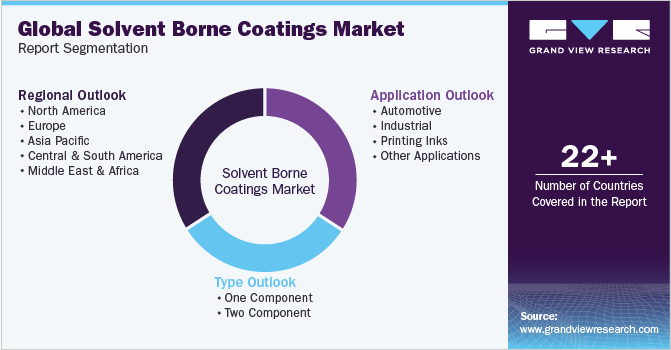
This report forecasts revenue and volume growth at the global, regional, and country levels and provides an analysis of the latest industry trends in each of the sub-segments from 2021 to 2033. For the purpose of this study, Grand View Research has segmented the global solvent borne coatings market report on the basis of type, application, and region:
 To learn more about this report, Download Free Sample Report
-
Type Outlook (Volume, Kilotons; Revenue, USD Million, 2021 - 2033)
-
One Component
-
Two Component
-
-
Application Outlook (Volume, Kilotons; Revenue, USD Million, 2021 - 2033)
-
Automotive
-
Industrial
-
Printing Inks
-
Other Applications
-
-
Regional Outlook (Volume, Kilotons; Revenue, USD Million, 2021 - 2033)
-
North America
-
U.S.
-
Canada
-
Mexico
-
-
Europe
-
Germany
-
UK
-
France
-
Italy
-
Spain
-
Netherlands
-
Russia
-
Switzerland
-
-
Asia Pacific
-
China
-
India
-
Japan
-
South Korea
-
Malaysia
-
Indonesia
-
Vietnam
-
Australia
-
New Zealand
-
-
Central & South America
-
Brazil
-
Argentina
-
Chile
-
Colombia
-
-
Middle East & Africa
-
Saudi Arabia
-
South Africa
-
Iran
-
Oman
-
UAE
-
Qatar
-
Kuwait
-
Angola
-
Nigeria
-
-
Research Methodology
The solvent borne coatings market figures in this report are based on a proven research process that combines executive interviews with secondary research from proprietary databases, company filings, and recognized regulatory and institutional sources. Market size is built through value-chain sizing - reconciling supply-side and demand-side estimates - and triangulated with bottom-up and top-down approaches. Every estimate passes multiple levels of expert validation before publication, with each solvent borne coatings segment quantified using the revenue-capture definitions in the table below.
Segment Definition
Segment – Type
Revenue capture definition
One Component
Captures revenue generated from sales of single-component solvent borne coatings that cure through solvent evaporation or exposure to moisture and are widely used in industrial maintenance, automotive refinishing, wood coatings, and protective coating applications due to their ease of application and operational efficiency.
Two Component
Represents revenue generated from two-component solvent borne coatings consisting of a resin and hardener that chemically react after mixing to provide superior mechanical strength, chemical resistance, durability, and corrosion protection for automotive, marine, industrial, and infrastructure applications.
Segment – Application
Revenue capture definition
Automotive Solvent Borne Coatings
Accounts for revenue generated from solvent borne coatings used in automotive OEM manufacturing and vehicle refinishing applications, providing durable finishes, corrosion resistance, weather protection, and high-quality appearance for passenger and commercial vehicles.
Industrial Solvent Borne Coatings
Reflects revenue derived from solvent borne coatings applied to industrial machinery, equipment, structural steel, pipelines, storage tanks, and manufacturing facilities to enhance corrosion protection, chemical resistance, and long-term operational performance.
Printing Inks
Measures revenue generated from solvent borne coating formulations used as binders and protective layers in solvent-based printing inks for flexible packaging, labels, publications, and commercial printing applications, offering excellent adhesion, color stability, and fast drying characteristics.
Other Applications
Captures revenue generated from solvent borne coatings used across wood and furniture coatings, marine and offshore structures, aerospace components, protective maintenance coatings, architectural finishes, and other specialized applications requiring high durability and environmental resistance.
Estimation Model
Layer No.
Layer Name
Key Question
Description
01
Solvent Borne Coatings Production Layer
What forms is the supply base?
Identify the global production capacity of solvent borne coatings by evaluating the availability of key raw materials such as solvents, resins, pigments, additives, and curing agents, along with manufacturing technologies, production facilities, formulation capabilities, and regional supply networks. This layer establishes the overall supply base supporting industrial and commercial coating applications.
02
Application Adoption Layer
Where are solvent borne coatings utilized?
Estimate the distribution of solvent borne coatings consumption across major application segments, including automotive coatings, industrial coatings, printing inks, wood coatings, marine coatings, protective coatings, and other specialty applications by analyzing end-use demand, coating performance requirements, and regional consumption trends.
03
Consumption Intensity Layer
How much solvent borne coatings is consumed?
Assess solvent borne coating consumption across key end-use industries by evaluating production volumes in automotive manufacturing, industrial equipment, construction, marine, aerospace, packaging, and general manufacturing sectors to estimate annual coating demand across major regional markets.
04
Revenue Layer
How is market revenue generated?
Market revenue is generated through the sale of one-component and two-component solvent borne coatings to automotive manufacturers, industrial equipment producers, marine and offshore operators, construction companies, printing ink manufacturers, and maintenance service providers through direct sales, distributors, OEM supply agreements, and industrial coating networks.
Delivered Customizations
This report has been delivered with the following In-depth customizations
Client Request
Customization Delivered
Value Adds
Cross-Segmentation Analysis
Detailed cross-segmentation assessment evaluating the relationship between type (One Component and Two Component) and application (Automotive Solvent Borne Coatings, Industrial Solvent Borne Coatings, Printing Inks, and Other Applications). The analysis identifies application-specific demand patterns, technology adoption, coating performance requirements, and revenue contribution across each type–application combination.
Supports product portfolio optimization by identifying the most profitable type–application combinations, enabling manufacturers to improve production planning, prioritize high-growth end-use sectors, and strengthen market positioning.
Competitive Benchmarking
Comparative evaluation of leading solvent borne coatings manufacturers based on product portfolio, manufacturing capacity, formulation technologies, research and development capabilities, geographic presence, sustainability initiatives, distribution network, and recent strategic developments across major regional markets.
Assists competitive intelligence and strategic decision-making by providing insights into market positioning, innovation capabilities, operational strengths, and competitive advantages, supporting effective investment and expansion strategies.
Opportunity Assessment
Comprehensive assessment of emerging opportunities across high-growth applications including automotive, industrial, marine, protective coatings, and printing inks, along with increasing demand for low-VOC solvent borne coatings, infrastructure development, industrial expansion, and growing investments in transportation and energy projects across key regional markets.
Helps identify high-growth application segments, technology innovation opportunities, and attractive regional markets, supporting capacity expansion, product development, market entry strategies, and long-term revenue growth.
Frequently Asked Questions About This Report
The Industrial Solvent Borne Coatings segment is expected to expand at the highest CAGR of 4.8% over the forecast period. The growth is attributed to rising investments in manufacturing facilities, industrial infrastructure, oil & gas projects, power generation, and heavy machinery, where high-performance protective coatings are essential for corrosion protection and extended asset life.
The global solvent borne coatings market size was valued at USD 43.1 billion in 2025 and is estimated at USD 44.7 billion for 2026.
The global solvent borne coatings market is expected to grow at a CAGR of 4.5% from 2026 to 2033, reaching USD 60.8 billion by 2033.
Asia Pacific dominated with a revenue share of 38.9% in 2025. This is attributable to the rising construction activities and growing demand from the automotive sector in emerging countries, such as India, Japan, and South Korea.
Some key players operating in the solvent borne coatings market include BASF SE, PPG Industries, The Sherwin-Williams Company, Akzo Nobel N.V., RPM International, Inc, Axalta Coating Systems, Glass Paint Technology, The Lubrizol Corporation, NEI Corporation, DOW
Key factors that are driving the market growth include the rising application of solvent-based coatings for industrial and architectural purposes, owing to their various properties such as lower drying times and better functionality in open & humid conditions.
The one component segment dominated the global solvent borne coatings market in 2025, accounting for 66.3% of the total market revenue. Its leadership is driven by its ease of application, lower labor costs, faster curing process, and widespread use in automotive refinishing, industrial maintenance, wood coatings, and general protective coating applications.
The automotive solvent borne coatings segment accounted for the largest market share of 36.1% in 2025. Growth is primarily supported by increasing global vehicle production, rising demand for high-quality OEM and refinish coatings, and the need for durable, corrosion-resistant, and aesthetically superior finishes for passenger and commercial vehicles.
The two component segment is projected to grow at the fastest rate, registering a CAGR of 4.7% during the forecast period. This growth is driven by increasing demand for high-performance coatings offering superior chemical resistance, mechanical strength, and durability across industrial, marine, infrastructure, and heavy equipment applications.
About the Author(s)
Paints, Coatings & Printing Inks Research Team
Bulk Chemicals · Paints, Coatings & Printing InksThis report was authored by the paints, coatings & printing inks research team at Grand View Research - comprising two research analysts, one senior research analyst, and one industry expert - with specialized expertise in the paints, coatings & printing inks segment of the bulk chemicals industry. All findings are based on proprietary bulk chemicals databases, executive interviews, and regulatory analysis, subject to internal peer review prior to publication.
Last Updated:
Speak to Analyst

Customize this report to your needs - add regions, segments, or data points, with 20% free customization.
Or view our licence options:


ISO 9001:2015 & 27001:2022 Certified
We are GDPR and CCPA compliant! Your transaction & personal information is safe and secure. For more details, please read our privacy policy.


