
- Home
- »
- Advanced Interior Materials
- »
-
Static Process Equipment Market Size & Share Report, 2033GVR Report cover

Static Process Equipment Market (2026 - 2033)
Size, Share & Trends Analysis Report By Equipment (Heat Exchangers, Pressure Vessels), By Material (Carbon Steel, Stainless Steel, Aluminum), By End-use (Oil & Gas, Chemicals, Power Generation), By Region, And Segment Forecasts
Market Size, 2025
$178.4BMarket Estimate, 2026
$185.0BMarket Forecast, 2033
$247.7BCAGR, 2026–2033
4.3%Static Process Equipment Market Summary
The global static process equipment market size was valued at USD 178.4 billion in 2025 and is projected to grow from USD 185.0 billion in 2026 to USD 247.7 billion by 2033, at a CAGR of 4.3% from 2026 to 2033. Asia Pacific dominated the market, accounting for a revenue share of 34.5% in 2025. The global static process equipment market is driven by sustained capital expenditure across process-intensive industries, including oil & gas, refining, petrochemicals, chemicals, power generation, pharmaceuticals, food processing, and water treatment.
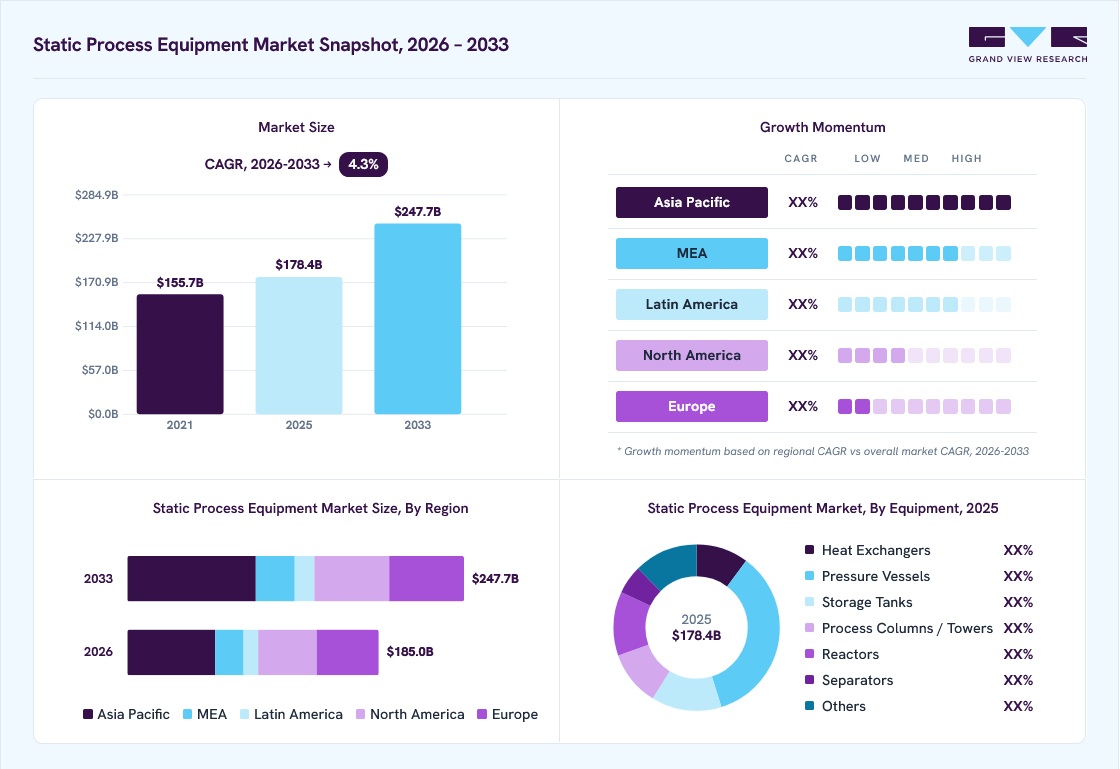 Source: Grand View Research, IR Documents, Primary Interviews, Paid DatabasesTo learn more about this report,
 Download Free Sample Report
Key Market Trends & Insights
- By equipment: Heat exchangers segment is projected to register the fastest CAGR during the forecast period.
- By material: Stainless steel segment dominated the market in 2025, accounting for 24.2% market share in 2025.
- By end-use: Oil & gas is expected to retain the largest market share, accounting for 27.1% in 2025.
Regional Highlights
- Largest regional market: Asia Pacific (34.5% revenue share, 2025)
- By country: China held the largest share in 2025.
Market Size & Forecast
- Market size in 2025: USD 178.4 Billion
- Estimated market size in 2026: USD 185.0 Billion
- Projected market size by 2033: USD 247.7 Billion
- CAGR (2026-2033): 4.3%
GVR research-powered AIAsk Prism AI about the static process equipment marketGet cited answers from GVR research on market growth, segments, regulations and forecasts.Start with✓ Source-linked answers ✓ Market-specific context ✓ Traceable figuresExplore Prism AI ↗
Expansion of production capacity, debottlenecking of existing facilities, refinery modernization, and replacement of aging process assets are generating consistent requirements for pressure vessels, heat exchangers, reactors, columns, storage vessels, and other stationary equipment.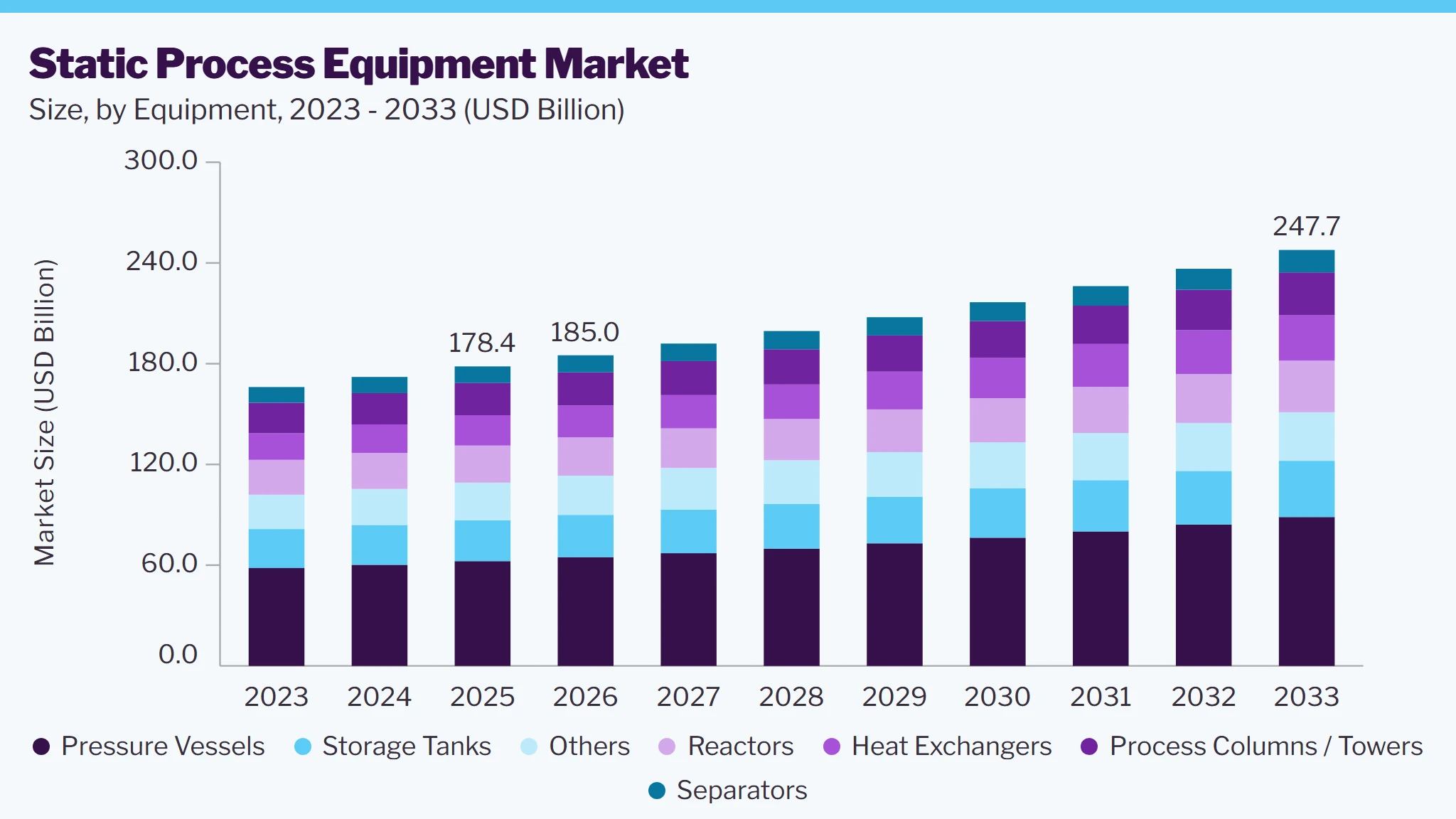 To learn more about this report, Download Free Sample Report
Increasing investment in energy-transition and infrastructure applications is broadening the equipment requirement across hydrogen production, carbon capture, LNG infrastructure, renewable fuels, specialty chemicals, and advanced water-treatment facilities. These applications often require equipment capable of handling demanding thermal, chemical, and pressure conditions, creating opportunities for specialized fabrication and higher-specification equipment
Market Dynamics
The global static process equipment market is influenced by process-plant investment, equipment replacement cycles, operating-condition requirements, and the increasing technical complexity of industrial facilities. Demand extends across equipment categories such as pressure vessels, heat exchangers, reactors, columns, tanks, and storage systems, with purchasing decisions determined by process specifications, material requirements, operating parameters, applicable codes, and lifecycle considerations. Market development therefore depends not only on new plant construction but also on equipment integrity requirements and modifications to existing process assets.
Increasing emphasis on containment integrity, pressure management, thermal performance, and operational safety is supporting demand for high-specification static equipment. Process facilities handling hydrocarbons, chemicals, corrosive compounds, and high-temperature streams require equipment capable of maintaining structural integrity under demanding service conditions. Periodic inspections, integrity assessments, statutory requirements, and asset-reliability programs encourage operators to replace equipment that no longer meets required operating or safety specifications, creating a recurring demand base independent of new plant construction.
Static process equipment frequently involves detailed engineering, material certification, fabrication inspection, non-destructive testing, and customer-specific approval procedures. Complex equipment may require extended design and manufacturing schedules before installation, particularly when specialized alloys, unusual dimensions, or stringent pressure and temperature specifications are involved. Delays in engineering approvals, raw-material procurement, inspection, and vendor qualification can increase project timelines and working-capital requirements, creating constraints for equipment suppliers and project developers.
The increasing use of modular process configurations is creating opportunities for manufacturers to supply pre-engineered and application-specific static equipment assemblies. Modular fabrication can shift a greater portion of manufacturing and inspection activities to controlled workshop environments, reducing the extent of field fabrication and facilitating installation in constrained project locations. Demand for specialized equipment for LNG, hydrogen, carbon capture, specialty chemicals, and other technically demanding applications further creates scope for manufacturers with expertise in advanced materials, thermal design, corrosion management, and customized fabrication.
Market Concentration & Characteristics
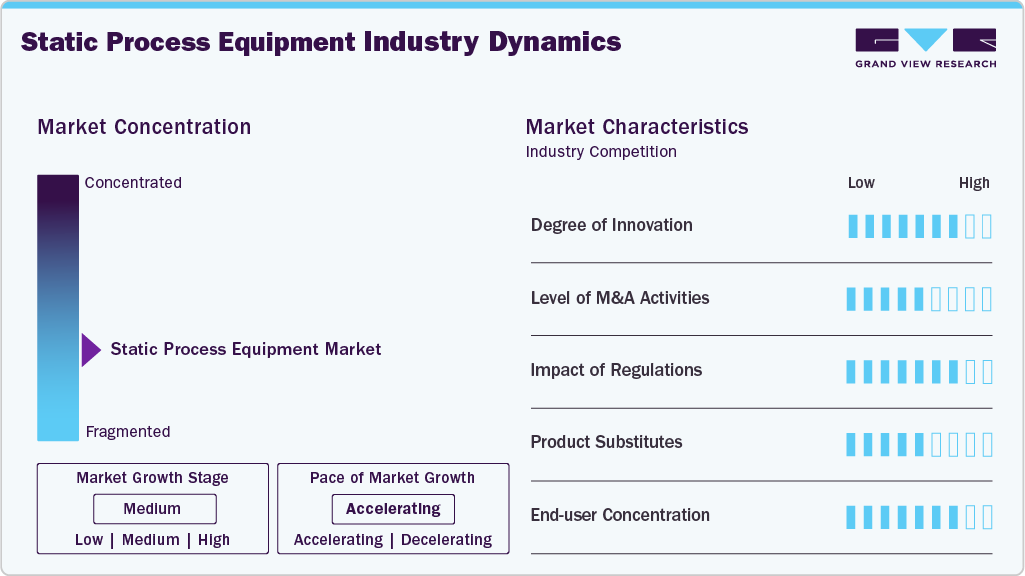
The global static process equipment market presents a moderately fragmented competitive structure, comprising diversified engineering and equipment manufacturers, specialized process-equipment fabricators, and regional suppliers. Competitive positioning is shaped by engineering and design capabilities, fabrication capacity, metallurgical expertise, quality assurance, certification, project execution capabilities, and established relationships with EPC contractors and process-industry operators. Supplier qualification requirements are particularly stringent for equipment used in critical process services, limiting participation to manufacturers with demonstrated technical and manufacturing credentials.
Product differentiation is predominantly specification-based, with procurement decisions influenced by operating pressure and temperature, material grade, corrosion resistance, mechanical integrity, thermal performance, dimensional requirements, and compliance with applicable design and fabrication codes. Static equipment is frequently engineered to accommodate plant-specific process conditions, resulting in demand for customized pressure vessels, reactors, heat exchangers, process columns, and storage vessels. Standardized and modular equipment configurations are also gaining adoption where repeatable process requirements allow manufacturers and project developers to reduce fabrication complexity and installation time.
 To learn more about this report, Download Free Sample Report
Market characteristics differ across end-use industries and geographic markets according to industrial capacity, capital expenditure, asset maturity, regulatory requirements, and project development cycles. Established industrial markets generate recurring requirements through equipment replacement, plant modernization, maintenance turnarounds, debottlenecking, and regulatory upgrades, while emerging markets offer opportunities from new process facilities and capacity expansion. High fabrication-capacity requirements, stringent inspection and certification procedures, lengthy vendor-approval processes, technical qualification standards, and established EPC procurement relationships create entry barriers, particularly for suppliers serving high-pressure, high-temperature, corrosive, and safety-critical process applications.
Analyst Perspective
The global static process equipment market is shaped by industrial capital expenditure, equipment replacement, and increasingly stringent requirements for pressure containment, thermal performance, corrosion resistance, and mechanical integrity. Demand varies with process conditions, material specifications, equipment configuration, plant capacity, and applicable design and fabrication standards, sustaining requirements for engineered pressure vessels, heat exchangers, reactors, columns, storage tanks, and separators. Heat exchangers offer strong growth potential as facilities expand heat recovery and thermal integration, while stainless steel remains broadly specified across process applications and titanium serves more demanding corrosive duties.
Equipment Insights
Pressure vessels are expected to retain the largest market share, accounting for 35.0% of the global static process equipment market. Their extensive deployment for the containment and processing of liquids and gases under controlled pressure conditions makes them integral to oil & gas, refining, petrochemical, chemical, power generation, and industrial processing facilities. Demand is further reinforced by stringent requirements concerning pressure integrity, material strength, fabrication quality, inspection, and operational safety.
The heat exchangers segment is projected to register the fastest CAGR during the forecast period. Demand is supported by their extensive incorporation into process heating, cooling, condensation, heat recovery, and thermal management systems across process-intensive industries. Increasing emphasis on energy conservation, thermal integration, and process optimization is encouraging the deployment of higher-performance heat-transfer equipment in refining, chemicals, petrochemicals, power generation, and other industrial facilities.
Material Insights
The stainless steel segment dominated the market with revenue share of 24.2% in 2025, reflecting its established position across applications requiring corrosion resistance, mechanical strength, durability, and compatibility with diverse process media. Stainless steel is widely incorporated into pressure vessels, heat exchangers, reactors, tanks, and other static equipment used in chemical processing, pharmaceuticals, food and beverage, oil & gas, and water-treatment operations. Availability across multiple grades and established fabrication practices further support its adoption where equipment must withstand corrosive environments, elevated temperatures, or stringent cleanliness requirements.
The titanium segment is projected to register the fastest CAGR of 5.2% during the forecast period. Its growth is associated with increasing requirements for materials capable of maintaining structural and corrosion performance under highly aggressive operating conditions. Titanium offers strong resistance to seawater, chlorides, and several chemically severe environments, making it particularly relevant for specialized heat-transfer and process applications. Although its comparatively higher material and fabrication costs restrict broad deployment, its durability and corrosion resistance support adoption where conventional materials may experience accelerated degradation or shorter service life.
End-use Insights
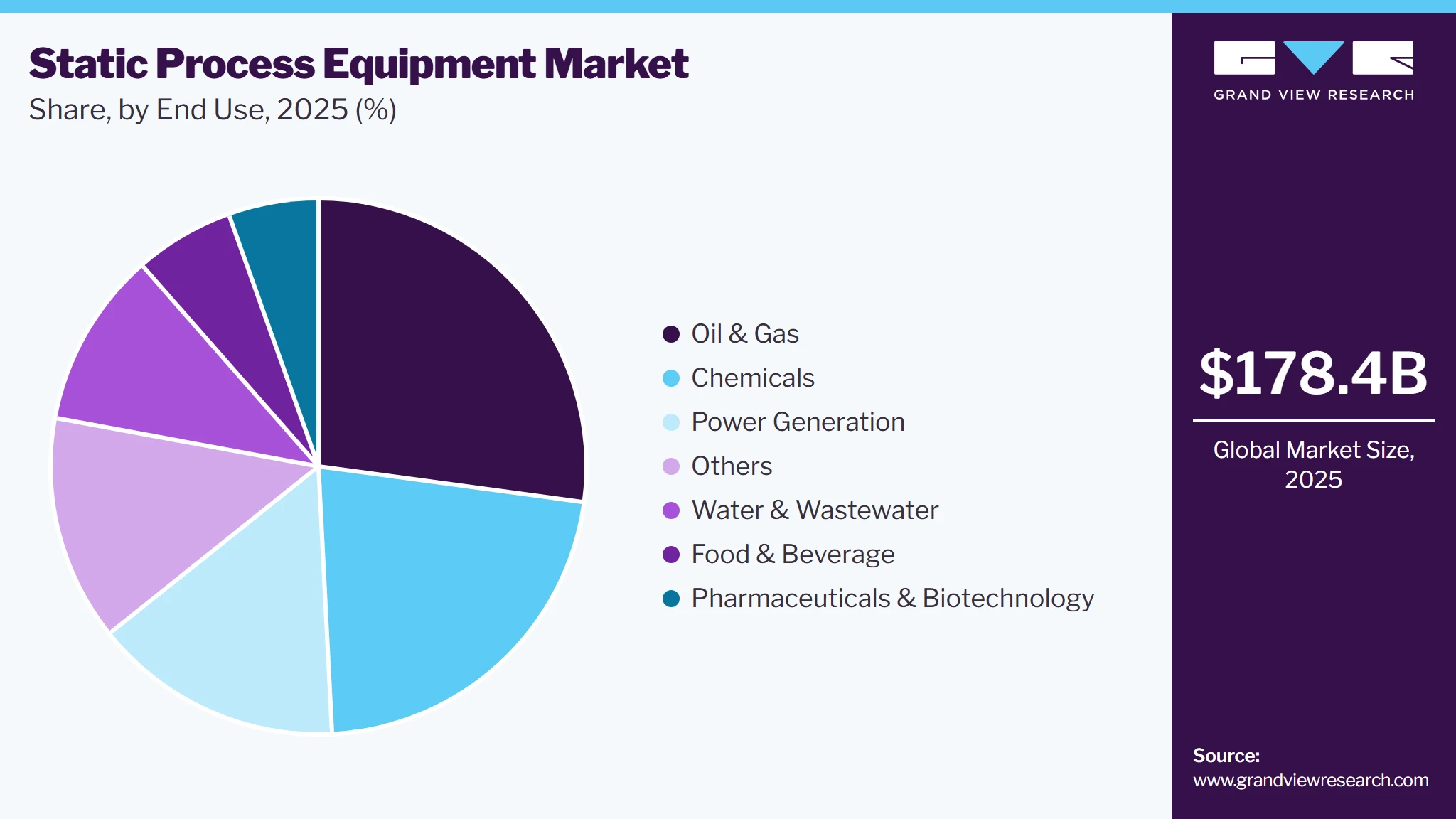
Oil & gas is expected to retain the largest market share, accounting for 27.1% of the global static process equipment market. The sector represents a broad application base for pressure vessels, heat exchangers, process columns, reactors, separators, and storage tanks across hydrocarbon processing, refining, petrochemical operations, and storage infrastructure. Equipment requirements are further sustained by stringent operating conditions involving elevated pressures, temperatures, and exposure to chemically aggressive process streams.
 To learn more about this report, Download Free Sample Report
The pharmaceuticals & biotechnology segment is projected to register the fastest growth from 2026 to 2033, supported by expansion of pharmaceutical manufacturing and bioprocessing infrastructure. Increasing requirements for controlled processing environments, stringent hygiene standards, material compatibility, contamination control, and equipment integrity are strengthening demand for specialized static process equipment. The segment requires purpose-built vessels, tanks, heat exchangers, and reactors capable of meeting rigorous manufacturing and validation requirements, creating opportunities for higher-specification equipment across pharmaceutical and biotechnology facilities.
Regional Insights
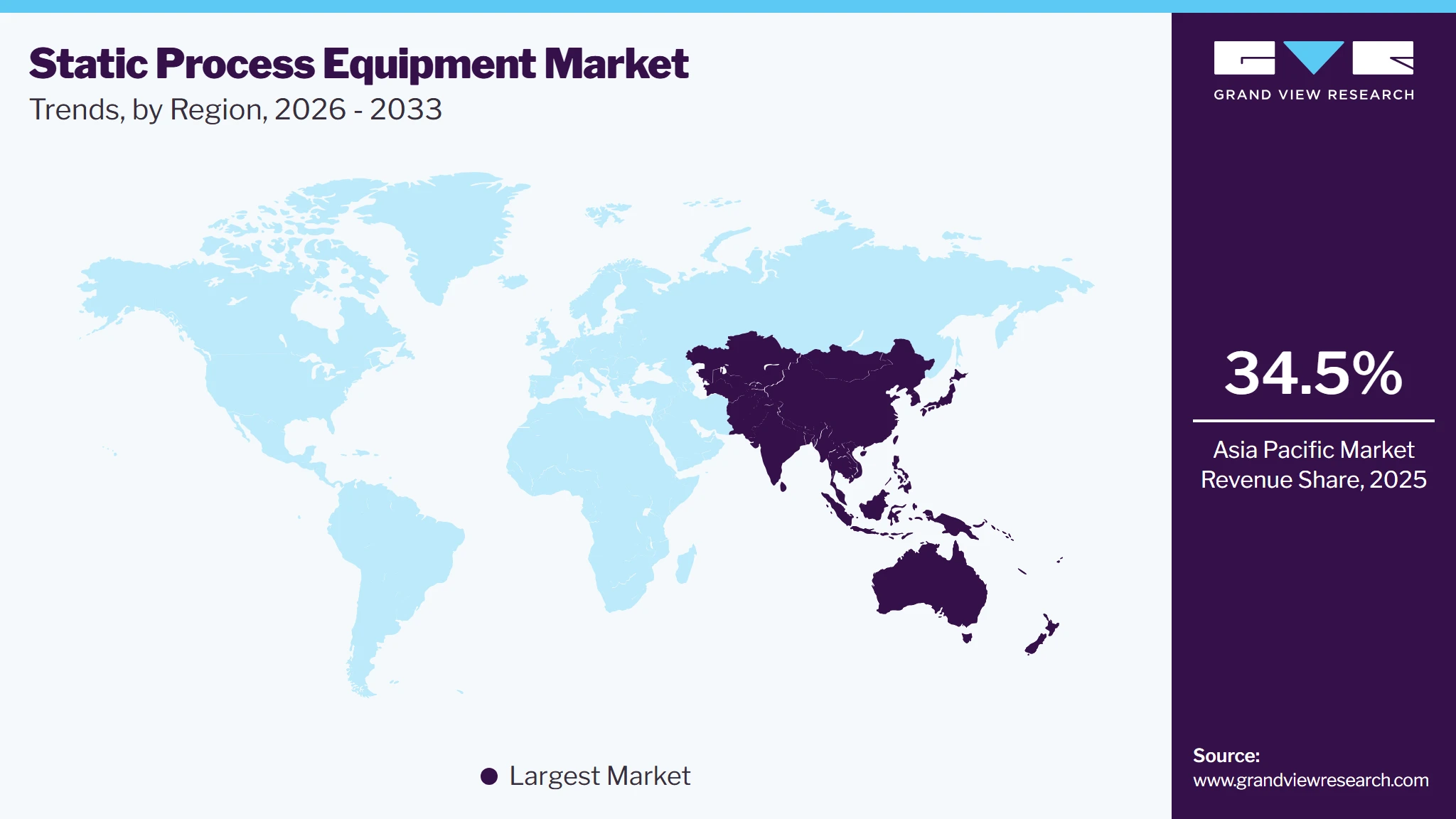
Asia Pacific dominated the market, accounting for a revenue share of 34.5% in 2025. Asia Pacific represents a broad demand base for static process equipment, supported by refining, petrochemicals, chemicals, pharmaceuticals, power generation, and industrial processing. Regional requirements span pressure vessels, heat exchangers, reactors, columns, separators, and storage equipment, with demand shaped by new process facilities, plant expansion, equipment renewal, and increasing domestic fabrication capabilities.
 To learn more about this report, Download Free Sample Report
China Static Process Equipment Market Trends
China maintains substantial demand through its large refining, petrochemical, chemical, metallurgy, and power industries. Integrated industrial complexes require large-scale pressure vessels, reactors, process columns, heat exchangers, and storage systems. Specialty chemicals, LNG, and advanced-material projects are further widening applications, while the country's established fabrication infrastructure facilitates domestic equipment production.
India is projected to register the fastest CAGR of 6.4% during the forecast period. Refining and petrochemical expansion, pharmaceutical and chemical manufacturing, power infrastructure, and industrial investment are strengthening requirements for stationary process equipment. Greenfield projects, plant expansion, and replacement of aging equipment are generating demand for pressure vessels, heat exchangers, reactors, columns, and tanks, while increasing domestic fabrication is improving local supply capabilities.
North America Static Process Equipment Market Trends
North America has a mature static process equipment market supported by extensive refining, petrochemical, natural gas processing, chemical, pharmaceutical, power generation, and industrial infrastructure. Demand is shaped by new processing facilities as well as plant turnarounds, equipment replacement, process modifications, and regulatory requirements. The region also maintains a strong engineering and fabrication base for customized equipment.
The U.S. accounts for extensive requirements across refining, petrochemicals, LNG, gas processing, chemicals, pharmaceuticals, and power generation. LNG infrastructure and investments in hydrogen, carbon capture, and advanced processing are creating additional requirements for pressure vessels, heat exchangers, reactors, columns, and storage equipment. Established industrial facilities continue to generate demand through equipment renewal, process-unit modifications, and capacity optimization.
Canada's market is closely associated with oil and gas, natural gas processing, petrochemicals, mining, mineral processing, and power generation. Resource-processing facilities require robust equipment capable of operating under demanding pressure, temperature, corrosion, and environmental conditions. Natural gas and hydrocarbon projects generate requirements for pressure vessels, separators, heat exchangers, and storage systems, while mining operations provide an additional application base for heavy-duty process equipment.
Europe Static Process Equipment Market Trends
Europe represents a technically mature market characterized by stringent engineering requirements, established process industries, and increasing investment in industrial decarbonization. Chemicals, pharmaceuticals, refining, food processing, power generation, and specialty manufacturing remain important application areas. Hydrogen, carbon management, renewable fuels, and process-efficiency projects are also creating demand for specialized stationary equipment.
Germany maintains strong demand across chemicals, pharmaceuticals, refining, power generation, and specialty manufacturing. Its extensive process infrastructure requires pressure vessels, reactors, heat exchangers, columns, and storage systems manufactured to rigorous technical specifications. Industrial decarbonization, hydrogen, alternative fuels, and carbon-management projects are expanding applications for specialized equipment alongside ongoing plant renewal.
France has a diversified requirement base spanning chemicals, refining, pharmaceuticals, food processing, power generation, and emerging low-carbon industries. Hydrogen, renewable fuels, nuclear-related industrial activity, and process modernization are creating additional equipment applications. Existing facilities also generate requirements through refurbishment, turnaround activities, equipment replacement, and process-unit modifications.
Middle East & Africa Static Process Equipment Market Trends
Middle East & Africa demand is strongly associated with refining, petrochemicals, gas processing, power generation, desalination, and industrial development. Large-scale process facilities require extensive pressure-containing, heat-transfer, reaction, separation, and storage equipment. Expansion of downstream industries and broader economic diversification are gradually widening the regional application base.
Saudi Arabia represents an important regional market, supported by refining, petrochemicals, gas processing, power, desalination, and industrial infrastructure. Expansion of downstream value chains is increasing requirements for reactors, process columns, pressure vessels, heat exchangers, and storage systems. Hydrogen, specialty chemicals, advanced manufacturing, and other diversification initiatives are creating additional applications beyond conventional hydrocarbon processing.
Latin America Static Process Equipment Market Trends
Latin America's demand for static process equipment is concentrated across oil and gas, refining, petrochemicals, mining, pulp and paper, food processing, power generation, and water infrastructure. Offshore hydrocarbon development, mineral processing, biofuels, and industrial expansion generate requirements for pressure equipment, heat-transfer systems, reactors, separators, and storage installations. Market development varies according to industrial capacity, project pipelines, financing conditions, and local fabrication capabilities.
Brazil represents the region's most diversified demand center, with applications across offshore oil and gas, refining, petrochemicals, chemicals, mining, pulp and paper, food processing, and power generation. Offshore developments require equipment capable of handling demanding pressure, temperature, and corrosion conditions, while refining and petrochemical projects generate requirements for vessels, heat exchangers, reactors, separators, and storage systems. Biofuels and broader industrial investment are also expanding the application base.
Key Static Process Equipment Company Insights
Some of the key players operating in the market include Larsen & Toubro Limited, Mitsubishi Heavy Industries, Ltd., among others.
-
Larsen & Toubro Limited is a diversified engineering and manufacturing group headquartered in Mumbai, India, with its Heavy Engineering business serving process-intensive industries through the manufacture of large and engineered static equipment. Its portfolio encompasses hydroprocessing reactors, tubular reactors, coke drums, pressure vessels, process columns, heat exchangers, and reactor-regenerator systems for refining, petrochemical, fertilizer, oil & gas, and nuclear applications.
-
Mitsubishi Heavy Industries, Ltd. is a Japan-based industrial engineering and manufacturing group with operations spanning energy, infrastructure, industrial machinery, and specialized heavy equipment. Its process-equipment capabilities include pressure vessels, heat exchangers, boilers, and other large fabricated systems supplied for energy and industrial facilities. MHI's engineering depth, large-scale manufacturing infrastructure, materials expertise, and project execution capabilities enable it to address equipment requirements involving demanding thermal, mechanical, and operating conditions.
Key Static Process Equipment Companies:
The following key companies have been profiled for this study on the static process equipment market.
-
Larsen & Toubro Limited
-
Mitsubishi Heavy Industries, Ltd.
-
IHI Corporation
-
Bharat Heavy Electricals Limited (BHEL)
-
Doosan Enerbility Co., Ltd.
-
Alfa Laval AB
-
Godrej Enterprises Group
-
GEA Group AG
-
Mersen
-
thyssenkrupp Uhde
-
TEMA India Limited
-
ISGEC Heavy Engineering Ltd.
-
GMM Pfaudler Ltd.
-
KNM Group Berhad
-
CIMC Enric Holdings Limited
Competitive Benchmarking
Category
Operating Strategies
Competitive Edge
Weakness
Established Players (e.g., Larsen & Toubro Limited; Mitsubishi Heavy Industries, Ltd.; IHI Corporation; Bharat Heavy Electricals Limited (BHEL); Doosan Enerbility Co., Ltd.; Alfa Laval AB; Godrej Enterprises Group; GEA Group AG; Mersen; thyssenkrupp Uhde)
- Maintain diversified portfolios covering pressure vessels, heat exchangers, reactors, process columns, storage tanks, separators, and other engineered static equipment.
Strengthen engineering, heavy fabrication, materials expertise, inspection, certification, and project execution capabilities for demanding process applications.
- Extensive manufacturing infrastructure, engineering depth, and established relationships with EPC contractors and process-industry operators.
Capability to manufacture customized equipment for high-pressure, high-temperature, corrosive, and large-scale process applications.
- High engineering, fabrication, testing, certification, and capital requirements can increase operating costs.
Large portfolios and complex project structures can increase coordination requirements and extend engineering and manufacturing cycles.
Emerging & Regional Players (e.g., TEMA India Limited; ISGEC Heavy Engineering Ltd.; GMM Pfaudler Ltd.; KNM Group Berhad; CIMC Enric Holdings Limited)
- Focus on selected equipment categories such as heat exchangers, pressure vessels, reactors, process columns, storage equipment, and specialized fabricated systems.
Expand through customized engineering, regional manufacturing, local customer relationships, and participation in industrial expansion and equipment-replacement projects.
- Specialized fabrication capabilities, focused product portfolios, and flexible engineering approaches support application-specific equipment requirements.
Regional manufacturing presence can provide responsiveness in customized projects and selected process-industry applications.
- More limited geographic coverage, manufacturing scale, and international project reach than diversified multinational suppliers.
- Greater concentration in selected industries or regions can increase exposure to project cycles and fluctuations in capital expenditure.
Recent Developments
- In May 2026, Alfa Laval introduced the TS45 semi-welded plate heat exchanger, the largest model in its semi-welded range. The unit is engineered for high-capacity heat-transfer duties under elevated pressure and extends the application range of plate heat exchanger technology into services traditionally handled by shell-and-tube equipment. The TS45 targets industrial heat pumps, thermal energy storage, carbon capture, sulfuric acid production, and other demanding process applications.
-
In March 2026, IHI Corporation entered into a memorandum of understanding with X-energy to examine manufacturing and supply-chain opportunities for pressure-boundary equipment associated with the Xe-100 advanced reactor. The scope includes reactor pressure vessels, reactor internals, steam-generator pressure vessels and internals, and cross vessels. The collaboration draws on IHI’s heavy engineering and nuclear manufacturing capabilities and is intended to support the development of specialized pressure equipment for next-generation nuclear power facilities.
Static Process Equipment Market Report Scope
Report Attribute
Details
Market size in 2025
USD 178.4 billion
Estimated market size in 2026
USD 185.0 billion
Projected market size by 2033
USD 247.7 billion
Growth rate
CAGR of 4.3% from 2026 to 2033
Base year for estimation
2025
Historical data
2021 - 2024
Forecast period
2026 - 2033
Quantitative units
Revenue in USD million and CAGR from 2026 to 2033
Report coverage
Revenue forecast, company market position analysis, competitive landscape, growth factors, and trends
Segments covered
Equipment, material, end-use, region
Regional scope
North America; Europe; Asia Pacific; Latin America; Middle East & Africa
Country Scope
U.S.; Canada; Mexico; Germany; UK; Italy; Spain; France; China; Japan; India; Australia; South Korea; Brazil; Argentina; Saudi Arabia; UAE; South Africa
Key companies profiled
Larsen & Toubro Limited; Mitsubishi Heavy Industries, Ltd.; IHI Corporation; Bharat Heavy Electricals Limited (BHEL); Doosan Enerbility Co., Ltd.; Alfa Laval AB; Godrej Enterprises Group; GEA Group AG; Mersen; thyssenkrupp Uhde; TEMA India Limited; ISGEC Heavy Engineering Ltd.; GMM Pfaudler Ltd.; KNM Group Berhad; CIMC Enric Holdings Limited
Customization scope
Free report customization (equivalent up to 8 analysts working days) with purchase. Addition or alteration to country, regional & segment scope.
Pricing and purchase options
Avail customized purchase options to meet your exact research needs. Explore purchase options
Global Static Process Equipment Market Report Segmentation
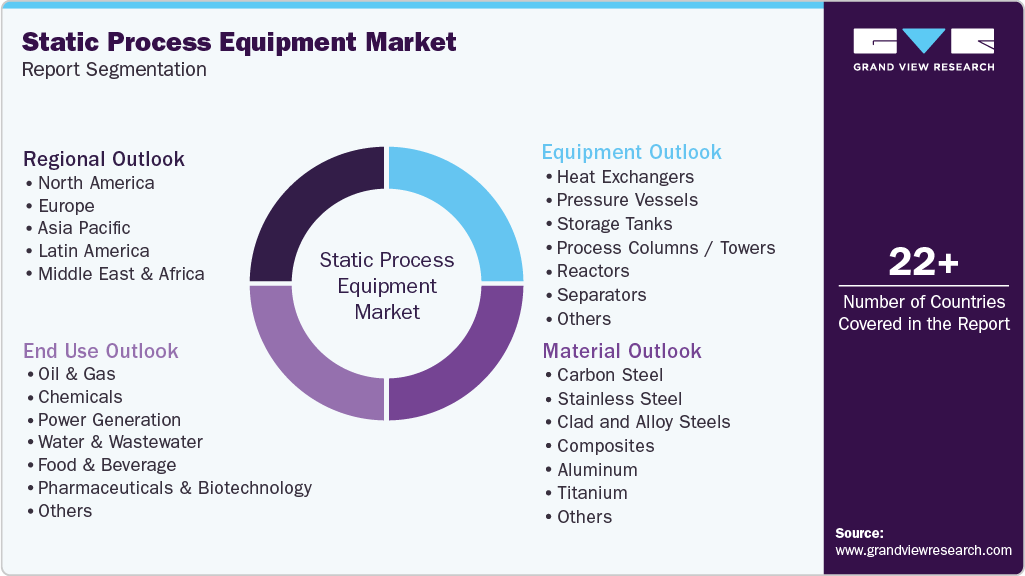
This report forecasts revenue growth at global, regional & country levels and provides an analysis on the industry trends in each of the sub-segments from 2021 to 2033. For this study, Grand View Research has segmented the static process equipment market on the basis of equipment, material, end-use, and region:
 To learn more about this report, Download Free Sample Report
-
Equipment Outlook (Revenue, USD Million, 2021 - 2033)
-
Heat Exchangers
-
Pressure Vessels
-
Storage Tanks
-
Process Columns / Towers
-
Reactors
-
Separators
-
Others
-
-
Material Outlook (Revenue, USD Million, 2021 - 2033)
-
Carbon Steel
-
Stainless Steel
-
Clad and Alloy Steels
-
Composites
-
Aluminum
-
Titanium
-
Others
-
-
End-use Outlook (Revenue, USD Million, 2021 - 2033)
-
Oil & Gas
-
Chemicals
-
Power Generation
-
Water & Wastewater
-
Food & Beverage
-
Pharmaceuticals & Biotechnology
-
Others
-
-
Regional Outlook (Revenue, USD Million, 2021 - 2033)
-
North America
-
U.S.
-
Canada
-
Mexico
-
-
Europe
-
Germany
-
France
-
UK
-
Spain
-
Italy
-
-
Asia Pacific
-
China
-
India
-
Japan
-
South Korea
-
Australia
-
-
Latin America
-
Brazil
-
Argentina
-
-
Middle East & Africa
-
Saudi Arabia
-
UAE
-
South Africa
-
-
Research Methodology
The static process equipment market figures in this report are based on a proven research process that combines executive interviews with secondary research from proprietary databases, company filings, and recognized regulatory and institutional sources. Market size is built through value-chain sizing-reconciling supply-side and demand-side estimates-and triangulated with bottom-up and top-down approaches. Every estimate passes multiple levels of expert validation before publication, with each static process equipment segment quantified using the revenue-capture definitions in the table below.
Segment Definition
Equipment
Revenue Capture Definition
Heat Exchangers
Revenue generated from the sale of fabricated and assembled heat exchangers, including shell-and-tube, plate, air-cooled, double-pipe, and other static heat transfer equipment.
Pressure Vessels
Revenue generated from the sale of fabricated pressure vessels, including horizontal, vertical, spherical, and other stationary vessels manufactured to specified pressure and temperature requirements.
Storage Tanks
Revenue generated from the sale of fabricated storage tanks, including fixed-roof, floating-roof, atmospheric, low-pressure, and other stationary storage vessels.
Process Columns / Towers
Revenue generated from the sale of fabricated process columns and towers, including distillation columns, absorption towers, stripping columns, and other vertically oriented process vessels.
Reactors
Revenue generated from the sale of fabricated process reactors, including reaction vessels and associated stationary reactor assemblies supplied as complete equipment.
Separators
Revenue generated from the sale of fabricated static separators, including two-phase and three-phase separators, knockout vessels, scrubbers, and other stationary phase-separation equipment.
Others
Revenue generated from the sale of other static process equipment not classified under heat exchangers, pressure vessels, storage tanks, process columns/towers, reactors, or separators.
Material
Revenue Capture Definition
Carbon Steel
Revenue generated from the sale of static process equipment in which carbon steel constitutes the primary material of construction, including equipment fabricated and supplied as finished units.
Stainless Steel
Revenue generated from the sale of static process equipment in which stainless steel constitutes the primary material of construction, including equipment fabricated and supplied as finished units.
Clad and Alloy Steels
Revenue generated from the sale of static process equipment manufactured using clad steel, alloy steel, or combinations of these materials as the principal construction material.
Composites
Revenue generated from the sale of static process equipment manufactured primarily from composite materials, including fiber-reinforced and polymer-based composite structures.
Aluminum
Revenue generated from the sale of static process equipment manufactured primarily from aluminum or aluminum alloys, including fabricated and assembled equipment.
Titanium
Revenue generated from the sale of static process equipment manufactured primarily from titanium or titanium alloys, including fabricated and assembled equipment.
Others
Revenue generated from the sale of static process equipment manufactured primarily from materials other than carbon steel, stainless steel, clad and alloy steels, composites, aluminum, and titanium.
End Use
Revenue Capture Definition
Oil & Gas
Revenue generated from the sale of static process equipment classified within oil & gas procurement, including equipment supplied directly by manufacturers or through project and engineering procurement contracts.
Chemicals
Revenue generated from the sale of static process equipment classified within chemical industry procurement, including direct equipment sales and equipment supplied under project contracts.
Power Generation
Revenue generated from the sale of static process equipment classified within power generation procurement, including direct sales and equipment supplied under plant or project contracts.
Water & Wastewater
Revenue generated from the sale of static process equipment classified within water and wastewater procurement, including direct equipment sales and project-based equipment supply.
Food & Beverage
Revenue generated from the sale of static process equipment classified within food and beverage procurement, including direct equipment sales and equipment supplied under plant or project contracts.
Pharmaceuticals & Biotechnology
Revenue generated from the sale of static process equipment classified within pharmaceutical and biotechnology procurement, including direct equipment sales and project-based equipment supply.
Others
Revenue generated from the sale of static process equipment classified within end-use categories other than oil & gas, chemicals, power generation, water & wastewater, food & beverage, and pharmaceuticals & biotechnology.
Estimation Model
Layer Name
Key Question
Description
Industrial Process Demand Layer
Where is demand for static process equipment generated?
Assess demand for static process equipment across oil & gas, chemicals, power generation, water & wastewater, food & beverage, pharmaceuticals & biotechnology, and other industrial sectors. Evaluate requirements for heat exchangers, pressure vessels, storage tanks, process columns/towers, reactors, separators, and related static equipment according to processing requirements, plant configuration, production capacity, operating conditions, and equipment replacement requirements.
Plant Investment & Capacity Expansion Layer
Where is incremental demand for static process equipment being created?
Analyze new production facilities, refinery and petrochemical projects, chemical plants, power generation facilities, water-treatment infrastructure, and manufacturing expansions that create requirements for static process equipment. Consider greenfield projects, brownfield expansions, capacity additions, plant modernization, process-unit upgrades, and replacement of aging equipment to assess incremental equipment demand.
Equipment & Material Adoption Layer
What types of static process equipment and materials are being adopted?
Evaluate demand across heat exchangers, pressure vessels, storage tanks, process columns/towers, reactors, separators, and other equipment, together with carbon steel, stainless steel, clad and alloy steels, composites, aluminum, titanium, and other materials. Assess material and equipment selection according to pressure and temperature conditions, corrosion resistance, mechanical properties, process-media characteristics, design specifications, fabrication requirements, and service-life expectations.
Revenue Generation Layer
How much revenue is generated from static process equipment sales?
Estimate annual market revenue from the sale of static process equipment across equipment types, materials, end-use industries, and regions. Revenue estimation considers equipment specifications, material requirements, equipment dimensions and capacity, design complexity, fabrication requirements, customization, project-based procurement, and regional pricing conditions.
Customization Table
Client Request
Customization Delivered
Value Adds
Competitive Benchmarking
A structured benchmarking assessment of leading global static process equipment manufacturers covering equipment portfolios, material capabilities, engineering and fabrication competencies, manufacturing capacity, customization capabilities, technical specifications, project execution capabilities, EPC relationships, geographic presence, pricing approaches, strategic initiatives, and recent business developments.
Enabled stakeholders to compare manufacturer capabilities, evaluate portfolio breadth and technical expertise, identify competitive differentiation, assess supplier suitability, and strengthen sourcing and competitive positioning decisions.
Regional Segmentation
A detailed assessment of North America, Europe, Asia Pacific, Latin America, and Middle East & Africa based on static process equipment demand, industrial capacity, capital investment, project pipelines, new plant construction, capacity additions, equipment replacement, and modernization across oil & gas, chemicals, power generation, water & wastewater, food & beverage, pharmaceuticals & biotechnology, and other end uses.
Provided a comparative view of regional demand conditions, industrial investment, project activity, and equipment requirements, supporting geographic prioritization, market expansion planning, and resource allocation.
Opportunity Assessment
A targeted assessment of opportunities arising from greenfield and brownfield projects, refinery and petrochemical expansions, chemical and pharmaceutical facility additions, power and water infrastructure development, plant modernization, and replacement of aging equipment.
Helped stakeholders identify addressable revenue opportunities, prioritize attractive equipment and material segments, assess demand from new capacity and replacement cycles, and develop market-entry, investment, sourcing, and portfolio-expansion strategies.
Frequently Asked Questions About This Report
The stainless steel segment dominated the market with revenue share of 24.2% in 2025,while titanium is the fastest-growing segment.
The global static process equipment market was valued at USD 178.4 million in 2025 and is estimated to reach USD 185.0 million in 2026.
The global static process equipment market is projected to grow at a CAGR of 4.3% from 2026 to 2033, reaching USD 247.7 million by 2033.
Asia Pacific dominated the global static process equipment market with a revenue share of 34.5% in 2025.
Pressure vessels segment led with a 35.0% revenue share in 2025, while heat exchangers is the fastest-growing segment.
Oil & gas dsegment led with a 27.1% revenue share in 2025, while pharmaceuticals & biotechnology is the fastest-growing segment.
Key players include Larsen & Toubro Limited, Mitsubishi Heavy Industries, Ltd., IHI Corporation, Bharat Heavy Electricals Limited (BHEL), Doosan Enerbility Co., Ltd., Alfa Laval AB, Godrej Enterprises Group, GEA Group AG, Mersen, thyssenkrupp Uhde, TEMA India Limited, ISGEC Heavy Engineering Ltd., GMM Pfaudler Ltd., KNM Group Berhad, and CIMC Enric Holdings Limited.
The market is driven by sustained capital expenditure across process-intensive industries, production capacity expansion, debottlenecking of existing facilities, refinery modernization, replacement of aging process assets, and stringent process safety and equipment integrity requirements.
About the Author(s)
Advanced Interior Materials Research Team
Advanced Materials · Advanced Interior MaterialsThis report was authored by the advanced interior materials research team at Grand View Research - comprising two research analysts, one senior research analyst, and one industry expert - with specialized expertise in the advanced interior materials segment of the advanced materials industry. All findings are based on proprietary advanced materials databases, executive interviews, and regulatory analysis, subject to internal peer review prior to publication.
Last Updated:
Speak to Analyst

Customize this report to your needs - add regions, segments, or data points, with 20% free customization.
Or view our licence options:


ISO 9001:2015 & 27001:2022 Certified
We are GDPR and CCPA compliant! Your transaction & personal information is safe and secure. For more details, please read our privacy policy.


