
- Home
- »
- Automotive & Transportation
- »
-
SUV Market Size, Share And Trends Report, 2026-2033GVR Report cover

SUV Market (2026 - 2033)
Size, Share & Trends Analysis By Vehicle Size (Compact, Mid-size, Full-Size), By Propulsion Type (ICE, Electric), By Drivetrain (2WD, 4WD, AWD), By Seating Capacity (5-Seater, 7-Seater), By Region, And Segment Forecasts
Market Size, 2025
$2,089.6BMarket Estimate, 2026
$2,436.1BMarket Forecast, 2033
$8,067.6BCAGR, 2026–2033
18.7%SUV Market Summary
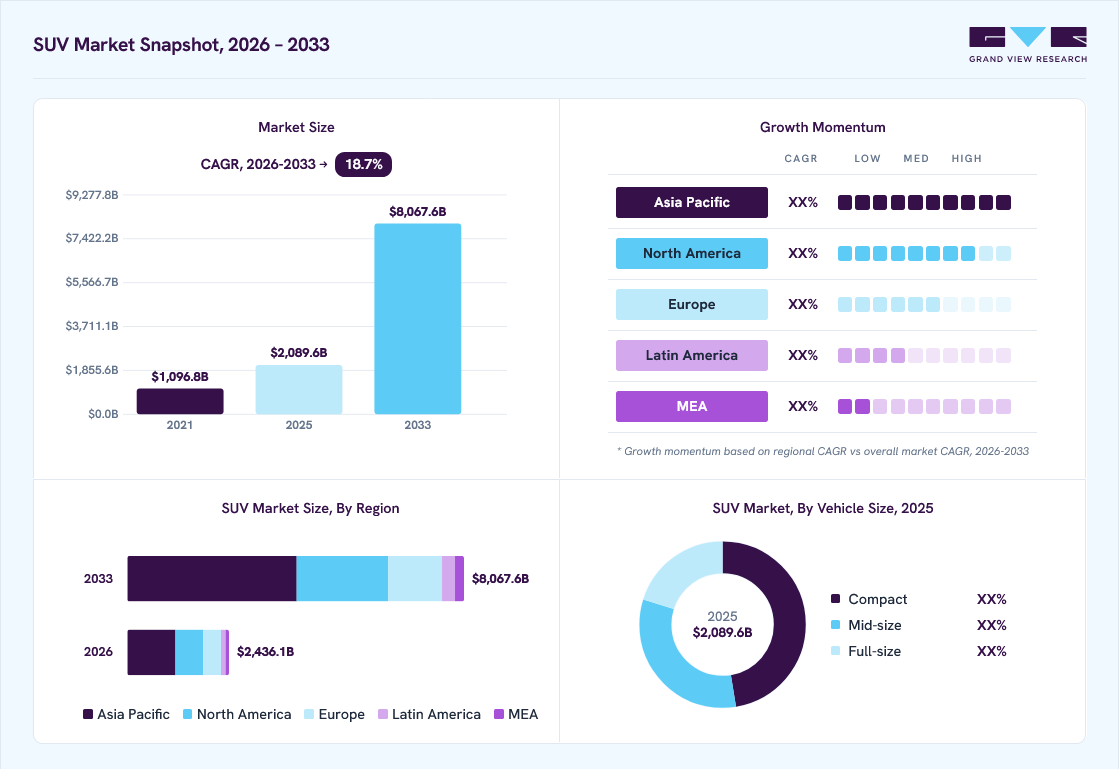
The global SUV market size was valued at USD 2,089.6 billion in 2025 and is projected to grow from 2,436.1 billion in 2026 to reach USD 8,067.6 billion by 2033, at a CAGR of 18.7% from 2026 to 2033. Asia Pacific dominated the market, accounting for the largest revenue share of 46.9% in 2025. The increasing consumer demand for spacious and versatile vehicles is driving the growth of the SUV market.
 Source: Grand View Research, IR Documents, Primary Interviews, Paid DatabasesTo learn more about this report,
 Download Free Sample Report
 Key Market Trends & Insights
- By vehicle size: Compact segment led the market and accounted for 47.3% of the global revenue in 2025.
- By propulsion type: ICE segment held the largest share of 54.2% in 2025.
- By drivetrain: 2WD drivetrain segment accounted for the largest share of global revenue in 2025.
- By seating capacity: 5-seater segment accounted for the largest market revenue share in 2025.
Regional Highlights
- Largest regional market: Asia Pacific (46.9% revenue share, 2025)
- By country: China held the largest market share in 2025.
Market Size & Forecast
- Market Size in 2025: USD 2,089.6 Billion
- Estimated Market Size in 2026: USD 2,436.1 Billion
- Projected Market Size by 2033: USD 8,067.6 Billion
- CAGR (2026-2033): 18.7%
Three ways to get this report
Buy it, customize it, or ask a question.Ask an Analyst
A direct answer, usually in 1 working day
- AccessReport author, directly
- Reply timeWithin 1 working day
- No sales callDirect answer only
- FormatEmail reply
- CostFree, no cost
Get the Full Report
What the study covers
- FormatsPDF · Excel · Dashboard
- Timeline2026–2033 annual, 2025 base
- Coverage20+ countries, 5 regions
- Companies10+ key players profiled
Customize the Report
20% free customization
- IncludeCountries, segments, points
- TailorTo your product definition
- ExtendDeeper competitor detail
- OrA fully bespoke study
- Turnaround5–10 working days
The increasing demand for road visibility and superior driving comfort is driving the growth of the SUV market. This demand is supported by the design features of SUVs, including a higher seating position and increased ground clearance, which enables drivers to navigate rough and uneven road conditions while reducing the risk of vehicle’s underside contacting the road surface. In addition, the elevated driving position provides a wider field of view, improving road visibility and enhancing the driver's confidence. Furthermore, the upright seating posture distributes the driver's weight more effectively through the seat, providing greater comfort during both daily commuting and long-distance travel. These functional and ergonomic advantages are strengthening consumer preference for SUVs over conventional passenger cars, thereby supporting market growth.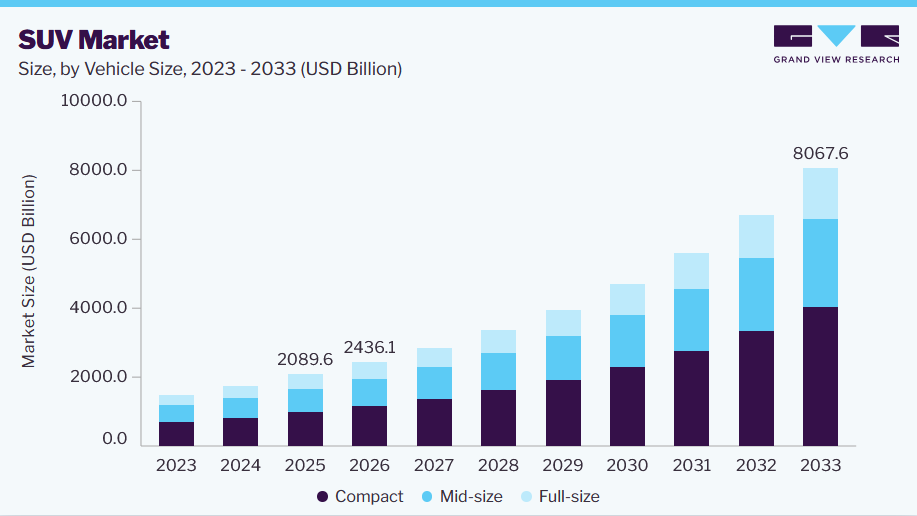 To learn more about this report, Download Free Sample Report
 The integration of advanced off-road and all-weather driving technologies is becoming a significant trend in the SUV market. Manufacturers are equipped with intelligent all-wheel drive, terrain-specific driving modes, traction and stability control, and hill-start and hill-descent assist systems. These technologies improve vehicle stability, traction, and control across wet, snowy, muddy, and uneven road conditions. Moreover, the adoption of advanced terrain management and electronic control systems is enhancing vehicle capability, safety, and overall driving performance in modern SUVs.
Stringent environmental regulations are shaping the SUV market by enabling greater circularity and environmental sustainability throughout the vehicle lifecycle. Furthermore, the EU Regulation on Circularity Requirements for Vehicle Design and the Management of End-of-Life Vehicles introduces measures such as the Circularity Vehicle Passport, an EU-wide Extended Producer Responsibility (EPR) system, minimum recycled content requirements, and improved rules for vehicle reuse and end-of-life treatment. Additionally, these requirements encourage manufacturers to adopt more sustainable vehicle design and resource-efficient production practices.
The high fuel consumption of SUVs is restraining the growth of the SUV market. SUVs are known for their larger size and higher power, but fuel efficiency is often a trade-off. Although newer SUV models are becoming more fuel-efficient, many still consume more fuel than smaller passenger vehicles. Furthermore, factors such as aggressive driving, underinflated tires, and blocked air filters can further increase fuel consumption. Consequently, improving fuel efficiency remains a key focus area for SUV manufacturers to address evolving consumer expectations.
Market Dynamics
Changing consumer lifestyles are driving demand for SUVs that offer comfort, safety, spacious interiors, and versatility for urban commuting, family travel, and recreational activities. Rising disposable incomes and the growing preference for higher seating positions and enhanced safety features are further supporting global SUV adoption.
Manufacturers are expanding compact, mid-size, and full-size SUV portfolios while introducing hybrid and electric models with advanced safety, connectivity, and infotainment technologies. These innovations are enhancing customer appeal and driving sustained market growth.
SUVs generally have higher purchase prices and ownership costs than passenger cars due to larger vehicle size, advanced technologies, higher insurance, and maintenance expenses. Rising financing costs and economic uncertainty also discourage price-sensitive consumers. This restraint is more pronounced in emerging markets, where affordability remains a key factor. Higher costs slow the adoption of premium and full-size SUVs, limiting broader market expansion.
Growing electrification, supportive government policies, improved charging infrastructure, and advances in battery technology are creating significant opportunities for electric SUVs. Consumers increasingly prefer electric SUVs that combine sustainability with advanced features and strong performance.
Automakers are investing in dedicated EV platforms and expanding electric SUV portfolios across compact and mid-size segments. Companies with strong EV capabilities and battery supply chains are well positioned to capture future market growth.
Market Concentration & Characteristics
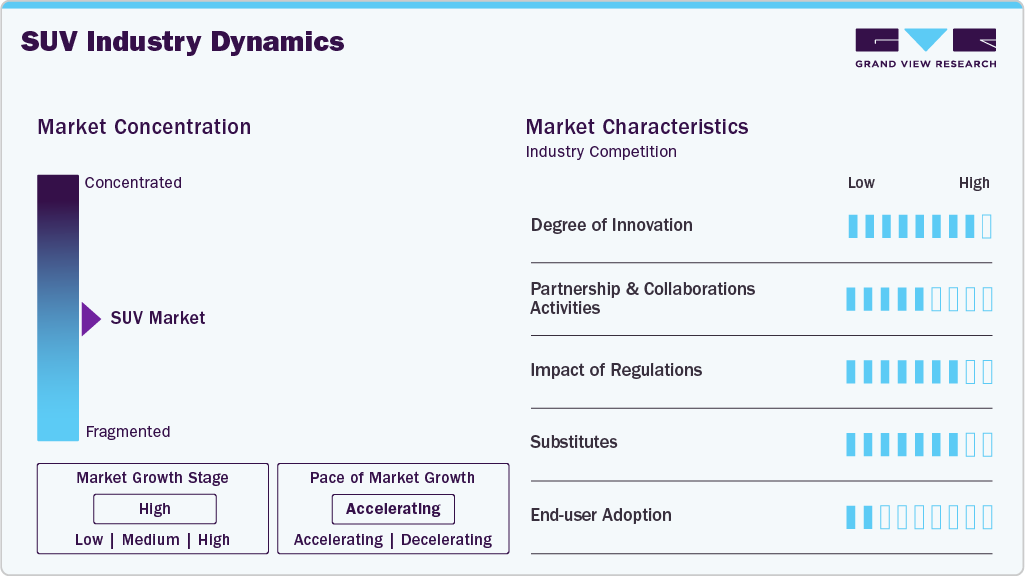
The SUV market is moderately concentrated due to the presence of numerous global automotive manufacturers offering compact, mid-size, full-size across multiple regions. Companies are focusing on expanding SUV portfolios, accelerating electrification, strengthening global manufacturing capabilities, and investing in advanced technologies such as connected vehicles, advanced driver assistance systems (ADAS), and software-defined vehicle platforms. As consumer demand continues to evolve, manufacturers compete through product innovation, brand strength, pricing strategies, and extensive dealer networks rather than solely through market concentration.
 To learn more about this report, Download Free Sample Report
 Moderate concentration is further supported by the presence of established manufacturers such as Toyota Motor Corporation, Hyundai Motor Company, Volkswagen Group, Ford Motor Company, and Nissan Motor Co., Ltd., which maintain strong global market positions through diversified SUV portfolios and large-scale production capabilities. Meanwhile, companies including Subaru Corporation, Mazda Motor Corporation, Geely Auto, Mitsubishi Motors Corporation, and Great Wall Motor are expanding their SUV offerings through regional expansion, competitive pricing, electrification, and continuous model launches. Market participants primarily compete based on vehicle quality, safety features, fuel efficiency, electrification, technology integration, and brand reputation, maintaining the moderately concentrated nature of the SUV market.
Analyst Perspective
The SUV market continues to demonstrate strong resilience, supported by sustained consumer demand for versatile, technology-rich, and safety-oriented vehicles. Electrification, advanced driver assistance systems, connected vehicle technologies, and software-defined vehicle platforms are fundamentally reshaping product development strategies across the industry. Manufacturers are increasingly investing in dedicated electric SUV platforms, battery technologies, and digital ecosystems to strengthen long-term competitiveness. Strategic collaborations, localized manufacturing, and expansion into emerging markets are expected to remain key investment priorities, while portfolio electrification likely to continue to define future competitive differentiation
Vehicle Size Insights
The compact segment accounted for 47.3% the largest share of global revenue in 2025 and it is projected to grow at the fastest CAGR over the forecast period. The segment's dominance reflects the growing consumer preference for versatile and fuel-efficient vehicles, which is driving the growth of the compact SUV market. Compact SUVs combine the higher driving position, spacious interiors, and cargo capacity of traditional SUVs with the maneuverability and fuel efficiency of passenger cars. Their ability to comfortably accommodate up to five passengers, along with the availability of all-wheel drive for improved traction in different road and weather conditions, makes them suitable for both daily commuting and recreational travel. These advantages continue to support the growth of the compact SUV segment.
The mid-size vehicle size segment is expected to grow at a significant CAGR during the forecast period, driven by their larger interior space, higher comfort, and improved performance compared to compact SUVs. This segment offers spacious cabins, ample legroom, and larger cargo capacity, making them a preferred choice for families and long-distance travellers while maintaining good fuel efficiency. Furthermore, mid-size equipped with powerful engines, premium features, and advanced safety technologies that enhance the driving experience. Their better ride comfort and stability on highways and rough roads continue to increase their appeal, supporting the growth of the mid-size SUV segment.
Propulsion Type Insights
The ICE segment dominated the market in 2025, due to its well-established fuel infrastructure and wide availability of vehicle models across all price ranges. Consumers continue to prefer ICE SUVs for their quick refueling, long driving range, and suitability for both daily commuting and long-distance travel. Automakers are enhancing ICE SUVs with improved fuel efficiency, advanced safety features, and connected technologies. These developments continue to reinforce the dominance of the ICE propulsion segment in the SUV market.
The electric propulsion type segment is projected to grow at the fastest CAGR over the forecast period The electric segment is further classified into BEV and PHEV. The demand for battery electric SUVs is increasing as consumers seek zero-emission vehicles with longer driving ranges, faster charging, and advanced digital features. Continuous improvements in battery technology are making BEVs more practical for everyday use. In addition, Plug-in hybrid SUVs are gaining popularity among consumers who want the benefits of electric driving while retaining the flexibility of a gasoline engine for longer journeys. This combination is encouraging wider adoption, particularly in markets where charging infrastructure is still developing.
Drivetrain Insights
The 2WD segment accounted for the largest share of global revenue in 2025. This dominance can be attributed to the SUV market, which offers better fuel efficiency and lower ownership costs compared to AWD and 4WD models. As most consumers use SUVs for daily commuting and city driving, where off-road capability is not essential, 2WD vehicles remain the preferred choice. Their lower purchase price and reduced maintenance costs further strengthen their appeal among budget-conscious buyers. The expansion of affordable and fuel-efficient 2WD SUV models continues to support the segment's largest revenue share.
The AWD segment is projected to grow at the fastest CAGR over the forecast period. Consumers increasingly seek better traction, stability, and vehicle control in different road and weather conditions. AWD systems are becoming more popular as they improve driving confidence on wet roads, snow, and uneven terrain, making them suitable for both urban driving and recreational use. This rising preference is encouraging automakers to expand the availability of AWD across premium and electric SUV models. Moreover, continuous advancements in drivetrain technology are further supporting the rapid growth of the AWD segment.
Seating Capacity Insights
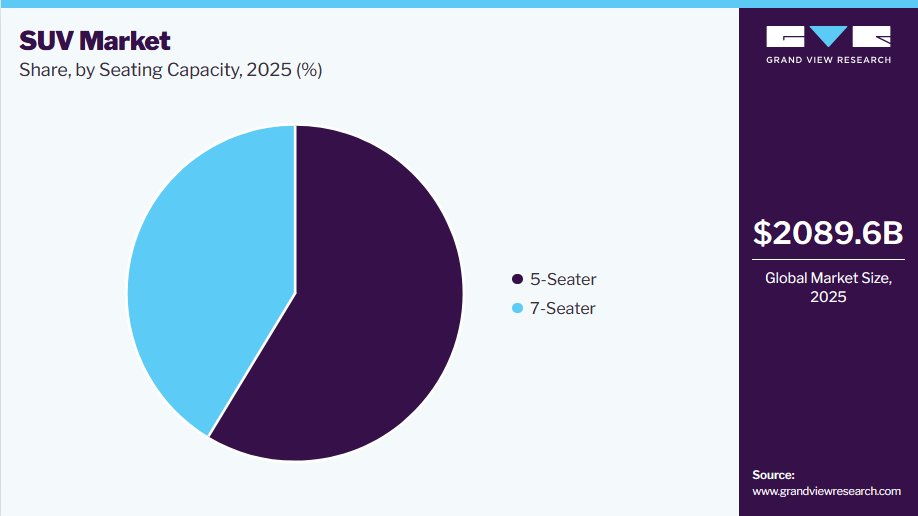
The 5-seater segment accounted for the largest market revenue share in 2025 and is projected to grow at the fastest CAGR over the forecast period. The segment’s growth is supported by its balance of affordability, practicality, and fuel efficiency, making it a preferred choice among small families, urban consumers, and first-time SUV buyers. This segment provides sufficient passenger space, easy maneuverability, and suitability for daily commuting as well as weekend travel. Furthermore, manufacturers continue to introduce feature-rich 5-seater SUV models with advanced safety and connectivity technologies, strengthening segment demand.
 To learn more about this report, Download Free Sample Report
 The 7-seater segment is expected to register significant growth from 2026 to 2033, driven by increasing consumer demand for larger vehicles for family transportation and long-distance travel. This segment offers additional seating capacity, greater interior space, and enhanced versatility for carrying multiple passengers comfortably. Furthermore, automakers are introducing new 7-seater models with improved comfort, premium features, and advanced safety technologies to attract family-oriented consumers. These developments are supporting steady growth of the 7-seater SUV segment.
Regional Insights
The SUV market in Asia Pacific led the global market and accounted for 46.9% of the global revenue in 2025 and is expected to register the highest growth from 2026 to 2033. The growing demand for compact SUVs in densely populated urban areas is accelerating the market growth in the Asia Pacific. Compact SUVs are increasingly preferred due to their smaller footprint, easier maneuverability in congested cities, and better fuel efficiency compared with larger SUVs. Their combination of practicality, comfort, and compact dimensions makes them well suited for consumers living in densely populated urban areas.
 To learn more about this report, Download Free Sample Report
 China SUV Market Trends
SUV market in China held a dominant share in the Asia Pacific market. China is expanding its electric SUV ecosystem, including investments in EV manufacturing, battery technologies, and smart vehicle infrastructure, to support the growing demand for connected and efficient vehicles. These developments enable manufacturers to introduce advanced electric and hybrid SUV models with improved driving range, intelligent features, and enhanced performance, accelerating the adoption of electric SUVs across China.
Japan SUV market is expected to grow at a significant CAGR over the forecast period. Japan is expanding its SUV market by increasing investments in hybrid and electric vehicle development, advanced manufacturing capabilities, and next-generation automotive technologies. This expansion supports the introduction of fuel-efficient, connected, and technologically advanced SUVs, strengthening consumer adoption and the country's position in the SUV market.
North America SUV Market Trends
SUV market in North America led the global market and accounted for 18.5% of the global revenue in 2025, supported by strong consumer preference for spacious vehicles, high demand for family-oriented transportation, and the popularity of premium and luxury SUVs. The region’s well-established automotive ecosystem, higher disposable income levels, and increasing availability of advanced SUV models equipped with safety, connectivity, and comfort features are driving market expansion.
SUV market in the U.S. is anticipated to register a significant growth from 2026 to 2033. The U.S. market growth is supported by increasing demand for electric and hybrid SUVs, as consumers seek fuel-efficient and environmentally friendly vehicle options without compromising on performance and utility. Additionally, automakers are expanding SUV portfolios with new compact, mid-size, and electric models, while investments in domestic vehicle production and battery manufacturing are strengthening the regional SUV market.
Europe SUV Market Trends
SUV market in Europe is poised for significant growth from 2026 to 2033. Europe is witnessing increasing demand for mid-size and large SUVs as affordable electric vehicles and advanced plug-in hybrid models improve value, driving range, and efficiency. The growing popularity of models such as the Tesla Model Y and BYD Seal U is encouraging automakers to expand their larger SUV portfolios in the region. This shift toward spacious, electrified SUVs is accelerating market growth as consumers seek enhanced comfort, technology, and sustainable mobility options.
The UK SUV market is gaining momentum due to rising consumer interest in electric SUVs supported by expanding charging networks and incentives for low-emission vehicles. Automakers are introducing new electric SUV models with improved driving ranges, advanced connectivity features, and enhanced performance, increasing their adoption among consumers.
The Germany held a substantial share in the Europe SUV market. The growing preference for SUVs in Germany is driven by consumer demand for vehicles that offer higher seating positions, better visibility, greater interior space, and greater versatility than traditional sedans. SUVs are increasingly chosen by families and daily commuters for their practicality and versatility across a range of driving needs. This shift in consumer preference is supporting the expansion of SUV adoption in the Germany.
Key SUV Market Company Insights
Key players operating in the SUV market include TOYOTA MOTOR CORPORATION, Hyundai Motor Company, Volkswagen Group., Ford Motor Company, Nissan Motor Co., Ltd., SUBARU CORPORATION, Mazda Motor Corporation, Geely Auto, MITSUBISHI MOTORS CORPORATION., and Great Wall Motor. Key players in the SUV market are expanding their vehicle portfolios, electric and hybrid SUV offerings, and advanced automotive technologies. Companies are focusing on enhancing product innovation, improving vehicle performance, and meeting growing consumer demand for versatile, connected, and sustainable SUVs.
-
TOYOTA MOTOR CORPORATION is a global automotive manufacturer engaged in the development, production, and sale of passenger and commercial vehicles, as well as mobility solutions. The company offers a diverse portfolio of vehicles, including SUVs, hybrid vehicles, plug-in hybrid electric vehicles (PHEVs), battery electric vehicles (BEVs), and fuel cell electric vehicles (FCEVs), addressing different consumer and regional mobility needs. The company continues to expand its lineup by integrating hybrid and electric powertrains, advanced safety systems, connected features, and improved driving technologies to meet the growing demand for versatile and sustainable vehicles.
-
Hyundai Motor Company is a global automotive manufacturer engaged in the production and sale of passenger and commercial vehicles, as well as future mobility solutions. The company is transforming from a traditional automobile manufacturer into a global mobility brand by focusing on innovative and sustainable transportation technologies. Hyundai Motor Company offers a diverse vehicle portfolio, including SUVs, electric vehicles (EVs), hybrid models, and hydrogen-powered vehicles, while continuously advancing electrification, autonomous driving, connectivity technologies, and software-defined vehicles to meet evolving consumer mobility needs.
Key SUV Companies:
The following key companies have been profiled for this study on the SUV market.
-
Toyota Motor Corporation
-
Hyundai Motor Company
-
Volkswagen Group
-
Ford Motor Company
-
Nissan Motor Co., Ltd.
-
Subaru Corporation
-
Mazda Motor Corporation
-
Geely Auto
-
Mitsubishi Motors Corporation.
-
Great Wall Motor.
Competitive Benchmarking
Operating Strategies
Competitive Edge
Weaknesses
Mature Players: TOYOTA MOTOR CORPORATION, Hyundai Motor Company, Volkswagen Group, Ford Motor Company, Nissan Motor Co., Ltd.
Mature players in the SUV market are maintaining extensive global SUV portfolios across multiple vehicle sizes and propulsion technologies, invest in electrification, advanced safety systems, software-defined vehicles, localized manufacturing, and global distribution networks.
Mature players gain a competitive advantage through strong global brand recognition, diversified SUV portfolios, significant production capacity, established dealer networks, robust R&D capabilities, economies of scale, and strong financial resources.
Large organizational structures can slow decision-making and product development due to complex approval processes. Higher regulatory compliance costs increase operational expenses, while complex global supply chains can create challenges in managing production, sourcing, and delivery efficiency.
Emerging Players: SUBARU CORPORATION, Mazda Motor Corporation, Geely Auto, MITSUBISHI MOTORS CORPORATION, Great Wall Motor
Emerging players in the SUV market are focusing on niche SUV segments, regional expansion, competitive pricing, electric vehicle investments, strategic technology partnerships, and continuous product differentiation.
Emerging players gain market traction through agility in product development, strong presence in selected regional markets, competitive pricing strategies, growing electric SUV portfolios, and increasing investment in smart vehicle technologies.
Emerging players face limited global presence, and smaller production volumes reduce economies of scale and market reach. Lower brand recognition and constrained distribution networks can make it more challenging to attract customers and expand into new international markets.
Recent Developments
-
In November 2025, Hyundai Motor Company launched the all-new Hyundai VENUE and VENUE N Line, strengthening its compact SUV portfolio to meet the rising demand for smart, connected, and versatile vehicles. The new models introduce advanced connectivity, safety technologies, enhanced performance, and updated design features, improving the overall driving experience. This launch supports Hyundai Motor Company’s strategy to expand its presence in the growing compact SUV segment by offering feature-rich vehicles aligned with evolving consumer preferences.
-
In January 2026, Volkswagen Group launched the all-new Tayron R-Line, a flagship 7-seater SUV, to expand its premium SUV portfolio, offering enhanced space and comfort, advanced technology, and sporty R-Line design features. The model is designed to meet growing consumer demand for larger, family-oriented SUVs that offer luxury, versatility, and a commanding road presence. The SUV likely to be locally assembled in India, supporting the strategy to strengthen its presence in the premium SUV segment.
SUV Market Report Scope
Report Attribute
Details
Market size value in 2025
USD 2,089.62 billion
Estimated market size in 2026
USD 2,436.1 billion
Projected market size by 2033
USD 8,067.6 billion
Growth rate
CAGR of 18.7% from 2026 to 2033
Base year for estimation
2025
Historical data
2021 - 2024
Forecast period
2026 - 2033
Quantitative units
Revenue in USD billion and CAGR from 2026 to 2033
Report coverage
Revenue forecast, company ranking, competitive landscape, growth factors, and trends
Segments covered
Vehicle size, propulsion type, drivetrain, seating capacity, region
Regional scope
North America; Europe; Asia Pacific; Latin America; MEA
Country scope
U.S.; Canada; Mexico; Germany; UK; France; China; Japan; India; South Korea; Australia; Brazil; KSA; UAE; South Africa
Key companies profiled
Toyota Motor Corporation; Hyundai Motor Company; Volkswagen Group; Ford Motor Company; Nissan Motor Co. Ltd.; Subaru Corporation; Mazda Motor Corporation; Geely Auto; Mitsubishi Motors Corporation; Great Wall Motor.
Customization scope
Free report customization (equivalent up to 8 analysts working days) with purchase. Addition or alteration to country, regional & segment scope.
Pricing and purchase options
Avail customized purchase options to meet your exact research needs. Explore purchase options
Global SUV Market Report Segmentation
The report forecasts revenue growth at global, regional, and country levels and provides an analysis of the latest industry trends in each of the sub-segments from 2021 to 2033. For this study, Grand View Research has segmented the SUV market based on vehicle size, propulsion type, drivetrain, seating capacity, and region:
-
Vehicle Size Outlook (Revenue, USD Billion, 2021 - 2033)
-
Compact
-
Mid-size
-
Full-size
-
-
Propulsion Type Outlook (Revenue, USD Billion, 2021 - 2033)
-
ICE
-
Electric
-
BEV
-
PHEV
-
-
-
Drivetrain Outlook (Revenue, USD Billion, 2021 - 2033)
-
2WD
-
4WD
-
AWD
-
-
Seating Capacity Outlook (Revenue, USD Billion, 2021 - 2033)
-
5-Seater
-
7-Seater
-
-
Regional Outlook (Revenue, USD Billion, 2021 - 2033)
-
North America
-
U.S.
-
Canada
-
Mexico
-
-
Europe
-
Germany
-
UK
-
France
-
-
Asia Pacific
-
China
-
India
-
Japan
-
South Korea
-
Australia
-
-
Latin America
-
Brazil
-
-
Middle East & Africa (MEA)
-
UAE
-
Kingdom of Saudi Arabia (KSA)
-
South Africa
-
-
Research Methodology
The SUV marketfigures in this report are based on a proven research process that combines executive interviews with secondary research from proprietary databases, company filings, and recognized regulatory and institutional sources. Market size is built through value-chain sizing—reconciling supply-side and demand-side estimates—and triangulated with bottom-up and top-down approaches. Every estimate passes multiple levels of expert validation before publication, with eachSUVsegment quantified using the revenue-capture definitions in the table below.
Segment Definition
Segment - Vehicle Size
Revenue capture definition
Compact
The segment revenue is generated from compact SUVs, including gasoline, diesel, hybrid, and electric models, as well as factory-installed features and optional equipment.
Mid-size
The segment revenue is generated from mid-size SUVs, including conventional and electrified models, premium variants, technology packages, and OEM-installed accessories.
Full-size
The segment revenue is generated from full-size SUVs, including luxury, premium, and performance models, optional packages, advanced technologies, and manufacturer-installed features.
Segment - Propulsion Type
Revenue capture definition
ICE
The segment revenue is generated from the sale of SUVs powered by internal combustion engines (gasoline or diesel), including compact, mid-size, and full-size models.
Electric
The segment revenue generated from the sale of electric SUVs, including battery electric vehicles (BEVs) and plug-in hybrid electric vehicles (PHEVs).
-
BEV: The segment revenue generated from the sale of battery electric SUVs that operate entirely on electricity using rechargeable battery systems.
-
PHEV: The segment revenue generated from the sale of plug-in hybrid electric SUVs that combine a rechargeable battery with an internal combustion engine.
Segment - Drivetrain
Revenue capture definition
2WD
The segment revenue is generated from the sale of front-wheel drive (FWD) and rear-wheel drive (RWD) SUVs, including compact, mid-size, and full-size models powered by ICE, BEV, and PHEV propulsion, along with factory-installed drivetrain components and OEM vehicle configurations.
4WD
The segment revenue is generated from the sale of SUVs equipped with four-wheel drive systems, including off-road, utility, and premium SUV models, together with manufacturer-installed 4WD systems and related drivetrain technologies.
AWD
The segment revenue is generated from the sale of SUVs equipped with all-wheel drive systems, including premium, luxury, performance, hybrid, and electric SUVs, along with OEM-installed AWD technologies and drivetrain configurations.
Segment - Seating Capacity
Revenue capture definition
5-Seater
The segment revenue is generated from the sale of five-seater SUVs across compact, mid-size, and full-size categories, including ICE, BEV, and PHEV models, along with factory-installed comfort, safety, and technology features.
7-Seater
The segment revenue is generated from the sale of seven-seater SUVs designed for family and commercial use, including premium and luxury variants, optional seating configurations, and OEM-installed safety, connectivity, and comfort features.
Estimation Model
Layer Name
Key Question
Description
Global Automotive Industry Assessment
What is the overall size and growth of the global passenger vehicle industry?
This layer evaluates worldwide passenger vehicle production and sales trends to establish an overall addressable automotive market. It analyzes economic indicators, vehicle ownership rates, regulatory developments, and consumer purchasing behavior. The assessment provides the foundation for estimating SUV demand within the broader automotive sector.
SUV Penetration Analysis
What proportion of passenger vehicle demand is represented by SUVs?
This layer measures SUV adoption across major regions by analyzing consumer preferences, body-style trends, pricing strategies, and manufacturer product portfolios. Market share variations across compact, mid-size, and full-size SUV categories are evaluated. Regional adoption differences are incorporated to improve market estimation accuracy.
Segment-Level Revenue Estimation
Which SUV segments contribute the highest revenue?
This layer estimates revenue across vehicle size, propulsion type, drivetrain, and seating capacity segments. Average selling prices, production volumes, technology content, and regional demand patterns are analyzed. Segment-level analysis identifies the primary contributors to total market revenue.
Competitive & Regional Validation
How is the estimated market validated across regions and manufacturers?
The final layer validates market estimates using OEM sales performance, production capacity, regional registrations, product launches, and competitive positioning. Market assumptions are cross-checked using manufacturer financial disclosures and industry production statistics. This ensures consistent and reliable revenue estimation across all major SUV markets.
Delivered Customization
This report has been delivered with the following In-depth customizations
Client Request
Customization Delivered
Value Adds
Regional SUV Market Opportunity Assessment
- Country/region-wise market sizing and forecasts
- Analysis of demand, adoption trends, and regulatory landscape
- Identification of high-growth regions and investment hotspots
- Identified region-specific growth opportunities
- Supported expansion and go-to-market strategy
- Enabled informed regional investment decisions
Cross-Segmentation Analysis for the SUV Market
- Criss-cross market analysis by vehicle size, propulsion type, drivetrain, seating capacity
- Demand and adoption assessment across key segments
- Segment attractiveness and growth potential benchmarking
- Identified high-potential market segments
- Supported targeted product positioning and marketing strategy
- Improved customer and segment prioritization
Competitive Benchmarking and Strategic Positioning in the SUV Market
- Benchmarking of key competitors across products, pricing, partnerships, and innovation
- Comparative assessment of market share, capabilities, and strategies
- Analysis of competitive strengths, gaps, and differentiation areas
- Identified competitive white spaces and growth gaps
- Supported strategic positioning and differentiation
- Enabled data-driven competitive strategy development
Frequently Asked Questions About This Report
The global SUV market size was valued at USD 2,089.6 billion in 2025 and is estimated at USD 2,436.1 billion in 2026.
The global SUV market is expected to grow at a CAGR of 18.7% from 2026 to 2033, reaching USD 8,067.6 billion by 2033.
The increasing consumer demand for spacious and versatile vehicles is driving the growth of the SUV market.
Some key players operating in the SUV market include TOYOTA MOTOR CORPORATION, Hyundai Motor Company, Volkswagen Group., Ford Motor Company, Nissan Motor Co., Ltd., SUBARU CORPORATION, Mazda Motor Corporation, Geely Auto, MITSUBISHI MOTORS CORPORATION., and Great Wall Motor
ICE segment led the market and accounted for the global revenue in 2025, while electric propulsion type segment is projected to grow at the fastest CAGR over the forecast period
2WD segment accounted for the largest share of global revenue in 2025, while AWD segment is projected to grow at the fastest CAGR over the forecast period
5-seater segment accounted for the largest market revenue share in 2025 and is projected to grow at the fastest CAGR over the forecast period
Compact segment accounted for 47.3% the largest share of global revenue in 2025 and it is projected to grow at the fastest CAGR over the forecast period. The segment's dominance reflects the growing consumer preference for versatile and fuel-efficient vehicles, which is driving the growth of the compact SUV market.
Asia Pacific dominated the market, accounting for the largest revenue share of 46.9% in 2025.
About the Author(s)
Automotive & Transportation Research Team
Technology · Automotive & TransportationThis report was authored by the automotive & transportation research team at Grand View Research - comprising two research analysts, one senior research analyst, and one industry expert - with specialized expertise in the automotive & transportation segment of the technology industry. All findings are based on proprietary technology databases, executive interviews, and regulatory analysis, subject to internal peer review prior to publication.
Last Updated:
Speak to Analyst

Customize this report to your needs - add regions, segments, or data points, with 20% free customization.
Or view our licence options:


ISO 9001:2015 & 27001:2022 Certified
We are GDPR and CCPA compliant! Your transaction & personal information is safe and secure. For more details, please read our privacy policy.


