
- Home
- »
- Paints, Coatings & Printing Inks
- »
-
Synthetic Dyes Market Size, Share & Trends Report, 2030GVR Report cover

Synthetic Dyes Market (2024 - 2030) Size, Share & Trends Analysis Report By Product (Reactive Dyes, Vat Dyes, Acid Dyes), By End-use (Textile, Pulp & Paper) By Region, And Segment Forecasts
Synthetic Dyes Market Summary
The global synthetic dyes market size was estimated at USD 6.35 billion in 2023 and is projected to reach USD 10.06 billion by 2030, growing at a CAGR of 6.8% from 2024 to 2030. The rising consumption of synthetic dyes across various industries, including textiles, plastics, printing inks, and paints is driving this growth.
Key Market Trends & Insights
- The synthetic dyes market in Asia Pacific held the largest revenue share of 70.5% in 2023.
- The North America synthetic dyes market is expected to grow at a significant share from 2024 to 2030.
- By product, the reactive dyes segment held the largest revenue share of 58.1% in 2023.
- By end use, the textile segment held the largest revenue share of 62.9% in 2023.
Market Size & Forecast
- 2023 Market Size: USD 6.35 Billion
- 2030 Projected Market Size: USD 10.06 Billion
- CAGR (2024-2030): 6.8%
- Asia Pacific: Largest market in 2023
Three ways to get this report
Buy it, customize it, or ask a question.Ask an Analyst
Analyst response in 1 business day
- AccessReport author, directly
- Reply timeWithin 1 working day
- No sales callDirect answer only
- FormatEmail reply
- CostFree, no cost
Get the Full Report
What the study covers
- FormatsPDF · Excel · Dashboard
- Timeline2024–2030 annual, 2023 base
- Coverage20+ countries, 5 regions
- Companies10+ key players profiled
Customize the Report
20% free customization
- IncludeCountries, segments, points
- TailorTo your product definition
- ExtendDeeper competitor detail
- OrA fully bespoke study
- Turnaround5–10 working days
The growth of the digital printing industry and increasing demand for high-performance pigments drive the product demand globally. Synthetic dyes are favored for their wide range of colors, affordability, and extended shelf life, making them popular choices across various applications. Furthermore, heightened demand from the packaging sector and the increasing need for advanced pigments are expected to propel the product demand worldwide.
 Source: Grand View Research, IR Documents, Primary Interviews, Paid DatabasesTo learn more about this report,
 Download Free Sample Report
 In addition, the growing use of plastics in various applications, such as packaging, consumer goods, and construction, has increased product demand. The versatility of plastics has expanded the range of applications for the product. For example, color-stable products are used to produce colored plastic products, such as toys, household items, and automotive parts. The use of specialized products can enhance the performance of plastic products, such as UV stability, weather resistance, and flame resistance. Moreover, the demand for innovative and high-quality plastic products is driving the development of new products, resulting in increased opportunities for the product market.
The global product market is forecasted to grow positively during the forecast period. Despite their increasing demand and growth of the end-use industries, the market growth is expected to be hindered by stringent government regulations.Factors such as high-water consumption in the textile industry to rinse dye, solubility of the product, high metal content in pigments, and water pollution during the manufacturing process are the major environmental threats caused by the product market
End-use Insights
The textile segment dominated the market with a revenue share of 62.9% in 2023.The product is used in the textile industry to color fibers, fabrics, and garments. They are applied during the manufacturing process to impart color to the final product.
Different products are used for different types of fibers, such as natural fibers (e.g. cotton, wool) or synthetic fibers (e.g. polyester), and the choice of dye depends on factors such as the fiber type, desired color intensity, and fastness to light and washing. The product can be applied using various methods, including dipping, padding, spraying, and printing.
In printing inks, the product is used as colorants to produce bright and vivid prints. The product is suspended in a liquid carrier, usually a solvent, to create an ink that can be transferred to a substrate such as paper or fabric. The ink adheres to the substrate and the solvent evaporates, leaving behind a brightly colored print. The type of product used can affect the quality of the print and the longevity of the ink, with some products being more resistant to fading than others.
The product is used in the leather industry to color leather and make it more attractive. The product is applied to the surface of the leather using various techniques such as dipping, padding, spray, or brush. Different types of products such as aniline, pigmented, or metallic can be used, depending on the desired effect and the type of leather being used. The dyes penetrate the leather fibers, providing long-lasting color and resistance to fading.
Product Insights
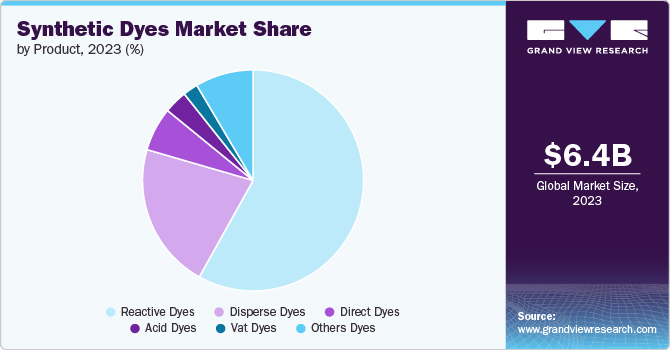
The reactive type of the product dominated the market with a revenue share of 58.1% in 2023. It is a synthetic product used for coloring textiles, specifically for cellulosic fibers like cotton and rayon. They are called "reactive" because they react chemically with the fibers, forming covalent bonds and producing a permanent color. These products are considered one of the best quality products for cellulosic fibers, as they produce bright and intense colors that are resistant to fading and washing.
 To learn more about this report, Download Free Sample Report
 Disperse type of the product is used to color synthetic fibers such as polyester, nylon, and acrylic. They are water-insoluble and must be dispersed in the form of very fine particles to color the fabric. They are commonly used in the textile industry due to their bright colors and good colorfastness. Disperse type of the product can also be applied using heat transfer printing, which is a digital printing process.
Regional Insights
The North America synthetic dyes market is expected to grow at a significant share from 2024 to 2030. The demand for specialty and high-performance products, such as UV-resistant and heat-resistant pigments, is growing in this region, driven by their increasing use in industries such as automotive, packaging, and construction.
Asia Pacific Synthetic Dyes Market Trends
The synthetic dyes market in Asia Pacific dominated the market with a revenue share of 70.5% in 2023. Asia Pacific is a key region in terms of textile production, and thus, it held the highest share in the global product market. Factors such as robust demand, policy support, increasing investments, and competitive advantage are driving the textile industry, especially in Asian countries, such as China which is further positively affecting the product market in the region.
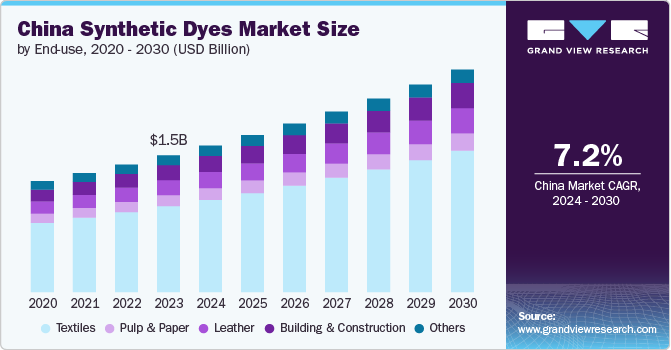
China synthetic dyes market is the largest textile producer in the world, accounting for around 36% of global textile production in 2023 as per International Institute for Sustainable Development, Other major textile producers include India, Bangladesh, and Vietnam.
The synthetic dyes market in India is anticipated to expand at a CAGR of 10%, reaching an estimated USD 350 billion by 2030 as per India Brand Equity Foundation (IBEF). India currently stands as the world's third-largest exporter of textiles and apparel. As the textile industry continues to develop, it is expected to stimulate domestic demand for the product market in the country.
Europe Synthetic Dyes Market Trends
The Europe synthetic dyes market is growing, driven by the increasing demand for high-quality, colorfast products in the packaging industry. This has fueled the need for superior pigments in printing and packaging applications. The automotive sector is also driving demand for high-performance products that can withstand harsh conditions and maintain color stability. The use of cutting-edge technologies like nanotechnology and biotechnology in the production of products is boosting product performance and improving production efficiency.
Key Synthetic Dyes Company Insights
Some of the key players operating in the market include Huntsman International LLC, BASF SE, LANXESS, SHAH INDUSTRIES, KIWA Chemical Industry Co., Ltd, Kiri Industries Ltd., Archroma, Atul Ltd and The Chemours Company among others.
-
Huntsman International LLC is a multinational chemical manufacturing company that produces a variety of chemical products such as polyurethanes, performance products, and advanced materials. The Company operates in more than 100 countries with production facilities in 69 countries. The dyes and pigments segment of the company offers high-performance products for a wide range of industries, including textiles, coatings, plastics, and graphic arts.
-
Lanxess is manufacturer and distributor for additives, chemical intermediates, plastics, and specialty chemicals. It currently operates through three major business segments, namely the performance polymers segment, the advanced intermediates segment, and the performance chemicals segment.
Key Synthetic Dyes Companies:
The following are the leading companies in the synthetic dyes market. These companies collectively hold the largest market share and dictate industry trends.
- Huntsman International LLC
- BASF SE
- LANXESS
- SHAH INDUSTRIES
- KIWA Chemical Industry Co., Ltd
- Kiri Industries Ltd.
- Archroma
- Atul Ltd
- The Chemours Company
Recent Developments
-
In March 2022, the global chemical company, Archroma developed and launched two new acid dyes which are metal and halogen-free.
-
In October 2023, The Center for Science in the Public Interest reported that the carcinogenic food dye Red 3 is banned in California. This landmark legislation also includes provisions to phase out the use of brominated vegetable oil, potassium bromate, and propylparaben by the year 2027.
Synthetic Dyes Market Report Scope
Report Attribute
Details
Market size value in 2024
USD 6.78 billion
Revenue forecast in 2030
USD 10.06 billion
Growth rate
CAGR of 6.8% from 2024 to 2030
Actual data
2018 - 2023
Forecast period
2024 - 2030
Quantitative units
Revenue in USD million/billion and CAGR from 2024 to 2030
Report coverage
Revenue forecast, company ranking, competitive landscape, growth factors, and trends
Segments covered
Product, end-use, region
Regional scope
North America; Europe; Asia Pacific; Central & South America; Middle East & Africa
Country scope
U.S.; Canada; Mexico; Germany; UK; Italy; France; Spain; China; India; Japan, South Korea; Brazil; Argentina; South Africa, Saudi Arabia
Key companies profiled
Huntsman International LLC; BASF SE; LANXESS
SHAH INDUSTRIES; KIWA Chemical Industry Co., Ltd; Kiri Industries Ltd.; Archroma, Atul Ltd; The Chemours Company
Customization scope
Free report customization (equivalent up to 8 analysts working days) with purchase. Addition or alteration to country, regional & segment scope.
Pricing and purchase options
Avail customized purchase options to meet your exact research needs. Explore purchase options
Global Synthetic Dyes Market Report Segmentation
This report forecasts revenue growth at global, regional, and country levels and provides an analysis of the latest industry trends in each of the sub-segments from 2018 to 2030. For this study, Grand View Research has segmented the global synthetic dyes market report based on product, end-use, and region.
-
Product Outlook (Revenue, USD Million, 2018 - 2030)
-
Reactive Dyes
-
Vat Dyes
-
Acid Dyes
-
Direct Dyes
-
Disperse Dyes
-
Other dyes
-
-
End Use Outlook (Revenue, USD Million, 2018 - 2030)
-
Textiles
-
Pulp & Paper
-
Leather
-
Building & Construction
-
Others
-
-
Regional Outlook (Revenue, USD Million, 2018 - 2030)
-
North America
-
U.S.
-
Canada
-
Mexico
-
-
Europe
-
Germany
-
UK
-
France
-
Italy
-
Spain
-
-
Asia Pacific
-
China
-
India
-
Japan
-
South Korea
-
-
Central & South America
-
Brazil
-
Argentina
-
-
Middle East and Africa
-
Saudi Arabia
-
South Africa
-
-
Frequently Asked Questions About This Report
The global synthetic dyes market size was estimated at USD 6.35 billion in 2023 and is expected to reach USD 6.78 billion in 2024.
The global synthetic dyes market is expected to grow at a compound annual growth rate of 6.8% from 2024 to 2030 to reach USD 10.06 billion by 2030.
Asia Pacific dominated the market segment with a revenue share of 70.5% in 2023. Asia Pacific is a key region in terms of textile production, and thus, it held the highest share in the global product market.
Some key players operating in the synthetic dyes market include Huntsman International LLC, BASF SE, LANXESS, SHAH INDUSTRIES, KIWA Chemical Industry Co., Ltd, Kiri Industries Ltd., Archroma, Atul Ltd, The Chemours Company
Key factors that are driving the market growth include its rising consumption across various industries, including textiles, plastics, printing inks, and paints.
About the Author(s)
Paints, Coatings & Printing Inks Research Team
Bulk Chemicals · Paints, Coatings & Printing InksThis report was authored by the paints, coatings & printing inks research team at Grand View Research - comprising two research analysts, one senior research analyst, and one industry expert - with specialized expertise in the paints, coatings & printing inks segment of the bulk chemicals industry. All findings are based on proprietary bulk chemicals databases, executive interviews, and regulatory analysis, subject to internal peer review prior to publication.
Last Updated:
Speak to Analyst

Customize this report to your needs - add regions, segments, or data points, with 20% free customization.
Or view our licence options:


ISO 9001:2015 & 27001:2022 Certified
We are GDPR and CCPA compliant! Your transaction & personal information is safe and secure. For more details, please read our privacy policy.


