
- Home
- »
- Plastics, Polymers & Resins
- »
-
Tire-derived Rubber Market Size, Growth Report, 2026-2033GVR Report cover
![Tire-derived Rubber Market (2026 - 2033)Report]()
Tire-derived Rubber Market (2026 - 2033)
Size, Share & Trends Analysis Report By Form (Crumb Rubber, Rubber Powder, Reclaimed/Devulcanized Rubber), By Application (Road & Infrastructure), By Region, And Segment Forecasts
Market Size, 2025
$9.0BMarket Estimate, 2026
$9.5BMarket Forecast, 2033
$13.4BCAGR, 2026–2033
5.1%Tire-derived Rubber Market Summary
The global tire-derived rubber market size was valued at USD 9.0 billion in 2025 and is projected to grow from USD 9.5 billion in 2026 to USD 13.4 billion by 2033, at a CAGR of 5.1% from 2026 to 2033. Asia Pacific dominated the global market, accounting for the largest revenue share of 35.2% in 2025. Rising demand for cost-effective raw materials in manufacturing is supporting the adoption of tire-derived rubber.

Key Market Trends & Insights
- By form: Reclaimed/devulcanized rubber segment is anticipated to grow at a CAGR of 6.4% over the forecast period in the form category.
- By application: Civil engineering & construction segment is expected to grow at a 6.4% CAGR in revenue from 2026 to 2033.
Regional Highlights
- Largest regional market: Asia Pacific (35.2% revenue share, 2025)
- By country: The U.S. tire-derived rubber industry is a major contributor to the global market.
Market Size & Forecast
- Market size in 2025: USD 9.0 Billion
- Estimated market size in 2026: USD 9.5 Billion
- Projected market size by 2033: USD 13.4 Billion
- CAGR (2026-2033): 5.1%
Industries such as construction, automotive components, and molded goods are increasingly using TDR as a partial substitute for virgin rubber to reduce material costs while maintaining functional performance. Integration of tire-derived rubber into performance-engineered materials is emerging as a key trend. Process innovations such as cryogenic grinding and devulcanization are enabling consistent particle size and improved compatibility with polymers.

This is driving large usage in high-value applications such as modified asphalt, molded goods, and advanced sports surfaces. Rubberized asphalt accounts for a large share of crumb rubber demand, reflecting strong adoption in infrastructure systems that require durability and noise reduction.
Drivers, Opportunities & Restraints
Regulatory pressure on end-of-life tire disposal is a primarily driving the demand. Governments are mandating landfill diversion and promoting circular material utilization, which directly increases feedstock availability for TDR production. According to industry data, more than 1.5 billion tires are generated annually, creating a stable raw material stream for recycling processes. This supply consistency supports large-scale commercialization and encourages adoption across construction, automotive, and recreational infrastructure sectors where cost-efficient and sustainable materials are prioritized.
Infrastructure modernization programs present a significant growth opportunity. Rubber-modified asphalt and geotechnical applications are gaining traction due to superior elasticity, crack resistance, and lifecycle cost advantages. Rubberized asphalt can extend road life by up to 40%, improving long-term maintenance economics. Emerging economies in the Asia Pacific and Latin America are increasingly adopting such materials in highways, urban roads, and smart city projects, creating scalable demand for TDR in civil engineering applications.
Market fragmentation and inconsistent product quality remain key restraints. Variability in feedstock composition and processing technologies leads to inconsistent material performance, limiting acceptance in high-specification applications. In addition, price volatility and competition from low-cost virgin rubber and alternative fillers constrain margins. Industry observations indicate that producers often face challenges in securing stable demand and maintaining profitability due to fluctuating crumb rubber prices and competition from subsidized recycling operations, which impacts long-term investment confidence.
Market Concentration & Characteristics
The market is in a medium growth stage, with growth accelerating steadily. The market exhibits fragmentation, with key players dominating the industry landscape. Major companies such as Genan Holding A/S, Liberty Tire Recycling Holdco LLC, CRM Co., LLC, Lehigh Technologies, Inc., Tyrecycle Pty Ltd., Tyromer Inc., Tyre Crumb Pty Ltd., Lead Reclaim and Rubber Products Ltd., and others play a significant role in shaping the market dynamics. These leading players often drive innovation in the market by introducing new products, technologies, and materials to meet the industry's evolving demands.
The tire-derived rubber market is witnessing a moderate to high level of innovation, focused on material recovery and performance enhancement. Advanced devulcanization, micronization, and cryogenic grinding technologies are improving rubber purity, elasticity, and compatibility with new compounds. This is enabling higher-value applications beyond basic fillers, including engineered asphalt and molded industrial products. According to the U.S. Tire Manufacturers Association (USTMA), rubber-modified asphalt consumption increased by 17% between 2021 and 2023, reflecting the rapid uptake of performance-driven innovations in infrastructure materials. Innovation remains largely process-driven rather than product-disruptive, with gradual but consistent technological improvements.
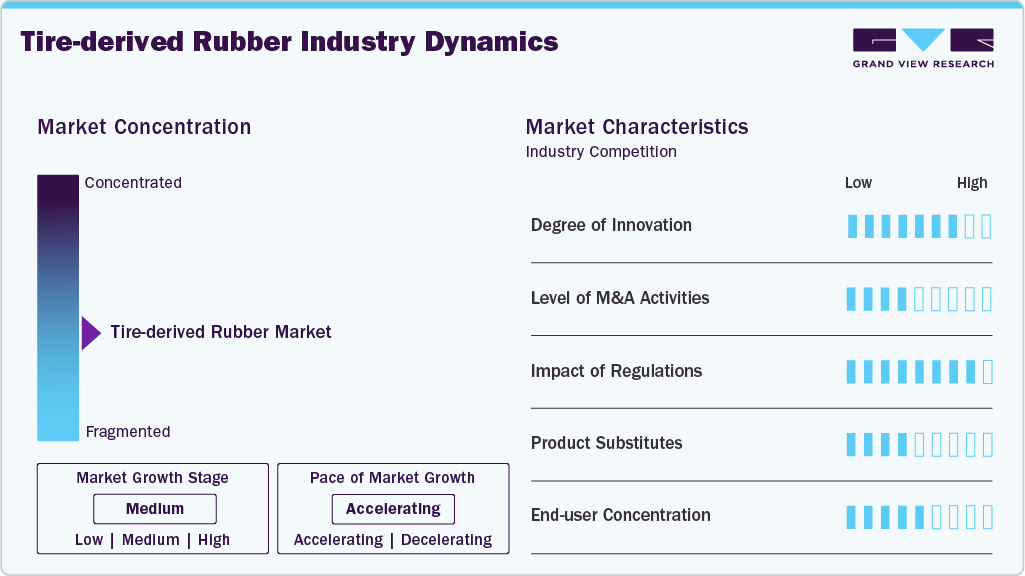
Regulatory frameworks play a decisive role in shaping the demand and supply dynamics of tire-derived rubber. Governments are enforcing landfill restrictions, extended producer responsibility, and end-of-waste criteria to formalize recycling streams and improve material quality. According to the UK government’s data, 79% of end-of-life tires were recycled or recovered in 2023, supported by policy measures promoting circular utilization. Moreover, defined quality protocols allow processed tire rubber to transition from waste to secondary raw material status, improving market acceptance and enabling its use in construction and industrial applications.
Form Insights
The crumb rubber segment dominated the market with a revenue share of 60.7% in 2025, and is expected to grow at a 4.9% CAGR from 2026 to 2033. Demand for crumb rubber is primarily driven by its strong performance enhancement in asphalt modification applications. The material offers elasticity, rutting resistance, and fatigue life of pavements, making it suitable for high-traffic road networks. Crumb rubber-modified asphalt demonstrates superior resistance to thermal cracking and permanent deformation compared to conventional binders, which directly supports longer service life. This performance advantage, combined with its lower cost relative to polymer modifiers, is accelerating adoption across large-scale road construction and maintenance programs.
The reclaimed/devulcanized rubber segment is expected to grow at the fastest CAGR of 6.4% over the forecast period. Growth in devulcanized rubber is driven by its ability to partially substitute virgin rubber without compromising mechanical integrity. Advanced devulcanization technologies break sulfur crosslinks, restoring processability and enabling higher blending ratios in new rubber compounds. Studies by the National Library of Medicine indicate that up to 40-65% replacement of natural rubber is feasible while maintaining product performance. This capability directly reduces raw material costs and dependency on petrochemical inputs, making it highly attractive for tire manufacturing and industrial rubber goods production.
Application Insights
The road & infrastructure segment led the market, accounting for 36.8% of revenue share in 2025. The expansion of road infrastructure is a major demand driver due to the functional benefits of rubberized asphalt in large-scale transportation projects. Tire-derived rubber enhances durability, reduces maintenance cycles, and improves resistance to extreme temperatures and load stress. According to the U.S. Environmental Protection Agency, asphalt rubber represents the largest application for ground rubber, consuming significant volumes of recycled tires in highway construction. Governments and contractors are increasingly adopting these materials to improve lifecycle performance while addressing waste tire management challenges.

The civil engineering & construction segment is expected to grow at the fastest CAGR of 6.4% over the forecast period. In broader construction applications, the driver is linked to material substitution and performance optimization in structural and non-structural components. Tire-derived rubber is used as a lightweight aggregate and stabilizing agent in concrete, embankments, and geotechnical systems. Its ability to enhance flexibility, vibration damping, and impact resistance makes it suitable for specialized infrastructure applications. At the same time, increasing constraints on natural aggregates are pushing the adoption of recycled alternatives, positioning TDR as a viable solution in sustainable construction material strategies.
Regional Insights
The Asia Pacific tire-derived rubber market held the largest revenue share of 35.2% in 2025, and is expected to grow at a CAGR of 6.5% over the forecast period. Asia Pacific growth is primarily supported by rapid urbanization and increasing vehicle parc, which generate substantial volumes of end-of-life tires. The region processes over 14 million tons of scrap tires annually, with rising investments in recycling capacity and rubber powder production. Infrastructure expansion across emerging economies is accelerating the use of cost-effective materials, including TDR, in road construction and industrial applications. Government-backed waste management initiatives are also improving collection efficiency, strengthening raw material availability, and market scalability.

China Tire-derived Rubber Market Trends
Tire-derived rubber (TDR) market in China is driven by its large-scale tire production and associated waste generation, which ensures abundant feedstock for TDR processing. The country produces approximately 700 million tires annually, generating over 5.5 million tons of waste. This volume supports extensive recycling and pyrolysis capacity expansion. In parallel, national policies promoting circular economy practices are encouraging the utilization of recycled rubber in infrastructure and manufacturing, creating strong domestic demand for tire-derived materials.
The tire-derived rubber market in South Korea is experiencing consistent growth due to a heightened focus on sustainable waste management practices and circular economy strategies. The country's robust automotive and tire manufacturing sector, backed by firms like Hankook Tire and Kumho Tire, is producing significant quantities of end-of-life tires, which aids in ensuring a steady supply of raw materials for the production of recycled rubber.
North America Tire-derived Rubber Market Trends
The primary driver in North America is the maturity of organized tire collection and recycling infrastructure, which ensures consistent feedstock availability for TDR production. A major share of scrap tires is diverted from landfills, supported by structured state-level programs and established processing networks. This high recovery rate enables stable supply chains and supports large-scale applications such as rubberized asphalt and civil engineering, where reliability of material input is critical for long-term infrastructure planning and execution.
In the U.S., demand is driven by strong adoption of rubber-modified asphalt in transportation infrastructure. According to USTMA, rubber-modified asphalt consumption has increased significantly, with over 165,000 tons of end-of-life tires utilized since 2021. Federal and state agencies prioritize lifecycle cost reduction in highways, and TDR improves durability and crack resistance. This performance advantage, combined with large annual scrap tire generation exceeding 300 million units, supports sustained demand across road construction programs.
Europe Tire-derived Rubber Market Trends
In Europe, the key driver is stringent regulatory enforcement under extended producer responsibility frameworks. Collection and recovery rates exceed 90%, supported by harmonized waste management systems across member states. These policies ensure a steady supply of processed tire materials while promoting high-value applications such as granulated rubber for construction and sports surfaces. In addition, circular economy targets and landfill restrictions are accelerating the adoption of TDR in infrastructure and industrial applications, strengthening long-term market demand.
Key Tire-derived Rubber Company Insights
The tire-derived rubber (TDR) industry is highly competitive, with several key players dominating the landscape. Major companies in the market include Genan Holding A/S, Liberty Tire Recycling Holdco LLC, CRM Co., LLC, Lehigh Technologies, Inc., Tyrecycle Pty Ltd., Tyromer Inc., Tyre Crumb Pty Ltd., and Lead Reclaim and Rubber Products Ltd. The tire-derived rubber (TDR) industry is characterized by a competitive landscape with several key players driving innovation and market growth. Major companies in this sector are investing heavily in research and development to enhance the performance, cost-effectiveness, and sustainability of their products.
Key Tire-derived Rubber Companies:
The following key companies have been profiled for this study on the tire-derived rubber market.
- Genan Holding A/S
- Liberty Tire Recycling Holdco LLC
- CRM Co., LLC
- Lehigh Technologies, Inc.
- Tyrecycle Pty Ltd.
- Tyromer Inc.
- Tyre Crumb Pty Ltd.
- Lead Reclaim and Rubber Products Ltd.
Recent Developments
-
In March 2026, Waste Energy began commissioning its Midland tire recycling facility in Texas, which is designed to process 15 tons per day in phase one and add another 15 tons per day later in the year, strengthening local tire recovery and recycled output.
-
In November 2025, Liberty Tire Recycling announced two new Alabama facilities, with one opening in Mobile in early 2026 and another in north Alabama, expanding its footprint, creating a crumb rubber feedstock stream, and lifting state-level processing capacity above four million tires.
Tire-derived Rubber Market Report Scope
Report Attribute
Details
Market size in 2025
USD 9.0 billion
Estimated Market size in 2026
USD 9.5 billion
Projected Market size by 2033
USD 13.4 billion
Growth rate
CAGR of 5.1% from 2026 to 2033
Historical data
2021 - 2025
Forecast period
2026 - 2033
Quantitative units
Revenue in USD million/billion, volume in kilotons and CAGR from 2026 to 2033
Report coverage
Revenue & volume forecast, competitive landscape, growth factors, and trends
Segments covered
Form, application, region
Regional scope
North America; Europe; Asia Pacific; Central & South America; Middle East & Africa
Country Scope
U.S.; Canada; Mexico; Germany; UK; France; Italy; Spain; China; India; Japan; South Korea; Australia; Brazil; Argentina; Saud Arabia; UAE; South Africa
Key companies profiled
Genan Holding A/S; Liberty Tire Recycling Holdco LLC; CRM Co., LLC; Lehigh Technologies, Inc.; Tyrecycle Pty Ltd.; Tyromer Inc.; Tyre Crumb Pty Ltd.; Lead Reclaim and Rubber Products Ltd.
Customization scope
Free report customization (equivalent to up to 8 analyst working days) with purchase. Addition or alteration to country, regional & segment scope
Pricing and purchase options
Avail customized purchase options to meet your exact research needs. Explore purchase options
Global Tire-derived Rubber Market Report Segmentation
This report forecasts revenue growth at the global, regional, and country levels and provides an analysis of the latest industry trends across sub-segments from 2021 to 2033. For this study, Grand View Research has segmented the global tire-derived rubber market report based on form, application, and region:

-
Form Outlook (Volume, Kilotons; Revenue, USD Million, 2021 - 2033)
-
Crumb Rubber
-
Rubber Powder
-
Reclaimed/Devulcanized Rubber
-
Other forms
-
-
Application Outlook (Volume, Kilotons; Revenue, USD Million, 2021 - 2033)
-
Road & Infrastructure
-
Civil Engineering & Construction
-
Sports & Recreation Surfaces
-
Automotive & Industrial
-
Adhesives, Sealants & Coatings
-
Other applications
-
-
Regional Outlook (Volume, Kilotons; Revenue, USD Million, 2021 - 2033)
-
North America
-
U.S.
-
Canada
-
Mexico
-
-
Europe
-
Germany
-
UK
-
France
-
Italy
-
Spain
-
-
Asia Pacific
-
China
-
India
-
Japan
-
South Korea
-
Australia
-
-
Central & South America
-
Brazil
-
Argentina
-
-
Middle East & Africa
-
Saudi Arabia
-
UAE
-
South Africa
-
-
Frequently Asked Questions About This Report
Road & infrastructure segment held the largest revenue share 36.8% in 2025, while civil engineering & construction is the fastest-growing area.
Asia Pacific dominated with a 35.2% revenue share in 2025.
The global tire-derived rubber market size was estimated at USD 9.0 billion in 2025 and is expected to reach USD 9.5 billion in 2026.
The global tire-derived rubber market is expected to grow at a compound annual growth rate of 5.1% from 2026 to 2033 to reach USD 13.4 billion by 2033.
The crumb rubber segment dominated the market across form segmentation in terms of revenue, accounting for 60.7% market share in 2025, and is forecast to grow at a 4.9% CAGR from 2026 to 2033.
Some key players operating in the TDR market include Genan Holding A/S, Liberty Tire Recycling Holdco LLC, CRM Co., LLC, Lehigh Technologies, Inc., Tyrecycle Pty Ltd., Tyromer Inc., Tyre Crumb Pty Ltd., and Lead Reclaim and Rubber Products Ltd.
Rising demand for cost-effective raw materials in manufacturing is supporting the adoption of tire-derived rubber. Industries such as construction, automotive components, and molded goods are increasingly using TDR as a partial substitute for virgin rubber to reduce material costs while maintaining functional performance.
About the Author(s)
Plastics, Polymers & Resins Research Team
Bulk Chemicals · Plastics, Polymers & ResinsThis report was authored by the plastics, polymers & resins research team at Grand View Research - comprising two research analysts, one senior research analyst, and one industry expert - with specialized expertise in the plastics, polymers & resins segment of the bulk chemicals industry. All findings are based on proprietary bulk chemicals databases, executive interviews, and regulatory analysis, subject to internal peer review prior to publication.
Last Updated:
Speak to Analyst


Customize this report to your needs — add regions, segments, or data points, with 20% free customization.
Or view our licence options:


ISO 9001:2015 & 27001:2022 Certified
We are GDPR and CCPA compliant! Your transaction & personal information is safe and secure. For more details, please read our privacy policy.


