
- Home
- »
- Healthcare IT
- »
-
U.S. AI Wearables Market Size & Share Report, 2026-2033GVR Report cover

U.S. AI Wearables Market (2026 - 2033)
Size, Share & Trends Analysis Report By Type (Smart Earwear, Fitness Bands/Wrist Bands, Smart Rings, Smart Eyewear/AI Glasses), By Application, By Channel, And Segment Forecasts
Market Size, 2025
$11.9BMarket Estimate, 2026
$14.6BMarket Forecast, 2033
$47.8BCAGR, 2026–2033
18.5%U.S. AI Wearables Market Summary
The U.S. AI wearables market size was valued at USD 11.9 billion in 2025 and is projected to grow from USD 14.6 billion in 2026 to USD 47.8 billion by 2033, at a CAGR of 18.5% from 2026 to 2033. This growth is driven by the increasing adoption of smartwatches, smart earwear, smart rings, and AI-enabled glasses, along with advancements in artificial intelligence, sensors, and connectivity technologies. In addition, rising consumer demand for personalized health and fitness insights, hands-free digital assistance, and real-time data analysis is supporting market growth.
Key Market Trends & Insights
- By type: Smart earwear segment held the largest revenue share of 40.2% in 2025.
- By application: Health & wellness monitoring segment held a largest share of 37.6% in 2025.
- By channel: Third-party online channels dominated the market, accounting for a revenue share of 39.0% in 2025
Market Size & Forecast
- Market size in 2025: USD 11.9 Billion
- Estimated market size in 2026: USD 14.6 Billion
- Projected market size by 2033: USD 47.8 Billion
- CAGR (2026-2033): 18.5%
Prism AI by Grand View Research Free to tryAsk a question about the U.S. AI wearables marketTry asking✓Every figure cited from GVR research Prefer the report? Download free sample →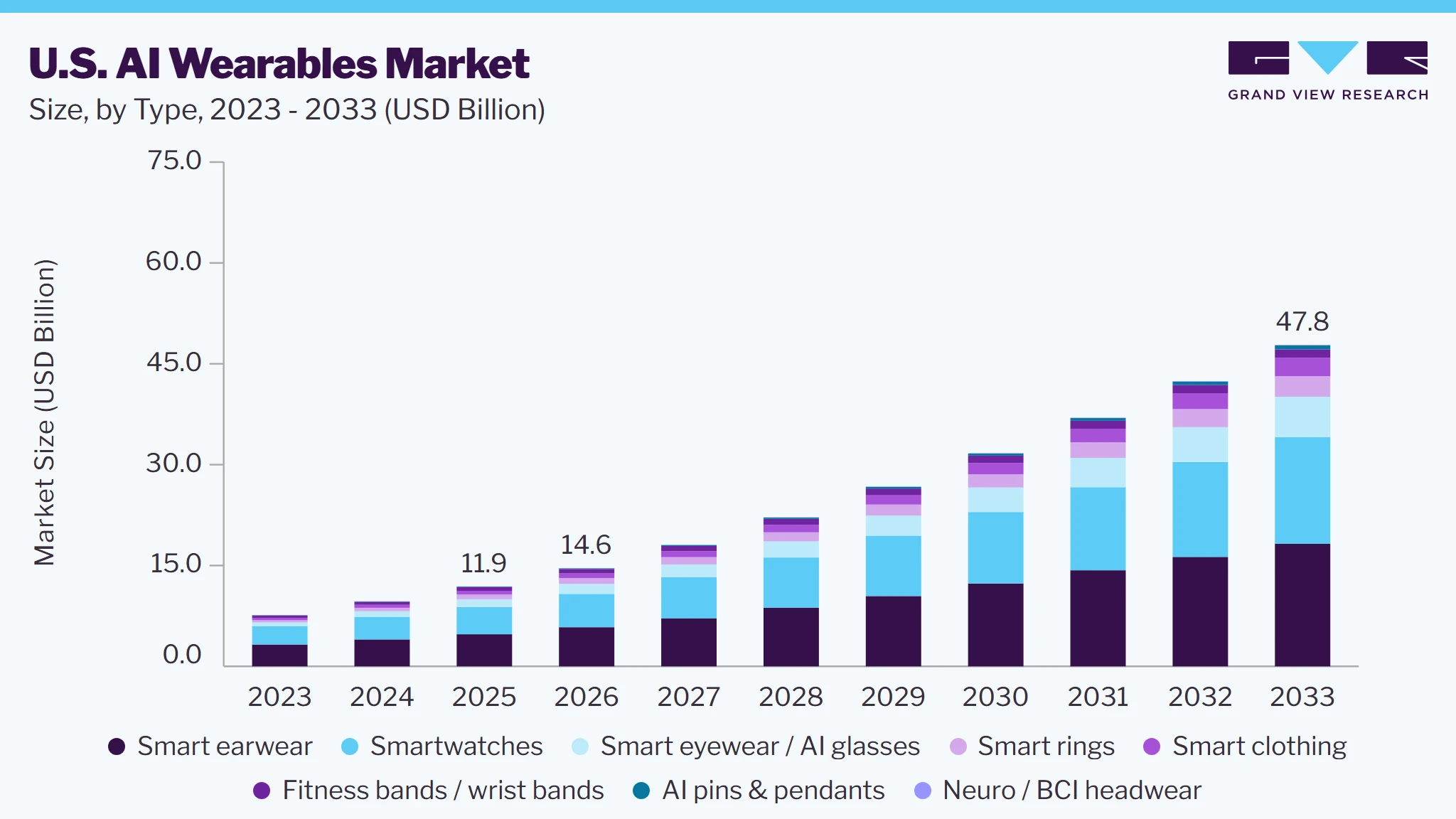 Source: Grand View Research, IR Documents, Primary Interviews, Paid DatabasesTo learn more about this report,
 Download Free Sample Report
The growing integration of generative AI and voice-based assistants into wearable devices, connected with increasing investments by technology companies in next-generation AI wearables, is further driving market expansion.
Market Dynamics
The U.S. AI wearables market is growing rapidly, driven by rising demand for intelligent, connected, and personalized wearable devices. Increasing adoption of AI-enabled smartwatches, smart glasses, and hearables is supporting market expansion. Advancements in generative AI, voice assistants, health monitoring, and real-time data analysis are further improving device capabilities. Growing consumer interest in fitness, wellness, and continuous health tracking is also contributing to demand. In addition, investments by technology companies in AI-powered wearable platforms are expected to accelerate product innovation and adoption during the forecast period.
The rapid commercialization of AI-enabled smart glasses is emerging as a key driver of the U.S. AI wearables market. These devices are expanding beyond traditional wearable functions by integrating AI assistants, cameras, voice interaction, translation, visual search, and hands-free controls. In September 2025, EssilorLuxottica reported that more than 7 million AI glasses, including Ray-Ban Meta and Oakley Meta, had been sold during 2025, reflecting strong consumer demand for AI-enabled eyewear. The company also reported a significant acceleration in its AI-glasses business during the second half of 2025.
The expansion of AI-glasses offerings and retail availability is further supporting market growth in the U.S. In June 2026, Meta expanded its AI glasses portfolio in the U.S. with new products offering multimodal AI capabilities, including visual assistance, translation, and hands-free interaction. In the same month, Best Buy introduced Meta Lab experiences across more than 50 U.S. stores, allowing consumers to test AI-enabled glasses before purchase. These developments are increasing consumer awareness, product accessibility, and real-world use cases, thereby supporting wider adoption of AI wearables in the U.S.
AI-enabled wearables collect and process sensitive data, including health metrics, location, audio, video, and biometric information. Growing concerns regarding unauthorized data access, third-party data sharing, and misuse of personal information may reduce consumer willingness to adopt AI-enabled devices. In July 2024, the U.S. Federal Trade Commission (FTC) amended its Health Breach Notification Rule to clarify its application to health apps and connected devices, increasing privacy and compliance requirements for companies handling consumer health data.
Regulatory scrutiny of AI-enabled wearables has further highlighted these concerns. In May 2026, the Texas Attorney General launched an investigation into Meta AI Glasses over potential privacy issues related to facial data, recordings, and other personal information. The investigation raised concerns regarding the devices' continuous AI-enabled capabilities and collection of visual data. Such regulatory actions may increase compliance costs and encourage stricter controls on data collection and AI functionality, potentially limiting the adoption and use of AI-enabled wearables in the U.S. market.
The integration of AI wearables into clinical documentation and point-of-care workflows presents a significant growth opportunity in the U.S. market. AI-enabled smart glasses can capture audio and visual information during patient interactions, allowing healthcare professionals to generate clinical notes and medication histories hands-free. In February 2026, a study published in NPI Digital Medicine evaluated a vision-enabled AI scribe using Ray-Ban Meta smart glasses and Google Gemini. The system achieved 98% overall accuracy, highlighting the potential of multimodal AI wearables to improve clinical documentation compared with audio-only systems.
The opportunity is further supported by increasing AI adoption among U.S. physicians. In March 2026, the American Medical Association reported that 81% of physicians used AI in their professional activities, up from 38% in 2023. This growing acceptance of AI-based clinical tools is expected to encourage healthcare providers to adopt wearable solutions that reduce documentation time and support point-of-care activities. As a result, manufacturers can target applications such as clinical note generation, medication reconciliation, teleconsultation, patient assessment, and hands-free access to medical information, creating new revenue opportunities beyond consumer-focused AI wearables.
Cybersecurity vulnerabilities represent a growing challenge for the U.S. AI wearables market, as connected devices collect and transmit sensitive personal, biometric, health, location, and behavioral data. AI-enabled wearables increasingly rely on smartphones, cloud platforms, wireless connectivity, and third-party applications, creating multiple points of exposure to cyberattacks. A security breach could lead to unauthorized access to personal information, device manipulation, or misuse of continuously generated user data. These risks can reduce consumer trust and increase compliance and security costs for manufacturers.
Market Concentration & Characteristics
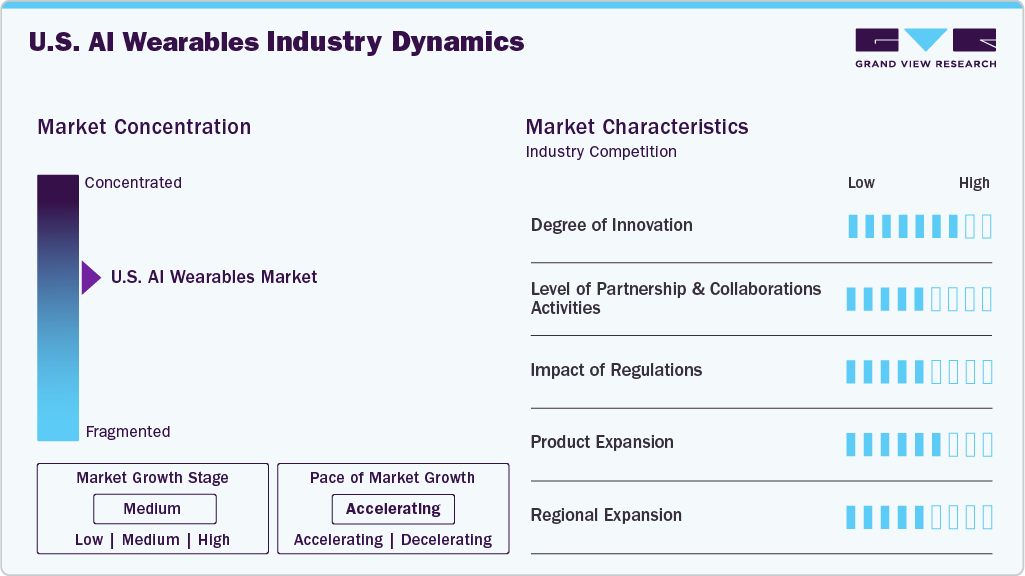
The U.S. AI wearables market is fragmented, with strong competition among technology companies, consumer electronics firms, and specialized wearable providers. The degree of innovation is high, driven by rapid integration of AI assistants, multimodal capabilities, sensors, and connected features. Partnership and collaboration activity is medium, while regulations have a medium-to-high impact due to privacy, data security, and health-related applications. Product expansion is high, as companies continue to broaden AI-enabled wearable offerings, while regional expansion remains medium as providers continue to target new consumer segments and use cases. The market is in a medium growth stage, with the pace of growth accelerating.
Innovation is high, driven by rapid advances in AI-enabled glasses, multimodal interaction, and real-time assistance. In September 2025, Meta launched Ray-Ban Meta Gen 2 with improved battery life, 3K video recording, and enhanced AI capabilities. The glasses can support longer usage and more advanced visual and voice-based interactions. These developments reflect the rapid integration of AI into everyday wearable devices.
 To learn more about this report, Download Free Sample Report
Partnership activity is medium, supported by collaborations between AI, wearable, and fitness technology companies. In September 2025, Meta partnered with Garmin to integrate real-time fitness and biometric data into Oakley Meta Vanguard AI glasses. Collaboration enables users to access metrics such as heart rate, pace, and speed through voice commands.
Regulations have a medium-to-high impact on the U.S. AI wearables market, primarily because AI-enabled wearables collect and process sensitive health, biometric, location, and behavioral data through sensors, cameras, microphones, and connected applications. The U.S. Federal Trade Commission (FTC) has emphasized that companies collecting consumer health information must maintain appropriate privacy and security safeguards, while the Health Breach Notification Rule, updated in 2024, extends its obligations to certain health apps and connected devices not covered by HIPAA.
Product expansion is medium to high, as companies are extending AI wearables into sports, fitness, communication, and everyday activities. In September 2025, Meta introduced Oakley Meta Vanguard with Garmin and Strava integrations and real-time AI assistance. The product enables users to access fitness metrics and performance information through voice commands while exercising. This reflects the expanding use of AI wearables beyond traditional communication and lifestyle applications.
Regional expansion remains medium, with leading companies gradually extending AI wearable availability beyond the U.S. In April 2025, Meta expanded Meta AI on Ray-Ban glasses to additional European markets, while further international launches followed. The expansion also included broader language support and additional AI features, indicating increasing localization of AI wearable technologies for international users.
Analyst Perspective
The U.S. AI wearables market is entering a high-growth phase as AI transforms traditional devices into more intelligent, personalized, and context-aware solutions. Growing adoption of smartwatches, smart earwear, smart eyewear, fitness bands, and AI-enabled health devices is expanding applications beyond fitness into health monitoring, communication, productivity, and personal assistance. Smart eyewear is expected to emerge as a key growth area, driven by advanced voice, vision, and contextual AI capabilities. Healthcare applications also present significant opportunities, although privacy, cybersecurity, regulatory requirements, battery limitations, and high costs remain key challenges. Going forward, competition is expected to shift toward AI performance, ecosystem integration, proprietary data, and seamless user experience.
Type Insights
Smart earwear dominated the U.S. AI wearables market, accounting for the largest revenue share of 40.2% in 2025. Growth is driven by AI-enabled audio, voice assistance, and emerging health-monitoring applications. In September 2024, the U.S. FDA authorized Apple’s Hearing Aid Feature for compatible AirPods Pro, allowing the devices to function as over-the-counter hearing aids for adults with perceived mild-to-moderate hearing impairment.
 To learn more about this report, Download Free Sample Report
AI pins & pendants are anticipated to register the fastest CAGR of 28.8% from 2026 to 2033. Growth is supported by increasing demand for screen-free AI interaction and always-available digital assistants. In December 2025, Meta acquired AI wearable startup Limitless, which developed an AI-powered pendant for recording and processing conversations, highlighting growing industry interest in pendant-based AI wearables.
Application Insights
Health & wellness monitoring dominated the U.S. AI wearables market, accounting for the largest revenue share of 37.6% in 2025. Growth is supported by increasing adoption of wearable devices for continuous health tracking, glucose monitoring, and chronic disease management. the U.S. FDA cleared Dexcom’s G7 15 Day Continuous Glucose Monitoring System, enabling continuous glucose monitoring through a wearable sensor. The development highlights the growing integration of sensor-based technologies into consumer and clinical health monitoring, supporting demand for AI-enabled wearables in health and wellness applications.
Education & learning is anticipated to register the fastest CAGR of 26.0% from 2026 to 2033. Growth is driven by increasing adoption of AI-enabled wearables that provide personalized and interactive learning experiences. In December 2025, Namibox launched NAMI INSIGHT One, an AI-powered smart learning glasses designed to combine wearable technology, AI, and educational content. The launch demonstrates the expansion of AI wearables beyond health and fitness into learning applications and is expected to support adoption among students and education-focused users.
Channel Insights
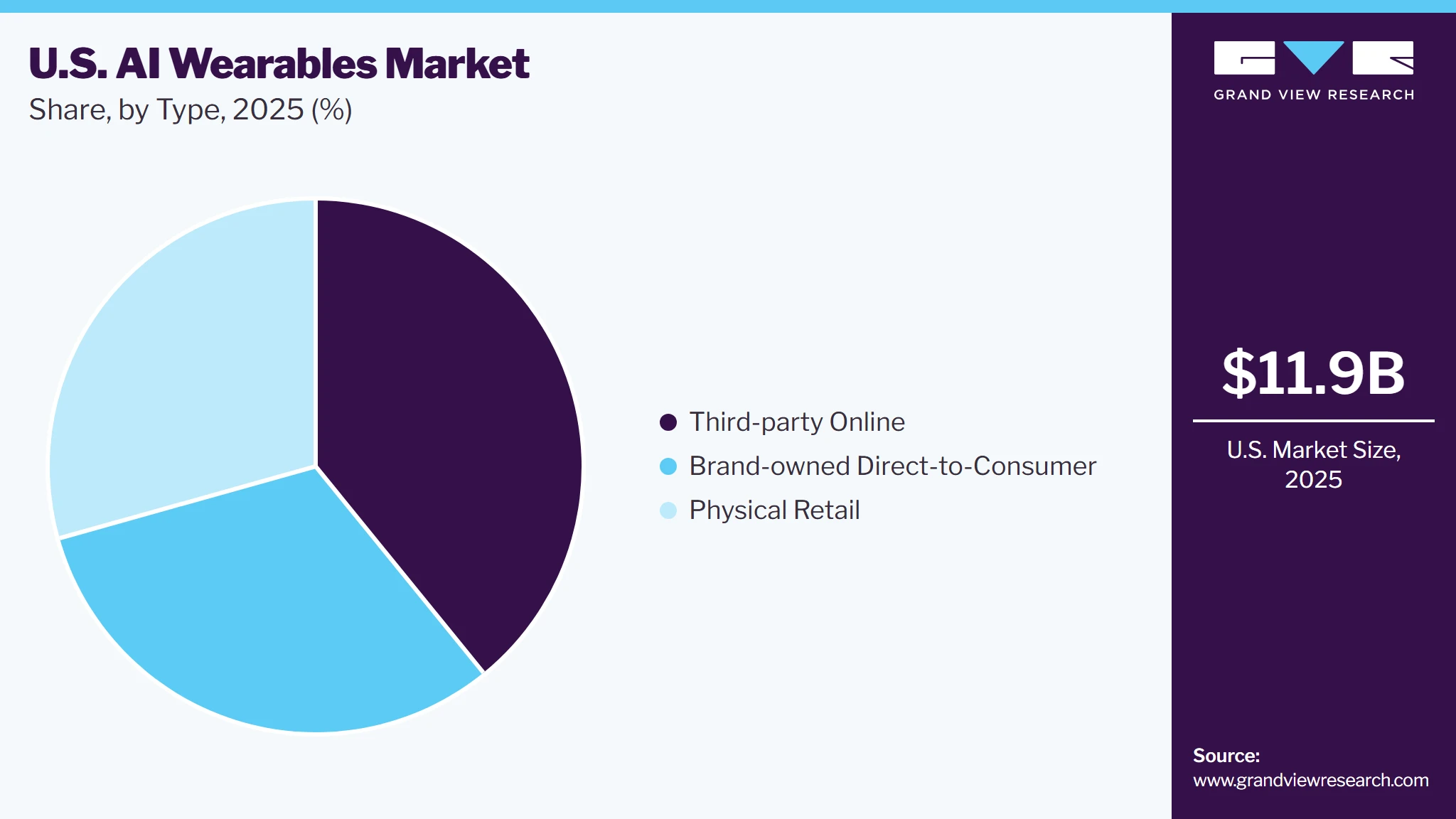
Third-party online channels dominated the U.S. AI wearables market, accounting for the largest revenue share of 39.0% in 2025. The segment is supported by broad product availability, convenient purchasing, price comparison, and growing adoption of online marketplaces. In November 2025, Oura expanded the availability of Oura Ring 4 and Oura Ring 4 Ceramic through Walmart.com in the U.S., strengthening access to smart rings through a major online retail platform. This expansion highlights the increasing role of third-party e-commerce platforms in the distribution of AI-enabled wearables.
Brand-owned direct-to-consumer (D2C) channels are anticipated to register the fastest CAGR of 20.0% from 2026 to 2033. Growth is supported by manufacturers increasingly using their own digital platforms to control product launches, pricing, customer engagement, and subscription services. In June 2026, Snap introduced SPECS augmented reality glasses and opened pre-orders directly through its SPECS.com website. The launch demonstrates how AI wearable companies are using brand-owned online channels to introduce premium products and establish direct relationships with consumers, supporting the expansion of the D2C channel.
Key U.S. AI Wearables Company Insights
Key companies in the U.S. wearables market include major technology and consumer electronics players such as Samsung Electronics, Meta, Apple, Google, Garmin, and Xiaomi, alongside specialized wearable companies such as Oura Health, WHOOP, Ultrahuman, and Vuzix. These companies compete across smartwatches, smart glasses, fitness trackers, smart rings, hearables, and AI-enabled wearable devices. Their competitive strength lies in product innovation, AI integration, health and fitness tracking, ecosystem connectivity, and personalized user experiences. In addition, companies are expanding wearable capabilities through strategic partnerships, acquisitions, and integration of AI-powered features to strengthen their position in the rapidly evolving U.S. market.
Key U.S. AI Wearables Companies
-
Samsung Electronics Co. Ltd.
-
Meta
-
Fitbit, Inc. (Google, Inc.)
-
Garmin Ltd.
-
Google, Inc.
-
Xiaomi
-
Motorola Solutions, Inc.
-
Starkey Laboratories, Inc.
-
Apple, Inc.
-
Sony Corporation
-
Hexoskin
-
Sensoria
-
Oura Health Oy
-
Ultrahuman Healthcare Pvt Ltd.
-
Zepp Inc. (Amazfit India)
-
RealWear Inc.
-
Vuzix Corporation
-
Empatica Inc.
-
Phonak - A Sonova brand
-
Limitless AI (Acquired by Meta)
-
Friend Global, Inc.
-
Ageless Digital Technologies Private Limited (Plaud)
-
Emotiv
-
NeuroSky Inc.
-
InteraXon Inc. (Muse)
-
WHOOP
-
Wearable X
Competitive Benchmarking
Category
Operating Strategies
Competitive Edge
Weakness
Established Players
(e.g., Samsung Electronics Co. Ltd., Meta, Fitbit, Inc. (Google, Inc.), Garmin Ltd., Google, Inc., Xiaomi, Motorola Solutions, Inc., Apple, Inc., Sony Corporation)
- Expand wearable portfolios across smartwatches, smart earwear, smart eyewear, fitness bands, and AI-enabled health devices to address applications spanning health and wellness, fitness, communication, productivity, and personal assistance.
- Strengthen product ecosystems through AI integration, connected platforms, strategic partnerships, and continuous product innovation to improve device functionality and deliver more personalized user experiences.
- Established technology and consumer-electronics capabilities, broad product portfolios, and ecosystem connectivity provide a strong foundation for integrating AI, sensors, and connected features across multiple wearable categories.
- Strong commercialization capabilities and established consumer reach support rapid adoption of new AI-enabled wearable products, while partnerships and acquisitions help expand technological capabilities and market presence.
- Broad product expansion and continuous AI integration require substantial investment in technology development, ecosystem integration, and product innovation, increasing complexity as wearable applications diversify.
- Privacy, cybersecurity, regulatory requirements, battery limitations, and high product costs can increase operating challenges and restrict adoption of advanced wearable solutions.
Emerging / Specialized Players
(e.g., Starkey Laboratories, Inc., Hexoskin, Sensoria, Oura Health Oy, Ultrahuman Healthcare Pvt Ltd., Zepp Inc. (Amazfit India), RealWear Inc., Vuzix Corporation, Empatica Inc., Phonak - A Sonova brand, Limitless AI(Acquired by Meta), Friend Global, Inc., Ageless Digital Technologies Private Limited (Plaud), Emotiv, NeuroSky Inc., InteraXon Inc. (Muse), WHOOP, Wearable X)
- Focus on specialized wearable applications and differentiated form factors, including smart rings, smart glasses, AI pins and pendants, smart clothing, neuro/BCI headwear, health monitoring, fitness performance, accessibility, and AI assistance.
- Develop specialized AI, sensing, and connected capabilities while using targeted partnerships and focused product innovation to address specific consumer, healthcare, fitness, enterprise, and emerging use cases.
- Focused expertise enables these companies to develop differentiated wearable solutions and address specialized applications beyond the mainstream smartwatch and fitness-tracking categories.
- Greater emphasis on specific use cases supports innovation in biometric monitoring, personalized health and fitness insights, AI interaction, accessibility, smart eyewear, and neurotechnology.
- More focused product portfolios and specialized applications can limit market breadth compared with companies offering broad wearable ecosystems across multiple device categories.
- Dependence on emerging use cases, specialized customer segments, and integration with broader connected ecosystems can make large-scale adoption more challenging in a fragmented and rapidly evolving market.
Recent Developments
-
June 2026: Meta expanded its AI glasses portfolio with new Meta Glasses, starting at USD 299. The devices integrate Meta AI for multimodal interactions, translation, and hands-free assistance, supporting wider adoption of AI-enabled eyewear in the U.S. market
-
July 2025: Amazon announced an agreement to acquire Bee, a San Francisco-based AI wearable startup. Bee developed a USD 50 AI-powered wristband that can transcribe conversations and generate summaries and to-do lists. The acquisition strengthens Amazon’s position in AI-enabled wearable devices and expands its focus beyond traditional smart speakers and fitness trackers.
-
May 2026: Samsung and Google unveiled new intelligent eyewear developed with Gentle Monster and Warby Parker. The glasses combine AI capabilities with voice interaction and smartphone connectivity, while Google’s Android XR platform provides the underlying software ecosystem. The development highlights increasing competition in AI-powered eyewear beyond Meta.
-
June 2026: Snap introduced SPECS, a wearable computer built into see-through augmented reality glasses. The device provides AI assistance, work tools, entertainment, and shared experiences, with pre-orders starting at USD 2,195. SPECS are expected to ship in the U.S. in fall 2026, strengthening Snap’s presence in the emerging AI and AR wearable segment
-
May 2025: Google announced that Gemini would be integrated into Android XR glasses, allowing users to interact with an AI assistant through cameras, microphones, and speakers. Google also announced partnerships with Gentle Monster and Warby Parker to develop consumer smart glasses.
U.S. AI Wearables Market Report Scope
Report Attribute
Details
Market Size in 2025
USD 11.9 billion
Estimated Market Size in 2026
USD 14.6 billion
Projected market size by 2033
USD 47.8 billion
Growth rate
CAGR of 18.5% from 2025 to 2033
Actual data
2021 - 2025
Forecast data
2026 - 2033
Quantitative units
Revenue in USD million/billion and CAGR from 2026 to 2033
Report coverage
Revenue forecast, company ranking, competitive landscape, growth factors, and trends
Segments covered
Type, application, channel
Country scope
U.S.
Key companies profiled
Samsung Electronics Co. Ltd.; Meta; Fitbit, Inc. (Google, Inc.); Garmin Ltd.; Google, Inc.; Xiaomi; Motorola Solutions, Inc.; Starkey Laboratories, Inc.; Apple, Inc.; Sony Corporation; Hexoskin; Sensoria; Oura Health Oy; Ultrahuman Healthcare Pvt Ltd.; Zepp Inc. (Amazfit India); RealWear Inc.; Vuzix Corporation; Empatica Inc.; Phonak (A Sonova brand); Limitless AI (acquired by Meta); Friend Global, Inc.; Ageless Digital Technologies Private Limited (Plaud); Emotiv; NeuroSky Inc.; InteraXon Inc. (Muse); WHOOP; Wearable X
Customization scope
Free report customization (equivalent to 8 analysts working days) with purchase. Addition or alteration to country, regional & segment scope.
Pricing and purchase options
Avail customized purchase options to meet your exact research needs. Explore purchase options
U.S. AI Wearables Market Report Segmentation
This report forecasts revenue growth, country level and provides an analysis of the latest industry trends in each of the sub-segments from 2021 to 2033. For this study, Grand View Research has segmented the U.S. AI wearables market report based on type, application, and channel:
-
Type Outlook (Revenue, USD Billion, 2021 - 2033)
-
Smart Earwear
-
Smartwatches
-
Fitness Bands / Wrist Bands
-
Smart Rings
-
Smart Eyewear / AI Glasses
-
AI Pins & Pendants
-
Smart Clothing
-
Neuro / BCI Headwear
-
-
Application Outlook (Revenue, USD Billion, 2021 - 2033)
-
Health & Wellness Monitoring
-
Productivity & AI Assistance
-
Education & Learning
-
Fitness & Performance Coaching
-
Communication & Accessibility
-
Entertainment & Personal AI Interaction
-
Others (Navigation, Personal Safety, Social Interaction, and Experimental Applications.)
-
-
Channel Outlook (Revenue, USD Billion, 2021 - 2033)
-
Third-party Online (marketplaces & 1P e-tail)
-
Brand-owned Direct-to-Consumer (D2C)
-
Physical Retail (mass-market & specialty)
-
Research Methodology
The U.S. AI wearables market figures in this report are based on a proven research process that combines executive interviews with secondary research from proprietary databases, company filings, and recognized regulatory and institutional sources. Market size is built through value-chain sizing-reconciling supply-side and demand-side estimates-and triangulated with bottom-up and top-down approaches. Every estimate passes multiple levels of expert validation before publication, with each U.S. AI wearables segment quantified using the revenue-capture definitions in the table below.
Segment Definition
Segment
Segment Revenue Capture Definition
By Type
Smart Earwear
AI-enabled earbuds and hearing devices with built-in intelligence for voice assistance, adaptive audio, translation, hearing enhancement, health sensing, or contextual awareness, connected to smartphones or cloud-based AI platforms.
Smartwatches
Wrist-worn AI-enabled devices that combine health monitoring, fitness tracking, notifications, and intelligent analytics using on-device or cloud-based AI to deliver personalized insights and recommendations.
Fitness Bands / Wrist Bands
Lightweight AI-enabled wrist-worn fitness trackers focused on activity, sleep, recovery, and wellness monitoring through AI-powered coaching, health analytics, and personalized performance recommendations.
Smart Rings
Finger-worn AI-enabled wearable devices that continuously monitor biometric signals and use AI to generate personalized health, sleep, readiness, and wellness insights with minimal user interaction.
Smart Eyewear / AI Glasses
AI-enabled glasses integrating cameras, microphones, speakers, sensors, or displays to support visual recognition, voice interaction, real-time translation, navigation, and contextual AI assistance.
AI Pins & Pendants
Compact AI wearables devices worn as pins or pendants that provide always-available voice assistance, meeting transcription, memory support, and contextual AI interactions without requiring a smartphone screen.
Smart Clothing
AI-enabled garments and textile-based wearables with embedded sensors that collect physiological or movement data and generate health, fitness, rehabilitation, or performance insights using AI analytics.
Neuro / BCI Headwear
Wearable caps, headbands, or beanies equipped with brain-sensing technologies that use AI to interpret neural activity for cognitive assessment, wellness monitoring, neurofeedback, or brain-computer interaction applications.
By Application
Health & Wellness Monitoring
AI wearables used to monitor vital signs, sleep, stress, recovery, and overall wellness while providing personalized health insights and preventive recommendations through continuous biometric analysis.
Productivity & AI Assistance
AI wearables that improve daily productivity through voice assistants, meeting transcription, reminders, contextual information, scheduling support, and intelligent task management.
Education & Learning
AI-enabled wearable devices that support learning through language translation, real-time tutoring, hands-free information access, immersive educational experiences, and personalized learning assistance.
Fitness & Performance Coaching
AI wearables that analyze physical activity, exercise performance, recovery, and training patterns to deliver personalized coaching, performance optimization, and goal-based fitness recommendations.
Communication & Accessibility
AI wearables that enhance communication through voice interaction, hearing assistance, speech recognition, translation, accessibility features, and hands-free connectivity for diverse user needs.
Entertainment & Personal AI Interaction
AI wearables designed for immersive entertainment, media control, gaming, social engagement, and personalized conversational AI experiences through voice or augmented interfaces.
Others (Navigation, Personal Safety, Social Interaction, and Experimental Applications)
AI wearable applications supporting navigation, emergency assistance, personal safety, social interaction, industrial use cases, and emerging AI-driven experiences beyond mainstream consumer applications.
By Channel
Brand-owned Direct-to-Consumer (D2C)
Purchases completed on brand-owned infrastructure where the brand is merchant of record, including the brand website, brand app and brand-operated physical locations.
Third-party Online (marketplaces and first-party e-tail)
Purchases completed on a third-party website or app, including Amazon, Walmart.com, BestBuy.com, Target.com, Costco.com and other retailer websites or marketplaces.
Physical Retail (mass-market and specialty)
Purchases completed in physical stores, including Walmart, Target, Costco, Best Buy, warehouse clubs, REI and other mass-market or specialty retailers.
Estimation Model
Consensus-Based Estimates & Forecasting
The life sciences quality management software market presents emerging to dominant opportunities, featuring global key players such as Samsung Electronics Co. Ltd.; Meta; Fitbit, Inc. (Google, Inc.); Garmin Ltd.; Google, Inc.; Xiaomi; Motorola Solutions, Inc.; Starkey Laboratories, Inc.; Apple, Inc.; Sony Corporation; Hexoskin; Sensoria; Oura Health Oy; Ultrahuman Healthcare Pvt Ltd.; Zepp Inc. (Amazfit India); RealWear Inc.; Vuzix Corporation; Empatica Inc.; Phonak (A Sonova brand); Limitless AI (acquired by Meta); Friend Global, Inc.; Ageless Digital Technologies Private Limited (Plaud); Emotiv; NeuroSky Inc.; InteraXon Inc. (Muse); WHOOP; Wearable X. To ensure a holistic approach, the GVR research team adopted a comprehensive methodology, considering multiple companies worldwide and using various variables to improve data accuracy.
Our methodology included
Model 1: Commodity Flow Analysis - For public players, annual reports were referenced. For private players, premium-paid data sources, such as S&P Global, Crunchbase, ZoomInfo, and RocketReach, were used to obtain the latest revenue insights.
Model 2: Parent Market Analysis
Model 3: Country-level Multivariate Analysis Assumptions
Model 4: Segment-level Multivariate Analysis Assumptions
Model 5: U.S.AI Wearables Market CAGR Calculations
Commodity flow analysis was employed to track the movement of U.S. AI wearables through the value chain, from technology providers to end users. This analysis provided insights into demand generation points, intermediary roles, and ultimate consumption patterns.
Delivered Customizations
This report has been delivered with the following In-depth customizations
Client Request
Customization Delivered
Value Adds
AI Wearables Pricing & Business Model Analysis
Assessed product pricing, premium versus mass-market positioning, subscription-based services, bundled AI features, and hardware-plus-services business models across leading products.
Supports pricing strategy development, product positioning, revenue-model optimization, and identification of opportunities for recurring revenue generation.
AI Wearables Regulatory & Privacy Impact Assessment
Evaluated the impact of U.S. privacy, biometric-data, health-data, AI governance, cybersecurity, and consumer-protection requirements on AI-enabled wearable products.
Helps companies anticipate compliance requirements, identify regulatory risks, and incorporate privacy and security considerations into product development and market-entry strategies.
AI Wearables Technology & Innovation Assessment
Evaluated advancements in generative AI, multimodal AI, on-device processing, sensors, computer vision, voice interfaces, health monitoring, and connectivity across AI-enabled wearable products.
Helps companies identify emerging technologies, assess innovation gaps, and align future product roadmaps with evolving consumer and technological trends.
Frequently Asked Questions About This Report
Key factors that are driving the market growth include growing adoption of real-time health tracking and personalized wellness solutions, technological advancements in AI and sensor technologies, growing enterprise adoption and augmented reality applications
Based on application, the health & wellness monitoring segment led the market with the largest revenue share 37.6% in 2025.
Some of the key players in the U.S. AI wearables market including, Samsung Electronics Co. Ltd.; Meta; Fitbit, Inc. (Google, Inc.); Garmin Ltd.; Google, Inc.; Huawei Technologies Co. Ltd.; Xiaomi; Motorola Solutions, Inc.; Starkey Laboratories, Inc.; Apple, Inc.; Sony Corporation; Hexoskin Sensoria; Oura Health Oy; Ultrahuman Healthcare Pvt Ltd.; Zepp INC. (Amazfit India); RealWear Inc.; Vuzix Corporation; F. Hoffmann-La Roche Ltd.; SmartCardia Inc.; Empatica Inc.; Phonak – A Sonova brand
The U.S. AI Wearables market is expected to grow at a compound annual growth rate of 18.5% from 2026 to 2033, reaching USD 47.8 billion by 2033
Third-party online channels dominated the market, accounting for a revenue share of 32.0% in 2025
The U.S. AI Wearables market size was estimated at USD 11.9 billion in 2025 and is estimated at USD 14.6 billion for 2026
Based on type, the smart earwear segment led the market with the largest revenue share of 40.2% in 2025.
About the Author(s)
Healthcare IT Research Team
Healthcare · Healthcare ITThis report was authored by the healthcare it research team at Grand View Research - comprising two research analysts, one senior research analyst, and one industry expert - with specialized expertise in the healthcare it segment of the healthcare industry. All findings are based on proprietary healthcare databases, executive interviews, and regulatory analysis, subject to internal peer review prior to publication.
Last Updated:
Speak to Analyst

Customize this report to your needs - add regions, segments, or data points, with 20% free customization.
Or view our licence options:


ISO 9001:2015 & 27001:2022 Certified
We are GDPR and CCPA compliant! Your transaction & personal information is safe and secure. For more details, please read our privacy policy.


