
- Home
- »
- Consumer F&B
- »
-
U.S. Cocoa Butter Alternatives Market Size Report, 2033GVR Report cover

U.S. Cocoa Butter Alternatives Market (2026 - 2033)
Size, Share & Trends Analysis Report By Source (Palm Oil & Palm Kernel Oil, Shea Butter, Kokum Butter), By Application (Bakery & Confectionery, Cosmetics & Personal Care), And Segment Forecasts
Market Size, 2025
$655.2MMarket Estimate, 2026
$707.0MMarket Forecast, 2033
$960.1MCAGR, 2026–2033
4.5%U.S. Cocoa Butter Alternatives Market Summary
The U.S. cocoa butter alternatives market size was valued at USD 655.2 million in 2025 and is projected to grow from USD 707.0 million in 2026 to USD 960.1 million by 2033, at a CAGR of 4.5% from 2026 to 2033. The industry is primarily driven by rising cocoa butter prices and supply volatility caused by climate-related crop losses, diseases, and disruptions in major cocoa-producing regions.
Key Market Trends & Insights
- By source: Palm oil & palm kernel oil segment led the market and accounted for a share of 42.1% in 2025.
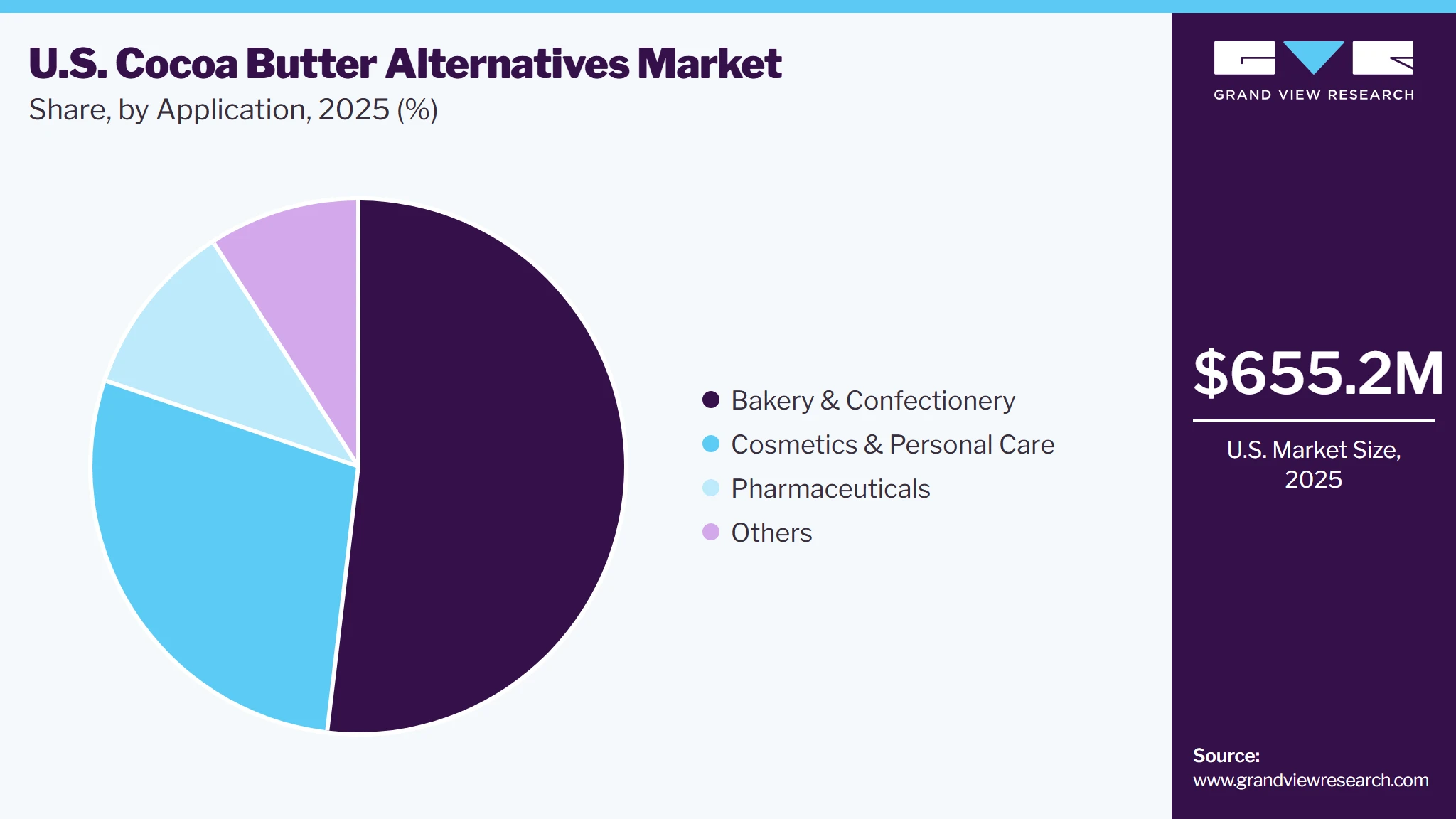
- By application: Bakery & confectionery segment led the market and accounted for a share of 51.9% in 2025.
Market Size & Forecast
- Market size in 2025: USD 655.2 Million
- Estimated market size in 2026: USD 707.0 Million
- Projected market size by 2033: USD 960.1 Million
- CAGR (2026-2033): 4.5%
Three ways to get this report
Buy it, customize it, or ask a question.Ask an Analyst
Analyst response in 1 business day
- AccessReport author, directly
- Reply timeWithin 1 working day
- No sales callDirect answer only
- FormatEmail reply
- CostFree, no cost
Get the Full Report
What the study covers
- FormatsPDF · Excel · Dashboard
- Timeline2026–2033 annual, 2025 base
- Coverage20+ countries, 5 regions
- Companies10+ key players profiled
Customize the Report
20% free customization
- IncludeCountries, segments, points
- TailorTo your product definition
- ExtendDeeper competitor detail
- OrA fully bespoke study
- Turnaround5–10 working days
These factors are encouraging confectionery, bakery, and dessert manufacturers to adopt cost-effective alternatives such as cocoa butter equivalents, shea butter, palm kernel oil, and other vegetable-based fats. Technological advancements in fat processing are enabling manufacturers to develop cocoa butter alternatives with improved texture, melting profiles, stability, and sensory properties. In January 2025, California-based Yali Bio exhibited a cocoa-butter equivalent developed using precision fermentation. The company developed the alternative at its South San Francisco R&D facility, achieving a triglyceride composition comparable to cocoa butter and a similarly sharp melting profile, highlighting the growing application of biotechnology in developing next-generation cocoa butter alternatives.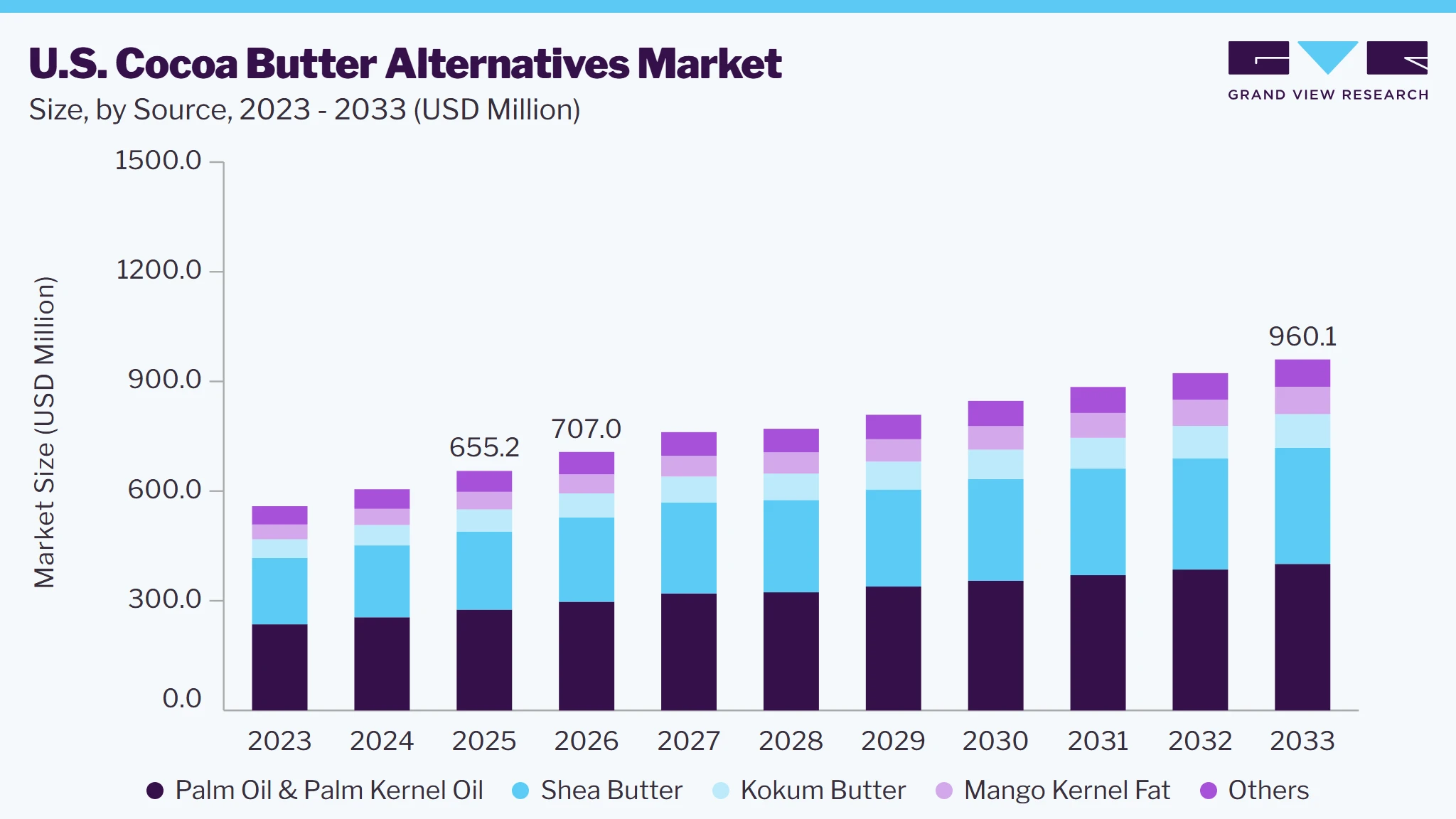 Source: Grand View Research, IR Documents, Primary Interviews, Paid DatabasesTo learn more about this report,
 Download Free Sample Report
 The expanding use of these ingredients in premium chocolates, spreads, fillings, baked goods, and functional food formulations is creating new opportunities for market players. Increasing investments in product innovation and customized fat solutions are also contributing to the adoption of cocoa butter alternatives across the U.S. food industry. In June 2024, Blommer Chocolate launched Elevate, a cocoa-butter alternative using palm kernel and sunflower oils, designed to provide a similar taste and quality at a lower cost.
Moreover, the growing focus of food manufacturers is on improving production efficiency and extending product life. Cocoa butter alternatives offer greater formulation flexibility, enabling manufacturers to achieve consistent texture and performance under varying processing conditions. The wider availability of specialized ingredients through established distribution networks is also making these alternatives increasingly accessible to U.S. manufacturers.
Market Dynamics
Cocoa butter alternatives are being incorporated into a wider range of confectionery and bakery formulations. Their ability to support desired product structure and processing characteristics makes them suitable for diverse applications. Manufacturers can use these ingredients to develop consistent formulations across different product categories. Expanding product innovation within snacks, fillings, coatings, and baked treats is supporting their utilization. In July 2025, ingredient suppliers showcased cocoa butter alternatives such as shea butter and rice-bran butter for fillings, coatings, baked goods, and other formulations, offering desired texture, mouthfeel, and processing benefits.
Certain premium chocolate products require highly specific melting behavior and sensory characteristics that alternatives may not consistently replicate. Differences in crystallization properties can affect attributes such as snap, mouthfeel, gloss, and melting sensation. This can make formulation adjustments necessary when replacing conventional cocoa butter. Premium manufacturers may therefore maintain stricter ingredient specifications for specialized chocolate products. According to data published by Musim Mas in July 2026, the use of non-cocoa vegetable fats is prohibited in standardized chocolate products in the U.S., while specific compositional requirements apply to cocoa solids, milk solids, and milk fat. Such technical limitations can restrict the use of alternatives in selected high-end formulations.
The shift toward simpler ingredient lists are creating opportunities for manufacturers to introduce more recognizable fat ingredients. Plant-based formulations can appeal to consumers seeking products aligned with natural and transparent ingredient preferences. This trend encourages suppliers to develop alternatives with fewer artificial components and clearer sourcing profiles. Innovation in ingredient combinations can also help achieve desirable functionality while maintaining a clean-label positioning. In May 2026, Cargill and Voyage Foods introduced NextCoa to the North American market as a cocoa-free confectionery solution formulated with plant-based ingredients, including grape seeds. The product can be incorporated into various applications such as confectionery coatings, bars, baked products, snacks, and ice cream, expanding the application scope of cocoa alternatives across food segments. Such developments can enable suppliers to differentiate their products and target emerging consumer preferences.
Analyst Perspective
The market is developing as food and ingredient manufacturers seek greater formulation flexibility across diverse product categories. Increasing product diversification within packaged foods is creating demand for specialty fats with application-specific functional characteristics. Technological improvements in fat fractionation and blending are enabling suppliers to offer more tailored ingredient solutions. The growing presence of specialized ingredient distributors is also improving access to alternative fat systems for smaller and mid-sized manufacturers. Overall, continued innovation in ingredient functionality is expected to strengthen competitive opportunities across the U.S. market.
Source Insights
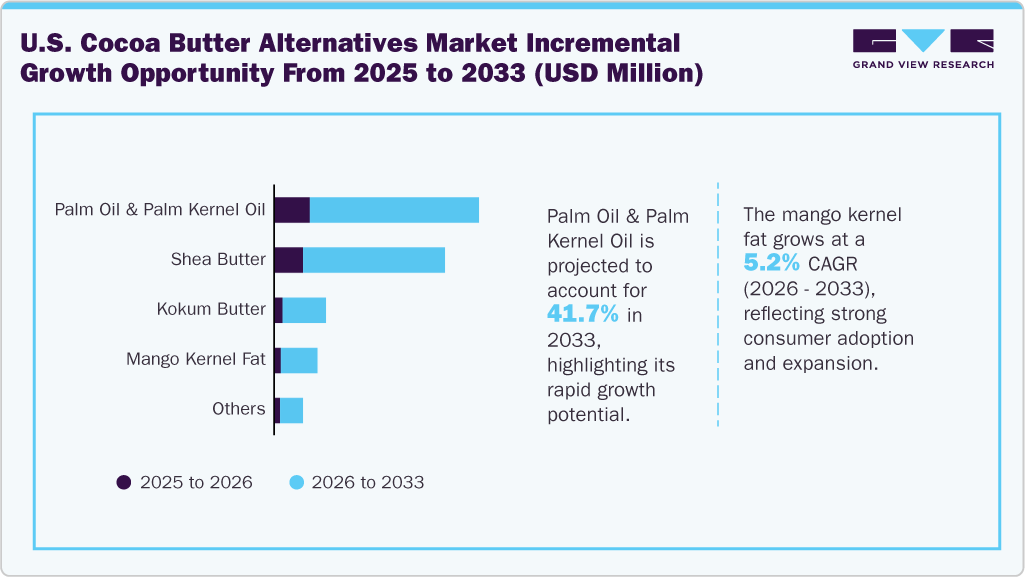
The palm oil & palm kernel oil segment accounted for the largest revenue share of 42.1% in 2025, supported by the broad availability of palm-derived feedstocks for industrial fat applications in the U.S. Their adaptable functional characteristics allow manufacturers to formulate fats with targeted melting and solid-fat properties. Established processing technologies also enable these oils to be modified for use in confectionery formulations. Their versatility makes them suitable for applications requiring specific consistency and stability. Ongoing ingredient innovation is further supporting the use of palm oil and palm kernel oil in cocoa butter alternative formulations.
 To learn more about this report, Download Free Sample Report
 The mango kernel fat segment is projected to grow at the fastest CAGR of 5.2% from 2026 to 2033. Mango kernel fat is gaining attention as an emerging source for developing specialty cocoa butter alternatives. Its utilization can support greater value extraction from mango-processing by-products, aligning with increasing interest in resource-efficient ingredient solutions. The fat contains characteristics that make it suitable for investigation in chocolate and confectionery applications. Growing research into alternative plant-based fat sources is encouraging their incorporation into innovative formulations. Its potential for upcycled and differentiated ingredient offerings creates opportunities for further segment development in the U.S. market.
Application Insights
The bakery & confectionery segment accounted for the largest revenue share of 51.9% in 2025, supported by the need for fats that provide suitable texture, structure, and processing performance in finished products. Cocoa butter alternatives can be incorporated into coatings, fillings, compound chocolates, biscuits, and other sweet applications. Their ability to support formulation flexibility allows manufacturers to develop products with different textures and sensory profiles. The growing variety of packaged bakery and confectionery products is creating additional formulation requirements for specialized fats. Product development across these categories is therefore supporting the use of cocoa butter alternatives in the U.S. market.
 To learn more about this report, Download Free Sample Report
 The cosmetics & personal care segment is projected to grow at a CAGR of 4.7% from 2026 to 2033. The segment benefits from the functional properties of cocoa butter alternatives in topical formulations. Plant-derived fats can contribute emolliency, smooth application, and desirable consistency in products such as creams, lotions, balms, and lip-care formulations. Their compatibility with oil-based formulations makes them useful for developing different personal care textures. Manufacturers are also exploring diverse botanical lipid sources to broaden ingredient options for formulation development. This expanding use of specialty plant-based fats is supporting demand for cocoa butter alternatives within U.S. personal care applications.
Key U.S. Cocoa Butter Alternatives Company Insights
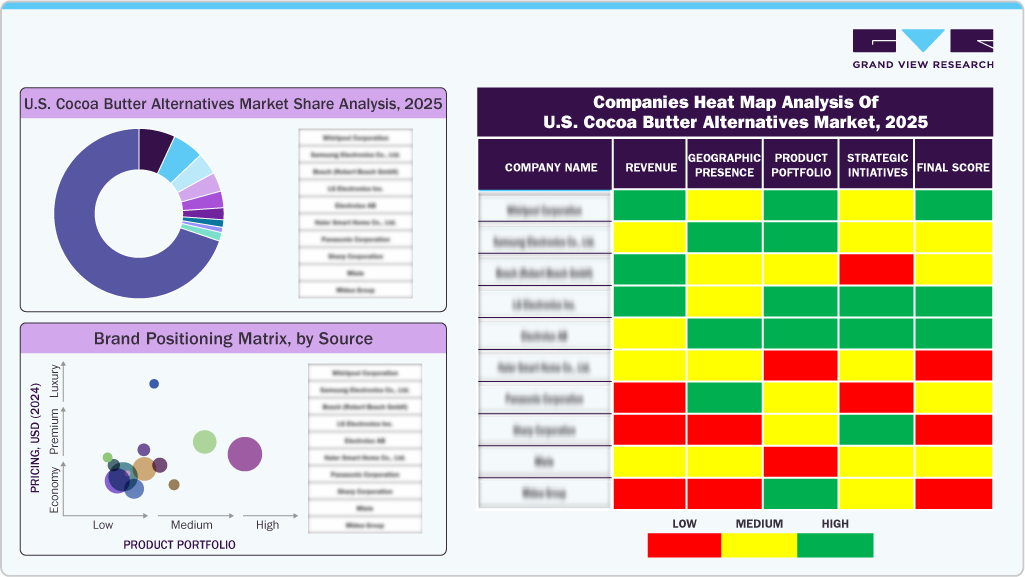
The U.S. cocoa butter alternatives industry is characterized by the presence of both established ingredient manufacturers and specialized fat producers, creating a competitive market landscape. Key companies compete through product innovation, formulation expertise, quality consistency, and expansion across end-use industries. Market share is influenced by companies’ production capabilities, distribution networks, customer relationships, and ability to meet regulatory requirements. Leading participants are also focusing on developing specialized fat solutions to address changing formulation needs. Overall, the market remains competitive, with opportunities for both large manufacturers and niche suppliers to strengthen their positions.
 To learn more about this report, Download Free Sample Report
 Key U.S. Cocoa Butter Alternatives Companies:
-
ADM
-
Cargill, Incorporated
-
AAK USA Inc.
-
Bunge
-
Olam International Limited.
-
C16 Biosciences Ingredients
-
Blommer Chocolate Company
-
Azelis Americas
-
Fuji Oil Holdings
-
The Nisshin OilliO Group, Ltd.
Competitive Benchmarking
Category
Operating Strategies
Competitive Edge
Weakness
Established Players (Cargill Incorporated, ADM, The Nisshin OilliO Group, Ltd.)
- Scale specialty-fat production; expand CBE/CBR/CBS portfolios; invest in formulation support & sustainable sourcing.
- Strong U.S. distribution, technical expertise, broad portfolios, and established food-manufacturer relationships.
- Large cost base; commodity/raw-material exposure; competition on price.
Emerging Players (C16 Biosciences, Azelis Americas)
- Target specialty/niche formulations; emphasize sustainable sourcing; compete in selected applications and customers.
- Agility, customized products, sustainability positioning, and competitive pricing.
- Smaller U.S. footprint, limited scale, weaker customer/distribution networks.
Recent Developments
-
In September 2026, C16 Biosciences launched Palmless, a cocoa butter equivalent produced through aerobic precision fermentation using a naturally oil-producing microorganism. The ingredient offers a more predictable fat profile than conventional cocoa butter, whose composition can vary with cocoa-growing region, season, and harvest conditions.
-
In May 2026, Cargill and Voyage Foods introduced NextCoa to the North American market as a cocoa-free confectionery solution formulated with plant-based ingredients, including grape seeds. The product can be incorporated into various applications such as confectionery coatings, bars, baked products, snacks, and ice cream, expanding the application scope of cocoa alternatives across food segments.
U.S. Cocoa Butter Alternatives Market Report Scope
Report Attribute
Details
Market size in 2025
USD 655.2 million
Estimated market size in 2026
USD 707.0 million
Projected market size by 2033
USD 960.1 million
Growth rate
CAGR of 4.5% from 2026 to 2033
Actuals
2021 - 2025
Forecast period
2026 - 2033
Quantitative units
Revenue in USD million and CAGR from 2026 to 2033
Report coverage
Revenue forecast, company ranking, competitive landscape, growth factors, and trends
Segments covered
Source, application
Country scope
U.S.
Key companies profiled
ADM; Cargill, Incorporated; AAK USA Inc.; Bunge; Olam International Limited; C16 Biosciences; Blommer Chocolate Company; Azelis Americas; Fuji Oil Holdings; The Nisshin OilliO Group, Ltd.
Customization scope
Free report customization (equivalent up to 8 analysts’ working days) with purchase. Addition or alteration to country, regional & segment scope.
Pricing and purchase options
Avail customized purchase options to meet your exact research needs. Explore purchase options
U.S. Cocoa Butter Alternatives Market Report Segmentation
This report forecasts revenue growth at the country level and provides an analysis of the latest industry trends and opportunities in each of the sub-segments from 2021 to 2033. For this study, Grand View Research has segmented the U.S. cocoa butter alternatives market report based on source and application:
-
Source Outlook (Revenue, USD Million, 2021 - 2033)
-
Palm Oil & Palm Kernel Oil
-
Shea Butter
-
Kokum Butter
-
Mango Kernel Fat
-
Others
-
-
Application Outlook (Revenue, USD Million, 2021 - 2033)
-
Bakery & Confectionery
-
Cosmetics & Personal Care
-
Pharmaceuticals
-
Others
-
Research Methodology
The U.S. cocoa butter alternatives market figures in this report are based on a proven research process that combines executive interviews with secondary research from proprietary databases, company filings, and recognized regulatory and institutional sources. Market size is built through value-chain sizing-reconciling supply-side and demand-side estimates-and triangulated with bottom-up and top-down approaches. Every estimate passes multiple levels of expert validation before publication, with each U.S. cocoa butter alternatives segment quantified using the revenue-capture definitions in the table below.
Segment Definition
Segment - Application
Revenue capture definition
Bakery & Confectionery
Revenue is captured through the incorporation of cocoa butter alternatives into products such as compound chocolate, coatings, fillings, biscuits, cakes, and other sweet baked goods. Ingredient suppliers generate sales by providing fats that support product structure, mouthfeel, and processing requirements. Revenue also comes from application-specific formulations developed for industrial food producers and private-label manufacturers.
Cosmetics & Personal Care
Revenue is generated from the use of cocoa butter alternatives in creams, lotions, lip-care products, body butters, and other topical formulations. Suppliers capture value by offering cosmetic-grade ingredients with properties suited to emollient performance, spreadability, and formulation consistency. Sales are supported by direct supply arrangements with personal-care manufacturers, formulators, and specialty cosmetic ingredient distributors.
Pharmaceuticals
Revenue is captured through the supply of specialty fats used as functional excipients and formulation components in selected pharmaceutical products. Manufacturers generate sales by providing ingredients that can support consistency, handling characteristics, and controlled formulation performance. Demand is primarily linked to pharmaceutical and nutraceutical manufacturers requiring fats that meet defined quality and purity specifications.
Others
Revenue is generated through applications outside the major food, personal-care, and pharmaceutical categories, including specialty formulations and industrial uses. Suppliers capture value by developing tailored fat systems that meet specific performance or processing requirements. Sales may occur through specialty ingredient distributors, direct industrial contracts, and customized formulations for niche applications.
Estimation Model
Layer
Key Question
Description
Consumption Universe Layer
Who uses cocoa butter alternatives?
Food manufacturers across confectionery, bakery, coatings, dairy/frozen desserts & snacks.
Access & Availability Layer
Who can source alternatives?
Manufacturers with access to CBE, CBR, CBS and specialty-fat suppliers.
Purchase & Usage Layer
Who regularly purchases these alternatives?
Manufacturers actively using CBAs for cost optimization, formulation & cocoa-butter replacement
Revenue Conversion Layer
How is revenue generated?
Revenue is generated through sales of cocoa butter alternatives to U.S. food manufacturers for use in confectionery, bakery, dairy, snacks, and other processed food products.
Delivered Customizations
This report has been delivered with the following In-depth customizations
Client Request
Customization Delivered
Value Adds
US Cocoa Butter Alternative Market Landscape
Assessed the U.S. market by alternative-fat type, including CBE, CBR, and CBS, and evaluated the competitive positioning of domestic and international suppliers serving US food manufacturers.
Provides a clear view of market structure, supplier positioning, and whitespace opportunities for differentiated cocoa-butter-alternative offerings.
US Cocoa Butter Alternative Demand & End-Use Assessment
Examined demand across chocolate coatings, compound chocolate, bakery fillings, ice cream and frozen desserts, snacks, and other specialty food formulations, highlighting application-specific performance needs.
Helps identify the most attractive U.S. demand pockets and match alternative-fat solutions to formulation, sensory, and cost requirements.
US Cocoa Butter Alternative Supply Chain & Commercial Strategy
Evaluated feedstock availability, import exposure, supplier relationships, processing capabilities, pricing considerations, and sustainability expectations relevant to the US market.
Supports supplier-selection and sourcing decisions while identifying opportunities to improve supply resilience, manage input-cost exposure, and develop competitive market-entry strategies.
Frequently Asked Questions About This Report
The U.S. cocoa butter alternatives market size was valued at USD 655.2 million in 2025 and is estimated at USD 707.0 million for 2026.
The U.S. cocoa butter alternatives market is expected to grow at a CAGR of 4.5% from 2026 to 2033, reaching USD 960.1 million by 2033.
Key factors driving the U.S. cocoa butter alternatives market include rising cocoa butter prices and supply volatility, encouraging manufacturers to adopt cost-effective substitutes.
The palm oil & palm kernel oil segment led with a 42.1% revenue share in 2025, while mango kernel fat is the fastest-growing segment.
Key players include ADM, Cargill, Incorporated, AAK USA Inc., Bunge, Olam International Limited, C16 Biosciences, Blommer Chocolate Company, Azelis Americas, Fuji Oil Holdings, and The Nisshin OilliO Group, Ltd.
The bakery & confectionery segment accounted for the largest revenue share of 51.9% in 2025, while cosmetics & personal care the fastest-growing segment.
About the Author(s)
Consumer F&B Research Team
Consumer Goods · Consumer F&BThis report was authored by the consumer f&b research team at Grand View Research - comprising two research analysts, one senior research analyst, and one industry expert - with specialized expertise in the consumer f&b segment of the consumer goods industry. All findings are based on proprietary consumer goods databases, executive interviews, and regulatory analysis, subject to internal peer review prior to publication.
Last Updated:
Speak to Analyst

Customize this report to your needs - add regions, segments, or data points, with 20% free customization.
Or view our licence options:


ISO 9001:2015 & 27001:2022 Certified
We are GDPR and CCPA compliant! Your transaction & personal information is safe and secure. For more details, please read our privacy policy.


