
- Home
- »
- Medical Devices
- »
-
U.S. Dental 3D Printing Market Size, Industry Report, 2033GVR Report cover

U.S. Dental 3D Printing Market (2026 - 2033) Size, Share & Trends Analysis Report By Application (Orthodontics, Prosthodontics, Implantology), By Technology (Polyjet Technology, Fused Deposition Modelling), By Material (Metals, Photopolymer, Ceramic), By End-use, And Segment Forecasts
U.S. Dental 3D Printing Market Summary
The U.S. dental 3D printing market size was estimated at USD 1.56 billion in 2025 and is projected to reach USD 8.49 billion by 2033, growing at a CAGR of 23.4% from 2026 to 2033. The increasing demand for customized treatments, advancements in materials, and increased cost efficiency and time reduction are the key drivers for the market growth.
Key Market Trends & Insights
- Based on application, the orthodontics segment held the largest revenue share of 39.7% in 2025.
- Based on material, the photopolymer segment held the largest revenue share in 2025.
- Based on technology, the selective laser sintering segment dominated the market with the largest share in 2025.
Market Size & Forecast
- 2025 Market Size: USD 1.56 Billion
- 2033 Projected Market Size: USD 8.49 Billion
- CAGR (2026-2033): 23.4%
Three ways to get this report
Buy it, customize it, or ask a question.Ask an Analyst
Analyst response in 1 business day
- AccessReport author, directly
- Reply timeWithin 1 working day
- No sales callDirect answer only
- FormatEmail reply
- CostFree, no cost
Get the Full Report
What the study covers
- FormatsPDF · Excel · Dashboard
- Timeline2026–2033 annual, 2025 base
- Coverage20+ countries, 5 regions
- Companies10+ key players profiled
Customize the Report
20% free customization
- IncludeCountries, segments, points
- TailorTo your product definition
- ExtendDeeper competitor detail
- OrA fully bespoke study
- Turnaround5–10 working days
According to the American Dental Association (ADA), approximately 17.0% of dentists adopted 3D printing technology in their practices in 2023. It also stated that about 67.0% of dentists were utilizing this technology for a relatively short period. Specifically, less than two years implies the rising adoption of dental 3D printing in the U.S.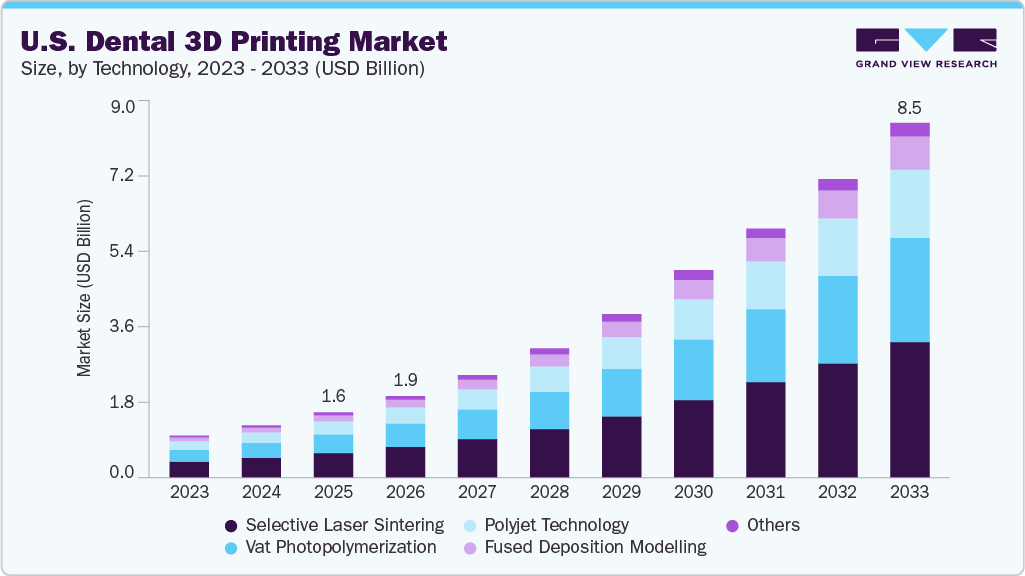 Source: Grand View Research, IR Documents, Primary Interviews, Paid DatabasesTo learn more about this report,
 Download Free Sample Report
 The U.S. held a dominant position in the global dental 3D printing market in 2025. Several factors contributing to the growth include the escalating demand for cosmetic dentistry, technological advancements, and an increasing consciousness among individuals regarding the importance of oral health maintenance. In addition, the rising geriatric population, growing healthcare expenditure, favorable government policies, and enhancements in healthcare infrastructure also create a favorable market outlook.
The market is growing significantly and is expected to grow further in emerging economies. The American College of Prosthodontists stated that about 15.0% of the edentulous population makes dentures each year. Edentulism affects the most vulnerable populations, economically challenged and aging populations. Approximately 120 million individuals are affected by tooth loss, with at least one missing tooth, while over 36 million Americans face the challenge of complete edentulism or the absence of natural teeth. Over the next two decades, it is anticipated that the number of people in the U.S. experiencing tooth loss, including both partial and complete edentulism, is likely to increase. Consequently, a significant proportion of the aging population and younger individuals opt for dental procedures with dental implants as a viable solution for addressing their dental needs.
Market Concentration & Characteristics
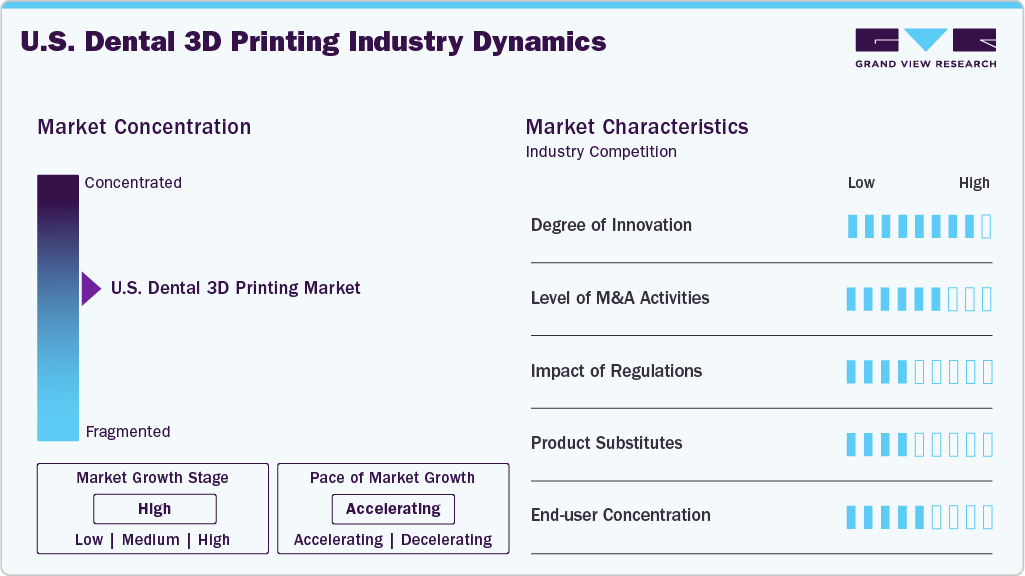
The market growth stage is high, and the pace of growth is accelerating. The U.S. dental 3D printing industry is characterized by high innovation due to the R&D in dental materials and dental 3D printing technology. Research on high-quality materials that can mimic the properties of natural teeth and improve their appearance is the motivating factor for research and development in the market.
The merger and acquisition activity in the market is high, as it creates opportunities to introduce innovative and advanced products to increase the customer base. For instance, in January 2026, Rapid Shape and Circle announced a strategic partnership to simplify and accelerate chairside manufacturing through 3D printing. By integrating Circle One, Circle’s fully cloud-based chairside design solution, with Rapid Shape’s advanced 3D printing technologies, dental professionals can now enjoy a seamless end-to-end workflow from design to printing in just a few clicks.
 To learn more about this report, Download Free Sample Report
 “The partnership between Circle and Rapid Shape delivers a highly efficient solution for single-visit dentistry. Thanks to its collaborative AI, Circle One offers unprecedented ease of use and design speed. The seamless integration of our design solution with Rapid Shape’s manufacturing environment makes it possible to start the Rapid Shape ONE printer with just one click. On the manufacturing side, Rapid Shape’s expertise in 3D printing enables a fully automated, step-by-step process. Today, any assistant can start a print and, just 15 minutes later, have a prosthetic ready for chairside use.”said Sébastien Lenoir, CEO of Circle.
“This partnership with Circle perfectly reflects our vision of making chairside 3D printing more accessible, intuitive, and efficient for dental professionals. By seamlessly connecting Circle One’s cloud-based, AI-driven design capabilities with Rapid Shape’s proven printing ecosystem, we are removing barriers between design and manufacturing. The result is a streamlined, reliable workflow that empowers dental teams to deliver high-quality restorations faster and with greater confidence.” said Andreas Schultheiss, CEO of Rapid Shape.
Dental 3D printing has limited substitutes, such as dental milling. 3D printing has become a preferred solution in dentistry in recent years. However, dental milling technology also holds significance regarding the choice of material and durability.
The end-user concentration is a significant factor in the market. The increasing preference for aesthetic surgeries drives the demand for 3D printing among end-users, such as dental laboratories and clinics.
Application Insights
The orthodontics segment held the largest revenue share of 39.7% in 2025 and is expected to grow at a significant rate of 25.9% during the forecast period. The growth is attributed to the rising number of cases of misalignment and gaps in the teeth. In addition, the American Association of Orthodontists (AAO) has advised that children should have their initial orthodontic evaluation before age 8, increasing its demand. The rising demand and need for orthodontics treatment are driving the industry's overall growth.
The prosthodontics segment is estimated to witness the fastest growth from 2026 to 2033 due to increasing edentulism and tooth decay cases. For instance, as per the information published by the National Institute of Dental and Craniofacial Research, tooth decay continued to be one of the most widespread chronic conditions affecting adults and children in the U.S.
Technology Insights
The selective laser sintering segment dominated the market with the largest share in 2025 due to its benefits, such as superior chemical resistance, biocompatibility, and outstanding surface finishing. Selective laser sintering, a revolutionary additive manufacturing technology, allows the creation of complex 3D objects from various materials, such as nylon, polyamide, and even metal powders. Such factors are contributing to segment growth.
The other technological segment is expected to register a significant CAGR from 2026 to 2033. This is driven by the increasing research and development investments to advance the dental industry, such as electron beam melting, material jetting, and binder jetting methods. The application frequency of Fused Deposition Modeling (FDM) is increasing owing to the extensive availability of robust, biocompatible, and sterilizable thermoplastics. The FDM's affordability and versatility in creating intricate shapes and designs make it the most popular method.
Material Insights
The photopolymer segment held the largest revenue share in 2025. The photopolymer resin is specifically designed for dental applications. These resins are dental 3D printing materials or biocompatible resins and are formulated to closely mimic natural teeth's mechanical, optical, and thermal properties. Such features of these resins are leading to the surge in demand for photopolymer resin and are expected to boost market growth. The natural appearance of the teeth due to photopolymer resin is expected to increase the demand in the population and potentially drive segment growth.
The ceramic segment is estimated to grow fastest from 2026 to 2033. This is attributed to some of the benefits of ceramic materials, such as high efficiency, aesthetics, and the ability to create complex shapes. The new product approvals and launches in the U.S. market are further expected to drive the segment demand.
End-use Insights
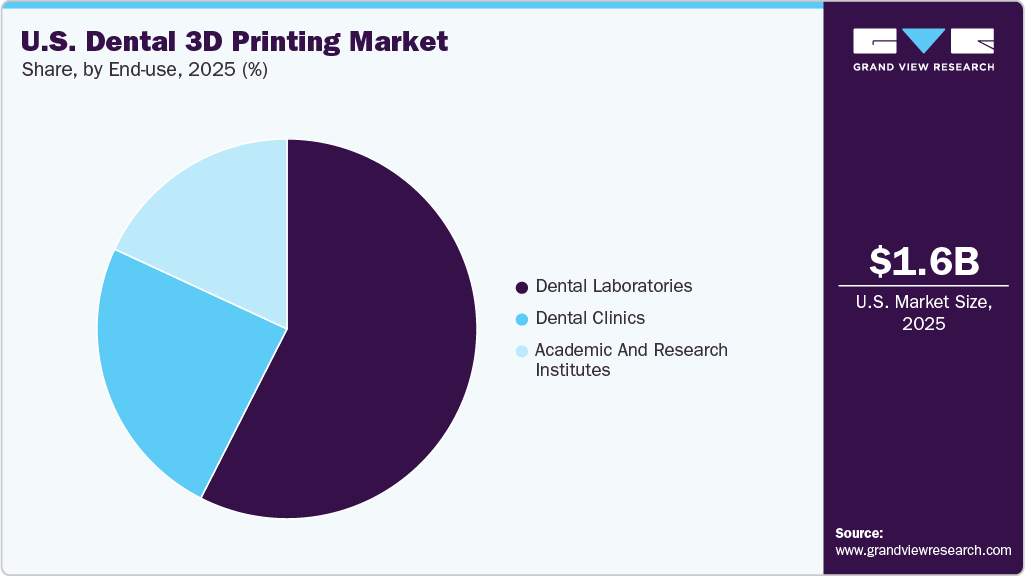
The dental laboratories segment dominated the market with the largest revenue share in 2025 and is expected to grow at the fastest CAGR from 2026 to 2033. The rising adoption of advanced technologies in the U.S. dental laboratories is supplementing the segment growth. Moreover, the rise in the number of dental laboratories, increasing outsourcing of different manufacturing functions to dental laboratories in the country, and increased demand and preference for customized dental framing solutions for several applications fuel the demand for dental 3D printing technologies.
 To learn more about this report, Download Free Sample Report
 The dental clinics segment is estimated to grow significantly from 2026 to 2033. This is attributed to some benefits, such as customized treatment, reduced time, cost efficiency, and the development of biocompatible and high-performance 3D printing materials. The application of 3D printing in dental clinics in the U.S. has been increasing due to its numerous advantages and the high preferences of dentists among the population. Further, the 3D printing technology in U.S. dental clinics enables dentists to create models, surgical guides, and other visual aids that help patients better understand their treatment plans, improving communication and patient confidence.
Key U.S. Dental 3D Printing Company Insights
Some key players operating in the market include 3D Systems, Stratasys Ltd, and Dentsply Sirona.
-
3D Systems provides 3D printing solutions, offering dental 3D printers, materials, and software, such as the DMP 8500 and D2P 2500.
-
Stratasys Ltd. offers dental 3D printers, including the Objet30 OrthoDesk 3D Printer and the J750 Dental 3D Printer, along with materials suitable for dental applications.
Formlabs, DWS GmbH, and Markforged are some of the other market participants.
-
Formlabs provides the Form 3B and Form 3L 3D printers, which are famous for dental laboratories and clinics due to their precision and affordability.
-
DWS GmbH manufactures the Ceramill Map 400 3D Printer, a ceramic 3D printer designed for dental applications.
Key U.S. Dental 3D Printing Companies:
- 3D Systems
- Stratasys Ltd.
- Straumann
- Dentsply Sirona
- Renishaw plc
- Asiga
- Formlabs
- DWS GmbH
- Markforged
Recent Developments
-
In January 2026, Rapid Shape and Circle announced a strategic partnership to simplify and accelerate chairside manufacturing through 3D printing. By integrating Circle One, Circle’s 100% cloud-based chairside design solution, with Rapid Shape’s advanced 3D printing technologies, dental professionals can benefit from a seamless, end-to-end workflow from design to printing in just a few clicks.
-
In July, 2025, 3D Systems commercially launched its NextDent Jetted Denture Solution in the U.S., enabling direct multi-material denture production and accelerating scalable, high-efficiency digital denture manufacturing for dental labs.
-
In July 2024, Stratasys launched the DentaJet XL, enabling high-volume dental labs to increase throughput and reduce production costs for crowns, bridges, aligners, and surgical guides through high-speed, multi-material 3D printing.
-
In January 2024, Formlabs Dental introduced Premium Teeth Resin, a biocompatible material for 3D printing temporary crowns, bridges, inlays, onlays, veneers and full-arch restorations on Formlabs dental printers. This resin later received FDA 510(k) clearance, enabling dental applications in the U.S.
-
In March 2023, 3D Systems introduced significant advancements to fortify its digital dentistry portfolio, including the launch of two new materials, NextDent Base and NextDent Cast, and a printing platform, the NextDent LCD1.
-
In December 2022, Stratasys and 3Shape jointly introduced an innovative automated digital color workflow designed specifically for dental 3D printing to streamline the color customization process in dental applications, enhancing efficiency and accuracy.
U.S. Dental 3D Printing Market Report Scope
Report Attribute
Details
Market Size in 2026
USD 1.95 billion
Revenue forecast in 2033
USD 8.49 billion
Growth rate
CAGR of 23.4% from 2026 to 2033
Base year for estimation
2025
Historical data
2021 - 2024
Forecast period
2026 - 2033
Quantitative units
Revenue in USD million/billion, and CAGR from 2026 to 2033
Report coverage
Revenue forecast, company ranking, competitive landscape, growth factors, and trends
Segments covered
Application, technology, material, end-use
Country scope
U.S.
Key companies profiled
3D Systems; Stratasys Ltd.; Straumann; Dentsply Sirona; Renishaw plc; Asiga; Formlabs; DWS GmbH; Markforged
Customization scope
Free report customization (equivalent up to 8 analyst’s working days) with purchase. Addition or alteration to country, regional, and segment scope
Pricing and purchase options
Avail customized purchase options to meet your exact research needs. Explore purchase options
U.S. Dental 3D Printing Market Report Segmentation
This report forecasts revenue growth at the country level and analyzes the latest vertical trends in each sub-segment from 2021 to 2033. For this study, Grand View Research has segmented the U.S. dental 3D printing market report based on the application, technology, material, and end-use:
-
Application Outlook (Revenue, USD Million, 2021 - 2033)
-
Orthodontics
-
Prosthodontics
-
Implantology
-
-
Technology Outlook (Revenue, USD Million, 2021 - 2033)
-
Vat Photopolymerization
-
Stereolithography
-
Digital Light Processing
-
-
Polyjet Technology
-
Fused Deposition Modelling
-
Selective Laser Sintering
-
Others
-
-
Material Outlook (Revenue, USD Million, 2021 - 2033)
-
Metals
-
Photopolymer
-
Ceramic
-
Others
-
-
End-use Outlook (Revenue, USD Million, 2021 - 2033)
-
Dental Clinics
-
Dental Laboratories
-
Academic and Research Institutes
-
Frequently Asked Questions About This Report
Some of the key players operating in the market include 3D Systems, Stratasys Ltd, EnvisionTEC, and DentsPly Sirona.
The key drivers of the U.S. dental 3D printing market are the increasing demand for customized treatments, advancements in materials, and increased cost efficiency and time reduction.
The U.S. dental 3D printing market size was estimated at USD 1.56 billion in 2025 and is expected to reach USD 1.95 billion in 2026.
The U.S. dental 3D printing market is projected to grow at a compound annual growth rate (CAGR) of 23.4% from 2026 to 2033 to reach USD 8.49 billion by 2033.
The selective laser sintering segment dominated the market, with the largest share in 2025, due to its benefits over other technologies, such as superior chemical resistance, biocompatibility, and outstanding surface finishing.
About the Author(s)
Medical Devices Research Team
Healthcare · Medical DevicesThis report was authored by the medical devices research team at Grand View Research - comprising two research analysts, one senior research analyst, and one industry expert - with specialized expertise in the medical devices segment of the healthcare industry. All findings are based on proprietary healthcare databases, executive interviews, and regulatory analysis, subject to internal peer review prior to publication.
Last Updated:
Speak to Analyst

Customize this report to your needs - add regions, segments, or data points, with 20% free customization.
Or view our licence options:


ISO 9001:2015 & 27001:2022 Certified
We are GDPR and CCPA compliant! Your transaction & personal information is safe and secure. For more details, please read our privacy policy.


