U.S. RF Filters Market Summary
The U.S. RF filters market size was estimated at USD 3.7 billion in 2024 and is projected to reach USD 14.4 billion by 2033, growing at a CAGR of 16.3% from 2025 to 2033. The demand for Radio Frequency (RF) filters in the U.S. is witnessing a notable surge, primarily due to the increasing penetration of 5G technology, rising mobile data consumption, and the rapid adoption of wireless communication systems across consumer electronics and defense sectors.
Key Market Trends & Insights
- By filter type, the surface acoustic wave (SAW) filters dominated the U.S. RF filters market with the highest revenue share of 58.2% in 2024.
- By end-user, the telecommunication segment dominated the U.S. RF filters industry with the highest revenue share of 40.3% in 2024.
Market Size & Forecast
- 2024 Market Size: USD 3.7 Billion
- 2033 Projected Market Size: USD 14.4 Billion
- CAGR (2025-2033): 16.3%
As telecommunication providers upgrade their infrastructure, the need for high-performance RF filters to manage signal integrity and reduce interference is critical. Additionally, the rise in IoT-connected devices and smart home applications is creating a high-density signal environment, further increasing demand for efficient filtering solutions to ensure optimal signal performance.
The U.S. government has been playing an active role in supporting domestic chip production and related component manufacturing, which includes RF filters. Initiatives such as the $52 billion CHIPS and Science Act are aimed at enhancing the nation's self-sufficiency in advanced electronic component manufacturing. Moreover, the Federal Communications Commission (FCC) continues to reallocate and auction spectrum bands to accommodate the expansion of 5G services, creating additional demand for filters that can operate efficiently across diverse frequency bands.
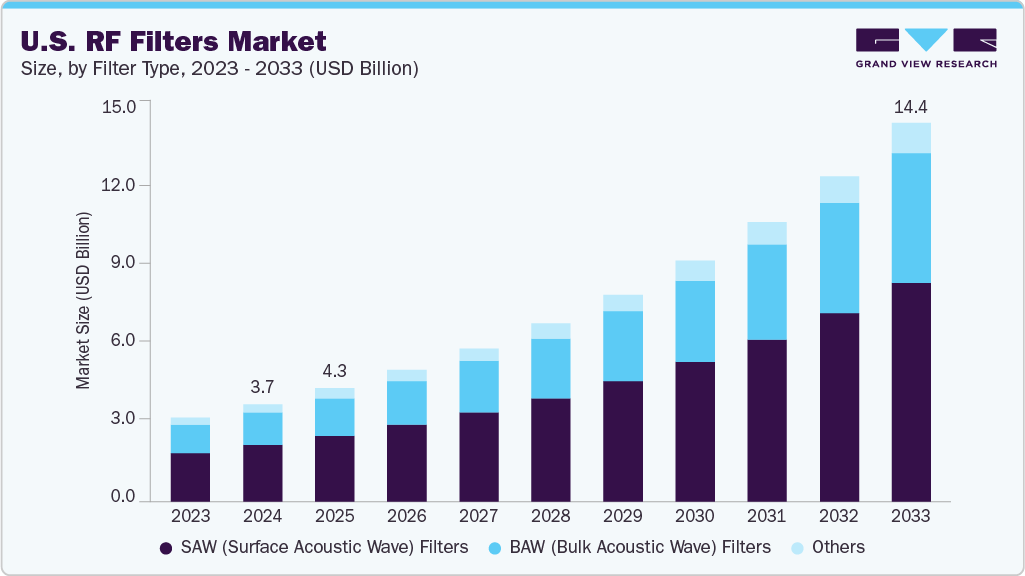
Innovations in SAW (Surface Acoustic Wave) and BAW (Bulk Acoustic Wave) filter technologies are shaping the future of the RF filter market. BAW filters, in particular, are gaining traction due to their superior performance in higher frequency bands used in 5G applications. Companies are investing in hybrid filters that combine SAW and BAW technologies to offer better bandwidth and reduced size. Trends also indicate a shift toward tunable filters and MEMS-based designs to address the evolving needs of next-gen wireless networks. Additionally, strategic partnerships and in-house chip development by OEMs are becoming common to ensure supply chain resilience and IP control.
Market Concentration & Characteristics
The U.S. RF filters market is moderately consolidated, with a few key players such as Broadcom Inc., Qorvo, Inc., Skyworks Solutions, and Murata Manufacturing dominating the landscape. These companies maintain a strong competitive edge through proprietary technology, vertical integration, and long-standing relationships with OEMs and network providers. However, new entrants and niche firms focusing on specific frequencies or custom filter solutions are gradually gaining ground due to the rising complexity of 5G systems and IoT applications.
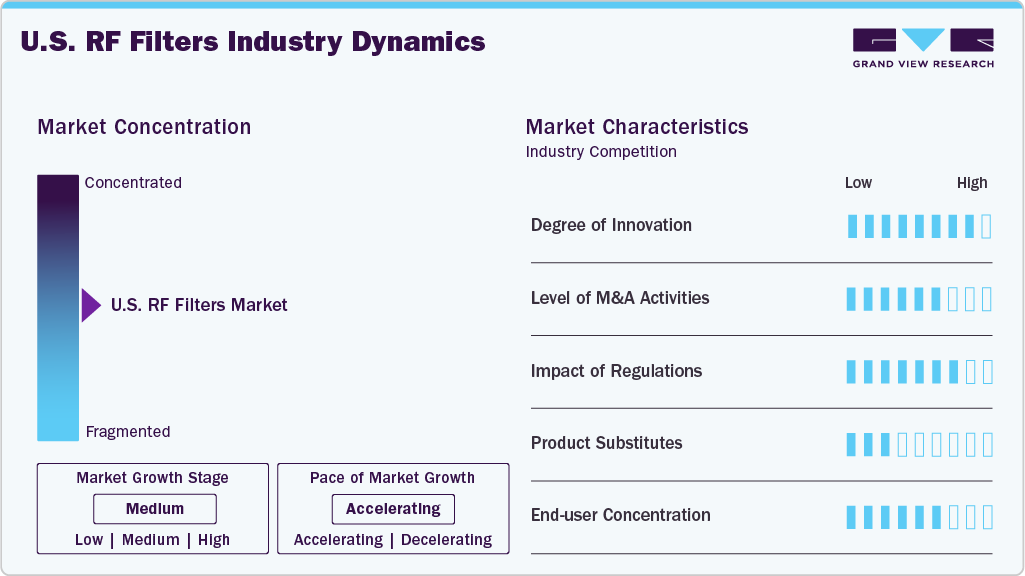
The threat of substitutes in the U.S. RF filters industry remains low, as RF filters are essential for the proper functioning of wireless communication systems. While alternatives like advanced signal processing algorithms can complement certain aspects of interference management, they cannot fully replace the physical signal isolation capabilities offered by RF filters. Additionally, the growing complexity of RF environments, especially with the rise of millimeter-wave technologies, reinforces the need for robust filter components.
Filter Type Insights
Surface Acoustic Wave (SAW) filters dominated the U.S. RF filters market with the highest revenue share of 58.2% in 2024, due to their cost-effectiveness, compact size, and suitability for low to mid-frequency applications. They are widely used in mobile handsets, GPS receivers, and Bluetooth devices where performance requirements are moderate and cost sensitivity is high. The mature manufacturing processes and widespread design expertise around SAW technology have enabled high-volume production with consistent quality. Their dominance is further reinforced by long-standing relationships with consumer electronics OEMs, ensuring consistent demand across multiple wireless communication platforms.
Bulk Acoustic Wave (BAW) filters are expected to grow at a significant CAGR of 16.7% over the forecast period, driven by the increased deployment of 5G networks and the need for filters that operate efficiently at higher frequencies. BAW filters offer superior performance in terms of power handling, temperature stability, and out-of-band rejection, making them ideal for applications above 3 GHz, such as mid-band and mmWave 5G. Their adoption is expanding beyond telecom into areas like defense, automotive radar systems, and IoT devices requiring high-performance filtering. As device complexity and bandwidth requirements rise, BAW filters are increasingly seen as the go-to solution for next-gen wireless communication infrastructure in the U.S.
End-user Insights
The telecommunication segment dominated the U.S. RF filters industry with the highest revenue share of 40.3% in 2024, primarily due to the widespread deployment of advanced mobile networks and the growing demand for uninterrupted, high-speed wireless communication. As network providers expand 5G infrastructure and enhance existing 4G capabilities, RF filters play a crucial role in managing signal integrity and reducing interference across multiple frequency bands. The increasing adoption of smartphones, IoT devices, and data-heavy applications further fuels the need for efficient filtering technologies. With telecom operators prioritizing bandwidth optimization and connectivity quality, the segment remains the primary driver of RF filter adoption in the country.
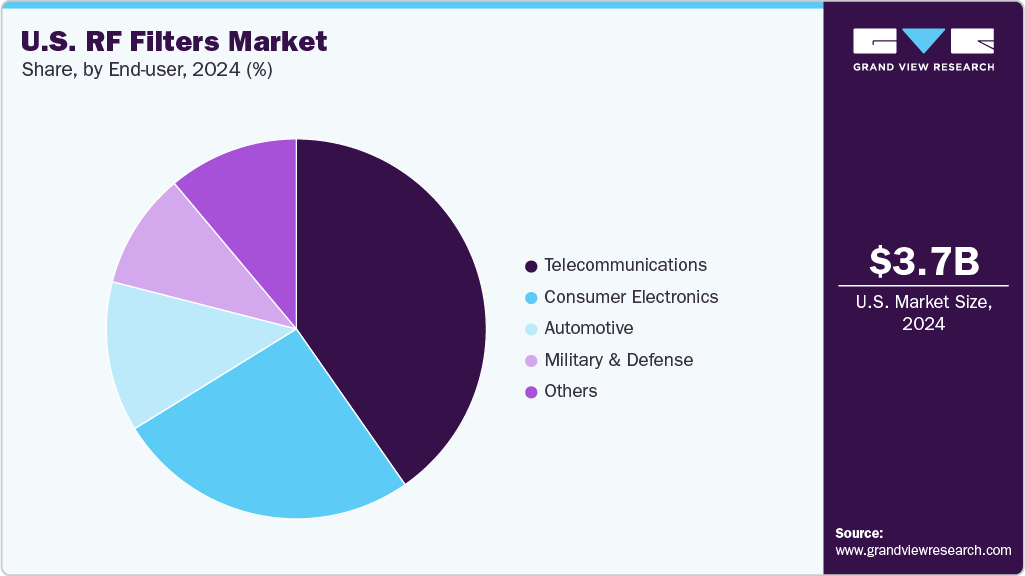
The automotive segment is expected to grow at the fastest CAGR of 16.8% over the forecast period, fueled by the rapid integration of connected vehicle technologies such as ADAS, V2X communication, and electrification. As modern vehicles increasingly rely on high-frequency wireless communication for navigation, infotainment, and safety systems, RF filters are essential to mitigate interference and maintain reliable signal performance. Industry reports highlight that automotive-related RF filter demand is accelerating at a notably higher compound annual growth rate than other sectors, outpacing more mature uses such as telecommunications.
Key U.S. RF Filters Company Insights
Some of the key players operating in the U.S. market include Qorvo, Inc. and Skyworks Solutions, Inc.
-
Qorvo is a leading U.S.-based provider of RF solutions, including SAW and BAW filters, primarily serving the mobile, infrastructure, aerospace, and defense markets. The company is known for its expertise in RF front-end modules used in smartphones and 5G base stations.
-
Skyworks designs and manufactures high-performance analog and mixed-signal semiconductors, with a strong portfolio of SAW filters for mobile communications. It supplies RF components to major smartphone OEMs and is expanding into automotive, IoT, and 5G markets.
TDK Corporation and MACOM Technology Solutions are some of the emerging participants in the U.S. RF filters market.
-
Though headquartered in Japan, TDK operates significant U.S. facilities through its subsidiaries (like EPCOS), offering a wide range of SAW and BAW filters. It serves telecommunications, industrial, and automotive applications with advanced miniaturized RF components.
-
MACOM is a U.S.-based supplier of RF, microwave, and millimeter-wave components, including custom filters for aerospace, defence, telecom, and industrial systems. The company is known for its high-reliability products used in mission-critical applications.
Key U.S. RF Filters Companies:
- Qorvo, Inc.
- Skyworks Solutions, Inc.
- Broadcom Inc.
- Murata Manufacturing Co., Ltd.
- TDK Corporation
- Akoustis Technologies Inc.
- MACOM Technology Solutions
- K&L Microwave
- Mercury Systems
- Herley Industries
Recent Developments
-
In June 2023, Broadcom introduced FiFEM, the world’s first Wi-Fi RF fem with filter integration optimized for Wi-Fi 7 access points.
-
In Early 2024, Skyworks acquired the remaining interest in its filter joint venture with Panasonic.
-
In June 2025, Qorvo launched compact high‑rejection BAW filters (QPQ3550) for 5G infrastructure.
U.S. RF Filters Market Report Scope
|
Report Attribute
|
Details
|
|
Market size value in 2025
|
USD 4.3 billion
|
|
Revenue forecast in 2033
|
USD 14.4 billion
|
|
Growth rate
|
CAGR of 16.3% from 2025 to 2033
|
|
Base year for estimation
|
2024
|
|
Historical data
|
2021 - 2023
|
|
Forecast period
|
2025 - 2033
|
|
Quantitative units
|
Revenue in USD billion and CAGR from 2025 to 2033
|
|
Report coverage
|
Revenue forecast, company ranking, competitive landscape, growth factors, and trends
|
|
Segments covered
|
Filter type, end-user
|
|
Country scope
|
U.S.
|
|
Key companies profiled
|
Qorvo, Inc.; Skyworks Solutions, Inc.; Broadcom Inc.; Murata Manufacturing Co., Ltd.; TDK Corporation; Akoustis Technologies, Inc.; MACOM Technology Solutions; K&L Microwave; Mercury Systems; Herley Industries
|
|
Customization scope
|
Free report customization (equivalent up to 8 analysts’ working days) with purchase. Addition or alteration to country, regional & segment scope.
|
|
Pricing and purchase options
|
Avail customized purchase options to meet your exact research needs. Explore purchase options
|
U.S. RF Filters Market Report Segmentation
This report forecasts revenue growth at the country level and provides an analysis of the latest industry trends in each of the sub-segments from 2021 to 2033. For this study, Grand View Research has segmented the U.S. RF filters market report based on filter type and end-user:
-
Filter Type Outlook (Revenue, USD Billion, 2021 - 2033)
-
End-user Outlook (Revenue, USD Billion, 2021 - 2033)
-
Telecommunications
-
Automotive
-
Military & Defense
-
Consumer Electronics
-
Others
Frequently Asked Questions About This Report
b. The U.S. RF filters market size was estimated at USD 3.7 billion in 2024 and is expected to reach USD 4.3 billion in 2025.
b. The U.S. RF filters market is expected to grow at a CAGR of 16.3% from 2025 to 2033, reaching USD 14.4 billion by 2033.
b. Surface Acoustic Wave (SAW) filters dominated the U.S. RF filters market and held the highest revenue market share of 58.2% in 2024, due to their cost-effectiveness, compact size, and suitability for low to mid-frequency applications.
b. Some of the prominent companies in the RF filters market include Qorvo, Inc., Skyworks Solutions, Inc., Broadcom Inc., Murata Manufacturing Co., Ltd., TDK Corporation, Akoustis Technologies, Inc., MACOM Technology Solutions, K&L Microwave, Mercury Systems, and Herley Industries.
b. Key factors driving the U.S. RF filters market include rapid 5G expansion, rising smartphone and IoT adoption, and increased use of connected automotive and smart vehicle technologies.

 Download Sample Report
















