U.S. Smart Plastics in Precision Agriculture Market Summary
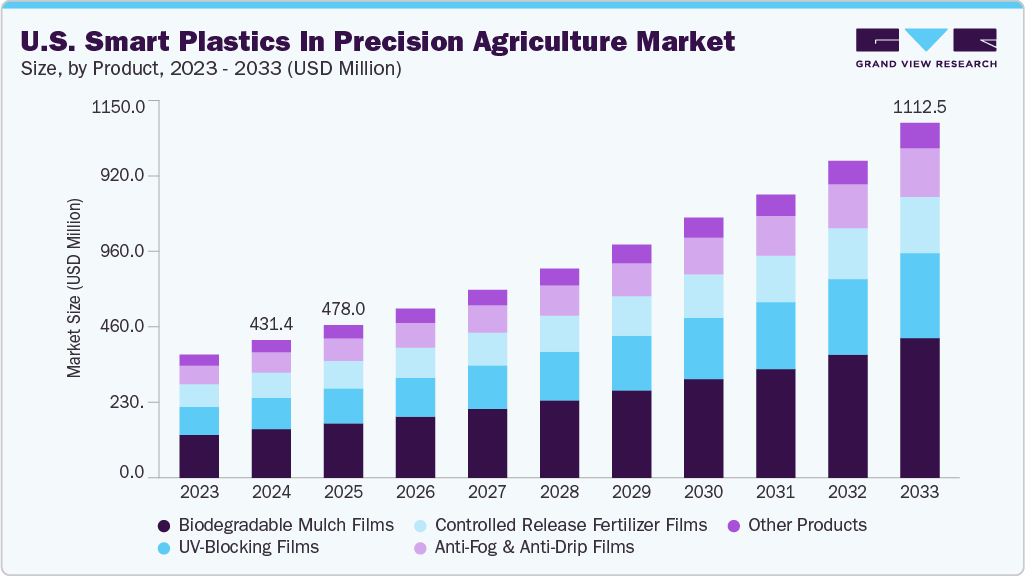
The U.S. smart plastics in precision agriculture market size was estimated at USD 431.4 million in 2024 and is projected to reach USD 1.11 billion by 2033, growing at a CAGR of 11.1% from 2025 to 2033. Federal and state-level subsidies for precision agriculture technologies are encouraging farmers to invest in smart plastics. Meanwhile, rising demand for data-driven decision-making in crop management is accelerating the adoption of sensor-embedded materials.
Key Market Trends & Insights
- By product, the biodegradable mulch films segment is expected to grow at a considerable CAGR of 12.5% from 2025 to 2033 in terms of revenue.
- By application, the crop monitoring segment is expected to grow at a considerable CAGR of 11.9% from 2025 to 2033 in terms of revenue.
- By end use, the cereals & grains segment is expected to grow at a considerable CAGR of 12.4% from 2025 to 2033 in terms of revenue.
Market Size & Forecast
- 2024 Market Size: USD 431.4 million
- 2033 Projected Market Size: USD 1.11 billion
- CAGR (2025-2033): 11.1%
There is a rising trend toward the integration of sensor-embedded biodegradable plastics in precision agriculture, enabling real-time monitoring of soil moisture, nutrient levels, and crop health. These smart materials are gaining traction due to their dual benefits: minimizing environmental impact and providing actionable data to farmers. This convergence of materials science and IoT is shaping the next wave of sustainable farming technologies in the U.S. market.
Drivers, Opportunities & Restraints
The growing need to optimize input efficiency and reduce agricultural waste is a major driver for smart plastics adoption in precision agriculture. U.S. farmers are increasingly under pressure to maximize yields while minimizing the use of fertilizers and water. Smart plastics, such as mulching films with embedded sensors or slow-release fertilizer coatings, help streamline resource allocation, enabling more profitable and environmentally responsible farming practices.
There is a significant opportunity in developing customized smart plastic solutions tailored for U.S. crop-specific needs, particularly in high-value segments like vineyards, specialty vegetables, and orchards. As climate variability increases, regionally adapted materials that offer real-time responsiveness to weather and soil conditions could command a premium, opening a profitable channel for domestic manufacturers and agritech startups.
High initial deployment costs and a fragmented adoption curve across different farm sizes and geographies remain key restraints. Many small to mid-sized farms in the U.S. lack the financial bandwidth or technical know-how to adopt smart plastics at scale. In addition, the return on investment is not always immediate, which discourages adoption despite long-term cost benefits.
Market Concentration & Characteristics
The market growth stage of the U.S. smart plastics in precision agriculture is high, and the pace is accelerating. The market exhibits slight fragmentation, with key players dominating the industry landscape. Major companies like Berry Global Inc., Armando Alvarez Group, RKW Group, Poly-America, L.P., Ginegar Plastic Products Ltd., Novamont, and others play a significant role in shaping the market dynamics. These leading players often drive innovation within the market, introducing new products, technologies, and end uses to meet evolving industry demands.
Innovations in remote sensing, such as drone-mounted multispectral cameras and high-resolution satellite imagery, are emerging as viable alternatives to in-ground smart plastics, delivering detailed field data without the need for material deployment or retrieval. Organic mulches and cover-crop systems also compete with sensor-embedded films by naturally moderating soil moisture and temperature, though they lack real-time monitoring capabilities. Collectively, these substitutes offer farmers flexibility in data acquisition and field management while sidestepping end-of-season waste concerns.
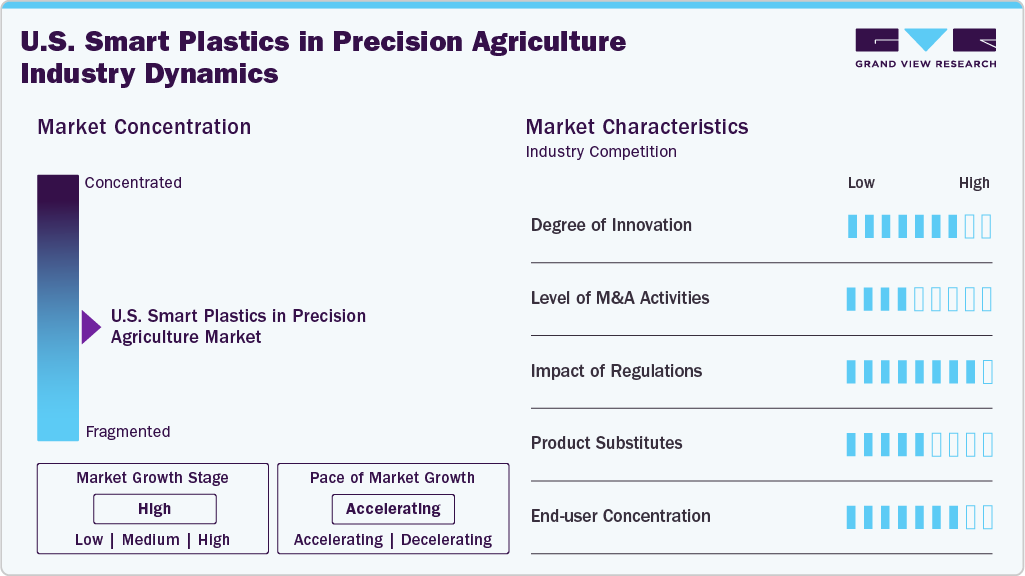
A tightening regulatory landscape, spanning state bans on single-use agricultural plastics to USDA guidelines on data privacy and cybersecurity, is reshaping the smart-plastics market in the U.S. Producers must now comply with evolving ASTM and EPA standards for biodegradable materials, while technology providers navigate USDA and FCC-led initiatives to establish interoperability and protect farm data. These measures, though increasing compliance costs, are simultaneously creating clearer pathways for certified, sustainable smart-plastic solutions.
Product Insights
Biodegradable mulch films dominated the market across the product segmentation in terms of revenue, accounting for a market share of 35.25% in 2024. Strict U.S. regulations on single-use plastics and growing environmental awareness are spurring farmers to replace conventional polyethylene films with biodegradable alternatives.
These materials decompose naturally after the growing season, eliminating removal and disposal costs while protecting soil health. As state and federal agencies tighten plastic-waste mandates, adoption rates are rising, especially among organic growers seeking compliance and long-term cost savings.
The UV-blocking films segment is anticipated to grow at a significant CAGR of 11.8% through the forecast period. Farmers are increasingly deploying UV-blocking plastic films to shield high-value crops from sunscald and suppress pathogen development.
By filtering harmful ultraviolet radiation, these films reduce fungal sporulation and crop stress, translating into higher marketable yields and quality premiums. This targeted protection is particularly valued in specialty produce and greenhouse operations, where minimizing chemical fungicides aligns with retailer and consumer demands.
Application Insights
Irrigation management led the market across the application segmentation in terms of revenue, accounting for a market share of 30.14% in 2024. Persistent drought in key basins such as the Colorado River watershed is driving rapid uptake of smart irrigation plastics.
These geotextiles and sensor-integrated drip lines deliver water precisely at root zones, cutting waste amid tightening water allocations. Federal subsidies under the Bureau of Reclamation’s water-conservation programs further offset installation costs, encouraging both large agribusinesses and family farms to invest in these systems for long-term resilience.
The crop monitoring segment is anticipated to grow at a significant CAGR of 11.9% over the forecast period. Labor shortages and the need for real-time field insights are fueling demand for sensor-embedded plastic films in U.S. agriculture. IoT-enabled soil and leaf sensors woven into mulches continuously relay moisture, nutrient, and stress data to cloud dashboards. This constant visibility empowers farmers to make data-driven interventions—optimizing inputs, reducing risks, and enhancing traceability for increasingly stringent supply-chain standards.
End-use Insights
Fruits & vegetables led the market across the application segmentation in terms of revenue, accounting for a market share of 39.39% in 2024. High-value fruit and vegetable growers are at the forefront of smart-plastics adoption, leveraging precision films to create controlled microclimates that boost flavor, shelf life, and visual appeal.
Biodegradable and UV-modulating films help manage soil temperature and light exposure, reducing rot and post-harvest losses. With consumer preference shifting toward sustainably produced fresh produce, retailers are rewarding farms that can demonstrate both quality and eco-credentials.
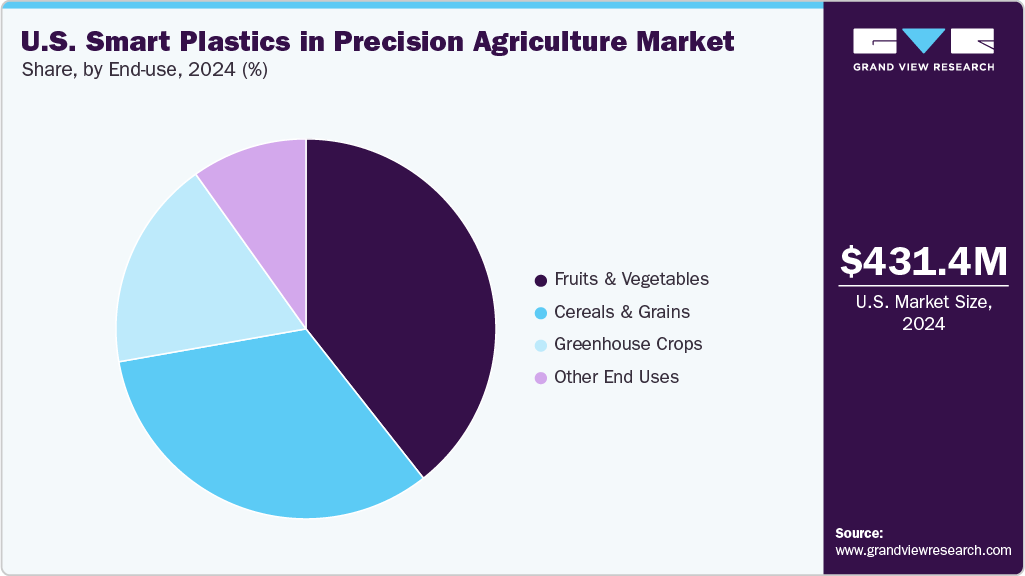
The cereals & grains segment is expected to grow at a substantial CAGR of 12.4% through the forecast period. Major corn, wheat, and soybean producers are adopting smart plastic mulches integrated with moisture and temperature sensors to meet tight yield targets and qualify for USDA precision-agriculture grants.
These materials ensure uniform soil conditions across vast acreages, enabling variable-rate irrigation and fertilization that maximizes resource efficiency. The result is improved germination consistency, reduced input costs, and enhanced return on investment for commodity crops.
Key U.S. Smart Plastics in Precision Agriculture Company Insights
The U.S. Smart Plastics in Precision Agriculture is highly competitive, with several key players dominating the landscape. Major companies include Berry Global Inc., Armando Alvarez Group, RKW Group, Poly-America, L.P., Ginegar Plastic Products Ltd., and Novamont. The U.S. smart plastics in precision agriculture is characterized by a competitive landscape with several key players driving innovation and market growth. Major companies in this sector are investing heavily in research and development to enhance the performance, cost-effectiveness, and sustainability of their types.
Key U.S. Smart Plastics in Precision Agriculture Companies:
- Berry Global Inc.
- Armando Alvarez Group
- RKW Group
- Poly-America, L.P.
- Ginegar Plastic Products Ltd.
- Novamont
Recent Developments
-
In April 2025, Plastika Kritis launched four new advanced greenhouse films in 2025 aimed at boosting productivity, improving crop quality, and supporting sustainable farming. The innovations included
-
Suncooler, a cooling film using nanotechnology and near-infrared additives to reduce greenhouse temperatures while maintaining high light transmission, ideal for warm climates.
-
Polydispersive films offered ultra-high light diffusion for uniform light distribution, preventing plant scorching in high-radiation areas.
-
EVO AC AR films featured anti-reflective properties increasing light transmission above 93%, enhancing early crop yields, especially in low-angle sunlight conditions.
-
CHAMELEON films smartly shift between clear and diffused states based on humidity to optimize light and protect plants throughout the day. These products collectively aimed to extend growing seasons, reduce energy and water use, and improve operational efficiency for growers worldwide
U.S. Smart Plastics in Precision Agriculture Market Report Scope
|
Report Attribute
|
Details
|
|
Market size value in 2025
|
USD 478.0 million
|
|
Revenue forecast in 2033
|
USD 1.11 billion
|
|
Growth rate
|
CAGR of 11.1% from 2025 to 2033
|
|
Historical data
|
2021 - 2023
|
|
Forecast period
|
2025 - 2033
|
|
Quantitative units
|
Revenue in USD million/billion, volume in kilotons, and CAGR from 2025 to 2033
|
|
Report coverage
|
Revenue forecast, competitive landscape, growth factors, and trends
|
|
Segments covered
|
Product, application, end-use
|
|
Country Scope
|
U.S.
|
|
Key companies profiled
|
Berry Global Inc.; Armando Alvarez Group; RKW Group; Poly-America, L.P.; Ginegar Plastic Products Ltd.; Novamont
|
|
Customization scope
|
Free report customization (equivalent up to 8 analyst’s working days) with purchase. Addition or alteration to country, regional & segment scope
|
|
Pricing and purchase options
|
Avail customized purchase options to meet your exact research needs. Explore purchase options
|
U.S. Smart Plastics in Precision Agriculture Market Report Segmentation
This report forecasts revenue growth at the country level and provides an analysis of the latest industry trends in each of the sub-segments from 2021 to 2033. For this study, Grand View Research has segmented the U.S. smart plastics in precision agriculture market report based on product, application, and end-use:
-
Product Outlook (Volume, Kilotons; Revenue, USD Million, 2021 - 2033)
-
Biodegradable Mulch Films
-
UV-Blocking Films
-
Anti-Fog & Anti-Drip Films
-
Controlled Release Fertilizer Films
-
Other Products
-
Application Outlook (Volume, Kilotons; Revenue, USD Million, 2021 - 2033)
-
Crop Monitoring
-
Irrigation Management
-
Soil Health Monitoring
-
Crop Protection
-
Other Applications
-
End-use Outlook (Volume, Kilotons; Revenue, USD Million, 2021 - 2033)
-
Cereals & Grains
-
Fruits & Vegetables
-
Greenhouse Crops
-
Other End Uses
Frequently Asked Questions About This Report
b. The U.S. smart plastics in precision agriculture market size was estimated at USD 431.4 million in 2024 and is expected to reach USD 478.0 million in 2025.
b. The U.S. smart plastics in precision agriculture market is expected to grow at a compound annual growth rate of 11.1% from 2025 to 2033 to reach USD 1,112.5 million by 2033.
b. Biodegradable mulch films dominated the U.S. smart plastics in precision agriculture across the product type segmentation in terms of revenue, accounting for a market share of 35.25% in 2024. Strict U.S. regulations on single-use plastics and growing environmental awareness are spurring farmers to replace conventional polyethylene films with biodegradable alternatives.
b. Some key players operating in the U.S. smart plastics in precision agriculture market include Berry Global Inc., Armando Alvarez Group, RKW Group, Poly-America, L.P., Ginegar Plastic Products Ltd., and Novamont.
b. Federal and state-level subsidies for precision agriculture technologies are encouraging farmers to invest in smart plastics. Meanwhile, rising demand for data-driven decision making in crop management is accelerating the adoption of sensor-embedded materials

 Download Sample Report
















