
- Home
- »
- Advanced Interior Materials
- »
-
Wear-Resistant Materials Market Size & Share Report, 2033GVR Report cover
![Wear-Resistant Materials Market Size, Share & Trends Report]()
Wear-Resistant Materials Market (2026 - 2033) Size, Share & Trends Analysis Report By Material Type (Metal, Ceramic, Polymer, Composite), By End Use (Mining, Oil & Gas, Power Generation, Industrial Manufacturing), By Region, And Segment Forecasts
- Report ID: GVR-4-68040-931-7
- Number of Report Pages: 107
- Format: PDF
- Historical Range: 2021 - 2024
- Forecast Period: 2026 - 2033
- Industry: Advanced Materials
- Report Summary
- Table of Contents
- Segmentation
- Methodology
- Download FREE Sample
-
 Download Sample Report
Market Size, 2025$10.2BMarket Estimate, 2026$10.9BMarket Forecast, 2033$17.6BCAGR, 2026 - 20337.1%Wear-Resistant Materials Market Summary
The global wear-resistant materials market size was valued at USD 10.2 billion in 2025 and is projected to grow from USD 10.9 billion in 2026 to USD 17.6 billion by 2033, at a CAGR of 7.1% from 2026 to 2033. Asia Pacific dominated the global market with the largest revenue share of 37.6% in 2025. The demand for wear-resistant materials is increasing rapidly as heavy industries such as mining, construction, power generation, and manufacturing expand.

Key Market Trends & Insights
- The market in China accounted for the largest market revenue share in the Asia Pacific in 2025.
- By material type, the composite segment is expected to grow at the fastest CAGR of 8.0% over the forecast period.
- By end use, the mining segment is projected to register at the fastest CAGR of 7.8% during the forecast period.
Market Size & Forecast
- 2025 Market Size: USD 10.2 Billion
- 2033 Projected Market Size: USD 17.6 Billion
- CAGR (2026-2033): 7.1%
- Asia Pacific: Largest market in 2025
Industrial equipment operating under abrasive, erosive, and high-impact environments requires advanced materials to reduce maintenance frequency and improve operational efficiency. Wear-resistant coatings, ceramics, alloys, and composites are increasingly being adopted to extend machinery lifespan and minimize downtime.Growing industrial automation and high-speed manufacturing processes are further increasing component wear, creating sustained demand for durable material solutions. In addition, the rise in global infrastructure development is driving the use of wear-resistant products in earthmoving machinery and construction tools. Industries are focusing on lowering lifecycle costs, which supports long-term adoption of wear-resistant technologies.

The mining and mineral processing sector remains one of the largest consumers of wear-resistant materials, due to the extreme operating conditions it faces. Crushers, chutes, pipelines, and grinding mills require superior wear protection to ensure uninterrupted production. In addition, the steel and cement industries are increasingly using wear-resistant linings and coatings to enhance plant productivity and reduce replacement costs.
Oil & gas companies are adopting corrosion- and wear-resistant alloys in drilling and exploration equipment to improve performance under harsh conditions. The growing use of renewable energy systems, such as wind turbines, is also driving demand for wear-resistant bearings and protective coatings. Industrial manufacturers are prioritizing reliability and asset optimization, thereby strengthening the market outlook.
The wear-resistant material industry is witnessing rapid innovation in advanced ceramic materials, carbide composites, and nano-coatings. Nanotechnology enables the development of ultra-hard surfaces with enhanced abrasion resistance and thermal stability. Thermal spray coatings and laser cladding technologies are becoming increasingly popular due to their ability to improve equipment durability without replacing entire components.
Manufacturers are also focusing on multifunctional coatings that combine wear resistance with corrosion protection and thermal insulation. These innovations are helping industries improve productivity while reducing maintenance costs.
Market Dynamics
One of the primary drivers of the wear resistant materials industry is the increasing need for reducing operational downtime across industrial facilities. Equipment failures caused by abrasion and erosion can lead to significant productivity losses and high maintenance expenditures. Companies are therefore investing in high-performance ceramics, carbide-based materials, and engineered polymers that offer superior resistance to wear and friction.
Advanced wear-resistant coatings are also gaining traction in automotive and aerospace applications where component durability directly impacts performance and safety. The increasing use of lightweight yet durable materials in transportation industries is further supporting market growth.
One of the major restraints in the wear resistant materials industry is the high initial cost of advanced materials such as ceramics, carbide composites, specialty alloys, and nanocoatings. These materials require sophisticated manufacturing processes, precision engineering, and specialized installation techniques, significantly increasing overall project costs.
Small and medium-sized enterprises, particularly in developing economies, often hesitate to invest in premium wear-resistant solutions due to budget limitations and long payback periods. In addition, fluctuations in the prices of raw materials for tungsten carbide, chromium, nickel, and advanced ceramics further increase production costs and create pricing challenges for manufacturers.
Market Concentration & Characteristics
The wear-resistant materials industry is moderately fragmented with the presence of global material manufacturers, specialty coating companies, and regional engineering solution providers. Large multinational companies dominate high-performance alloy, ceramics, and advanced coating segments due to their extensive R&D capabilities and global distribution networks.
However, regional manufacturers remain competitive in industrial maintenance and localized wear-protection applications. Strategic partnerships, acquisitions, and technological collaborations are increasingly shaping the competitive landscape. Companies are focusing on product customization, improved material efficiency, and long-term service contracts to strengthen market positioning.
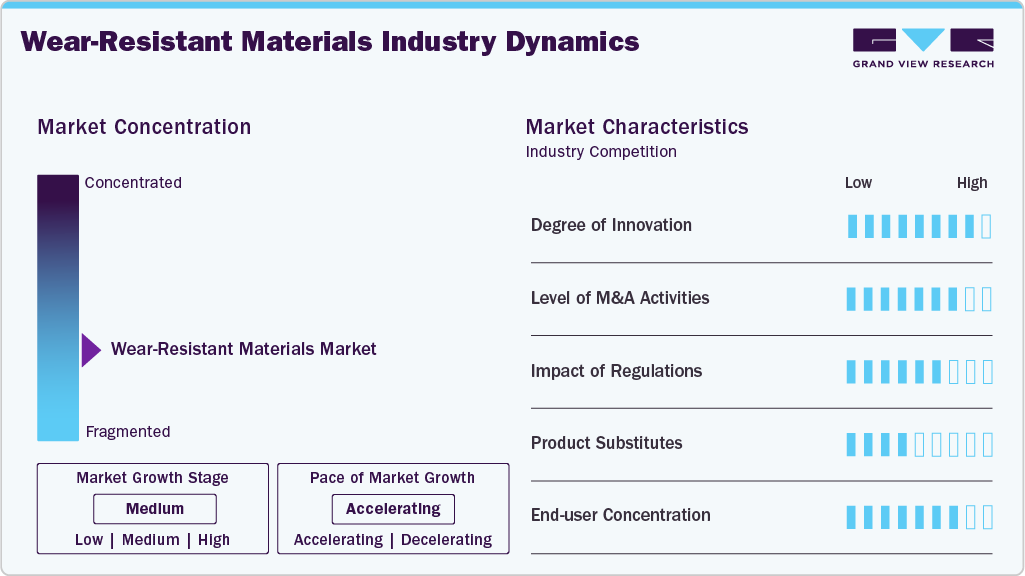
The threat of substitutes in the wear-resistant materials industry is moderate as industries may opt for frequent equipment replacement or conventional steel components in cost-sensitive applications. However, standard materials often result in higher maintenance costs and shorter operational lifespans under abrasive conditions.
Alternative approaches, such as lubrication systems and operational process optimization, can partially reduce wear but cannot fully replace advanced wear-resistant solutions. The superior durability, lifecycle cost advantages, and operational efficiency offered by wear-resistant materials continue to support their adoption across demanding industrial environments.
Material Type Insights
The metal segment led the market with the largest revenue share of 40.6% in 2025, driven by extensive use across mining, construction, power generation, and heavy industrial applications. Wear-resistant steels, chromium alloys, and tungsten carbide-based alloys are widely preferred for their superior strength, impact resistance, and durability under abrasive operating conditions. Industries rely heavily on metallic wear-resistant solutions for crushers, pipelines, drilling equipment, and industrial machinery components to improve operational efficiency and reduce maintenance costs. The segment also benefits from continuous advancements in alloy development and heat-treatment technologies that enhance hardness, corrosion resistance, and service life in demanding industrial environments.
The composite segment is expected to grow at the fastest CAGR of 8.0% over the forecast period, driven by increasing demand for lightweight yet highly durable materials across industrial manufacturing, the aerospace, and automotive sectors. Composite wear-resistant materials offer advantages such as a high strength-to-weight ratio, corrosion resistance, and improved thermal stability compared to conventional metals. Industries are increasingly adopting ceramic-matrix and polymer-based composites for applications that require reduced friction and extended equipment lifespan. The growing focus on energy efficiency, equipment optimization, and advanced material engineering is further accelerating the adoption of wear-resistant composites in high-performance industrial applications.
End Use Insights
The mining segment led the market with the largest revenue share of 31.1% in 2025, driven by the extreme abrasive and erosive conditions encountered in mineral extraction and processing. Mining operations require wear-resistant liners, grinding media, pipes, and protective coatings to withstand continuous exposure to rocks, ores, and slurry materials. Frequent equipment wear in crushers, conveyors, and grinding mills underscores the need for advanced, wear-resistant solutions that minimize downtime and maintenance costs. Rising global demand for metals, minerals, and rare earth elements is further driving investments in mining infrastructure, thereby supporting strong demand for durable wear-resistant materials across the sector.

The industrial manufacturing segment is expected to grow at the significant CAGR of 7.2% over the forecast period, as manufacturers increasingly focus on improving production efficiency, reducing operational downtime, and extending machinery lifespan. High-speed manufacturing equipment and automated production systems generate significant friction and mechanical wear, creating demand for advanced coatings, ceramics, and wear-resistant alloys. Industries such as automotive, machinery, food processing, and packaging are adopting durable material solutions to enhance productivity and reduce maintenance frequency. In addition, the integration of smart manufacturing technologies and predictive maintenance systems is encouraging industrial facilities to invest in high-performance, wear-resistant components to ensure long-term operational reliability.
Regional Insights
Asia Pacific dominated the global wear-resistant materials market with the largest revenue share of 37.6% in 2025 and is projected to grow at the fastest CAGR during the forecast period, due to rapid industrialization, infrastructure expansion, and strong mining and manufacturing activities across China, India, Japan, and Southeast Asia. The region has a large base of steel, cement, and power generation industries that extensively use wear-resistant linings, coatings, and components. Growing investments in construction and transportation infrastructure are increasing demand for durable industrial machinery and equipment protection solutions. Rising automation in manufacturing facilities is also driving the adoption of advanced wear-resistant materials. In addition, the presence of major material manufacturing companies and lower production costs supports regional market growth.

The wear-resistant materials market in China accounted for the largest market revenue share in the Asia Pacific in 2025, owing to its dominant mining, steel, and industrial manufacturing sectors. The country is witnessing increasing investments in high-performance industrial machinery to improve operational efficiency and reduce maintenance downtime. Government initiatives promoting industrial modernization and advanced manufacturing technologies are accelerating the adoption of wear-resistant coatings and ceramics. Growing renewable energy installations and infrastructure projects are also generating strong demand for durable material solutions. Domestic manufacturers are increasingly investing in advanced material research to enhance competitiveness and reduce dependence on imports.
North America Wear-Resistant Materials Market Trends
The wear resistant materials market in North America is experiencing stable growth driven by strong demand from the mining, aerospace, oil & gas, and industrial manufacturing sectors. The region emphasizes predictive maintenance and operational efficiency, increasing the adoption of premium wear-resistant technologies. Advanced thermal-spray coatings and ceramic composites are widely used in aerospace and defense applications that require high durability. The U.S. and Canada are also investing in energy infrastructure upgrades and mining modernization, further supporting market demand. The growing adoption of automation and digital monitoring systems is encouraging industries to use advanced, wear-resistant materials to optimize long-term costs.
U.S. Wear-Resistant Materials Market Trends
The wear-resistant materials market in the U.S. market is driven by strong industrial automation, aerospace manufacturing, and shale oil & gas activities. Industries are increasingly investing in advanced carbide coatings, engineered polymers, and wear-resistant alloys to improve machinery performance and reduce downtime. The growing focus on domestic manufacturing and infrastructure modernization is creating additional opportunities for suppliers of wear-resistant materials. The country also leads in R&D on nanotechnology-based coatings and additive manufacturing for industrial applications. The defense and aviation sectors continue to drive significant demand for lightweight, high-strength, wear-resistant materials.
Europe Wear-Resistant Materials Market Trends
The wear-resistant materials market in Europe is seeing increasing demand for sustainable, energy-efficient industrial materials across the manufacturing and automotive industries. The region’s strict environmental regulations are encouraging industries to adopt durable solutions that minimize waste and extend equipment lifecycles. Germany, France, and the UK are key contributors due to their strong industrial machinery and automotive sectors. The region is also investing heavily in renewable energy infrastructure, increasing demand for wear-resistant turbine and bearing components. Advanced research in surface engineering and ceramic technologies continues to support innovation across European markets.
The Germany wear-resistant materials market remains a major market due to its advanced engineering, automotive manufacturing, and industrial machinery industries. Companies in the country are highly focused on productivity enhancement and predictive maintenance strategies, boosting the adoption of wear-resistant technologies. The growing use of robotics and automation in manufacturing facilities is increasing the need for durable machine components and protective coatings. Germany is also a leader in advanced materials research, supporting the development of high-performance ceramics and nanoscale coatings. Rising investments in clean energy projects are further supporting demand for wear-resistant systems in turbines and industrial equipment.
Central and South America Wear-Resistant Materials Market Trends
The wear-resistant materials market in Central and South America is witnessing growing demand amid expanding mining and construction activities in countries such as Brazil, Chile, and Peru. The mining sector extensively uses wear-resistant linings, pipes, and grinding solutions to improve productivity and reduce operational interruptions. Infrastructure modernization and industrial development projects are also supporting market growth across the region. International material manufacturers are expanding their presence in Latin America to capitalize on growing industrial investments. The adoption of advanced coatings and composite materials is gradually increasing as industries focus on reducing maintenance costs and improving equipment reliability.
Middle East & Africa Wear-Resistant Materials Market Trends
The wear-resistant materials market in the Middle East & Africa is growing steadily, driven by strong investments in the oil & gas, mining, and infrastructure sectors. Wear-resistant alloys and coatings are widely used in drilling equipment, pipelines, and heavy industrial machinery operating in harsh environmental conditions. Countries such as Saudi Arabia, the UAE, and South Africa are investing in industrial diversification and mining expansion projects, supporting market growth. Rising construction activities and power generation investments are also increasing the demand for durable machinery components. The region is gradually adopting advanced material technologies to improve operational efficiency and extend equipment lifespan in energy-intensive industries.
Key Wear-Resistant Materials Company Insights
Some of the key players operating in the market include SSAB and Saint-Gobain
-
SSAB is a leading global steel manufacturer specializing in high-strength and wear-resistant steel solutions for industries such as mining, construction, heavy transport, and energy. The company is widely recognized for its Hardox wear plate products, which offer superior hardness, durability, and operational efficiency in abrasive environments. SSAB focuses heavily on sustainable steel production and advanced metallurgy innovations to support industrial productivity and equipment longevity.
-
Saint-Gobain is a multinational manufacturer of advanced materials and engineered solutions with a strong presence in wear-resistant ceramics, abrasives, and industrial performance materials. The company serves sectors including construction, automotive, mining, aerospace, and manufacturing through innovative material technologies designed to improve durability and efficiency.
Dillinger Group and Kennametal Inc. are some of the emerging market participants in the global wear-resistant materials industry.
-
Dillinger Group is a major producer of heavy steel plates and specialized wear-resistant steel products used in construction machinery, mining equipment, offshore structures, and industrial applications. The company is known for producing high-strength and abrasion-resistant steel grades capable of operating under extreme mechanical stress and harsh industrial conditions.
-
Kennametal Inc. is a global industrial technology company specializing in wear-resistant tooling, carbide materials, and engineered components for aerospace, energy, mining, and manufacturing industries. The company develops advanced tungsten carbide and ceramic-based solutions that improve machining precision, equipment durability, and operational performance.
Key Wear-Resistant Materials Companies:
The following key companies have been profiled for this study on the wear resistant materials market.
-
SSAB
-
Saint-Gobain
-
Vautid Group
-
FE Steel Corporation
-
ArcelorMittal
-
Industeel
-
Tega Industries
-
Dillinger Group
-
thyssenkrupp Steel Europe
-
Kennametal Inc.
Competitive Benchmarking
Operating Strategies
Competitive Edge
Weakness
Mature Players: SSAB; Saint-Gobain; JFE Steel Corporation; ArcelorMittal
- Focus on long-term supply contracts with mining, construction, steel, and industrial manufacturing companies to ensure recurring revenue streams.
- Invest heavily in R&D for advanced alloys, carbide technologies, ceramic coatings, and sustainable material solutions with enhanced durability.
- Expand global manufacturing and distribution networks through acquisitions, partnerships, and regional production facilities to strengthen market penetration.
- Strong global brand recognition and diversified product portfolios across multiple industrial end-use sectors.
- Advanced metallurgical expertise and proprietary technologies enabling superior wear resistance, hardness, and lifecycle performance.
- Extensive customer support capabilities including technical consulting, predictive maintenance services, and customized wear-protection solutions.
- High operational and manufacturing costs associated with advanced material processing and premium product development.
- Dependence on cyclical industries such as mining, steel, construction, and oil & gas, which can affect revenue stability during economic slowdowns.
- Longer innovation and commercialization timelines due to complex testing, certification, and industrial qualification requirements.
Emerging Players: Vautid Group; Industeel; Tega Industries
- Focus on niche wear-protection applications and customized solutions tailored for regional mining and industrial customers.
- Strengthen market presence through strategic collaborations with equipment manufacturers and industrial maintenance providers.
- Increase investments in cost-effective wear-resistant composites, rubber linings, and specialized coating technologies to differentiate offerings.
- Greater flexibility in customization and faster response times for specific industrial requirements and localized applications.
- Competitive pricing strategies and lower operational costs compared to large multinational corporations.
- Strong regional expertise and growing presence in developing industrial economies with expanding mining and infrastructure activities.
- Limited global distribution networks and smaller production capacities compared to established multinational competitors.
- Lower R&D budgets and technological capabilities, restricting the development of highly advanced wear-resistant materials.
- Greater vulnerability to raw material price fluctuations and competitive pressure from dominant global players with economies of scale.
Recent Developments
-
In February 2025, SSAB introduced Hardox 450 made from SSAB Zero steel at Bauma 2025, offering wear-resistant steel with virtually zero fossil carbon emissions for mining and construction applications.
Wear-Resistant Materials Market Report Scope
Report Attribute
Details
Market size value in 2025
USD 10.2 billion
Market size value in 2026
USD 10.9 billion
Revenue forecast in 2033
USD 17.6 billion
Growth rate
CAGR of 7.1% from 2026 to 2033
Base year for estimation
2025
Historical data
2021 - 2024
Forecast period
2026 - 2033
Quantitative units
Revenue in USD million/billion, and CAGR from 2026 to 2033
Report coverage
Revenue forecast, company ranking, competitive landscape, growth factors, and trends
Segments covered
Material type, end use, region.
Regional scope
North America; Asia Pacific; Europe; Central & South America; Middle East & Africa
Country scope
U.S.; Canada; Mexico; Germany; UK; Germany; France; Italy; China; Japan; India
Key companies profiled
SSAB; Saint-Gobain; Vautid Group; JFE Steel Corporation; ArcelorMittal; Industeel; Tega Industries; Dillinger Group; thyssenkrupp Steel Europe; Kennametal Inc.
Customization scope
Free report customization (equivalent up to 8 analysts working days) with purchase. Addition or alteration to country, regional & segment scope.
Pricing and purchase options
Avail customized purchase options to meet your exact research needs. Explore purchase options
Global Wear-Resistant Materials Market Report Segmentation
This report forecasts revenue growth at regional & country levels and provides an analysis on the industry trends in each of the sub-segments from 2021 to 2033. For the purpose of this study, Grand View Research has segmented the global wear-resistant materials market report based on the material type, end use, and region:

-
Type Outlook (Revenue, USD Billion, 2021 - 2033)
-
Metal
-
Ceramic
-
Polymer
-
Composite
-
-
End Use Outlook (Revenue, USD Billion, 2021 - 2033)
-
Mining
-
Oil & Gas
-
Power Generation
-
Industrial Manufacturing
-
Others
-
-
Regional Outlook (Revenue, USD Billion, 2021 - 2033)
-
North America
-
U.S.
-
Canada
-
Mexico
-
-
Europe
-
UK
-
Germany
-
France
-
Italy
-
-
Asia Pacific
-
China
-
Japan
-
India
-
-
Central and South America
-
Middle East and Africa
-
Delivered Customizations
This report has been delivered with the following In-depth customizations
Client Request
Customization Delivered
Value Adds
Regulatory Impact Analysis
Detailed assessment of the impact of industrial safety regulations, environmental standards, mining regulations, and manufacturing compliance requirements on wear-resistant materials demand
Helps clients understand compliance risks, regulatory opportunities, and future market entry requirements
Competitive Landscape Assessment
Delivered detailed benchmarking of global and regional players based on product portfolio, innovation capabilities, geographic presence, and strategic initiatives
Supports competitive positioning, partnership evaluation, and market expansion planning
Technology Innovation Analysis
Analysis of advancements in carbide materials, ceramic composites, nano-coatings, thermal spray technologies, and additive manufacturing
Enables identification of emerging technology opportunities and long-term innovation trends
Frequently Asked Questions About This Report
The mining segment held the highest revenue market share of 31.1% in 2025, due to the extreme abrasive and erosive conditions involved in mineral extraction and processing activities.
Some key players in the wear-resistant materials market include SSAB, Saint-Gobain, Vautid Group, JFE Steel Corporation, ArcelorMittal, Industeel, Tega Industries, Dillinger Group, Kennametal Inc., and thyssenkrupp Steel Europe.
Increasing demand for durable industrial equipment, rising mining and construction activities, advancements in material engineering, and the growing focus on reducing maintenance costs and operational downtime are the key factors driving the wear-resistant materials market.
The global wear-resistant materials market size was estimated at USD 10.2 billion in 2025 and is expected to reach USD 10.9 billion in 2026.
The global wear-resistant materials market is expected to grow at a compound annual growth rate of 7.1% from 2026 to 2033 to reach USD 17.6 billion by 2033.
About the authors:
Author: GVR Advanced Interior Materials Research Team | Last Updated:


Share this report with your colleague or friend.
Need a Tailored Report?
Customize this report to your needs — add regions, segments, or data points, with 20% free customization.


ISO 9001:2015 & 27001:2022 Certified
We are GDPR and CCPA compliant! Your transaction & personal information is safe and secure. For more details, please read our privacy policy.












