
- Home
- »
- Plastics, Polymers & Resins
- »
-
Wood-fiber Packaging Market Size & Share Report, 2033GVR Report cover
![Wood-fiber Packaging Market (2026 - 2033)Report]()
Wood-fiber Packaging Market (2026 - 2033)
Size, Share & Trends Analysis Report By Material (Plastic, Paper & Paperboard, Metal, Textile/Fabric), By Security Technology, By Packaging Format (Corrugated Boxes), By End-use Industry, By Region, And Segment Forecasts
Market Size, 2025
$8.5BMarket Estimate, 2026
$8.5BMarket Forecast, 2033
$15.3BCAGR, 2026–2033
7.8%Wood-fiber Packaging Market Summary
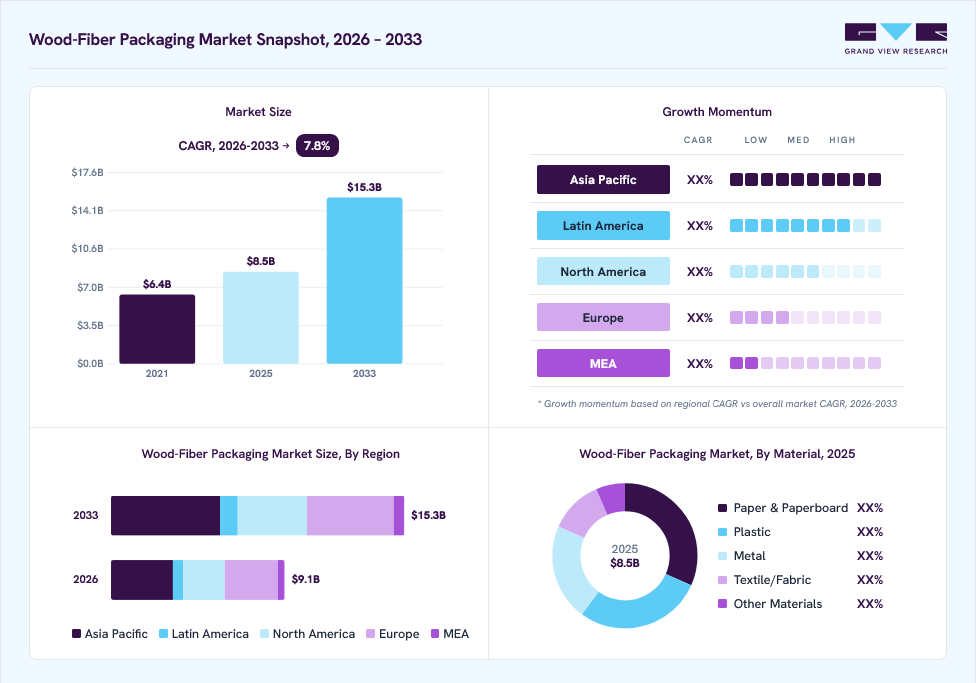
The global wood-fiber packaging market size was valued at USD 8.5 billion in 2025 and is projected to grow from USD 9.1 billion in 2026 to USD 15.3 billion by 2033, at a CAGR of 7.8% from 2026 to 2033. Asia Pacific dominated the market, accounting for the revenue share of 35.4% in 2025. The market is primarily driven by the growing shift toward sustainable and recyclable packaging, increasing demand for renewable fiber-based materials, and the expansion of food & beverage, e-commerce, consumer goods, and pharmaceutical packaging applications.
Key Market Trends & Insights
- By material: Paper & paperboard segment accounted for the largest market share of 31.6% in 2025.
- By security technology: Mechanical security features held the largest share accounting for 45.5% in 2025.
- By packaging format: Corrugated boxes segment held the largest share of the wood-fiber packaging market, accounting for 44.7% in 2025.
- By end-use industry: Pharmaceuticals & healthcare segment is expected to register the fastest CAGR of 8.6%.
Regional Highlights
- Largest regional market: Asia Pacific (35.4% revenue share, 2025)
- By country: China held the largest share in 2025.
Market Size & Forecast
- Market size in 2025: USD 8.5 Billion
- Estimated market size in 2026: USD 9.1 Billion
- Projected market size by 2033: USD 15.3 Billion
- CAGR (2026-2033): 7.8%
The market is driven by the growing shift toward sustainable, renewable, and recyclable packaging materials across consumer goods and industrial supply chains. As manufacturers and retailers increasingly seek alternatives to conventional packaging materials, wood-fiber-based solutions are gaining traction due to their renewable raw-material base, recyclability, lightweight characteristics, and potential for lower environmental impact. Paper & paperboard represents the largest material segment, accounting for 31.6% of the market in 2025, while demand for fiber-based packaging is further supported by the expansion of e-commerce, consumer goods, electronics, apparel, and other packaged-product industries. The increasing adoption of corrugated and fiber-based formats is strengthening demand for wood-fiber packaging across high-volume packaging applications.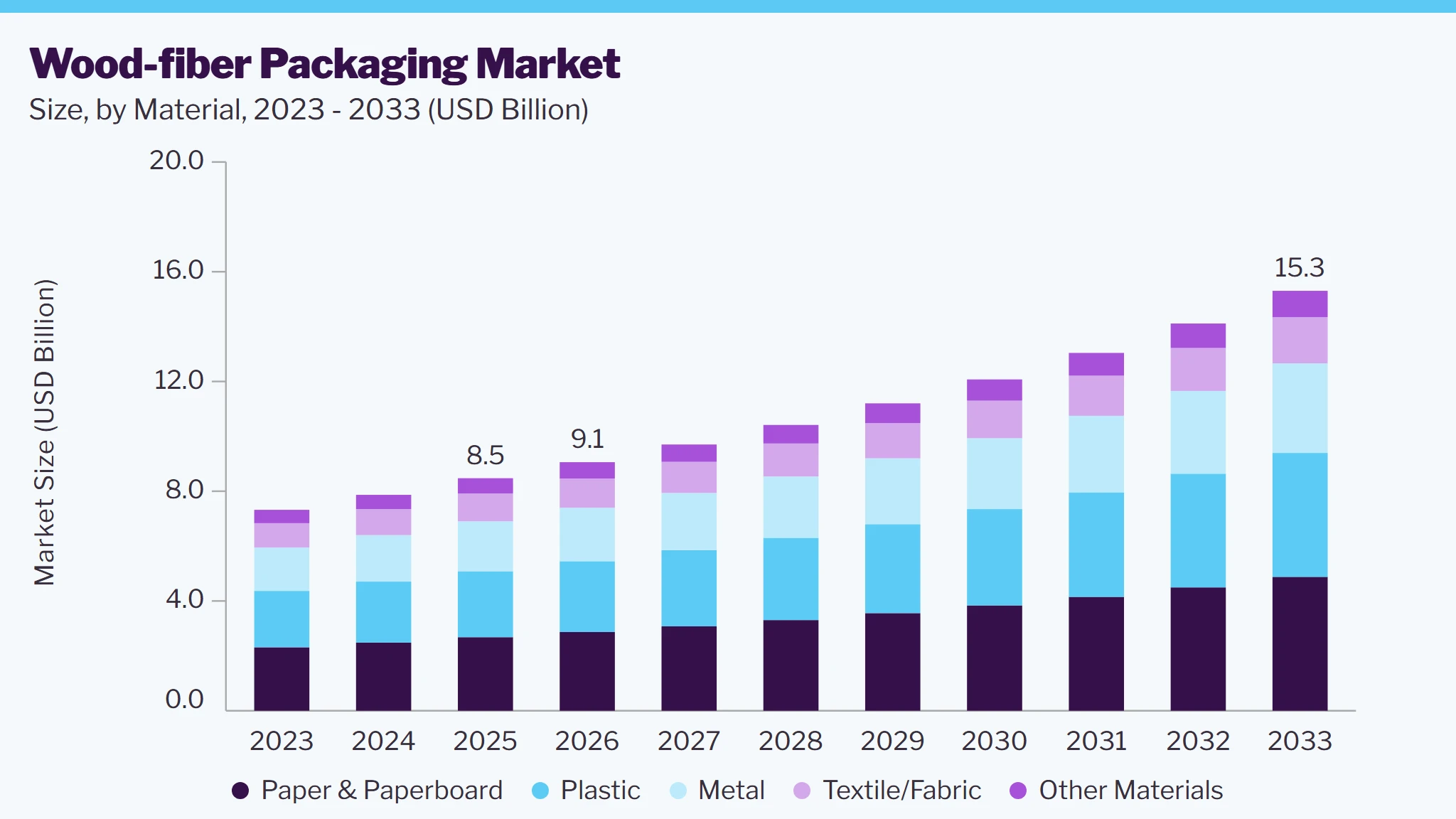
An increasing focus on sustainable packaging, waste reduction, and material recyclability across global supply chains is expected to boost market growth in the coming years. Industries such as consumer electronics, apparel & footwear, luxury goods, pharmaceuticals & healthcare, beauty & personal care, and food & grocery are increasingly adopting fiber-based packaging solutions to meet sustainability objectives and evolving consumer preferences. Regulatory initiatives aimed at reducing packaging waste, improving recyclability, and increasing the use of renewable materials are encouraging manufacturers to develop recyclable and fiber-based packaging formats. In addition, growing demand for protective, lightweight, and customizable packaging is supporting the integration of wood-fiber materials into diverse consumer and commercial packaging applications.
Sustainability initiatives and the transition toward circular economy packaging systems are also significantly contributing to market growth. A defining trend in the wood-fiber packaging industry is the increasing shift toward recyclable paper and paperboard materials, resource-efficient fiber processing, and packaging designs that support material recovery and recycling. This transition is being reinforced by growing investments in sustainable fiber sourcing, recycling infrastructure, lightweight packaging technologies, and alternative fiber-based materials. Paper & paperboard is projected to grow at a CAGR of 7.9% from 2026 to 2033, while the overall wood-fiber packaging market is expected to expand at a CAGR of 7.8% during the same period.
The expansion of sustainable packaging production and recycling capabilities is expected to improve the availability and utilization of recovered fibers and renewable raw materials for packaging applications. Such developments are anticipated to support the production of recyclable, lightweight, and resource-efficient wood-fiber packaging solutions, particularly as demand increases across consumer electronics, apparel & footwear, luxury goods, pharmaceuticals & healthcare, beauty & personal care, and food & grocery applications.
Market Dynamics
The market is witnessing steady growth, driven by increasing demand for sustainable packaging, growing adoption of renewable fiber-based materials, and rising efforts to reduce dependence on conventional packaging materials. Manufacturers are focusing on recyclable, lightweight, and resource-efficient packaging solutions to meet evolving sustainability expectations and regulatory requirements. Additionally, the expansion of e-commerce, consumer goods, healthcare, apparel, and electronics industries is supporting market expansion, while increasing emphasis on packaging waste reduction is encouraging innovation in wood-fiber-based materials and formats.
The increasing demand for sustainable and renewable packaging solutions worldwide is a key driver of the wood-fiber packaging market. Growing environmental awareness, concerns regarding packaging waste, and increasing preference for recyclable materials are encouraging manufacturers and brands to incorporate paper, paperboard, and other fiber-based materials into their packaging strategies. The expansion of e-commerce, consumer electronics, apparel & footwear, and consumer goods markets has further increased demand for lightweight and protective packaging solutions, creating sustained demand for wood-fiber packaging.
As brands and packaging manufacturers continue to strengthen their sustainability strategies, the need for recyclable, lightweight, and cost-effective fiber-based packaging is growing. Companies are investing in improved fiber processing, packaging design, barrier technologies, and material optimization to enhance product protection while reducing material consumption. The increasing use of wood-fiber packaging across retail, logistics, healthcare, and consumer product applications is further supporting market growth.
A significant restraint for the wood-fiber packaging market is the performance limitations of certain fiber-based materials, particularly their sensitivity to moisture, humidity, and demanding barrier requirements. Packaging manufacturers may need to use coatings, treatments, or advanced barrier technologies to improve strength, durability, and moisture resistance, which can increase production costs and create challenges for recyclability. In addition, wood-fiber packaging competes with plastic and metal formats that can provide superior moisture resistance, flexibility, and mechanical performance in specific applications, potentially limiting adoption in performance-critical end uses.
A major opportunity for the market lies in the growing adoption of recyclable, renewable, and circular packaging solutions. Increasing environmental awareness, packaging-waste reduction initiatives, and demand for sustainable materials are encouraging brands to shift toward paper, paperboard, molded fiber, and other wood-fiber-based formats. Advancements in lightweight fiber structures, recyclable barrier coatings, recycled-content materials, and efficient fiber-processing technologies are creating opportunities across consumer electronics, apparel & footwear, pharmaceuticals & healthcare, beauty & personal care, and food & grocery applications.
Market Concentration & Characteristics
The market is characterized by its growing emphasis on sustainable materials, recyclable packaging formats, and resource-efficient production processes. The industry relies heavily on paper, paperboard, wood pulp, and other fiber-based materials, with manufacturers focusing on efficient fiber processing, lightweighting, material optimization, and scalable production to meet rising packaging demand. Packaging formats such as corrugated boxes and other fiber-based solutions are increasingly used across consumer electronics, apparel & footwear, luxury goods, pharmaceuticals & healthcare, beauty & personal care, and food & grocery applications. Leading players are optimizing manufacturing capabilities around automated converting, high-speed forming, material recovery, and sustainable fiber sourcing to improve cost efficiency and packaging performance.
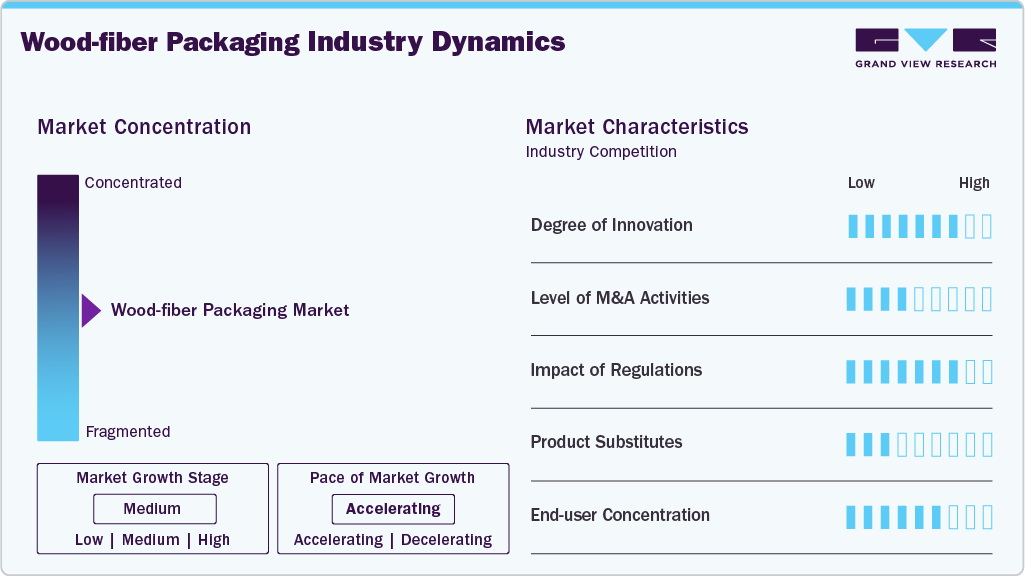
A defining feature of the industry is its growing shift toward recyclable, renewable fiber-based packaging as brands seek to reduce packaging waste and improve environmental performance. Paper & paperboard remains the largest material segment, accounting for 31.6% of the market in 2025, while the broader market is supported by growing adoption of recycled fibers, responsibly sourced wood pulp, molded fiber, and lightweight paperboard solutions. However, manufacturers must balance sustainability with requirements for strength, moisture resistance, barrier performance, and product protection. Advances in fiber treatment, recyclable coatings, lightweight structures, and material recovery technologies are therefore shaping product development and investment decisions across the wood-fiber packaging industry.
Analyst Perspective
The global wood-fiber packaging market has evolved from conventional paper and corrugated packaging toward sustainable, recyclable, lightweight, and renewable fiber-based solutions, driven by growing environmental awareness and the shift away from resource-intensive packaging materials. Currently, manufacturers are emphasizing recycled fibers, molded fiber, lightweighting, improved barrier performance, and circular packaging solutions across consumer goods, electronics, healthcare, apparel, and food applications. Going forward, the market is expected to maintain strong growth, supported by e-commerce expansion, sustainability initiatives, plastic replacement, technological innovation, and increasing adoption of fiber-based packaging, with Asia Pacific remaining a key growth region.
Material Insights
The paper & paperboard segment accounted for the largest market share of 31.6% in 2025. Its leading position is supported by the widespread use of fiber-based packaging for corrugated boxes, protective packaging, and consumer goods applications, along with strong recyclability and renewable-material characteristics. The segment is expected to maintain its leading position through 2033, supported by increasing demand for recyclable and lightweight packaging solutions across consumer electronics, apparel & footwear, healthcare, and other end-use industries.
The plastic segment is projected to be the fastest-growing material segment in the wood-fiber packaging market, registering a CAGR of 8.3% during the forecast period. Growth is supported by demand for packaging formats requiring flexibility, durability, moisture resistance, and enhanced product protection. The segment's share is expected to increase from 28.4% in 2025 to 29.5% by 2033, reflecting continued demand for performance-oriented packaging solutions across e-commerce, consumer goods, electronics, healthcare, and other applications.
Security Technology Insights
The mechanical security features segment held the largest share of the wood-fiber packaging market in 2025 at 45.5%, primarily driven by the widespread use of tamper-evident structures, locking mechanisms, protective closures, and physical security features that strengthen packaging integrity and product protection across various end-use applications.
The digital authentication technologies segment represented the fastest-growing segment, with a CAGR of 8.6%, driven by increasing adoption of QR codes, serialization, digital tracking, smart labels, and authentication solutions that enhance traceability, brand protection, and anti-counterfeiting capabilities in wood-fiber packaging.
Packaging Format Insights
The corrugated boxes segment held the largest share of the wood-fiber packaging market, accounting for 44.7% in 2025. The segment is supported by its broad use for product protection, shipping, storage, and secondary packaging across consumer electronics, apparel & footwear, healthcare, and other consumer goods. Its share is projected to increase to 46.8% by 2033, reflecting continued demand for recyclable, lightweight, durable, and fiber-based packaging solutions, particularly with the expansion of e-commerce and sustainable packaging adoption.
The poly mailers segment is the second-fastest-growing packaging format in the market, registering a CAGR of 7.8%. Growth is supported by increasing demand for lightweight, flexible, and space-efficient packaging, particularly for e-commerce, apparel & footwear, and consumer goods shipments. The segment is also benefiting from growing emphasis on efficient material usage, easy handling, and cost-effective packaging solutions.
End-use Industry Insights
The consumer electronics remained the largest end use segment in the wood-fiber packaging market, accounting for 33.8% share in 2025. Its dominance is supported by the high volume of electronic devices and accessories requiring protective, lightweight, and durable packaging during transportation, handling, and storage. Growing e-commerce distribution and increasing preference for recyclable packaging are further supporting demand. The segment is projected to maintain its leading position through 2033, although its share is expected to gradually decline to 33.0% as other end-use industries expand at faster rates.
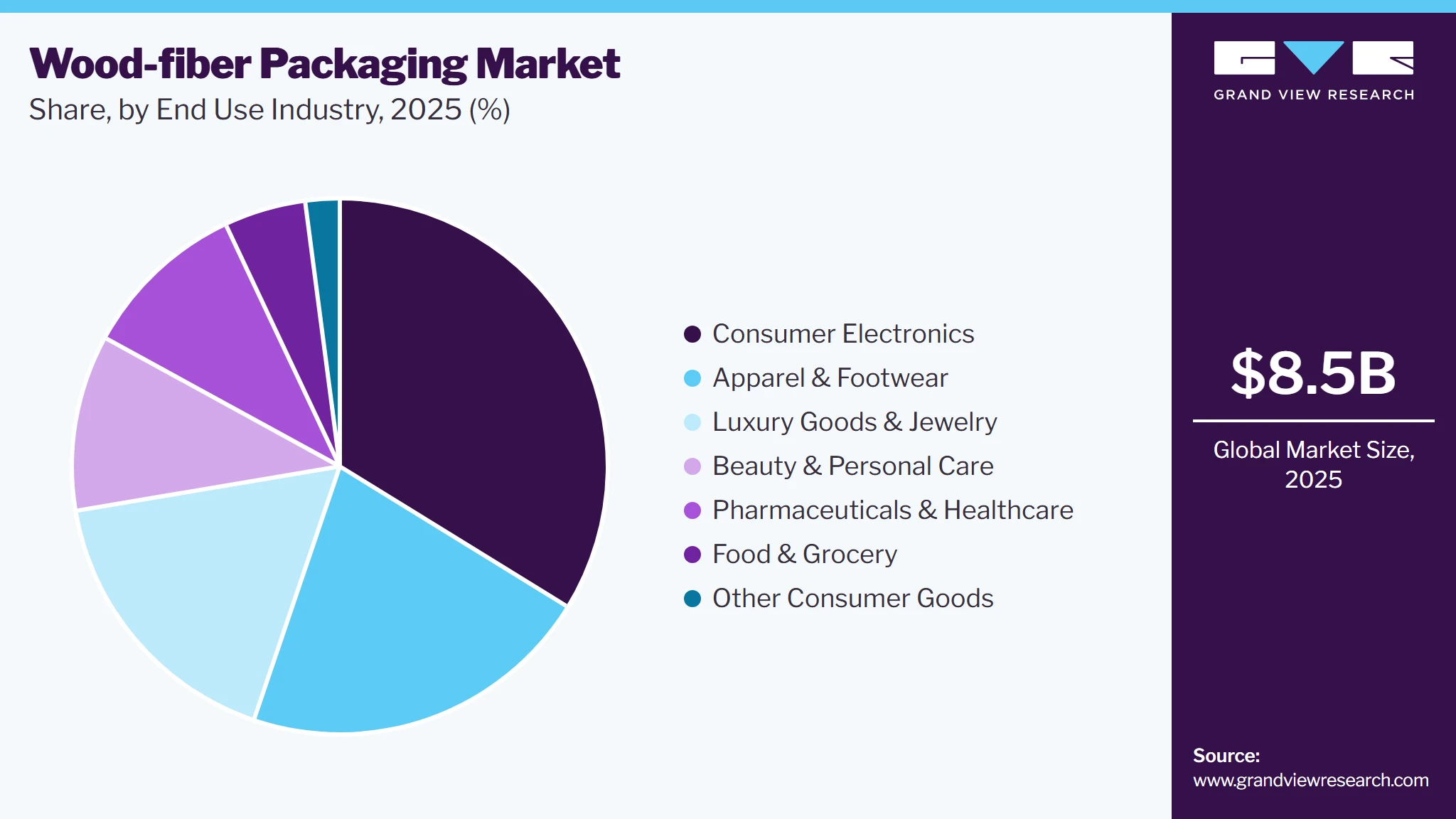
The pharmaceuticals & healthcare is the fastest-growing end use segment, registering a CAGR of 8.6%. The segment's growth is driven by increasing demand for secure, hygienic, lightweight, and sustainable packaging for medicines, medical products, and healthcare supplies. Its market share is expected to rise from 10.0% in 2025 to 10.7% by 2033, supported by expanding healthcare consumption and greater adoption of recyclable fiber-based packaging solutions.
Regional Insights
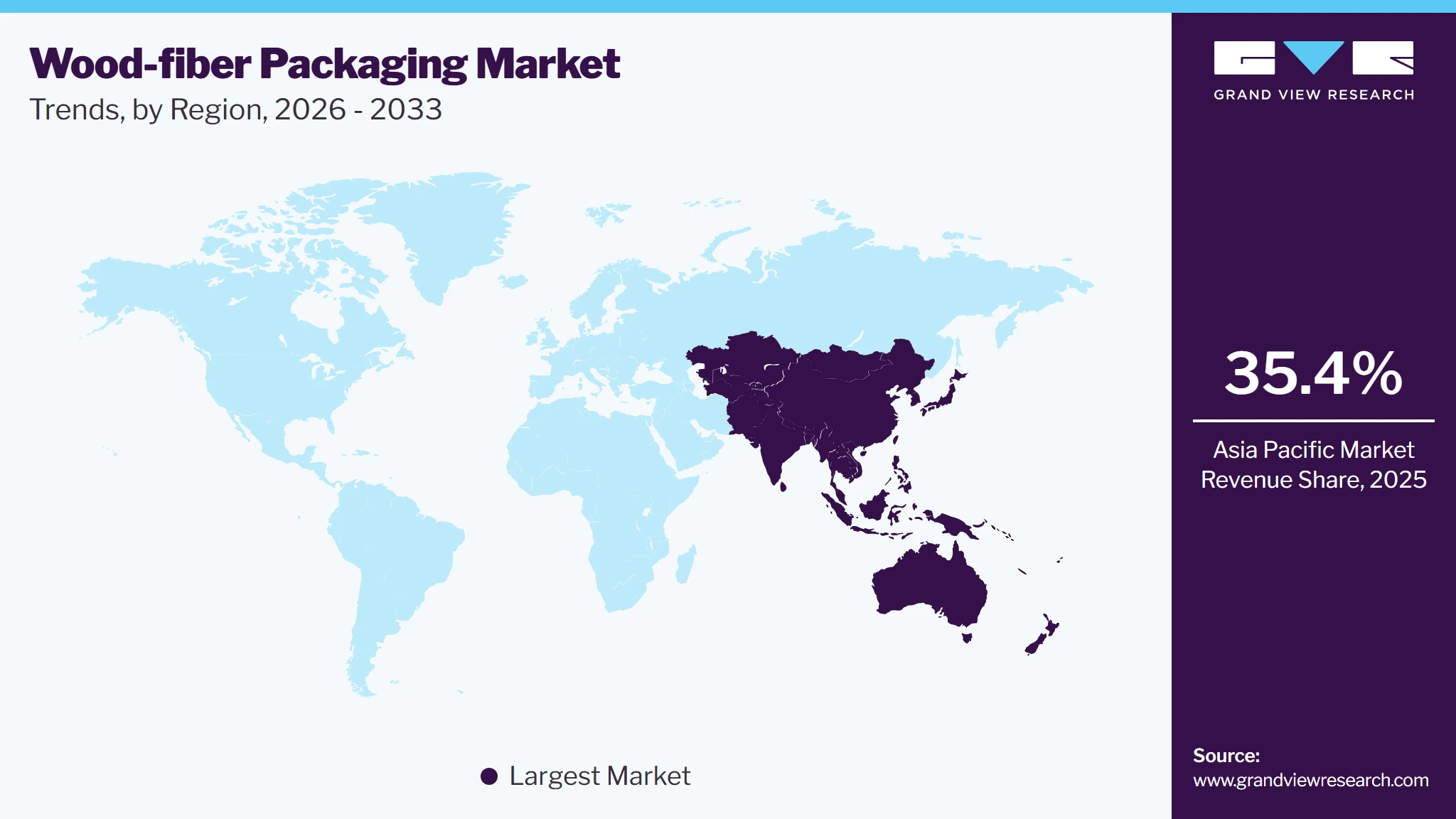
Asia Pacific dominated the global wood-fiber packaging market with a revenue share of 35.4% in 2025 and is also the fastest-growing region, registering a CAGR of 8.4%. The region's leadership is driven by rapid industrialization, expanding e-commerce, large-scale manufacturing of consumer electronics and apparel, and increasing demand for sustainable packaging. Its share is projected to rise to 37.2% by 2033, highlighting the continued strengthening of regional demand. Investments in packaging manufacturing capacity, fiber-based materials, and lightweight recyclable formats are further supporting growth.
China Wood-fiber Packaging Market Trends
The China wood-fiber packaging market represents a leading market within Asia Pacific, supported by its extensive manufacturing base and high production of consumer electronics, apparel, consumer goods, and other packaged products. The expansion of e-commerce and growing emphasis on packaging efficiency are increasing demand for corrugated and other fiber-based solutions. Continued development of sustainable packaging capabilities is expected to support long-term market growth.
The India wood-fiber packaging market is expected to experience strong growth in wood-fiber packaging, supported by expanding manufacturing, e-commerce penetration, rising consumer spending, and increasing demand for sustainable packaging. Growing activity across consumer electronics, apparel, pharmaceuticals, food, and personal care is creating a broader customer base for fiber-based packaging. The country's developing packaging infrastructure and increasing focus on recyclable materials are expected to accelerate adoption.
North America Wood-fiber Packaging Market Trends
The North America wood-fiber packaging market is expected to grow steadily during the forecast period, supported by strong demand for recyclable and lightweight packaging across consumer electronics, apparel, healthcare, and other consumer goods. The region benefits from established packaging infrastructure, advanced converting capabilities, and an increasing emphasis on reducing packaging waste. The market is projected to grow at a 7.6% CAGR, while its share gradually declines from 24.0% in 2025 to 23.6% by 2033 as faster-growing regions expand.
The U.S. wood-fiber packaging market is supported by widespread e-commerce activity, high consumption of consumer electronics and apparel, and increasing adoption of sustainable packaging formats. Manufacturers are focusing on recyclable fiber-based structures, lightweight designs, and improved packaging performance to meet brand and consumer sustainability requirements. Growing demand for protective packaging in healthcare and consumer goods is also expected to contribute to market expansion.
Europe Wood-fiber Packaging Market Trends
Europe represents a major market for wood-fiber packaging, supported by strong sustainability initiatives, established recycling infrastructure, and increasing preference for recyclable packaging materials. Demand is particularly influenced by consumer goods, apparel, luxury products, healthcare, and food-related applications. However, the region's share is expected to moderate from 30.8% in 2025 to 29.6% by 2033, reflecting faster expansion in Asia Pacific and Latin America.
The Germany wood-fiber packaging market accounts for a significant portion of the European wood-fiber packaging market due to its strong manufacturing base, advanced packaging industry, and emphasis on resource-efficient production. Demand from consumer electronics, automotive-related supply chains, pharmaceuticals, and industrial goods supports adoption. Increasing focus on recyclable materials and efficient packaging design is expected to sustain market development.
The UK wood-fiber packaging market is expected to witness steady expansion as retailers, brands, and manufacturers increasingly prioritize recyclable and lightweight packaging. Strong e-commerce activity and demand from apparel, beauty, healthcare, and consumer goods are creating opportunities for corrugated and other fiber-based formats. Continued emphasis on packaging waste reduction is expected to encourage further adoption.
Latin America Wood-fiber Packaging Market Trends
The Latin America wood-fiber packaging market is projected to expand at a CAGR of 8.1%, making it another high-growth regional market. Growth is supported by increasing consumer goods production, e-commerce development, and rising demand for recyclable packaging solutions. The region's market share is expected to increase modestly from 5.9% in 2025 to 6.0% by 2033, indicating gradual expansion within the global market.
The Brazil wood-fiber packaging market represents a significant Latin American market due to its large consumer base, growing manufacturing activity, and expanding retail and e-commerce sectors. Demand for fiber-based packaging is increasing across food and grocery, apparel, consumer goods, and other applications. Investments in sustainable packaging and improvements in recycling and packaging infrastructure are expected to create additional opportunities.
The Argentina wood-fiber packaging market is expected to develop steadily, supported by demand from consumer goods, food and grocery, apparel, and retail applications. Increasing interest in recyclable packaging and the need for lightweight solutions are encouraging the use of fiber-based formats. Growth in domestic manufacturing and retail activity is expected to provide further support during the forecast period.
Middle East & Africa Wood-fiber Packaging Market Trends
The Middle East & Africa wood-fiber packaging market is expected to register steady growth, with a 6.7% CAGR during the forecast period. Demand is supported by expanding retail and consumer goods industries, increasing e-commerce activity, and gradual adoption of sustainable packaging solutions. The region's share is expected to decline slightly from 3.9% in 2025 to 3.6% by 2033, mainly because other regions are growing at a faster pace.
Key Wood-fiber Packaging Company Insights
Some key companies in the Wood-Fiber Packaging market include Stora Enso, Huhtamaki, Metsä Spring, International Paper, Mondi, PAPACKS, Matrix Pack, BFG Packaging, Nordic Woodfibre, and UPM. The market is characterized by sustainable fiber sourcing, paper and paperboard packaging development, molded-fiber innovation, recyclable packaging structures, lightweighting, and development of renewable alternatives to conventional packaging materials. Key participants are focusing on recyclable, renewable, fiber-based, lightweight, and high-performance packaging solutions for consumer electronics, apparel & footwear, luxury goods & jewelry, pharmaceuticals & healthcare, beauty & personal care, and food & grocery applications.
-
Stora Enso is a major renewable materials and packaging company offering fiber-based packaging solutions, including renewable paperboard and corrugated packaging materials. Its portfolio supports applications requiring recyclable, renewable, and lightweight packaging, positioning the company strongly in the transition toward wood-fiber-based packaging solutions.
-
Huhtamaki develops sustainable packaging solutions based on paperboard, molded fiber, and other renewable materials. The company focuses on recyclable, fiber-based packaging for food, consumer goods, and other applications, with an emphasis on material efficiency, product protection, and reduced environmental impact.
Key Wood-fiber Packaging Companies
The following key companies have been profiled for this study on the wood-fiber packaging market.
-
Stora Enso
-
Huhtamaki
-
Metsä Spring
-
International Paper
-
Mondi
-
PAPACKS
-
Matrix Pack
-
BFG Packaging
-
Nordic Woodfibre
-
UPM
Competitive Benchmarking
Category
Operating Strategies
Competitive Edge
Weakness
Established Players (Stora Enso; Huhtamaki; International Paper; Mondi; UPM)
- Expand fiber-based packaging portfolios, invest in sustainable sourcing, recyclable materials, lightweighting, and advanced converting.
- Strong global presence, manufacturing scale, fiber expertise, distribution networks, R&D capabilities, and established customer base.
- High capital investment, exposure to pulp, wood, and energy costs, and ongoing requirements for improved barrier and packaging performance.
Emerging Players (Metsä Spring; PAPACKS; Matrix Pack; BFG Packaging; Nordic Woodfibre)
- Focus on molded fiber, wood-fiber innovation, plastic replacement, customized packaging, and sustainable product development.
- Strong specialization, material innovation, customization, flexibility, and faster response to sustainability-driven customer needs.
- Limited production scale, geographic reach, distribution networks, and financial resources compared with established players.
Recent Development
-
In August 2026, Stora Enso announced plans to further optimize its Nordic production footprint, while continuing to focus its portfolio on renewable materials and packaging solutions made from fresh and recycled fibers. The company’s ongoing packaging strategy supports the transition toward renewable and circular fiber-based materials.
-
In July 2026, Huhtamaki reported continued growth in its Fiber Packaging business, supported by recent investments and increasing opportunities in fiber-based packaging applications. The company highlighted continued investment to capture growth in egg and fruit packaging and to strengthen its position in sustainable fiber packaging.
Wood-fiber Packaging Market Report Scope
Report Attribute
Details
Market size in 2025
USD 8.5 billion
Market size value in 2026
USD 9.1 billion
Revenue forecast in 2033
USD 15.3 billion
Growth rate
CAGR of 7.8% from 2026 to 2033
Base year for estimation
2025
Historical data
2021 - 2024
Forecast period
2026 - 2033
Quantitative units
Revenue in USD million/billion and CAGR from 2026 to 2033
Report coverage
Revenue forecast, company ranking, competitive landscape, growth factors, and trends
Segments covered
Material, security technology, packaging format, end-use industry, region
Regional Scope
North America; Europe; Asia Pacific; Latin America; Middle East & Africa
Key companies profiled
Stora Enso; Huhtamaki; Metsä Spring; International Paper; Mondi; PAPACKS; Matrix Pack; BFG Packaging; Nordic Woodfibre; UPM
Customization scope
Free report customization (equivalent up to 8 analysts working days) with purchase. Addition or alteration to country, regional & segment scope.
Pricing and purchase options
Avail of customized purchase options to meet your exact research needs. Explore purchase options
Global Wood-fiber Packaging Market Report Segmentation
This report forecasts revenue growth at the regional, and country levels and provides an analysis on the latest industry trends and opportunities in each of the sub-segments from 2021 to 2033. For the purpose of this study, Grand View Research has segmented the wood-fiber packaging market report on the basis of material, security technology, packaging format, end-use industry, and region:
-
Material Outlook (Revenue, USD Million, 2021 - 2033)
-
Plastic
-
Paper & Paperboard
-
Metal
-
Textile/Fabric
-
Other Materials
-
-
Security Technology Outlook (Revenue, USD Million, 2021 - 2033)
-
Mechanical Security Features
-
Digital Authentication Technologies
-
Forensic & Covert Technologies
-
-
Packaging Format Outlook (Revenue, USD Million, 2021 - 2033)
-
Corrugated Boxes
-
Poly Mailers
-
Other Packaging Formats
-
-
End-use Industry Outlook (Revenue, USD Million, 2021 - 2033)
-
Consumer Electronics
-
Apparel & Footwear
-
Luxury Goods & Jewelry
-
Pharmaceuticals & Healthcare
-
Beauty & Personal Care
-
Food & Grocery
-
Other Consumer Goods
-
-
Regional Outlook (Revenue, USD Million, 2021 - 2033)
-
North America
-
U.S.
-
Canada
-
Mexico
-
-
Europe
-
Germany
-
France
-
UK
-
Italy
-
Spain
-
-
Asia Pacific
-
China
-
India
-
Japan
-
South Korea
-
Australia
-
-
Latin America
-
Brazil
-
Argentina
-
-
Middle East & Africa
-
Saudi Arabia
-
UAE
-
South Africa
-
-
Research Methodology
The wood-fiber packaging market figures in this report are based on a proven research process that combines executive interviews with secondary research from proprietary databases, company filings, and recognized regulatory and institutional sources. Market size is built through value-chain sizing-reconciling supply-side and demand-side estimates-and triangulated with bottom-up and top-down approaches. Every estimate passes multiple levels of expert validation before publication, with each wood-fiber packaging segment quantified using the revenue-capture definitions in the table below.
Segment Definition
Segment - Material Type
Revenue capture definition
Plastic
Revenue generated from packaging products incorporating plastic materials alongside or within wood-fiber packaging structures to provide flexibility, strength, moisture resistance, barrier properties, or enhanced product protection.
Paper & Paperboard
Revenue is generated from the sale of wood-fiber-based paper and paperboard packaging materials used in corrugated boxes, cartons, protective packaging, bags, and other packaging formats. Includes virgin- and recycled-fiber-based packaging products.
Metal
Revenue generated from packaging solutions incorporating metal components or structures with wood-fiber materials, primarily where additional strength, durability, protection, or barrier performance is required.
Textile/Fabric
Revenue generated from wood-fiber packaging solutions incorporating textile or fabric materials for flexible, protective, reusable, or specialty packaging applications. Includes fiber-based packaging formats requiring enhanced flexibility and handling performance.
Other Materials
Revenue generated from wood-fiber packaging solutions incorporating other materials, coatings, or composite structures used to improve durability, moisture resistance, barrier performance, appearance, or product protection across specialized packaging applications.
Segment - Security Technology
Revenue capture definition
Mechanical Security Features
Revenue generated from wood-fiber packaging incorporates physical security mechanisms such as tamper-evident closures, tear strips, breakable seals, locking structures, security cuts, and protective structural designs. Includes mechanically designed wood-fiber cartons, boxes, trays, and containers intended to prevent unauthorized opening, product substitution, or tampering.
Digital Authentication Technologies
Revenue generated from wood-fiber packaging integrated with digital authentication and traceability technologies, including QR codes, NFC, RFID, serialized identifiers, digital watermarks, and blockchain-enabled tracking systems. Includes packaging solutions enabling product authentication, supply-chain visibility, origin verification, and consumer-level digital verification. Digital traceability is particularly relevant to wood and fiber packaging because it can document the origin of fiber and its supply-chain movement.
Forensic & Covert Technologies
Revenue generated from wood-fiber packaging incorporating hidden or forensic security technologies such as invisible inks, UV/IR markers, microprinting, chemical or material markers, embedded identifiers, and covert authentication elements. Includes security features designed for specialized verification by manufacturers, distributors, investigators, or authorized personnel to detect counterfeiting and unauthorized packaging reproduction.
Segment - Packaging Format
Revenue capture definition
Corrugated Boxes
Revenue generated from the sale of wood-fiber-based corrugated boxes manufactured using wood-derived kraft paper, linerboard, and fluting. Includes regular slotted cartons, die-cut boxes, shipping boxes, mailer boxes, and heavy-duty corrugated containers used for transportation, e-commerce, retail, and industrial packaging.
Poly Mailers
Revenue generated from wood-fiber-based or paper-based mailer formats developed as alternatives to conventional plastic poly mailers. Includes fiber mailers, kraft paper mailers, padded paper mailers, and recyclable fiber-based shipping envelopes used for e-commerce, apparel, documents, and lightweight products.
Other Packaging Formats
Revenue generated from other wood-fiber packaging formats, including molded fiber trays, protective inserts, cushioning components, paper bags, pouches, folding cartons, wraps, containers, and specialty wood-fiber packaging solutions.
Segment - End Use Industry
Revenue capture definition
Consumer Electronics
Revenue generated from wood-fiber packaging used for electronic devices, accessories, components, and related products, including protective boxes, cartons, inserts, and transit packaging.
Apparel & Footwear
Revenue generated from wood-fiber packaging used for clothing, footwear, fashion products, and accessories, including boxes, bags, cartons, and protective packaging formats.
Luxury Goods & Jewelry
Revenue generated from wood-fiber packaging used for luxury products, jewelry, watches, premium accessories, and high-value goods, including premium boxes, cartons, inserts, and presentation packaging.
Pharmaceuticals & Healthcare
Revenue generated from wood-fiber packaging used for medicines, medical devices, healthcare products, and pharmaceutical supplies, including cartons, protective packaging, and fiber-based secondary packaging.
Beauty & Personal Care
Revenue generated from wood-fiber packaging used for cosmetics, skincare, fragrances, toiletries, and personal care products, including cartons, boxes, inserts, and other fiber-based packaging formats.
Food & Grocery
Revenue generated from wood-fiber packaging used for food, beverages, grocery products, and food-service applications, including corrugated boxes, cartons, paper-based containers, and protective packaging.
Other Consumer Goods
Revenue generated from wood-fiber packaging used for other consumer products, including household goods, toys, accessories, and general merchandise requiring protective, lightweight, and recyclable packaging.
Estimation Model
Layer Name
Key Question
Description
End-use Industry Layer
What drives demand?
Estimate demand from key industries including consumer electronics, apparel & footwear, luxury goods & jewelry, pharmaceuticals & healthcare, beauty & personal care, and food & grocery that utilize wood-fiber packaging.
Material Adoption Layer
Which materials are used?
Assess adoption of paper & paperboard, plastic, metal, textile/fabric, and other materials based on packaging performance, sustainability, durability, and product protection requirements.
Packaging Format Layer
Which packaging formats generate demand?
Evaluate consumption across corrugated boxes, poly mailers, and other packaging formats based on application requirements, shipping needs, lightweighting, and recyclability.
Revenue Layer
How is revenue generated?
Revenue is generated through the sale of wood-fiber packaging solutions used across consumer, healthcare, retail, food, and other end-use industries, including protective and transport packaging applications.
Delivered Customizations
We have successfully delivered the following deep-dive customizations
Client Request
Customization Delivered
Value Adds
Competitive Benchmarking
Benchmarking of major players based on fiber-based product portfolio, sustainability initiatives, innovation, manufacturing capabilities, regional presence, and packaging applications
Identifies high-growth regions, regional demand variations, regulatory influences, and expansion opportunities for Wood-Fiber packaging suppliers.
Pricing Analysis
Analysis of pricing trends, raw material costs, product specifications, packaging format, production scale, and regional price variations across fiber-based packaging
Identifies high-potential segment combinations, emerging demand pockets, packaging preferences, and growth opportunities across the cultivated meat value chain.
Trade Assessment
Assessment of import-export trends, trade flows, key exporting and importing regions, raw material availability, supply-chain patterns, and tariff influences for wood-fiber packaging
Provides insights into cost structures, price variations, technology premiums, and competitive pricing strategies to support supplier positioning and procurement decisions.
About the Author(s)
Plastics, Polymers & Resins Research Team
Bulk Chemicals · Plastics, Polymers & ResinsThis report was authored by the plastics, polymers & resins research team at Grand View Research - comprising two research analysts, one senior research analyst, and one industry expert - with specialized expertise in the plastics, polymers & resins segment of the bulk chemicals industry. All findings are based on proprietary bulk chemicals databases, executive interviews, and regulatory analysis, subject to internal peer review prior to publication.
Last Updated:
Speak to Analyst


Customize this report to your needs — add regions, segments, or data points, with 20% free customization.
Or view our licence options:


ISO 9001:2015 & 27001:2022 Certified
We are GDPR and CCPA compliant! Your transaction & personal information is safe and secure. For more details, please read our privacy policy.


