
- Home
- »
- Advanced Interior Materials
- »
-
Additive Manufacturing Equipment Market Size Report, 2033GVR Report cover

Additive Manufacturing Equipment Market (2026 - 2033)
Size, Share & Trends Analysis Report By Technology (Binder Jetting, Metal 3D Printing), By Material (Plastics, Metals), By Application (Production, Repair & Modification), By End-use, By Region, And Segment Forecasts
Market Size, 2025
$21.2BMarket Estimate, 2026
$24.7BMarket Forecast, 2033
$94.8BCAGR, 2026–2033
21.2%Additive Manufacturing Equipment Market Summary
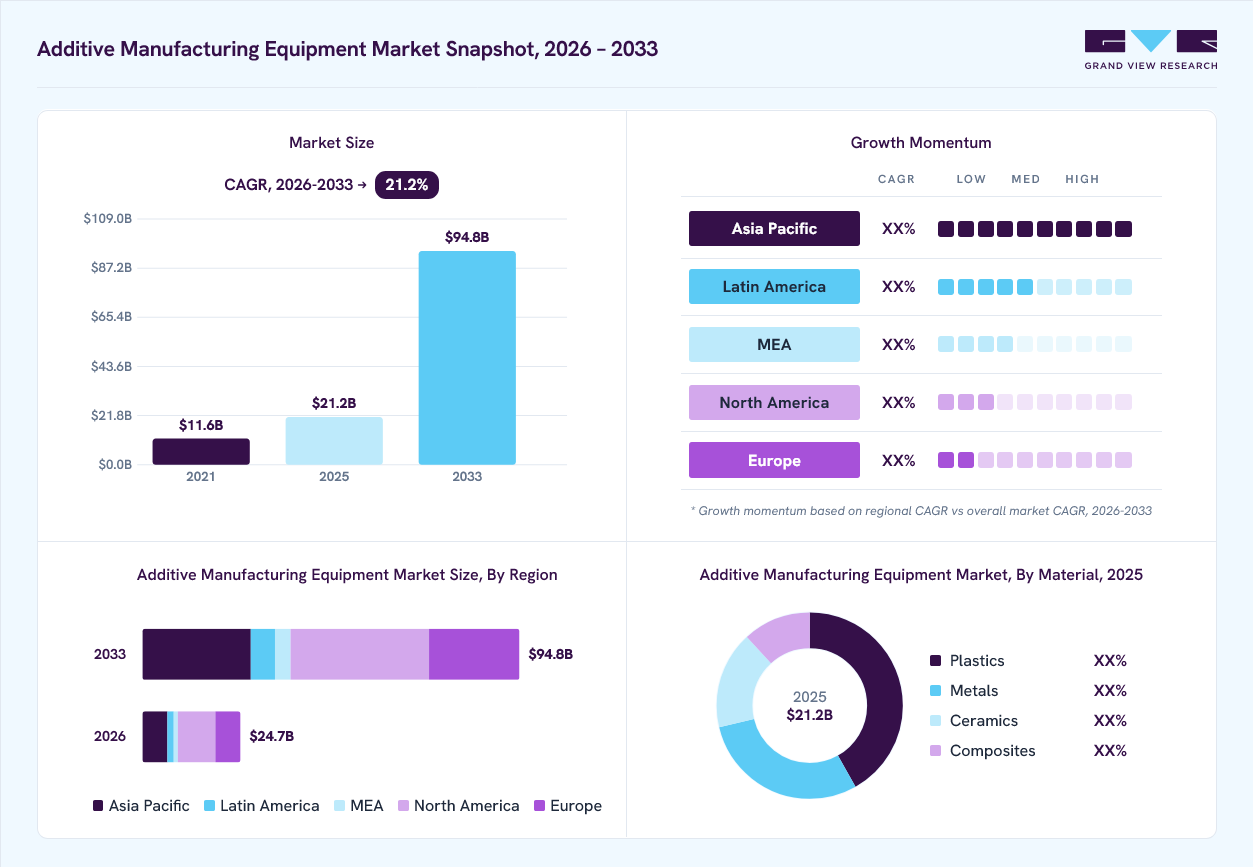
The global additive manufacturing equipment market size was valued at USD 21.2 billion in 2025 and is projected to grow from USD 24.7 billion in 2026 to USD 94.8 billion by 2033, at a CAGR of 21.2% from 2026 to 2033. North America dominated the market, accounting for a revenue share of 38.5% in 2025. The market is witnessing steady expansion, driven by the increasing adoption of 3D printing across industries such as automotive, aerospace, healthcare, and consumer goods.
 Source: Grand View Research, IR Documents, Primary Interviews, Paid DatabasesTo learn more about this report,
 Download Free Sample Report
 Key Market Trends & Insights
- By technology: Fused deposition modeling (FDM) segment led the market with the largest revenue share of 33.5% in 2025.
- By material: Plastics segment led the market with the largest revenue share of 41.8% in 2025.
- By application: Production segment led the market with the largest revenue share of 68.2% in 2025.
- By end use: Automotive segment led the market with the largest revenue share of 28.7% in 2025.
Regional Highlights
- Largest regional market: North America (38.5% revenue share, 2025)
- Fastest-growing regional market: Asia Pacific (highest CAGR, 2026-2033)
- By country: The U.S. held the largest market share in 2025.
Market Size & Forecast
- Market size in 2025: USD 21.2 Billion
- Estimated market size in 2026: USD 24.7 Billion
- Projected market size by 2033: USD 94.8 Billion
- CAGR (2026-2033): 21.2%
Three ways to get this report
Buy it, customize it, or ask a question.Ask an Analyst
Analyst response in 1 business day
- AccessReport author, directly
- Reply timeWithin 1 working day
- No sales callDirect answer only
- FormatEmail reply
- CostFree, no cost
Get the Full Report
What the study covers
- FormatsPDF · Excel · Dashboard
- Timeline2026–2033 annual, 2025 base
- Coverage20+ countries, 5 regions
- Companies10+ key players profiled
Customize the Report
20% free customization
- IncludeCountries, segments, points
- TailorTo your product definition
- ExtendDeeper competitor detail
- OrA fully bespoke study
- Turnaround5–10 working days
These sectors are leveraging additive manufacturing for rapid prototyping, lightweight component production, and design flexibility. Companies are increasingly integrating additive systems into production workflows to reduce lead times and material waste, while also benefiting from the ability to produce customized components on demand.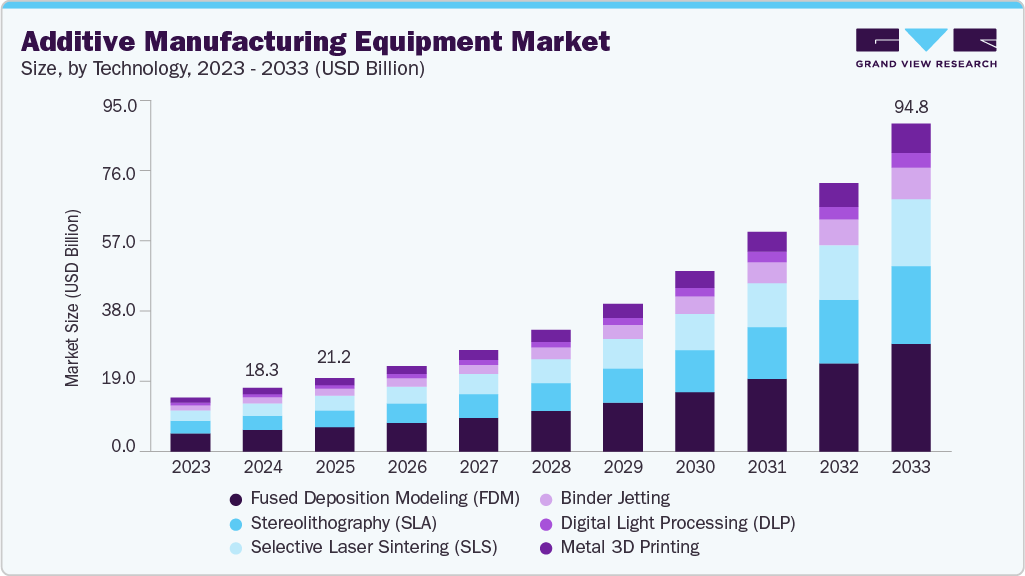 To learn more about this report, Download Free Sample Report
 Government initiatives promoting digital manufacturing and localized production are encouraging broader adoption across small and medium enterprises. As costs continue to decline and material diversity improves, additive manufacturing is transitioning into a mainstream production solution, enabling greater supply chain resilience and on-demand manufacturing flexibility across global industries.
Market Dynamics
The additive manufacturing equipment market is evolving with the increasing adoption of 3D printing technologies across aerospace, automotive, healthcare, and industrial manufacturing sectors. Manufacturers are leveraging additive manufacturing equipment for complex component production, rapid prototyping, lightweight designs, and customized parts while reducing material consumption and production time. Advancements in metal and polymer printing technologies, automation, and software integration are enhancing equipment capabilities and expanding applications beyond prototyping into end-use manufacturing. The shift toward digital manufacturing, smart factory adoption, and flexible production systems is further shaping market development.
The adoption of additive manufacturing equipment is expanding beyond prototyping into end-use production across aerospace, automotive, healthcare, and industrial sectors. Manufacturers are utilizing 3D printing systems to produce lightweight, complex, and customized components while improving design flexibility, reducing material waste, and shortening production cycles. Advancements in metal and polymer printing technologies are further enabling the use of additive manufacturing for functional parts and low-volume industrial production.
The significant capital investment required for industrial-grade additive manufacturing equipment, specialized printing materials, software solutions, and maintenance activities limits adoption among small and medium-sized manufacturers. In addition to equipment acquisition costs, expenses related to post-processing, calibration, material handling, and workforce training increase the overall operational burden. These cost factors can delay implementation, particularly for organizations evaluating additive manufacturing as an alternative to conventional production methods
Increasing adoption of additive manufacturing equipment across healthcare, electric vehicles, aerospace, defense, and customized manufacturing applications is creating new growth opportunities for market participants. The rising demand for patient-specific medical devices, lightweight automotive components, and complex aerospace parts is expanding the use of 3D printing technologies beyond traditional prototyping applications. Furthermore, advancements in advanced materials, automation solutions, and digital manufacturing platforms are improving production efficiency, scalability, and reliability, enabling broader industrial adoption of additive manufacturing systems.
Market Concentration & Characteristics
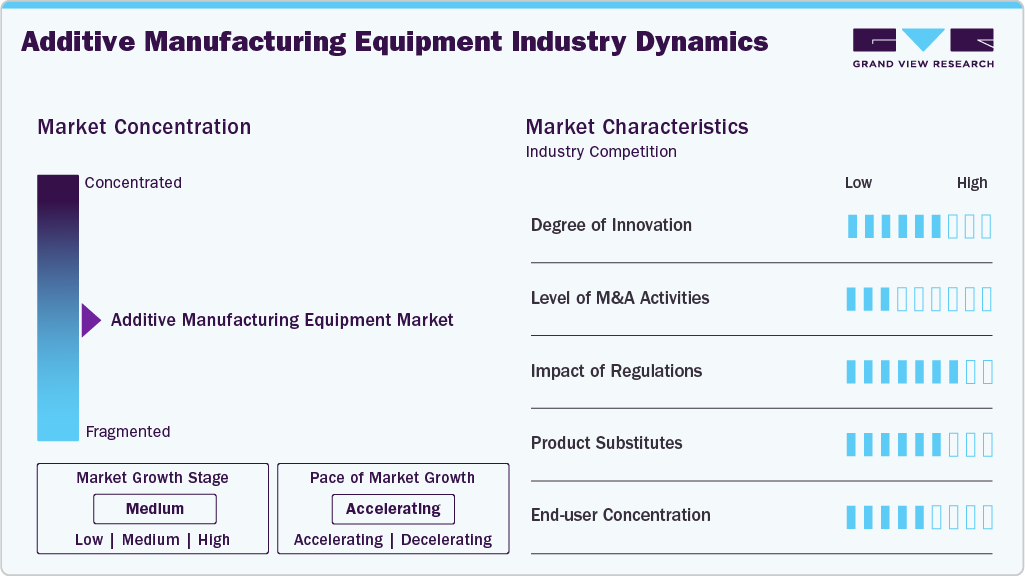
The additive manufacturing equipment industry is moderately concentrated, with a few leading companies such as Stratasys, 3D Systems, EOS GmbH, HP Inc., and GE Additive accounting for a considerable share of global revenue. These firms dominate due to strong R&D capabilities, established client bases in aerospace, healthcare, and automotive sectors, and extensive patent portfolios. However, the market is witnessing growing participation from regional and niche players offering specialized solutions in metal, polymer, and hybrid printing technologies. Consolidation through mergers and strategic alliances continues to shape the competitive landscape, with larger firms acquiring startups focused on new materials and software-driven process optimization.
The global market is innovation-driven and capital-intensive, characterized by rapid technological evolution, high material specialization, and increasing integration with digital manufacturing ecosystems. The shift from prototyping to end-use production has altered purchasing behavior, with customers demanding greater reliability, precision, and throughput. The market also exhibits strong cross-industry relevance, as sectors such as aerospace, defense, automotive, healthcare, and industrial manufacturing all leverage 3D printing for customized and lightweight components. Besides, the industry benefits from a growing base of service bureaus and contract manufacturers, which are expanding accessibility for small and medium enterprises.
 To learn more about this report, Download Free Sample Report
 Regulatory frameworks are evolving to keep pace with additive manufacturing’s industrialization. Standards bodies such as ISO, ASTM International, and SAE are establishing guidelines for process validation, material traceability, and part certification, particularly in aerospace, medical devices, and defense applications. Compliance with these standards is critical for ensuring the consistency and safety of printed parts. Governments in the U.S., the EU, and the Asia-Pacific region are also offering incentives and funding programs for additive manufacturing research and development (R&D), thereby accelerating adoption among domestic manufacturers. However, regulatory uncertainty in emerging markets, especially regarding intellectual property and product qualification, remains a constraint, emphasizing the need for global harmonization of 3D printing standards.
Technology Insights
Based on technology, the fused deposition modeling (FDM) segment led the market with the largest revenue share of 33.5% in 2025. FDM’s widespread use stems from its cost-efficiency, ease of operation, and compatibility with a wide range of thermoplastic materials such as ABS and PLA. It is the preferred technology for prototyping, design verification, and educational applications. The continued development of multi-nozzle and high-speed extrusion systems has enhanced FDM’s productivity and material precision, further solidifying its position as the most widely adopted 3D printing technology globally.
The Stereolithography (SLA) segment is the fastest-growing technology segment, reflecting rapid adoption where high surface finish, fine feature resolution, and precision are required. SLA’s superior part detail, smooth surface quality, and suitability for small, high-tolerance components are driving uptake in dental, jewelry, medical device prototyping, and tooling applications. Continued improvements in resin chemistry, faster curing systems, and reduced post-processing requirements are widening SLA’s use from specialist prototyping into higher-value production niches.
Material Insights
Based on material, the plastics segment led the market with the largest revenue share of 41.8% in 2025. Polymers such as ABS, PLA, and nylon are widely used for prototyping, tooling, and end-use components due to their versatility, low cost, and wide printer compatibility. Continuous innovation in high-performance and engineering-grade thermoplastics, including PEEK and ULTEM, is expanding their adoption in aerospace, automotive, and medical applications.
The metals segment is expected to grow at a significant CAGR of 22.0% from 2026 to 2033 in terms of revenue. Metals such as titanium, stainless steel, and aluminum alloys are increasingly being used to produce lightweight, high-strength parts that meet stringent structural and safety requirements. Continuous improvements in powder-bed fusion technologies and direct energy deposition (DED) processes are enhancing material density, surface finish, and production repeatability. As metal printing becomes more cost-competitive, its role is shifting from prototyping to large-scale manufacturing of critical components, solidifying its position as a key growth driver in the additive manufacturing equipment market.
Application Insights
Based on application, the production segment led the market with the largest revenue share of 68.2% in 2025. This dominance is driven by the accelerating shift from prototyping to end-use part manufacturing, particularly in industries such as automotive, aerospace, and healthcare. Additive manufacturing enables the production of lightweight, geometrically complex, and customized components that traditional methods cannot easily achieve. Continuous advancements in multi-material printing, build speed, and process automation are making additive manufacturing increasingly viable for serial production.
Additive technologies, such as directed energy deposition (DED) and laser metal deposition, are being utilized to restore worn or damaged components, thereby extending the service life of high-value assets in the aerospace, energy, and heavy machinery industries. These methods minimize waste, reduce downtime, and eliminate the need for costly part replacements. As sustainability and circular manufacturing practices gain traction, additive-based repair and modification are emerging as critical applications for reducing lifecycle costs and improving operational efficiency.
End-use Insights
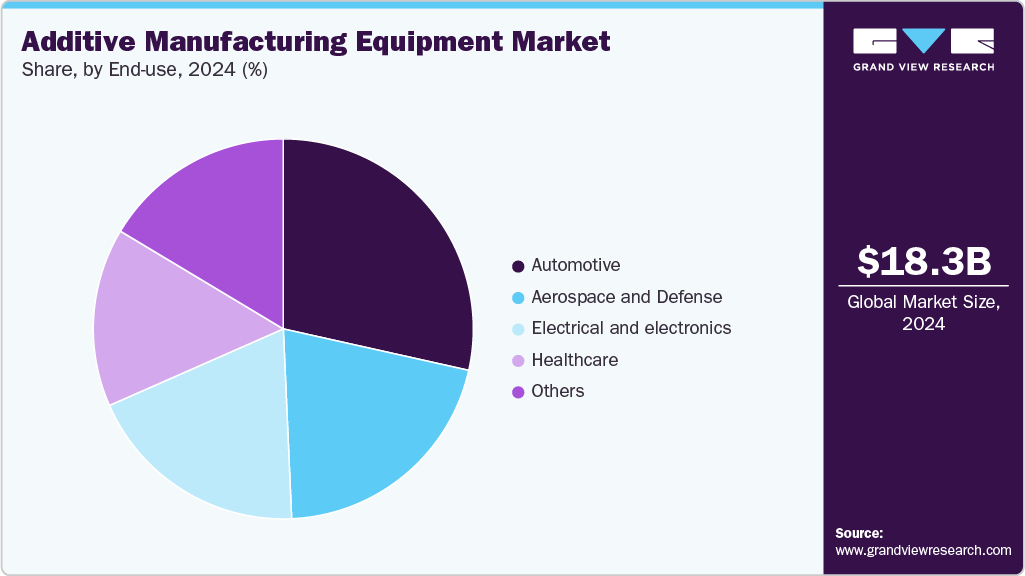
Based on end-use, the automotive segment led the market with the largest revenue share of 28.7% in 2025. Automakers are increasingly integrating 3D printing into prototyping, tooling, and low-volume part production, benefiting from shorter design cycles and material efficiency. The technology’s ability to produce lightweight, complex geometries supports fuel efficiency goals and accelerates innovation in the development of electric and hybrid vehicles.
 To learn more about this report, Download Free Sample Report
 Additive manufacturing enables the production of high-strength, lightweight metal components, thereby optimizing engine performance and minimizing material waste. Continuous advancements in metal powder-bed fusion and electron beam melting technologies are expanding the range of flight-qualified components. The increasing certification of 3D-printed parts by aerospace authorities underscores the sector’s growing reliance on additive manufacturing for both prototyping and end-use component production.
Regional Insights
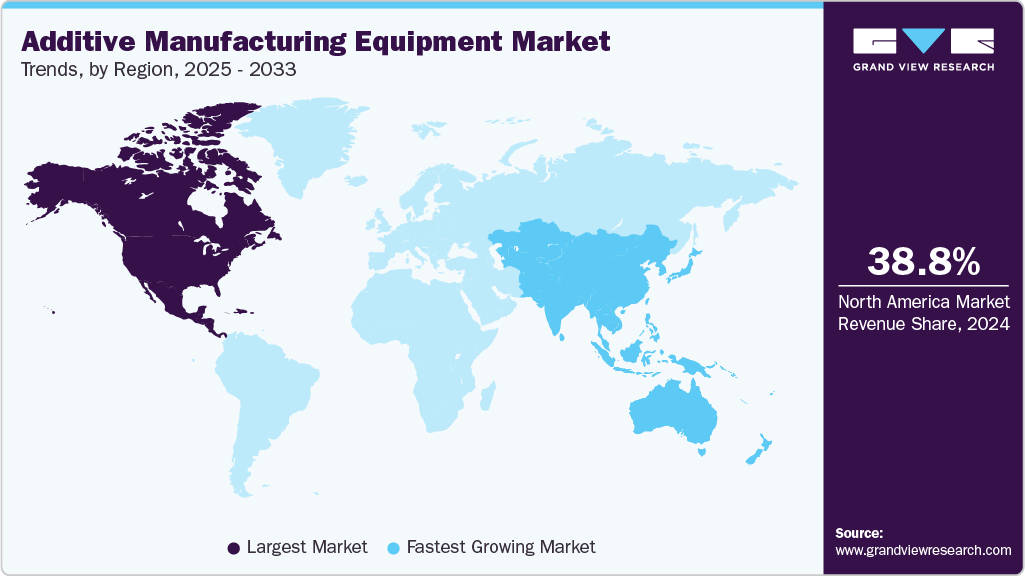
North America dominated the additive manufacturing equipment market with the largest revenue share of 38.5% in 2025, supported by advanced adoption in aerospace, defense, healthcare, and industrial manufacturing. The region benefits from a strong innovation ecosystem, well-established research infrastructure, and robust investment by companies such as Stratasys, 3D Systems, and GE Additive. Ongoing initiatives in supply chain localization and on-demand production are further accelerating growth, particularly in the U.S., where the technology is integral to advanced manufacturing strategies.
 To learn more about this report, Download Free Sample Report
 The additive manufacturing equipment market in U.S. held the largest share in the North America region in 2025. The additive manufacturing equipment industry in the U.S. remains a sizeable national market, driven by its strong industrial base, government-backed innovation programs, and early adoption in aerospace, defense, and healthcare. Major OEMs and service providers leverage 3D printing for production-grade parts, while continued investment in metal additive systems and automation ensures the country’s global technological leadership.
Europe Additive Manufacturing Equipment Market Trends
The additive manufacturing equipment industry in the Europe continues to experience steady growth, driven by the region’s strong regulatory frameworks, sustainability goals, and focus on industrial modernization. Countries such as Germany, the UK, and France are leading adoption through their advanced automotive and aerospace sectors. The European Union’s investment in digital manufacturing, through the Horizon Europe program, is promoting research and development in additive materials, process automation, and quality assurance. Growing emphasis on circular manufacturing and low-carbon production further strengthens regional market expansion.
The Germany additive manufacturing equipment industry gains from deep integration across automotive, engineering, and medical technology sectors. Supported by national Industry 4.0 initiatives, the country emphasizes precision manufacturing, quality certification, and material innovation. German OEMs such as EOS and Siemens continue to advance industrial-scale metal and polymer printing technologies.
The additive manufacturing equipment industry in the UK is expanding steadily, driven by strong academic-industrial collaboration and a focus on aerospace, defense, and medical device production. Government funding through programs like Innovate UK supports R&D in next-generation additive materials and process optimization. Growing emphasis on sustainability and localized manufacturing is fostering adoption across SMEs.
Asia Pacific Additive Manufacturing Equipment Market Trends
The additive manufacturing equipment industry in the Asia Pacific is propelled by rapid industrialization, government-led manufacturing programs, and a robust electronics and automotive base. China, Japan, South Korea, and India are at the forefront of adoption, supported by national strategies promoting Industry 4.0 and smart manufacturing. Lower material costs, expanding domestic production capabilities, and the rise of local printer manufacturers are making Asia Pacific the fastest-growing regional market through 2033.
The China additive manufacturing equipment industry leads the Asia Pacific landscape, supported by aggressive industrial digitalization policies and heavy state-backed investment in 3D printing infrastructure. The country’s manufacturing ecosystem increasingly integrates additive systems for prototyping, tooling, and end-use production. Local players are scaling up metal and large-format printers, making China a key exporter of additive manufacturing equipment.
The additive manufacturing equipment industry in India is rapidly emerging, propelled by initiatives such as the National Strategy on Additive Manufacturing (2022) and rising investment in defense and healthcare applications. The growing network of service bureaus and domestic printer manufacturers is expanding accessibility. Demand is particularly strong in automotive prototyping and industrial tooling.
Middle East & Africa Additive Manufacturing Equipment Market Trends
The additive manufacturing equipment industry in the Middle East & Africa region is emerging as a niche but high-potential market, particularly in the aerospace, construction, and healthcare sectors. The United Arab Emirates and Saudi Arabia are leading the adoption through smart city initiatives and investments in digital industrialization. In Africa, adoption remains in its early stages but is gaining traction through technology transfer partnerships and education-driven awareness. Increasing government support for diversification beyond oil-based economies is expected to create new opportunities for additive manufacturing over the next decade.
The Saudi Arabia additive manufacturing equipment industry is positioning as a key pillar of its Vision 2030 diversification plan, focusing on industrial, defense, and construction applications. Government-backed initiatives and partnerships with global technology providers are establishing local 3D printing hubs. The country’s emphasis on digital industrialization and sustainable infrastructure is accelerating long-term market potential.
Latin America Additive Manufacturing Equipment Market Trends
The additive manufacturing equipment industry in Latin America is witnessing gradual but steady adoption, driven by increasing awareness and pilot-scale industrial integration in countries such as Brazil and Mexico. While high equipment costs and limited technical expertise remain challenges, the regional expansion of multinational manufacturers and university-led research programs is improving accessibility. Growth is expected to strengthen as local industries explore additive technologies for prototyping, spare parts, and small-batch production.
The Brazil additive manufacturing equipment industry represents Latin America’s largest market, with growing adoption in aerospace, energy, and industrial manufacturing. Increased academic collaboration and public-private partnerships are fostering local innovation. While equipment costs and material imports remain challenges, Brazil’s manufacturing modernization programs are expected to boost adoption through the next decade.
Key Additive Manufacturing Equipment Company Insights
Some of the key players operating in the market include Stratasys Ltd and HP Inc.
-
Stratasys Ltd., headquartered in Minnesota, U.S., is one of the world’s prominent manufacturers of polymer-based 3D printing systems. The company is best known for pioneering Fused Deposition Modeling (FDM) and PolyJet technologies, which are widely used across industries such as aerospace, automotive, healthcare, and consumer goods for both prototyping and end-use part production.
-
HP Inc., California, U.S., is a major player in the global additive manufacturing market, recognized for its Multi Jet Fusion (MJF) and Metal Jet technologies. The company leverages its expertise in digital printing and imaging to produce high-throughput, precision 3D printing systems that cater to automotive, healthcare, and consumer product applications. HP’s additive manufacturing solutions are designed for scalable production.
Key Additive Manufacturing Equipment Companies:
The following key companies have been profiled for this study on the additive manufacturing equipment market.
-
Stratasys Ltd
-
3D Systems Corporation
-
HP Inc.
-
General Electric Company
-
MakerBot Industries, LLC
-
Empire Tool Rentals
-
EOS GmbH
-
Nikon SLM Solutions AG
-
Markforged Inc
-
Formlabs
-
Eplus3D
-
DMG MORI
-
MELD Manufacturing Corporation
-
Breton S.p.A.
-
Additive Industries
Competitive Benchmarking
Category
Operating Strategies
Competitive Edge
Weakness
Established Players (e.g., Stratasys Ltd., 3D Systems Corporation, EOS GmbH, HP Inc., General Electric Company (GE Additive))
- Expand additive manufacturing equipment portfolios across polymer, metal, and industrial printing technologies while investing in R&D, automation, materials, and software integration.
- Strengthen market presence through strategic partnerships, global distribution networks, and solutions targeting large-scale industrial production.
- Broad technology portfolios, strong brand recognition, established customer relationships, and global service capabilities.
- Significant R&D capabilities, manufacturing expertise, and ability to support diverse industrial applications.
- High capital requirements for technology development, manufacturing infrastructure, and continuous equipment upgrades.
- Complex operations and pricing pressures due to rapid technological advancements and increasing market competition.
Emerging & Regional Players (e.g., Nikon SLM Solutions AG, Markforged Inc., Formlabs, Desktop Metal, Inc., Additive Industries BV)
- Focus on specialized additive manufacturing solutions, including metal printing, composite systems, and application-specific equipment platforms.
- Leverage innovation, strategic collaborations, and targeted product development to expand adoption in niche industrial segments.
- Greater flexibility in developing customized solutions and faster adoption of emerging printing technologies.
- Strong specialization in specific additive manufacturing processes and ability to address evolving customer requirements.
- Limited manufacturing scale, brand visibility, and global distribution compared with established competitors.
- Higher dependence on specific technology segments and strategic partnerships for market expansion.
Recent Developments
-
In November 2025, Additive Industries launched the MetalFab 420K, a modular metal additive manufacturing (AM) system designed for high productivity and industrial-grade quality in sectors such as aerospace, automotive, space, and high-technology. The machine features four full-field 1 kW lasers operating over a build volume of 420 × 420 × 400 mm, automated alignment and calibration, and a tunable beam‐diameter (100-500 µm) parameter that supports advanced materials and custom process development.
-
In October 2024,Eplus3D launched its EP-M4750, a metal additive manufacturing machine designed for batch production with a build chamber measuring 450 × 750 × 530 mm, enabling the printing of wide and high-precision metal parts for industries such as aerospace, automotive, tooling, and heavy machinery.
Additive Manufacturing Equipment Market Report Scope
Report Attribute
Details
Market size in 2025
USD 21.2 billion
Estimated market size in 2026
USD 24.7 billion
Projected market size by 2033
USD 94.8 billion
Growth rate
CAGR of 21.2% from 2026 to 2033
Base year for estimation
2025
Historical data
2021 - 2024
Forecast period
2026 - 2033
Quantitative units
Revenue in USD billion and CAGR from 2026 to 2033
Report coverage
Revenue forecast, company ranking, competitive landscape, growth factors, and trends
Segments covered
Technology, material, application, end-use, region
Regional scope
North America; Europe; Asia Pacific; Latin America; Middle East & Africa
Country scope
U.S.; Canada; Mexico; Germany; UK; France; Spain; Italy; China; Japan; India; South Korea; Australia; Brazil; Argentina; UAE; South Africa; Saudi Arabia
Key companies profiled
Stratasys Ltd.; 3D Systems Corporation; EOS GmbH; HP Inc.; General Electric Company (GE Additive); Nikon SLM Solutions AG; Markforged Inc.; Formlabs; Desktop Metal, Inc.; Additive Industries BV.
Customization scope
Free report customization (equivalent up to 8 analysts' working days) with purchase. Addition or alteration to country, regional & segment scope.
Pricing and purchase options
Avail customized purchase options to meet your exact research needs. Explore purchase options
Global Additive Manufacturing Equipment Market Report Segmentation
This report forecasts revenue growth at global, regional, and country levels and provides an analysis of the latest industry trends in each of the sub-segments from 2021 to 2033. For this study, Grand View Research has segmented the global additive manufacturing equipment market report based on technology, material, application, end-use, and region:
-
Technology Outlook (Revenue, USD Million, 2021 - 2033)
-
Fused Deposition Modeling (FDM)
-
Stereolithography (SLA)
-
Selective Laser Sintering (SLS)
-
Binder Jetting
-
Digital Light Processing (DLP)
-
Metal 3D Printing
-
-
Material Outlook (Revenue, USD Million, 2021 - 2033)
-
Plastics
-
Metals
-
Ceramics
-
Composites
-
-
Application Outlook (Revenue, USD Million, 2021 - 2033)
-
Production
-
Repair & Modification
-
-
End-use Outlook (Revenue, USD Million, 2021 - 2033)
-
Automotive
-
Aerospace and Defense
-
Electrical and electronics
-
Healthcare
-
Others
-
-
Regional Outlook (Revenue, USD Million, 2021 - 2033)
-
North America
-
U.S.
-
Canada
-
Mexico
-
-
Europe
-
Germany
-
France
-
Italy
-
Spain
-
UK
-
-
Asia Pacific
-
China
-
India
-
Japan
-
South Korea
-
Australia
-
-
Latin America
-
Brazil
-
Argentina
-
-
Middle East and Africa
-
Saudi Arabia
-
UAE
-
South Africa
-
-
Research Methodology
The additive manufacturing equipment market figures in this report are based on a proven research process that combines executive interviews with secondary research from proprietary databases, company filings, and recognized regulatory and institutional sources. Market size is built through value-chain sizing—reconciling supply-side and demand-side estimates—and triangulated with bottom-up and top-down approaches. Every estimate passes multiple levels of expert validation before publication, with each additive manufacturing equipment segment quantified using the revenue-capture definitions in the table below.
Segment Definition
Segment - Technology
Revenue Capture Definition
Fused Deposition Modeling (FDM)
Revenue is captured from the sale of extrusion-based additive manufacturing systems that build components using thermoplastic filament materials.
Stereolithography (SLA)
Revenue is captured from the sale of resin-based additive manufacturing systems that utilize light-curing technology for layer-by-layer part fabrication.
Selective Laser Sintering (SLS)
Revenue is captured from the sale of powder-bed fusion systems that use laser energy to sinter polymer powders into solid parts.
Binder Jetting
Revenue is captured from the sale of additive manufacturing systems that form parts by selectively depositing binders onto powder-based materials.
Digital Light Processing (DLP)
Revenue is captured from the sale of photopolymer-based printing systems that use digital light projection to cure resin materials.
Metal 3D Printing
Revenue is captured from the sale of metal additive manufacturing systems designed for processing metal powders, wires, or feedstock materials.
Segment - Material
Revenue Capture Definition
Plastics
Revenue is captured from additive manufacturing equipment compatible with polymer-based feedstocks, including filaments, resins, and powders.
Metals
Revenue is captured from systems designed for additive manufacturing using metallic materials such as powders, wires, and alloys.
Ceramics
Revenue is captured from equipment capable of processing ceramic materials through additive manufacturing techniques.
Composites
Revenue is captured from additive manufacturing systems engineered for composite material processing, including reinforced polymer formulations.
Segment - Application
Revenue Capture Definition
Production
Revenue is captured from additive manufacturing equipment designed for manufacturing finished parts and components at production scale.
Repair & Modification
Revenue is captured from equipment used for additive material deposition, component restoration, and modification processes.
Segment - End-use
Revenue Capture Definition
Automotive
Revenue is captured through the sale of additive manufacturing equipment to automotive manufacturers and related production facilities.
Aerospace and Defense
Revenue is captured through equipment sales supporting additive manufacturing requirements within aerospace and defense manufacturing operations.
Electrical and Electronics
Revenue is captured through the supply of additive manufacturing systems for electronic component and assembly-related production needs.
Healthcare
Revenue is captured through the sale of specialized additive manufacturing equipment for medical and healthcare manufacturing processes.
Others
Revenue is captured through equipment sales across industrial, research, education, consumer goods, and other non-classified applications.
Estimation Model
Layer Name
Key Question
Description
Additive Manufacturing Demand Layer
Where is additive manufacturing equipment required?
Analyze demand across aerospace, automotive, healthcare, industrial manufacturing, electronics, defense, consumer products, and other sectors. Assess prototyping, tooling, production part manufacturing, customized component production, and rapid manufacturing requirements to establish the addressable demand for additive manufacturing equipment.
Manufacturing Technology Investment Layer
Where is new equipment demand being created?
Evaluate investments in advanced manufacturing facilities, digital production lines, research centers, aerospace and automotive production programs, and industrial automation initiatives. Assess new facility development, production capacity expansion, and replacement of conventional manufacturing processes that drive procurement of new additive manufacturing equipment.
Technology Adoption Layer
Which additive manufacturing technologies are being deployed?
Segment demand by technology type, including fused deposition modeling (FDM), stereolithography (SLA), selective laser sintering (SLS), binder jetting, digital light processing (DLP), metal 3D printing, and other processes. Apply adoption rates based on material compatibility, production volume, part complexity, precision requirements, build speed, and end-use application.
Revenue Generation Layer
How much market revenue is generated?
Estimate annual shipments and revenues generated from the sale of new additive manufacturing equipment by technology type, material capability, application, end-use industry, and region. The scope includes revenues from equipment supplied to manufacturers, research institutions, service bureaus, and industrial users.
Delivered Customizations
This report has been delivered with the following In-depth customizations
Client Request
Customization Delivered
Value Adds
Competitive Benchmarking
A competitive benchmarking analysis was conducted by evaluating additive manufacturing equipment manufacturers based on technology portfolio, printer capabilities, material compatibility, product innovation, production capacity, geographic presence, strategic developments, and competitive positioning.
The analysis enabled stakeholders to understand competitive differentiation, assess equipment capabilities, identify technology gaps, and develop effective strategies for strengthening market presence in the additive manufacturing equipment landscape.
Regional Segmentation
A detailed regional analysis was provided by assessing additive manufacturing equipment adoption, manufacturing infrastructure, industrial automation trends, technology penetration, and equipment demand across major regions and countries.
The regional assessment helped stakeholders identify high-growth markets, evaluate regional adoption patterns, prioritize expansion opportunities, and align equipment offerings with market-specific requirements.
Opportunity Assessment
An opportunity assessment was conducted by analyzing advancements in additive manufacturing technologies, development of high-performance printing systems, increasing adoption of industrial-grade equipment, expansion of material processing capabilities, and integration of automation and digital manufacturing solutions.
The assessment supported stakeholders in identifying future growth areas, prioritizing technology investments, enhancing product development strategies, and capturing opportunities arising from the transition toward advanced manufacturing systems.
Frequently Asked Questions About This Report
The global additive manufacturing equipment market is expected to grow at a CAGR of 21.2% from 2026 to 2033, reaching USD 94.8 billion by 2033.
Fused deposition modeling (FDM) segment led the market with the largest revenue share of 33.5% in 2025.
Plastics segment led the market with the largest revenue share of 41.8% in 2025.
Production segment led the market with the largest revenue share of 68.2% in 2025.
Automotive segment led the market with the largest revenue share of 28.7% in 2025.
The global additive manufacturing equipment market size was valued at USD 21.2 billion in 2025 and is estimated at USD 24.7 billion in 2026.
North America market dominated, with a revenue share of 38.5% in 2025.
Key players include Stratasys Ltd., 3D Systems Corporation, HP Inc., General Electric Company, MakerBot Industries LLC, Empire Tool Rentals, EOS GmbH, Nikon SLM Solutions AG, Markforged Inc., Formlabs, Eplus3D, DMG MORI, MELD Manufacturing Corporation, Breton S.p.A., and Additive Industries.
The key factors driving the additive manufacturing equipment market include the growing demand for lightweight, customizable, and cost-efficient production solutions across industries. Advancements in materials, automation, and multi-material printing technologies are further accelerating large-scale adoption.
About the Author(s)
Advanced Interior Materials Research Team
Advanced Materials · Advanced Interior MaterialsThis report was authored by the advanced interior materials research team at Grand View Research - comprising two research analysts, one senior research analyst, and one industry expert - with specialized expertise in the advanced interior materials segment of the advanced materials industry. All findings are based on proprietary advanced materials databases, executive interviews, and regulatory analysis, subject to internal peer review prior to publication.
Last Updated:
Speak to Analyst

Customize this report to your needs - add regions, segments, or data points, with 20% free customization.
Or view our licence options:


ISO 9001:2015 & 27001:2022 Certified
We are GDPR and CCPA compliant! Your transaction & personal information is safe and secure. For more details, please read our privacy policy.


