
- Home
- »
- Plastics, Polymers & Resins
- »
-
Advanced Recycling of Plastic Packaging Market Report, 2033GVR Report cover

Advanced Recycling of Plastic Packaging Market (2026 - 2033)
Size, Share & Trends Analysis Report By Plastic Type (Polyethylene (PE), Polyethylene Terephthalate (PET), Polypropylene (PP), Polystyrene (PS)), By Feedstock, By Packaging Type, By Technology, By Region, And Segment Forecasts
Market Size, 2025
$4.0BMarket Estimate, 2026
$4.4BMarket Forecast, 2033
$8.3BCAGR, 2026–2033
9.7%Advanced Recycling of Plastic Packaging Market Summary
The global advanced recycling of plastic packaging market size was valued at USD 4.0 billion in 2025 and is projected to grow from USD 4.4 billion in 2026 to USD 8.3 billion by 2033, at a CAGR of 9.7% from 2026 to 2033. The market in Europe dominated with a revenue share of 34.4% in 2025. The market is primarily driven by the growing need to divert plastic packaging waste from landfills and incineration, increasing adoption of advanced recycling technologies, and rising demand for recycled feedstock that can be used in packaging applications.
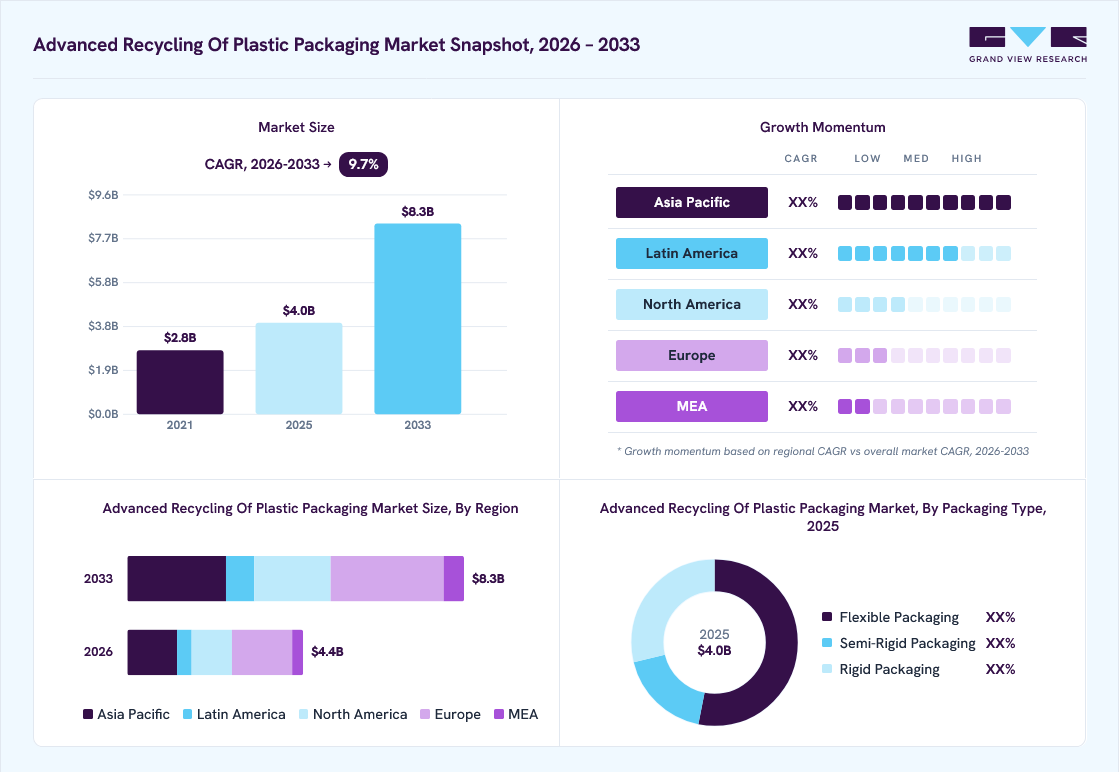 Source: Grand View Research, IR Documents, Primary Interviews, Paid DatabasesTo learn more about this report,
 Download Free Sample Report
 Key Market Trends & Insights
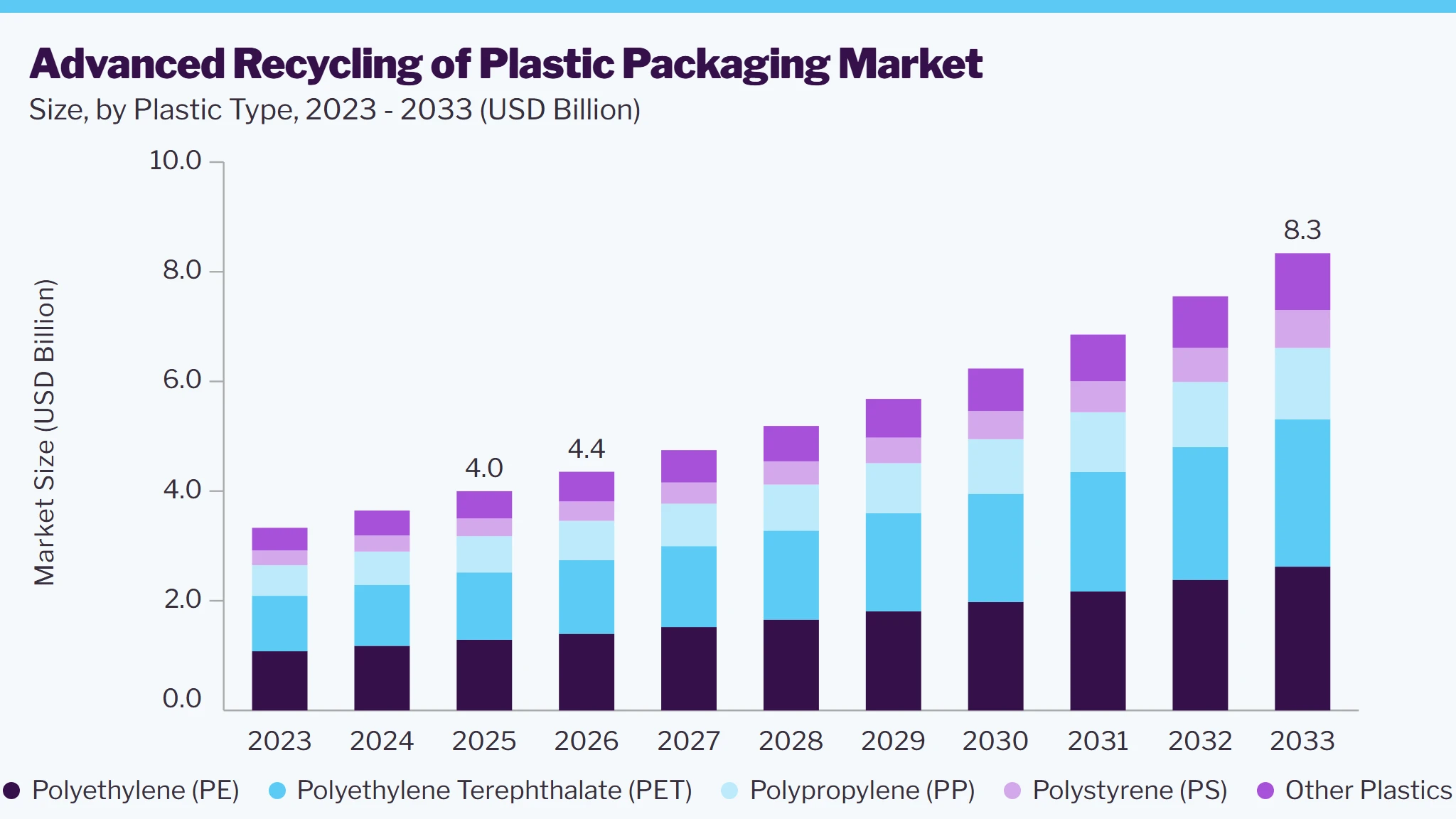
- By plastic type: Polyethylene (PE) segment held the largest market share of 32.2% in 2025.
- By feedstock: Post-consumer packaging waste segment held the largest market share of 79.3% in 2025.
- By packaging type: Flexible packaging segment held the largest market share of 53.0% in 2025.
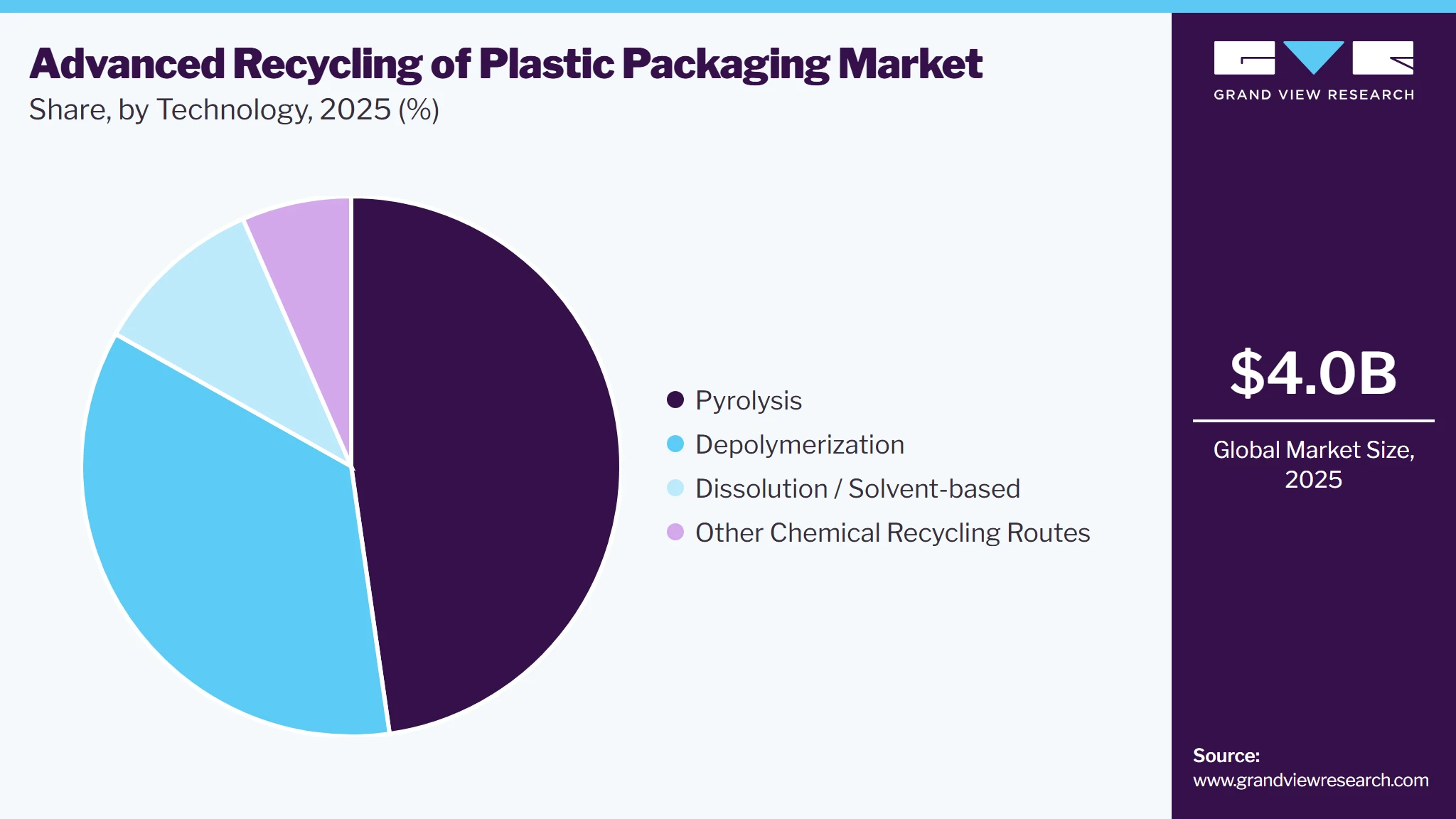
- By technology: Pyrolysis segment held the largest market share of 47.7% in 2025.
Regional Highlights
- Largest regional market: Europe (34.4% revenue share, 2025)
- Fastest-growing regional market: Asia Pacific (highest CAGR, 2026-2033)
- By country: Germany held the largest market share in 2025
Market Size & Forecast
- Market size in 2025: USD 4.0 Billion
- Estimated market size in 2026: USD 4.4 Billion
- Projected market size by 2033: USD 8.3 Billion
- CAGR (2026-2033): 9.7%
Three ways to get this report
Buy it, customize it, or ask a question.Ask an Analyst
A direct answer, usually in 1 working day
- AccessReport author, directly
- Reply timeWithin 1 working day
- No sales callDirect answer only
- FormatEmail reply
- CostFree, no cost
Get the Full Report
What the study covers
- FormatsPDF · Excel · Dashboard
- Timeline2026–2033 annual, 2025 base
- Coverage20+ countries, 5 regions
- Companies10+ key players profiled
Customize the Report
20% free customization
- IncludeCountries, segments, points
- TailorTo your product definition
- ExtendDeeper competitor detail
- OrA fully bespoke study
- Turnaround5–10 working days
The advanced recycling of plastic packaging market is driven by the growing volume of plastic packaging waste and the increasing need for advanced recycling solutions capable of processing waste streams that are difficult to recycle through conventional mechanical methods. As packaging manufacturers, consumer goods companies, and waste management operators increasingly focus on improving plastic recovery rates, there is growing demand for technologies such as pyrolysis, depolymerization, and dissolution/solvent-based recycling. Advanced chemical recycling enables the conversion of complex or contaminated plastic waste into recycled feedstocks that can be reintroduced into plastic production, supporting material recovery and circular plastic supply chains. The rising consumption of flexible packaging, multilayer structures, and other challenging-to-recycle formats is further accelerating demand for advanced recycling technologies.
An increasing focus on recycled-content targets, resource efficiency, and circular economy objectives across global packaging supply chains is expected to boost market growth in the coming years. Industries such as food & beverage, consumer goods, pharmaceuticals, and personal care are increasingly seeking recycled feedstocks that can meet stringent quality and performance requirements while supporting packaging sustainability goals. Post-consumer packaging waste accounted for the largest feedstock share in 2025, reflecting the growing emphasis on recovering value from discarded packaging materials. Regulatory initiatives related to plastic waste reduction, recycling targets, and recycled-content requirements are encouraging investments in advanced recycling infrastructure including chemical recycling infrastructure and improving the integration of recovered materials into packaging supply chains.
 To learn more about this report, Download Free Sample Report
 Technological advancements and the transition toward circular plastic production systems are also significantly contributing to market growth. A defining trend in the advanced recycling of plastic packaging industry is the increasing adoption of advanced recycling technologies for polyethylene (PE), polyethylene terephthalate (PET), polypropylene (PP), polystyrene (PS), and other plastic waste streams. Pyrolysis represented the largest technology segment in 2025, while dissolution/solvent-based recycling is projected to register the fastest growth as recyclers seek more selective approaches for recovering polymers and producing higher-quality recycled materials. At the same time, PET-based chemical recycling is gaining traction for its ability to convert waste into feedstocks for producing new PET materials.
For instance, investments in advanced recycling facilities and the development of commercial-scale depolymerization, pyrolysis, and solvent-based recycling processes are increasing the availability of recycled feedstocks for packaging applications. Such developments are expected to strengthen plastic waste recovery capabilities, improve the supply of recycled polymers, and support the integration of chemically recycled materials into packaging production. The growing adoption of these technologies across post-consumer packaging waste streams is therefore expected to create new opportunities for the advanced recycling of plastic packaging market over the forecast period.
Market Dynamics
The advanced recycling of plastic packaging market is witnessing significant growth, driven by increasing volumes of difficult-to-recycle plastic packaging waste, rising demand for recycled feedstocks, and growing emphasis on circular plastic production. Advanced chemical recycling technologies enable the conversion of post-consumer and post-industrial plastic waste into valuable chemical intermediates, polymers, and hydrocarbon feedstocks that can be reused in new packaging production. Increasing adoption across food & beverage, consumer goods, personal care, and other packaging-intensive industries is supporting market expansion, while the need to improve plastic recovery rates and reduce dependence on virgin materials continues to encourage technological innovation.
The increasing generation of plastic packaging waste worldwide is a key driver of the advanced recycling of plastic packaging market. Conventional mechanical recycling can face limitations when processing contaminated, multilayer, mixed, or degraded packaging materials, creating demand for technologies capable of recovering value from complex waste streams. Advanced chemical recycling processes such as pyrolysis, depolymerization, and dissolution/solvent-based recycling can break down plastic waste into feedstocks suitable for producing new materials, supporting higher-value recovery and circularity in packaging supply chains.
As packaging producers and recyclers seek to increase the availability of recycled materials, investments in advanced recycling infrastructure and commercial-scale processing facilities are increasing. The strong presence of post-consumer packaging waste in the market further reflects the growing focus on recovering materials from discarded packaging. Demand for recycled PE, PET, PP, PS, and other plastic feedstocks is also encouraging technology developers to improve processing efficiency, feedstock flexibility, product quality, and integration with existing polymer production systems.
A significant restraint for the advanced recycling of plastic packaging market is the high capital intensity associated with developing and operating advanced recycling facilities. Commercial-scale chemical recycling plants require specialized reactors, purification systems, sorting and preprocessing infrastructure, and stringent process controls, increasing initial investment and operational complexity. In addition, the availability and consistency of suitable plastic waste feedstock can vary by region, while contamination, mixed polymers, additives, and moisture can affect processing efficiency and output quality. These factors can increase operating costs and create challenges in achieving consistent recycled feedstock production, particularly for emerging projects and smaller recycling operators.
A major opportunity for the advanced recycling of plastic packaging market lies in the expanding adoption of circular plastic supply chains and increasing demand for high-quality recycled feedstocks. Packaging manufacturers and consumer brands are seeking alternatives to virgin plastic while maintaining the performance, safety, and quality requirements of packaging applications. Advanced chemical recycling can create opportunities to convert challenging packaging waste into feedstocks that can be incorporated into new plastic production, particularly for applications requiring consistent material properties. The growing development of pyrolysis, depolymerization, and dissolution-based technologies, along with investments in collection, sorting, preprocessing, and recycling infrastructure, is expected to strengthen the supply of recycled materials and create new commercial opportunities across the plastic packaging value chain.
Market Concentration & Characteristics
The advanced recycling of plastic packaging market is characterized by its technology-intensive and infrastructure-driven nature, supported by increasing volumes of difficult-to-recycle plastic waste and the growing need for advanced material recovery solutions. The industry relies heavily on specialized technologies such as pyrolysis, depolymerization, and dissolution/solvent-based recycling to convert plastic packaging waste into valuable chemical feedstocks and recycled materials. Manufacturers and recycling operators prioritize process efficiency, feedstock flexibility, product quality, and operational scalability, while investments in sorting, preprocessing, purification, and chemical conversion systems remain critical to commercial-scale operations. As packaging producers increasingly seek reliable sources of recycled feedstock, industry participants are developing integrated recycling systems capable of processing post-consumer and post-industrial packaging waste across PE, PET, PP, PS, and other plastic streams.
 To learn more about this report, Download Free Sample Report
 A defining feature of the industry is its dependence on advanced chemical conversion technologies to process plastic waste streams that may be difficult to recycle through conventional mechanical methods. Pyrolysis represents a major technology pathway, while depolymerization and dissolution/solvent-based processes are gaining importance for producing higher-quality and application-specific recycled feedstocks. The industry is also being reshaped by circular economy initiatives, recycled-content targets, and increasing demand for materials that can be incorporated into new packaging production. Investments in commercial-scale recycling facilities, technology development, feedstock collection, and partnerships between recyclers, packaging manufacturers, and petrochemical companies are influencing industry development and investment decisions. At the same time, variations in waste collection infrastructure, feedstock quality, processing economics, and regulatory treatment across regions continue to influence the pace of adoption of chemical recycling technologies.
Analyst Perspective
From an industry perspective, the advanced recycling of plastic packaging market has progressed from an emerging technology area toward commercial-scale advanced recycling, driven by the limitations of mechanical recycling in handling contaminated, multilayer, and mixed plastic packaging waste. Increasing focus on circular economy, recycled feedstock, plastic waste recovery, and recycled-content requirements is strengthening market adoption. Going forward, investments in pyrolysis, depolymerization, solvent-based recycling, feedstock preprocessing, and commercial-scale facilities are expected to support continued expansion, with stronger integration across waste management, chemical production, and packaging value chains.
Plastic Type Insights
The polyethylene (PE) segment led the advanced recycling of plastic packaging market with the largest revenue share of 32.2% in 2025. PE is widely used in flexible films, bags, and pouches, as well as in rigid packaging, generating substantial volumes of packaging waste. Its extensive use across food & beverage, consumer goods, and personal care packaging supports strong feedstock availability for advanced chemical recycling. Advanced recycling technologies can help recover value from contaminated and difficult-to-recycle PE waste, supporting circular plastic production.
The polyethylene terephthalate (PET) segment is expected to grow at the fastest CAGR of 10.4% during the forecast period. PET is extensively used in bottles, containers, trays, and other packaging formats, creating a significant post-consumer waste stream. Depolymerization and other chemical recycling processes can convert PET waste into chemical building blocks for producing new PET, supporting closed-loop recycling. Rising demand for high-quality recycled materials and increasing focus on circular packaging are expected to support PET recycling growth.
Feedstock Insights
The post-consumer packaging waste segment led the advanced recycling of plastic packaging market with the largest revenue share of 79.3% in 2025. The segment includes discarded plastic packaging collected after consumer use, such as films, pouches, containers, and other packaging formats. Growing volumes of post-consumer plastic waste and the limitations of mechanical recycling for contaminated or mixed materials are increasing the need for chemical recycling solutions. Pyrolysis, depolymerization, and solvent-based processes can help recover valuable feedstocks from challenging waste streams, supporting greater plastic circularity.
The post-industrial packaging waste segment is expected to register a CAGR of 7.9% over the forecast period. Growth is supported by increasing recovery of production scrap, off-cuts, rejected packaging, and other manufacturing waste generated during plastic packaging production and converting processes. Advanced recycling technologies enable manufacturers to recover reusable chemical feedstocks and recycled materials from these waste streams, supporting resource efficiency, waste reduction, and circular plastic packaging initiatives.
Packaging Type Insights
The flexible packaging segment led the advanced recycling of plastic packaging market with the largest revenue share of 53.0% in 2025. Flexible packaging includes films, pouches, bags, and multilayer structures that generate substantial volumes of post-consumer plastic waste. Many flexible formats can be challenging to recycle mechanically due to contamination, multilayer construction, and mixed materials, creating demand for advanced recycling solutions. Growing efforts to recover value from difficult-to-recycle packaging waste are supporting the segment's leading position.
The semi-rigid packaging segment is expected to register the second-fastest CAGR of 9.8% over the forecast period. Growth is supported by increasing advanced recycling of plastic trays, tubs, cups, lids, and other semi-rigid packaging formats that are difficult to process in conventional recycling systems. Rising demand for recycled feedstocks, improvements in advanced recycling technologies, and growing emphasis on circular plastic packaging are further supporting segment expansion.
Technology Insights
The pyrolysis segment accounted for the largest revenue share of 47.7% in 2025. Pyrolysis is widely used to convert mixed and difficult-to-recycle plastic packaging waste into hydrocarbon-based feedstocks. Its ability to process contaminated and multilayer plastics supports growing adoption, particularly where mechanical recycling is challenging.
 To learn more about this report, Download Free Sample Report
 The dissolution/solvent-based segment is expected to register the fastest CAGR of 10.5% from 2026 to 2033. The technology selectively dissolves polymers and separates contaminants, enabling the recovery of higher-quality recycled materials. Rising demand for recycled feedstock, advances in solvent-based processes, and increasing focus on circular plastic packaging are supporting its growth.
Regional Insights
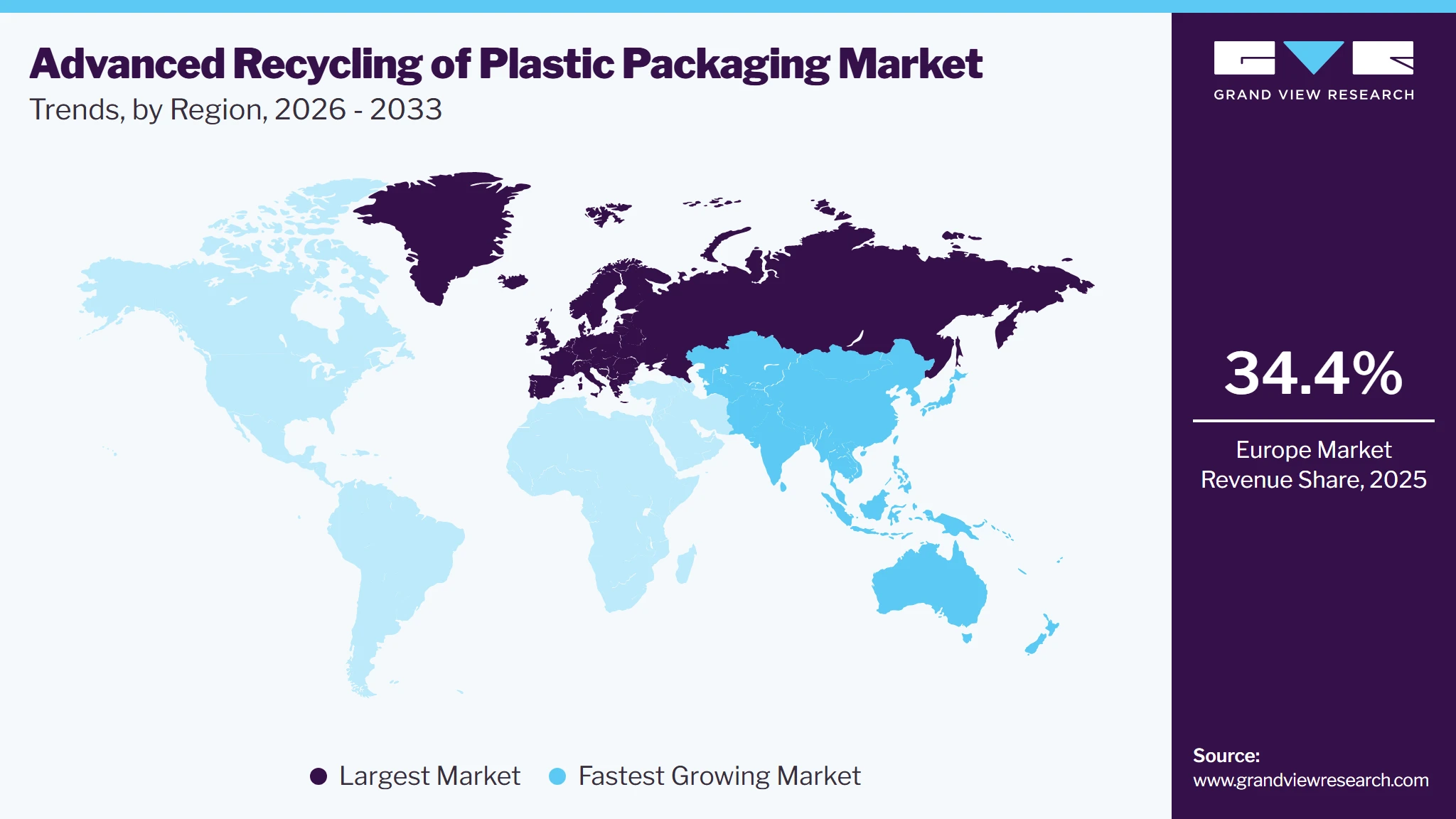
Europe accounted for the largest regional revenue share of 34.4% in 2025 and is expected to maintain its leading position during the forecast period. The region's market is supported by strong circular economy initiatives, established waste management systems, and increasing emphasis on recycled content in plastic packaging. Demand for advanced recycling solutions is particularly relevant for multilayer, contaminated, and other plastic waste streams that are difficult to process mechanically. Investments in advanced recycling capacity and collaboration across the packaging value chain are further supporting regional development.
 To learn more about this report, Download Free Sample Report
 Germany Advanced Recycling of Plastic Packaging Market Trends
Germany represents a significant market within Europe, supported by its well-developed recycling infrastructure, strong packaging manufacturing base, and established chemical industry. Increasing efforts to recover value from complex plastic waste are encouraging interest in pyrolysis, depolymerization, and other advanced recycling technologies. The country's focus on resource efficiency and circular material flows also supports the integration of recycled feedstocks into industrial and packaging applications.
The UK advance recycling of plastic packaging market is expected to develop steadily, driven by increasing attention toward plastic waste recovery and circular packaging systems. Growing investments in advanced recycling infrastructure and demand for recycled materials are creating opportunities for chemical recycling technologies. Manufacturers and waste-management companies are also exploring solutions for flexible and mixed-plastic packaging streams that pose challenges for conventional recycling.
Asia Pacific Advanced Recycling of Plastic Packaging Market Trends
Asia Pacific is expected to register the fastest CAGR of 10.3% from 2026 to 2033. Market growth is supported by rising plastic packaging consumption, expanding manufacturing activity, increasing investment in recycling infrastructure, and growing adoption of circular economy practices. The region's large post-consumer plastic waste base is creating opportunities for pyrolysis, depolymerization, and solvent-based recycling technologies. Expanding packaging production in emerging economies is also increasing demand for recycled feedstocks and advanced waste recovery solutions.
The China advance recycling of plastic packaging represents a major market in Asia Pacific, supported by its large plastics and packaging manufacturing base and substantial generation of plastic waste. Increasing investment in recycling infrastructure and advanced waste-treatment technologies is creating opportunities for advanced recycling. Growing emphasis on resource recovery and the use of recycled materials is also encouraging manufacturers to explore technologies capable of processing complex plastic packaging streams.
The India advanced recycling of plastic packaging market is expected to grow steadily, supported by increasing plastic consumption, expanding packaging production, and ongoing development of waste management infrastructure. Rising investments in recycling facilities and growing interest in recovering value from post-consumer plastic waste are creating opportunities for advanced recycling technologies. Increasing focus on circular material use is also encouraging packaging and chemical industry participants to explore recycled feedstock solutions.
North America Advanced Recycling of Plastic Packaging Market Trends
The North America market is expected to grow steadily during the forecast period, supported by increasing investments in advanced plastic waste recovery technologies and the development of circular packaging systems. Growing demand for recycled feedstocks, improvements in waste collection and sorting infrastructure, and expanding adoption of pyrolysis and depolymerization technologies are supporting regional market expansion. The region's established packaging and chemical industries also provide a strong base for integrating chemically recycled materials into existing production chains.
The U.S. advanced recycling of plastic packaging market is expected to expand throughout the forecast period, driven by rising efforts to recover difficult-to-recycle plastic packaging and increase the availability of recycled feedstock. Investments in commercial-scale advanced chemical recycling facilities, technology development, and partnerships between recyclers, chemical companies, and packaging manufacturers are supporting market development. Increasing interest in circular plastic supply chains is also encouraging the use of advanced recycling technologies for post-consumer packaging waste.
Latin America Advanced Recycling of Plastic Packaging Market Trends
The Latin America advanced recycling of plastic packaging market is projected to expand during the forecast period, supported by rising plastic packaging consumption and increasing efforts to improve waste recovery. Development of recycling infrastructure, investments in waste-management systems, and growing interest in circular packaging are creating opportunities for advanced chemical recycling technologies. The region also offers potential for converting underutilized plastic waste streams into valuable feedstocks for industrial applications.
The Braziladvanced recycling of plastic packaging marketrepresents a significant market in Latin America due to its large consumer base, packaging industry, and growing focus on plastic waste management. Increasing investments in recycling infrastructure and efforts to improve the recovery of post-consumer packaging waste are supporting market development. The expansion of circular economy initiatives is also creating opportunities for advanced chemical recycling technologies to complement conventional mechanical recycling.
The Argentina advanced recycling of plastic packaging is expected to witness gradual growth, supported by increasing attention toward plastic waste reduction and improvements in recycling infrastructure. Growing demand for recycled materials across packaging and industrial applications is creating opportunities for advanced recycling solutions. Development of collection, sorting, and processing capabilities is expected to contribute to the adoption of chemical recycling technologies.
Middle East & Africa Advanced Recycling of Plastic Packaging Market Trends
The Middle East & Africa Advanced Recycling of Plastic Packaging Market is expected to grow during the forecast period, supported by increasing investments in waste management, industrial infrastructure, and circular economy initiatives. The region's established petrochemical sector provides opportunities for integrating recycled plastic feedstocks into existing chemical value chains. Growing efforts to reduce plastic waste and diversify resource utilization are also encouraging interest in advanced recycling technologies, particularly for converting difficult-to-recycle packaging waste into valuable chemical feedstocks.
Key Advanced Recycling of Plastic Packaging Company Insights
Some key companies in the Advanced Recycling of Plastic Packaging Market include Plastic Energy Technology Ltd, Eastman Chemical Company, Exxon Mobil Corporation, SABIC, BASF, TotalEnergies, PureCycle, Brightmark, Carbios, Mura Technology Limited, Licella Holdings Ltd., Ioniqa, and Pyrowave. The market is characterized by advanced chemical recycling technologies, investment in commercial-scale recycling capacity, development of recycled feedstocks, and partnerships across the plastics and packaging value chain. Key participants are focusing on pyrolysis, depolymerization, dissolution, and other advanced chemical recycling routes to process difficult-to-recycle plastic waste and support circular plastic production.
-
Plastic Energy Technology Ltd develops advanced chemical recycling solutions focused on converting difficult-to-recycle plastic waste into feedstock for new plastic production. Its technology is based on thermal conversion and supports the recovery of value from post-consumer plastics that are challenging to process through mechanical recycling, strengthening its role in circular packaging applications.
-
Eastman Chemical Company focuses on molecular recycling technologies that break down plastic waste into molecular building blocks for producing new materials. Its approach supports the recycling of hard-to-recycle plastics while enabling recycled content with performance characteristics suitable for demanding packaging applications.
Key Advanced Recycling of Plastic Packaging Companies:
The following key companies have been profiled for this study on the advanced recycling of plastic packaging market
-
Plastic Energy Technology Ltd
-
Eastman Chemical Company
-
Exxon Mobil Corporation
-
SABIC
-
BASF
-
TotalEnergies
-
PureCycle
-
Brightmark
-
Carbios
-
Mura Technology Limited
-
Licella Holdings Ltd,
-
Ioniqa
-
Pyrowave
Competitive Benchmarking
Category
Operating Strategies
Competitive Edge
Weakness
Established Players (Plastic Energy Technology Ltd; Eastman Chemical Company; Exxon Mobil Corporation; SABIC; BASF; TotalEnergies)
- Scale chemical recycling capacity, advanced recycling technologies, recycled feedstocks, circular polymers, and strategic partnerships.
- Strong global presence, chemical expertise, manufacturing infrastructure, feedstock access, and established customer networks support commercial-scale recycling.
- High capital investment, feedstock quality challenges, technology scale-up requirements, and evolving recycling regulations.
Emerging / Specialized Players (PureCycle; Brightmark; Carbios; Mura Technology Limited; Licella Holdings Ltd.; Ioniqa; Pyrowave)
- Develop specialized depolymerization, purification, pyrolysis, hydrothermal, enzymatic, and microwave recycling technologies for difficult-to-recycle plastics.
- Proprietary technologies, polymer-specific expertise, flexible technology platforms, and focus on high-quality recycled feedstock and circular plastics.
- Smaller scale, limited infrastructure, financing requirements, feedstock availability challenges, and technology commercialization risks.
Recent Development
-
In March 2026, Plastic Energy and TotalEnergies announced the start-up of their joint TEPEAR advanced plastics recycling plant at the Grandpuits complex in France. The facility is designed to process approximately 15,000 tonnes of hard-to-recycle plastic waste annually using Plastic Energy’s chemical recycling technology to produce circular feedstock for new plastics.
-
In February 2026, ExxonMobil’s third advanced recycling unit became operational as the company expanded its chemical recycling capacity in the U.S. The company indicated that its advanced recycling operations were on track to reach approximately 450 million pounds of annual plastic-waste processing capacity during 2026, supporting the production of recycled feedstocks from difficult-to-recycle plastics.
Advanced Recycling of Plastic Packaging Market Report Scope
Report Attribute
Details
Market size in 2025
USD 4.0 billion
Estimated market size in 2026
USD 4.4 billion
Projected market size by 2033
USD 8.3 billion
Growth Rate
CAGR of 9.7% from 2026 to 2033
Base year for estimation
2025
Historical data
2021 - 2024
Forecast period
2026 - 2033
Quantitative units
Revenue in USD Billion/Billion and CAGR from 2026 to 2033
Report coverage
Revenue forecast, company ranking, competitive landscape, growth factors, and trends
Segments covered
Plastic Type, Feedstock, Packaging Type, Technology, Region
Regional Scope
North America; Europe; Asia Pacific; Latin America; Middle East & Africa
Country Scope
U.S.; Canada; Mexico; Germany; France; UK; Italy; Spain; China; India; Japan; South Korea; Australia; Brazil; Argentina; Saudi Arabia; UAE; South Africa
Key companies profiled
Plastic Energy Technology Ltd; Eastman Chemical Company; Exxon Mobil Corporation; SABIC; BASF; TotalEnergies PureCycle; Brightmark; Carbios; Mura Technology Limited; Licella Holdings Ltd; Ioniqa; Pyrowave
Customization scope
Free report customization (equivalent up to 8 analysts working days) with purchase. Addition or alteration to country, regional & segment scope.
Pricing and purchase options
Avail of customized purchase options to meet your exact research needs. Explore purchase options
Global Advanced Recycling of Plastic Packaging Market Report Segmentation
This report forecasts revenue growth at the regional, and country levels and provides an analysis on the latest industry trends and opportunities in each of the sub-segments from 2021 to 2033. For the purpose of this study, Grand View Research has segmented the global advanced recycling of plastic packaging market report on the basis of plastic type, feedstock, packaging type, technology, and region:
-
Plastic Type Outlook (Revenue, USD Billion, 2021 - 2033)
-
Polyethylene (PE)
-
Polyethylene Terephthalate (PET)
-
Polypropylene (PP)
-
Polystyrene (PS)
-
Other Plastics
-
-
Feedstock Outlook (Revenue, USD Billion, 2021 - 2033)
-
Post-consumer Packaging Waste
-
Post-industrial Packaging Waste
-
-
Packaging Type Outlook (Revenue, USD Billion, 2021 - 2033)
-
Flexible Packaging
-
Semi-Rigid Packaging
-
Rigid Packaging
-
-
Technology Outlook (Revenue, USD Billion, 2021 - 2033)
-
Pyrolysis
-
Depolymerization
-
Dissolution / Solvent-based
-
Other Chemical Recycling Routes
-
-
Regional Outlook (Revenue, USD Billion, 2021 - 2033)
-
North America
-
U.S.
-
Canada
-
Mexico
-
-
Europe
-
Germany
-
France
-
UK
-
Italy
-
Spain
-
-
Asia Pacific
-
China
-
India
-
Japan
-
South Korea
-
Australia
-
-
Latin America
-
Brazil
-
Argentina
-
-
Middle East & Africa
-
Saudi Arabia
-
UAE
-
South Africa
-
-
Research Methodology
The advanced recycling of plastic packaging marketfigures in this report are based on a proven research process that combines executive interviews with secondary research from proprietary databases, company filings, and recognized regulatory and institutional sources. Market size is built through value-chain sizing-reconciling supply-side and demand-side estimates-and triangulated with bottom-up and top-down approaches. Every estimate passes multiple levels of expert validation before publication, with eachadvanced recycling of plastic packagingsegment quantified using the revenue-capture definitions in the table below.
Segment Definition
Plastic Type
Revenue capture definition
Polyethylene (PE)
Revenue generated from advanced recycling of polyethylene packaging waste, including PE films, bags, pouches, containers, and other flexible or rigid packaging, through technologies such as pyrolysis, depolymerization, and solvent-based recycling.
Polyethylene Terephthalate (PET)
Revenue generated from advanced recycling of PET packaging waste, including bottles, trays, containers, and other PET formats, using depolymerization and other advanced recycling processes to recover monomers or feedstocks for new PET production.
Polypropylene (PP)
Revenue generated from advanced or advanced recycling of polypropylene packaging waste, including food containers, caps, closures, films, and flexible packaging, to produce recycled feedstocks or polymer-grade materials for new packaging applications.
Polystyrene (PS)
Revenue generated from advanced recycling of polystyrene packaging waste, including food service containers, protective packaging, trays, and other PS products, using depolymerization, pyrolysis, or other chemical recycling processes to recover styrene or hydrocarbon feedstocks.
Other Plastics
Revenue generated from advanced recycling of other plastic packaging materials, including PVC, ABS, polyamide, multilayer plastics, and mixed plastic waste, through specialized chemical recycling technologies to recover chemical feedstocks, monomers, or recycled materials.
Feedstock
Revenue capture definition
Post-consumer Packaging Waste
Revenue generated from the advanced recycling of discarded plastic packaging collected after consumer use, including films, pouches, bottles, containers, trays, and other packaging waste, using technologies such as pyrolysis, depolymerization, and solvent-based recycling to recover chemical feedstocks, monomers, or recycled materials.
Post-industrial Packaging Waste
Revenue generated from the advanced recycling of plastic packaging waste generated during manufacturing, converting, and packaging operations, including production scrap, off-cuts, rejected packaging, and process waste, through chemical recycling technologies to recover reusable feedstocks, monomers, or recycled polymers.
Packaging Type
Revenue capture definition
Flexible Packaging
Revenue generated from the advanced recycling of flexible plastic packaging waste, including films, pouches, bags, wraps, and multilayer structures, through technologies such as pyrolysis, depolymerization, and solvent-based recycling to recover reusable chemical feedstocks or recycled materials.
Semi-Rigid Packaging
Revenue generated from the advanced recycling of semi-rigid plastic packaging waste, including trays, tubs, cups, lids, and similar formats, using chemical recycling technologies to recover monomers, chemical feedstocks, or recycled polymer materials for subsequent packaging applications.
Rigid Packaging
Revenue generated from the advanced recycling of rigid plastic packaging waste, including bottles, containers, jars, drums, and other rigid formats, through pyrolysis, depolymerization, and other advanced recycling processes to produce reusable feedstocks or recycled materials.
Technology
Revenue capture definition
Pyrolysis
Revenue generated from the advanced recycling of plastic packaging waste through thermal decomposition in the absence of oxygen, converting plastics into pyrolysis oil, gases, and other hydrocarbon feedstocks for reuse in plastics and chemical production.
Depolymerization
Revenue generated from advanced recycling processes that break plastic polymers into monomers or chemical building blocks, particularly for PET and other suitable polymers, which can be purified and used to produce new polymers or packaging materials.
Dissolution / Solvent-based
Revenue generated from solvent-based recycling processes that selectively dissolve targeted polymers from plastic packaging waste and separate them from contaminants, additives, or other materials to recover purified polymer feedstocks.
Other Chemical Recycling Routes
Revenue generated from alternative advanced chemical recycling technologies, including hydrothermal, enzymatic, microwave-assisted, and other specialized processes that convert difficult-to-recycle plastic packaging waste into monomers, chemical intermediates, hydrocarbon feedstocks, or reusable polymer materials.
Estimation Model
Layer Name
Key Question
Description
Plastic Packaging Waste Layer
What drives feedstock availability?
Estimate the volume and composition of plastic packaging waste generated across major packaging applications, including flexible, semi-rigid, and rigid formats, with a focus on waste streams suitable for advanced recycling.
Feedstock & Polymer Layer
Which plastic waste streams are processed?
Assess the availability and processing potential of post-consumer and post-industrial packaging waste across PE, PET, PP, PS, and other plastic types used as feedstock for chemical recycling.
Technology Adoption Layer
How is plastic packaging waste chemically recycled?
Evaluate the adoption and processing capacity of pyrolysis, depolymerization, dissolution/solvent-based, and other chemical recycling routes based on feedstock compatibility, process efficiency, recycled output quality, and scalability.
Revenue Layer
How is revenue generated?
Revenue is generated through the processing of plastic packaging waste and the sale of recycled feedstocks, chemical intermediates, monomers, hydrocarbon products, and recycled polymer materials for use in new packaging and other applications.
Delivered Customizations
We have successfully delivered the following deep-dive customizations
Client Request
Customization Delivered
Value Adds
Competitive Benchmarking
Comparative assessment of leading advanced chemical recycling companies based on recycling technology capabilities, feedstock compatibility, processing capacity, polymer coverage, recycled feedstock output, commercial-scale facilities, technology partnerships, regional presence, and circular economy initiatives.
Enables evaluation of competitor positioning, technology differentiation, commercialization capabilities, scalability, feedstock access, and strategic strengths across the advanced chemical recycling value chain.
Cross-Segmentation Analysis
Detailed assessment of market opportunities across combinations of Plastic Type (PE, PET, PP, PS, Other Plastics), Feedstock (Post-consumer Packaging Waste, Post-industrial Packaging Waste), Technology (Pyrolysis, Depolymerization, Dissolution/Solvent-based, Other Chemical Recycling Routes), Packaging Type (Flexible, Semi-Rigid, Rigid), and regional markets.
Helps identify high-growth technology-feedstock combinations, polymer-specific opportunities, regional adoption patterns, demand pockets for recycled feedstocks, and emerging market opportunities.
Pricing Analysis
Assessment of pricing dynamics for recycled feedstocks, pyrolysis oil, recycled polymers, monomers, and other chemical recycling outputs, considering feedstock costs, collection and sorting, preprocessing, energy consumption, processing technology, purification, certification, and regional supply-demand conditions.
Provides insights into cost drivers, technology-related cost differences, recycled material pricing dynamics, cost competitiveness versus virgin plastics, and factors influencing commercial viability across advanced chemical recycling routes.
About the Author(s)
Plastics, Polymers & Resins Research Team
Bulk Chemicals · Plastics, Polymers & ResinsThis report was authored by the plastics, polymers & resins research team at Grand View Research - comprising two research analysts, one senior research analyst, and one industry expert - with specialized expertise in the plastics, polymers & resins segment of the bulk chemicals industry. All findings are based on proprietary bulk chemicals databases, executive interviews, and regulatory analysis, subject to internal peer review prior to publication.
Last Updated:
Speak to Analyst

Customize this report to your needs - add regions, segments, or data points, with 20% free customization.
Or view our licence options:


ISO 9001:2015 & 27001:2022 Certified
We are GDPR and CCPA compliant! Your transaction & personal information is safe and secure. For more details, please read our privacy policy.


