
- Home
- »
- Plastics, Polymers & Resins
- »
-
Algae-Derived Packaging Materials Market Report 2026-2033GVR Report cover
![Algae-Derived Packaging Materials Market (2026 - 2033)Report]()
Algae-Derived Packaging Materials Market (2026 - 2033)
Size, Share & Trends Analysis Report By Algae Source (Brown Macroalgae, Red Macroalgae, Green Macroalgae, Microalgae), By Material, By End-use, By Packaging Product, By Region, And Segment Forecasts
Market Size, 2025
$20.4BMarket Estimate, 2026
$22.8BMarket Forecast, 2033
$51.0BCAGR, 2026–2033
12.2%Algae-derived Packaging Materials Market Summary
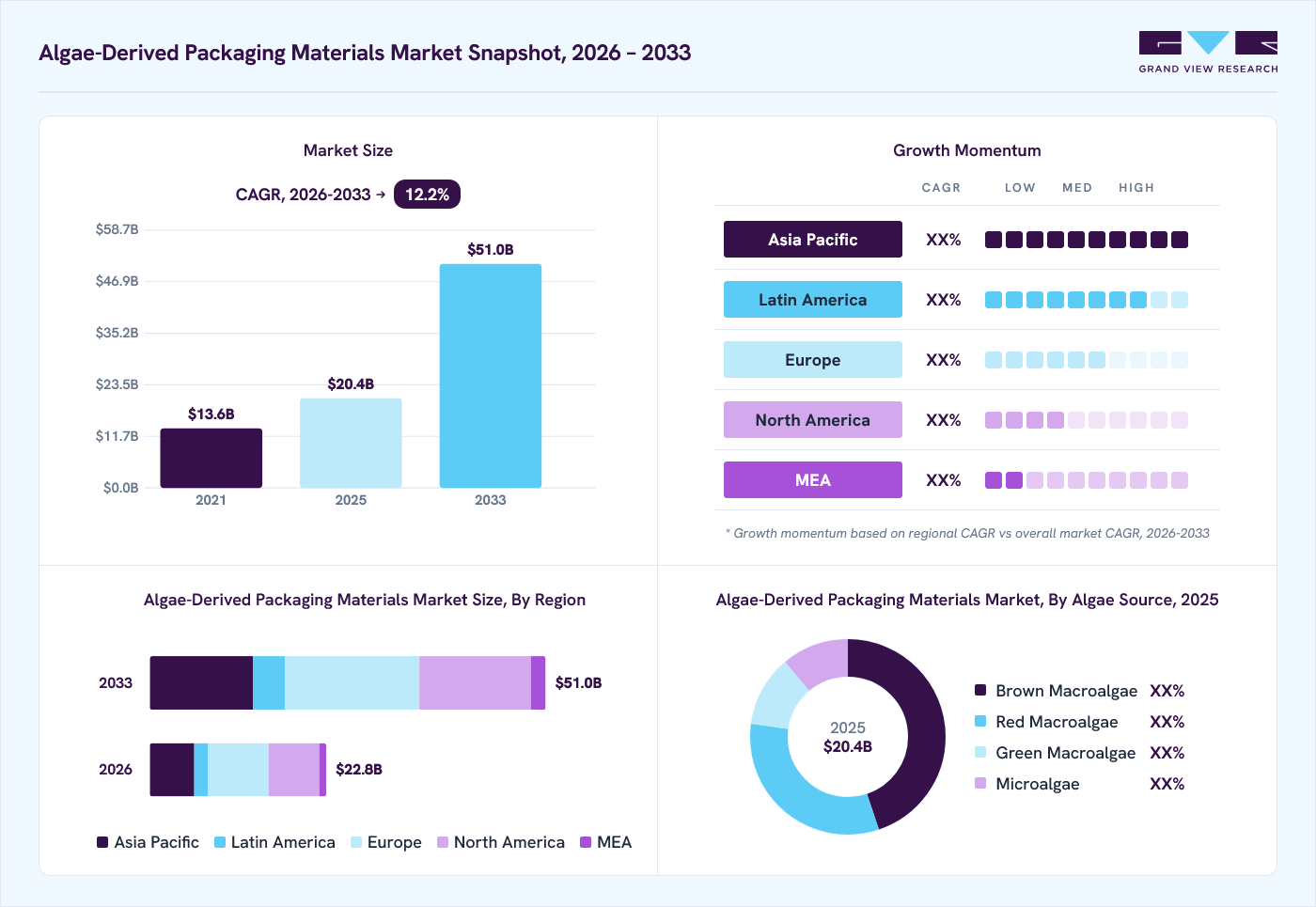
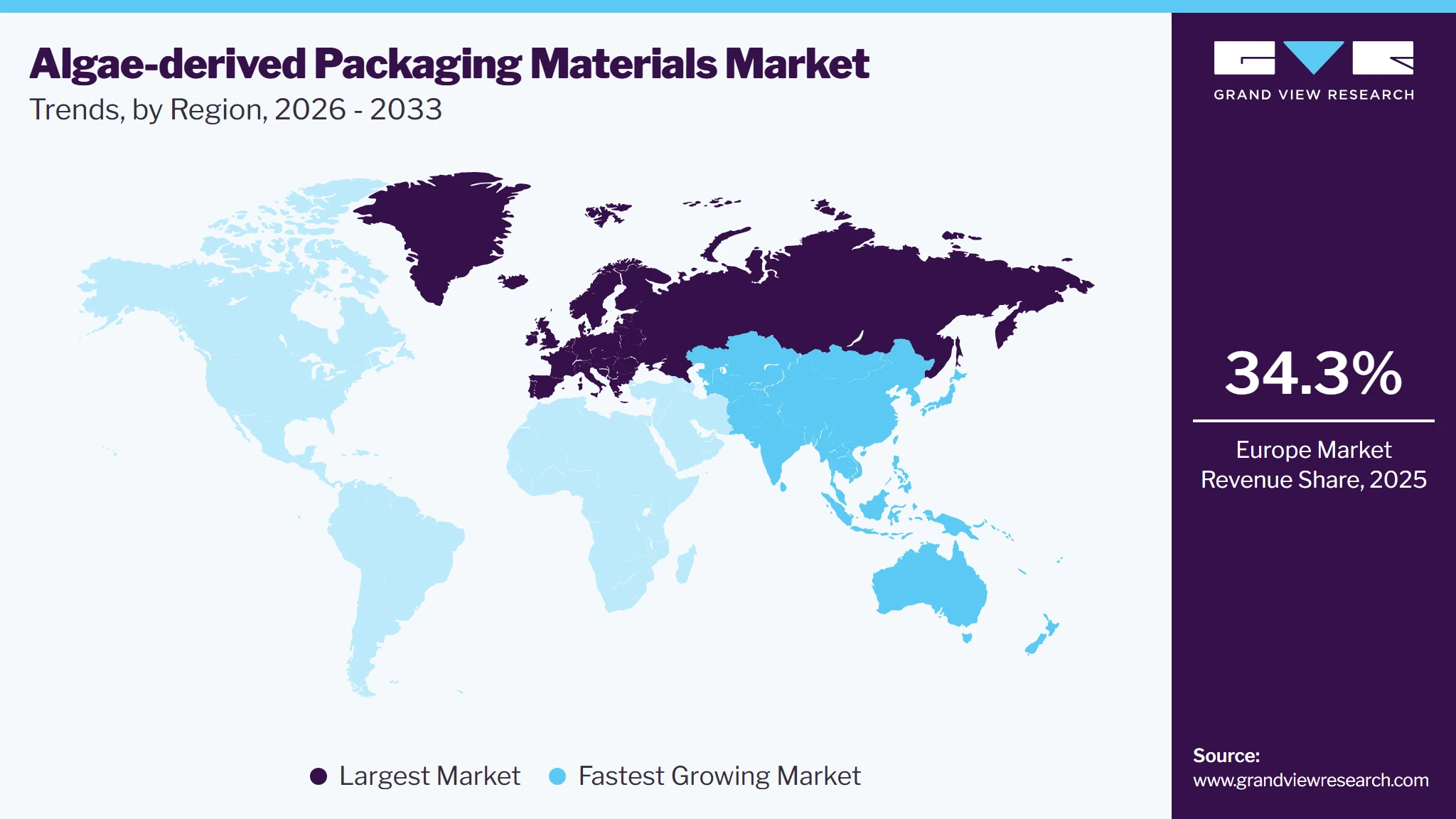
The global algae-derived packaging materials market size was valued at USD 20.4 billion in 2025 and is projected to grow from USD 22.8 billion in 2026 to USD 51.0 billion by 2033, at a CAGR of 12.2% from 2026 to 2033. Europe dominated the market, accounting for the largest revenue share of 34.3% in 2025. The market is primarily driven by the growing demand for sustainable and biodegradable packaging alternatives, increasing regulatory pressure to reduce plastic waste, rising consumer preference for eco-friendly materials, and the expanding adoption of algae-derived materials across food & beverage, cosmetics, pharmaceuticals, and consumer goods packaging.
Key Market Trends & Insights
- By algae source: Brown macroalgae segment held the largest market share of 44.8% in 2025.
- By material type: Seaweed-derived polysaccharide materials segment held the largest market share of 45.6% in 2025.
- By end use: Food & beverage segment held the largest market share of 55.2% in 2025.
- By packaging product: Films & wraps segment held the largest market share of 31.1% in 2025.
Regional Highlights
- Largest regional market: Europe (34.3% revenue share, 2025)
- Fastest-growing regional market: Asia Pacific (highest CAGR, 2026-2033)
- By country: The Germany dominated Europe with the largest revenue share in 2025
Market Size & Forecast
- Market size in 2025: USD 20.4 Billion
- Estimated market size in 2026: USD 22.8 Billion
- Projected market size by 2033: USD 51.0 Billion
- CAGR (2026-2033): 12.2%
The market is supported by increasing investments in sustainable packaging, expanding manufacturing capabilities, and favorable environmental initiatives. The market is driven by the growing demand for sustainable, biodegradable, and renewable alternatives to conventional petroleum-based packaging materials. As food & beverage, cosmetics, pharmaceuticals, personal care, and consumer goods manufacturers increasingly seek to reduce their reliance on fossil-based plastics, algae-derived materials are gaining traction as a versatile feedstock for films, coatings, pouches, trays, and other packaging formats. Brown macroalgae represent the largest segment of the algae market, supported by their abundant availability and suitability for extracting alginates and other functional biopolymers for packaging applications. The expanding development of biodegradable packaging technologies and investments in marine biomass utilization are further accelerating the adoption of algae-derived materials across sustainable packaging supply chains.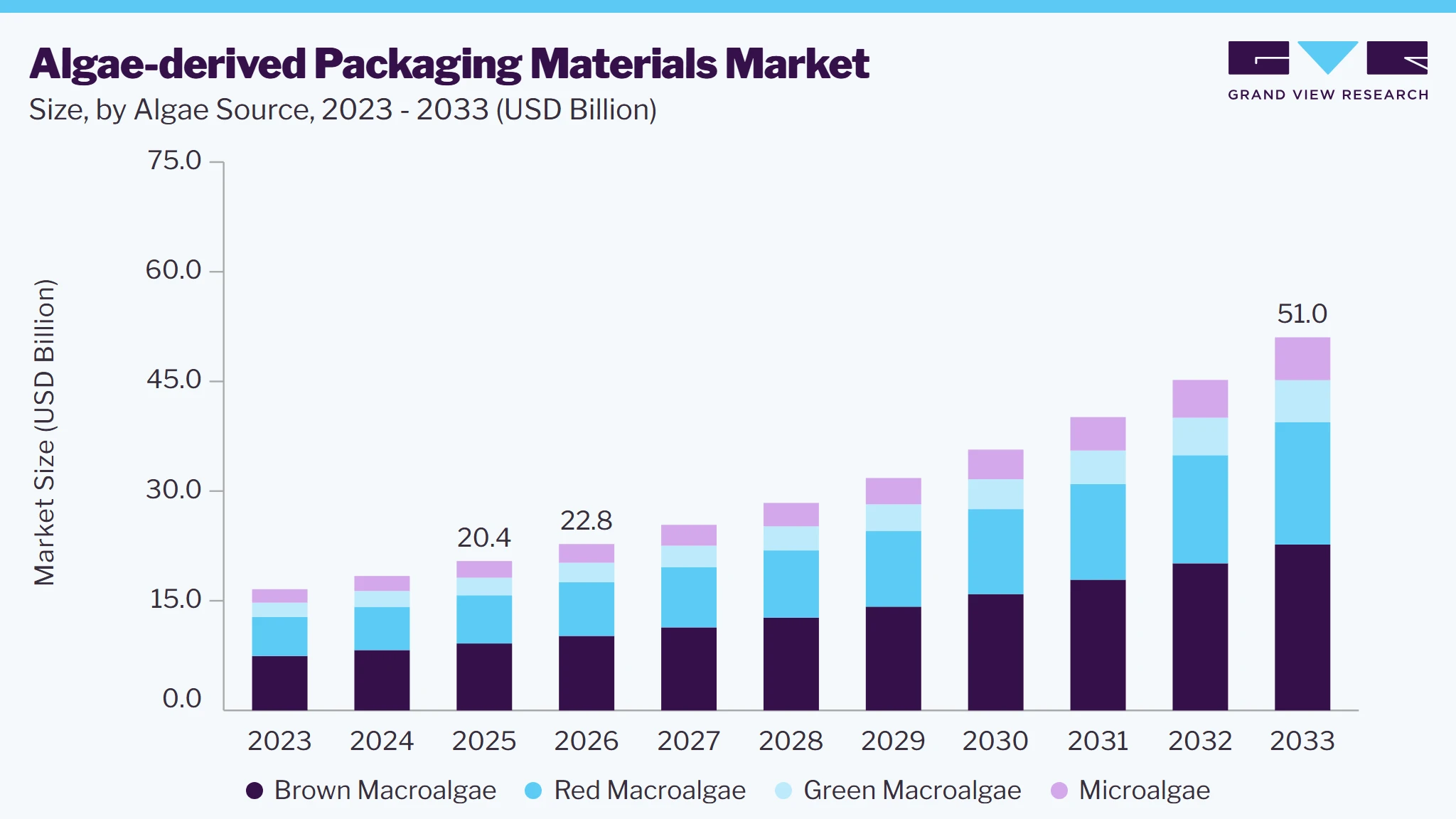
An increasing focus on plastic waste reduction, biodegradability, and regulatory compliance is expected to boost market growth in the coming years. Packaging manufacturers and brand owners are increasingly exploring algae-derived materials as renewable, biodegradable, and potentially compostable alternatives to conventional plastic-based packaging.
Red macroalgae are gaining importance due to their availability of carrageenan and other polysaccharides that can be incorporated into films, coatings, and flexible packaging structures. Similarly, green macroalgae and microalgae are being increasingly evaluated for their functional properties and potential applications in bio-based packaging formulations. Growing consumer preference for low-impact packaging, coupled with government initiatives targeting single-use plastics and packaging waste, is encouraging manufacturers to incorporate algae-derived feedstocks into commercial packaging solutions.
Sustainability initiatives and the transition toward bio-based and circular packaging systems are also significantly contributing to market growth. A defining trend in the algae-derived packaging materials industry is the increasing use of diverse algal sources to develop renewable packaging materials with improved biodegradability and reduced dependence on fossil-based feedstocks.
Green macroalgae and microalgae are emerging as important sources, with their respective market values projected to reach USD 5.8 billion by 2033. This diversification is being reinforced by advances in algae cultivation, biomass processing, biopolymer extraction, and material formulation technologies. Such developments are expected to improve the scalability and commercial viability of algae-derived packaging materials, supporting their broader adoption across food, beverage, personal care, pharmaceutical, and consumer goods packaging applications.
Market Dynamics
The algae-derived packaging material industry is expanding rapidly, primarily driven by rising demand for sustainable, biodegradable, and renewable alternatives to conventional petroleum-based plastics across food & beverage, cosmetics, pharmaceuticals, personal care, and consumer goods packaging applications. Algae-derived materials are gaining attention for their renewable feedstock characteristics, potential biodegradability, and ability to be processed into films, coatings, pouches, trays, and other packaging formats. However, market growth is influenced by challenges related to large-scale algae cultivation, biomass processing costs, material performance, and the availability of consistent raw materials. These developments, combined with increasing restrictions on single-use plastics and advances in algae processing and biopolymer extraction technologies, are reshaping the future growth trajectory of the market.
The increasing demand for sustainable and biodegradable packaging materials is a major driver for the algae-derived packaging material industry. Food & beverage, cosmetics, personal care, pharmaceutical, and consumer goods manufacturers are increasingly shifting toward renewable packaging feedstocks to reduce dependence on petroleum-based plastics and address growing concerns regarding packaging waste. Algae-derived materials offer potential advantages such as renewability, biodegradability, and compatibility with films, coatings, pouches, trays, and other packaging formats, making them attractive for companies pursuing sustainable packaging strategies.
Growing consumer awareness of plastic pollution, corporate sustainability commitments, and regulatory initiatives to reduce single-use plastics are further strengthening demand for algae-based packaging solutions. The availability of diverse algae sources, particularly brown macroalgae, which reached approximately USD 9.2 billion in 2025, is also supporting market expansion. Continued investments in algae cultivation, biopolymer extraction, and material formulation are expected to improve the availability and functionality of algae-derived packaging materials, enabling their adoption across a broader range of packaging applications.
High production costs and limited large-scale commercialization remain major constraints on the algae-derived packaging materials industry. Algae cultivation, harvesting, drying, extraction, and processing require specialized infrastructure and can increase overall material costs. Maintaining consistent biomass quality and supply can also be challenging for large-scale packaging manufacturers. In addition, algae-based materials may exhibit lower moisture resistance, mechanical strength, and thermal performance than conventional plastics. These factors can restrict adoption in cost-sensitive packaging applications.
Advancements in algae cultivation, processing, and biopolymer extraction technologies are creating significant opportunities for market participants. Improved material formulations can enhance the strength, flexibility, barrier properties, and durability of algae-derived packaging. The increasing utilization of brown, red, and green macroalgae and microalgae is also expanding the available feedstock base. Growing applications in food packaging, flexible packaging, coatings, cosmetics, and pharmaceutical packaging provide additional growth opportunities. Continued technological innovation and sustainability-focused investments are expected to accelerate commercial adoption.
Market Concentration & Characteristics
The algae-derived packaging material industry is rapidly evolving and innovation-driven, supported by increasing demand for renewable and biodegradable alternatives to conventional petroleum-based packaging materials. The industry is increasingly focused on developing algae-based films, coatings, pouches, trays, and other packaging formats for food & beverage, cosmetics, pharmaceuticals, and personal care applications. Manufacturers are prioritizing material performance, scalability, cost optimization, and improvements in barrier properties to achieve greater commercial viability. The availability of diverse feedstocks, particularly brown macroalgae, is supporting industry development, while investments in algae cultivation, biomass processing, and biopolymer extraction are helping expand production capabilities.
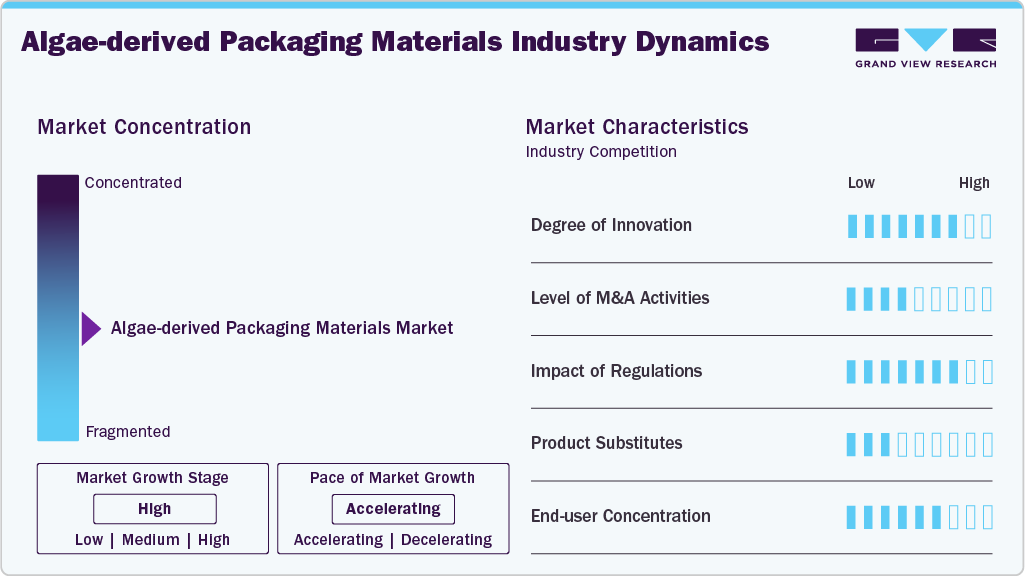
A defining feature of the industry is its reliance on macroalgae and microalgae-derived biopolymers, including alginates, carrageenan, and other functional compounds that can be incorporated into packaging formulations. However, higher production costs, limited processing infrastructure, and challenges related to moisture resistance and mechanical performance remain important considerations compared with established plastic materials. Growing restrictions on single-use plastics, corporate sustainability commitments, and consumer preference for eco-friendly packaging are accelerating investment in algae-based alternatives. Technological advancements in algae cultivation, extraction, formulation, and material processing are expected to improve performance and cost competitiveness, supporting wider adoption across sustainable packaging applications.
Analyst Perspective
The algae-derived packaging material market has evolved from a niche sustainable-materials concept into an emerging commercial packaging segment, driven by growing concerns about plastic waste and demand for renewable alternatives. Advancements in algae cultivation, biopolymer extraction, and material formulation have improved the viability of algae-based films, coatings, composites, and bioplastics. The market is driven by sustainability regulations, consumer preferences, and increasing adoption across food & beverage, personal care, and consumer goods packaging.
Algae Source Insights
The brown macroalgae segment led the market with the largest revenue share of 44.8% in 2025, driven by abundant availability and extensive use as a source of alginates and other bio-based compounds for packaging applications. Brown macroalgae-derived materials are increasingly used in films, coatings, pouches, and other sustainable packaging formats due to their renewable and biodegradable properties. Growing investments in algae cultivation and biopolymer extraction, along with increasing demand for alternatives to conventional plastics, are further supporting the dominance of brown macroalgae in the market.
The microalgae segment is anticipated to grow at the fastest CAGR of 12.6% from 2026 to 2033, supported by increasing research into microalgae-derived biopolymers, proteins, lipids, and functional compounds for advanced packaging formulations. Its market share is projected to increase from 11.2% in 2025 to 11.5% by 2033, reflecting growing interest in high-value, multifunctional bio-based materials. Advancements in microalgae cultivation, biomass processing, and material formulation are expected to further enhance their application potential across food, beverage, cosmetics, and other sustainable packaging applications.
Material Insights
The seaweed-derived polysaccharide materials segment led the market with the largest revenue share of 45.6% in 2025, due to their extensive use in biodegradable films, coatings, pouches, and other sustainable packaging formats. Materials such as alginates and carrageenan provide favorable film-forming and functional properties, making them suitable for replacing conventional petroleum-based packaging in several applications. Growing demand for renewable materials, rising concerns about plastic waste, and expanding investments in seaweed processing are further supporting the segment’s market dominance.
The algae-derived bioplastic resins segment is anticipated to grow at the fastest CAGR of 12.8% from 2026 to 2033, supported by increasing demand for bio-based alternatives to conventional plastic resins. Growing investments in algae-derived polymer development, improvements in material performance, and rising adoption of sustainable packaging across food & beverage, cosmetics, and consumer goods applications are expected to further accelerate segment growth.
Packaging Product Insights
The films & wraps segment led the market with the largest revenue share of 31.1% in 2025, owing to its broad applications in packaging for food, beverage, personal care, and consumer goods. Algae-derived films and wraps offer renewable and biodegradable alternatives to conventional flexible plastic packaging, while their lightweight and versatile characteristics support growing adoption. Increasing demand for sustainable flexible packaging and advancements in algae-based film formulations are further strengthening the segment’s market position.
The capsules/pods/dissolvable formats segment is anticipated to grow at the fastest CAGR of 12.9% from 2026 to 2033, supported by growing demand for convenient, portion-controlled, and low-waste packaging solutions. Increasing applications in food, beverages, nutraceuticals, personal care, and other dissolvable product formats, combined with growing interest in biodegradable packaging, are expected to accelerate growth in the segment.
End Use Insights
The food & beverage segment led the market with the largest revenue share of 55.2% in 2025, driven by the growing adoption of sustainable packaging for food products, beverages, fresh produce, and processed foods. Algae-derived materials offer renewable and biodegradable characteristics, making them suitable for films, coatings, pouches, and other food packaging applications. Growing consumer demand for eco-friendly packaging, coupled with increasing efforts by food manufacturers to reduce plastic use, is further supporting the segment's dominance.
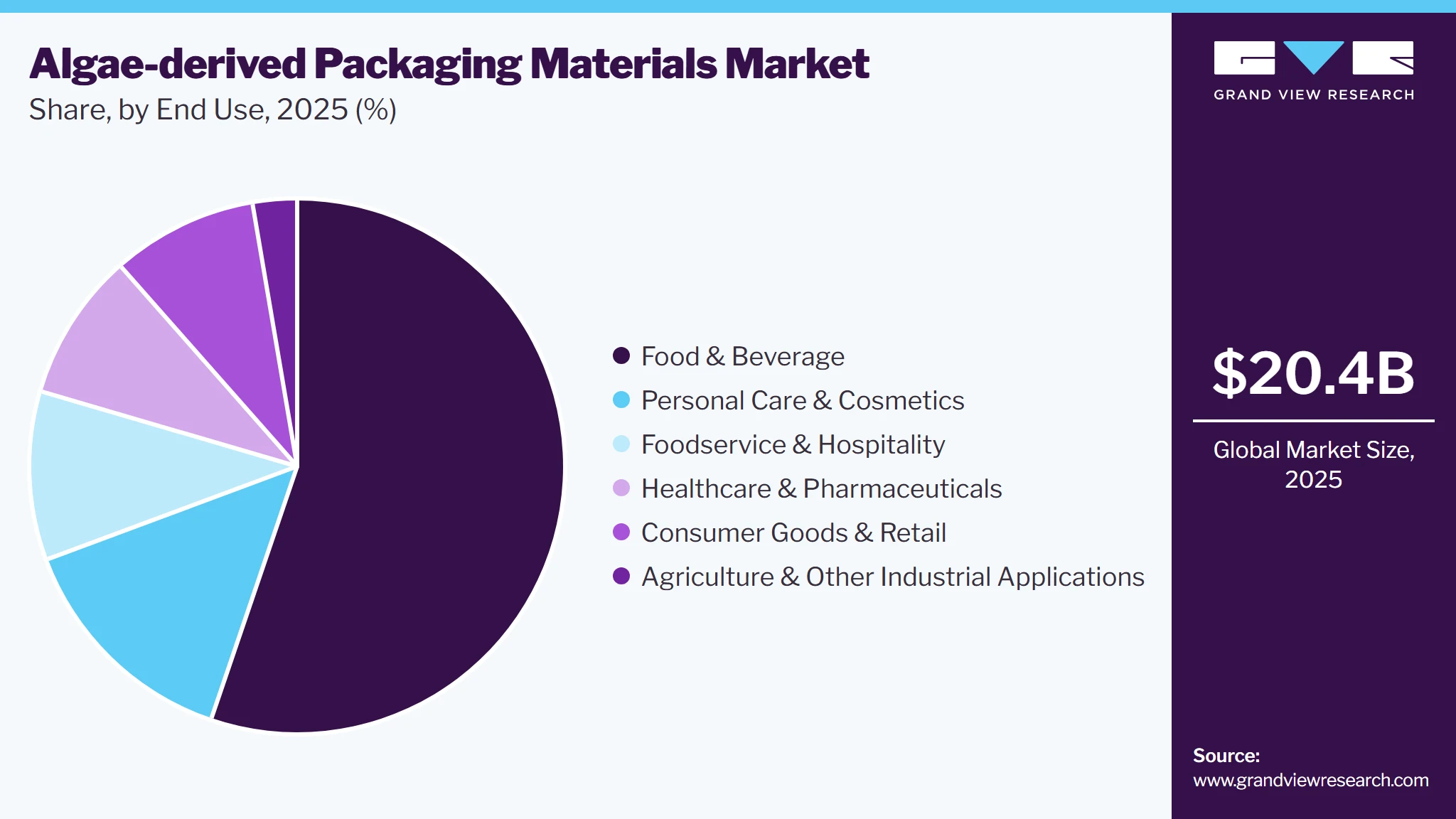
The foodservice & hospitality segment is anticipated to grow at the fastest CAGR of 12.8% from 2026 to 2033, supported by rising demand for sustainable takeaway containers, cups, wraps, and single-use foodservice packaging. Increasing restrictions on conventional single-use plastics, growing sustainability initiatives among restaurants and hospitality operators, and rising consumer preference for environmentally responsible foodservice products are expected to further accelerate segment growth.
Regional Insights
The algae-derived packaging materials market in North America is expected to grow at a substantial CAGR during the forecast period. Growth is supported by increasing demand for sustainable packaging across food & beverage, personal care, and consumer goods industries, along with growing efforts to reduce plastic waste. The region's established packaging industry and rising investments in bio-based materials are further encouraging the commercialization of algae-derived packaging solutions.
U.S. Algae-derived Packaging Materials Market Trends
The algae-derived packaging materials market in the U.S. is expected to grow at a moderate CAGR over the forecast period, driven by strong demand for biodegradable and renewable packaging alternatives. Increasing sustainability commitments among consumer brands, growing restrictions on conventional plastics, and investments in bio-based material technologies are creating favorable conditions for algae-derived packaging. Food packaging, flexible packaging, and sustainable coatings are expected to remain important application areas as manufacturers seek to improve packaging's environmental performance.
Europe Algae-derived Packaging Materials Market Trends
Europe dominated the global algae-derived packaging materials market with the largest revenue share of 34.3% in 2025. Regional growth is driven by stringent regulations on plastic waste, strong circular economy initiatives, and increasing demand for biodegradable and renewable packaging materials. The growing adoption of sustainable films, coatings, and flexible packaging across the food & beverage, personal care, and consumer goods industries is further supporting market expansion. Investments in bio-based material technologies and sustainable packaging infrastructure are expected to strengthen Europe's leading position through 2033.
The algae-derived packaging materials market in Germany accounted for the largest market revenue share in Europe in 2025, due to its advanced packaging and chemical manufacturing base and strong focus on sustainable material technologies. Increasing investments in bio-based polymers, recyclable packaging systems, and environmentally responsible manufacturing are expected to support the development of algae-derived packaging applications.
The UK algae-derived packaging materials market is expected to grow at a significant CAGR during the forecast period, as food, beverage, retail, and personal care companies increasingly adopt sustainable packaging solutions. Growing consumer awareness regarding plastic pollution and continued development of biodegradable and compostable packaging technologies are creating opportunities for algae-derived materials.
Asia Pacific Algae-derived Packaging Materials Market Trends
The algae-derived packaging materials market in the Asia Pacific is expected to grow at the fastest CAGR of 12.8% during the forecast period. The region's growth is driven by expanding food & beverage and consumer goods manufacturing, rising environmental awareness, and increasing investments in sustainable packaging production. Its market share is projected to rise from 25.1% in 2025 to 26.1% by 2033, reflecting its strengthening position in the global market.
The China algae-derived packaging materials market is a major segment in the Asia Pacific region, supported by its large packaging manufacturing base, expanding food and consumer goods industries, and growing focus on reducing plastic waste. Growing investments in bio-based materials and algae processing technologies are expected to facilitate wider adoption of algae-derived packaging across commercial applications.
The algae-derived packaging materials market in India is expected to grow strongly as the country's food processing, retail, personal care, and packaging industries increasingly seek sustainable alternatives to conventional plastics. Rising government and corporate sustainability initiatives, combined with expanding domestic packaging manufacturing capabilities, are expected to create new opportunities for algae-derived films, coatings, and other packaging formats.
Latin America Algae-derived Packaging Materials Market Trends
The algae-derived packaging materials market in Latin America is projected to grow at a significant CAGR of 12.5% during the forecast period. Market expansion is being supported by increasing demand for environmentally responsible packaging, growth in food and beverage production, and rising awareness of plastic waste management. The region's growing consumer markets and gradual development of sustainable packaging infrastructure are expected to create additional opportunities for algae-derived materials.
The Brazil algae-derived packaging materials market is anticipated to grow at a substantial CAGR during the forecast period, driven by the country's large food processing, beverage, cosmetics, and consumer goods industries. Increasing adoption of sustainable packaging and growing interest in renewable raw materials are expected to support demand for algae-derived packaging solutions across multiple applications.
The algae-derived packaging materials market in Argentina is expected to grow steadily, driven by growing interest in biodegradable packaging and expanding sustainability initiatives across the food, beverage, and consumer product industries. The expansion of sustainable packaging applications and the greater availability of bio-based materials are likely to support future market opportunities.
Middle East & Africa Algae-derived Packaging Materials Market Trends
The algae-derived packaging materials market in the Middle East & Africa is expected to grow at a steady CAGR of 11.5% during the forecast period. Growth is supported by increasing sustainability initiatives, rising demand for environmentally responsible packaging, and the expansion of the food & beverage and retail sectors. Although the region represents a smaller share of the global market, investments in sustainable materials and packaging infrastructure are expected to gradually strengthen adoption.
Key Algae-derived Packaging Materials Company Insights
Some key companies in the algae-derived packaging materials industry include Notpla, B’ZEOS, Kelpi, LOLIWARE Inc., Sway, Algopack, ULUU, Oceanium, Noriware, Blue Ocean Algae Membrane, and Origin by Ocean. The market is characterized by rapid material innovation, development of seaweed- and algae-derived biopolymers, and increasing collaboration between algae producers, material developers, packaging converters, and consumer brands.
Key participants are focusing on scaling production, improving barrier and mechanical performance, reducing dependence on conventional plastics, and expanding the use of algae-derived materials across flexible, rigid, coated, fiber-based, and edible packaging formats.
-
Notpla is a leading developer of seaweed-based packaging solutions, offering materials and packaging formats designed as alternatives to conventional plastic. The company focuses on seaweed-derived coatings, food containers, films, sachets, and paper-based packaging solutions. Its technology platform enables the development of biodegradable and home-compostable packaging materials, supporting applications across foodservice, takeaway packaging, and consumer products. Notpla's emphasis on scalable commercialization, material innovation, and partnerships with brands and foodservice operators strengthens its position in the emerging algae-derived packaging industry.
-
B’ZEOS specializes in seaweed-based biomaterials and packaging solutions, with a focus on converting seaweed into functional packaging materials. Its portfolio includes seaweed-based pellets and solutions for films, wraps, flowpacks, pouches, trays, and other packaging formats. The company is focused on improving material performance and scalability while enabling packaging manufacturers to incorporate renewable seaweed-derived materials into existing production processes. Its broad application focus positions B’ZEOS as an important participant in the development of algae-based flexible and rigid packaging solutions
Key Algae-derived Packaging Materials Companies
The following key companies have been profiled for this study on the algae-derived packaging materials market.
-
Notpla
-
BZEOS
-
Kelpi
-
LOLIWARE INC.
-
Sway
-
Algopack
-
Uluu
-
OCEANIUM
-
Noriware
-
Blue Ocean Algae Membrane
-
Origin by Ocean
Competitive Benchmarking
Category
Operating Strategies
Competitive Edge
Weakness
Established Players (Notpla; OCEANIUM; Origin by Ocean; Algopack)
- Focus on scaling algae-based material production, expanding packaging applications, R&D, and strategic partnerships with packaging and consumer-goods companies.
- Strong technology platforms, diversified material portfolios, growing commercial partnerships, and established algae-processing capabilities.
- High production costs, limited scale relative to conventional packaging producers, and dependence on consistent availability of algal feedstock.
Emerging Players (B’ZEOS; Kelpi; LOLIWARE Inc.; Sway; ULUU; Noriware; Blue Ocean Algae Membrane)
- Focus on developing specialized algae-based films, coatings, bioplastics, and flexible packaging through material innovation and pilot-scale commercialization.
- Specialized technologies, innovative formulations, strong sustainability positioning, and flexibility in developing application-specific solutions.
- Limited production capacity, higher costs, limited commercial reach, and challenges related to scaling and meeting packaging performance standards.
Recent Development
-
In January 2026, Noriware closed a Euro 4.3 billion seed financing round to prepare the commercial launch of its Norifresh seaweed-based packaging film. The funding is intended to support market entry for plastic-free fresh fruit and vegetable packaging, with the film designed to run on existing packaging machinery and comply with the evolving EU Packaging and Packaging Waste Regulation (PPWR).
-
In October 2025, Sway was named a TIME Best Invention of 2025 for its seaweed-based packaging technology. The recognition follows the company's progress toward commercial adoption of its TPSea Flex materials, which are designed as home-compostable alternatives to conventional plastic films and bags. Sway aims to replace up to 1.4 billion plastic bags annually by 2030
Algae-derived Packaging Materials Market Report Scope
Report Attribute
Details
Market size in 2025
USD 20.4 billion
Estimated market size in 2026
USD 22.8 billion
Projected market size by 2033
USD 51.0 billion
Growth rate
CAGR of 12.2%from 2026 to 2033
Base year for estimation
2025
Historical data
2021 - 2024
Forecast period
2026 - 2033
Quantitative units
Revenue in USD million/billion, and CAGR from 2026 to 2033
Report coverage
Revenue forecast, company ranking, competitive landscape, growth factors, and trends
Segments covered
Algae source, material, end use, packaging product, region
Regional scope
North America; Europe; Asia Pacific; Latin America; Middle East & Africa
Country scope
U.S.; Canada; Mexico; UK; Germany; France; Italy; Spain; China; Japan; India; Australia; South Korea; Brazil; Argentina; Saudi Arabia; South Africa; UAE
Key companies profiled
Notpla; BZEOS; Kelpi; LOLIWARE Inc.; Sway; Algopack; Uluu; OCEANIUM; Noriware; Blue Ocean Algae Membrane; Origin by Ocean.
Customization scope
Free report customization (equivalent up to 8 analysts working days) with purchase. Addition or alteration to country, regional & segment scope.
Pricing and purchase options
Avail of customized purchase options to meet your exact research needs. Explore purchase options
Global Algae-derived Packaging Materials Market Report Segmentation
This report forecasts revenue growth at the regional and country levels and provides an analysis of the latest industry trends and opportunities in each of the sub-segments from 2021 to 2033. For this study, Grand View Research has segmented the global algae-derived packaging materials market report based on the algae source, material, end use, packaging product, and region:
-
Algae Source Outlook (Revenue, USD Billion, 2021 - 2033)
-
Brown Macroalgae
-
Red Macroalgae
-
Green Macroalgae
-
Microalgae
-
-
Material Outlook (Revenue, USD Billion, 2021 - 2033)
-
Seaweed-derived Polysaccharide Materials
-
Algae Biomass-based Composites
-
Algae-derived Bioplastic Resins
-
Algae-based Paper & Fiber Materials
-
Algae-based Functional Coating Materials
-
-
End Use Outlook (Revenue, USD Billion, 2021 - 2033)
-
Food & Beverage
-
Foodservice & Hospitality
-
Personal Care & Cosmetics
-
Healthcare & Pharmaceuticals
-
Consumer Goods & Retail
-
Agriculture & Other Industrial Applications
-
-
Packaging Product Outlook (Revenue, USD Billion, 2021 - 2033)
-
Films & Wraps
-
Pouches & Sachets
-
Trays, Containers & Tubs
-
Coatings & Coated Packaging
-
Molded Fiber & Paper Packaging
-
Edible Packaging Formats
-
Capsules / Pods / Dissolvable Formats
-
Other Packaging Products
-
-
Regional Outlook (Revenue, USD Billion, 2021 - 2033)
-
North America
-
U.S.
-
Canada
-
Mexico
-
-
Europe
-
Germany
-
France
-
UK
-
Italy
-
Spain
-
-
Asia Pacific
-
China
-
India
-
Japan
-
South Korea
-
Australia
-
-
Latin America
-
Brazil
-
Argentina
-
-
Middle East & Africa
-
Saudi Arabia
-
UAE
-
South Africa
-
-
Research Methodology
The algae-derived packaging materials market figures in this report are based on a proven research process that combines executive interviews with secondary research from proprietary databases, company filings, and recognized regulatory and institutional sources. Market size is built through value-chain sizing-reconciling supply-side and demand-side estimates-and triangulated with bottom-up and top-down approaches. Every estimate passes multiple levels of expert validation before publication, with eachalgae-derived packaging materials segment quantified using the revenue-capture definitions in the table below.
Segment Definition
Segment - Algae Source Type
Revenue capture definition
Brown Macroalgae
Revenue generated from the sale of algae-derived packaging materials produced from brown macroalgae, including materials based on alginates and other polysaccharides. Includes brown macroalgae-derived materials used in films, wraps, coatings, pouches, trays, containers, and other sustainable packaging applications.
Red Macroalgae
Revenue generated from the sale of packaging materials derived from red macroalgae, including carrageenan-rich and other polysaccharide-based materials used in biodegradable films, coatings, flexible packaging, edible packaging, and other packaging formats.
Green Macroalgae
Revenue generated from the sale of algae-derived packaging materials produced from green macroalgae, including biomass-based materials and biopolymer formulations used in films, molded packaging, coatings, paper and fiber products, and other sustainable packaging applications.
Microalgae
Revenue generated from the sale of packaging materials derived from microalgae biomass, including microalgae-based bioplastics, composites, films, coatings, and other bio-based packaging formulations. Includes materials developed using microalgae-derived polymers, proteins, lipids, and other functional compounds for sustainable packaging applications.
Segment - Material
Revenue capture definition
Seaweed-Derived Polysaccharide Materials
Revenue generated from the sale of packaging materials produced from seaweed-derived polysaccharides, including alginate, carrageenan, and other bio-based polymers. Includes materials used in biodegradable films, wraps, pouches, coatings, edible packaging, and other sustainable packaging formats.
Algae Biomass-Based Composites
Revenue generated from the sale of packaging materials incorporating algae biomass as a functional or reinforcing component in composite formulations. Includes algae-based composite materials used in trays, containers, molded packaging, protective packaging, and other rigid or semi-rigid packaging applications.
Algae-Derived Bioplastic Resins
Revenue generated from the sale of bioplastic resins produced using algae-derived biomass, polymers, or other algae-based feedstocks. Includes resins used to manufacture films, pouches, containers, trays, bottles, and other plastic-replacement packaging products.
Algae-Based Paper & Fiber Materials
Revenue generated from the sale of paper and fiber-based packaging materials incorporating algae biomass, algae-derived fibers, or algae-based additives. Includes algae-based paper, molded fiber packaging, wraps, cartons, sleeves, and other fiber-based packaging formats.
Algae-Based Functional Coating Materials
Revenue generated from the sale of functional coating materials formulated using algae-derived compounds to provide packaging with properties such as barrier protection, moisture resistance, grease resistance, antimicrobial functionality, or improved surface performance. Includes coatings applied to paper, fiber, films, containers, and other packaging substrates.
Segment - End Use
Revenue capture definition
Food & Beverage
Revenue generated from the sale of algae-derived packaging materials used for food and beverage products, including fresh and processed foods, beverages, snacks, dairy products, and other packaged food applications. Includes films, wraps, pouches, trays, containers, coatings, and other algae-based packaging formats.
Foodservice & Hospitality
Revenue generated from the sale of algae-derived packaging materials used by restaurants, cafés, catering services, hotels, and other foodservice and hospitality establishments. Includes takeaway containers, cups, wraps, sachets, pouches, edible packaging, and other single-use or sustainable foodservice packaging formats.
Personal Care & Cosmetics
Revenue generated from the sale of algae-derived packaging materials used for cosmetics, skincare, haircare, toiletries, and personal care products. Includes containers, tubes, pouches, films, coatings, and other sustainable packaging formats designed for personal care and cosmetic products.
Healthcare & Pharmaceuticals
Revenue generated from the sale of algae-derived packaging materials used for pharmaceutical, healthcare, nutraceutical, and medical products. Includes pouches, sachets, containers, films, coatings, capsules, and other packaging formats designed to support product protection and sustainability requirements.
Consumer Goods & Retail
Revenue generated from the sale of algae-derived packaging materials used for consumer products distributed through retail and e-commerce channels. Includes packaging for household products, consumer goods, specialty products, and other retail applications requiring sustainable, lightweight, and functional packaging solutions.
Agriculture & Other Industrial Applications
Revenue generated from the sale of algae-derived packaging materials used in agricultural, industrial, and other specialized applications. Includes packaging for agricultural products, seeds, fertilizers, industrial goods, components, and specialty products where renewable, biodegradable, or functional packaging materials are required.
Segment - Packaging Product
Revenue capture definition
Films & Wraps
Revenue generated from the sale of algae-derived films and wraps used for food, beverage, personal care, and consumer product packaging. Includes flexible films designed to provide product protection, barrier performance, and sustainable alternatives to conventional plastic films.
Pouches & Sachets
Revenue generated from the sale of algae-derived pouches and sachets used for food, beverages, personal care products, nutraceuticals, and other packaged goods. Includes flexible, lightweight formats designed for portioning, convenience, and reduced packaging impact.
Trays, Containers & Tubs
Revenue generated from the sale of algae-based trays, containers, tubs, and other rigid or semi-rigid packaging formats. Includes packaging used for food, beverages, cosmetics, consumer goods, and other applications requiring structural protection and sustainable material alternatives.
Coatings & Coated Packaging
Revenue generated from the sale of algae-derived functional coatings and packaging products incorporating algae-based coatings. Includes coatings providing moisture, grease, oxygen, antimicrobial, or other barrier properties to paper, fiber, films, and other packaging substrates.
Molded Fiber & Paper Packaging
Revenue generated from the sale of algae-based molded fiber and paper packaging products, including trays, cartons, boxes, inserts, sleeves, and other fiber-based formats. Includes packaging incorporating algae biomass or algae-derived fibers as a primary or functional material.
Edible Packaging Formats
Revenue generated from the sale of edible packaging products manufactured using algae-derived materials that can be safely consumed along with or after the packaged product. Includes edible films, wraps, coatings, sachets, and other consumable packaging formats primarily used in food and beverage applications.
Capsules / Pods / Dissolvable Formats
Revenue generated from the sale of algae-derived capsules, pods, sachets, and dissolvable packaging formats designed to dissolve or disintegrate during product use. Includes formats used for food ingredients, beverages, nutraceuticals, personal care products, and other portion-controlled applications.
Other Packaging Formats
Revenue generated from the sale of other algae-derived packaging products not classified under the above categories. Includes specialized containers, sleeves, labels, protective packaging, closures, and customized packaging formats incorporating algae-derived materials.
Estimation Model
Layer Name
Key Question
Description
End Use Layer
What drives demand?
Estimate demand from key industries including food & beverage, foodservice & hospitality, personal care & cosmetics, healthcare & pharmaceuticals, consumer goods & retail, and agriculture and other industrial applications that utilize algae-derived packaging materials.
Algae Source Layer
Which algae sources generate demand?
Assess the adoption of brown macroalgae, red macroalgae, green macroalgae, and microalgae based on availability, biomass characteristics, biopolymer content, and suitability for sustainable packaging applications.
Material Type Layer
Which materials are consumed?
Evaluate consumption of seaweed-derived polysaccharide materials, algae biomass-based composites, algae-derived bioplastic resins, algae-based paper & fiber materials, and algae-based functional coating materials across packaging applications.
Packaging Product Layer
Where are algae materials applied?
Assess the utilization of algae-derived materials across films & wraps, pouches & sachets, trays, containers & tubs, coatings & coated packaging, molded fiber & paper packaging, edible packaging, capsules/pods/dissolvable formats, and other packaging products.
Revenue Layer
How is revenue generated?
Revenue is generated through the sale of algae-derived packaging materials and finished packaging products across food, beverage, foodservice, personal care, pharmaceutical, consumer goods, retail, and other industrial applications.
Delivered Customizations
This report has been delivered with the following In-depth customizations
Client Request
Customization Delivered
Value Adds
Competitive Benchmarking
Detailed benchmarking of key market participants based on product portfolio, algae sourcing capabilities, material technologies, geographic presence, R&D activities, sustainability initiatives, and strategic developments.
Enables clients to assess competitive positioning, identify technology gaps, benchmark capabilities, and develop effective strategies for market entry and expansion.
Pricing Analysis
Assessment of pricing trends for algae-derived packaging materials based on algae feedstock costs, processing requirements, material formulation, production scale, and regional supply-demand dynamics.
Supports pricing strategy development, procurement planning, cost optimization, margin management, and supplier negotiations.
Opportunity Assessment
In-depth assessment of emerging opportunities across algae sources, including brown macroalgae, red macroalgae, green macroalgae, and microalgae, as well as high-growth applications such as bioplastic resins, films, pouches, edible packaging, and sustainable foodservice packaging.
Helps clients identify high-potential investment areas, target emerging applications, prioritize geographic expansion, and develop strategies aligned with the transition toward bio-based and circular packaging solutions.
Frequently Asked Questions About This Report
The global algae-derived packaging materials market size was valued at USD 20.4 billion in 2025 and is estimated at USD 22.8 billion in 2026.
The global algae-derived packaging materials market is expected to grow at a CAGR of 12.2% from 2026 to 2033, reaching USD 51.0 billion by 2033.
The algae-derived packaging materials market is primarily driven by increasing demand for sustainable and biodegradable packaging, growing restrictions on conventional plastics, rising adoption of circular-economy solutions, increasing utilization of renewable feedstocks, and growing demand for eco-friendly packaging across food & beverage, foodservice, personal care, and consumer goods industries
Europe dominated the algae-derived packaging materials market with a 34.3% revenue share in 2025.
The brown macroalgae segment led the algae-derived packaging materials market with a 44.8% revenue share in 2025.
The algae-derived bioplastic resins segment is the fastest-growing material type segment, with a CAGR of 12.8% over the forecast period.
The food & beverage segment led the algae-derived packaging materials market with a 55.2% revenue share in 2025.
The capsules / pods / dissolvable formats segment is the fastest-growing packaging product segment, with a CAGR of 12.9% over the forecast period.
Key players in the algae-derived packaging materials market include Notpla, BZEOS, Kelpi, LOLIWARE Inc., Sway, Algopack, Uluu, OCEANIUM, Noriware, Blue Ocean Algae Membrane, and Origin by Ocean.
About the Author(s)
Plastics, Polymers & Resins Research Team
Bulk Chemicals · Plastics, Polymers & ResinsThis report was authored by the plastics, polymers & resins research team at Grand View Research - comprising two research analysts, one senior research analyst, and one industry expert - with specialized expertise in the plastics, polymers & resins segment of the bulk chemicals industry. All findings are based on proprietary bulk chemicals databases, executive interviews, and regulatory analysis, subject to internal peer review prior to publication.
Last Updated:
Speak to Analyst


Customize this report to your needs — add regions, segments, or data points, with 20% free customization.
Or view our licence options:


ISO 9001:2015 & 27001:2022 Certified
We are GDPR and CCPA compliant! Your transaction & personal information is safe and secure. For more details, please read our privacy policy.


