
- Home
- »
- Electronic & Electrical
- »
-
Audio Equipment Market Analysis: Trends, Size & Forecast 2033GVR Report cover

Audio Equipment Market (2026 - 2033) Size, Share & Trends Analysis Report By Product (Earphones & Headphones, Loudspeaker, Microphones), By Technology (Wired, Wireless), By Distribution Channel (Online, Offline), By Price Range, By End Use, By Region, And Segment Forecasts
Market Size, 2025
$125.0BMarket Estimate, 2026
$133.7BMarket Forecast, 2033
$220.2BCAGR, 2026–2033
7.4%Audio Equipment Market Summary
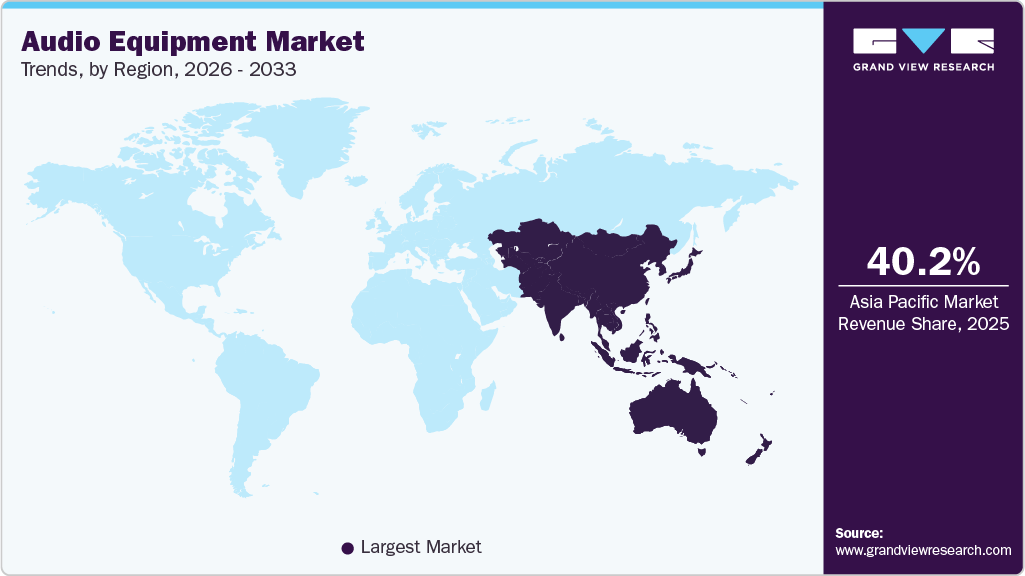
The global audio equipment market size was valued at USD 125.04 billion in 2025 and is projected to grow from USD 133.7 billion in 2026 to USD 220.2 billion by 2033, at a CAGR of 7.4% from 2026 to 2033. Asia Pacific held the dominating position in the global audio equipment market with 40.2% share in 2025. The industry is driven by wireless connectivity, smart integration, immersive/spatial audio, with strong momentum in consumer segments (especially true wireless earbuds, soundbars, and smart loudspeakers) alongside steady professional and home entertainment growth.
 Source: Grand View Research, IR Documents, Primary Interviews, Paid DatabasesTo learn more about this report,
 Download Free Sample Report
 Key Market Trends & Insights
- By product: Earphones & headphones accounted for the largest revenue share of 64.3% in 2025.
- By technology: Wireless segment accounted for the largest share in 2025.
- By distribution channel: Offline segment accounted for the largest share in 2025.
Regional Highlights
- Largest regional market: Asia Pacific (40.2%% revenue share, 2025)
- By country: The China audio equipment industry is a major contributor to the global market.
Market Size & Forecast
- Market size in 2025: USD 125.04Billion
- Estimated market size in 2026: USD 133.7 Billion
- Projected market size by 2033: USD 220.2 Billion
- CAGR (2026-2033): 7.4%
GVR research-powered AIAsk Prism AI about the audio equipment marketGet cited answers from GVR research on market growth, segments, regulations and forecasts.Start with✓ Source-linked answers ✓ Market-specific context ✓ Traceable figuresExplore Prism AI ↗
This industry continues to thrive as consumer preferences shift toward high-quality sound experiences in everyday life. Driven by the rise of streaming loudspeakers and smart home integrations, the industry has seen steady expansion across segments such as headphones, loudspeakers, and professional setups. Companies in the audio equipment industry are focusing on innovation to meet demands for clearer, more immersive audio, while navigating supply chain challenges and evolving global trade dynamics. This market's resilience stems from its ability to adapt to technological advancements, making it a key player in the entertainment and communication sectors. For instance, in January 2025, Samsung announced Eclipsa Audio, a 3D audio technology developed with Google, for its 2025 TVs and soundbars, including Crystal UHD and Neo QLED 8K models. This technology enables immersive spatial sound and allows creators to enhance audio in videos, including YouTube content. By integrating advanced 3D audio, Samsung aims to strengthen its leadership in home entertainment, likely boosting demand in the global market.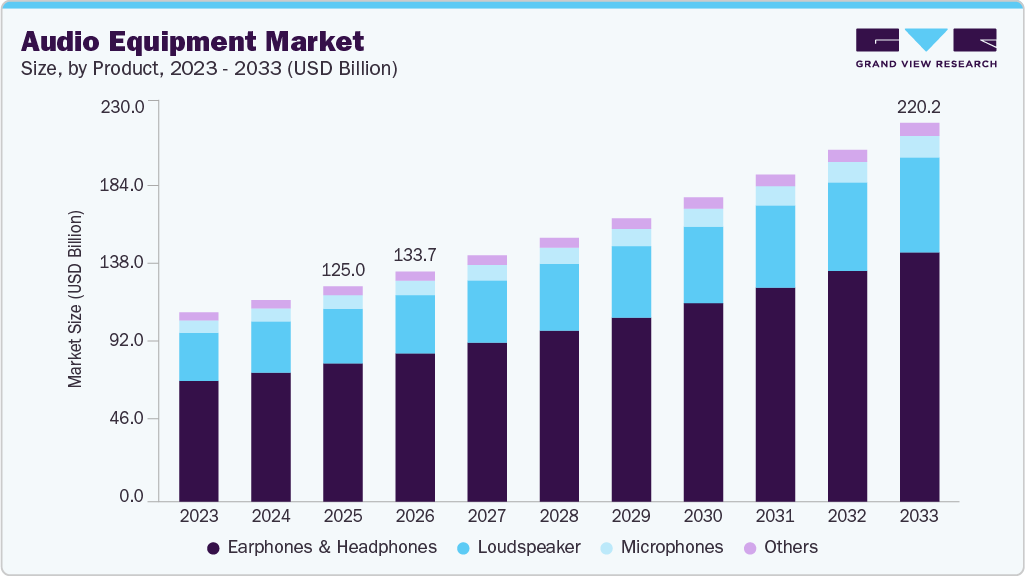 To learn more about this report, Download Free Sample Report
 Key trends shaping the industry include the growing adoption of wireless and energy-efficient devices, alongside AI-enhanced features that personalize sound for users. Opportunities abound in areas such as augmented reality, price ranges, and electric vehicle audio systems, where compact, high-fidelity solutions are in high demand. However, the audio equipment industry faces hurdles such as competition from low-cost alternatives and the need for sustainable manufacturing practices. Overall, these trends point to a dynamic.
Market Dynamics
The wireless audio market is experiencing strong growth as companies integrate advanced technologies such as dual-driver sound systems, Hi-Res audio, Active Noise Cancellation (ANC), AI-powered call enhancement, and next-generation Bluetooth connectivity into audio devices. Consumers are seeking better sound quality, smarter connectivity, and advanced listening experiences across music, gaming, and communication applications. This trend is encouraging manufacturers to invest in audio innovation and feature enhancement to strengthen their market position.
For instance, in September 2025, EarFun introduced the Air Pro 4+ earbuds and Wave Pro X headphones featuring dual-driver Hi-Res audio, advanced ANC, Bluetooth 6.0, AI-powered call clarity, and long battery life. Such developments are increasing competition and accelerating innovation in the wireless audio market, supporting overall industry growth. As audio technologies continue to evolve, manufacturers are expected to focus more on feature-rich products to strengthen consumer engagement. The growing availability of advanced audio capabilities is also expanding adoption across different end-user segments. This trend is expected to support long-term growth opportunities in the audio equipment market.
The audio equipment market is facing increasing pressure from growing regulations on product reparability, sustainability, and electronic waste management. Governments and regulatory authorities are encouraging manufacturers to design products that facilitate easier repair, longer use, and improved environmental compliance. For instance, the European Union Ecodesign regulations are promoting product durability, reparability, and spare part availability across electronic products, encouraging manufacturers to align with stricter sustainability requirements. Audio equipment companies are therefore required to redesign products and strengthen compliance efforts, which can increase operational costs and product development efforts.
In addition, meeting evolving lifecycle regulations may increase manufacturing complexity and extend product development timelines. Companies may need additional investments in design modifications, compliance processes, and supply chain adjustments to meet regulatory standards. While these initiatives support long-term sustainability goals, they can act as a restraining factor for market growth by increasing costs and limiting operational flexibility for audio equipment manufacturers.
Market Concentration & Characteristics
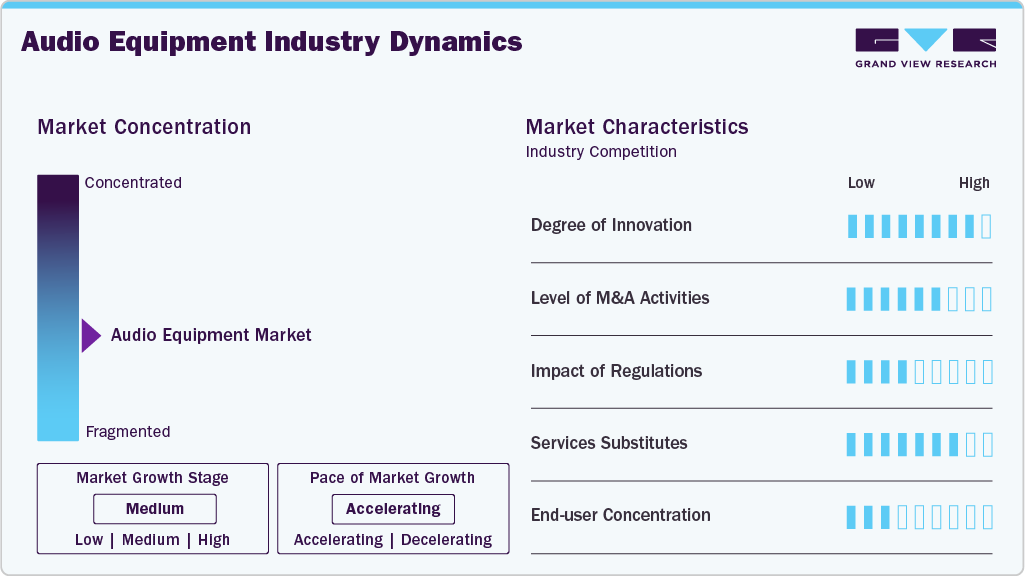
The audio equipment market is moderately fragmented, with several global brands alongside many regional and emerging players competing across headphones, earbuds, speakers, soundbars, and professional audio systems. The market is experiencing strong growth due to rising consumer demand for wireless audio products, premium sound quality, gaming accessories, and smart connected devices. The increasing adoption of technologies such as Active Noise Cancellation (ANC), spatial audio, AI-powered sound enhancement, and Bluetooth 6.0 is further driving product demand worldwide. In addition, the pace of market growth is accelerating as companies continue to introduce feature-rich audio devices at competitive prices to attract mainstream consumers.
 To learn more about this report, Download Free Sample Report
 The market shows a high degree of innovation, with manufacturers focusing on advanced audio technologies, improved connectivity, and enhanced user experience to differentiate their products. Merger and acquisition activities are moderate, with companies expanding their product portfolios and strengthening their presence in premium and smart audio categories. Regulatory impact remains moderate due to compliance requirements related to wireless communication standards, battery safety, and environmental regulations. The market also faces strong substitute pressure from multifunctional consumer electronics and integrated audio solutions. However, end-user concentration remains low because audio equipment is widely used across personal entertainment, gaming, commercial, and professional applications, creating a large, diverse customer base.
Product Insights
The headphones & earphones segment dominated the market, accounting for a 64.3% revenue share in 2025, fueled by strong consumer appetite for wireless audio devices to experience freedom and superior sound isolation in daily routines. True wireless stereo earbuds now command the largest share within this category, as buyers favor compact designs that pair seamlessly with smartphones, fitness trackers, and work calls without cables getting in the way. Active noise cancellation has become almost standard even in mid-range models, helping users block distractions during commutes, gym sessions, or focused office hours across urban centers. Moreover, brands keep pushing battery life improvements alongside AI-driven sound personalization to stand out in a crowded field full of competitive pricing from both global names and regional players. Overall, this segment drives much of the audio equipment industry's momentum by blending convenience, performance, and evolving lifestyle needs into accessible products.
The loudspeaker segment is expected to grow at a significant CAGR from 2026 to 2033, driven by rising demand for wireless and smart audio solutions. Key product types include portable loudspeakers, followed by soundbars, subwoofers, and home theater systems, catering to mobility and immersive entertainment needs. Manufacturers face typical pressures from component costs and supply chains, yet innovation in connectivity and battery life keeps the segment competitive. Overall, this area continues to deliver reliable growth within the larger audio landscape, supported by everyday consumer habits around music, streaming, and entertainment.
Technology Insights
The wireless segment accounted for the largest revenue share in 2025. True wireless earbuds, along with portable Bluetooth loudspeakers, lead demand, supported by steady improvements in battery life, sound clarity, and seamless device pairing that keep buyers coming back for upgrades. Brands continue investing in features such as active noise cancellation and longer-range connectivity to stand out in a crowded field where basic wireless options have turned common. Competition stays intense from both established names and newer entrants, yet consumer appetite for reliable, high-performing wireless gear ensures this part of the audio equipment industry remains one of the most vibrant and promising areas right now. Overall, the shift away from cables has firmly taken hold, positioning wireless solutions as the go-to choice across personal and professional audio needs in the upcoming years.
The wired segment is expected to grow at a significant CAGR from 2026 to 2033. In the broader audio equipment industry, wired headphones, loudspeakers, and amplifiers deliver consistent high-fidelity sound through direct connections such as USB, AUX, or balanced XLR cables, making them a trusted choice for studios, critical listening, and fixed installations. Despite the strong push toward wireless options across the market, the wired portion continues to see demand in areas where zero latency and uncompressed audio matter most, supporting its role alongside newer technologies. Overall, the audio equipment market benefits from this enduring wired presence, which complements wireless innovations and ensures options for varied user needs in both personal and commercial settings. This balance helps maintain stability in the industry as preferences evolve with streaming and content demands.
Distribution Channel Insights
The offline segment dominated the audio equipment market in 2025. Specialty audio retailers, consumer electronics chains, and hypermarkets continue to attract serious enthusiasts and first-time purchasers who prefer comparing loudspeakers, amplifiers, or home theater setups in real listening environments rather than relying solely on digital descriptions. Despite faster online channel expansion driven by convenience and pricing, brick-and-mortar outlets hold steady appeal through personalized demonstrations, post-sale support, and bundled offerings that build trust in higher-value purchases across the audio equipment industry. This physical presence helps brands showcase innovations such as spatial audio systems or wireless integrations more effectively, sustaining loyalty among customers seeking tangible experiences over quick transactions.
The online segment is expected to grow at the fastest CAGR from 2026 to 2033. The market has gained strong momentum as buyers turn to e-commerce platforms for convenience, wide product variety, and competitive pricing on items such as wireless headphones, smart loudspeakers, and soundbars. Major marketplaces along with direct-to-consumer brand sites now capture a substantial portion of sales, often outpacing traditional retail channels due to easy comparisons, customer reviews, and frequent promotions that appeal to younger consumers seeking premium yet affordable options. Growth in this area benefits from rising internet access and mobile shopping habits, allowing niche audio brands to reach global audiences without heavy reliance on physical stores. Direct-to-consumer approaches help companies build loyalty through personalized experiences and better data insights on buyer preferences.
Price Range Insights
The mid-range (151-1000 USD) segment held the largest revenue share in 2025. In this price band, buyers find wireless headphones with effective noise cancellation, portable Bluetooth loudspeakers offering clear bass and decent battery life, and compact soundbars that upgrade home setups affordably. Brands continue to pack in features such as app-based EQ adjustments, multi-device connectivity, and improved drivers, making these products appealing for daily use in commuting, workouts, or casual home listening. Growth in the mid-range audio equipment industry stems from steady demand for wireless and smart-integrated devices that fit modern lifestyles, including hybrid work routines and streaming habits. While competition from budget imports keeps pressure on margins, the segment benefits from rising expectations around durability and ecosystem compatibility, encouraging repeat purchases when upgrades become necessary.
The premium (More than 1000 USD) segment is expected to grow at the fastest CAGR over the forecast period. This segment encompasses products priced above USD 1000, demonstrating robust momentum as affluent consumers chase unparalleled sound fidelity and craftsmanship in both home and personal listening setups. Demand in this price bracket stems largely from dedicated audiophiles, home theater enthusiasts, and professionals who view superior audio as a worthwhile long-term investment rather than a fleeting purchase. For instance, in May 2025, HARMAN Luxury Audio unveiled three new JBL Summit Series loudspeakers - Makalu, Pumori, and Ama at HIGH END Munich 2025. These loudspeakers are priced above USD 19,995 per pair; these premium models feature advanced acoustic engineering and refined craftsmanship for high-end listeners. This launch strengthens growth momentum in the premium (above USD 1000) segment of the market.
End Use Insights
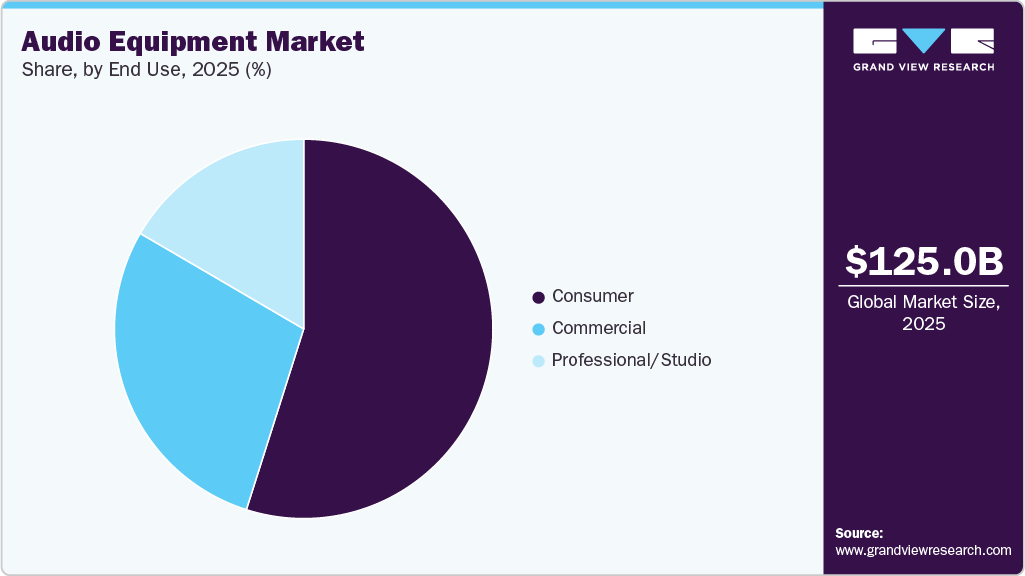
The consumer segment accounted for the largest revenue share in 2025. Consumers turn to enhanced sound solutions for daily entertainment, from streaming music and movies to gaming and virtual meetings at home, which keeps this part of the industry ahead of commercial uses. Manufacturers respond by rolling out more wireless loudspeakers, soundbars, and smart-integrated systems that fit easily into living spaces while delivering richer audio quality. Factors such as higher disposable incomes in many regions, along with the spread of connected home setups, continue to fuel steady purchases in households. As people spend more time indoors and seek better immersion in their leisure activities, residential buyers drive the bulk of innovation and sales volume across the audio equipment industry. This leading position looks set to hold firm, supported by ongoing upgrades in technology that make high-performance audio more accessible for everyday home use.
 To learn more about this report, Download Free Sample Report
 The commercial segment is expected to grow at the highest CAGR during the forecast period. This part of the audio equipment industry is fueled by rising needs in corporate offices, hospitality venues, retail spaces, stadiums, and educational facilities. Businesses now prioritize clear, reliable sound systems to support hybrid meetings, background music, public announcements, and immersive guest experiences, pushing steady investments in professional-grade loudspeakers, amplifiers, microphones, and networked audio solutions. This shift reflects broader trends toward digital integration and enhanced communication, where scalable, easy-to-manage installations deliver long-term value and help organizations stay competitive. Demand keeps climbing as companies upgrade outdated setups and adopt energy-efficient, AI-supported technologies that adapt to different room sizes and usage patterns.
Regional Insights
North America audio equipment market held a significant share in 2025. Consumers here favor wireless headphones, smart loudspeakers, and immersive home theater setups that integrate seamlessly with streaming platforms and voice assistants, pushing manufacturers to prioritize features such as spatial audio and AI sound optimization. Growth remains solid despite occasional supply pressures, supported by robust e-commerce channels and ongoing innovation from established brands. This region's leadership in value stems from early adoption of advanced technologies and a large base of tech users who upgrade equipment regularly for better entertainment and gaming experiences.
U.S. Audio Equipment Market Trends
The audio equipment industry in the U.S. is expected to grow significantly from 2026 to 2033, fueled by high consumer spending power, widespread adoption of streaming platforms, and a keen interest in premium sound solutions for homes, vehicles, and personal use. Manufacturers respond by rolling out products that blend high-fidelity audio with smart features such as voice control and multi-room connectivity, while the professional side benefits from ongoing needs in entertainment production and live events.
Asia Pacific Audio Equipment Market Trends
The audio equipment industry in Asia Pacific held the largest share in 2025, fueled by fast-rising disposable incomes, widespread smartphone use, and strong demand for personal listening devices across countries such as China, India, Japan, and South Korea. Wireless products, especially true wireless earbuds and portable loudspeakers, lead the charge with steady uptake thanks to better connectivity options such as Bluetooth advancements and growing e-commerce channels that make premium gear more reachable to everyday buyers. At the same time, industry events and trade platforms are playing a key role in accelerating regional business collaboration and technology adoption. For instance, in October 2025, Messe Frankfurt and VNU Exhibitions Asia Pacific will launch Prolight + Sound Bangkok in September 2026 at BITEC, creating a new platform for professional audio and entertainment technology in Southeast Asia. The event will connect global brands with ASEAN buyers, supporting regional demand growth. This initiative is expected to strengthen expansion in the Asia Pacific audio equipment market. Moreover, home setups, automotive sound systems, and professional installations also contribute solid growth, as urban lifestyles push people toward immersive experiences in entertainment, work-from-home arrangements, and in-car journeys.
 To learn more about this report, Download Free Sample Report
 China audio equipment market held a significant share in 2025, fueled by massive domestic consumption, strong manufacturing capabilities, and rapid uptake of wireless headphones, smart loudspeakers, and home theater systems among urban middle-class buyers. Local brands have gained solid ground by offering affordable yet feature-rich options with AI sound tuning and long battery life, while exports continue to support overall industry volume despite some shifts in global demand. Rising disposable incomes, widespread smartphone use, and growing interest in immersive audio for gaming, streaming, and electric vehicles keep pushing steady expansion across consumer and professional segments.
The audio equipment market in Japan is expanding rapidly. Local brands such as Sony and Yamaha lead the industry with ongoing innovations in wireless loudspeakers, noise-canceling headphones, and integrated smart audio solutions, while the shift toward Bluetooth-enabled devices reflects changing lifestyles in urban areas. Growth continues across segments such as demand for home audio equipment and portable audio device options, fueled by rising streaming usage and demand for compact yet powerful equipment suited to smaller living spaces. Overall, the Japan audio equipment industry remains anchored in quality-driven demand and domestic expertise, positioning it well for measured but reliable progress ahead.
India audio equipment market held a significant share in 2025, fueled by rising disposable incomes, widespread smartphone adoption, and the rapid rollout of affordable loudspeakers across urban and rural areas. Domestic brands such as boAt and Zebronics, along with international players, are capitalizing on government incentives for local manufacturing, which has lowered costs and improved product availability in tier-2 and tier-3 cities. Consumers now prioritize wireless audio devices such as true wireless earbuds and portable loudspeakers, drawn to features such as noise cancellation and long battery life that fit modern lifestyles involving streaming, gaming, and personal entertainment.
Europe Audio Equipment Market Trends
The audio equipment industry in Europe is expected to grow at a significant CAGR from 2026 to 2033. Consumers across countries such as Germany, the UK, and France show a clear preference for wireless headphones, smart loudspeakers, and compact systems that fit modern lifestyles. Growth comes partly from widespread streaming loudspeakers, increased podcast listening, and greater integration with smart homes, pushing people toward reliable, feature-rich options. Manufacturers respond by offering improved battery life, better connectivity, and eco-friendly designs to meet stricter regional standards. While economic factors create some caution in spending, the sector benefits from ongoing demand in both everyday consumer products and higher-end setups.
The UK audio equipment market is expected to grow rapidly in the coming years. Shoppers here keep buying wireless headphones, portable loudspeakers, and home cinema gear, helped by widespread music streaming and more people working from home. Brands focus on clear audio, long battery life, and easy connection to phones or smart devices, while the professional side sees demand from events and studios. Recent reports point to ongoing recovery after earlier supply issues, with modest sales increases expected as household budgets ease and new tech arrives. Competition stays strong from both big names and cheaper options, pushing companies to highlight quality and features. Overall, the industry holds firm in a mature market where people value reliable, modern audio solutions for entertainment and communication.
The audio equipment market in Germany held a significant market share in 2025, fueled by high disposable incomes, a deep appreciation for quality sound among consumers, and strong demand from both home entertainment and professional users. In recent years, the sector has shown solid expansion, particularly in wireless headphones, smart loudspeakers, and automotive audio systems, where local brands such as Sennheiser and Beyerdynamic maintain a loyal following thanks to their engineering reputation.
Key Audio Equipment Company Insights
Some of the key companies operating in the market, include Apple Inc., Audio‑Technica Corporation, Behringer (Music Group), Bose Corporation, d&b audiotechnik GmbH & Co. KG., Edifier Technology Co. Ltd., LG Electronics, among others are some of the leading participants in the market.
Key Audio Equipment Companies:
The following key companies have been profiled for this study on the audio equipment market.
- Apple Inc.
- Audio‑Technica Corporation
- Behringer (Music Group)
- Bose Corporation
- d&b audiotechnik GmbH & Co. KG.
- Edifier Technology Co. Ltd.
- LG Electronics
- MISCO/Minneapolis Speaker Company Inc.
- Onkyo Corporation
- Panasonic Corporation
- Samsung Electronics Co., Ltd.
- Sennheiser Electronic GmbH & Co. KG
- Shure Incorporated
- Sony Corporation
- Yamaha Corporation
Competitive Benchmarking
Operating Strategies
Competitive Edge
Weaknesses
Mature Players: Sony Corporation; Bose Corporation; Apple Inc.; Samsung Electronics Co.; Ltd.; Sennheiser Electronic GmbH & Co. KG; and Yamaha Corporation
- Focus on premium and ecosystem-based product positioning
- Heavy investment in R&D for high-end technologies such as ANC, spatial audio, Hi-Res sound, and smart connectivity
- Strong global brand recognition and customer loyalty
- Advanced technology leadership with consistent innovation in premium audio experience
- High product pricing limits penetration in price-sensitive markets
- Slower adaptation to ultra-low-cost and fast-changing entry-level segments
Emerging Players: Shure Incorporated; Audio-Technica Corporation; d&b audiotechnik GmbH & Co. KG; and Onkyo Corporation
- Strong focus on professional audio, studio equipment, and high-fidelity sound systems
- Targeting niche segments such as live sound, recording studios, and enterprise audio solutions
- Exceptional audio quality reputation in professional and audiophile segments
- Deep specialization in high-performance and precision audio engineering
- Limited presence in mass consumer wireless audio markets
- Slower scaling in fast-growing TWS (true wireless stereo) and smart audio segments
Recent Developments
-
In September 2025, Roland Professional A/V partnered with Techni+Contact as its official Canadian distributor, expanding access to its professional audio and video solutions, including V-series switchers and streaming products. The collaboration strengthens sales and support across Canada. This move is expected to enhance competition and growth within the North American market.
-
In February 2025, Yamaha introduced Sound xR, combining technologies from Yamaha, NEXO, and Steinberg to expand immersive audio across live venues and virtual environments at ISE 2025. New processors and headphones & earphones enable scalable 3D sound solutions for professional price ranges. This initiative is expected to accelerate innovation and demand within the market.
-
In September 2024, Apple introduced AirPods 4, with Active Noise Cancellation, updated AirPods Max colors, and new hearing health features for AirPods Pro 2, including Hearing Protection, Hearing Test, and Hearing Aid capabilities. These innovations expand functionality beyond audio performance. This launch is expected to drive premium segment growth in the global market.
Audio Equipment Market Report Scope
Report Attribute
Details
Market size in 2025
USD 125.04 billion
Estimated Market size in 2026
USD 133.66 billion
Projected Market size by 2033
USD 220.19 billion
Growth rate
CAGR of 7.4% from 2026 to 2033
Actual data
2021 - 2025
Forecast period
2026 - 2033
Quantitative units
Revenue in USD million/billion and CAGR from 2026 to 2033
Report coverage
Revenue forecast, company share, competitive landscape, growth factors, and trends
Segments covered
Product, technology, distribution channel, price range, end use, region
Regional scope
North America; Europe; Asia Pacific; Latin America; MEA
Country scope
U.S.; Canada; Mexico; UK; Germany; France; China; India; Japan; Australia; South Korea; Brazil; UAE; Saudi Arabia; South Africa
Key companies profiled
Apple Inc.; Audio‑Technica Corporation; Behringer (Music Group); Bose Corporation; d&b audiotechnik GmbH & Co. KG. ; Edifier Technology Co. Ltd.; LG Electronics; MISCO/Minneapolis Speaker Company Inc.; Onkyo Corporation; Panasonic Corporation; Samsung Electronics Co., Ltd.; Sennheiser Electronic GmbH & Co. KG; Shure Incorporated; Sony Corporation; Yamaha Corporation
Customization scope
Free report customization (equivalent to 8 analysts working days) with purchase. Addition or alteration to country, regional & segment scope.
Pricing and purchase options
Avail customized purchase options to meet your exact research needs. Explore purchase options
Global Audio Equipment Market Report Segmentation
This report forecasts revenue growth at global, regional, and country levels and provides an analysis of the latest industry trends in each of the sub-segments from 2021 to 2033. For this study, Grand View Research has segmented the global audio equipment market report based on product, technology, distribution channel, price range, end use, and region.
-
Product Outlook (Revenue, USD Billion, 2021 - 2033)
-
Earphones & Headphones
-
Loudspeaker
-
Microphones
-
Others
-
-
Technology Outlook (Revenue, USD Billion, 2021 - 2033)
-
Wired
-
Wireless
-
-
Distribution Channel Outlook (Revenue, USD Billion, 2021 - 2033)
-
Online
-
Offline
-
-
Price Range Outlook (Revenue, USD Billion, 2021 - 2033)
-
Entry-level (Less than 150 USD)
-
Mid-range (151-1000 USD)
-
Premium (More than 1000 USD)
-
-
End Use Outlook (Revenue, USD Billion, 2021 - 2033)
-
Consumer
-
Commercial
-
Professional/Studio
-
-
Regional Outlook (Revenue, USD Billion, 2021 - 2033)
-
North America
-
U.S.
-
Canada
-
Mexico
-
-
Europe
-
Germany
-
UK
-
France
-
-
Asia Pacific
-
China
-
India
-
Japan
-
South Korea
-
Australia
-
-
Latin America
-
Brazil
-
-
Middle East & Africa
-
UAE
-
Saudi Arabia
-
South Africa
-
-
Delivered Customizations
This report has been delivered with the following In-depth customizations
Client Request
Customization Delivered
Value Adds
Detailed analysis of specific product features across audio equipment categories
- Feature-wise segmentation of audio equipment across earbuds, headphones, and speakers
- Benchmarking of leading brands based on feature depth and integration level
- Mapping of consumer preference trends for high-end audio functionalities
- Enabled precise understanding of which features are driving premium product demand
- Supported product development prioritization based on high-growth feature sets
- Helped refine positioning strategy in competitive premium audio segment
Region-wise identification of key audio equipment players with focus on competitive positioning in Europe
- Region-wise competitive landscape of leading audio brands
- Identification of dominant local and global players in Europe
- Improved clarity on region-specific competitive intensity
- Supported entry strategy and expansion planning in high-potential markets
Insights on automotive audio system providers and their offerings integrated within modern vehicles.
- Mapping of key automotive audio system providers and OEM partnerships
- Analysis of premium in-car audio technologies such as spatial sound and noise cancellation systems
- Overview of integration trends between automotive manufacturers and audio brands
- Helped identify high-value automotive partnerships and supplier ecosystems
- Supported strategic decision-making for expansion into in-vehicle audio segment
- Provided visibility into long-term growth opportunity within connected car audio systems
Frequently Asked Questions About This Report
Asia Pacific dominated with a 40.2% revenue share in 2025.
The wireless segment accounted for the largest revenue share in 2025.
Offline segment held the largest revenue share in 2025, while online segment is the fastest-growing channel.
The global audio equipment market size was valued at USD 125.0 billion in 2025 and is estimated at USD 133.7 billion for 2026.
The global audio equipment market is expected to grow at a CAGR of 7.4% from 2026 to 2033, reaching USD 220.2 billion.
The headphones & earphones segment dominated the market, accounting for a 64.3% revenue share in 2025.
Key players include Apple Inc.; Audio‑Technica Corporation; Behringer (Music Group); Bose Corporation; d&b audiotechnik GmbH & Co. KG. ; Edifier Technology Co. Ltd.; LG Electronics; MISCO/Minneapolis Speaker Company Inc.; Onkyo Corporation; Panasonic Corporation; Samsung Electronics Co., Ltd.; Sennheiser Electronic GmbH & Co. KG; Shure Incorporated; Sony Corporation; Yamaha Corporation.
Factors such as the rising consumer demand for high-quality audio, the growth of smart and wireless devices, and the growth in commercial and professional applications play a key role in accelerating the audio equipment market.
About the Author(s)
Electronic & Electrical Research Team
Consumer Goods · Electronic & ElectricalThis report was authored by the electronic & electrical research team at Grand View Research - comprising two research analysts, one senior research analyst, and one industry expert - with specialized expertise in the electronic & electrical segment of the consumer goods industry. All findings are based on proprietary consumer goods databases, executive interviews, and regulatory analysis, subject to internal peer review prior to publication.
Last Updated:
Speak to Analyst

Customize this report to your needs - add regions, segments, or data points, with 20% free customization.
Or view our licence options:


ISO 9001:2015 & 27001:2022 Certified
We are GDPR and CCPA compliant! Your transaction & personal information is safe and secure. For more details, please read our privacy policy.


