
- Home
- »
- Next Generation Technologies
- »
-
Automatic Content Recognition Market Size Report, 2033GVR Report cover

Automatic Content Recognition Market (2026 - 2033)
Size, Share & Trends Analysis Report By Component (Software), By Content (Audio, Video, Image), By Platform, By Technology, By Industry Vertical, By End Use, And Segment Forecasts
Market Size, 2025
$4.0BMarket Estimate, 2026
$4.8BMarket Forecast, 2033
$18.9BCAGR, 2026–2033
21.6%Automatic Content Recognition Market Summary
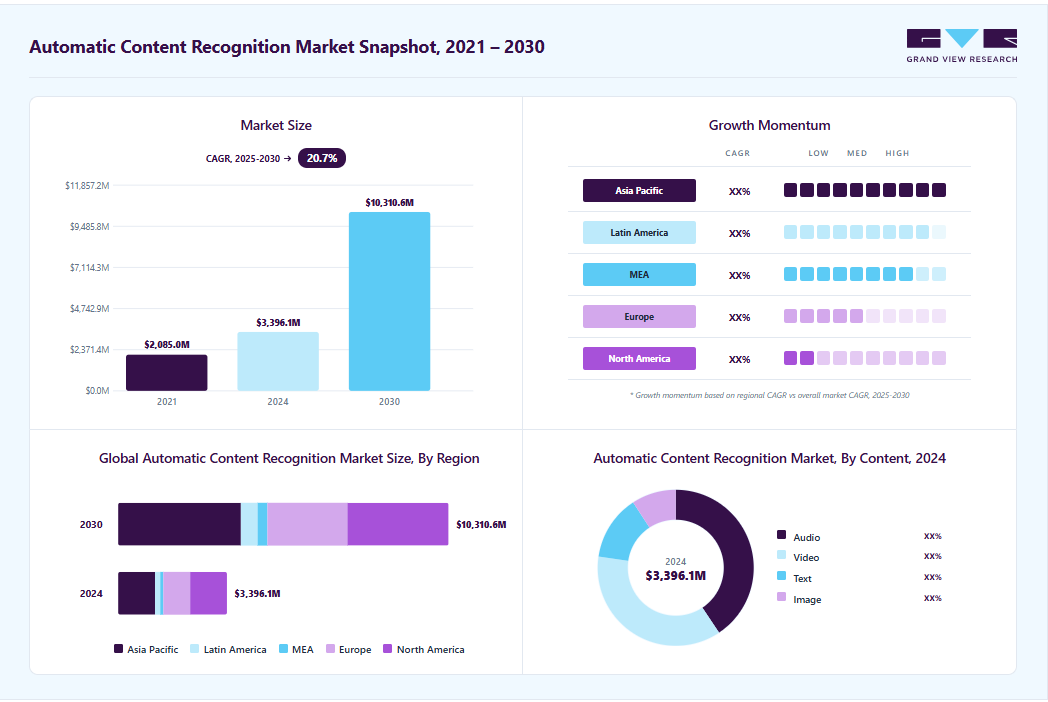
The global automatic content recognition market size was valued at USD 4.0 billion in 2025 and is projected to grow from USD 4.8 billion in 2026 to USD 18.9 billion by 2033, at a CAGR of 21.6% from 2026 to 2033. The market in North America dominated with a revenue share of 34.8% in 2025. The automatic content recognition market is primarily driven by the growing need for real-time identification, monitoring, and analysis of digital media content across increasingly fragmented, multi-platform viewing environments.
 Source: Grand View Research, IR Documents, Primary Interviews, Paid DatabasesTo learn more about this report,
 Download Free Sample Report
 Key Market Trends & Insights
- By component: Software segment held the largest market share of 74.7% in 2025.
- By content: Audio segment held the largest market share of 41.1% in 2025.
- By platform: Smart TVs segment held the largest market share of 69.6% in 2025.
- By technology: Audio & video fingerprinting segment held the largest market share of 36.2% in 2025.
- By industry vertical: Media & entertainment segment held the largest market share of 23.0% in 2025.
- By end use: Audience measurement segment held the largest market share of 40.6% in 2025.
Regional Highlights
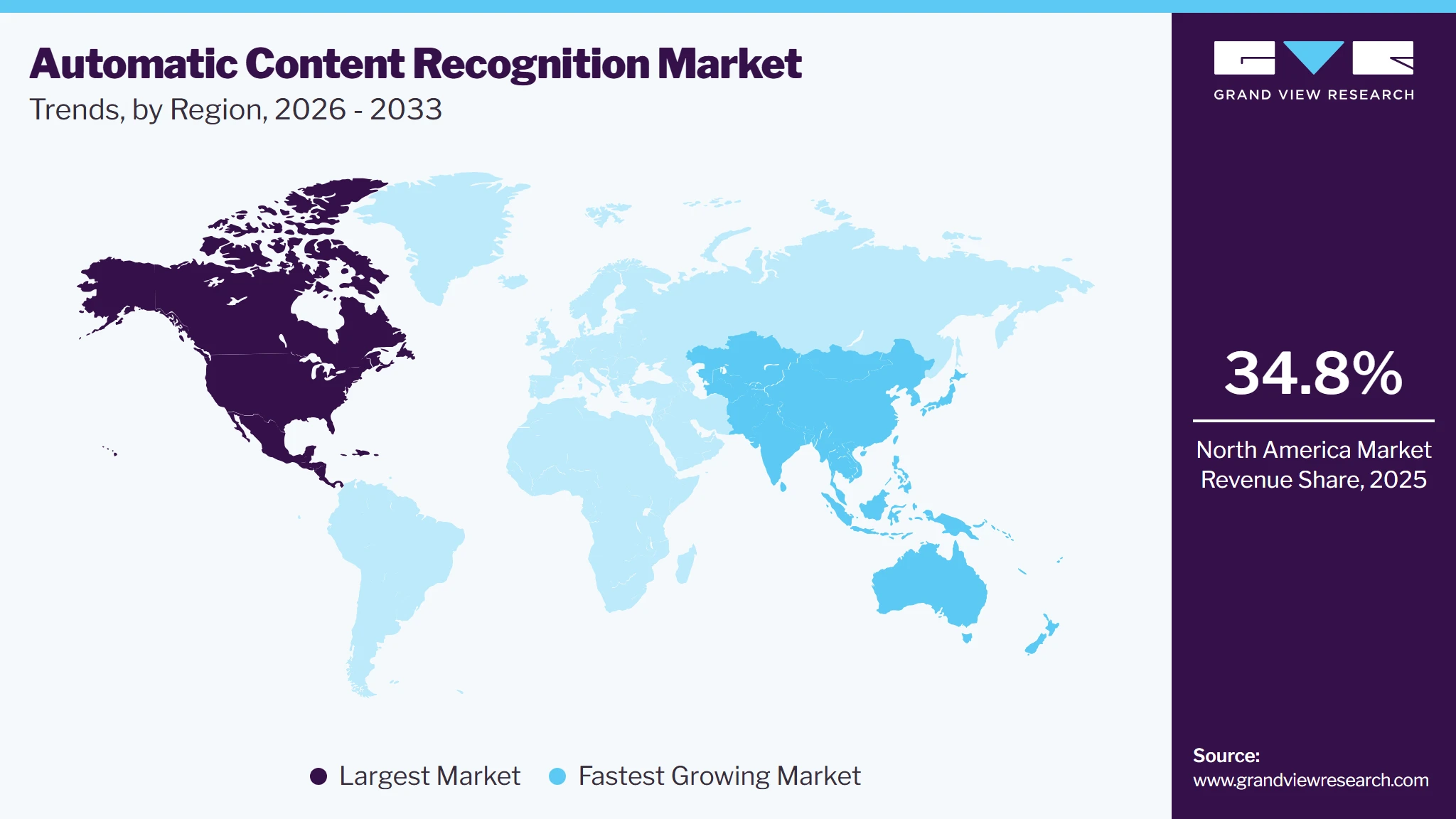
- Largest regional market: North America (34.8% revenue share, 2025)
- Fastest-growing regional market: Asia Pacific (highest CAGR, 2026-2033)
- By country: The U.S. held the largest market share in 2025
Market Size & Forecast
- Market size in 2025: USD 4.0 Billion
- Estimated market size in 2026: USD 4.8 Billion
- Projected market size by 2033: USD 18.9 Billion
- CAGR (2026-2033): 21.6%
Three ways to get this report
Buy it, customize it, or ask a question.Ask an Analyst
Analyst response in 1 business day
- AccessReport author, directly
- Reply timeWithin 1 working day
- No sales callDirect answer only
- FormatEmail reply
- CostFree, no cost
Get the Full Report
What the study covers
- FormatsPDF · Excel · Dashboard
- Timeline2026–2033 annual, 2025 base
- Coverage20+ countries, 5 regions
- Companies10+ key players profiled
Customize the Report
20% free customization
- IncludeCountries, segments, points
- TailorTo your product definition
- ExtendDeeper competitor detail
- OrA fully bespoke study
- Turnaround5–10 working days
Moreover, the increasing emphasis on content protection, copyright enforcement, and broadcast monitoring in a rapidly expanding digital media ecosystem is strengthening market growth across stakeholders such as broadcasters, advertisers, and content owners. The integration of ACR with AI and machine learning is enhancing content recommendations and improving user engagement, while the surge in digital advertising and real-time audience analytics fuels market growth.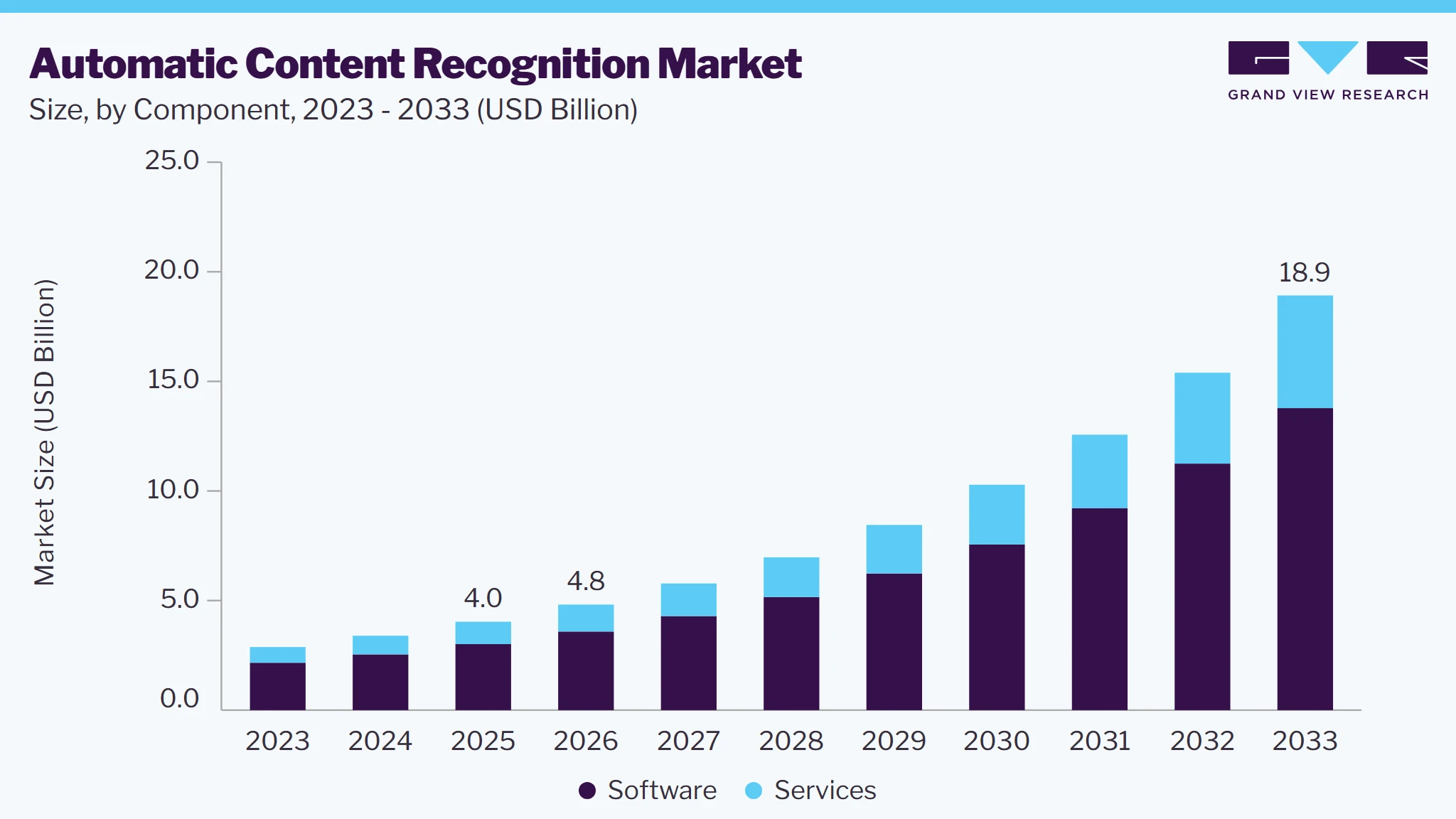 To learn more about this report, Download Free Sample Report
 Moreover, the expansion of over-the-top (OTT) services and second-screen applications is creating new opportunities for ACR deployment. With advancements in audio and video fingerprinting technologies, ACR is becoming more accurate and efficient, enabling seamless content identification and synchronization. The increasing need for audience measurement and content performance analysis is also pushing businesses toward ACR solutions. As media consumption habits evolve, the ACR market is poised for significant expansion, driven by the demand for smarter, data-driven content delivery strategies.
The automatic content recognition industry is seeing rapid growth due to the widespread adoption of smart devices like smart TVs, smartphones, and connected home systems. These devices increasingly rely on ACR technology to offer personalized content recommendations and seamless cross-device experiences. As more households adopt smart home ecosystems, the integration of ACR becomes crucial for synchronizing media consumption across multiple screens. This trend is also boosting the demand for targeted advertising, as ACR data provides precise insights into user preferences and viewing habits. Consequently, the proliferation of smart devices is a key driver shaping the ACR market’s expansion.
AI and machine learning are transforming the automatic content recognition industry by enhancing the accuracy and efficiency of content identification. These technologies enable ACR systems to analyze audio, video, and image data in real time, providing more accurate metadata and better content recommendations. Machine learning algorithms improve over time, learning from user interactions to refine content suggestions and ad targeting. AI-driven ACR is also being used in sentiment analysis, helping brands gauge audience reactions to media content. This integration is pushing the boundaries of what ACR can achieve, making it a vital tool for media and entertainment companies.
The surge in over-the-top (OTT) platforms and streaming services has created a strong demand for automatic content recognition technologies. ACR helps these platforms monitor viewership metrics, track content performance, and deliver personalized viewing experiences. As competition among streaming services intensifies, the need for precise audience analytics and content recommendations becomes even more critical. ACR also supports ad-supported streaming models by enabling dynamic ad insertion based on real-time content recognition. This growth in streaming services is directly fueling advancements and adoption in the ACR industry.
The automatic content recognition industry is revolutionizing digital advertising by enabling more targeted and effective ad placements. ACR technology identifies what content a user is engaging with and delivers relevant ads in real time, increasing ad relevance and engagement. This capability is particularly valuable for connected TV (CTV) and addressable TV advertising, where precision targeting drives a higher return on investment. Advertisers also use ACR data to measure campaign performance, ensuring that ads reach the right audience at the right moment. Enhanced monetization opportunities through targeted advertising are making ACR a cornerstone of modern media strategies.
As the automatic content recognition industry grows, so do concerns about data privacy and content security. ACR systems collect and analyze vast amounts of user data, raising questions about how that data is stored, shared, and protected. Regulatory frameworks like GDPR and CCPA are pushing companies to adopt stricter data protection measures and ensure transparency in data usage. Innovations in encrypted ACR technologies and anonymized data processing are emerging to address these privacy concerns. Balancing personalized content experiences with robust data security will be crucial for the industry’s long-term success.
The automatic content recognition industry is evolving with significant advancements in audio and visual recognition technologies. Improved algorithms now enable ACR systems to detect and identify content with higher accuracy, even in noisy or low-quality environments. Visual ACR is being used in applications like augmented reality (AR) and virtual reality (VR), enhancing interactive media experiences. Audio-based ACR is finding use in identifying songs, dialogue, and ambient sounds across various platforms. These technological advancements are making ACR more versatile and effective across diverse media landscapes.
Market Dynamics
The automatic content recognition market is experiencing robust growth, driven by the increasing integration of ACR capabilities into smart TV ecosystems, mobile applications, and connected consumer devices, enabling seamless cross-platform content identification and user behavior tracking. Additionally, the growing need for broadcast monitoring, copyright enforcement, and advertising verification across fragmented digital media channels is accelerating adoption among broadcasters, advertisers, and content owners seeking improved content control and monetization efficiency.
The rapid expansion of connected TV (CTV) devices and over-the-top (OTT) streaming services is a major driver of the automatic content recognition market. Consumers are increasingly shifting from traditional television to digital streaming platforms, prompting content providers, advertisers, and broadcasters to adopt ACR technologies for real-time content identification, audience engagement measurement, and delivery of personalized viewing experiences.
Additionally, the growing demand for targeted advertising, cross-platform audience measurement, and AI-driven content recommendations is accelerating ACR deployment. Smart TV manufacturers and streaming service providers are integrating ACR capabilities to enhance content discovery, optimize advertising performance, and improve user engagement, driving sustained market growth.
The collection and analysis of user viewing behavior through ACR technologies have raised concerns regarding data privacy, consumer consent, and regulatory compliance. Stringent data protection regulations require companies to implement transparent data collection practices and robust security measures, increasing compliance costs and operational complexity.
Furthermore, varying privacy regulations across different countries create challenges for global ACR solution providers seeking standardized deployments. Consumer concerns regarding data tracking and personalized advertising may also limit user acceptance, affecting the pace of adoption in certain markets.
The increasing integration of artificial intelligence (AI) and machine learning into ACR platforms presents significant growth opportunities for the market. AI-enabled content recognition enhances the accuracy of content identification, contextual analysis, multilingual recognition, and real-time audience insights across digital media platforms.
Moreover, the rapid growth of interactive advertising, shoppable TV, second-screen experiences, and advanced content personalization is creating new revenue opportunities for ACR vendors. As broadcasters, OTT providers, and advertisers seek more intelligent audience engagement and monetization strategies, demand for AI-powered ACR solutions is expected to expand significantly.
Market Concentration & Characteristics
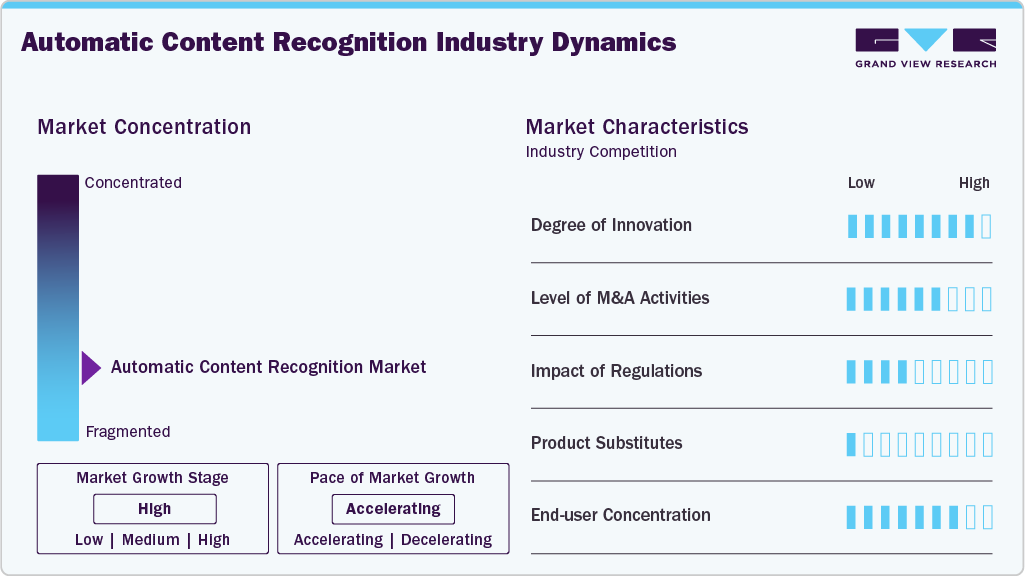
The automatic content recognition (ACR) market is moderately fragmented, with a mix of global technology companies, media intelligence providers, AI software vendors, and specialized content recognition firms. The market is highly technology-driven, fueled by advancements in AI, machine learning, audio and video fingerprinting, watermarking, speech recognition, computer vision, cloud computing, and real-time analytics. Mergers and acquisitions are moderate to high, as established technology and media companies acquire niche ACR providers to strengthen AI capabilities, expand content databases, and enhance audience measurement, advertising, and content intelligence solutions.
Regulatory influence is moderate to high, driven by evolving data privacy, copyright protection, and digital rights management (DRM) requirements. Product substitution remains low, as ACR technologies offer automated, scalable, and real-time content identification that surpasses traditional monitoring methods. Demand is diversified across media & entertainment, OTT platforms, broadcasters, consumer electronics, telecommunications, automotive, retail, healthcare, education, and government, supported by the growing need for personalized content delivery, audience analytics, targeted advertising, and content monetization.
 To learn more about this report, Download Free Sample Report
 Analyst Perspective
The automatic content recognition market is experiencing strong structural growth, driven by the rapid expansion of connected TV (CTV) and over-the-top (OTT) streaming platforms, increasing demand for personalized content recommendations, and growing adoption of data-driven audience measurement and targeted advertising solutions. Rising integration of artificial intelligence (AI), machine learning (ML), and cloud-based analytics into content recognition technologies, coupled with the proliferation of smart TVs, smartphones, and connected devices, is further accelerating market adoption.
Component Insights
Based on component, the software segment led the market with the largest revenue share of 74.22% in 2024.The rising demand for automatic content recognition software to track and analyze TV viewership data is fueling its adoption across various industries. Broadcasting stations, film production companies, marketing and advertising agencies, and game developers are among the key users leveraging ACR technology for better audience insights and content management. With the rapid advancement of smart devices like smart TVs, smartphones, and tablets, ACR software is finding diverse applications in targeted advertising, ad monitoring, copyright protection, and license tracking. In the AdTech industry, ACR plays a crucial role by providing valuable engagement metrics, ad viewability data, and conversion rate analysis, enabling more effective ad strategies. This growing reliance on ACR software highlights its importance in enhancing content delivery, optimizing advertising efforts, and ensuring proper rights management across digital platforms.
The services segment is expected to witness at the fastest CAGR of 21.7% from 2025 to 2030. The service segment of the automatic content recognition industry is gaining traction as companies seek expert support for implementing and managing ACR solutions. These services include system integration, maintenance, and consulting, ensuring seamless deployment and optimal performance of ACR software across various platforms. As demand for real-time content identification and audience analytics grows, service providers play a vital role in customizing ACR solutions to meet specific business needs. This increasing reliance on specialized services is driving the expansion of the service segment, making it a crucial component of the ACR market’s overall growth.
Content Insights
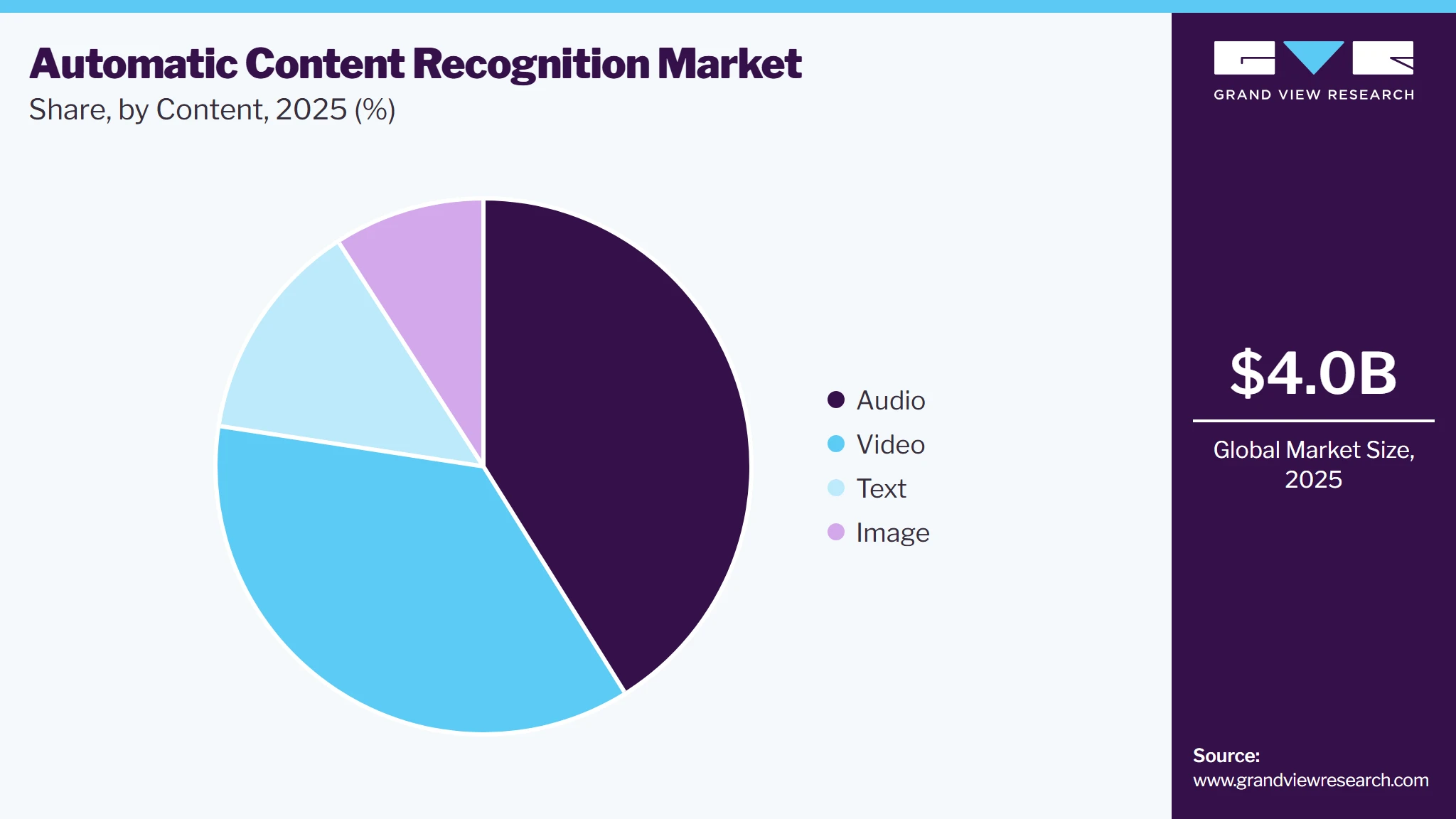
Based on content, the audio segment dominated the market with the largest revenue share of 41.1% in 2025 and is expected to grow at a considerable CAGR over the forecast period. The audio segment of the automatic content recognition industry is experiencing significant growth due to its ability to identify and analyze audio content in real-time. This technology is widely used in media monitoring, music recognition, and audience measurement, providing valuable insights into listener behavior and content performance. Streaming platforms, broadcasters, and advertisers leverage audio-based ACR to track song plays, detect copyrighted material, and deliver targeted ads based on audio context. The increasing consumption of audio content across smart devices like speakers, TVs, and smartphones is further fueling demand for this segment. As a result, the audio segment remains a vital driver of innovation and expansion within the ACR industry.
 To learn more about this report, Download Free Sample Report
 The video segment is expected to record at the fastest CAGR from 2026 to 2033. The video segment of the automatic content recognition industry is growing rapidly, driven by the increasing demand for real-time video identification and analytics. This technology helps streaming platforms, broadcasters, and advertisers track video content performance, monitor copyright compliance, and deliver personalized recommendations. With the rise of smart TVs, OTT platforms, and video-sharing services, the need for accurate video recognition has become essential for enhancing viewer engagement and optimizing ad placement. Video recognition also supports advanced applications like interactive advertising and content synchronization across devices. As video consumption continues to surge globally, this segment plays a crucial role in shaping the industry’s future growth and innovation.
Platform Insights
Based on platform, the smart TVs segment dominated the market with the largest revenue share of 69.6% in 2025, due to their widespread adoption and advanced capabilities. These devices use content recognition technology to identify what users are watching, enabling personalized recommendations and targeted advertising. By gathering real-time viewership data, smart TVs help broadcasters and streaming platforms better understand audience preferences and optimize content delivery. This technology also supports interactive features like on-screen information and synchronized second-screen experiences, enhancing user engagement. As smart TV penetration continues to rise globally, their role in expanding content recognition applications becomes even more critical.
The over-the-top (OTT) segment is expected to record at the fastest CAGR from 2026 to 2033. Over-the-top (OTT) platforms are playing a pivotal role in driving the growth of the automatic content recognition industry by offering vast amounts of digital video content directly to consumers. These platforms use content recognition technology to track viewer preferences, monitor content performance, and deliver highly personalized recommendations. By analyzing real-time viewing data, OTT services can enhance audience engagement and optimize their ad targeting strategies. Content recognition also helps ensure copyright compliance and prevents unauthorized distribution of digital media. As the demand for streaming services continues to grow globally, the adoption of this technology within the OTT segment is expected to expand significantly.
Technology Insights
Based on technology, the audio & video fingerprinting segment dominated the market with the largest revenue share of 36.2% in 2025. The audio and video fingerprinting segment is a crucial component of the automatic content recognition industry, offering advanced capabilities for identifying and tracking media content. This technology creates unique digital "fingerprints" from audio and video files, enabling precise content recognition without relying on metadata or watermarks. Streaming platforms, broadcasters, and advertisers use fingerprinting to monitor content usage, protect intellectual property, and deliver targeted ads based on real-time media analysis. With the growing demand for personalized viewing experiences and accurate audience measurement, audio and video fingerprinting has become essential for optimizing content delivery and monetization. As media consumption continues to rise across digital channels, this segment is poised for significant growth within the automatic content recognition industry.
The optical character recognition (OCR) segment is expected to grow at a significant CAGR from 2026 to 2033. Speech recognition is an essential segment of the automatic content recognition industry, enabling the real-time analysis and identification of spoken content across various media. This technology converts audio speech into text, allowing broadcasters, streaming platforms, and advertisers to analyze dialogue, detect keywords, and enhance content indexing. Speech recognition plays a crucial role in improving accessibility through features like automated captions and voice search, while also supporting targeted advertising by understanding the context of spoken words. Its ability to extract insights from conversations makes it invaluable for audience analytics and personalized content recommendations. As voice-driven interfaces and smart devices become more popular, the demand for speech recognition technology in the automatic content recognition industry continues to grow rapidly.
Industry Vertical Insights
Based on industry vertical, the media & entertainment segment dominated the market with the largest revenue share of 23.0% in 2025. The media and entertainment segment is a major driver of growth in the automatic content recognition industry, leveraging advanced technology to enhance audience engagement and content management. Broadcasters, streaming services, and production companies use content recognition to track viewership patterns, monitor copyright compliance, and optimize ad placements. This technology also enables personalized content recommendations and interactive viewing experiences, making entertainment more tailored and immersive. By providing real-time analytics on audience behavior, it helps media companies make data-driven decisions to improve programming and marketing strategies. As digital content consumption continues to rise, the media and entertainment segment remains at the forefront of adopting content recognition solutions.
The healthcare segment is expected to record at the fastest CAGR from 2026 to 2033. The healthcare segment is emerging as a promising area in the automatic content recognition industry, utilizing advanced technology to streamline operations and improve patient care. Hospitals and medical institutions use content recognition for managing and organizing vast amounts of medical video and audio data, such as surgical recordings, diagnostic imaging, and patient consultations. This technology helps in accurately indexing and retrieving medical content, aiding in training, research, and telemedicine. Speech recognition also plays a key role in transcribing doctor-patient conversations and generating real-time medical documentation. As digital transformation accelerates in healthcare, the adoption of content recognition solutions is set to enhance efficiency, accuracy, and patient outcomes.
End Use Insights
Based on end use, the audience measurement segment dominated the market with the largest revenue share of 40.6% in 2025. The audience measurement segment is a vital part of the automatic content recognition industry, providing real-time insights into viewer behavior and content consumption patterns. By analyzing data from smart TVs, OTT platforms, and digital devices, this technology tracks what audiences are watching and how they engage with media. It helps broadcasters, advertisers, and content creators measure viewership metrics, such as audience size, attention span, and interaction rates. These insights enable more effective ad targeting, personalized content recommendations, and data-driven programming decisions. As the demand for precise and automated audience analytics grows, the audience measurement segment continues to gain importance in shaping media strategies.
The ad-tracking segment is expected to record at the fastest CAGR from 2026 to 2033. The ad-tracking segment plays a crucial role in the automatic content recognition industry by offering real-time monitoring and analysis of advertisements across various media channels. Using advanced recognition technology, it identifies when and where ads are aired, tracks their frequency, and measures audience engagement. This enables advertisers and marketers to assess campaign performance, optimize ad placement, and ensure brand visibility. By providing detailed insights on ad viewability and effectiveness, the ad-tracking segment helps maximize return on investment for advertising spend. As digital advertising continues to evolve, the demand for accurate and automated ad-tracking solutions is expected to grow significantly.
Regional Insights
North America dominated the automatic content recognition market, accounting for the largest revenue share of 34.8% in 2025. The automatic content recognition industry in North America is experiencing robust growth driven by increasing demand for personalized content and advanced audience measurement solutions. The proliferation of smart TVs and connected devices, along with the rise of OTT platforms, is further fueling market expansion. Strategic partnerships between tech companies and content providers are also shaping the evolving ecosystem of ACR in this region.
 To learn more about this report, Download Free Sample Report
 U.S. Automatic Content Recognition Market Trends
The automatic content recognition market in the U.S. held the largest share in the North America region in 2025. The U.S. remains the dominant player in the North American ACR market due to its strong presence of global technology companies and early adoption of advanced media solutions. Growing investments in AI and big data analytics to enhance content recognition capabilities are pushing innovation. In addition, the rising popularity of interactive and targeted advertising is creating new opportunities for ACR adoption.
Asia-Pacific Automatic Content Recognition Market Trends
The automatic content recognition market in Asia Pacific is expected to grow at the highest CAGR over the forecast period. The market is expanding rapidly, driven by the surge in digital content consumption and the growing popularity of streaming platforms. Increasing smartphone penetration and the adoption of smart home devices are supporting the growth of ACR solutions. Countries in this region are investing heavily in AI-driven analytics to improve content personalization and viewer insights.
The automatic content recognition market in China is thriving due to its vast digital user base and the dominance of local streaming giants. The country’s focus on technological innovation and the development of AI-powered recognition systems are accelerating market growth. Strong government support for digital transformation is also playing a key role in market expansion.
The India automatic content recognition market is on an upward trajectory driven by increasing internet penetration and the popularity of regional OTT platforms. The demand for localized and personalized content is pushing content providers to adopt advanced ACR solutions. Growing investments in AI and data-driven analytics are enhancing content discovery and audience engagement.
Europe Automatic Content Recognition Market Trends
The automatic content recognition market in Europe was identified as a lucrative region in 2025. In Europe, the market is growing steadily due to increasing demand for real-time content analytics and audience engagement tools. The region’s focus on data privacy and stringent regulations like GDPR are influencing the development of compliant ACR technologies. The expansion of smart home ecosystems and streaming services is also driving the need for more sophisticated content recognition capabilities.
The UK automatic content recognition market is a key contributor to Europe’s market, driven by the rapid digitalization of media and entertainment sectors. Growing consumer preference for personalized content and tailored recommendations is boosting the adoption of ACR solutions. Partnerships between broadcasters and technology providers are accelerating market innovation and deployment.
The automatic content recognition market in Germany is witnessing growth due to the country’s strong engineering expertise and emphasis on precision technology. Demand for advanced audience measurement and interactive advertising is pushing broadcasters to integrate ACR solutions. The rise of connected devices and smart TVs is further enhancing market potential.
Key Automatic Content Recognition Company Insights
Some of the key players operating in the market include Gracenote and Audible Magic Corporation.
-
Gracenote is a prominent entity in the ACR landscape, offering comprehensive media recognition solutions. Their flagship product, Gracenote Video Automatic Content Recognition, enables smart TVs and other devices to identify and synchronize content in real time, enhancing user engagement through interactive features. This technology has been widely adopted by major consumer electronics manufacturers, embedding Gracenote's ACR capabilities into millions of devices worldwide. By providing accurate content identification, Gracenote facilitates personalized viewing experiences and targeted advertising.
-
Audible Magic Corporation has made significant strides in content identification and rights management. Their flagship product, the Audible Magic Content Recognition Service, offers real-time identification of audio and video content, enabling platforms to manage user-generated content effectively. This service is crucial for social media platforms and content-sharing websites to monitor and control the distribution of copyrighted material, ensuring compliance and reducing unauthorized use. Audible Magic's extensive database and recognition capabilities have positioned it as a trusted partner for content owners and distributors.
ACRCloud, andClarifai Inc are some of the emerging participants in the automatic content recognition industry.
-
ACRCloud is gaining attention with its robust audio recognition services. Their flagship offering, the ACRCloud Music Recognition Service, provides real-time identification of music tracks, enabling developers to integrate music recognition features into their applications seamlessly. This service supports a vast database of songs and is utilized in various applications, from music discovery apps to broadcast monitoring systems. ACRCloud's scalable and efficient solution makes it a preferred choice for developers seeking reliable music recognition capabilities.
-
Clarifai Inc. is an emerging player focusing on artificial intelligence-driven image and video recognition. Their flagship product, the Clarifai Visual Recognition Platform, offers advanced machine-learning models that can identify and tag various elements within visual content. This platform is used across industries for applications such as content moderation, visual search, and automated metadata generation. Clarifai's emphasis on AI and deep learning enables it to provide highly accurate and customizable recognition solutions, catering to diverse client needs.
Key Automatic Content Recognition Companies
The following key companies have been profiled for this study on the automatic content recognition market.
-
ACRCloud
-
Apple Inc.
-
Audible Magic Corporation
-
Clarifai Inc.
-
Digimarc Corporation
-
Google LLC (Alphabet Inc.)
-
Gracenote
-
IBM Corporation
-
KT Corporation
-
Kudelski Group
-
Microsoft Corporation
-
Nuance Communications Inc.
Competitive Benchmarking
Category
Operating Strategies
Competitive Edge
Weakness
Established Players (Apple Inc., Google LLC (Alphabet Inc.), Microsoft Corporation, IBM Corporation)
- Focus on delivering end-to-end Automatic Content Recognition (ACR) solutions integrated with AI, cloud computing, connected TV ecosystems, digital media platforms, and enterprise analytics.
- Strong emphasis on audience measurement, personalized content recommendations, targeted advertising, content monetization, broadcast monitoring, and digital rights management through scalable cloud-based platforms.
- Strong global brand recognition, extensive AI and cloud infrastructure, large installed customer base, advanced data analytics capabilities, broad product portfolios, and established partnerships across media, entertainment, telecommunications, and consumer electronics industries.
- Significant R&D investments and financial resources enable continuous innovation, large-scale deployments, and global market expansion.
High implementation and integration costs for enterprise deployments, increasing regulatory scrutiny related to data privacy and consumer data usage, and relatively slower product innovation cycles due to large organizational structures.
Emerging & Specialized Players (ACRCloud, Audible Magic Corporation, Clarifai Inc., Digimarc Corporation)
- Focus on specialized ACR technologies such as audio and video fingerprinting, watermarking, speech recognition, computer vision, OCR, and AI-powered content intelligence.
- Emphasize flexible APIs, cloud-native deployment, rapid innovation, content identification, copyright protection, broadcast monitoring, and customized solutions for media companies, OTT platforms, and enterprise customers.
- High agility in technology innovation, deep expertise in specific content recognition technologies, faster product development cycles, cost-effective and scalable deployment models.
- Strong customization capabilities, and specialized intellectual property in media recognition, AI, and digital content analytics.
Limited global scale and financial resources compared to established technology companies, narrower customer base, lower brand recognition, and greater dependence on strategic partnerships, licensing agreements, and media industry adoption.
Recent Developments
-
In August 2024, ACRCloud announced the integration of its automatic content recognition (ACR) technology into major streaming services. This update introduces enhanced fingerprinting algorithms designed to improve content-matching accuracy and deliver a more personalized user experience. By advancing content discovery capabilities, ACRCloud aims to strengthen its position in the evolving digital entertainment landscape.
-
In August 2024, Vobile Group launched a new suite of ACR tools aimed at enhancing brand safety and compliance in digital advertising. These tools utilize advanced recognition techniques to monitor brand mentions across various digital media platforms. By providing advertisers with greater visibility and control over their brand presence, Vobile Group strengthens its role in the digital marketing ecosystem.
-
In July 2024, Audible Magic introduced its latest ACR solution, pushing the boundaries of content management and protection. Leveraging machine learning-based detection, the system offers advanced copyright protection and sophisticated digital media tracking. This technology ensures stricter control against unauthorized content use, making it a powerful tool for safeguarding intellectual property.
Automatic Content Recognition Market Report Scope
Report Attribute
Details
Market size in 2025
USD 4.0 billion
Estimated market size in 2026
USD 4.8 billion
Projected market size by 2033
USD 18.9 billion
Growth rate
CAGR of 21.6% from 2026 to 2033
Base year for estimation
2025
Historical data
2021 - 2024
Forecast period
2026 - 2033
Quantitative units
Revenue in USD billion and CAGR from 2026 to 2033
Report coverage
Revenue forecast, company ranking, competitive landscape, growth factors, and trends
Segments covered
Component, content, platform, technology, industry vertical, end use, region
Regional scope
North America; Europe; Asia Pacific; Latin America; MEA
Country scope
U.S.; Canada; UK; Germany; France; Italy; Spain; China; India; Japan; South Korea; Australia; Brazil; Mexico; Saudi Arabia; UAE; South Africa
Key companies profiled
ACRCloud; Apple Inc.; Audible Magic Corporation; Clarifai Inc.; Digimarc Corporation; Google LLC (Alphabet Inc.); Gracenote; IBM Corporation; KT Corporation; Kudelski Group; Microsoft Corporation; and Nuance Communications Inc.
Customization scope
Free report customization (equivalent up to 8 analysts' working days) with purchase. Addition or alteration to country, regional & segment scope.
Pricing and purchase options
Avail customized purchase options to meet your exact research needs. Explore purchase options
Global Automatic Content Recognition Market Report Segmentation
This report forecasts revenue growth at the country level and provides an analysis of the latest industry trends in each of the sub-segments from 2018 to 2030. For this study, Grand View Research has segmented the global automatic content recognition market report based on component, content, platform, technology, industry vertical, end use, and region:
-
Component Outlook (Revenue, USD Million, 2021 - 2033)
-
Software
-
Services
-
-
Content Outlook (Revenue, USD Million, 2021 - 2033)
-
Audio
-
Video
-
Text
-
Image
-
-
Platform Outlook (Revenue, USD Million, 2021 - 2033)
-
Smart TVs
-
Linear TVs
-
Over-The-Top (OTT)
-
Others
-
-
Technology Outlook (Revenue, USD Million, 2021 - 2033)
-
Audio & Video Watermarking
-
Audio & Video Fingerprinting
-
Speech Recognition
-
Optical Character Recognition (OCR)
-
Others
-
-
Industry Vertical Outlook (Revenue, USD Million, 2021 - 2033)
-
Media & Entertainment
-
IT & Telecommunication
-
Automotive
-
Retail & E-commerce
-
Audience Measurement
-
Content Filtering
-
IT & Telecommunication Electronics
-
Government & Defense
-
Others
-
-
End-use Outlook (Revenue, USD Million, 2021 - 2033)
-
Audience Measurement
-
Content Enhancement
-
Broadcast Monitoring
-
Content Filtering
-
Ad-tracking
-
Others
-
-
Regional Outlook (Revenue, USD Million, 2021 - 2033)
-
North America
-
U.S.
-
Canada
-
-
Europe
-
UK
-
Germany
-
France
-
Italy
-
Spain
-
-
Asia Pacific
-
China
-
India
-
Japan
-
South Korea
-
Australia
-
-
Latin America
-
Brazil
-
Mexico
-
-
Middle East & Africa
-
Saudi Arabia
-
UAE
-
South Africa
-
-
Research Methodology
The automatic content recognition market figures in this report are based on a proven research process that combines executive interviews with secondary research from proprietary databases, company filings, and recognized regulatory and institutional sources. Market size is built through value-chain sizing-reconciling supply-side and demand-side estimates-and triangulated with bottom-up and top-down approaches. Every estimate passes multiple levels of expert validation before publication, with each automatic content recognition segment quantified using the revenue-capture definitions in the table below.
Segment Definition
Component
Revenue capture definition
Software
Revenue is generated through software licensing, API-based usage fees, and subscription-based analytics platforms that enable content identification, metadata tagging, audience analytics, and real-time media intelligence solutions.
Services
Revenue is derived from managed services, system integration, deployment support, maintenance, consulting, content database management, and ongoing optimization of ACR systems across media and enterprise applications.
Content
Revenue capture definition
Audio
Revenue is generated through audio fingerprinting, music recognition services, broadcast monitoring, and royalty tracking solutions used for content identification and monetization.
Video
Revenue is derived from video recognition, scene detection, advertising verification, OTT content tracking, and video metadata enrichment services for broadcasters and streaming platforms.
Text
Revenue is generated through OCR-based content extraction, text recognition, digital publishing analytics, and content classification services used for indexing and monitoring textual media.
Image
Revenue is derived from image recognition, visual content tagging, brand monitoring, copyright enforcement, and visual analytics used across advertising and digital media ecosystems.
Platform
Revenue capture definition
Smart TVs
Revenue is generated through embedded ACR software integration, OEM licensing agreements, viewer analytics, and targeted advertising services delivered via smart TV ecosystems.
Linear TVs
Revenue is derived from broadcast monitoring services, audience measurement contracts, content verification, and ad-tracking solutions for traditional television networks.
Over-The-Top (OTT)
Revenue is generated through streaming analytics, personalized recommendation engines, ad targeting, content discovery optimization, and subscription-based platform intelligence services.
Others
Revenue is derived from multi-device integration including mobile apps, gaming consoles, automotive infotainment systems, and IoT-enabled media consumption platforms using ACR capabilities.
Technology
Revenue capture definition
Audio & Video Watermarking
Revenue is generated through embedding and detection of digital watermarks for content protection, copyright enforcement, and broadcast tracking across media channels.
Audio & Video Fingerprinting
Revenue is derived from content identification services using unique audio/video signatures for real-time matching, monitoring, and media analytics applications.
Speech Recognition
Revenue is generated through voice-to-text conversion, voice analytics, contextual understanding, and smart assistant integration for media interaction and indexing.
Optical Character Recognition (OCR)
Revenue is derived from text extraction from visual media, automated content indexing, document digitization, and metadata generation for searchable content systems.
Others
Revenue is generated through emerging AI-driven recognition technologies including computer vision, deep learning-based multimodal analysis, and hybrid content recognition systems.
Industry Vertical
Revenue capture definition
Media & Entertainment
Revenue is generated through content tracking, audience analytics, ad monetization, and rights management solutions for broadcasters, studios, and streaming platforms.
IT & Telecommunication
Revenue is derived from platform integration, network-based content analytics, OTT services enablement, and subscriber behavior analysis solutions.
Automotive
Revenue is generated through in-vehicle infotainment content recognition, personalized media delivery, and voice-enabled content discovery systems.
Retail & E-commerce
Revenue is derived from advertising analytics, visual recognition for product identification, and customer engagement tracking across digital retail platforms.
Education
Revenue is generated through digital learning content tracking, lecture recognition, and AI-based educational media indexing and personalization solutions.
Healthcare
Revenue is derived from medical training content recognition, digital documentation analysis, and AI-driven medical media indexing systems.
Consumer Electronics
Revenue is generated through embedded ACR capabilities in smart devices, licensing agreements with OEMs, and device-based content intelligence solutions.
Government & Defense
Revenue is derived from secure media monitoring, surveillance content analysis, broadcast tracking, and regulatory compliance applications.
Others
Revenue is generated through diverse niche applications including enterprise communications, digital signage analytics, and specialized AI content recognition use cases.
End Use
Revenue capture definition
Audience Measurement
Revenue is generated through viewer tracking, engagement analytics, cross-platform audience profiling, and media consumption behavior insights
Content Enhancement
Revenue is derived from metadata enrichment, content tagging, recommendation engines, and personalized content delivery solutions.
Broadcast Monitoring
Revenue is generated through real-time tracking of broadcast content, compliance monitoring, and content verification services for media regulators and networks.
Content Filtering
Revenue is derived from automated content moderation, copyright enforcement, parental control systems, and brand safety solutions.
Ad-tracking
Revenue is generated through advertising verification, campaign performance measurement, attribution analytics, and targeted ad optimization services.
Others
Revenue is derived from emerging applications such as digital rights management, AI-based media intelligence, and cross-platform content analytics services.
Estimation Model
Layer No.
Layer Name
Key Question
Description
01
Data Generation & End-User Layer
Who generates demand for Automatic Content Recognition (ACR) systems?
Represents the total addressable market for ACR solutions, driven by end users such as media & entertainment companies, OTT platforms, broadcasters, advertisers, smart TV manufacturers, telecommunications providers, automotive infotainment systems, and government agencies. Demand is fueled by rising digital content consumption, increasing OTT and connected TV penetration, need for audience measurement, personalized content delivery, ad targeting, content moderation, and copyright protection across multiple digital ecosystems.
02
Technology & Infrastructure Layer
What technologies enable Automatic Content Recognition?
Includes core enabling technologies such as audio/video fingerprinting, watermarking, speech recognition, optical character recognition (OCR), computer vision, artificial intelligence (AI) and machine learning (ML) models, natural language processing (NLP), cloud computing platforms, edge AI processing, big data analytics engines, and high-speed content indexing systems that enable real-time identification, classification, and contextual analysis of multimedia content across devices and platforms.
03
Deployment, Integration & Processing Layer
How are ACR systems deployed and operationalized?
Covers ecosystem participants and deployment models involved in implementing ACR solutions, including AI platform providers, cloud service providers, smart TV OEMs, OTT platform integrators, telecom operators, and media analytics vendors. It includes integration into smart TVs, mobile apps, OTT platforms, and broadcasting systems, along with real-time content matching pipelines, metadata enrichment workflows, cross-platform tracking systems.
04
Revenue Generation Layer
How is revenue generated?
Revenue is generated through software licensing fees, API-based usage pricing, SaaS subscriptions for analytics platforms, data monetization services, advertising technology solutions, content identification and monitoring services, broadcast analytics contracts, OEM integration partnerships, and enterprise-grade managed services.
Delivered Customizations
This report has been delivered with the following In-depth customizations
Client Request
Customization Delivered
Value Adds
Market Sizing, Competitive Landscape & Growth Opportunity Assessment
Assessed the global Automatic Content Recognition (ACR) market size, historical and forecast growth trends, and detailed segmentation by component (software, services), content type (audio, video, text, image), platform (smart TVs, linear TVs, OTT, others), technology (audio & video watermarking, fingerprinting, speech recognition, OCR, others), industry vertical, and end use.
Supports market entry and expansion strategies, identifies high-growth opportunities across OTT platforms, AI-powered content recognition, and smart TV ecosystems, improves investment prioritization, and enables data-driven product portfolio planning across the digital media value chain.
Competitive Benchmarking & Strategic Positioning Analysis
Benchmarked leading ACR technology providers, media analytics companies, smart TV platform vendors, and software developers based on recognition accuracy, AI/ML capabilities, platform compatibility, real-time analytics, scalability, privacy compliance, content identification speed, ecosystem partnerships, pricing models, and global market presence.
Supports competitive differentiation, strengthens product positioning, identifies technology gaps in AI-driven content recognition and cross-platform analytics, improves partnership and acquisition decisions, and enhances long-term competitive strategy in the connected media ecosystem.
Regional Market Demand & Deployment Opportunity Analysis
Analyzed regional demand across North America, Europe, Asia Pacific, Latin America, and the Middle East & Africa, evaluating factors such as connected TV penetration, OTT adoption, digital advertising expenditure, AI adoption, media consumption patterns, data privacy regulations, and smart device ecosystem maturity.
Supports geographic expansion planning, identifies high-growth regions driven by increasing OTT consumption and connected device adoption, improves localization strategies, enables region-specific partnership development, and strengthens long-term international growth planning.
Frequently Asked Questions About This Report
The global automatic content recognition market size was estimated at USD 4.0 billion in 2025 and is expected to reach USD 4.8 billion in 2026.
The global automatic content recognition market is expected to grow at a compound annual growth rate of 21.6% from 2026 to 2033 to reach USD 18.9 billion by 2033.
The key players in this industry are ACRCloud, Apple Inc., Audible Magic Corporation, Clarifai Inc., Digimarc Corporation, Google LLC (Alphabet Inc.), Gracenote, IBM Corporation, KT Corporation, Kudelski Group, Microsoft Corporation, and Nuance Communications Inc. among others.
Key factors that are driving the automatic content recognition market growth include the increased demand for personalized content and an upsurge in the popularity of digital platforms, including social media, streaming services, and online video-sharing platforms.
Based on component, the software segment dominated the market in 2025 with a share of over 74.7%. The rising demand for automatic content recognition software to track and analyze TV viewership data is fueling its adoption across various industries. Broadcasting stations, film production companies, marketing and advertising agencies, and game developers are among the key users leveraging ACR technology for better audience insights and content management.
North America accounted for the largest market share of 34.8% revenue share in 2025
The software segment accounted for the largest market share of 74.7% in 2025.
The audio segment dominated the market, with a share of 41.1% in 2025.
The smart TV’s segment dominated the market in 2025.
About the Author(s)
Next Generation Technologies Research Team
Technology · Next Generation TechnologiesThis report was authored by the next generation technologies research team at Grand View Research - comprising two research analysts, one senior research analyst, and one industry expert - with specialized expertise in the next generation technologies segment of the technology industry. All findings are based on proprietary technology databases, executive interviews, and regulatory analysis, subject to internal peer review prior to publication.
Last Updated:
Speak to Analyst

Customize this report to your needs - add regions, segments, or data points, with 20% free customization.
Or view our licence options:


ISO 9001:2015 & 27001:2022 Certified
We are GDPR and CCPA compliant! Your transaction & personal information is safe and secure. For more details, please read our privacy policy.


