
- Home
- »
- Automotive & Transportation
- »
-
Automotive Logistics Market Size & Share Report, 2026-2033GVR Report cover
![Automotive Logistics Market Size, Share & Trends Report]()
Automotive Logistics Market (2026 - 2033) Size, Share & Trends Analysis Report By Activity (Warehousing, Transportation), By Type (Finished Vehicle, Automobile Parts), By Distribution (Domestic, International), By Logistic Solution, By Region, And Segment Forecasts
Market Size, 2025
$249.2BMarket Estimate, 2026
$269.1BMarket Forecast, 2033
$460.2BCAGR, 2026–2033
8.0%Automotive Logistics Market Summary
The global automotive logistics market size was valued at USD 249.2 billion in 2025 and is projected to grow from USD 269.1 billion in 2026 to USD 460.2 billion by 2033, at a CAGR of 8.0% from 2026 to 2033. The Asia Pacific dominated the global market with a revenue share of 37.7% in 2025. Growing demand from vehicle manufacturers across various regions, increasing growth experienced by the automotive industry in countries such as India, and a significant increase in demand for electric vehicles worldwide have contributed to this market's growth.

Key Market Trends & Insights
- By activity: The transportation segment dominated the global industry in 2025, capturing a revenue share of 80.7%.
- By logistic solution: The inbound segment dominated the global market in 2025.
- By type: The automobile parts segment held the largest revenue share in 2025.
- By distribution: The domestic distribution segment held the largest revenue share in 2025.
Regional Highlights
- Largest regional market: Asia Pacific (37.7% revenue share, 2025)
- Fastest-growing regional market: Asia Pacific (highest CAGR, 2026-2033)
- By country: China held the largest revenue share of the regional industry in 2025.
Market Size & Forecast
- Market size in 2025: USD 249.2 billion
- Estimated market size in 2026: USD 269.1 billion
- Projected market size by 2033: USD 460.2 billion
- CAGR (2026-2033): 8.0%
Vehicle production has increased significantly in multiple countries over the last few years. This includes countries such as China, India, South Korea and others. In 2023, nearly 93 million vehicles were produced worldwide. Diverse consumer requirements mainly drive demand for these vehicles and the variety of automotive products. Once shipped to different regions and countries, the vehicles and numerous automotive parts are stored in warehousing facilities before getting dispatched to multiple distribution centers. These activities rely on key market participants' automotive logistics services and solutions. This includes warehousing, transportation, distribution, loading, unloading, aftermarket logistics, and others.The quality of automotive logistics and efficient strategy execution directly influence customer satisfaction, brand loyalty, brand perception, and brand positioning in the global automotive industry. A well-managed supply chain adds to the customer experience and enhances brand loyalty. Manufacturers emphasize deploying pre-determined automotive logistics strategies while collaborating with major market players with required resources, fleets, warehouses, and infrastructural support.

Numerous technology and innovation-based companies are launching advanced digital solutions and enterprise software, which is expected to enhance performance and improve operations and growth for this market. Increasing research and development activities add greater potential to market growth. For instance, in June 2024, The Massachusetts Institute of Technology Center for Transportation & Logistics (MIT CTL) launched a new laboratory setup supported by seed funding provided by Mecalux, a participant in the intralogistics technology market. The lab is dedicated to examining high-impact applications of modern data-driven technologies for logistics businesses.
Port authorities, railways, and similar organizations work with various industry participants to establish effective warehousing and transportation infrastructure to facilitate growing international trade. For instance, in March 2024, CEVA Logistics and The Port of Dunkirk signed a contract for a plot of land spanning a 9.5-hectare area, which is set to be used for a vehicle logistics park. CEVA Logistics, one of the market participants in the freight services and logistics solutions industry, has announced its plan to deploy this part to support maritime import and export activities driven through the Port of Dunkirk.
Various other industries, such as the mobility market, car rental businesses, tourism industry, and others, support the growth of the automotive logistics industry. Demand for newly developed vehicles equipped with advanced technology features and enhanced user assistance has generated significant demand for automotive logistics services. New contracts among vehicle manufacturers and mobility businesses are expected to add growth opportunities for this market in the forecast period.
For instance, in February 2024, Ayvens, a market participant in long-term vehicle leasing and fleet management, signed a frame agreement with Stellantis NV, a global automotive manufacturer. The agreement involves Ayvens purchasing nearly 500,000 Stellantis NV vehicles over the next three years for its long-term leasing business in Europe. Such business activities and contracts among major market participants are expected to fuel demand for effective automotive logistics services over the forecast period.
Market Dynamics
Increasing adoption of digital supply chain technologies and smart logistics infrastructure across the automotive industry is driving the growth of the automotive logistics market by enabling improved operational efficiency, real-time visibility, and enhanced coordination across transportation, warehousing, and distribution activities. Automotive manufacturers, suppliers, and logistics service providers are increasingly deploying technologies such as IoT-enabled tracking systems, AI-based route optimization, warehouse automation, cloud-based transportation management systems (TMS), and predictive analytics solutions to streamline complex supply chain operations. The growing production of electric vehicles, increasing globalization of automotive supply chains, and rising demand for just-in-time manufacturing are further accelerating the need for connected and technology-driven logistics ecosystems.
The increasing integration of automation and data-driven technologies into automotive logistics operations is enabling companies optimize inventory management, reduce transportation delays, improve fleet utilization, and enhance delivery accuracy. In addition, the adoption of smart warehousing solutions, automated guided vehicles (AGVs), robotics, and real-time fleet monitoring systems is supporting cost reduction and improving overall supply chain resilience. Automotive manufacturers are also emphasizing digital logistics networks to support sustainability goals, reduce carbon emissions, and improve customer satisfaction through faster and damage-free deliveries.As a result, logistics providers are increasingly investing in advanced digital infrastructure and intelligent transportation solutions, which is expected to create significant growth opportunities for the automotive logistics market over the forecast period.
High transportation costs and supply chain disruptions across automotive logistics networks are restraining the growth of the automotive logistics market by creating operational inefficiencies and increasing overall logistics expenses for manufacturers and service providers. Automotive logistics operations rely heavily on roadways, railways, ports, and warehousing infrastructure for the timely movement of automobile parts and finished vehicles. However, fluctuations in fuel prices, rising labor costs, port congestion, shortages of transport carriers, and geopolitical uncertainties are significantly increasing transportation and operational costs across global supply chains. In addition, delays associated with customs clearance, limited container availability, and disruptions in international trade routes further affect delivery schedules and inventory management activities.
The expansion of smart manufacturing and connected automotive supply chain ecosystems is creating significant growth opportunities for the automotive logistics market by accelerating the adoption of automation, real-time tracking, and intelligent transportation solutions across the automotive industry. Automotive manufacturers, suppliers, and logistics providers are increasingly integrating Industry 4.0 technologies such as IoT-enabled sensors, AI-driven analytics, robotics, warehouse automation, and cloud-based transportation management systems to improve operational efficiency and supply chain visibility. The growing production of electric vehicles, increasing international trade of automotive components, and rising demand for just-in-time deliveries are further supporting the development of digitally connected logistics networks.
Market Concentration & Characteristics
The automotive logistics market is moderately fragmented, with the presence of several global logistics providers, freight management companies, and specialized automotive supply chain service providers accounting for a significant share of the market. Leading companies compete based on transportation network capabilities, warehousing infrastructure, supply chain efficiency, geographic presence, and technology-driven logistics solutions. Major market participants dominate the industry through extensive global transportation networks, multimodal logistics capabilities, strategic partnerships with automotive manufacturers, and strong investments in digital supply chain technologies. However, regional and local logistics providers continue to maintain a notable presence in domestic transportation, aftermarket logistics, spare parts distribution, and specialized vehicle transportation services.
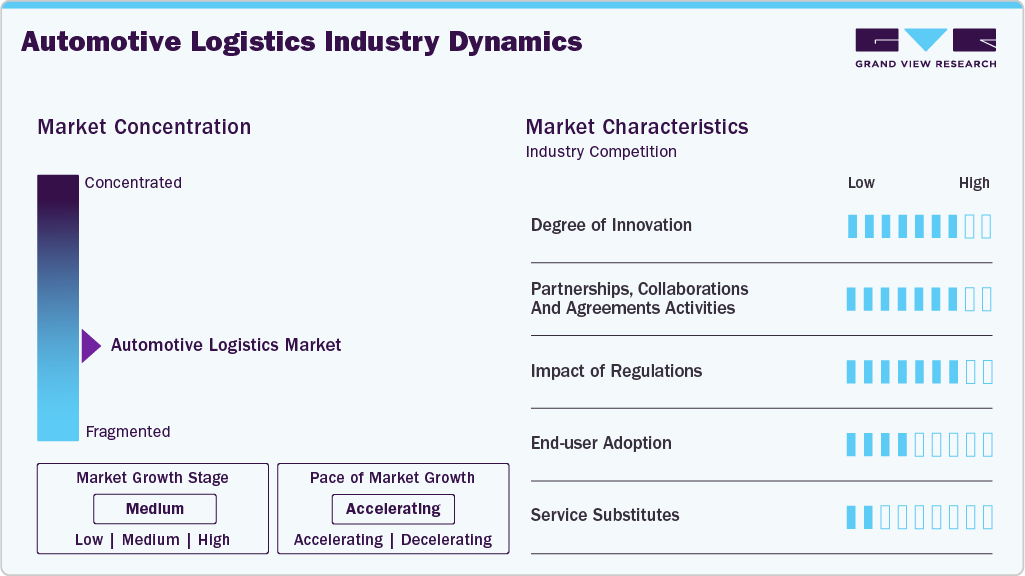
Strategic collaborations, mergers and acquisitions, long-term transportation agreements, and expansion of warehousing facilities are common across the industry as companies aim to strengthen their market presence and operational capabilities. Leading players are increasingly focusing on integration of advanced technologies such as AI-based route optimization, IoT-enabled fleet tracking, warehouse automation, transportation management systems (TMS), and predictive analytics solutions to improve operational efficiency and supply chain visibility. In addition, the growing demand for electric vehicles and battery logistics is prompting logistics providers to expand specialized transportation and storage infrastructure.
Activity Insights
The transportation segment dominated the global automotive logistics industry with a revenue share of 80.7% in 2025. Growth of this segment is driven by rising vehicle production, evolving distribution strategies adopted by automotive manufacturers, and the expanding presence of the automotive parts industry in the market. The focus of multiple vehicle manufacturers on establishing production facilities and supply chain networks in different regions and developing countries such as India is expected to result in significant growth in demand from different domestic markets.
Roadways segment contribute a significant revenue share to the automotive logistics market's transportation activities, followed by railways, maritime transport, and airways. Multiple governments' focus on enhancing infrastructure, including ports, highways, railroads, and supportive ecosystems, is expected to support the growth of this market.
Transportation of newly designed vehicles from manufacturing facilities to multiple distribution centers plays a vital role in customer experience, brand positioning, and delivery of promised products. The availability of advanced logistics solutions and fleets equipped with advanced technology-assisted vehicles and machines is expected to result in lucrative growth opportunities for this segment.
The warehousing segment is anticipated to experience the fastest CAGR from 2026 to 2033, driven by increasing demand for efficient warehousing solutions and services from the automotive industry. Numerous manufacturers and supply chain participants have focused on reducing C02 emissions by establishing a network of well-equipped warehouses and technology-driven operations. Demand for multiple warehousing facilities, the emergence of modern technology-assisted systems, and the increasing adoption of advanced software-based solutions are expected to add growth.
Type Insights
The automobile parts segment held the largest revenue share of the global automotive logistics industry in 2025. The increasing demand for automobile parts for vehicle refurbishment mainly drives the growth of this segment. Automobile parts manufacturers supply various parts, including brakes, batteries, coils, bushings, hardware, braking systems, suspension systems, and others to vehicle manufacturers. These parts are transported from the supplier’s facilities to the vehicle manufacturer’s location based on requirements and scheduled deliveries. Companies rely on in-house fleets, automotive logistics service providers, railways, and others for transportation activities. Innovation embraced by vehicle manufacturers, increasing inclination towards procurement of parts from dedicated vendors, and growing demand for effective warehousing and transportation of automobile parts are expected to generate growth for this segment.
The finished vehicles segment is projected to experience the fastest growth from 2026 to 2033, due to the growing demand from vehicle manufacturers and other industries, such as mobility solutions providers. Warehousing and transportation of finished vehicles play vital roles in the brand position of automotive industry participants. Effective logistics services ensure enhanced customer experiences and damage-free transportation of finished vehicles.
Logistic Solution Insights
The inbound segment dominated the global automotive logistics industry in 2025. The inbound logistics mainly feature transportation, storage, and distribution of automobile parts and vehicles to designated warehouse locations. The focus of manufacturers and automobile part vendors to establish a network of warehousing facilities and supply chain networks that facilitate reduced CO2 emissions, cost efficiency, and enhanced performances are expected to fuel growth for this segment.
The outbound segment is anticipated to experience the significant CAGR over the forecast period. Outbound logistic activities comprise the overall revenue collected by transporting finished vehicles and automobile parts from multiple warehousing facilities to the end user. Increasing demand for electric vehicles, effective distribution strategies adopted by brands, and growing demand from other industries, such as mobility solutions and the ride-sharing sector, are likely to drive the growth for this segment during the estimated period.
Distribution Insights
The domestic distribution segment held the largest revenue share of the global automotive logistics market in 2025. Large-scale automotive production in countries such as China, India, Japan, South Korea, and others is driving growth in this segment. Domestic distribution requirements are higher than international distribution, as multiple manufacturers and vehicle producers have focused on establishing manufacturing facilities in various regions and locations. This has led to rapid growth in domestic transportation requirements.
For instance, in October 2023, BMW and high-performance battery technology company AESEC Group Ltd. reached an agreement where AESEC stated the company would exclusively obtain cathode active battery material from the Ontario, Canada-based facility of Umicore. Such contracts, along with the growing inclination among automotive industry participants toward localized supply chain management and operations, are expected to support the growth of the domestic distribution segment.

The international logistics segment is projected to experience significant growth from 2026 to 2033. Large enterprises in certain regions and countries such as China, Germany, South Korea, India, and others primarily drive this market. Infrastructure enhancements initiated by various governments, including India, the U.S., China, Japan, and Australia, also contribute to the growth of this segment. Additionally, the availability of international transportation services provided by numerous freight management and shipping companies, the growing presence of various automobile parts manufacturers on online portals, and increasing demand from Asia Pacific are adding to the growth.
Regional Insights
Asia Pacific automotive logistics market dominated the global industry with a revenue share of 37.7% in 2025. The robust automotive manufacturing industry primarily drives this market in countries such as India, China, Japan, South Korea, and others. The presence of multiple producers of automobile parts, as well as significant growth in vehicle demand by individual users and commercial buyers such as governments, mobility solutions companies, hospitality industry participants, and others, is projected to fuel the growth of this market. The entry of numerous global automotive companies in the region also contributes to the development. For instance, in February 2024, ZF Friedrichshafen AG, one of the global automotive component suppliers and technology-driven companies, announced the establishment of a new plant in Oragadam, located in Tamil Nadu state of India. The company has planned to utilize a new facility to supply electric components for the Asia market.

China Automotive Logistics Market Trends
Automotive logistics market in China held the largest revenue share of the regional industry in 2025, driven by the domestic vehicle production and a large share of the global trade of electric vehicles (EVs). China produces more than half of the overall electric vehicles produced worldwide yearly. Availability of materials in the country, large-scale parts manufacturers operating, and significantly growing demand from domestic users are expected to develop growth for the automotive industry in China and support the development of the automotive logistics market.
Europe Automotive Logistics Market Trends
Europe was identified as one of the key regions of the global automotive logistics industry in 2025. This is attributed to the region's robust vehicle production and parts manufacturing industry. Europe is home to multiple global vehicle companies, such as Renault, Volkswagen Group, Mercedes-Benz Group AG, AB Volvo, BMW, and others. Growing demand experienced by the European automotive industry and increasing international trade are expected to add lucrative growth opportunities for this market.
Automotive logistics market in Germany held the largest regional revenue share in 2025. This market is driven by the country's strong automotive and automobile parts manufacturing sector. A large number of ongoing research activities, increasing availability and adoption of advanced technologies associated with vehicle manufacturing and designs, and increasing demand for vehicles offered by companies operating in Germany are some of the key growth driving factors.
North America Automotive Logistics Market Trends
North America accounted for a significant global automotive logistics market revenue share in 2025. This market is primarily influenced by factors such as key industry manufacturers' increasing localization of supply chain networks and individual users and commercial buyers' growing demand for electric vehicles and self-driving cars, such as delivery solution providers, mobility companies, governments, and others.
The U.S. dominated the regional industry in 2025, driven by aspects such as growing demand for electric vehicles from domestic buyers, increasing utilization of novel services such as ride-sharing, and growing focus of government agencies and authorities on ensuring the availability of advanced cars equipped with improved technology features and assistance for government use, military and other purposes. Increasing import of vehicles from various countries, growing international trade of automobile parts, and availability of modern technology-driven software solutions designed for the automotive logistics industry are expected to add growth to this market during the forecast period.
Key Automotive Logistics Company Insights
Some key global automotive logistics companies include CEVA Logistics, DSV, Hellmann Worldwide Logistics SE & Co. KG, KERRY LOGISTICS NETWORK LIMITED, NIPPON EXPRESS HOLDINGS, and others. To address growing competition and increasing demand from various regions, key market participants are embracing strategies such as technology adoption, diversification of service portfolios, collaborations, mergers, acquisitions, facility enhancements, capacity additions, and more.
-
DSV, a global transportation and logistics service provider, offers a range of solutions. The company operates nearly 500 warehouses for effective logistic operations. Its services include air freight, sea freight, road freight, project transport, green logistics, logistic solutions, etc. Its value-added services portfolio includes transporting dangerous goods, road control towers, logistics insurance, DSV protection, customs clearance, broker services, purchase order management, remote monitoring, supply chain security, and others.
-
CEVA Logistics, a global supply chain and logistics company, offers one of the largest networks of third-party logistics services worldwide. Its services include ground and rail freight, ocean freight, air freight, finished vehicle logistics, customs, fiscal representation, CEVA Lead Logistics (CLL), and more.
Key Automotive Logistics Companies:
The following key companies have been profiled for this study on the automotive logistics market.
- Kintetsu World Express, Inc.
- BLG LOGISTICS GROUP AG & Co. KG
- CMA CGM Group
- DHL
- DSV
- Expeditors International of Washington, Inc.
- CEVA Logistics
- Hellmann Worldwide Logistics SE & Co. KG
- LOGISTEED
- Imperial
- KERRY LOGISTICS NETWORK LIMITED
- Kuehne+Nagel
- NIPPON EXPRESS HOLDINGS
- Penske Logistics
- Ryder System, Inc.
Competitive Benchmarking
Operating Strategies
Competitive Edge
Weaknesses
Mature Players: DHL; DSV; CEVA Logistics; Kuehne+Nagel; NIPPON EXPRESS HOLDINGS; CMA CGM Group
- Mature players focus on providing integrated end-to-end automotive logistics solutions including transportation, warehousing, customs clearance, inbound and outbound logistics, and finished vehicle logistics.
- They emphasize digital transformation through AI-based route optimization, IoT-enabled fleet management, warehouse automation, and transportation management systems (TMS).
- Strong global logistics infrastructure with extensive warehousing and transportation networks across major automotive manufacturing regions.
- Ability to offer integrated multimodal logistics services with advanced digital supply chain capabilities.
- High operational and infrastructure costs associated with maintaining large transportation fleets and warehouse networks.
- Exposure to fuel price fluctuations, geopolitical disruptions, labor shortages, and global trade uncertainties.
Emerging Players: Kintetsu World Express, Inc.; Expeditors International of Washington, Inc.; Hellmann Worldwide Logistics SE & Co. KG; LOGISTEED
- Emerging and regional players focus on flexible logistics solutions, regional transportation services, freight forwarding, and technology-enabled supply chain management.
- Strategies emphasize expansion in Asia Pacific and emerging automotive manufacturing hubs, along with partnerships and digital logistics capabilities.
- Greater operational flexibility and ability to offer customized logistics solutions for regional automotive manufacturers and suppliers.
- Strong presence in high-growth markets such as Asia Pacific.
- Limited scale and transportation infrastructure compared to global market leaders.
- Lower bargaining power and reduced ability to secure large long-term contracts with major OEMs.
Recent Developments
-
In February 2026, DHL Group expanded its global Electric Vehicle (EV) logistics infrastructure by opening a new EV Center of Excellence in Central Europe (Slovakia), strengthening its battery and e-mobility supply chain capabilities. The facility spans 26,000 square meters and is designed to support end-to-end EV logistics, including lithium-ion battery handling, EV parts warehousing, and e-mobility supply chain services. It offers advanced capabilities such as battery testing, charging, temperature-controlled storage, and safe handling of dangerous goods. The center is part of DHL’s global network of 20 EV Centers of Excellence, supported by over 200 electrification specialists focused on battery logistics innovation. This development strengthens DHL’s sustainability-driven strategy and enhances its role in supporting the growing electric vehicle and automotive logistics market.
-
In September 2025, CEVA Logistics launched a reverse logistics solution for electric vehicle (EV) batteries in September 2025 to support recycling and reuse of end-of-life batteries across Europe. The initiative aims to build a circular supply chain as millions of lithium-ion batteries are expected to reach end-of-life in the coming years. It includes services such as collection, transportation, storage, diagnostics, dismantling, reconditioning, and recycling support. CEVA is developing a network of Battery Logistics Centers across multiple European countries to handle growing EV battery volumes safely and efficiently. Overall, the initiative strengthens CEVA’s role in sustainable automotive logistics and supports the transition to electric mobility.
Automotive Logistics Market Report Scope
Report Attribute
Details
Market size in 2025
USD 249.2 billion
Estimated Market size in 2026
USD 269.1 billion
Projected Market size by 2033
USD 460.2 billion
Growth rate
CAGR of 8.0% from 2026 to 2033
Base year for estimation
2025
Historical data
2021 - 2024
Forecast period
2026 - 2033
Quantitative units
Revenue in USD million/billion and CAGR from 2026 to 2033
Report coverage
Revenue forecast, company ranking, competitive landscape, growth factors, and trends
Segments covered
Activity, type, distribution, logistic solution, and region
Regional scope
North America; Europe; Asia Pacific; Latin America; MEA
Country scope
U.S.; Canada; Mexico; UK; Germany; France; China; India; Japan; South Korea; Australia; Brazil; KSA; UAE; South Africa
Key companies profiled
Kintetsu World Express, Inc.; BLG LOGISTICS GROUP AG & Co. KG; CMA CGM Group; DHL; DSV; Expeditors International of Washington, Inc.; CEVA Logistics; Hellmann Worldwide Logistics SE & Co. KG; LOGISTEED; Imperial; KERRY LOGISTICS NETWORK LIMITED; Kuehne+Nagel; NIPPON EXPRESS HOLDINGS; Penske Logistics.; Ryder System, Inc.
Customization scope
Free report customization (equivalent up to 8 analysts working days) with purchase. Addition or alteration to country, regional & segment scope.
Pricing and purchase options
Avail customized purchase options to meet your exact research needs. Explore purchase options
Global Automotive Logistics Market Report Segmentation
This report forecasts revenue growth at global, regional, and country levels and provides an analysis of the latest industry trends in each of the sub-segments from 2021 to 2033. For this study, Grand View Research Inc. has segmented the global automotive logistics market report based on activity, type, distribution, logistic solution, and region.
-
Activity Outlook (Revenue, USD Million, 2021 - 2033)
-
Warehousing
-
Transportation
-
Roadways
-
Airways
-
Maritime
-
Railways
-
-
-
Type Outlook (Revenue, USD Million, 2021 - 2033)
-
Finished vehicle
-
Automobile Parts
-
-
Distribution Outlook (Revenue, USD Million, 2021 - 2033)
-
Domestic
-
International
-
-
Logistic Solution Outlook (Revenue, USD Million, 2021 - 2033)
-
Inbound
-
Outbound
-
Reverse
-
-
Regional Outlook (Revenue, USD Million, 2021 - 2033)
-
North America
-
U.S.
-
Canada
-
Mexico
-
-
Europe
-
UK
-
Germany
-
France
-
-
Asia Pacific
-
China
-
India
-
Japan
-
South Korea
-
Australia
-
-
Latin America
-
Brazil
-
-
MEA
-
KSA
-
UAE
-
South Africa
-
-
Delivered Customizations
This report has been delivered with the following In-depth customizations
Client Request
Customization Delivered
Value Adds
Automotive Logistics Market Opportunity Assessment
Country/region-wise automotive logistics market sizing and growth forecasts across North America, Europe, Asia Pacific, and Rest of World
Assessment of regulatory frameworks impacting automotive logistics (emission norms, cross-border trade policies, EV battery transportation regulations, and safety standards for hazardous materials)
Identified region-specific growth opportunities driven by automotive manufacturing hubs and EV adoption
Supported logistics provider expansion strategies and OEM supply chain planning
Competitive Benchmarking and Strategic Positioning in the Automotive Logistics Market
Benchmarking of key competitors across products, partnerships, and innovation
Comparative assessment of market share, capabilities, and strategies
Analysis of competitive strengths, gaps, and differentiation areas
Identified competitive white spaces and growth gaps
Supported strategic positioning and differentiation
Enabled data-driven competitive strategy development
Regional Automotive Logistics Market Opportunity Assessment
Country/region-wise market sizing and forecasts
Analysis of demand, adoption trends, and regulatory landscape
Identification of high-growth regions and investment hotspots
Identified region-specific growth opportunities
Supported expansion and go-to-market strategy
Enabled informed regional investment decisions
Frequently Asked Questions About This Report
The inbound segment dominated the global market in 2025.
The automobile parts segment held the largest revenue share of the global automotive logistics industry in 2025.
The domestic distribution segment held the largest revenue share of the global automotive logistics market in 2025.
The global automotive logistics market size was valued at USD 249.2 billion in 2025 and is expected to reach USD 269.1 billion in 2026.
Key factors that are driving the market growth include strategic utilization of technologies such as Big Data and connected ship, by the companies to enhance their supply-chain management processes.
Asia Pacific is the fastest-growing region over the forecast period.
The transportation segment dominated the global industry in 2025, capturing a revenue share of 80.7%.
Key players include Kintetsu World Express, Inc.; BLG LOGISTICS GROUP AG & Co. KG; CMA CGM Group; DHL; DSV; Expeditors International of Washington, Inc.; CEVA Logistics; Hellmann Worldwide Logistics SE & Co. KG; LOGISTEED; Imperial; KERRY LOGISTICS NETWORK LIMITED; Kuehne+Nagel; NIPPON EXPRESS HOLDINGS; Penske Logistics; Ryder System, Inc.
Asia Pacific dominated the market with a revenue share of 37.7% in 2025.
About the Author(s)
Automotive & Transportation Research Team
Technology · Automotive & TransportationThis report was authored by the automotive & transportation research team at Grand View Research - comprising two research analysts, one senior research analyst, and one industry expert - with specialized expertise in the automotive & transportation segment of the technology industry. All findings are based on proprietary technology databases, executive interviews, and regulatory analysis, subject to internal peer review prior to publication.
Last Updated:
Speak to Analyst


Customize this report to your needs — add regions, segments, or data points, with 20% free customization.
Or view our licence options:


ISO 9001:2015 & 27001:2022 Certified
We are GDPR and CCPA compliant! Your transaction & personal information is safe and secure. For more details, please read our privacy policy.


