
- Home
- »
- Communication Services
- »
-
B2B Telecommunication Market Size & Share Report, 2033GVR Report cover

B2B Telecommunication Market (2026 - 2033)
Size, Share & Trend Analysis By Solution (WAN Solution, Voice over IP (VoIP) By Enterprise Size (Large Enterprise, SMEs), By Industry Vertical, By Region, And Segment Forecasts
Market Size, 2025
$84.1BMarket Estimate, 2026
$93.3BMarket Forecast, 2033
$210.9BCAGR, 2026–2033
12.4%B2B Telecommunication Market Summary
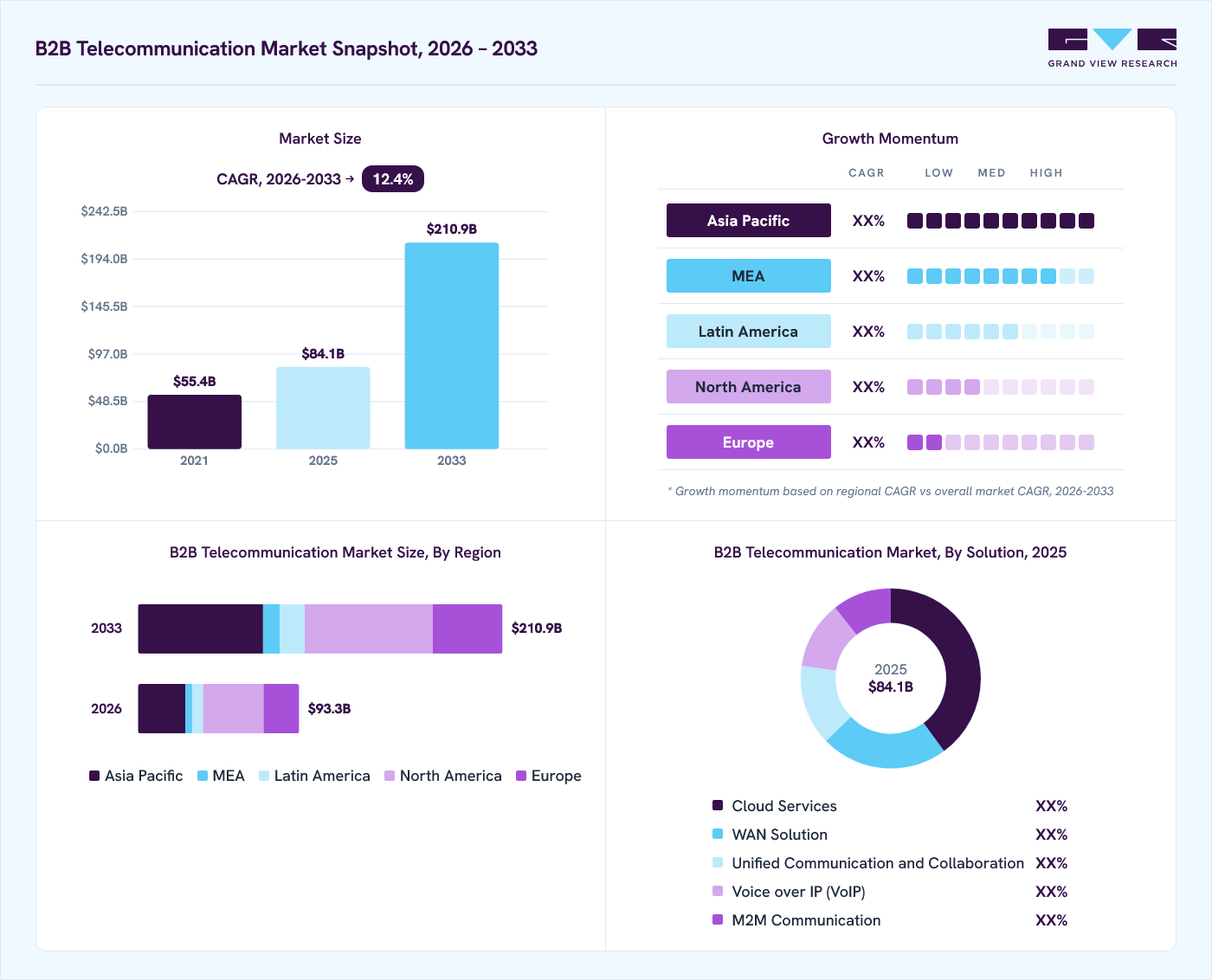
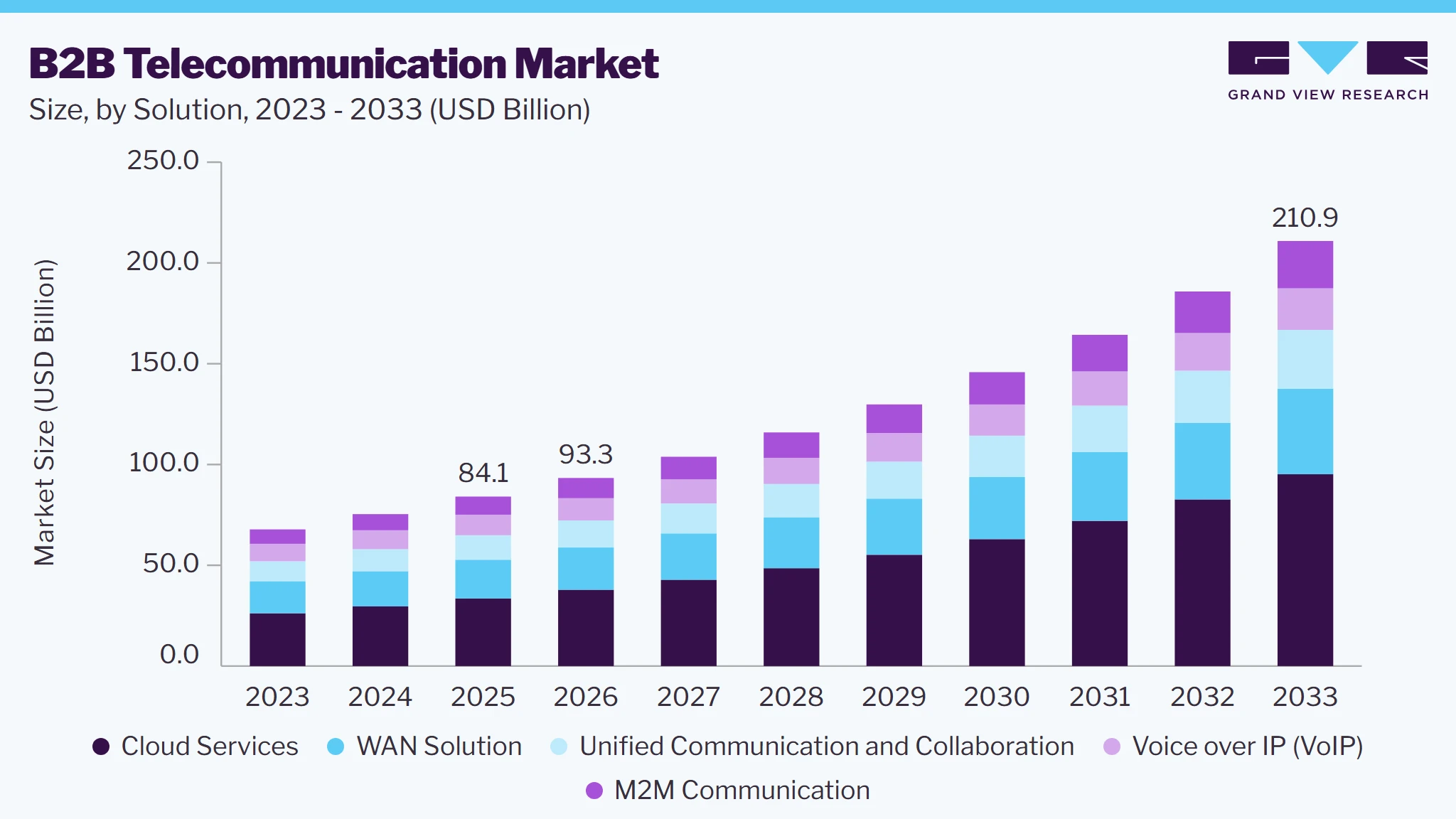
The global B2B telecommunication market size was valued at USD 84.1 billion in 2025 and is projected to grow USD 93.3 billion in 2026 to USD 210.9 billion by 2033, at a CAGR of 12.4% from 2026 to 2033. North America market led the global market and accounted for 37.9% of the global revenue in 2025. The growing integration of cloud services with enterprise networks is driving the growth of the market.
 Source: Grand View Research, IR Documents, Primary Interviews, Paid DatabasesTo learn more about this report,
 Download Free Sample Report
Key Market Trends & Insights
- By solution: Cloud services solution segment led the market and accounted for 39.9% of the global revenue in 2025
- By enterprise size: Large enterprise segment led the market and accounted for 69.3% of the global revenue in 2025.
- By industry verticals: BFSI segment accounted for the largest market revenue share in 2025.
Regional Highlights
- Largest regional market: North America (37.9% revenue share, 2025)
- By country: U.S. held the largest market share in 2025.
Market Size & Forecast
- Market size in 2025: USD 84.1 Billion
- Estimated market size in 2026: USD 93.3 Billion
- Projected market size by 2033: USD 210.9 Billion
- CAGR (2026-2033): 12.4%
Prism AI by Grand View Research Free to tryAsk a question about the B2B telecommunication marketTry asking✓Every figure cited from GVR research Prefer the report? Download free sample →The increasing adoption of cloud-based applications is driving demand for reliable and scalable B2B telecommunication services. Enterprises are increasingly shifting workloads such as enterprise resource planning, customer relationship management, collaboration, analytics, and data storage to cloud environments, creating greater dependence on high-speed and reliable connectivity. This is increasing demand for telecom solutions that can provide consistent bandwidth, low latency, network visibility, and secure access to distributed cloud resources. According to The European Commission, it has set a 2030 objective for 75% of European businesses to use cloud-edge technologies, highlighting the growing role of cloud infrastructure in enterprise operations.
 To learn more about this report, Download Free Sample Report
The increasing adoption of Software-Defined WAN Solutions is trending in the market. Software-defined WAN, or SD-WAN, is gaining traction as enterprises manage increasingly distributed office networks and cloud-based applications. Businesses are using SD-WAN to improve network visibility, optimize traffic across different connectivity links, and provide more flexible management of branch locations. The technology is particularly relevant for organizations operating multiple offices, warehouses, retail locations, and remote facilities. This trend is encouraging telecom operators to combine connectivity with managed networking, cybersecurity, and cloud services.
Increasing cybersecurity threats and the growing movement of enterprise workloads to cloud environments are strengthening regulatory requirements around data protection and network security. Telecom providers serving businesses are therefore required to strengthen security controls, incident management, data governance, and network resilience. These requirements increase compliance costs for service providers but also encourage enterprises to purchase managed security and secure connectivity services. Regulatory emphasis on cybersecurity is particularly relevant for industries such as BFSI, healthcare, government, and critical infrastructure.
High infrastructure deployment costs remain a major restraint for the B2B telecommunication market. Fiber networks, 5G infrastructure, data centers, edge facilities, network security systems, and supporting equipment require significant capital investment. Telecom operators also face ongoing costs related to network maintenance, upgrades, energy consumption, spectrum, and infrastructure expansion. These costs can make it challenging to provide advanced connectivity services profitably, particularly in low-density or geographically difficult locations.
Market Dynamics
The B2B telecommunication market is being shaped by the continued digitalization of enterprises, rising dependence on cloud-based applications, distributed workforces, connected devices, and growing requirements for secure, reliable, and flexible business connectivity. Enterprises are increasingly moving beyond traditional connectivity contracts toward integrated solutions combining WAN, cloud connectivity, cybersecurity, VoIP, M2M communication, and unified communications. Network modernization, 5G adoption, software-defined networking, and Network-as-a-Service models are further changing how enterprises procure and manage telecommunications. As a result, the market is gradually shifting from conventional connectivity services toward integrated digital infrastructure and managed communication solutions.
Enterprises are increasingly shifting applications, workloads, data storage, and collaboration tools toward public, private, and hybrid cloud environments. This transition is increasing the need for reliable, high-performance connectivity among corporate locations, employees, data centers, and multiple cloud platforms. Traditional network architectures can create complexity when businesses operate across several locations and cloud environments, particularly when they require consistent performance, security, scalability, and uninterrupted access to business applications. As a result, enterprises are increasingly seeking flexible telecommunications solutions that can support cloud-dependent operations while reducing network management complexity.
B2B telecommunication solutions are addressing this requirement through SD-WAN, dedicated internet connectivity, private cloud connectivity, multi-cloud networking, managed WAN, and Network-as-a-Service offerings. These solutions enable enterprises to dynamically manage network resources, improve application performance, and establish reliable connections between offices, remote users, data centers, and cloud environments. The increasing availability of scalable, software-defined networking solutions also enables businesses to expand connectivity to meet changing operational requirements without making extensive investments in physical infrastructure. Consequently, increasing cloud dependence is supporting higher adoption of enterprise connectivity solutions and contributing to recurring revenue growth across the B2B Telecommunication Market.
The modernization of enterprise telecommunications infrastructure can require significant investment in network upgrades, security solutions, software platforms, system integration, and employee training. Enterprises with legacy MPLS infrastructure, fragmented IT environments, and multiple technology systems may face additional migration and integration costs when adopting SD-WAN, cloud connectivity, 5G, or integrated communication platforms. The transition can also require changes to existing network architecture and operating processes, increasing implementation complexity and the risk of service disruption. These factors can extend procurement cycles and make enterprises more cautious about replacing established telecommunications infrastructure.
The restraint is particularly relevant for SMEs and enterprises operating in price-sensitive markets, where the initial cost of network transformation can outweigh the short-term benefits. Complex migration requirements can also delay the replacement of legacy voice, networking, and connectivity systems, limiting the pace at which newer solutions are adopted. Enterprises may therefore continue using existing infrastructure for longer periods, particularly when it remains operational and meets basic connectivity requirements. As a result, high transformation costs and implementation complexity can slow technology adoption, increase customer decision-making periods, and constrain the growth rate of advanced B2B telecommunication solutions.
The increasing convergence of telecommunications, cloud computing, cybersecurity, and enterprise IT is creating significant opportunities for integrated B2B service offerings. Enterprises increasingly require connectivity, cloud access, security, communication, and network management capabilities that can operate together across distributed business environments. This creates an opportunity to move beyond traditional connectivity services toward integrated solutions that address multiple enterprise requirements through a unified service architecture. The opportunity is further supported by the expansion of hybrid and multi-cloud environments, remote and distributed workforces, IoT deployments, and the growing use of data-intensive digital applications.
The adoption of integrated services can enable higher revenue generation per enterprise by combining connectivity with managed networking, cloud services, cybersecurity, collaboration, and other digital solutions. Solutions that provide centralized management, flexible deployment, scalable capacity, and integrated security are expected to gain increasing attention among enterprises seeking to simplify their technology environments. The opportunity is particularly significant in large enterprises with complex geographic operations and extensive digital infrastructure requirements. As enterprises increasingly prioritize simplified technology management and end-to-end service delivery, integrated network, cloud, and security solutions are expected to become an important area of market expansion.
Market Concentration & Characteristics
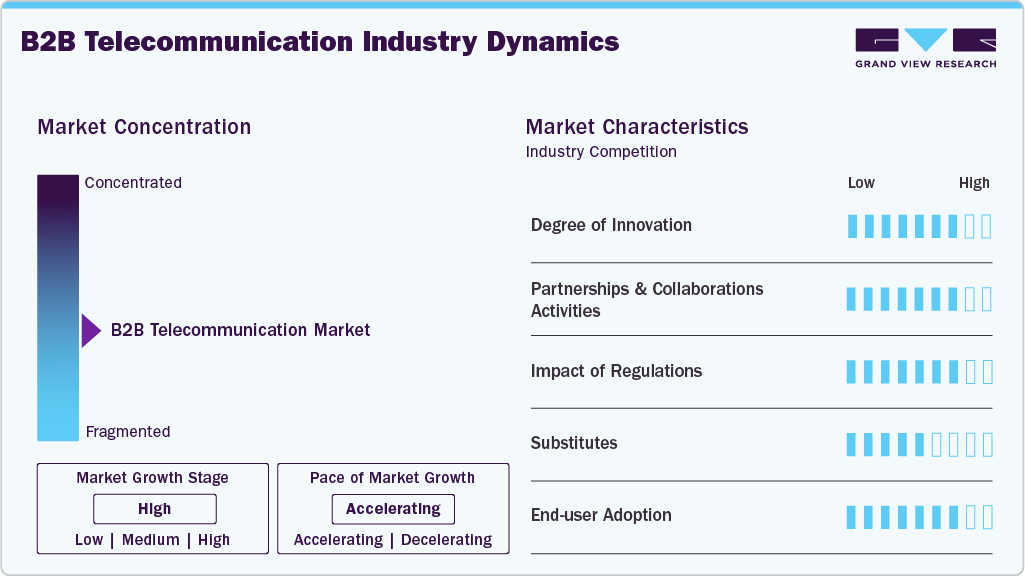
The B2B telecommunication market is moderately consolidated, with a relatively small number of large telecommunications operators and technology providers leading the market, while a broader group of regional, specialized, and alternative connectivity providers also participates. Major telecom companies benefit from extensive network infrastructure, established relationships with enterprise customers, spectrum and network assets, and the ability to provide integrated solutions, including connectivity, managed network services, cloud connectivity, cybersecurity, IoT, and unified communications. These factors create relatively high barriers to entry for new players, particularly in infrastructure-intensive services. However, the market is not fully concentrated because enterprises can source services from multiple national operators, regional telecom providers, cloud and network service companies, and specialized business connectivity providers. As a result, competition remains significant, particularly around service quality, network reliability, pricing, coverage, customization, and bundled digital services.
 To learn more about this report, Download Free Sample Report
The market characteristics further indicate a relatively high degree of innovation and strong partnerships and collaboration. Telecom providers increasingly compete by modernizing networks, integrating cloud, adopting software-defined networking, delivering 5G-based enterprise connectivity, offering IoT solutions, enhancing cybersecurity, and providing other value-added services rather than connectivity alone. Partnerships among telecom operators, cloud providers, technology vendors, system integrators, and equipment manufacturers are also important, as enterprise customers increasingly require integrated solutions. Regulatory impact is medium to high, as telecom operators operate within national licensing, spectrum, data protection, cybersecurity, infrastructure-sharing, and competition frameworks. At the same time, substitution remains moderate, as enterprises may shift among connectivity technologies, managed service providers, cloud networking solutions, and wireless alternatives depending on their requirements. End-user adoption is high, supported by increasing enterprise dependence on cloud applications, remote and hybrid operations, connected devices, and reliable digital communication infrastructure. Moreover, these characteristics support a market that is moderately consolidated but highly competitive and innovation-driven, with established players retaining strong positions, while partnerships and technological evolution create opportunities for new and specialized providers.
Analyst Perspective
The B2B telecommunication market is transitioning from traditional connectivity provision to an integrated digital infrastructure that supports cloud, security, IoT, collaboration, and distributed enterprise operations. Increasing cloud adoption, network modernization, 5G, and demand for secure connectivity are expected to remain key drivers of growth. Technology providers are increasingly combining connectivity with SD-WAN, SASE, multi-cloud networking, and Network-as-a-Service capabilities. Future investment is expected to focus on programmable networks, cloud-native infrastructure, cybersecurity, and AI-ready connectivity. Competitive differentiation is consequently shifting toward integrated platforms, managed services, ecosystem partnerships, and the ability to deliver flexible end-to-end digital solutions to enterprises.
Solution Insights
Based on solution, the cloud services solutions segment accounted for 39.9% of the largest share of global revenue in 2025 and is projected to grow at the fastest CAGR over the forecast period. The cloud services segment is supported by the increasing migration of enterprise applications, storage, analytics, and computing workloads to cloud platforms. Enterprises require dependable connectivity between their offices, users, data centers, and cloud environments, increasing demand for telecom-enabled cloud connectivity services. Large enterprises are particularly important customers because of their extensive use of cloud applications and geographically distributed operations. The European Commission reports significantly higher cloud adoption among large enterprises than small businesses, reinforcing the relationship between enterprise scale, cloud adoption, and connectivity demand.
The WAN solution segment is projected to grow at the significant CAGR over the forecast period. driven by the need to connect geographically distributed enterprise locations, including headquarters, branch offices, warehouses, retail outlets, and operational facilities. Enterprises are increasingly seeking flexible WAN architectures that can manage different connectivity technologies while maintaining network performance and security. The adoption of SD-WAN is further supporting the segment by enabling organizations to manage traffic and network resources more efficiently. Demand is expected to remain strong as enterprises expand cloud applications and operate increasingly distributed business environments.
Enterprise Size Insights
Based on enterprise size, the large enterprise segment accounted for 69.3% of the largest share of global revenue in 2025, supported by extensive network requirements across multiple offices, facilities, regions, and countries. Large organizations require high-bandwidth connectivity, dedicated network services, managed WAN solutions, cloud connectivity, cybersecurity, and network monitoring to support complex business operations. The increasing adoption of cloud applications, digital platforms, data-intensive technologies, and distributed work environments is further strengthening demand for advanced telecommunications services among large enterprises. Higher technology budgets, complex IT infrastructure, and stringent requirements for network reliability also enable large enterprises to enter into higher-value and longer-term B2B telecom contracts.
The SMEs segment is projected to grow at the fastest CAGR over the forecast period SMEs represent an expanding opportunity as smaller businesses increasingly adopt cloud applications, digital payment systems, remote collaboration tools, e-commerce platforms, and connected business applications. These businesses generally prefer flexible and cost-effective telecom solutions that can scale their operations without requiring substantial internal IT resources. Service providers are therefore increasingly offering managed connectivity, cloud services, cybersecurity, and bundled communication packages to SMEs. Cloud adoption data in Europe also indicates substantial uptake among small and medium-sized businesses, although adoption remains below that of large enterprises.
Industry Vertical Insights
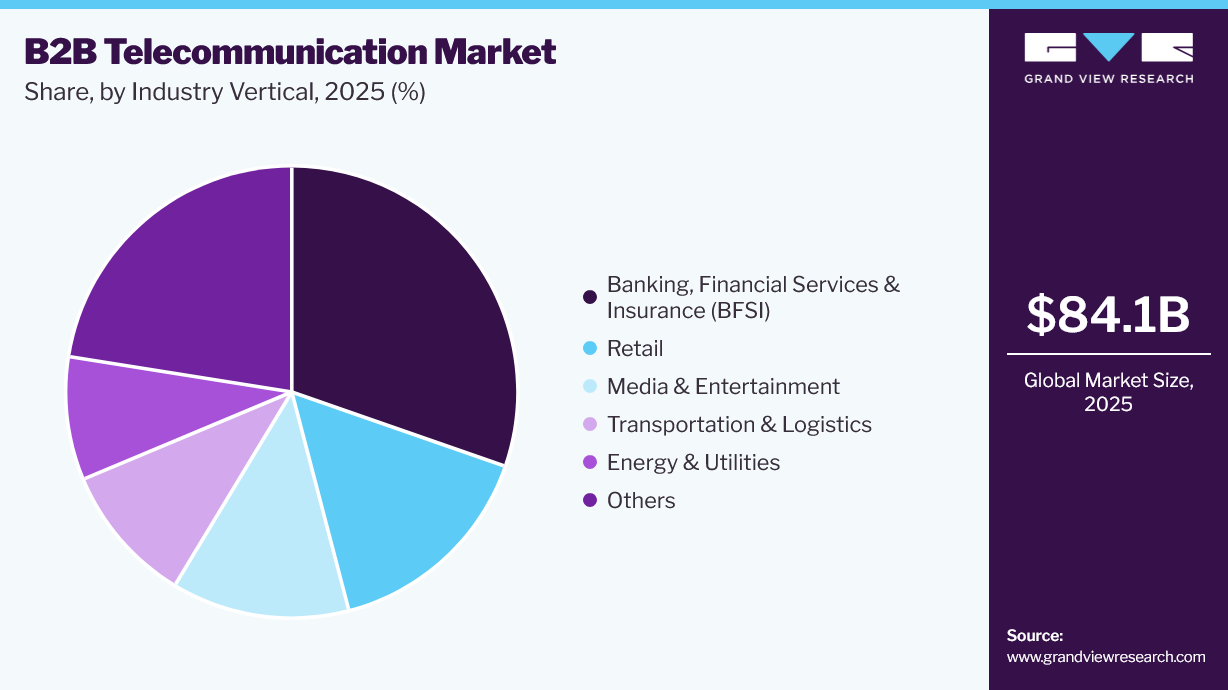
Based on industry vertical, the BFSI segment accounted for the largest market revenue share in 2025, driven by the growing dependence of banks, financial institutions, insurance companies, and payment service providers on reliable and secure B2B telecommunication services. These organizations require high-speed connectivity to support branch networks, data centers, ATMs, digital banking platforms, cloud-based applications, and interbank transactions. Increasing adoption of digital banking, real-time payment systems, cloud computing, and data-driven financial services is encouraging BFSI companies to strengthen their telecom infrastructure. Furthermore, stringent data security requirements, regulatory compliance, uninterrupted network availability, and disaster recovery needs are driving demand for dedicated connectivity, managed network services, and secure enterprise communication solutions.
 To learn more about this report, Download Free Sample Report
The transportation and logistics segment is projected to grow at the fastest CAGR over the forecast period. The segment growth is increasingly dependent on telecommunications networks to support fleet management, shipment tracking, warehouse systems, connected vehicles, route optimization, and real-time operational monitoring. The growth of e-commerce and increasingly complex supply chains is increasing the need for continuous data exchange between vehicles, warehouses, distribution centers, and enterprise platforms. Connectivity solutions such as WAN, cellular networks, cloud connectivity, and IoT communications therefore play an important role in improving operational visibility. The growing adoption of connected logistics systems is expected to create additional demand for reliable and scalable B2B telecom infrastructure.
Regional Insights
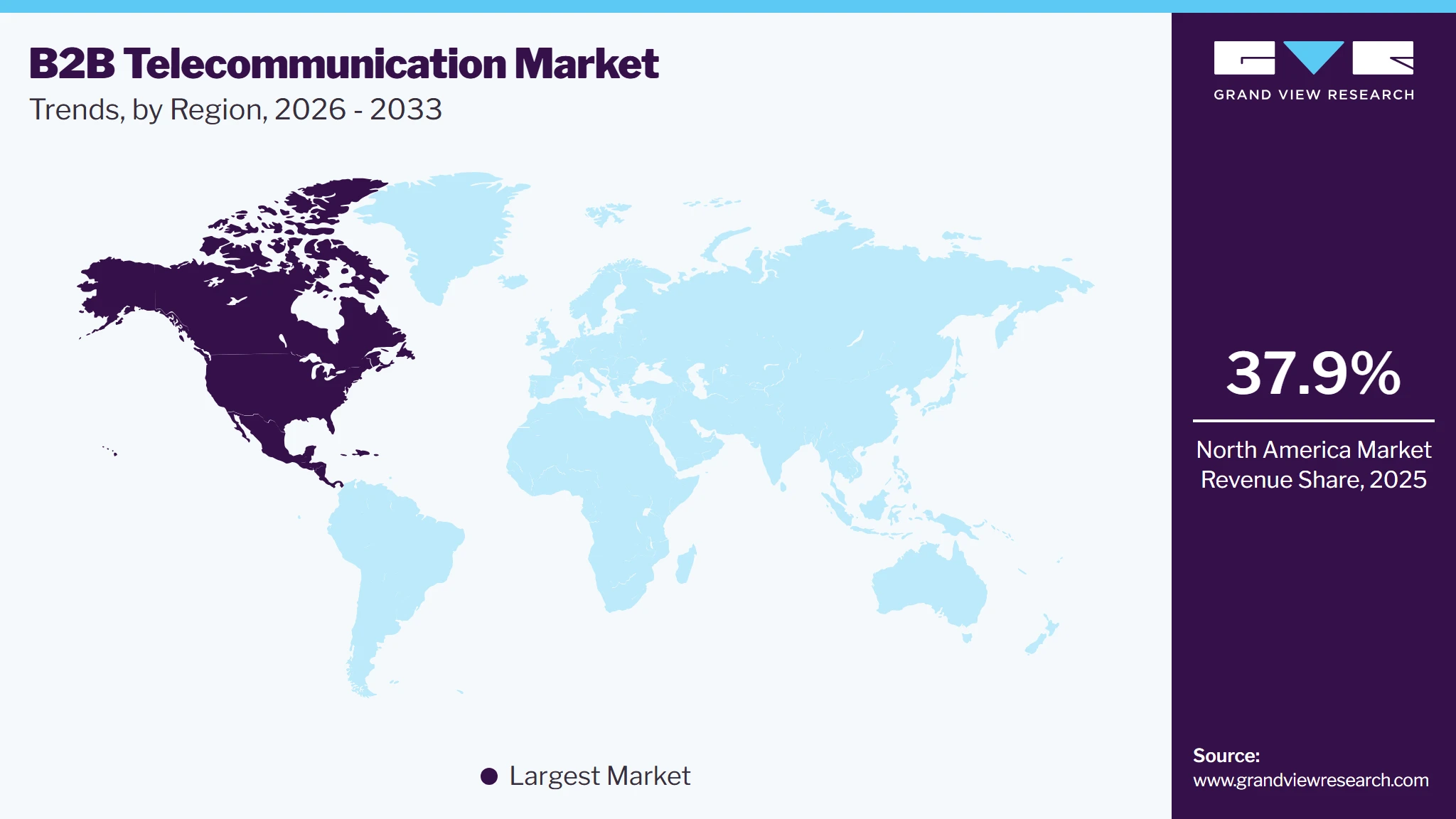
North America B2B telecommunication market led the global market and accounted for 37.9% of the global revenue in 2025, due to the region's mature enterprise technology ecosystem, extensive broadband infrastructure, and high adoption of cloud and digital business applications. Enterprises across financial services, technology, logistics, healthcare, manufacturing, and professional services increasingly require high-capacity connectivity to support distributed operations and cloud workloads. The region also benefits from continued investments in fiber, 5G, data centers, and enterprise network modernization.
 To learn more about this report, Download Free Sample Report
U.S. B2B Telecommunication Market Trends
The U.S. B2B telecommunication market is held the largest market share, supported by a large base of enterprises, advanced digital infrastructure, and strong adoption of cloud computing and enterprise software. Businesses are increasingly deploying cloud applications, AI, IoT, and distributed workplace technologies, which increases demand for high-performance WAN and cloud connectivity. The presence of major telecommunications operators, cloud providers, technology companies, and data-center ecosystems further supports the development of integrated B2B connectivity solutions.
The U.S. B2B telecommunication market is held the largest market share, supported by a large base of enterprises, advanced digital infrastructure, and strong adoption of cloud computing and enterprise software. Businesses are increasingly deploying cloud applications, AI, IoT, and distributed workplace technologies, which increases demand for high-performance WAN and cloud connectivity. The presence of major telecommunications operators, cloud providers, technology companies, and data-center ecosystems further supports the development of integrated B2B connectivity solutions.
Asia Pacific B2B Telecommunication Market Trends
The Asia Pacific B2B telecommunication market is projected to grow at the fastest CAGR over the forecast period, due to rapid enterprise digitalization, expanding cloud infrastructure, increasing 5G deployment, and the growth of technology-intensive industries. Businesses across manufacturing, financial services, logistics, retail, and technology are increasing their dependence on digital networks and cloud platforms. The region's large enterprise base and continued development of data centers, 5G networks, fiber infrastructure, and smart-industry applications create substantial opportunities for telecom providers.
China held a dominant share in the Asia Pacific B2B telecommunication market. China represents a major B2B telecommunication market because of its large industrial base, extensive digital economy, and increasing deployment of cloud, 5G, IoT, and smart-manufacturing applications. Enterprises are increasingly using telecommunications infrastructure to support connected factories, logistics networks, digital financial services, and cloud-based business applications. The country's large-scale enterprise ecosystem and continued investment in advanced digital infrastructure provide significant opportunities for telecom operators and enterprise connectivity providers.
Japan B2B telecommunication market is expected to grow at a significant CAGR over the forecast period, supported by advanced enterprise technology adoption and strong demand for reliable digital infrastructure. Businesses are increasingly integrating cloud computing, IoT, automation, connected manufacturing, and digital services into their operations, increasing the need for secure and dependable connectivity. The country's mature technology ecosystem and focus on digital transformation support demand for high-performance WAN, cloud connectivity, 5G, and managed enterprise network services.
Europe B2B Telecommunication Market Trends
The Europe B2B Telecommunication market poised significant growth from 2026 to 2033. Europe is experiencing continued demand for B2B telecommunication services as enterprises modernize their networks and governments accelerate digital infrastructure development. According to The European Union is targeting Gigabit connectivity and widespread 5G coverage by 2030, while its Digital Decade program also emphasizes cloud, AI, cybersecurity, and business digitalization. The latest European connectivity data indicate that FTTP and 5G coverage are continuing to expand, supporting the transition toward higher-capacity enterprise networks.
The U.K. B2B telecommunication market is supported by high enterprise dependence on cloud platforms, digital services, remote collaboration, and data-intensive applications. Businesses across financial services, professional services, retail, logistics, and technology are increasingly requiring reliable connectivity and secure access to distributed digital infrastructure. Demand for managed WAN, cloud connectivity, cybersecurity, and high-capacity broadband is therefore expected to remain an important source of B2B telecom growth.
The Germany held a substantial share in the Europe B2B telecommunication market, due to its large industrial base and growing requirement for connected manufacturing, logistics, cloud computing, and enterprise digitalization. Industrial companies increasingly require reliable networks to support connected production facilities, automation, IoT systems, and data-intensive operations. Germany's enterprise digitalization efforts and continued investment in high-capacity connectivity are therefore supporting demand for advanced B2B telecommunications services. The European Commission specifically tracks Germany's progress in cloud adoption, AI, cybersecurity, and broader business digitalization under the Digital Decade framework.
Key B2B Telecommunications Company Insights
Key players operating in the B2B telecommunication market include AT&T Intellectual Property., Verizon., Deutsche Telekom AG, China Telecom Corporation Limited., BT Limited, Orange Business, Telefónica S.A., Telstra Corporation Limited, Tata Communications Limited. and Lumen Technologies. Key players in the B2B telecommunication market are their service portfolios with cloud connectivity, managed WAN, SD-WAN, cybersecurity, 5G, and other enterprise communication solutions while strengthening partnerships with technology providers, cloud service providers, and enterprise customers. Companies are focusing on improving network reliability, enhancing cybersecurity, increasing bandwidth capacity, integrating cloud and software-defined networking capabilities.
-
AT&T Intellectual Property. is a telecommunications and technology company. The company offers B2B connectivity, communication, networking, broadband, cloud, cybersecurity, IoT, and enterprise technology solutions to businesses and organizations. It also develops and manages technologies across AI, data analytics, automation, IoT, cybersecurity, and network operations, strengthening its capabilities in the B2B telecommunications market. Through its intellectual property activities, the company also protects and commercializes technologies developed through its innovation programs.
-
Verizon Communications Inc. is a telecommunications and technology company that offers B2B connectivity, wireless, 5G, broadband, networking, cybersecurity, cloud, IoT, and communication solutions to businesses and enterprises. The company provides dedicated business solutions through its business segment, supporting organizations with connectivity and digital infrastructure services.
Key B2B Telecommunication Companies
The following key companies have been profiled for this study on the B2B telecommunication market.
-
AT&T Intellectual Property.
-
Verizon
-
Deutsche Telekom AG
-
China Telecom Corporation Limited.
-
BT Limited
-
Orange Business
-
Telefónica S.A.
-
Telstra Corporation Limited
-
Tata Communications Limited.
-
Lumen Technologies.
Competitive Benchmarking
Operating Strategies
Competitive Edge
Weaknesses
Mature Players: AT&T Intellectual Property, Verizon, Deutsche Telekom AG, Orange Business, Tata Communications Limited
- Mature players in the B2B telecommunication market are focusing on broad enterprise strategies combining connectivity with cloud, cybersecurity, IoT, managed networking, collaboration, and digital infrastructure services. Their strategies increasingly emphasize integrated solutions and long-term enterprise relationships rather than standalone connectivity.
- Mature players gain a competitive advantage through strong network infrastructure, extensive enterprise customer bases, broad service portfolios, established technology partnerships, and significant financial and operational resources support their competitive positioning.
- These companies often face challenges related to higher operating complexity and legacy infrastructure can make transformation slower and more expensive. Large portfolios and established systems can also create longer implementation cycles compared with more focused digital-native competitors.
Emerging Players: Telefónica S.A., Lumen Technologies
- Emerging players in the B2B telecommunication market are focusing on strengthening enterprise connectivity while expanding into cloud networking, cybersecurity, software-defined networking, edge, and other higher-value digital services. Companies increasingly use partnerships, automation, and network-as-a-service models to improve service flexibility.
- Emerging players gain market traction through greater focus on network modernization and specialized enterprise solutions can provide flexibility and help them compete in selected high-growth areas.
- Emerging players face limitations due to limited scale and portfolio breadth than the largest global telecom groups can restrict their ability to compete across every enterprise geography and service category. It may also face stronger pricing and investment pressure when competing against operators with larger customer bases and broader infrastructure.
Recent Developments
-
In June 2025, AT&T Intellectual Property. launched AT&T Business Voice, a cloud-based VoIP solution that helps businesses replace traditional copper phone lines with secure, scalable IP connectivity while retaining existing phone numbers and equipment. The solution includes remote monitoring, backup connectivity, spam protection, and support for essential business lines, reflecting the shift toward modern, reliable, and digitally managed B2B communication services.
-
In March 2025, Deutsche Telekom AG partnered with Google Cloud, a cloud computing company, to expand cloud, data, and AI capabilities across its networks and business operations. The collaboration includes SAP cloud migration and AI-based network solutions, helping improve operational efficiency, network performance, and customer experience.
B2B Telecommunication Market Report Scope
Report Attribute
Details
Market size in 2025
USD 84.1 billion
Estimated market size in 2026
USD 93.3 billion
Projected market size by 2033
USD 210.9 billion
Growth rate
CAGR of 12.4% from 2026 to 2033
Base year for estimation
2025
Historical data
2021 - 2024
Forecast period
2026 - 2033
Quantitative units
Revenue in USD billion and CAGR from 2026 to 2033
Report coverage
Revenue forecast, company ranking, competitive landscape, growth factors, and trends
Segments covered
Solution, enterprise size, industry vertical, and region
Regional scope
North America, Europe, Asia Pacific, Latin America, MEA
Country scope
U.S., Canada, Mexico, Germany, U.K., France, China, Japan, India, South Korea, Australia, Brazil, KSA, UAE, and South Africa
Key companies profiled
AT&T Intellectual Property., Verizon., Deutsche Telekom AG, China Telecom Corporation Limited., BT Limited, Orange Business, Telefónica S.A., Telstra Corporation Limited, Tata Communications Limited., and Lumen Technologies.
Customization scope
Free report customization (equivalent up to 8 analysts working days) with purchase. Addition or alteration to country, regional & segment scope.
Pricing and purchase options
Avail customized purchase options to meet your exact research needs. Explore purchase options
Global B2B Telecommunication Market Segmentation
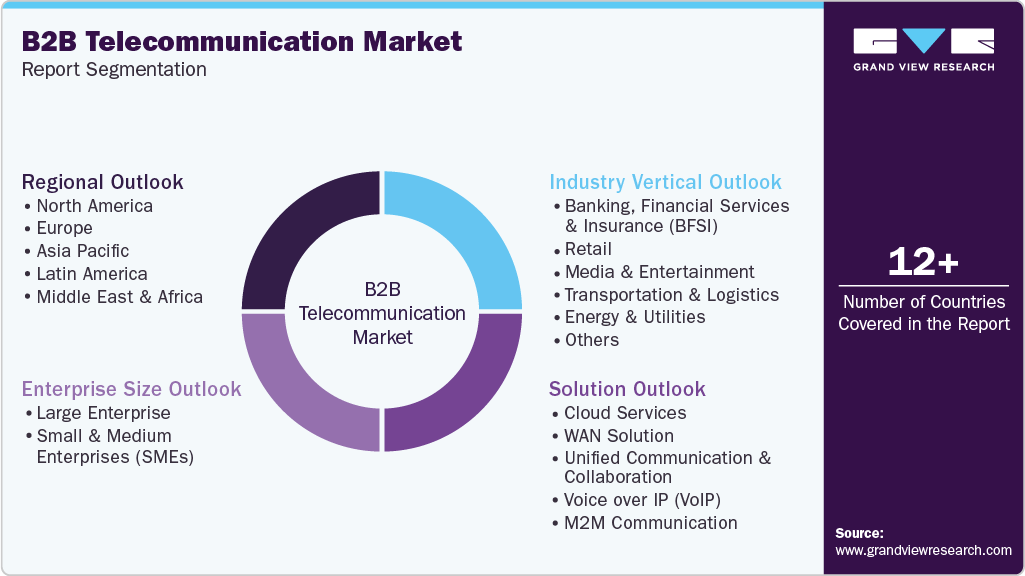
The report forecasts revenue growth at global, regional, and country levels and provides an analysis of the latest industry trends in each of the sub-segments from 2021 to 2033. For the purpose of this study, Grand View Research has segmented the global B2B telecommunication market based on solution, enterprise size, industry vertical, and region.
 To learn more about this report, Download Free Sample Report
-
Solution Outlook (Revenue, USD Billion, 2021 - 2033)
-
Cloud Services
-
WAN Solution
-
Unified Communication and Collaboration
-
Voice over IP (VoIP)
-
M2M Communication
-
-
Enterprise Size Outlook (Revenue, USD Billion, 2021 - 2033)
-
Large Enterprise
-
Small and Medium Enterprises (SMEs)
-
-
Industry Vertical Outlook (Revenue, USD Billion, 2021 - 2033)
-
Banking, Financial Services and Insurance (BFSI)
-
Retail
-
Media & Entertainment
-
Transportation and Logistics
-
Energy and Utilities
-
Others
-
-
Regional Outlook (Revenue, USD Billion, 2021 - 2033)
-
North America
-
U.S.
-
Canada
-
Mexico
-
-
Europe
-
Germany
-
U.K.
-
France
-
-
Asia Pacific
-
China
-
India
-
Japan
-
South Korea
-
Australia
-
-
Latin America
-
Brazil
-
-
Middle East & Africa (MEA)
-
UAE
-
Kingdom of Saudi Arabia (KSA)
-
South Africa
-
-
Research Methodology
The B2B telecommunication market figures in this report are based on a proven research process that combines executive interviews with secondary research from proprietary databases, company filings, and recognized regulatory and institutional sources. Market size is built through value-chain sizing-reconciling supply-side and demand-side estimates-and triangulated with bottom-up and top-down approaches. Every estimate passes multiple levels of expert validation before publication, with each B2B telecommunication segment quantified using the revenue-capture definitions in the table below.
Segment Definition
Segment - Solution
Revenue capture definition
Cloud Services
The segment revenue is generated from enterprise cloud connectivity and cloud-related telecommunications services, including private and hybrid cloud connectivity, cloud interconnection, managed cloud infrastructure, hosting, cloud networking, multi-cloud connectivity, and associated subscription, usage, implementation, and management fees.
WAN Solution
The segment revenue is generated from enterprise wide-area networking services, including MPLS, SD-WAN, managed WAN, enterprise internet connectivity, private IP networks, Ethernet connectivity, network management, and associated installation, subscription, usage, and managed-service fees.
Unified Communication and Collaboration
The segment revenue is generated from integrated enterprise communication and collaboration services, including business messaging, video conferencing, enterprise voice, team collaboration platforms, contact-center communication, hosted communication applications, licenses, subscriptions, implementation, and managed-service fees.
Voice over IP (VoIP)
The segment revenue is generated from business voice communication delivered over IP networks, including hosted VoIP, SIP trunking, business calling plans, cloud-based telephony, IP-PBX services, voice subscriptions, calling usage charges, and related deployment and managed-service fees.
M2M Communication
The segment revenue is generated from machine-to-machine connectivity services, including cellular and fixed connectivity subscriptions, IoT SIMs, connected-device communication, data transmission, device management, connectivity platforms, and recurring network access fees associated with machine communications.
Segment - Enterprise Size
Revenue capture definition
Large Enterprise
The segment revenue is generated from telecommunications products and managed services purchased by large organizations, including dedicated WAN, private connectivity, cloud networking, enterprise mobility, cybersecurity, VoIP, collaboration, IoT/M2M, and customized managed communication contracts.
Small and Medium Enterprises (SMEs)
The segment revenue is generated from telecommunications products and standardized or scalable services purchased by small and medium-sized businesses, including business broadband, internet connectivity, VoIP, cloud services, mobility, cybersecurity, collaboration, and managed networking subscriptions.
Segment - Industry Vertical
Revenue capture definition
Banking, Financial Services and Insurance (BFSI)
The segment revenue is generated from secure connectivity, WAN, cloud connectivity, cybersecurity, VoIP, collaboration, and managed network services purchased by banks, financial institutions, insurers, payment companies, and other financial organizations.
Retail
The segment revenue is generated from telecommunications services purchased by retailers for connecting stores, warehouses, distribution centers, employees, point-of-sale systems, digital commerce infrastructure, IoT devices, and customer-facing applications.
Media & Entertainment
The segment revenue is generated from connectivity, cloud networking, data transmission, collaboration, content distribution, and managed communication services purchased by broadcasters, streaming companies, production firms, gaming companies, and other media organizations.
Transportation and Logistics
The segment revenue is generated from connectivity, fleet communication, IoT/M2M, tracking, cloud networking, and enterprise communication services used by airlines, shipping companies, logistics providers, rail operators, ports, and transportation networks.
Energy and Utilities
The segment revenue is generated from telecommunications and connectivity services used to connect generation facilities, grids, substations, pipelines, field operations, control centers, employees, and connected infrastructure, including M2M/IoT and private networking services.
Others
The segment revenue is generated from B2B telecommunication products and services purchased by industries outside the specifically defined verticals, including healthcare, government, education, manufacturing, professional services, construction, hospitality, and other commercial organizations.
Estimation Model
Layer Name
Key Question
Description
Enterprise Addressable Base
How many organizations represent the potential customer base?
The estimation begins by identifying the number of businesses that can purchase B2B telecommunication services across large enterprises and SMEs. The analysis considers enterprise presence across major regions and industry verticals. It also evaluates differences in telecommunications requirements based on organization size, operating footprint, and digital maturity. This layer establishes the potential customer universe for the B2B telecommunication market.
Service Penetration & Adoption
What proportion of enterprises use each B2B telecommunication solution?
This layer estimates enterprise adoption of WAN solutions, VoIP, M2M communication, cloud services, and unified communication and collaboration. Adoption is assessed based on enterprise digitalization, cloud usage, connected-device deployment, workforce distribution, and network modernization. Different adoption levels are applied across enterprise sizes, industry verticals, and regions. This produces an estimated installed customer and service base for each solution category.
Revenue per Enterprise / Service
How much revenue is generated from each customer or service?
The model estimates average revenue generated from enterprise telecommunications services based on subscription charges, usage fees, implementation revenue, managed-service contracts, and other recurring or non-recurring charges. Revenue assumptions vary according to solution type, enterprise size, service complexity, and network requirements. Large enterprises generally generate higher revenue per customer because of larger network footprints and customized services. SME revenue is estimated to be using more standardized and scalable service packages.
Market Value Validation & Forecast
What is the current and future market value?
The estimated customer base is multiplied by applicable revenue per customer or service to derive the B2B Telecommunication Market value. The resulting market size is cross-checked against telecom operator revenues, enterprise service portfolios, industry adoption indicators, and regional market conditions. Forecast growth is then applied based on cloud adoption, 5G deployment, enterprise digital transformation, IoT expansion, cybersecurity requirements, and network modernization. The final output provides historical estimates, the base-year market size, and future market forecasts.
Delivered Customizations
This report has been delivered with the following In-depth customizations
Client Request
Customization Delivered
Value Adds
Regional B2B Telecommunication Market Opportunity Assessment
Country/region-wise market sizing and forecasts
Analysis of demand, adoption trends, and regulatory landscape
Identification of high-growth regions and investment hotspots
Identified region-specific growth opportunities
Supported expansion and go-to-market strategy
Enabled informed regional investment decisions
Cross-Segmentation Analysis for the B2B Telecommunication Market
Criss-cross market analysis by solution, enterprise size, industry vertical
Demand and adoption assessment across key segments
Segment attractiveness and growth potential benchmarking
Identified high-potential market segments
Supported targeted solution positioning and marketing strategy
Improved customer and segment prioritization
Competitive Benchmarking and Strategic Positioning in the B2B Telecommunication Market
Benchmarking of key competitors across solutions, pricing, partnerships, and innovation
Comparative assessment of market share, capabilities, and strategies
Analysis of competitive strengths, gaps, and differentiation areas
Identified competitive white spaces and growth gaps
Supported strategic positioning and differentiation
Enabled data-driven competitive strategy development
About the Author(s)
Communication Services Research Team
Technology · Communication ServicesThis report was authored by the communication services research team at Grand View Research - comprising two research analysts, one senior research analyst, and one industry expert - with specialized expertise in the communication services segment of the technology industry. All findings are based on proprietary technology databases, executive interviews, and regulatory analysis, subject to internal peer review prior to publication.
Last Updated:
Speak to Analyst

Customize this report to your needs - add regions, segments, or data points, with 20% free customization.
Or view our licence options:


ISO 9001:2015 & 27001:2022 Certified
We are GDPR and CCPA compliant! Your transaction & personal information is safe and secure. For more details, please read our privacy policy.


