
- Home
- »
- Advanced Interior Materials
- »
-
Ball Valves Market Size, Share, Trends, Growth Report, 2033GVR Report cover
![Ball Valves Market (2026 - 2033)Report]()
Ball Valves Market (2026 - 2033)
Size, Share & Trends Analysis Report By Material (Stainless Steel, Carbon Steel, Brass), By Valve Size (Up to 1 inch, 1- 4 inches, 4 - 8 inches), By End-use (Food & Beverage, Water & Wastewater), By Region, And Segment Forecasts
Market Size, 2025
$13.6BMarket Estimate, 2026
$14.3BMarket Forecast, 2033
$20.3BCAGR, 2026–2033
5.1%Ball Valves Market Summary
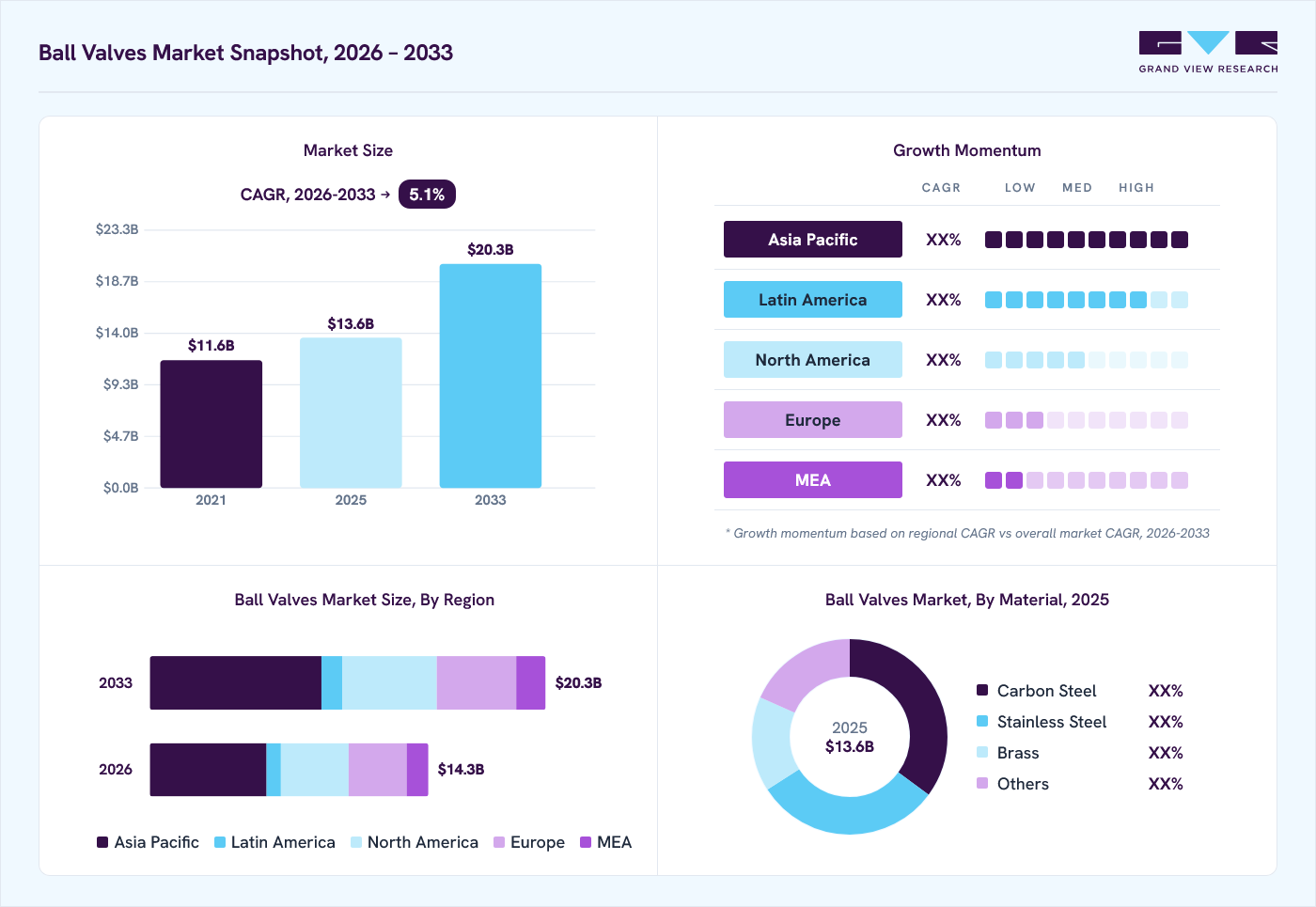
The global ball valves market size was valued at USD 13.6 billion in 2025 and is projected to grow from USD 14.3 billion in 2026 to USD 20.3 billion by 2033, at a CAGR of 5.1% from 2026 to 2033. Asia Pacific dominated the market, accounting for the largest revenue share of 41.7% in 2025. The expansion of oil & gas, chemical, petrochemical, power, and water infrastructure is driving demand for ball valves across pipelines, processing facilities, treatment plants, and utility systems.
Key Market Trends & Insights
- Based on material: Carbon steel segment led the market with the largest revenue share of 35.0% in 2025.
- Based on valve size: 4 - 8 inches segment led the market with the largest revenue share of 31.7% in 2025.
- Based on end use: Oil & gas segment led the market with the largest revenue share of 29.2% in 2025.
Regional Highlights
- Largest Regional Market: Asia Pacific (41.7% revenue share, 2025)
- By Country: China held the largest market share of Asia Pacific in 2025.
Market Size & Forecast
- 2025 Market Size: USD 13.6 Billion
- 2026 Market Size: USD 14.3 Billion
- 2033 Projected Market Size: USD 20.3 Billion
- CAGR (2026-2033): 5.1%
Rising industrialization and infrastructure investments are further supporting new valve installations and replacements. Another important factor is the growing adoption of automated and smart valve systems across industrial facilities. Manufacturers are increasingly integrating electric and pneumatic actuators, positioners, sensors, and digital monitoring capabilities with ball valves to enable remote operation, faster shut-off, and improved process control.

Industries such as pharmaceuticals, food & beverage, chemicals, semiconductor manufacturing, and data centers are also placing greater emphasis on precise flow management, corrosion resistance, hygienic designs, and reduced leakage. In addition, stricter requirements for process safety, emissions control, and fluid containment are encouraging industrial operators to replace conventional valves with higher-performance ball valves, while advancements in materials, sealing technologies, and low-maintenance valve designs are expanding their suitability across demanding applications.
Market Dynamics
The industry is influenced by industrial infrastructure expansion, demand for reliable flow isolation, automation of process systems, regulatory requirements, and the need to handle increasingly demanding operating conditions. Growth in oil & gas, chemical processing, water infrastructure, power generation, and food & beverage facilities supports valve demand, while pricing pressure, raw material costs, and competition from regional manufacturers influence market profitability.
Increasing investments in oil & gas pipelines, petrochemical plants, power facilities, water treatment infrastructure, and industrial processing plants are creating steady demand for ball valves. New projects require valves for pipeline isolation and fluid handling, while modernization of existing facilities generates replacement demand. Infrastructure development in emerging economies is further expanding the installation base for different valve sizes and materials. The growing need for efficient and reliable flow-control systems is also supporting adoption. Ball valves provide quick shut-off, tight sealing, and relatively low pressure loss, making them suitable for applications where dependable isolation is important. Their use across multiple industries reduces dependence on a single application sector and supports sustained market demand.
Volatility in the prices of steel, stainless steel, brass, and specialty alloys can increase manufacturing costs and pressure profit margins for ball valve producers. Smaller manufacturers may face greater difficulty absorbing these cost increases, while intense competition can limit their ability to pass higher material costs to customers. Supply-chain disruptions can further affect component availability and production lead times.
The increasing adoption of pneumatic and electric actuators, smart positioners, sensors, and digital monitoring systems presents an important growth opportunity. Industrial operators are increasingly seeking remotely operated valves that can provide real-time operating information and support automated process control. This is particularly relevant in oil & gas, chemical, water treatment, pharmaceutical, and power-generation facilities. Manufacturers can capture this opportunity by developing integrated smart valve solutions with predictive monitoring, improved leakage detection, energy-efficient actuation, and compatibility with industrial control systems. Such solutions can also help suppliers move beyond conventional valve sales toward higher-value automated products.
Market Concentration & Characteristics
The industry is fragmented, particularly because a large number of global, regional, and local manufacturers compete across different valve sizes, materials, pressure classes, and end-use industries. While companies such as Emerson, Flowserve, SLB, KITZ, Crane, and Baker Hughes have strong market presence, numerous specialized manufacturers and regional suppliers serve specific applications and geographic markets. The availability of customized products and relatively broad supplier base further contribute to the fragmented nature of the market.
The industry has a moderate degree of innovation, with manufacturers focusing on improved sealing, corrosion resistance, pressure handling, and operational reliability. Innovation is increasingly centered on automated ball valves, smart actuators, digital position monitoring, advanced materials, and low-emission designs. Product development is also driven by the need to handle demanding fluids, higher operating pressures, and specialized industrial applications.
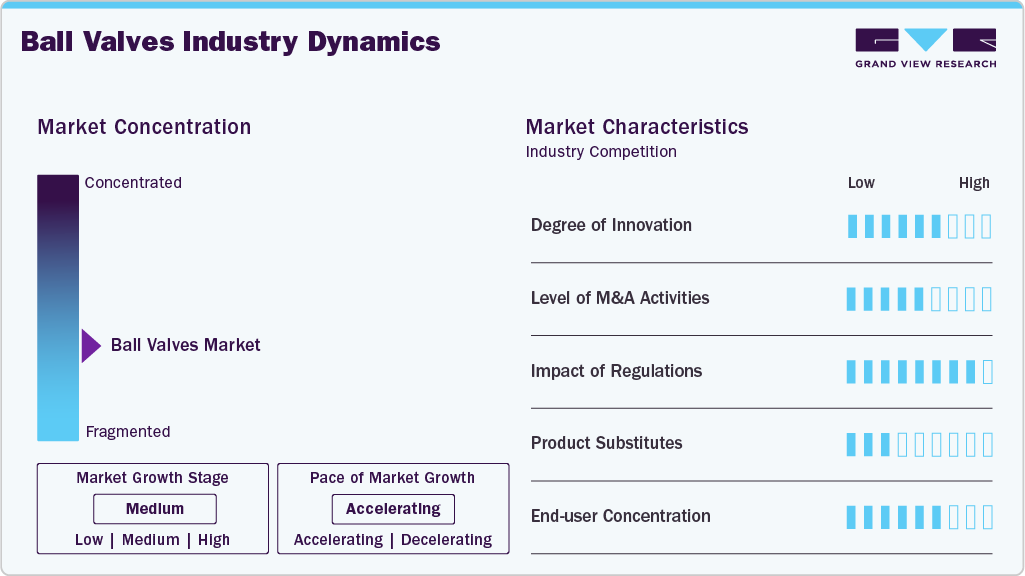
Regulations have a high impact on the industry, particularly in oil & gas, chemical, petrochemical, pharmaceutical, food & beverage, and water applications. Standards related to pressure containment, fugitive emissions, leakage, material compatibility, safety, and environmental protection influence valve design and certification requirements. Compliance with standards such as API, ASME, ISO, and IEC is often important for manufacturers seeking to supply critical industrial applications.
The industry has relatively moderate end-user concentration because demand is distributed across oil & gas, water & wastewater, chemical & petrochemical, power generation, food & beverage, pharmaceuticals, mining, and other industries. Large industrial projects can generate substantial orders from individual customers, but the overall customer base remains diversified across industries and regions. This broad application base reduces dependence on any single end-user sector and supports the fragmented structure of the market.
Analyst Perspective
The industry is supported by continued investments in oil & gas, chemical & petrochemical, water & wastewater, power generation, and pharmaceutical infrastructure. Demand is shifting toward stainless-steel, larger-diameter, automated, and application-specific valves as industries prioritize corrosion resistance, operational reliability, process safety, and efficient flow control. The market remains fragmented, with established global manufacturers competing alongside regional and specialized suppliers, while smart valve technologies, industrial automation, infrastructure modernization, and expansion of pharmaceutical and biotechnology facilities offer attractive opportunities for future revenue growth.
Material Insights
The carbon steel segment dominated the market, supported by its high strength, durability, cost-effectiveness, and suitability for high-pressure industrial applications. It is extensively used in oil & gas, chemical & petrochemical, power generation, water infrastructure, and general industrial systems. The material is particularly preferred for large-diameter valves and applications where mechanical strength and reliable performance are more important than high corrosion resistance.
The stainless steel segment is expected to grow at the fastest CAGR of 5.6%, driven by increasing demand for corrosion-resistant and hygienic valve solutions. Its adoption is rising in chemical processing, food & beverage, pharmaceutical, biotechnology, water treatment, and other applications involving corrosive or high-purity fluids. Growing requirements for product cleanliness, longer service life, and resistance to harsh operating environments are further supporting stainless-steel ball valve demand.
Valve Size Insights
The 4 - 8 inches segment dominated the market in 2025, driven by widespread use in medium-to-large industrial piping systems requiring higher flow capacity and reliable isolation. These valves are commonly deployed across oil & gas, chemical & petrochemical, power generation, water & wastewater, and mining facilities, where they provide an effective balance between flow handling, installation requirements, and operating performance. Expansion and modernization of industrial processing and pipeline infrastructure continue to support demand for this size range.
The 1 - 4 inches segment is expected to grow at the fastest CAGR of 5.6%, supported by increasing installation of ball valves in industrial equipment, process lines, water systems, HVAC, and smaller-scale chemical and pharmaceutical facilities. The growing adoption of automated and compact flow-control systems is further increasing demand for smaller-diameter valves. Their relatively lower material requirements, compact design, and suitability for diverse applications make the 1-4 inch range attractive for new installations and replacement applications.
End-use Insights
The oil & gas segment dominated the market in 2025, driven by extensive use across upstream production, midstream pipelines, LNG facilities, refineries, and downstream processing plants. Ball valves are widely used for pipeline isolation and fluid handling because of their tight shut-off, durability, and ability to operate under high-pressure and demanding conditions. Continued investments in pipeline networks, refinery upgrades, LNG infrastructure, and oil & gas processing facilities are supporting demand from this segment.
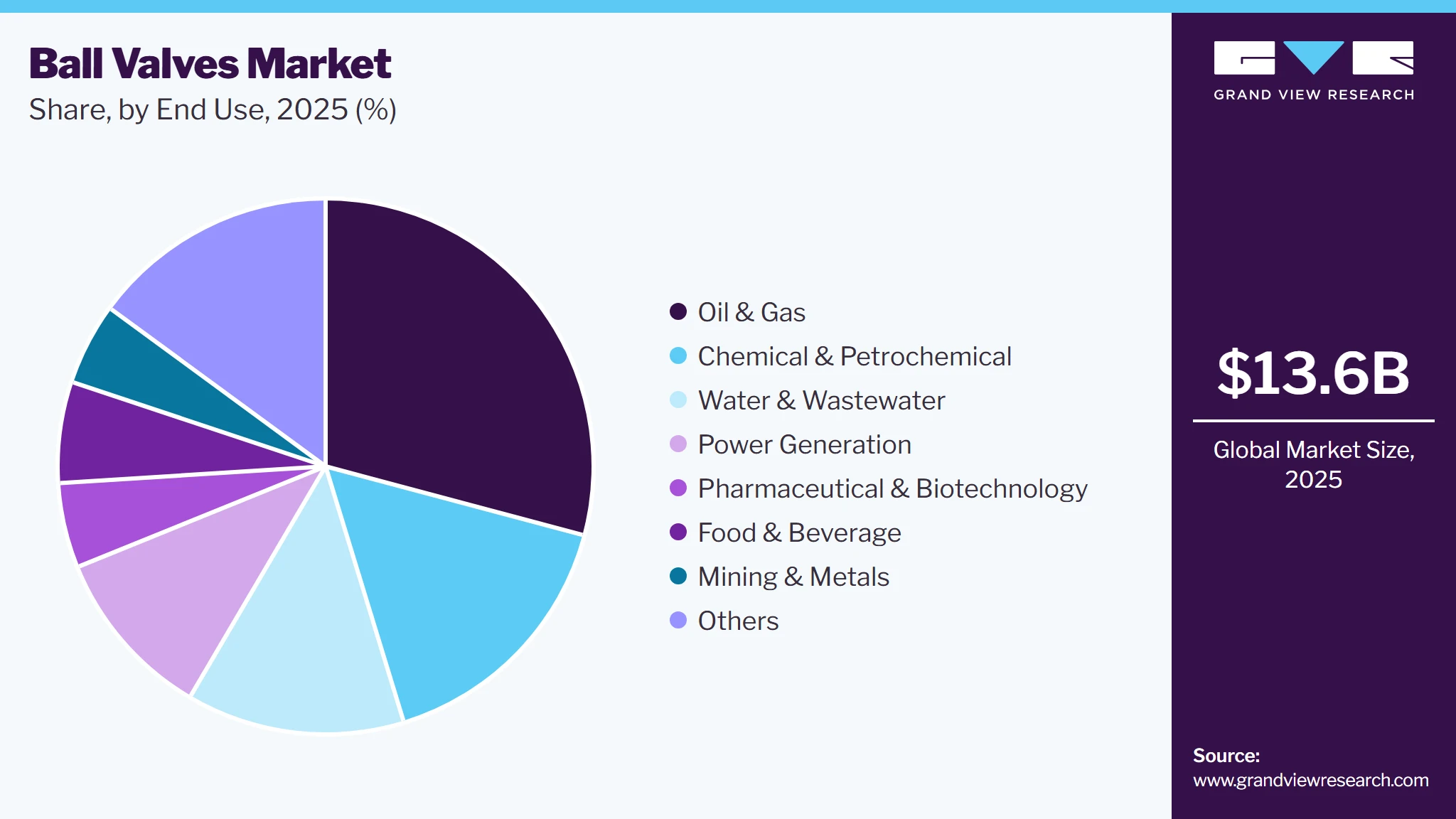
The pharmaceutical & biotechnology segment is expected to grow at the fastest CAGR of 7.1% over the forecast period, supported by increasing investments in pharmaceutical manufacturing, biotechnology facilities, and high-purity processing systems. These industries require corrosion-resistant, hygienic, and precise flow-control solutions for purified water, process fluids, gases, and other critical applications. Growing production capacity and stricter requirements for contamination control are encouraging the adoption of high-quality stainless-steel and specialized ball valves.
Regional Insights
The North America ball valves market is supported by continued investments in oil & gas production, LNG infrastructure, pipeline modernization, and industrial facilities. The U.S. remains a major demand center due to its extensive pipeline network and large installed base of process equipment. Increasing replacement of aging infrastructure and adoption of automated valve systems are also contributing to market growth.
U.S. Ball Valves Market Trends
The ball valves market in the U.S is supported by its large oil & gas, refining, chemical, power, and pipeline infrastructure. According to the U.S. Energy Information Administration (EIA), U.S. crude oil production reached a record 13.6 million barrels per day in 2025, increasing 3% from 2024. The country also remained the world's largest crude oil producer, supporting continued demand for ball valves across production, transportation, processing, and storage facilities.
The Canada ball valve demand is supported by the continued expansion of its energy infrastructure. According to the Canada Energy Regulator (CER), the country produced an average of 5.3 million barrels per day of crude oil and equivalents in 2025, compared with 5.1 million barrels per day in 2024. Production also reached 5.64 million barrels per day in December 2025, indicating sustained activity across oil-producing regions and supporting requirements for flow-control equipment in production and pipeline systems.
Europe Ball Valves Market Trends
The ball valves market in Europe is driven by the modernization of industrial facilities, stringent process-safety requirements, and investments in energy, water management, chemical processing, and pharmaceutical manufacturing. Demand is shifting toward higher-performance and energy-efficient valve solutions, while Germany, Italy, France, and the UK remain important markets due to their established industrial and engineering sectors.
The Germany ball valves market is supported by its strong manufacturing base and extensive chemical, industrial machinery, automotive, power, and process industries. Demand is driven by the need for reliable flow-control equipment across production facilities, processing plants, and industrial infrastructure, while ongoing modernization is supporting replacement and upgrade opportunities.
The ball valves market in France is witnessing steady market growth, supported by its pharmaceutical, chemical, food & beverage, energy, and water treatment industries. Increasing investments in industrial facilities, process automation, and infrastructure modernization are creating opportunities for ball valve suppliers, particularly for stainless-steel and automated valve solutions used in demanding process applications.
Asia Pacific Ball Valves Market Trends
Asia Pacific ball valves market held the largest revenue share of 41.7% in 2025, supported by rapid industrialization, large-scale manufacturing activity, and the expansion of oil & gas, chemical, power, and water infrastructure. China, India, Japan, and Southeast Asian economies are investing in new processing facilities, pipelines, water treatment projects, and industrial plants, creating broad demand for ball valves across different materials and sizes. The region’s strong manufacturing base and expanding industrial capacity further strengthen its market position.

The China ball valves market is supported by its large power-generation base and extensive industrial infrastructure. According to the National Bureau of Statistics of China, the country generated 10,575.3 billion kWh of electricity in 2025, representing a 4.8% increase from the previous year. Thermal power accounted for 6,327.2 billion kWh, while wind power generation increased by 13.1%, creating continued requirements for ball valves across power plants, utility systems, cooling circuits, and associated industrial facilities.
The ball valves market in India is supported by expanding chemical and petrochemical production and investments in processing capacity. According to the Department of Chemicals and Petrochemicals, Government of India, production of major chemicals and petrochemicals reached 58.6 million tonnes in FY 2024-25, compared with 45.6 million tonnes in FY 2015-16. Major petrochemical production alone reached 20.6 million tonnes in FY 2024-25, with total major petrochemical capacity utilization at 95.4%, highlighting strong activity across chemical and petrochemical facilities where ball valves are widely used for fluid isolation and process handling.
Middle East & Africa Ball Valves Market Trends
The ball valves market in the Middle East & Africa is expected to grow as investments in oil & gas, LNG, desalination, water treatment, and petrochemical projects increase. Gulf countries are developing downstream processing and industrial infrastructure to diversify their economies, while African markets are gradually expanding water, mining, and energy infrastructure. These developments are creating opportunities for ball valves across both new installations and infrastructure upgrades.
The Saudi Arabia ball valves market has a strong position in the Middle East & Africa because of its extensive oil & gas, refining, and petrochemical infrastructure. According to the U.S. International Trade Administration, the country holds approximately 17% of the world's proven petroleum reserves. As of December 2024, Saudi Aramco reserves under the concession agreement stood at 250 billion barrels of oil equivalent, including 190.2 billion barrels of crude oil and condensate, 26.1 billion barrels of NGLs, and 209.8 trillion standard cubic feet of natural gas. This large resource base and ongoing development of hydrocarbon and downstream facilities support demand for ball valves across production, pipelines, processing, and petrochemical applications.
Latin America Ball Valves Market Trends
The ball valves market in Latin America is witnessing growing demand from oil & gas exploration, mining, water infrastructure, and food-processing industries. Brazil and Mexico represent key markets as investments in energy projects, industrial production, and water treatment infrastructure create opportunities for valve suppliers. Expansion of industrial facilities is also supporting demand for corrosion-resistant and higher-pressure valve solutions.
The Brazil ball valves market is supported by its well-established oil & gas, mining, chemical, petrochemical, power generation, and industrial processing sectors. Ongoing investments in energy infrastructure, refinery and petrochemical projects, mining operations, and water systems are generating demand for ball valves across pipelines, processing facilities, and fluid-handling applications.
Key Ball Valves Companies Insights
Some of the key players operating in the market include Emerson Electric Co., Flowserve Corporation, and SLB.
-
Emerson is a global industrial technology and software company focused on automation solutions for essential industries. Its portfolio includes automation systems, industrial software, measurement instrumentation, final control products such as valves, digital valve controllers and actuators, and other technologies that help industrial customers improve operational efficiency, safety, sustainability, and process performance. Emerson serves industries including oil & gas, chemical, power, water, life sciences, mining, and manufacturing, with its automation portfolio supporting increasingly connected and data-driven industrial operations.
-
Flowserve Corporation is a global provider of flow-control products and solutions, offering pumps, seals, valves, actuators, instrumentation, and energy-recovery equipment for critical industrial applications. The company serves industries including energy, chemicals, power, mining, water, and general manufacturing, with its valve portfolio supporting demanding flow-control requirements. Flowserve operates across more than 50 countries, with over 16,000 associates, 206 facilities, and 10,000+ customers, giving it a broad global presence in industrial flow-management solutions.
Key Ball Valves Companies
The following key companies have been profiled for this study on the ball valves market.
-
Emerson Electric Co.
-
Flowserve Corporation
-
SLB
-
IMI plc
-
KITZ Corporation
-
Crane Company
-
Baker Hughes Company
-
Honeywell International Inc.
-
ALFA LAVAL
-
Curtiss-Wright Corporation
-
SAMSON AG
-
CIRCOR
-
AVK Group A/S
-
Mueller Co. LLC
-
Bonney Forge Corporation
Competitive Benchmarking
Category
Operating Strategies
Competitive Edge
Weakness
Established Players (e.g., Emerson Electric Co.; Flowserve Corporation; SLB; Baker Hughes Company; KITZ Corporation)
- Expand automated and smart ball valve portfolios for oil & gas, chemical, power, water, and process industries.
- Strengthen global manufacturing and distribution networks to serve large industrial projects.
- Develop customized valves for demanding pressure, temperature, corrosion, and flow-control requirements.
- Strong brand reputation and long-standing relationships with major industrial customers.
- Broad product portfolios covering different materials, sizes, pressure classes, and valve configurations.
- Extensive engineering capabilities, certifications, and global sales networks.
- Higher manufacturing and operating costs compared with smaller regional manufacturers.
- Large organizational structures can result in longer decision-making and customization cycles.
- Strong exposure to established industrial sectors can limit growth in certain mature markets.
Emerging & Regional Players (e.g., AVK Group A/S; Mueller Co. LLC; Bonney Forge Corporation; CIRCOR; SAMSON AG)
- Focus on specialized applications and customer-specific ball valve requirements.
- Expand regional presence through partnerships, acquisitions, and targeted distribution channels.
- Compete through flexible manufacturing, application expertise, and shorter delivery times.
- Greater flexibility in serving niche applications and customized requirements.
- Competitive pricing and responsiveness in selected regional markets.
- Specialized expertise in specific industrial, energy, water, and process applications.
- Smaller global manufacturing and distribution networks than leading multinational players.
- Lower brand visibility in some international markets.
- Comparatively limited financial and R&D resources for large-scale development of advanced smart valve technologies.
Recent Developments
-
In January 2026, AVK Industrial Solutions acquired PetrolValves’ manufacturing site in Piacenza, Italy, expanding its production capabilities for high-performance valves. The facility specializes in ball valves and triple offset valves and will add 42 employees to AVK operations. The acquisition strengthens AVK's presence in the Italian energy and industrial valve market while expanding its portfolio and manufacturing capacity.
-
In February 2025, Flowserve introduced a new range of floating ball valves designed for cryogenic and industrial gas applications, including LNG, hydrogen, nitrogen, oxygen, and ammonia. The product range includes three-piece and flanged configurations with improved stem sealing to help reduce fugitive emissions.
Ball Valves Market Report Scope
Report Attribute
Details
Market size value in 2025
USD 13.6 billion
Market size value in 2026
USD 14.3 billion
Revenue forecast in 2033
USD 20.3 billion
Growth rate
CAGR of 5.1% from 2026 to 2033
Historical data
2021 - 2024
Forecast period
2026 - 2033
Quantitative units
Revenue in USD billion, and CAGR from 2026 to 2033
Report coverage
Revenue forecast, company ranking, competitive landscape, growth factors, and trends
Segments covered
Material, valve size, end-use, region
Regional scope
North America; Europe; Asia Pacific; Latin America; Middle East & Africa; Africa
Country scope
U.S.; Canada; Mexico; UK; Germany; France; Spain; Italy; China; Japan; India; Australia; South Korea; Brazil; Argentina; Saudi Arabia; UAE; South Africa
Key companies profiled
Emerson Electric Co.; Flowserve Corporation; SLB; IMI plc; KITZ Corporation; Crane Company; Baker Hughes Company; Honeywell International Inc.; Alfa Laval; Curtiss-Wright Corporation; SAMSON AG; CIRCOR; AVK Group A/S; Mueller Co. LLC; Bonney Forge Corporation.
Customization scope
Free report customization (equivalent up to 8 analysts working days) with purchase. Addition or alteration to country, regional & segment scope.
Pricing and purchase options
Avail customized purchase options to meet your exact research needs. Explore purchase options
Global Ball Valves Market Report Segmentation
This report forecasts revenue growth at global, regional, and country levels and provides an analysis of the latest industry trends in each of the sub-segments from 2021 to 2033. For this study, Grand View Research has segmented the global ball valves market report based on material, valve size, end-use, and region:

-
Material Outlook (Revenue, USD Billion, 2021 - 2033)
-
Carbon Steel
-
Stainless Steel
-
Brass
-
Others
-
-
Valve Size Outlook (Revenue, USD Billion, 2021 - 2033)
-
Up to 1 inch
-
1- 4 inches
-
4 - 8 inches
-
Above 8 inches
-
-
End-use Outlook (Revenue, USD Billion, 2021 - 2033)
-
Water & Wastewater
-
Food & Beverage
-
Chemical & Petrochemical
-
Power Generation
-
Mining & Metals
-
Oil & Gas
-
Pharmaceutical & Biotechnology
-
Others
-
-
Regional Outlook (Revenue, USD Billion, 2021 - 2033)
-
North America
-
U.S.
-
Canada
-
Mexico
-
-
Europe
-
Germany
-
France
-
Italy
-
Spain
-
UK
-
-
Asia Pacific
-
China
-
India
-
Japan
-
South Korea
-
Australia
-
-
Latin America
-
Brazil
-
Argentina
-
Middle East & Africa
-
Saudi Arabia
-
UAE
-
South Africa
-
-
Research Methodology
The ball valves market figures in this report are based on a proven research process that combines executive interviews with secondary research from proprietary databases, company filings, and recognized regulatory and institutional sources. Market size is built through value-chain sizing-reconciling supply-side and demand-side estimates-and triangulated with bottom-up and top-down approaches. Every estimate passes multiple levels of expert validation before publication, with each ball valves segment quantified using the revenue-capture definitions in the table below.
Segment Definition
Material
Revenue Capture Definition
Carbon Steel
Revenue generated from the sale of ball valves manufactured primarily from carbon steel, including standard and industrial-grade valves used in high-pressure, high-temperature, and general process applications.
Stainless Steel
Revenue generated from the sale of ball valves manufactured using stainless steel, including valves designed for corrosive, hygienic, high-purity, and demanding industrial environments.
Brass
Revenue generated from the sale of brass ball valves used for controlling water, air, gas, and other compatible fluids across commercial, residential, and light industrial applications.
Others
Revenue generated from the sale of ball valves manufactured from other materials, including alloy steel, duplex stainless steel, nickel alloys, and other specialized materials used for specific operating conditions.
Valve Size
Revenue Capture Definition
Up to 1 inch
Revenue generated from the sale of ball valves with nominal sizes up to 1 inch, primarily used in compact piping, instrumentation, utility, equipment, and low-flow applications.
1- 4 inches
Revenue generated from the sale of ball valves ranging from 1 to 4 inches in nominal size, commonly used in industrial process lines, water systems, HVAC, and small- to medium-scale fluid-handling applications.
4 - 8 inches
Revenue generated from the sale of ball valves ranging from 4 to 8 inches in nominal size, mainly used in medium- to large-scale pipelines, process facilities, utilities, and industrial flow-control systems.
Above 8 inches
Revenue generated from the sale of ball valves exceeding 8 inches in nominal size, generally used in large pipelines, oil & gas infrastructure, water networks, power facilities, and other high-flow applications.
End Use
Revenue Capture Definition
Water & Wastewater
Revenue generated from the sale of ball valves used in water supply, distribution, pumping, treatment, wastewater processing, and sewage infrastructure for reliable flow isolation and control.
Food & Beverage
Revenue generated from the sale of ball valves used in food, beverage, dairy, brewing, and processing facilities, particularly where hygienic construction and contamination control are required.
Chemical & Petrochemical
Revenue generated from the sale of ball valves used for handling chemicals, hydrocarbons, solvents, gases, and process fluids in chemical and petrochemical production, processing, and storage facilities.
Power Generation
Revenue generated from the sale of ball valves used in thermal, nuclear, hydro, and renewable power facilities for controlling water, steam, fuels, gases, cooling fluids, and other process media.
Mining & Metals
Revenue generated from the sale of ball valves used in mining and metal-processing operations, including mineral processing, slurry systems, water circuits, chemical handling, and material-treatment processes.
Oil & Gas
Revenue generated from the sale of ball valves used across upstream, midstream, and downstream operations, including oil and gas production, gathering, pipelines, LNG, refining, storage, and processing facilities.
Pharmaceutical & Biotechnology
Revenue generated from the sale of ball valves used in pharmaceutical and biotechnology manufacturing for controlling purified water, process fluids, gases, chemicals, and other critical media under stringent hygienic and process requirements.
Others
Revenue generated from the sale of ball valves used in other applications, including general manufacturing, marine, construction, HVAC, commercial facilities, and industrial equipment not covered under the specified end-use categories.
Estimation Model
Layer No.
Layer Name
Key Question
Description
01
End-Use Demand Assessment
What is the demand for ball valves across major end-use industries?
Assess ball valve demand across oil & gas, chemical & petrochemical, water & wastewater, power generation, food & beverage, mining & metals, pharmaceutical & biotechnology, and other industries.
02
Volume & Product Mix Assessment
What volume of ball valves is required across different materials and sizes?
Estimate valve volumes by carbon steel, stainless steel, brass, and other materials, while further assessing demand across valve sizes such as up to 1 inch, 1-4 inches, 4-8 inches, and above 8 inches.
03
Manufacturer & Distribution Assessment
Who supplies ball valves and how do products reach end users?
Evaluate the market presence of major manufacturers, regional suppliers, distributors, and direct sales channels to determine supplier shares and product flow across different regions and end-use industries.
04
Revenue Estimation
What is the total revenue generated from ball valve sales?
Calculate the total ball valves market revenue by multiplying estimated sales volume by the applicable average selling price and aggregating revenue across materials, sizes, end-use industries, and regions.
Delivered Customizations
This report has been delivered with the following In-depth customizations
Client Request
Customization Delivered
Value Adds
Regional Segmentation
Delivered a comprehensive regional and country-level analysis covering North America, Europe, Asia Pacific, Latin America, and the Middle East & Africa, with key country insights for the U.S., Canada, Germany, France, China, India, Brazil, and Saudi Arabia.
Enables identification of regional market leaders, emerging demand centers, country-specific growth patterns, and investment opportunities across major end-use industries.
Competitive Benchmarking
Delivered detailed benchmarking of major ball valve manufacturers, including Emerson, Flowserve, SLB, Baker Hughes, KITZ, Crane, IMI, Alfa Laval, AVK, CIRCOR, SAMSON, and other key participants, covering product portfolios, market positioning, operating strategies, competitive advantages, and weaknesses.
Provides a structured view of the competitive landscape, helping identify established versus growth-oriented players, differentiation factors, product capabilities, and areas of competitive strength.
Opportunity Assessment
Delivered an assessment of key market opportunities arising from oil & gas and petrochemical investments, water and wastewater infrastructure, industrial automation, pharmaceutical and biotechnology expansion, smart valve adoption, and demand for corrosion-resistant and specialized valve materials.
Helps identify high-potential applications, product categories, end-use industries, and regional markets that can support future revenue growth and strategic expansion.
Frequently Asked Questions About This Report
The global ball valves market, in terms of revenue, is expected to grow at a compound annual growth rate of 5.1% from 2026 to 2033 to reach USD 20.3 billion by 2033.
Asia Pacific held the largest regional share, accounting for 41.7% of the market in 2025, supported by industrialization, manufacturing expansion, and investments in energy, chemical, water, and infrastructure projects.
Asia Pacific is expected to be the fastest-growing region, supported by increasing industrial investments, expansion of oil & gas and petrochemical facilities, infrastructure development, and rising adoption of automated flow-control systems.
The carbon steel segment led the market, accounting for the largest revenue share of 35.0% in 2025, driven by its strength, durability, cost-effectiveness, and widespread use across industrial applications.
The 4-8 inches segment led the market, accounting for the largest revenue share of 31.7% in 2025, supported by its extensive use in industrial pipelines, oil & gas facilities, chemical plants, power generation, and water infrastructure.
The oil & gas segment led the market, accounting for the largest revenue share of 29.2% in 2025, driven by extensive ball valve requirements across production, pipelines, refining, LNG, storage, and processing facilities.
Some of the key players operating in the global ball valves market include Emerson Electric Co.; Flowserve Corporation; SLB; IMI plc; KITZ Corporation; Crane Company; Baker Hughes Company; Honeywell International Inc.; Alfa Laval; Curtiss-Wright Corporation; SAMSON AG; CIRCOR; AVK Group A/S; Mueller Co. LLC; Bonney Forge Corporation.
Market growth is primarily driven by increasing investments in oil & gas pipelines, chemical and petrochemical facilities, water & wastewater infrastructure, power plants, and industrial processing facilities. The need for reliable shut-off, low-pressure-loss flow control, and durable valves in demanding operating environments is further supporting adoption.
The global ball valves market size was valued at USD 13.6 billion in 2025 and is estimated at USD 14.3 billion in 2026.
About the Author(s)
Advanced Interior Materials Research Team
Advanced Materials · Advanced Interior MaterialsThis report was authored by the advanced interior materials research team at Grand View Research - comprising two research analysts, one senior research analyst, and one industry expert - with specialized expertise in the advanced interior materials segment of the advanced materials industry. All findings are based on proprietary advanced materials databases, executive interviews, and regulatory analysis, subject to internal peer review prior to publication.
Last Updated:
Speak to Analyst


Customize this report to your needs — add regions, segments, or data points, with 20% free customization.
Or view our licence options:


ISO 9001:2015 & 27001:2022 Certified
We are GDPR and CCPA compliant! Your transaction & personal information is safe and secure. For more details, please read our privacy policy.


