
- Home
- »
- Plastics, Polymers & Resins
- »
-
Battery Separator Films Market Size Report, 2026-2033GVR Report cover
![Battery Separator Films Market (2026 - 2033)Report]()
Battery Separator Films Market (2026 - 2033)
Size, Share & Trends Analysis Report Market By Material Type (Polypropylene (PP), PP/PE/PP Multilayer, Polyethylene (PE)), By End Use (Electric Vehicles, Power Tools, Industrial Batteries), By Region, And Segment Forecasts
Market Size, 2025
$13.7BMarket Estimate, 2026
$15.5BMarket Forecast, 2033
$36.8BCAGR, 2026–2033
13.2%Battery Separator Films Market Summary
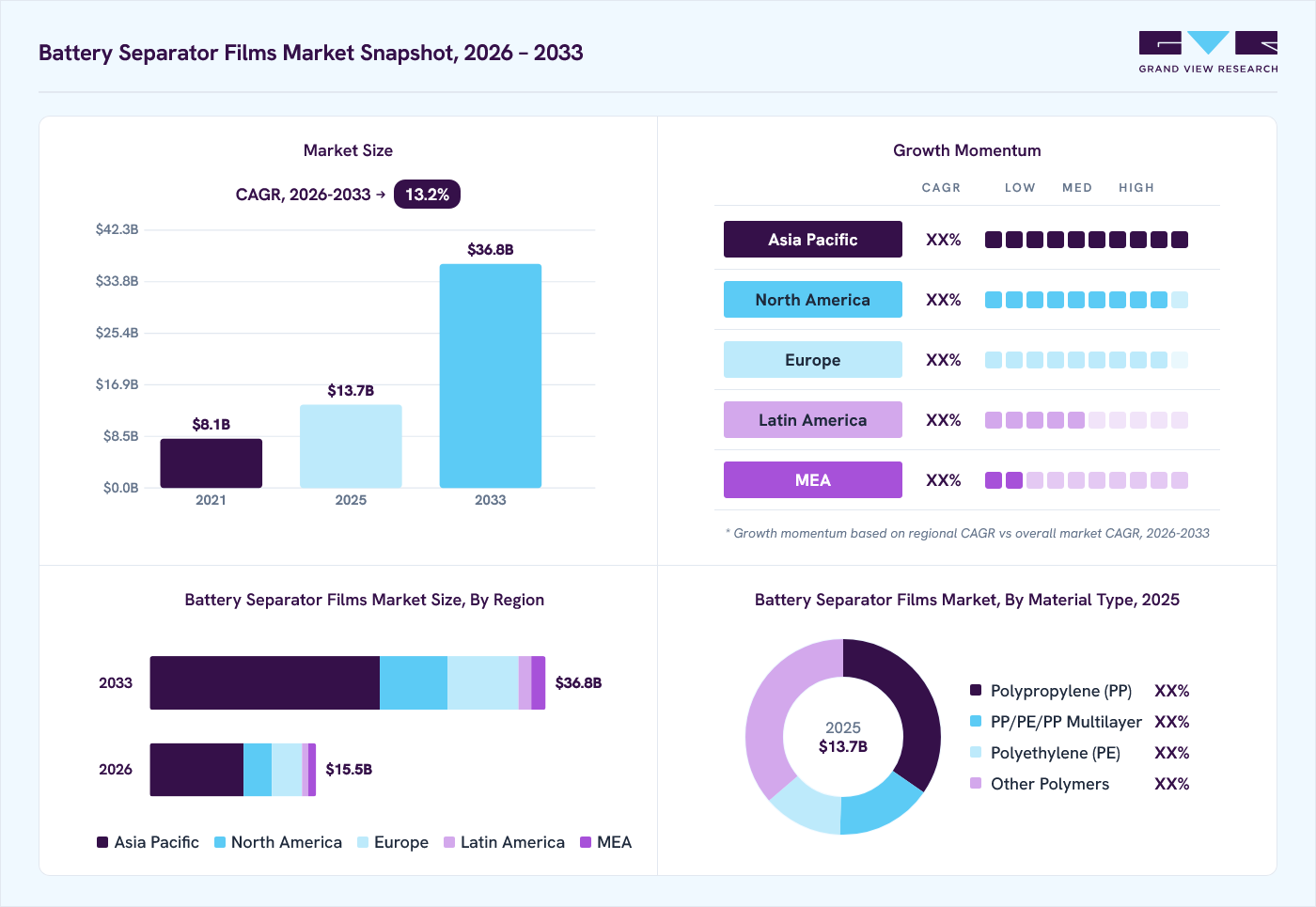
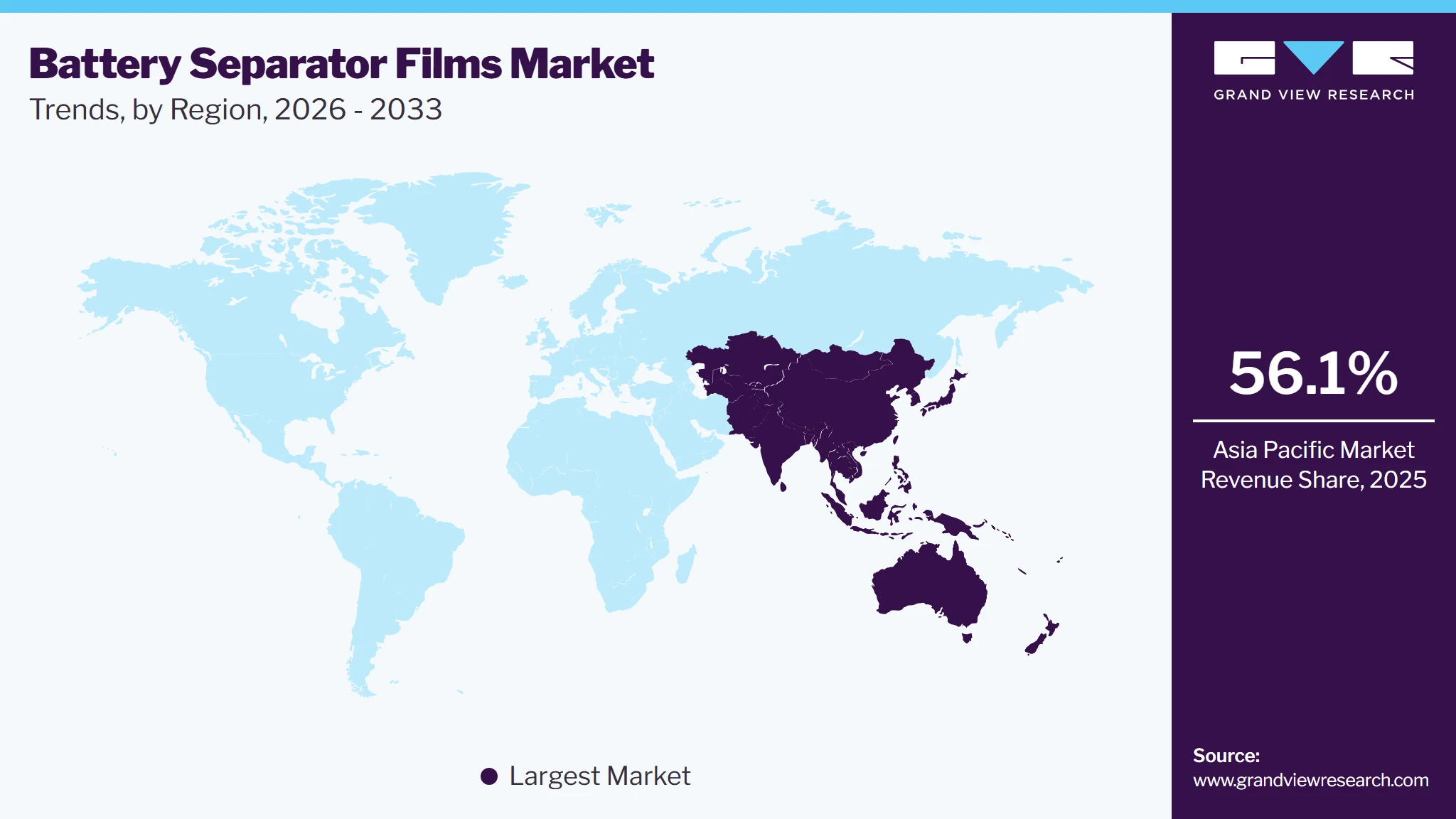
The global battery separator films market size was valued at USD 13.7 billion in 2025 and is projected to grow from USD 15.5 billion to USD 36.8 billion by 2033, at a CAGR of 13.2% from 2026 to 2033. Asia Pacific dominated the market, accounting for a revenue share of 56.1% in 2025. The market is driven by rising demand for EVs, consumer electronics, energy storage systems, power tools, and industrial batteries, increasing demand for high-performance separator films that enhance battery safety, thermal stability, ion transport, and performance.
Key Market Trends & Insights
- By material type: Polypropylene (PP) held the largest revenue share of 34.6% in 2025.
- By end use: Consumer electronics is expected to grow at the fastest CAGR of 14.3% from 2026 to 2033.
Regional Highlights
- Largest regional market: Asia Pacific (56.1% revenue share, 2025)
- By country: The China held the largest market share in 2025
Market Size & Forecast
- Market size in 2025: USD 13.7 Billion
- Estimated market size in 2026: USD 15.5 Billion
- Projected market size by 2033: USD 36.8 Billion
- CAGR (2026-2033): 13.2%
Three ways to get this report
Buy it, customize it, or ask a question.Get the Full Report
What the study covers
- FormatsPDF · Excel · Dashboard
- Timeline2026–2033 annual, 2025 base
- Coverage20+ countries, 5 regions
- Companies10+ key players profiled
Customize the Report
20% free customization
- IncludeCountries, segments, points
- TailorTo your product definition
- ExtendDeeper competitor detail
- OrA fully bespoke study
- Turnaround5–10 working days
Ask an Analyst
A direct answer, usually in 1 working day
- AccessReport author, directly
- Reply timeWithin 1 working day
- No sales callDirect answer only
- FormatEmail reply
- CostFree, no cost
The market is shifting toward ceramic-coated and functionalized separator films as battery manufacturers prioritize thermal stability, puncture resistance, electrolyte wettability, and reduced shrinkage. Advanced alumina, boehmite, and silica coatings are gaining adoption, particularly in high-energy-density electric vehicles and energy-storage batteries requiring enhanced safety and durability.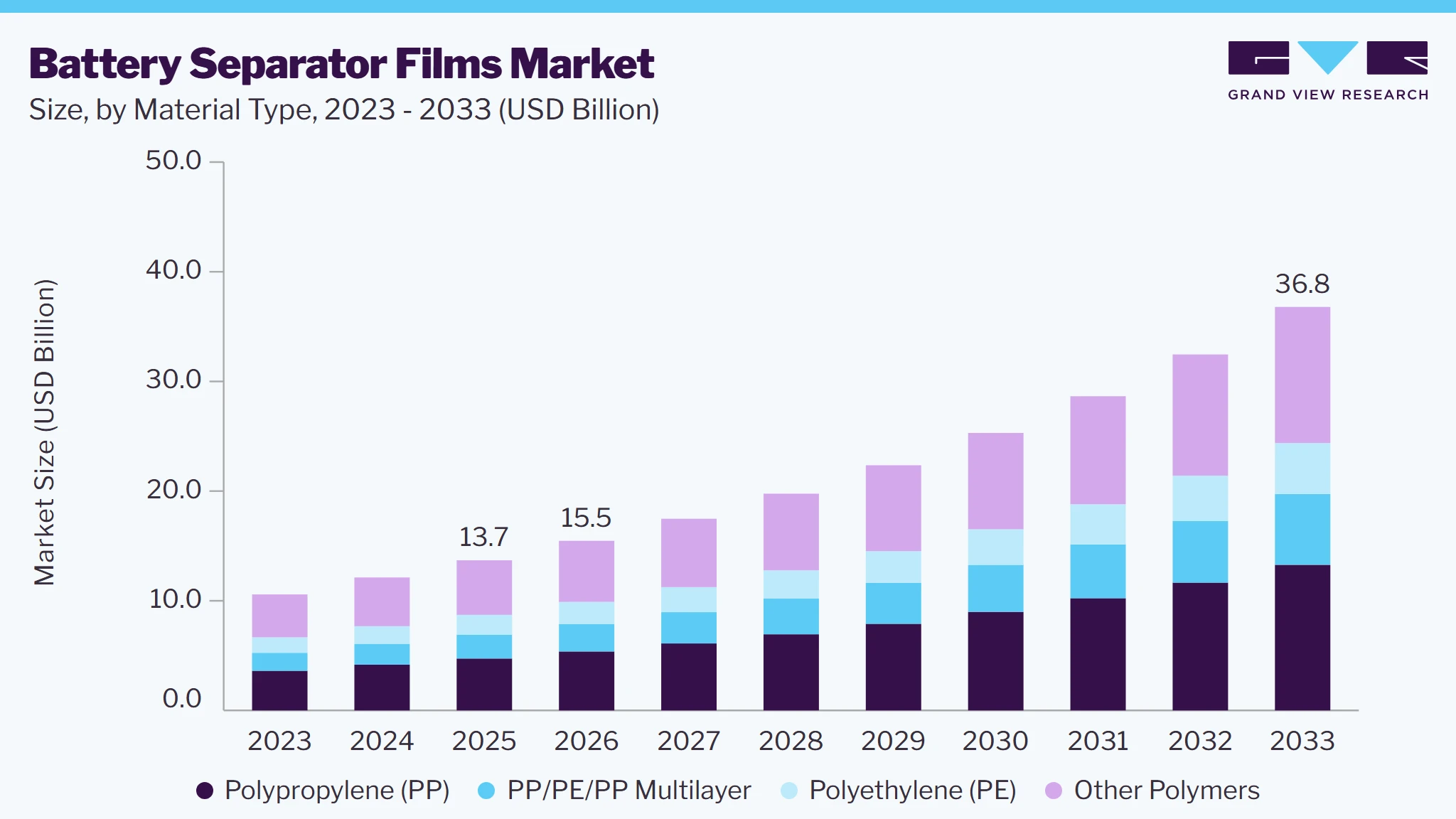
Another key trend is the development of ultrathin, multifunctional, and sustainable separator architectures. Manufacturers are exploring nanofiber, polyimide, hybrid polymer-ceramic, bio-derived, and PFAS-free separators to improve ionic conductivity, mechanical strength, fast-charging capability, and environmental performance while maintaining compatibility with scalable roll-to-roll manufacturing.
Market Dynamics
Electric vehicle adoption is increasing demand for high-capacity lithium-ion batteries, making automotive manufacturers a major end-user of battery separator films. Separators are essential for preventing internal short circuits while allowing efficient ion movement, supporting battery safety, reliability, and performance. The growth of EV production, rising battery capacities, and increasing demand for longer driving ranges are encouraging battery manufacturers to adopt advanced separator films. Thin, heat-resistant, and mechanically strong separators are gaining importance for high-performance automotive battery systems.
High manufacturing costs and capital intensity can restrain the battery separator films market by increasing investment requirements for precision extrusion, biaxial stretching, coating, drying, cleanroom processing, and quality-control systems. Wet-process and coated separator technologies require particularly high capital expenditure, making capacity expansion more challenging. These financial barriers can limit new entrants, reduce supplier competition, and slow the development of additional production capacity despite rising battery demand.
Grid-scale energy storage presents a significant opportunity for the battery separator films market as renewable energy projects increasingly deploy large lithium-ion battery systems for storing and balancing electricity. These applications require separators with high mechanical strength, thermal stability, and long-term durability. Growing investments in solar and wind power infrastructure are therefore expected to increase demand for sturdy, reliable separator films that support safe, efficient large-scale energy storage.
Market Concentration & Characteristics
The market growth stage is high, and growth is accelerating. The market exhibits fragmentation, with key players dominating the industry landscape. Major companies such as SEMCORP (Yunnan Energy New Material), Asahi Kasei/Celgard, SK IE Technology (SKIET), Toray Industries, UBE Corporation/UBE MAXELL, ENTEK International, W-SCOPE, Shenzhen Senior Technology Material, Hebei Gellec New Energy Science & Technology, Teijin and others play a significant role in shaping the market dynamics. These leading players often drive innovation in the market by introducing new products, technologies, and materials to meet the industry's evolving demands.
The battery separator films market has a high degree of innovation, driven by demand for thinner, stronger, and safer separators for high-energy-density batteries. Manufacturers are advancing ceramic-coated, polymer-coated, multilayer, aramid, and nanofiber separators to improve thermal stability, puncture resistance, electrolyte wettability, and ionic conductivity. In-line coating and advanced manufacturing processes are also improving production efficiency and consistency. These developments support EVs, fast-charging batteries, and energy storage systems while enabling higher energy density and improved safety.
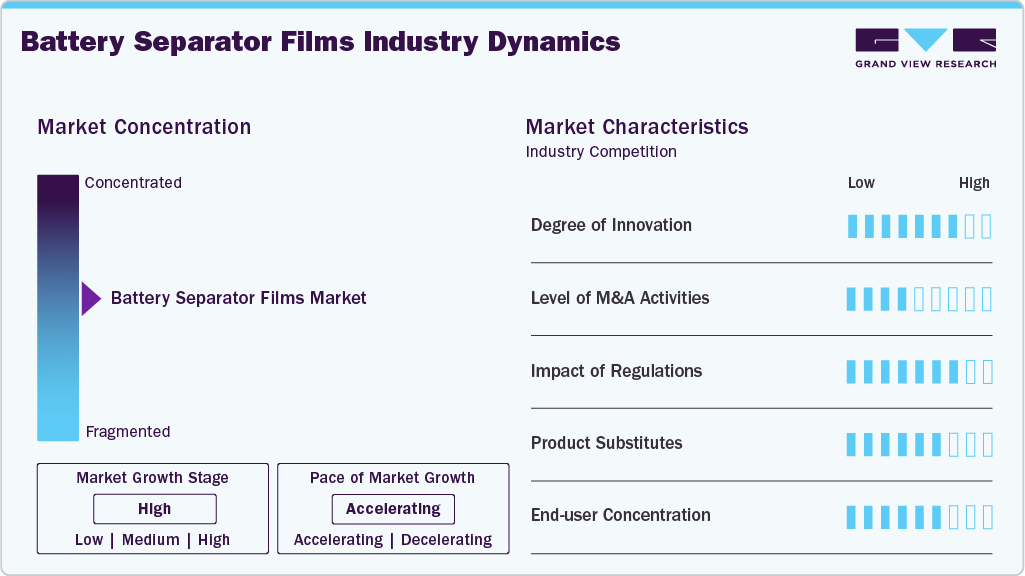
Product substitution is moderate due to conventional PE and PP separator films remain widely established, while alternative materials are increasingly adopted for specialized battery requirements. Ceramic-coated, polymer-coated, nonwoven, aramid, and nanofiber separators can offer better thermal stability, mechanical strength, or electrolyte absorption than standard films. However, substitution is constrained by qualification requirements, manufacturing compatibility, cost considerations, and the need to maintain consistent battery performance. As battery energy density and safety requirements increase, advanced coated and composite separators are expected to replace a greater share of conventional uncoated films.
Analyst Perspective
The battery separator films market will shift from volume growth to value and technology focus in 5-10 years. Demand remains driven by electric vehicles, electronics, energy storage, power tools, and industrial batteries. Higher energy density and fast-charging boost adoption of ceramic-coated, multilayer, high-performance separators. Regulations on safety, recycling, and sustainability favor domestic production and efficient materials. Market leaders will differentiate through advanced coatings, integrated manufacturing, tailored solutions, global production, and partnerships. Challenges like overcapacity, pricing, raw material volatility, competition, and supply disruptions may limit margins, emphasizing innovation, reliability, manufacturing, and regional supply security.
Material Type Insights
The polypropylene (PP) dominated the market, accounting for a revenue share of 34.6% in 2025, and is forecast to grow at an 13.8% CAGR from 2026 to 2033. Polypropylene (PP) is widely used in battery separator films due to its excellent chemical resistance, mechanical strength, low moisture absorption, and good thermal stability. Its lightweight structure and established manufacturing processes support cost-effective production of separators for lithium-ion batteries. Growing demand for electric vehicles, consumer electronics, and energy storage systems is increasing the adoption of PP-based separator films for reliable battery performance and safety.
The PP/PE/PP multilayer segment is expected to grow at the fastest CAGR of 14.6% over the forecast period. The segment is widely used in battery separator films because it combines the strength and chemical resistance of polypropylene with the favorable shutdown properties of polyethylene. Its layered structure prevents internal short circuits by closing pores during overheating while maintaining mechanical stability. Growing demand for safer, high-performance lithium-ion batteries in electric vehicles, consumer electronics, and energy storage systems supports segment growth.
End Use Insights
The electric vehicles segment led the market, accounting for 39.3% of revenue share in 2025, and is projected to grow at a significant CAGR from 2026 to 2033. The segment growth is supported by increasing EV adoption and rising battery production. Lithium-ion batteries used in EVs require separator films to prevent internal short circuits while enabling efficient ion movement. Growing demand for longer driving ranges, faster charging, higher energy density, and improved battery safety is encouraging the adoption of advanced, high-performance separator films.
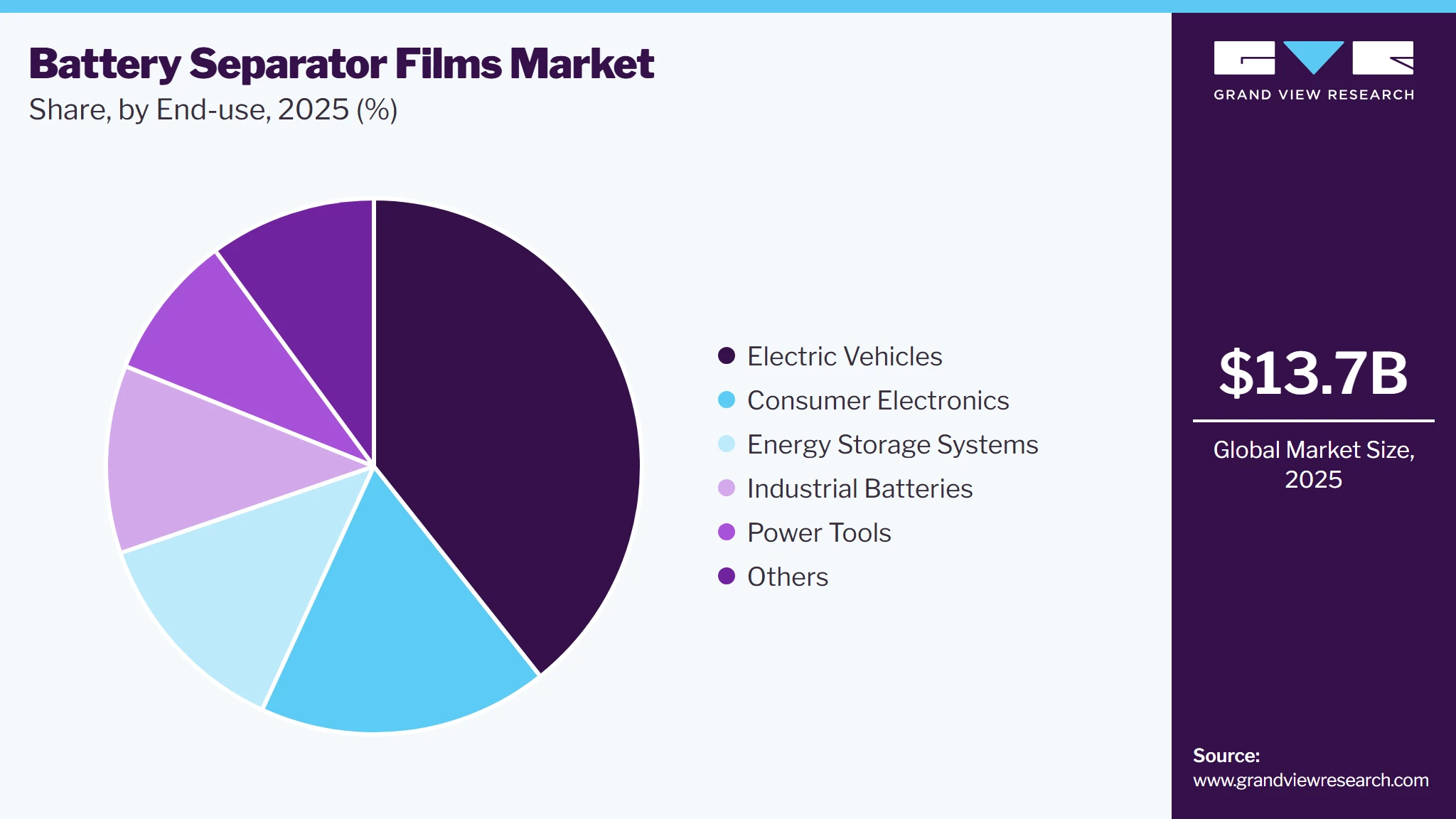
The consumer electronics segment is expected to grow at the fastest CAGR of 14.3% over the forecast period, driven by rising demand for smartphones, tablets, laptops, wearable devices, and other portable electronic products that rely on lithium-ion batteries. Battery separator films provide electrical insulation between electrodes while enabling efficient ion movement, supporting battery safety, energy density, and cycle life. Increasing device usage, product miniaturization, faster charging requirements, and longer battery life expectations are supporting demand for advanced separator films.
Regional Insights
The Asia Pacific battery separator films industry held the largest revenue share of 56.1% in 2025. The region is expected to grow at the fastest CAGR from 2026 to 2033. The APAC market is driven by its strong concentration of electric vehicles, lithium-ion batteries, and consumer electronics manufacturing. China, Japan, South Korea, and India are expanding battery production capacity, supported by EV adoption, renewable energy investments, and government incentives. The region’s established battery supply chain and large-scale separator manufacturing base further support demand for separator films, while increasing safety requirements encourage adoption of advanced coated products.
Battery separator films market in India is driven by rapid development of domestic battery manufacturing, electric mobility, and renewable energy storage. Government initiatives, including the USD 1.9 billion PLI scheme for 50 GWh of advanced chemistry cell capacity, are encouraging local battery production and component manufacturing. Rising investments in EV and grid-scale storage projects are expected to strengthen demand for high-quality separator films.
North America Battery Separator Films Market Trends
North America is driven by expanding domestic battery manufacturing, increasing electric vehicle adoption, and growing grid-scale energy storage deployment. Investments in battery gigafactories and government incentives supporting localized production are strengthening demand for locally manufactured separator films. Rising requirements for battery safety and supply-chain resilience are also encouraging manufacturers to develop advanced separator technologies and reduce dependence on imported battery components.
U.S. Battery Separator Films Market Trends
Battery separator films market in the U.S. is driven by expanding domestic lithium-ion battery manufacturing, increasing electric vehicle adoption, and growing demand for energy storage systems. Federal support for domestic battery supply chains is encouraging investment in cell and component production. This expansion is increasing demand for advanced separator films that provide thermal stability, mechanical strength, and reliable safety performance in high-capacity batteries.
Europe Battery Separator Films Market Trends
Battery separator films market in Europe is driven by expanding electric vehicle production, battery manufacturing, and grid-scale energy storage. EU initiatives supporting domestic battery supply chains are encouraging investments across separator and other component manufacturing. Rising renewable energy integration is also increasing demand for battery storage, creating additional requirements for high-quality separator films that provide safety, thermal stability, and reliable battery performance.
Latin America Battery Separator Films Market Trends
Latin America is witnessing increasing demand for battery separator films as electric vehicle adoption and battery energy storage projects expand. The region’s electric car sales increased strongly in 2025, supported by incentives in several countries, while Brazil and Chile are emerging as important markets for electrification and energy storage. Growing renewable power generation is further creating opportunities for lithium-ion battery deployment and separator film demand.
Middle East and Africa Battery Separator Films Market Trends
The Middle East & Africa battery separator films market is supported by rising investments in renewable energy, grid modernization, and battery energy storage systems. Increasing deployment of solar and wind projects is creating demand for batteries to manage intermittent power generation and improve grid stability. Growing investment in large-scale storage projects is therefore expected to increase requirements for durable, thermally stable, and reliable separator films.
Key Battery Separator Films Company Insights
Some of the key players operating in the market include SEMCORP (Yunnan Energy New Material) and Asahi Kasei/Celgard
-
SEMCORP is a leading global battery separator film manufacturer, supported by large-scale wet-process capacity, advanced base films and functional coatings, and a broad global customer base. Its strong R&D capabilities, extensive production footprint, and continued capacity expansion reinforce its competitive position in the Battery Separator Films Market.
-
Asahi Kasei, through Celgard, maintains a strong position in the battery separator films market with extensive expertise in dry- and wet-process technologies, broad separator portfolios, and global manufacturing capabilities. Recent investments in North American coating capacity further strengthen its localized supply capabilities for EV and energy-storage applications.
Hebei Gellec New Energy Science & Technology and ENTEK International are some of the emerging participants in the battery separator films market.
-
Hebei Gellec New Energy Science & Technology strengthens its position in the battery separator films market through wet-process and coated separator technologies. The company offers ultra-thin, high-strength, high-porosity, ceramic-coated, and resin-coated films while expanding production capacity and developing high-safety separator solutions for electric vehicles, energy storage, and consumer electronics.
-
ENTEK International is strengthening its position in the Battery Separator Films Market through wet-process polyethylene separator technology, ceramic-coated products, and vertically integrated manufacturing capabilities. Its planned Indiana capacity is expected to expand domestic U.S. supply for EV and energy-storage batteries.
Key Battery Separator Films Companies
The following key companies have been profiled for this study on the battery separator films market.
-
Asahi Kasei/Celgard
-
ENTEK International
-
Hebei Gellec New Energy Science & Technology
-
SEMCORP (Yunnan Energy New Material)
-
Shenzhen Senior Technology Material
-
SK IE Technology (SKIET)
-
Teijin
-
Toray Industries
-
UBE Corporation/UBE MAXELL
-
W-SCOPE
Competitive Benchmarking
Operating Strategies
Competitive Edge
Weakness
Mature Players: SEMCORP (Yunnan Energy New Material), Asahi Kasei / Celgard, SK IE Technology (SKIET), Toray Industries, UBE Corporation / UBE MAXELL, W-SCOPE, Shenzhen Senior Technology Material, Teijin
- Focus on wet-process, dry-process, multilayer, ceramic-coated, and functional separator films for lithium-ion batteries used in electric vehicles, consumer electronics, energy storage systems, and industrial applications.
- Invest in high-strength membranes, ceramic and polymer coatings, thin-film technologies, thermal-stability improvements, and high-performance separator formulations.
- Expand through large-scale manufacturing capacity, global production facilities, long-term supply agreements, technology partnerships, customer qualification, and relationships with major battery-cell manufacturers.
- Established manufacturing capabilities, extensive technical expertise, and broader product portfolios support strong market positioning.
- Advanced multilayer and coated separator technologies provide differentiation through improved thermal stability, mechanical strength, shutdown performance, and battery safety.
- Global production networks and established relationships with battery manufacturers strengthen geographic reach and support large-volume supply requirements.
- High capital requirements for production-line expansion, coating facilities, quality control, and advanced separator technology development increase operating costs.
- Maintaining consistent thickness, porosity, mechanical strength, and coating quality across high-volume production can increase manufacturing complexity.
- Dependence on large battery manufacturers and intense competition can create pricing pressure and require continuous investment in technology and capacity.
Emerging Players: Hebei Gellec New Energy Science & Technology, ENTEK International
- Focus on lithium-ion battery separator films, advanced membrane technologies, coated separators, and next-generation battery materials for EV, energy storage, and other high-performance applications.
- Emphasize technology development, separator customization, coating capabilities, production efficiency, and improvements in thermal and mechanical performance.
- Expand through regional manufacturing, production capacity additions, strategic partnerships, customer qualification, technology development, and direct technical support to battery manufacturers.
- Specialized separator technologies enable differentiation through improved safety, thermal resistance, mechanical strength, and compatibility with high-energy-density batteries.
- Flexible technology-development approaches can support customized separator specifications for different battery chemistries and cell designs.
- Regional manufacturing capabilities and capacity expansion strategies can improve supply-chain responsiveness and create opportunities in rapidly growing battery-producing regions.
- Comparatively smaller production scale and geographic presence can limit competitiveness against established global separator manufacturers.
- Significant capital requirements for manufacturing expansion, coating technology, quality certification, and customer qualification may constrain rapid commercialization.
- Dependence on battery-industry expansion, customer approvals, raw-material availability, and technology adoption can increase commercialization and project-cycle risks.
Recent Developments
-
In August 2026, Asahi Kasei opened a new Hipore wet-process lithium-ion battery separator coating line in Charlotte, North Carolina, expanding localized coating capacity and supply capabilities for North America, with commercial production scheduled for the second half of fiscal 2026.
-
In March 2026, SEMCORP completed its Yuxi battery separator project, adding eight production lines and 800 Billion square meters of annual lithium battery separator capacity, strengthening its manufacturing scale and supply capabilities for expanding battery demand.
Battery Separator Films Market Report Scope
Report Attribute
Details
Market size in 2025
USD 13.7 billion
Estimated market size in 2026
USD 15.5 billion
Projected market size by 2033
USD 36.8 billion
Growth rate
CAGR of 13.2% from 2026 to 2033
Actual data
2021 - 2025
Forecast period
2026 - 2033
Quantitative units
Revenue in USD billion, volume in kilotons, and CAGR from 2026 to 2033
Report coverage
Revenue & volume forecast, competitive landscape, growth factors, and trends
Segments covered
Material type, end use, and region
Regional scope
North America; Europe; Asia Pacific; Latin America; Middle East & Africa
Country scope
U.S.; Canada; Mexico; Germany; UK; France; Italy; Spain; China; India; Japan; South Korea; Australia; Brazil; Argentina; Saudi Arabia; UAE; South Africa
Key companies profiled
SEMCORP (Yunnan Energy New Material); Asahi Kasei/Celgard; SK IE Technology (SKIET); Toray Industries; UBE Corporation/UBE MAXELL; ENTEK International; W-SCOPE; Shenzhen Senior Technology Material; Hebei Gellec New Energy Science & Technology; Teijin
Customization scope
Free report customization (equivalent to up to 8 analyst working days) with purchase. Addition or alteration to country, regional & segment scope
Pricing and purchase options
Avail customized purchase options to meet your exact research needs. Explore purchase options
Global Battery Separator Films Market Report Segmentation
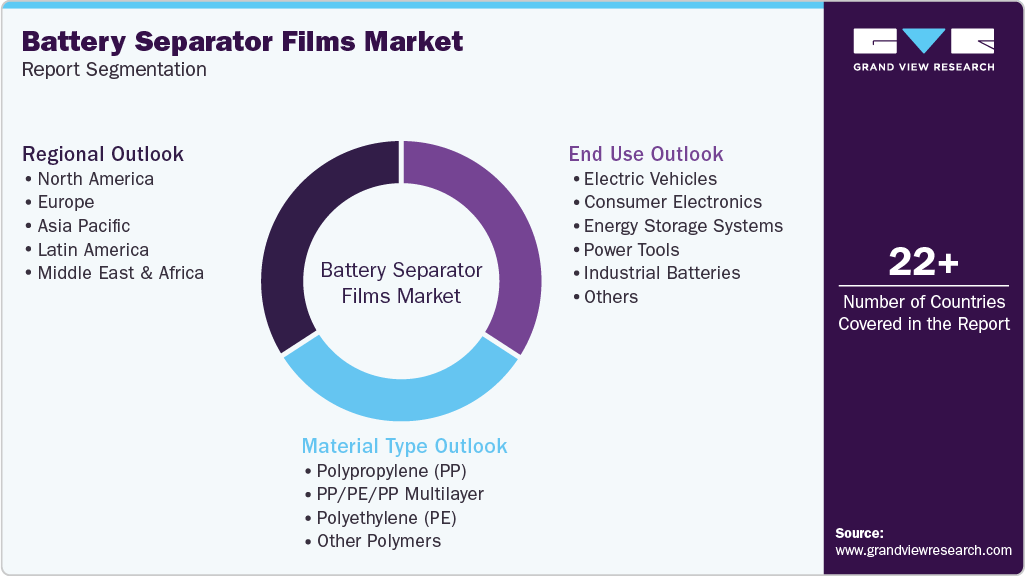
This report forecasts revenue growth at the global, regional, and country levels and provides an analysis of the latest industry trends across sub-segments from 2021 to 2033. For this study, Grand View Research has segmented the global battery separator films market report based on material type, end use, and region:
-
Material Type Outlook (Volume, Kilotons; Revenue, USD Billion, 2021 - 2033)
-
Polypropylene (PP)
-
PP/PE/PP Multilayer
-
Polyethylene (PE)
-
Other Polymers
-
-
End Use Outlook (Volume, Kilotons; Revenue, USD Billion, 2021 - 2033)
-
Electric Vehicles
-
Consumer Electronics
-
Energy Storage Systems
-
Power Tools
-
Industrial Batteries
-
Others
-
-
Regional Outlook (Volume, Kilotons; Revenue, USD Billion, 2021 - 2033)
-
North America
-
U.S.
-
Canada
-
Mexico
-
-
Europe
-
Germany
-
UK
-
France
-
Italy
-
Spain
-
-
Asia Pacific
-
China
-
India
-
Japan
-
South Korea
-
Australia
-
-
Latin America
-
Brazil
-
Argentina
-
-
Middle East & Africa
-
Saudi Arabia
-
UAE
-
South Africa
-
-
Research Methodology
The battery separator films market figures in this report are based on a proven research process that combines executive interviews with secondary research from proprietary databases, company filings, and recognized regulatory and institutional sources. Market size is built through value-chain sizing - reconciling supply-side and demand-side estimates - and triangulated with bottom-up and top-down approaches. Every estimate passes multiple levels of expert validation before publication, with each battery separator films segment quantified using the revenue-capture definitions in the table below.
Segment Definition
Segment - Material Type
Revenue capture definition
Polypropylene (PP)
Revenue is captured through polypropylene-based battery separator films used in lithium-ion batteries for electric vehicles, consumer electronics, energy storage systems, and industrial applications requiring chemical resistance, mechanical strength, dimensional stability, and reliable electrical insulation.
PP/PE/PP Multilayer
Revenue is generated through PP/PE/PP multilayer separator films incorporating polyethylene between polypropylene layers, used in lithium-ion batteries requiring enhanced thermal stability, shutdown functionality, puncture resistance, and improved safety during charging and operation.
Polyethylene (PE)
Revenue is captured through polyethylene-based battery separator films used in lithium-ion batteries requiring controlled porosity, electrolyte wettability, mechanical flexibility, and thermal shutdown characteristics. Growing demand for electric vehicles, portable electronics, and energy storage systems supports adoption of PE separators.
Other Polymers
Revenue comes from other polymer-based separator materials, including polyamide, polyimide, polyester, and specialized polymer systems, used in advanced battery applications requiring customized thermal resistance, mechanical strength, chemical stability, high-temperature performance, and improved safety characteristics.
Segment - End Use
Revenue capture definition
Electric Vehicles
Revenue is generated through battery separator films used in lithium-ion batteries for electric cars, buses, trucks, and two-wheelers requiring high thermal stability, mechanical strength, safety, energy density, and reliable cycle performance.
Consumer Electronics
Revenue is captured through battery separator films used in smartphones, tablets, laptops, wearable devices, and other portable electronics requiring thin construction, high energy density, thermal stability, safety, and long battery life.
Energy Storage Systems
Revenue is generated through battery separator films used in stationary energy storage systems supporting renewable energy integration, grid balancing, and backup power, requiring high durability, thermal resistance, mechanical stability, and reliable long-duration battery operation.
Power Tools
Revenue is captured through battery separator films used in cordless drills, saws, grinders, and other rechargeable power tools requiring high power output, rapid charging capability, mechanical strength, thermal stability, and resistance to internal short circuits.
Industrial Batteries
Revenue is generated through battery separator films used in industrial battery systems for material handling equipment, telecommunications, backup power, and industrial machinery requiring reliable performance, extended cycle life, thermal stability, and operational safety.
Others
Revenue comes from battery separator films used in other applications, including medical devices, aerospace systems, marine equipment, and specialty battery systems requiring customized safety, mechanical, thermal, and electrochemical performance.
Estimation Model
Layer No.
Layer Name
Key Question
Description
1
Top-Down Battery Separator Films Demand Assessment Layer
What defines overall market demand?
Establishes global demand for battery separator films across PP, PE, PP/PE/PP multilayer, ceramic-coated, and other separator materials used in electric vehicles, consumer electronics, energy storage systems, power tools, industrial batteries, and other applications.
2
End Use Demand Validation Layer
Where is demand concentrated?
Maps demand across electric vehicles, consumer electronics, energy storage systems, power tools, industrial batteries, and other end-uses based on battery production, lithium-ion cell demand, energy density requirements, safety standards, charging performance, and adoption of advanced battery technologies.
3
Consumption-to-Revenue Conversion Layer
How is demand monetized?
Converts battery separator film consumption into revenue using material type, film thickness, porosity, coating technology, production capacity, manufacturing costs, product specifications, pricing, battery-cell requirements, production volumes, and purchasing patterns of battery manufacturers.
4
Regional Demand Verification Layer
Where is demand validated?
Validates demand across North America, Europe, Asia Pacific, Latin America, and Middle East & Africa using lithium-ion battery manufacturing capacity, EV production, consumer electronics manufacturing, energy storage deployment, local separator production, battery supply-chain investments, and regulatory support.
Delivered Customizations
This report has been delivered with the following In-depth customizations
Client Request
Customization Delivered
Value Adds
Regional segmentation
Detailed market assessment across North America, Europe, Asia Pacific, Latin America, and Middle East & Africa, with country-level analysis for key battery manufacturing markets such as the U.S., China, Japan, South Korea, India, and major European markets.
Identifies regional demand centers, manufacturing clusters, localization trends, investment priorities, supply gaps, and growth opportunities. Asia Pacific is currently the dominant region, while North America is emerging as a high-growth localization market.
Competitive benchmarking
Benchmarking of major participants including SEMCORP, Asahi Kasei/Celgard, SK IE Technology, Toray Industries, UBE MAXELL, ENTEK International, W-SCOPE, Shenzhen Senior Technology Material, Hebei Gellec, and Teijin based on manufacturing capacity, geographical presence, product portfolio, technology, coating capabilities, customer base, strategic initiatives, and market positioning.
Establishes relative competitive strength, identifies market leaders and emerging suppliers, highlights technology differentiation, and assesses competitive gaps. The market remains concentrated among a limited number of qualified suppliers.
Opportunity assessment
Identification and prioritization of opportunities across EV batteries, energy storage systems, consumer electronics, high-energy-density cells, fast-charging batteries, ceramic-coated separators, ultra-thin films, multilayer structures, and localized separator manufacturing.
Highlights future revenue pools, technology-driven premium opportunities, underserved regions, strategic investment areas, and potential entry points. Coated and functional separators offer particularly attractive opportunities as battery manufacturers increasingly prioritize thermal stability, puncture resistance, and safety performance.
Frequently Asked Questions About This Report
The battery separator films market was estimated at around USD 13.7 billion in the year 2025 and is expected to reach around USD 15.5 billion in 2026.
The battery separator films market is expected to grow at a compound annual growth rate of 13.2% from 2026 to 2033 to reach around USD 36.8 billion by 2033.
The polypropylene (PP) in the battery separator films industry led the plastics in the material type market in 2025 with a 34.6% share. The Polypropylene (PP) battery separator films market is driven by rising EV and energy storage demand, supported by PP’s strong mechanical strength, chemical resistance, thermal stability, and cost-effective processing.
The key players in the Battery Separator Films market are SEMCORP (Yunnan Energy New Material), Asahi Kasei / Celgard, SK IE Technology (SKIET), Toray Industries, UBE Corporation / UBE MAXELL, ENTEK International, W-SCOPE, Shenzhen Senior Technology Material, Hebei Gellec New Energy Science & Technology, and Teijin.
The battery separator films market is driven by rising demand for electric vehicles, consumer electronics, energy storage systems, power tools, and industrial batteries. Growing battery production increases the need for high-performance separator films that support safety, thermal stability, efficient ion transport, and improved battery life and performance.
The Asia Pacific Battery Separator Films market accounted for the largest share of 56.1% market size in 2025.
India was the leading player in the Battery Separator Films market and is expected to grow at a compound annual growth rate of 16.1%.
Based on end-use, the electric vehicles segment accounted for the largest share of 39.3% market size in 2025. The electric vehicle battery separator films market is driven by rising EV production, growing demand for high-energy-density batteries, and the need for enhanced battery safety, thermal stability, and performance.
The PP/PE/PP multilayer segment, based on material type, is expected to grow at a CAGR of 14.6% for the forecast period.
About the Author(s)
Plastics, Polymers & Resins Research Team
Bulk Chemicals · Plastics, Polymers & ResinsThis report was authored by the plastics, polymers & resins research team at Grand View Research - comprising two research analysts, one senior research analyst, and one industry expert - with specialized expertise in the plastics, polymers & resins segment of the bulk chemicals industry. All findings are based on proprietary bulk chemicals databases, executive interviews, and regulatory analysis, subject to internal peer review prior to publication.
Last Updated:
Speak to Analyst


Customize this report to your needs - add regions, segments, or data points, with 20% free customization.
Or view our licence options:


ISO 9001:2015 & 27001:2022 Certified
We are GDPR and CCPA compliant! Your transaction & personal information is safe and secure. For more details, please read our privacy policy.


