
- Home
- »
- Advanced Interior Materials
- »
-
Beverage Processing Equipment Market Size Report, 2033GVR Report cover

Beverage Processing Equipment Market (2026 - 2033) Size, Share & Trends Analysis Report, By Equipment Type (Cleaning & Sterilization, Carbonation Equipment, Heat Treatment, Mixing & Blending, Filtration Equipment), By Operation, By Beverage Type, By Region, And Segment Forecasts
Market Size, 2025
$29.5BMarket Estimate, 2026
$31.0BMarket Forecast, 2033
$46.7BCAGR, 2026–2033
6.0%Beverage Processing Equipment Market Summary
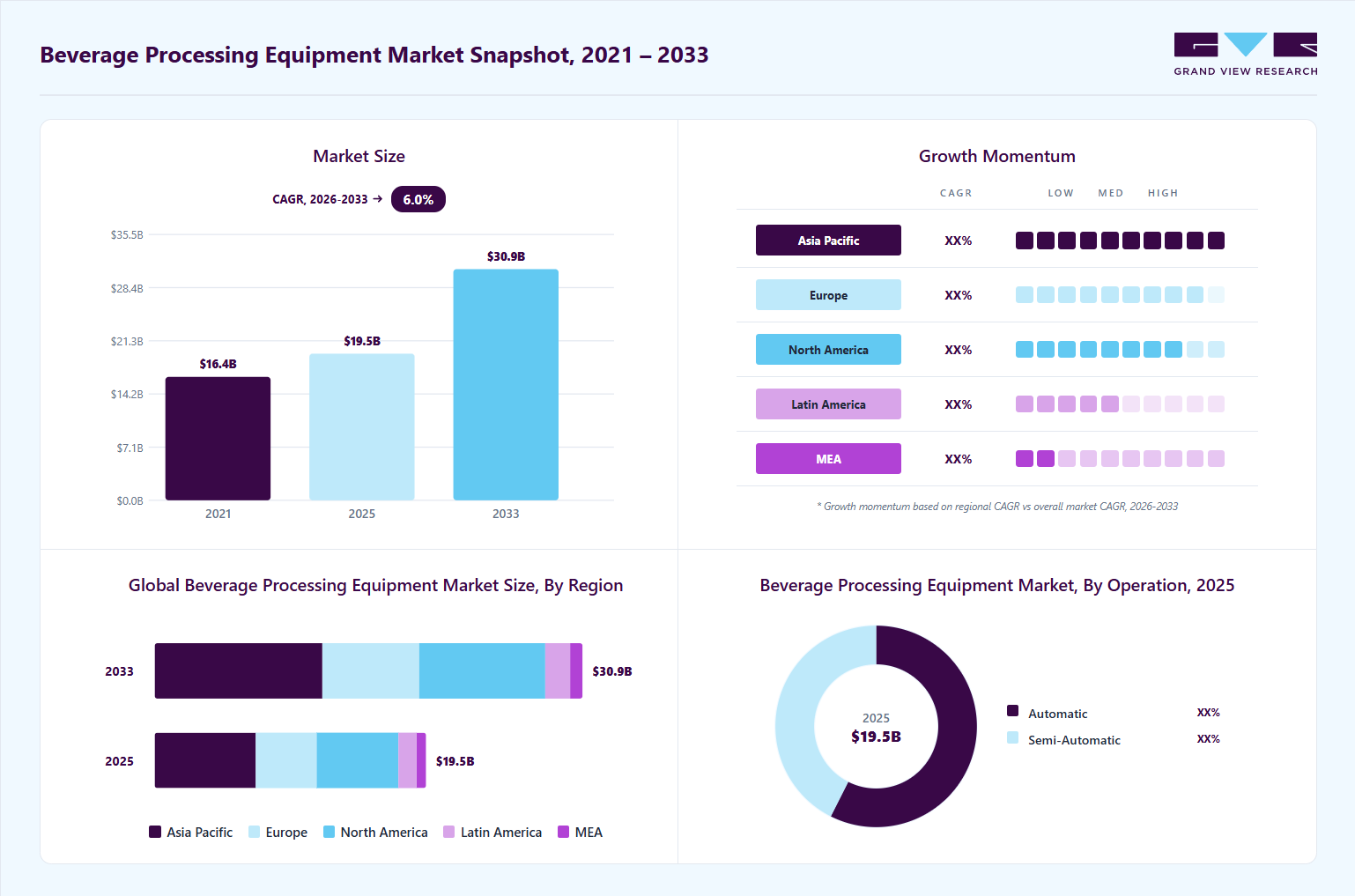
The global beverage processing equipment market size was valued at USD 29.5 billion in 2025 and is projected to grow from USD 31.0 billion in 2026 to USD 46.7 billion by 2033, at a CAGR of 6.0% from 2026 to 2033. The Asia Pacific dominated the global market with a revenue share of 37.6% in 2025. The market is driven by increasing demand for packaged and ready-to-drink beverages, rising consumer preference for functional drinks, and the growing adoption of automated, energy-efficient processing technologies.
 Source: Grand View Research, IR Documents, Primary Interviews, Paid DatabasesTo learn more about this report,
 Download Free Sample Report
 Key Market Trends & Insights
- By equipment type: The heat treatment equipment segment led the market with the largest revenue share of 24.9% in 2025.
- By operation: The automatic segment accounted for the largest market revenue share of 57.2% in 2025.
- By beverage type: The alcoholic drinks segment led the market with the largest revenue share of 20.2% in 2025.
Regional Highlights
- Largest regional market: Asia Pacific (37.6% revenue share, 2025)
- Fastest-growing regional market: Asia Pacific (highest CAGR, 2026-2033)
- By country: India accounted for the largest market revenue share in the Asia Pacific in 2025.
Market Size & Forecast
- Market size in 2025: USD 29.5 Billion
- Estimated market size in 2026: USD 31.0 Billion
- Projected market size by 2033: USD 46.7 Billion
- CAGR (2026-2033): 6.0%
Three ways to get this report
Buy it, customize it, or ask a question.Ask an Analyst
Analyst response in 1 business day
- AccessReport author, directly
- Reply timeWithin 1 working day
- No sales callDirect answer only
- FormatEmail reply
- CostFree, no cost
Get the Full Report
What the study covers
- FormatsPDF · Excel · Dashboard
- Timeline2026–2033 annual, 2025 base
- Coverage20+ countries, 5 regions
- Companies10+ key players profiled
Customize the Report
20% free customization
- IncludeCountries, segments, points
- TailorTo your product definition
- ExtendDeeper competitor detail
- OrA fully bespoke study
- Turnaround5–10 working days
Expanding beverage manufacturing activities, rapid urbanization, and continuous advancements in filtration, mixing, pasteurization, carbonation, and sterilization equipment are further supporting the market growth.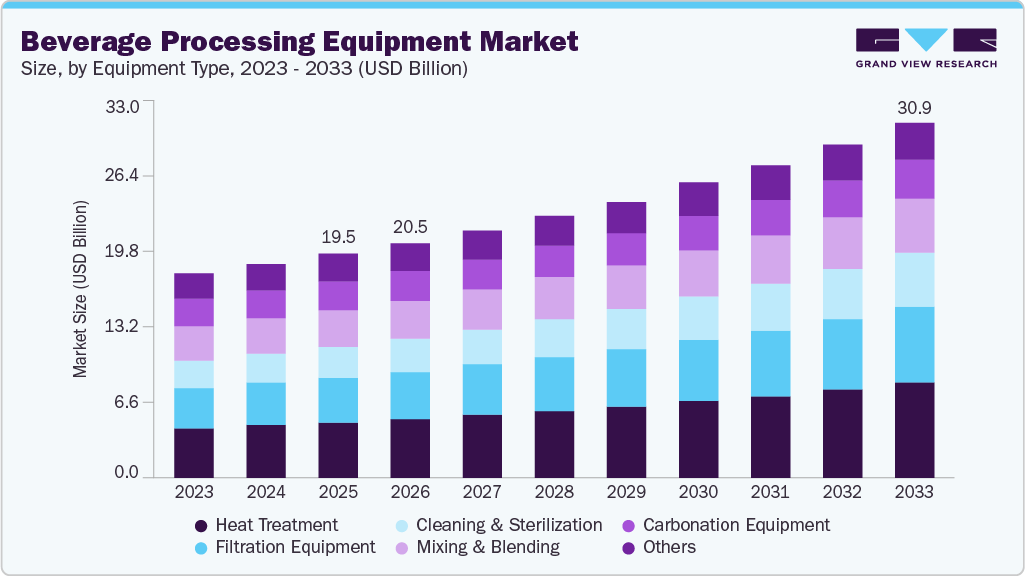 To learn more about this report, Download Free Sample Report
 The expansion of premium beverage categories, shorter product development cycles, and increasing demand for flexible production capabilities are driving manufacturers to adopt versatile processing equipment. Beverage companies are modernizing production facilities to improve processing accuracy, reduce water and energy consumption, and enhance overall manufacturing efficiency. The growing preference for customized beverage formulations and multi-product production lines is also driving demand for technologically advanced processing systems across the global market.
Market Dynamics
Growing consumption of packaged beverages, functional drinks, dairy alternatives, energy beverages, and ready-to-drink products is increasing demand for advanced beverage processing equipment across global markets. Beverage manufacturers are investing in modern processing technologies to improve production efficiency, maintain product consistency, and support high-volume manufacturing operations. Automation, digital monitoring systems, and energy-efficient equipment are also gaining importance as companies focus on reducing operational downtime, improving productivity, and meeting evolving consumer preferences. The carbonated beverage processing equipment market is experiencing steady demand due to the expansion of carbonated beverage production facilities and the growing introduction of new flavored, functional, and low-sugar drink formats worldwide.
High installation and operational costs associated with advanced beverage processing equipment remain a major restraint for the market. Small- and medium-sized beverage manufacturers often face challenges when investing in modern processing systems due to high procurement, maintenance, and upgrade costs. Integration of advanced automated equipment into existing production facilities can also be complex, as older manufacturing setups may require infrastructure modifications and additional technical support for smooth operation.
Market Concentration & Characteristics
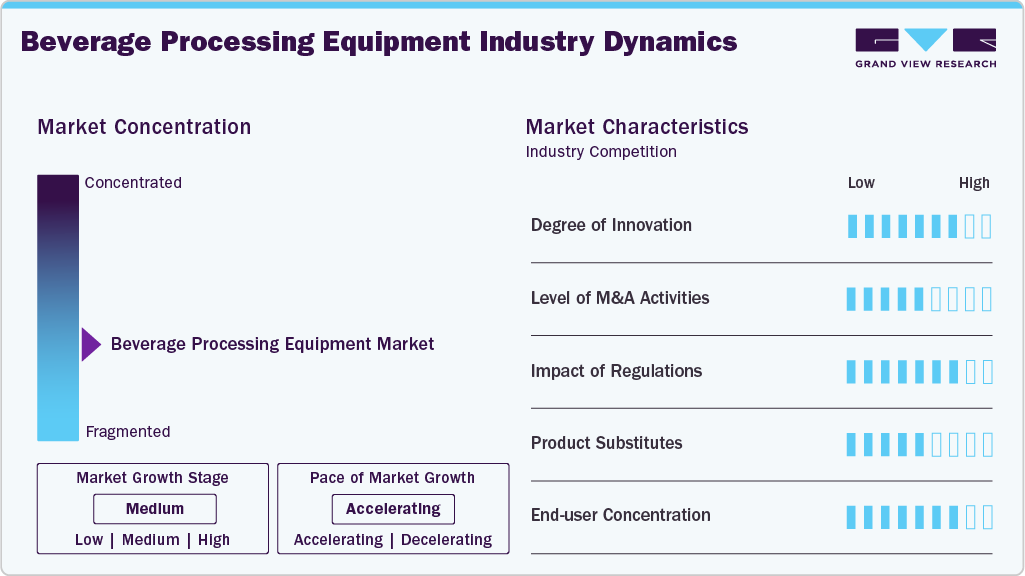
The global beverage processing equipment industry is relatively fragmented, with established multinational companies holding a considerable share of the industry through strong manufacturing capabilities, advanced technologies, and broad distribution networks. Competition remains strong as companies focus on product innovation, operational efficiency, equipment reliability, and long-term service support to strengthen their market position across developed and emerging economies.
The market is increasing adoption of automated and integrated processing systems that improve production efficiency, reduce labor dependency, and maintain consistent beverage quality. Rising production of packaged beverages, including dairy drinks, juices, bottled water, carbonated beverages, and alcoholic drinks, continues to support demand for advanced processing equipment. Beverage manufacturers are also emphasizing hygienic processing standards, flexible production systems, and sustainable operations to meet evolving consumer and regulatory requirements.
 To learn more about this report, Download Free Sample Report
 Continuous advancements in processing technologies are shaping the competitive landscape of the market. Advancements in carbonation technology, including precision carbonation systems and energy-efficient processing solutions, are creating opportunities in the carbonated beverage processing equipment market. Companies are investing in energy-efficient equipment, smart monitoring systems, and digitally connected manufacturing solutions to improve performance and reduce operational costs. Expansion activities, strategic collaborations, mergers, and acquisitions are further driving market growth as manufacturers strengthen their regional presence and expand their product offerings.
Equipment Type Insights
The heat treatment equipment segment led the market with the largest revenue share of 24.9% in 2025, due to its critical role in pasteurization, sterilization, and temperature management during beverage production. The equipment is widely used across dairy beverages, juices, carbonated drinks, and alcoholic beverages to maintain product stability, extend shelf life, and preserve taste and nutritional quality. Increasing large-scale beverage manufacturing activities are further supporting demand for heat treatment systems.
The cleaning & sterilization equipment segment is projected to register at the fastest CAGR during the forecast period, as beverage manufacturers increase emphasis on sanitary production environments and contamination control. Demand for automated cleaning systems, clean-in-place technologies, and advanced sterilization solutions is increasing across beverage processing facilities to improve operational efficiency and maintain strict hygiene standards. Expansion of packaged beverage production and regulatory requirements related to product safety and manufacturing standards are further contributing to segment growth.
Operation Insights
The automatic equipment segment accounted for the largest market share in 2025 and is projected to grow at the fastest CAGR during the forecast period, driven by the increasing adoption of advanced automation technologies across beverage manufacturing facilities. Beverage producers are investing in fully automated systems to improve production efficiency, enhance processing accuracy, reduce labor dependency, and support high-volume manufacturing operations. Growing focus on operational optimization and continuous production capabilities is further supporting segment growth.
The semi-automatic equipment segment is expected to register at a significant CAGR of 3.1% during the forecast period, driven by its cost-effectiveness and operational flexibility for small- and medium-scale beverage manufacturers. The segment continues to witness stable demand across facilities requiring controlled production operations with comparatively lower capital investment.
Beverage Type Insights
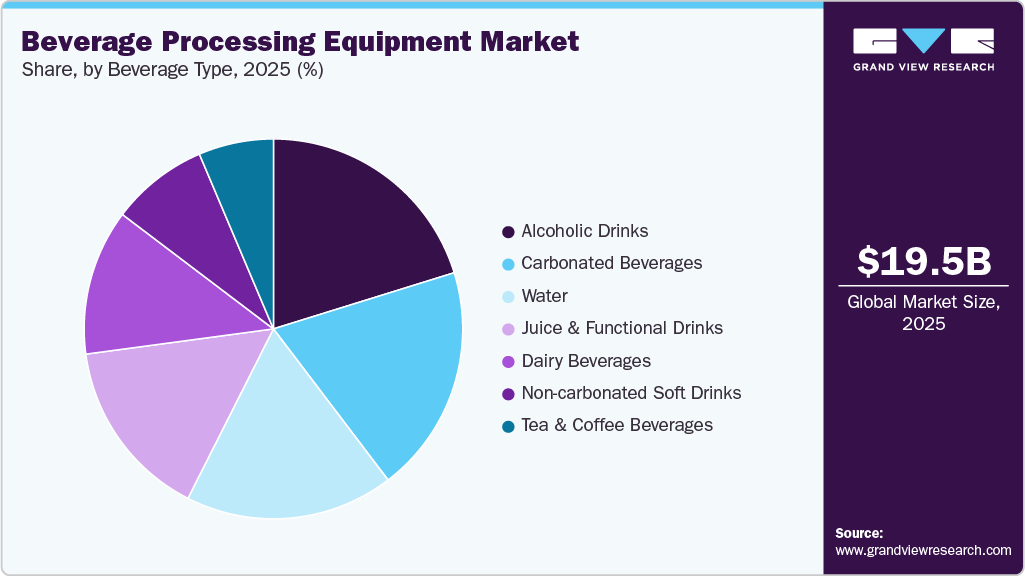
The alcoholic drinks segment accounted for the largest market revenue share in 2025, driven by strong worldwide production of beer, wine, and spirits. Continuous expansion of commercial brewing and beverage manufacturing facilities is increasing demand for advanced fermentation, cooling, blending, and bottling equipment across the segment.
 To learn more about this report, Download Free Sample Report
 The juice and functional drinks segment is anticipated to record at the fastest CAGR of 8.9% during the forecast period, with changing consumer preferences toward wellness-oriented beverages and natural ingredient formulations. Increasing product innovation in fortified drinks, protein beverages, and vitamin-enriched juices is accelerating the adoption of modern beverage processing systems.
Regional Insights
The beverage processing equipment market in the North America held a significant share in 2025, due to its established beverage manufacturing industry, high adoption of automation technologies, and increasing emphasis on production efficiency and product quality. Beverage manufacturers across the region are investing in advanced processing systems to improve operational performance, reduce downtime, and maintain consistent beverage production. Increasing demand for packaged beverages, functional drinks, dairy beverages, alcoholic beverages, and ready-to-drink products continues to support market growth across North America.
U.S. Beverage Processing Equipment Market Trends
The beverage processing equipment market in the U.S. represents a major market in the region, supported by high beverage consumption and continuous investments in manufacturing modernization. Beverage companies are increasingly adopting advanced filtration, pasteurization, mixing, and filling equipment to enhance productivity and support large-scale production requirements. The growing demand for energy drinks, flavored beverages, plant-based drinks, and premium beverage products, along with the increasing focus on sustainable, energy-efficient processing technologies, is further driving market expansion in the country.
Asia Pacific Beverage Processing Equipment Market Trends
Asia Pacific dominated the global beverage processing equipment market with the largest revenue share of 37.6% in 2025 and is projected to grow at the fastest CAGR during the forecast period, supported by expanding beverage manufacturing activities, rising urbanization, and increasing consumption of packaged beverages. Growing demand for dairy beverages, bottled water, carbonated drinks, juices, and functional beverages is encouraging manufacturers to invest in advanced processing technologies. The region is also witnessing growing adoption of automated and energy-efficient equipment to improve production capacity, operational efficiency, and product quality.
 To learn more about this report, Download Free Sample Report
 The beverage processing equipment market in China accounted for the largest market revenue share in the Asia Pacific in 2025, due to its large-scale beverage manufacturing industry and strong domestic consumption. Beverage producers in the country are continuously expanding production facilities and adopting advanced processing, filtration, and filling technologies to meet growing demand for packaged and ready-to-drink beverages.
The India beverage processing equipment market is driven by rising consumption of packaged beverages and changing consumer lifestyles, which are creating demand for functional drinks. The growing demand for fruit-based drinks, dairy beverages, energy drinks, and bottled water is driving the need for modern beverage processing equipment across the country. Increasing investments in manufacturing infrastructure, along with the adoption of automated, cost-efficient processing systems, are further contributing to market development in India.
Europe Beverage Processing Equipment Market Trends
The beverage processing equipment market in Europe is well-established, driven by its advanced beverage manufacturing industry and strong emphasis on product quality, hygiene, and production efficiency. Beverage manufacturers across the region are increasingly investing in automated, energy-efficient processing systems to improve operational efficiency while complying with stringent manufacturing and environmental regulations.
The Germany beverage processing equipment market holds a strong position in the European market, due to its advanced manufacturing sector and large beverage production industry. Companies are investing in advanced processing, filtration, and filling technologies to improve efficiency and support high-volume production requirements. Focusing on sustainable manufacturing practices and smart factory technologies is further contributing to market growth in the country.
The beverage processing equipment market in France is recording stable growth, driven by rising demand for dairy beverages, bottled water, juices, wine, and premium beverage products. Beverage manufacturers are focusing on improving production flexibility, reducing energy consumption, and maintaining product quality through modern processing technologies. Investments in automated equipment and modernization of beverage production facilities are also contributing to market expansion in France.
Middle East & Africa Beverage Processing Equipment Market Trends
The beverage processing equipment market in the Middle East & Africa is expanding rapidly due to rising consumption of packaged and ready-to-drink beverages, urban population growth, and the expansion of beverage manufacturing activities across the region. Beverage producers are adopting modern processing technologies to improve production efficiency, operational performance, and beverage quality. Demand for bottled water, dairy beverages, juices, carbonated drinks, and energy beverages continues to support the adoption of advanced beverage processing equipment.
The Saudi Arabia beverage processing equipment market holds a strong position in the regional market, driven by increasing investments in beverage production facilities and growing demand for packaged beverages. Beverage manufacturers in the country are expanding production capacity and adopting automated systems for processing, carbonation, filtration, and sterilization to improve manufacturing efficiency. The increasing emphasis on energy-efficient operations and the modernization of beverage processing infrastructure are further supporting market growth in Saudi Arabia.
Latin America Beverage Processing Equipment Market Trends
The beverage processing equipment market in Latin America is growing with the expansion of beverage manufacturing activities and increasing consumer demand for packaged and convenience beverages. Companies across the region are upgrading production facilities with modern processing technologies to improve manufacturing speed, product shelf life, and operational efficiency. The consumption of bottled water, flavored drinks, juices, dairy beverages, and alcoholic products continues to drive demand for advanced beverage processing systems.
The Brazil beverage processing equipment market remains one of the significant markets in the region with strong production and consumption of soft drinks, beer, fruit beverages, and bottled water. Beverage manufacturers are modernizing processing plants through the adoption of automated filtration, blending, cooling, and filling equipment to enhance production output and maintain quality standards. Focusing on reducing production costs, improving energy efficiency, and expanding domestic beverage manufacturing capacity further supports market growth in Brazil.
Key Beverage Processing Equipment Company Insights
Some of the key players operating in the market include GEA Group AG and Tetra Pak International S.A, among others.
-
GEA Group is a Germany-based multinational engineering company and one of the world’s largest suppliers of systems and process technology for the food, beverage, dairy, pharmaceutical, and chemical industries. Headquartered in Düsseldorf, the company provides machinery, plants, advanced process technologies, components, and comprehensive services that improve production efficiency and sustainability across industrial operations. Its portfolio includes separators, homogenizers, heat exchangers, valves, pumps, refrigeration systems, and beverage processing solutions, serving customers in more than 150 countries.
-
Tetra Pak International S.A. is a Switzerland-based multinational food processing and packaging company and one of the world’s prominent suppliers of integrated solutions for the dairy, beverage, food, and liquid processing industries. Founded in 1951 and part of the Tetra Laval Group, the company provides processing equipment, packaging systems, filling machines, automation solutions, and technical services for customers across more than 160 countries. Its portfolio covers beverage preparation systems, homogenizers, heat exchangers, separators, filtration systems, pasteurizers, and complete production lines, as well as its well-known aseptic carton packaging solutions.
Key Beverage Processing Equipment Companies:
The following key companies have been profiled for this study on the beverage processing equipment market.
- GEA Group AG
- Tetra Pak International S.A.
- Krones AG
- SPX FLOW (ITT Inc)
- Alfa Laval AB
- KHS GmbH
- John Bean Technologies Corporation (JBT)
- Sidel Group
- Bucher Industries AG
- Pentair plc
- Bühler Group
- Praj Industries Ltd.
- ProMach Inc.
- CFT Group
- STM SP. Z O. O.
Competitive Benchmarking
Operating Strategies
Competitive Edge
Weaknesses
Mature Players: GEA Group AG; Tetra Pak International S.A.
- These companies continuously strengthen their market leadership through product innovation, automation upgrades, digital factory solutions, and expansion of after-sales service capabilities across beverage processing and packaging lines.
- They focus on strategic acquisitions, technology partnerships, and global manufacturing optimization to maintain strong positions across filling, processing, aseptic systems, filtration, and end-of-line solutions.
- These players maintain a strong global market presence supported by established manufacturing facilities, direct subsidiaries, and extensive dealer and service networks across major beverage-producing regions.
- Their advantages lie in advanced engineering, strong process integration capabilities, and high equipment precision across dairy, carbonated drinks, alcoholic beverages, juices, and bottled water applications.
- High capital expenditure requirements for research, automation, sustainability compliance, and advanced manufacturing increase operating costs and result in premium machine pricing.
- Their large global operations create greater exposure to raw material cost fluctuations, economic slowdowns, labor cost inflation, and strict food safety and environmental regulations.
Emerging Players: Bucher Industries AG; Bühler Group
- These companies focus on strengthening their position through specialized processing expertise, selective automation upgrades, and expansion across high-growth beverage segments.
- They emphasize strategic regional expansion, technology partnerships, and flexible customization to serve both large beverage producers and mid-sized manufacturers with application-specific processing requirements.
- Strong technical specialization in niche processing areas such as evaporation, filtration, fermentation, water treatment, and filling systems enables them to maintain strong customer loyalty and application-specific leadership.
- Greater operational flexibility, faster project execution, and localized manufacturing support improve responsiveness while offering competitively priced solutions across regional and export markets.
- Compared to mature leaders, some players have relatively narrower end-to-end beverage line integration capabilities, particularly in fully turnkey local-scale projects.
- Competition remains intense from larger multinational players with stronger installed bases, broader service networks, and stronger long-term customer relationships across major beverage-producing regions.
Recent Developments
-
In April 2025, Alfa Laval launched a new heat treatment solution for oat-based beverages using its Hygienic WideGap plate heat exchanger (HL8-WG), designed to improve processing efficiency for high-fiber plant-based drinks. The technology helps reduce fouling, enhances cleanability, and supports longer production runs. It also improves energy efficiency while lowering water and chemical consumption during cleaning, resulting in more stable operations and higher equipment uptime in oat beverage production.
-
In May 2024, Omnia Technologies completed the acquisition of ACMI, SACMI Beverage, and SACMI Labeling to strengthen its position in the beverage processing and packaging automation space. The acquisition expands its capabilities in processing, high-speed bottling, labeling, and end-of-line systems, enabling the company to offer more integrated and efficient production line solutions for the global beverage industry. This move is expected to enhance its technology portfolio and improve its competitiveness in automated beverage manufacturing solutions.
Beverage Processing Equipment Market Report Scope
Report Attribute
Details
Market size in 2025
USD 29.5 billion
Estimated Market size in 2026
USD 31.0 billion
Projected Market size by 2033
USD 46.7 billion
Growth rate
CAGR of 6.0% from 2026 to 2033
Base year for estimation
2025
Historical data
2021 - 2024
Forecast period
2026 - 2033
Quantitative units
Revenue in USD million/billion, and CAGR from 2026 to 2033
Report coverage
Revenue forecast, company market position analysis, competitive landscape, growth factors, and trends
Segments covered
Equipment type, operation, beverage type, region
Regional scope
North America; Europe; Asia Pacific; Latin America; Middle East & Africa
Country scope
U.S.; Canada; Mexico; Germany; UK; Italy; Spain; France; China; Japan; India; Australia; South Korea; Brazil; Argentina; Saudi Arabia; UAE; South Africa
Key companies profiled
GEA Group AG; Tetra Pak International S.A.; Krones AG; SPX FLOW (ITT Inc.); Alfa Laval AB; KHS GmbH; John Bean Technologies Corporation (JBT); Sidel Group; Bucher Industries AG; Pentair plc; Bühler Group; Praj Industries Ltd.; ProMach Inc.; CFT Group; STM SP. Z O. O.
Customization scope
Free report customization (equivalent up to 8 analysts working days) with purchase. Addition or alteration to country, regional & segment scope.
Pricing and purchase options
Avail customized purchase options to meet your exact research needs. Explore purchase options
Global Beverage Processing Equipment Market Report Segmentation
This report forecasts revenue growth at global, regional & country levels and provides an analysis on the industry trends in each of the sub-segments from 2021 to 2033. For the study, Grand View Research has segmented the global beverage processing equipment market report based on the equipment type, operation, beverage type, and region:
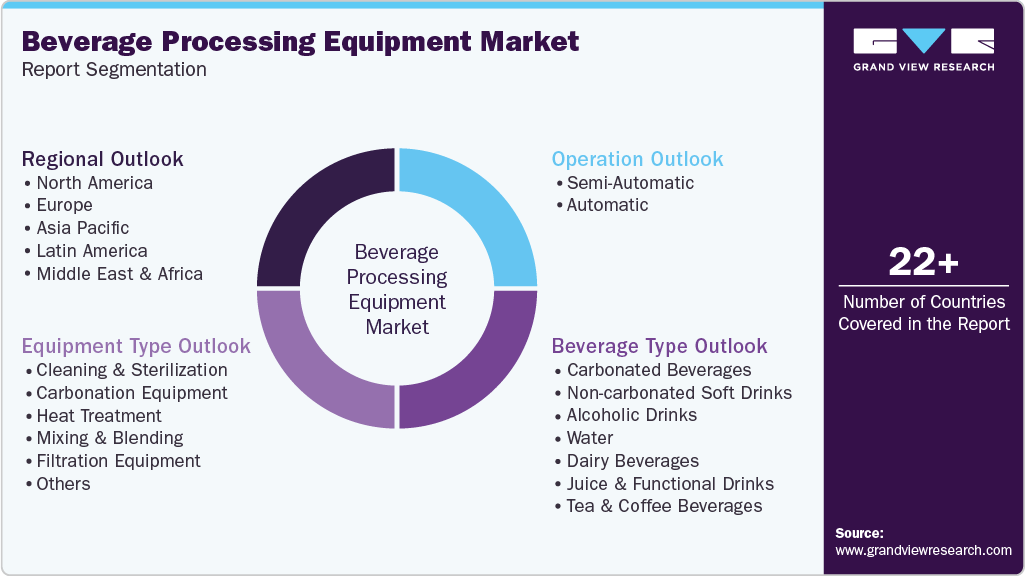 To learn more about this report, Download Free Sample Report
 -
Equipment Type Outlook (Revenue, USD Billion, 2021 - 2033)
-
Cleaning & Sterilization
-
Carbonation Equipment
-
Heat Treatment
-
Mixing & Blending
-
Filtration Equipment
-
Others
-
-
Operation Outlook (Revenue, USD Billion, 2021 - 2033)
-
Semi-Automatic
-
Automatic
-
-
Beverage Type Outlook (Revenue, USD Billion, 2021 - 2033)
-
Carbonated Beverages
-
Non-carbonated Soft Drinks
-
Alcoholic Drinks
-
Water
-
Dairy Beverages
-
Juice & Functional Drinks
-
Tea & Coffee Beverages
-
-
Regional Outlook (Revenue, USD Billion, 2021 - 2033)
-
North America
-
U.S.
-
Canada
-
Mexico
-
-
Europe
-
Germany
-
France
-
UK
-
Spain
-
Italy
-
-
Asia Pacific
-
China
-
India
-
Japan
-
South Korea
-
Australia
-
-
Latin America
-
Brazil
-
Argentina
-
-
Middle East & Africa
-
Saudi Arabia
-
UAE
-
South Africa
-
-
Delivered Customizations
This report has been delivered with the following In-depth customizations
Client Request
Customization Delivered
Value Adds
Regional Segmentation
The regional segmentation provides a detailed country- and region-level analysis of the global beverage processing equipment market, covering differences in beverage consumption patterns, manufacturing capacity expansion, automation adoption, and investments in beverage processing infrastructure across major regions. It highlights region-wise demand trends, production growth, and modernization activities influencing the adoption of beverage processing equipment.
This helps the client identify high-growth regional markets and areas where beverage manufacturing investments are increasing. It supports strategic planning for regional expansion, distribution network development, sales allocation, and investment decisions based on actual beverage production and processing demand trends.
Competitive Benchmarking
The competitive benchmarking customization provides a comparative analysis of beverage processing equipment manufacturers based on processing technology capabilities, automation expertise, product portfolio strength, operational efficiency, and strategic focus areas such as energy-efficient systems, hygienic processing solutions, and smart manufacturing technologies. It offers insights into how major players differentiate themselves across beverage applications and production requirements.
This enables the client to better understand the competitive landscape and identify commercially viable differentiation opportunities. It supports strategic decision-making related to product positioning, pricing strategies, partnerships, and customer targeting by identifying areas where leading companies hold strong market positions and where growth opportunities remain underserved.
Opportunity Assessment
The opportunity assessment customization identifies high-growth revenue opportunities by analyzing rapidly expanding beverage categories, increasing automation demand, and rising investments in advanced beverage manufacturing technologies.
This allows the client to focus resources on segments with strong commercial potential and long-term growth opportunities. It improves strategic planning for production expansion, technology investments, and market entry initiatives by identifying scalable and sustainable growth areas within the global beverage processing equipment market.
Frequently Asked Questions About This Report
The global beverage processing equipment market is expected to grow at a compound annual growth rate of 6.0% from 2026 to 2033 to reach USD 46.7 billion by 2033.
The global beverage processing equipment market size was valued at USD 29.5 billion in 2025 and is expected to reach USD 31.0 billion in 2026.
Asia Pacific dominated the global beverage processing equipment market with the largest revenue share of 37.6% in 2025.
Asia Pacific is the fastest-growing regional market during the forecast period.
The heat treatment equipment segment led the market with the largest revenue share of 24.9% in 2025.
The beverage processing equipment market is driven by rising demand for packaged and ready-to-drink beverages, along with increasing adoption of automated, energy-efficient, and hygienic processing systems to improve efficiency and meet stringent food safety regulations.
The automatic segment accounted for the largest market revenue share of 57.2% in 2025.
The alcoholic drinks segment led the market with the largest revenue share of 20.2% in 2025.
Some of the key players operating in the beverage processing equipment include GEA Group AG, Tetra Pak International S.A., Krones AG, SPX FLOW, (ITT Inc), Alfa Laval AB, KHS GmbH, John Bean Technologies Corporation (JBT), Sidel Group, Bucher Industries AG, Pentair plc, Bühler Group, Praj Industries Ltd., ProMach Inc., CFT Group, and STM SP. Z O. O.
About the Author(s)
Advanced Interior Materials Research Team
Advanced Materials · Advanced Interior MaterialsThis report was authored by the advanced interior materials research team at Grand View Research - comprising two research analysts, one senior research analyst, and one industry expert - with specialized expertise in the advanced interior materials segment of the advanced materials industry. All findings are based on proprietary advanced materials databases, executive interviews, and regulatory analysis, subject to internal peer review prior to publication.
Last Updated:
Speak to Analyst

Customize this report to your needs - add regions, segments, or data points, with 20% free customization.
Or view our licence options:


ISO 9001:2015 & 27001:2022 Certified
We are GDPR and CCPA compliant! Your transaction & personal information is safe and secure. For more details, please read our privacy policy.


