
- Home
- »
- Plastics, Polymers & Resins
- »
-
Capacitor Films Market Size And Share Report, 2026-2033GVR Report cover
![Capacitor Films Market (2026 - 2033)Report]()
Capacitor Films Market (2026 - 2033)
Size, Share & Trends Analysis Report By Dielectric Material (Polypropylene, Polyester), By Application (Automotive, Consumer Electronics, Renewable Energy, Industrial Equipment), By Region, And Segment Forecasts
Market Size, 2025
$3.6BMarket Estimate, 2026
$3.7BMarket Forecast, 2033
$5.4BCAGR, 2026–2033
5.5%Capacitor Films Market Summary
The global capacitor films market size was valued at USD 3.6 billion in 2025 and is projected to grow from USD 3.7 billion in 2026 to USD 5.4 billion by 2033, at a CAGR of 5.5% from 2026 to 2033. The market in Asia Pacific dominated with a revenue share of 42.0% in 2025. The growing demand for consumer electronics such as smartphones, laptops, and TVs is driving the need for capacitor films, as they play a role in energy storage and signal filtering.
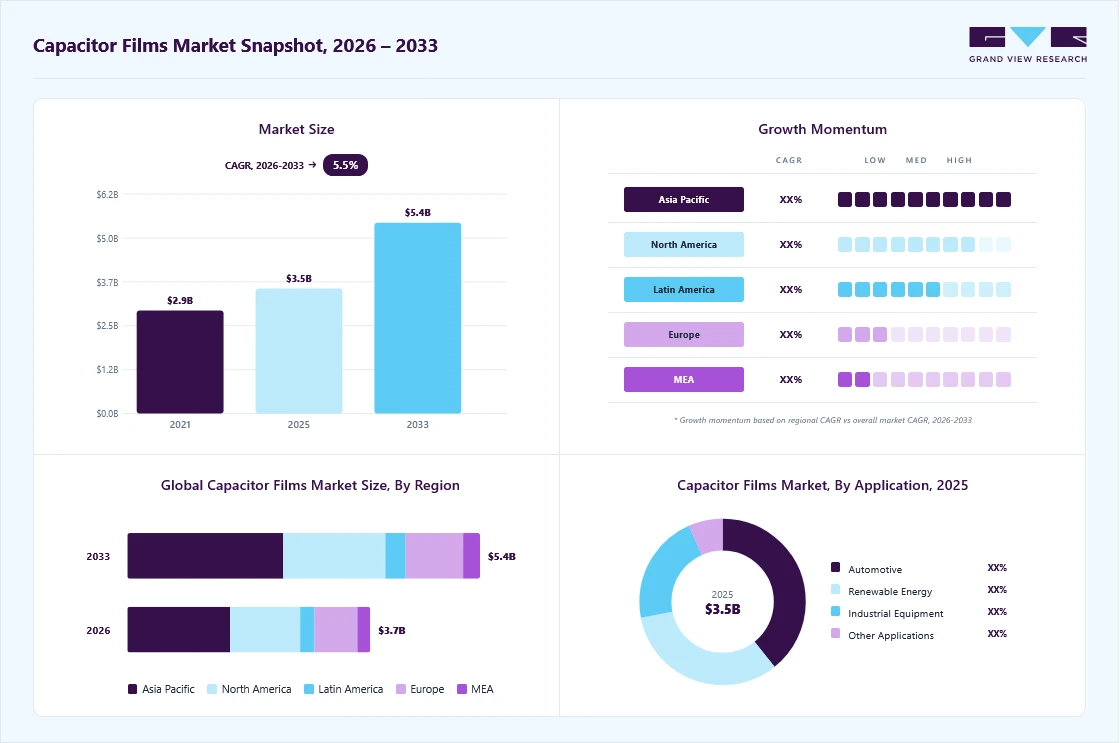 Source: Grand View Research, IR Documents, Primary Interviews, Paid DatabasesTo learn more about this report,
 Download Free Sample Report
 Key Market Trends & Insights
- By dielectric material: Polypropylene segment held the largest market share of 53.7% in 2025.
- By application: Consumer electronics segment held the largest market share of 34.1% in 2025.
Regional Highlights
- Largest regional market: Asia Pacific (42.0% revenue share, 2025)
- By country: China held the largest market share in 2025
Market Size & Forecast
- Market size in 2025: USD 3.6 Billion
- Estimated market size in 2026: USD 3.7 Billion
- Projected market size by 2033: USD 5.4 Billion
- CAGR (2026-2033): 5.5%
Three ways to get this report
Buy it, customize it, or ask a question.Ask an Analyst
A direct answer, usually in 1 working day
- AccessReport author, directly
- Reply timeWithin 1 working day
- No sales callDirect answer only
- FormatEmail reply
- CostFree, no cost
Get the Full Report
What the study covers
- FormatsPDF · Excel · Dashboard
- Timeline2026–2033 annual, 2025 base
- Coverage20+ countries, 5 regions
- Companies10+ key players profiled
Customize the Report
20% free customization
- IncludeCountries, segments, points
- TailorTo your product definition
- ExtendDeeper competitor detail
- OrA fully bespoke study
- Turnaround5–10 working days
Their lightweight, compact design makes them ideal for miniaturized electronic devices. A notable trend redefining the market is their accelerated adoption in cutting-edge power electronic systems, particularly in electric vehicles (EVs), renewable energy infrastructure, and industrial automation. Capacitor films, especially polypropylene-based variants, are being engineered for higher thermal stability, dielectric strength, and self-healing properties to meet the evolving requirements of high-voltage, high-frequency applications.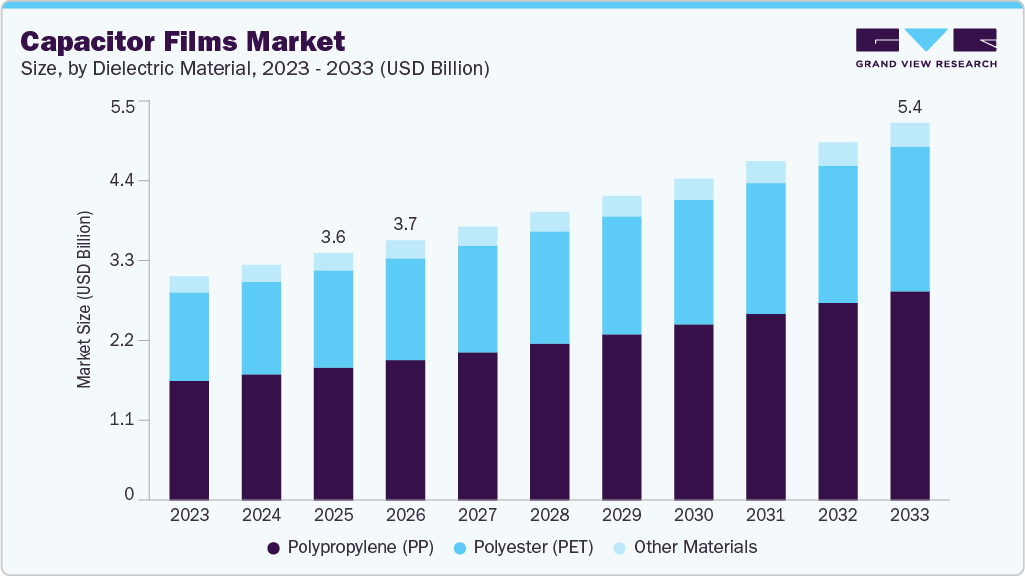 To learn more about this report, Download Free Sample Report
 As silicon carbide (SiC) and gallium nitride (GaN)-based power semiconductors become more prevalent, the demand for film capacitors that can operate in compact, high-efficiency systems has intensified. Manufacturers are now investing in film technologies that enable smaller footprints and enhanced performance longevity, aligning with the miniaturization and sustainability trends in power systems design.
Drivers, Opportunities & Restraints
The capacitor films industry is significantly driven by the robust expansion of the electric mobility ecosystem, encompassing not just electric passenger cars but also commercial EVs, two-wheelers, and electric public transport infrastructure. Capacitor films are critical in power conditioning and battery management systems, where they support stable energy transfer, voltage smoothing, and electromagnetic interference (EMI) suppression.
An emerging opportunity lies in the localization and vertical integration of capacitor film production, particularly across the Asia Pacific and Eastern Europe. As geopolitical tensions and global supply chain disruptions challenge the availability of high-grade polymer films and metallized substrates, local players are exploring backward integration to control quality and ensure supply continuity. This shift not only enhances regional competitiveness but also enables customization of film capacitors to suit local application needs across industrial, consumer electronics, and automotive sectors.
A key restraint to market growth is the high sensitivity of capacitor film production to fluctuations in raw material prices, particularly petroleum-based polymers like polypropylene and polyethylene terephthalate (PET). The unpredictable pricing environment, driven by crude oil dynamics and supply chain imbalances, often compresses margins and hinders long-term procurement planning.
Market Concentration & Characteristics
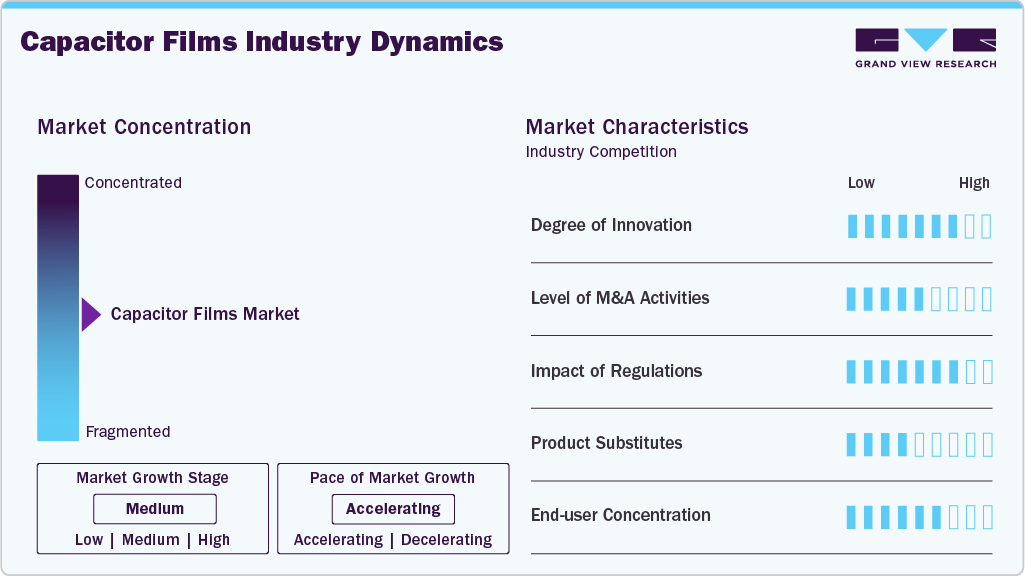
The market growth stage of the capacitor films industry is medium, and the pace is accelerating. The market exhibits a significant level of market concentration, with key players dominating the industry landscape. Major companies like JPFL Films, Cosmo Films, Toray Industries, Mitsubishi Shindoh Co., Ltd., TDK Corporation, Panasonic Corporation, AVX Corporation, Terichem Tervakoski, a.s., Xiamen Hongfa Electroacoustic Co., Ltd., and others play a significant role in shaping the market dynamics. These leading players often drive innovation within the market, introducing new products, technologies, and applications to meet evolving industry demands.
The capacitor films industry exhibits a moderately high degree of innovation, particularly driven by the push for ultra-thin, high-temperature-resistant films tailored for compact, high-voltage systems. Innovations are centered around nanolayer extrusion, metallization processes, and polymer blends that enhance dielectric stability and lifespan. Companies are also exploring recyclable and bio-based film alternatives to align with global sustainability mandates, reflecting a growing convergence between material science and environmental performance.
 To learn more about this report, Download Free Sample Report
 While ceramic capacitors and electrolytic capacitors present viable substitutes in certain low-frequency or low-cost applications, they lack the thermal resilience, self-healing properties, and long operational life of film capacitors. In high-reliability segments such as EV powertrains, solar inverters, and aerospace systems, the substitution threat is minimal due to the performance-critical nature of film technology. That said, advancements in multilayer ceramics (MLCCs) and hybrid capacitor designs are being closely monitored as emerging alternatives in high-density, space-constrained environments.
Dielectric Material Insights
Polypropylene (PP) dominated the market in the dielectric material segment, accounting for 53.7% of revenue in 2025. The rising preference for polypropylene (PP) films in high-frequency power electronics is being fueled by their exceptional dielectric strength, low dissipation factor, and superior thermal resistance. As inverter-based systems in electric vehicles, industrial drives, and renewable energy applications become more demanding, PP films are increasingly seen as the gold standard for reliability and stability under harsh operating conditions.
The polyester (PET) segment is anticipated to grow at a significant CAGR of 5.1% over the forecast period, driven by the growing penetration of low-cost, general-purpose capacitors in mass-market electronics and lighting systems. PET films offer balanced mechanical and dielectric properties and are particularly attractive for consumer applications requiring moderate voltage and temperature tolerances.
Application Insights
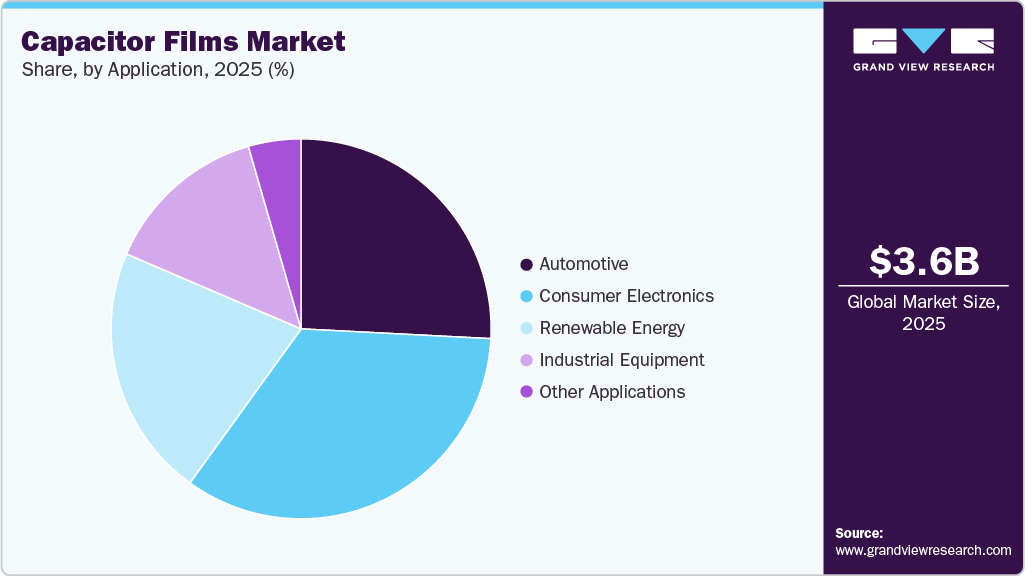
Consumer electronics dominated the market across the application segmentation, accounting for 34.1% of revenue in 2025. The proliferation of compact, high-performance consumer electronics, such as smartphones, tablets, wearables, and gaming consoles, is a key driver behind the increasing use of capacitor films. As device manufacturers push for thinner form factors with higher processing capabilities, there’s a growing demand for film capacitors that offer superior reliability, low ESR (Equivalent Series Resistance), and thermal stability within constrained spaces.
 To learn more about this report, Download Free Sample Report
 The renewable energy segment is projected to witness the fastest CAGR of 6.5% through the forecast period. The sector is driving strong demand for capacitor films, particularly in solar inverters, wind turbine converters, and grid interconnection systems. As energy systems become more decentralized and power conversion efficiency grows in importance, film capacitors are being leveraged for their low inductance and long-term stability.
Regional Insights
Asia Pacific dominated the global capacitor films market and accounted for the largest revenue share of 42.0% in 2025. Asia Pacific continues to lead global growth in capacitor films due to the rapid expansion of its electronics manufacturing base and the accelerating adoption of industrial automation.
 To learn more about this report, Download Free Sample Report
 China Capacitor Films Market Trends
The capacitor films market in China is expected to grow at a substantial CAGR of 6.4% from 2026 to 2033. The capacitor films market in China is being aggressively driven by state-backed initiatives to dominate electric mobility and renewable energy technologies. The country’s leadership in EV manufacturing directly boosts demand for high-performance film capacitors used in traction inverters and onboard electronics. Simultaneously, China's investments in solar and wind energy, combined with a maturing ultra-high-voltage (UHV) transmission network, are creating consistent demand for large-format capacitor films with high dielectric endurance.
North America Capacitor Films Market Trends
The capacitor films market in North America is expected to grow significantly. The transition toward grid modernization and decentralized energy storage is a primary driver for capacitor films. With increasing investment in utility-scale battery storage and smart grid infrastructure, especially across Canada and select U.S. states, film capacitors are vital for managing power quality and stabilizing frequency response. This trend is further reinforced by incentives under climate-driven legislation like the U.S. Inflation Reduction Act, which accelerates demand for durable and high-efficiency capacitor components.
The U.S. capacitor films market is being specifically propelled by the rapid scaling of domestic electric vehicle production and associated charging infrastructure. Major automakers and EV startups are localizing battery and power electronics manufacturing, requiring advanced film capacitors in DC link and inverter systems. Moreover, the Department of Energy’s emphasis on reshoring critical components in the EV supply chain is creating strategic opportunities for capacitor film producers to establish local manufacturing footprints.
Europe Capacitor Films Market Trends
The capacitor films market in Europe is being driven by stringent regulatory pressure to decarbonize its transport and energy sectors. The European Green Deal and the Fit for 55 initiatives are pushing automakers and renewable energy developers to adopt high-efficiency electrical systems that rely heavily on film capacitors for their reliability and low-loss characteristics.
Key Capacitor Films Company Insights
The market is highly competitive, with several key players dominating the landscape. Major companies include JPFL Films, Cosmo Films, Toray Industries, Mitsubishi Shindoh Co., Ltd., TDK Corporation, Panasonic Corporation, AVX Corporation, Terichem Tervakoski, a.s., and Xiamen Hongfa Electroacoustic Co., Ltd. The market is characterized by a competitive landscape with several key players driving innovation and market growth. Major companies in this sector are investing heavily in research and development to enhance the performance, cost-effectiveness, and sustainability of their products.
Key Capacitor Films Companies:
The following key companies have been profiled for this study on the capacitor films market
- JPFL Films
- Cosmo Films
- Toray Industries
- Mitsubishi Shindoh Co., Ltd.
- TDK Corporation
- Panasonic Corporation
- AVX Corporation
- Terichem Tervakoski, a.s.
- Xiamen Hongfa Electroacoustic Co., Ltd.
Recent Developments
-
In November 2025, Sinolong New Materials Co., Ltd. introduced its latest generation of premium BOPP capacitor film products, referred to as long plastic high-performance capacitor film, to the international market. This innovative film is distinguished by its ability to withstand high temperatures, its voltage resilience, minimal dielectric losses, and effective self-healing properties, making it suitable for a wide range of applications in industries such as new energy vehicles, photovoltaics, wind energy, household appliances, and electrical grids.
-
In November 2025, Peak Nano obtained two US patents that enable American manufacturers to enhance high-performance capacitor film technology. This innovation addresses supply chain weaknesses while enhancing performance in power grids, defense, and new fusion energy applications.
Capacitor Films Market Report Scope
Report Attribute
Details
Market size in 2025
USD 3.6 billion
Estimated market size in 2026
USD 3.7 billion
Projected market size by 2033
USD 5.4 billion
Growth rate
CAGR of 5.5% from 2026 to 2033
Historical data
2021 - 2024
Forecast period
2026 - 2033
Quantitative units
Revenue in USD million/billion, volume in kilotons, and CAGR from 2026 to 2033
Report coverage
Revenue forecast, competitive landscape, growth factors, and trends
Segments covered
Dielectric material, application, region
Regional scope
North America; Europe; Asia Pacific; Latin America; MEA
Country Scope
U.S., Canada; Mexico; Germany; UK; France; Italy; Spain, China; India; Japan; South Korea; Australia; Brazil; Argentina; Saudi Arabia; South Africa; UAE
Key companies profiled
JPFL Films; Cosmo Films; Toray Industries; Mitsubishi Shindoh Co., Ltd.; TDK Corporation; Panasonic Corporation; AVX Corporation; Terichem Tervakoski, a.s.; Xiamen Hongfa Electroacoustic Co., Ltd.
Customization scope
Free report customization (equivalent up to 8 analyst’s working days) with purchase. Addition or alteration to country, regional & segment scope
Pricing and purchase options
Avail customized purchase options to meet your exact research needs. Explore purchase options
Global Capacitor Films Market Report Segmentation
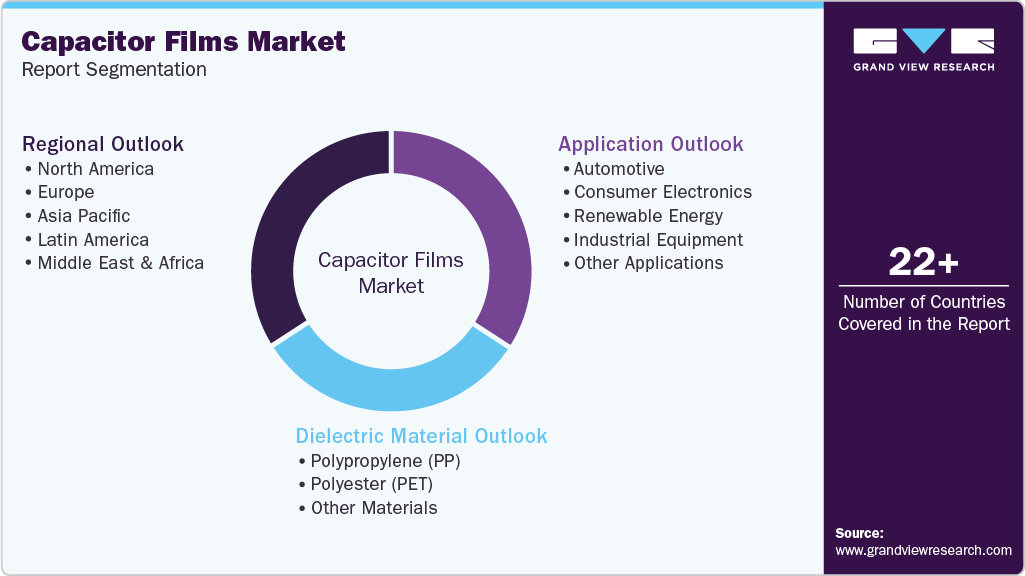
This report forecasts revenue growth at the global, regional, and country levels and provides an analysis of the latest industry trends in each of the sub-segments from 2021 to 2033. For this study, Grand View Research has segmented the global capacitor films market report based on dielectric material, application, and region:
 To learn more about this report, Download Free Sample Report
 -
Dielectric Material Outlook (Revenue, USD Million, Volume, Kilotons, 2021 - 2033)
-
Polypropylene (PP)
-
Polyester (PET)
-
Other Materials
-
-
Application Outlook (Revenue, USD Million, Volume, Kilotons, 2021 - 2033)
-
Automotive
-
Consumer Electronics
-
Renewable Energy
-
Industrial Equipment
-
Other Applications
-
-
Regional Outlook (Revenue, USD Million, Volume, Kilotons, 2021 - 2033)
-
North America
-
U.S.
-
Canada
-
Mexico
-
-
Europe
-
Germany
-
UK
-
France
-
Italy
-
Spain
-
-
Asia Pacific
-
China
-
India
-
Japan
-
South Korea
-
Australia
-
-
Latin America
-
Brazil
-
Argentina
-
-
Middle East & Africa
-
Saudi Arabia
-
South Africa
-
UAE
-
-
Frequently Asked Questions About This Report
Key players include JPFL Films, Cosmo Films, Toray Industries, Mitsubishi Shindoh Co., Ltd., TDK Corporation, Panasonic Corporation, AVX Corporation, Terichem Tervakoski, a.s., and Xiamen Hongfa Electroacoustic Co., Ltd..
Growing demand for consumer electronics like smartphones, laptops, and TVs is driving the need for capacitor films due to their role in energy storage and signal filtering. Their lightweight, compact design makes them ideal for miniaturized electronic devices.
The global capacitor films market is expected to grow at a CAGR of 5.5% from 2026 to 2033, reaching USD 5.4 billion.
The polypropylene dielectric material held the largest share (over 53.7%) in 2025.
The consumer electronics segment led with a 34.1% revenue share in 2025 and renewable energy is the fastest-growing.
The Asia Pacific region dominated with a 42.0% revenue share in 2025.
The global capacitor films market size was valued at USD 3.6 billion in 2025 and is estimated at USD 3.7 billion for 2026.
About the Author(s)
Plastics, Polymers & Resins Research Team
Bulk Chemicals · Plastics, Polymers & ResinsThis report was authored by the plastics, polymers & resins research team at Grand View Research - comprising two research analysts, one senior research analyst, and one industry expert - with specialized expertise in the plastics, polymers & resins segment of the bulk chemicals industry. All findings are based on proprietary bulk chemicals databases, executive interviews, and regulatory analysis, subject to internal peer review prior to publication.
Last Updated:
Speak to Analyst


Customize this report to your needs - add regions, segments, or data points, with 20% free customization.
Or view our licence options:


ISO 9001:2015 & 27001:2022 Certified
We are GDPR and CCPA compliant! Your transaction & personal information is safe and secure. For more details, please read our privacy policy.


