
- Home
- »
- Biotechnology
- »
-
Cell Culture Supplements Market Size, Industry Report, 2033GVR Report cover
![Cell Culture Supplements Market Size, Share & Trends Report]()
Cell Culture Supplements Market (2026 - 2033) Size, Share & Trends Analysis Report By Product (Protein-Based & Recombinant, Chemically Defined), By Application (Cell & Gene Therapy, Drug Discovery), By End Use, By Region, And Segment Forecasts
- Report ID: GVR-4-68040-692-7
- Number of Report Pages: 150
- Format: PDF
- Historical Range: 2021 - 2024
- Forecast Period: 2026 - 2033
- Industry: Healthcare
- Report Summary
- Table of Contents
- Segmentation
- Methodology
- Download FREE Sample
-
 Download Sample Report
Cell Culture Supplements Market Summary
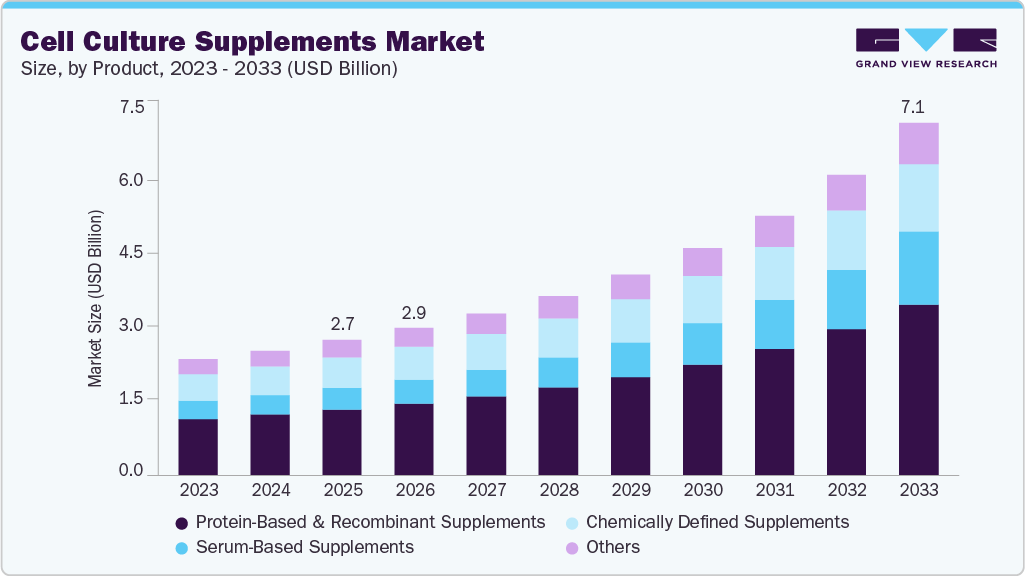
The global cell culture supplements market size was estimated at USD 2.74 billion in 2025 and is projected to reach USD 7.14 billion by 2033, expanding at a CAGR of 13.28% from 2026 to 2033. This growth is driven by increasing demand for biopharmaceuticals, advancements in cell culture technology, and the rising focus on personalized medicine and regenerative therapies.
Key Market Trends & Insights
- The North America cell culture supplements market held the largest share of 36.62% of the global market in 2025.
- The cell culture supplements industry in the U.S. is expected to grow at the fastest CAGR over the forecast period.
- By product, the protein-based & recombinant supplements segment held the highest market share of 42.56% in 2025.
- Based on application, the biopharmaceutical manufacturing segment held the highest market share in 2025.
- By end use, the pharmaceutical & biotechnology companies segment held the highest market share in 2025.
Market Size & Forecast
- 2025 Market Size: USD 2.74 Billion
- 2033 Projected Market Size: USD 7.14 Billion
- CAGR (2026 - 2033): 13.28%
- North America: Largest market in 2025
- Asia Pacific: Fastest-growing market
Advancements in 3D Cell Culture and Organoid Models
The increasing adoption of 3D cell culture systems and organoid technologies is driving demand for global cell culture supplements. Unlike 2D cultures, 3D models better mimic in vivo conditions, enabling more accurate studies of tissue development, disease progression, and drug responses. Organoids are increasingly used in regenerative medicine and disease modeling. These advanced systems require specialized supplements such as growth factors, extracellular matrix proteins, and defined media to maintain cell viability, differentiation, and functionality.
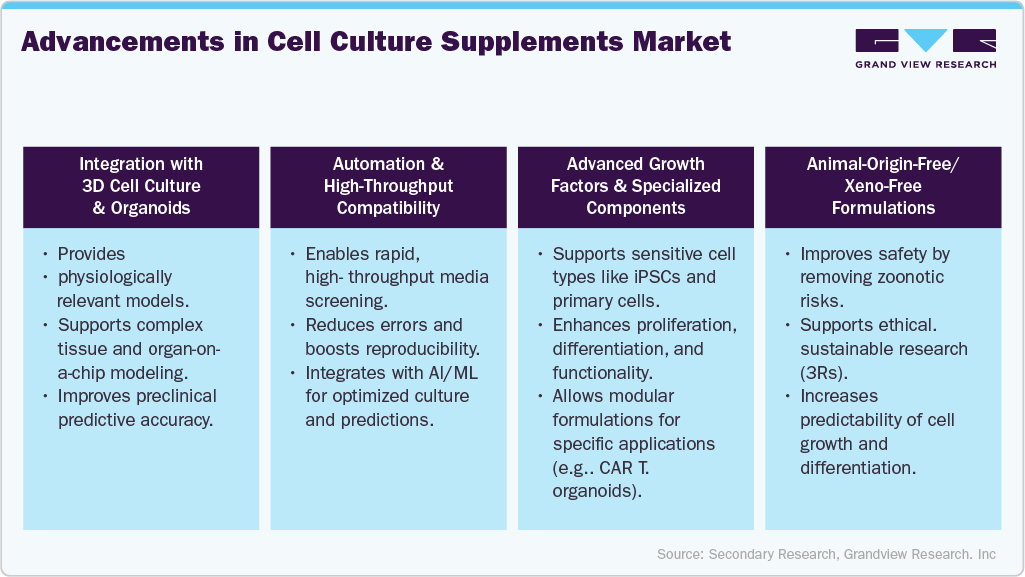
Pharmaceutical companies, together with biotech firms and academic institutions, now use innovative models to enhance their drug discovery processes while reducing their need for animal testing. The market demand for cell culture supplements, which are designed to support complex systems including three-dimensional cultures and organoids, will experience substantial growth because the segment serves as an essential foundation for future biomedical research and treatment development.
Rapid Growth in Regenerative Medicine and Stem Cell Research
The growth of regenerative medicine and stem cell research is driving demand for cell culture supplements. Stem cell treatments demonstrate high efficacy across various medical conditions, as shown through a 2025 NEJM study, which found that lab-grown islet cells decreased insulin needs for type 1 diabetes patients. The applications need specific supplements that help maintain stem cell health, support their growth, and enable their controlled development.
Rising clinical trials and regulatory approvals for stem cell therapies are boosting demand for scalable cell culture systems. Tissue engineering and personalized medicine depend on optimized culture conditions and advanced supplements, supporting sustained market growth.
Market Concentration & Characteristics
Innovation in the cell culture supplements industry is strong, driven by demand for safer, consistent, and ethically sourced products. Advances such as serum-free and animal-free supplements improve reproducibility and reduce contamination risks. For instance, in May 2025, PL BioScience introduced the first artificial human platelet lysate, a scalable alternative to fetal bovine serum that enhances cell safety and performance. These innovations support advances in regenerative medicine, drug discovery, and personalized therapies, driving future market growth.
M&A activity in the cell culture supplements industry has been moderately high, driven by pharma and biotech companies expanding cell-based research and therapeutics portfolios. Growing demand for scalable, regulatory-compliant products is expected to sustain consolidation as competition intensifies.
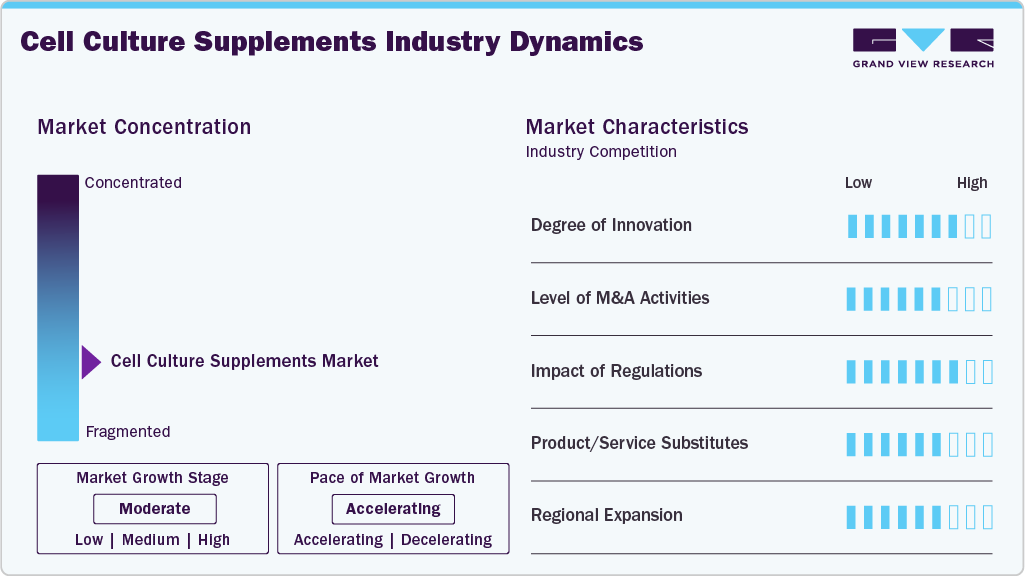
Regulations strongly influence the cell culture supplements industry by enforcing strict quality, safety, and traceability standards. Requirements from agencies such as the FDA and EMA are driving adoption of chemically defined, animal-free, and GMP-compliant supplements, especially for clinical and therapeutic use, supporting demand for consistent, high-purity products.
Product expansion is driving growth in the cell culture supplements industry as companies move beyond product supply into custom media formulation, technical support, and process optimization. The integrated services of the company provide clients with three benefits, which include better reproducibility and faster development of their work processes.
Regional expansion is a key strategy in the cell culture supplements industry, driven by rising biotech and biopharma activity in Asia-Pacific, Latin America, and the Middle East. Companies are investing in local manufacturing, distribution, and partnerships, especially in hubs like China, India, and South Korea, to improve market access, regulatory compliance, and supply chain resilience.
Product Insights
Protein-based and recombinant supplements led the market with a 42.56% revenue share in 2025, driven by demand for consistent, safe, and scalable solutions. Recombinant proteins reduce variability and eliminate animal-derived risks, supporting chemically defined systems. For instance, in January 2024, Core Biogenesis partnered with Nucleus Biologics to supply GMP plant-derived proteins, including thermostable FGF-2 for cell and gene therapy applications.
Chemically defined supplements are projected to grow at the fastest CAGR from 2026 to 2033, driven by demand for reproducible, animal-free formulations that reduce variability and support regulatory compliance. Advances in cell culture technologies and a preference for sustainable products are further boosting adoption.
Application Insights
The biopharmaceutical manufacturing segment dominated the market in 2025 with a share of 48.78%, driven by rising production of monoclonal antibodies, vaccines, and recombinant proteins that require optimized cell culture conditions. Growing biologics demand and bioprocessing advances continue to support segment growth.
The cell and gene therapy segment will achieve the highest annual growth rate because of two main factors, which include increased funding for new medical treatments, the rising number of people with genetic disorders and cancer, and the increasing use of personalized treatment methods. The demand for specialized supplements that enhance treatment effectiveness and safety has increased because of advancements in cell culture technologies and existing regulatory systems.
End Use Insights
The pharmaceutical and biotechnology companies segment led the market with a share of 41.65% in 2025, driven by higher R&D investments, rising demand for biologics and personalized medicines, and expanding capacity. This focus on innovative therapies is boosting the adoption of advanced cell culture supplements.
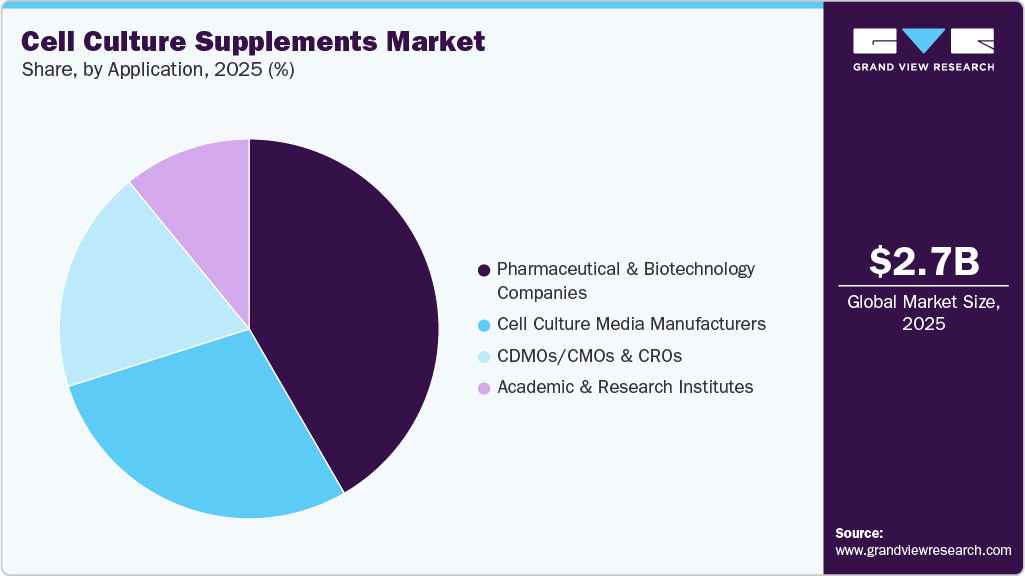
The CDMO/CMO and CRO segment is expected to grow at the fastest CAGR, driven by increased outsourcing to reduce costs, speed development, and access specialized expertise. A growing biologics and advanced therapy pipeline is further increasing demand for high-quality cell culture supplements.
Regional Insights
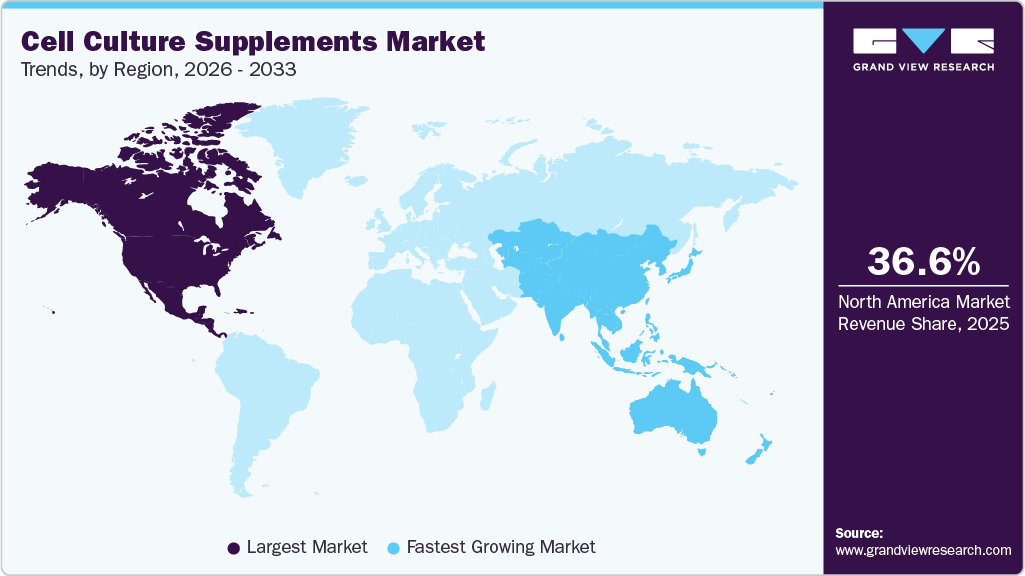
North America cell culture supplements industry dominated globally with the largest revenue share of 36.62% in 2025, driven by a strong biopharmaceutical industry, advanced research infrastructure, and robust government and private funding. High concentrations of pharma, biotech, academic institutions, and CROs fuel demand for reliable supplements.
U.S Cell Culture Supplements Market Trends
The cell culture supplements market in the U.S. is projected to grow at the fastest CAGR, driven by strong biomedical research, biotech advancements, and investments in regenerative medicine. Rising chronic diseases and demand for cell-based therapies further boost the need for scalable, high-performance solutions.
Europe Cell Culture Supplements Market Trends
The cell culture supplements market in Europe is expected to grow significantly, driven by government funding, a growing biopharma sector, and a focus on stem cell and gene therapies. Adoption of animal-free, chemically defined supplements and increased R&D activity further boost demand.
The UK cell culture supplements market is expected to expand because of top academic institutions, the strong biotechnology industry, and government support from the UK Life Sciences Vision. The markets will continue to grow because of stem cell and gene therapy research and the rising need for ethical serum-free chemically defined media.
The cell culture supplements market in Germany is expected to grow at a substantial CAGR over the forecast period, driven by the supportive government policies and funding initiatives to foster innovation and accelerate drug development, further propelling market growth in the cell culture supplements industry.
Asia Pacific Cell Culture Supplements Market Trends
The cell culture supplements market in the Asia Pacific is expected to grow at the fastest CAGR of 15.70% throughout the forecast period, driven by an expanding pharmaceutical industry, rising chronic diseases, and adoption of personalized medicine, along with cost advantages and growing local-global collaborations.
China cell culture supplements industry is expected to grow at a significant CAGR over the forecast period. China’s large patient population and increasing demand for advanced therapeutics, coupled with the establishment of numerous research institutions and biopharmaceutical companies, fuel market growth.
The cell culture supplements market in Japan is expected to grow, driven by demand for high-quality, animal-free, chemically defined products and the development of cell-based treatments for an aging population and rising chronic diseases.
MEA Cell Culture Supplements Market Trends
The cell culture supplements market in the Middle East and Africa will experience substantial growth throughout the entire projection period. The market growth is driven by two factors, which include rising public knowledge about advanced medical treatments and government efforts to improve research facilities.
Kuwait cell culture supplements market is poised for growth, driven by the country's strategic initiatives to diversify its economy and enhance its life sciences infrastructure, fostering innovation in regenerative medicine and cell-based therapies.
Key Cell Culture Supplements Company Insights
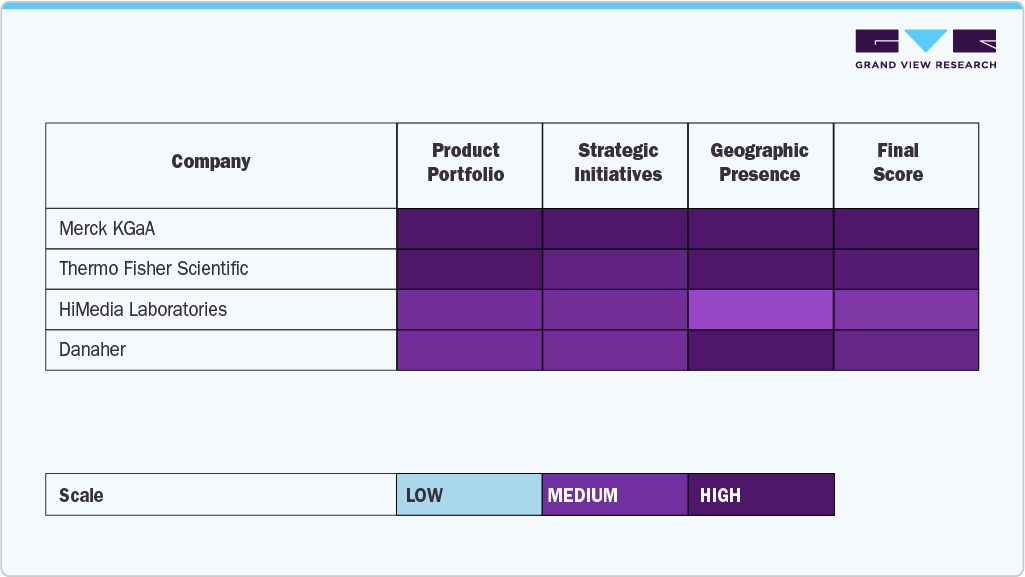
The market shows leadership through established companies Merck KGaA, Thermo Fisher Scientific, HiMedia Laboratories, and Danaher, who maintain their market position by offering a wide range of products and creating advanced product formulas while working with business partners and distributing their products worldwide.
Emerging and mid-sized companies are expanding by delivering innovative serum-free supplements that they customize to meet the specific needs of complex cell culture systems that include stem cells and organoids, and 3D cultures, while meeting strict regulatory requirements. Market growth is driven by rising demand for reproducible, scalable supplements in regenerative medicine and biopharma. Strategic M&A, partnerships, and innovation are intensifying competition, rewarding companies that combine scientific expertise with customer-focused solutions.
Key Cell Culture Supplements Companies:
The following key companies have been profiled for this study on the cell culture supplements market.
- Merck KGaA
- Thermo Fisher Scientific Inc.
- HiMedia Laboratories
- Danaher
- Sartorius AG
- Corning Inc.
- R&D Systems (Bio-Techne)
- STEMCELL Technologies
- Repligen Corporation
- Proteintech Group, Inc.
Recent Developments
-
In December 2025, Ajinomoto CELLiST Korea launched CELLiST AAV Production Supplement 1 in South Korea, developed with Forge Biologics, enhancing viral vector productivity 1.3-2× to support gene therapy manufacturing.
-
In April 2025, RoosterBio partnered with Thermo Fisher (USA) to enhance cell and exosome therapy manufacturing. The deal strengthens their position in the growing cell culture supplements industry with scalable, GMP-compliant solutions.
-
In December 2024, Merck KGaA’s U.S. unit, MilliporeSigma, acquired HUB Organoids (Netherlands) to expand its 3D cell model capabilities. This move supports the growing cell culture supplements industry by boosting demand for advanced media formulations tailored to organoid and 3D cultures critical for drug discovery and reducing animal use in preclinical testing.
Cell Culture Supplements Market Report Scope
Report Attribute
Details
Market size value in 2026
USD 2.98 billion
Revenue forecast in 2033
USD 7.14 billion
Growth rate
CAGR of 13.28% from 2026 to 2033
Base year for estimation
2025
Historical data
2021 - 2024
Forecast period
2026 - 2033
Quantitative units
Revenue in USD million/billion and CAGR from 2026 to 2033
Report coverage
Revenue forecast, company ranking, competitive landscape, growth factors, and trends
Segments covered
Product, application, end use, region
Regional scope
North America; Europe; Asia Pacific; Latin America; MEA
Country scope
U.S.; Canada; Mexico; UK; Germany; France; Italy; Spain; Denmark; Sweden; Norway; India; China; Japan; Australia; South Korea; Thailand; Brazil; Argentina; Saudi Arabia; UAE; South Africa; Kuwait
Key companies profiled
Merck KGaA; Thermo Fisher Scientific Inc.; HiMedia Laboratories; Danaher; Sartorius AG; Corning Inc.; R&D Systems (Bio-Techne); STEMCELL Technologies; Repligen Corporation; Proteintech Group, Inc.
Customization scope
Free report customization (equivalent up to 8 analyst’s working days) with purchase. Addition or alteration to country, regional & segment scope.
Global Cell Culture Supplements Market Report Segmentation
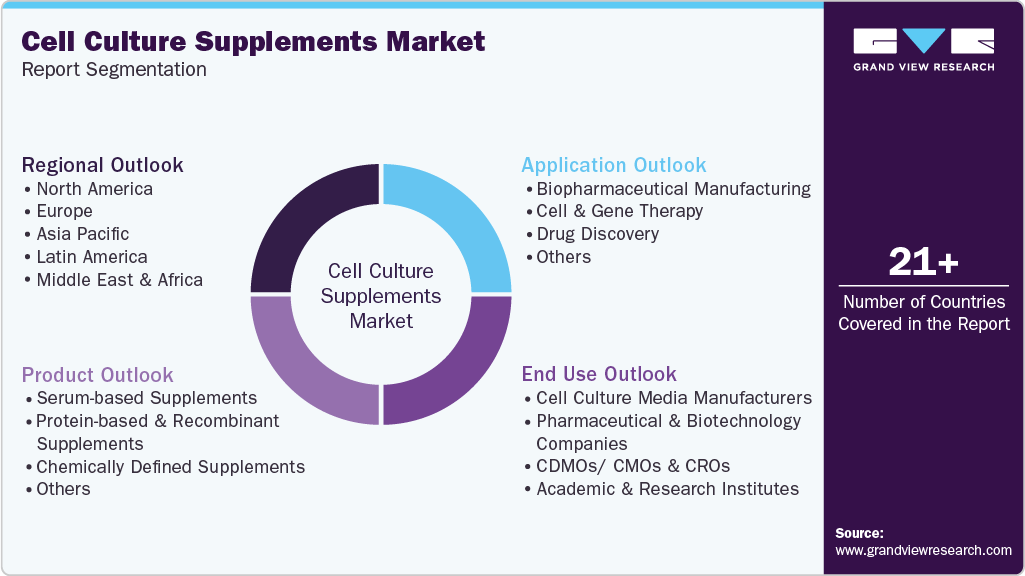
This report forecasts revenue growth and provides an analysis of the latest trends in each of the sub-segments from 2021 to 2033. For this study, Grand View Research has segmented the global cell culture supplements market report based on product, application, end use, and region:
-
Product Outlook (Revenue, USD Million, 2021 - 2033)
-
Serum-Based Supplements
-
Protein-Based & Recombinant Supplements
-
Chemically Defined Supplements
-
Others
-
-
Application Outlook (Revenue, USD Million, 2021 - 2033)
-
Biopharmaceutical Manufacturing
-
Cell & Gene Therapy
-
Drug Discovery
-
Others
-
-
End Use Outlook (Revenue, USD Million, 2021 - 2033)
-
Cell Culture Media Manufacturers
-
Pharmaceutical & Biotechnology Companies
-
CDMOs/ CMOs & CROs
-
Academic & Research Institutes
-
-
Regional Outlook (Revenue, USD Million, 2021 - 2033)
-
North America
-
U.S.
-
Canada
-
Mexico
-
-
Europe
-
Germany
-
UK
-
France
-
Italy
-
Spain
-
Denmark
-
Sweden
-
Norway
-
-
Asia Pacific
-
China
-
Japan
-
India
-
South Korea
-
Australia
-
Thailand
-
-
Latin America
-
Brazil
-
Argentina
-
-
MEA
-
South Africa
-
Saudi Arabia
-
UAE
- Kuwait
-
-
Frequently Asked Questions About This Report
b. The global cell culture supplements market size was estimated at USD 2.74 billion in 2025 and is expected to reach USD 2.98 billion in 2026.
b. The global cell culture supplements market is expected to grow at a compound annual growth rate of 13.28% from 2026 to 2033 to reach USD 7.14 billion by 2033.
b. North America cell culture supplements industry dominated globally with the largest revenue share of 36.62% in 2025, driven by a strong biopharmaceutical industry, advanced research infrastructure, and robust government and private funding.
b. Some key players operating in the cell culture supplements market include Merck KGaA; Thermo Fisher Scientific Inc.; HiMedia Laboratories; Danaher; Sartorius AG; Corning Inc.; R&D Systems (Bio-Techne); STEMCELL Technologies; Repligen Corporation; Proteintech Group, Inc.
b. The increasing demand for biologics, coupled with advancements in bioprocessing technologies, and others, continues to fuel the growth of the market.


Share this report with your colleague or friend.
Need a Tailored Report?
Customize this report to your needs — add regions, segments, or data points, with 20% free customization.


ISO 9001:2015 & 27001:2022 Certified
We are GDPR and CCPA compliant! Your transaction & personal information is safe and secure. For more details, please read our privacy policy.
Trusted market insights - try a free sample
See how our reports are structured and why industry leaders rely on Grand View Research. Get a free sample or ask us to tailor this report to your needs.













