
- Home
- »
- Medical Devices
- »
-
Cell Expansion Market Size, Growth Report, 2026-2033GVR Report cover
![Cell Expansion Market (2026 - 2033)Report]()
Cell Expansion Market (2026 - 2033)
Size, Share & Trends Analysis Report By Product (Instruments, Culture Flasks & Accessories, Consumables), By Cell Type (Mammalian, Microbial), By Application, By End Use, By Region, And Segment Forecasts
Market Size, 2025
$25.5BMarket Estimate, 2026
$28.7BMarket Forecast, 2033
$67.9BCAGR, 2026–2033
13.1%Cell Expansion Market Summary
The global cell expansion market was valued at USD 25.5 billion in 2025 and is projected to grow from USD 28.7 billion in 2026 to USD 67.9 billion in 2033, at a CAGR of 13.1% from 2026 to 2033. The North America accounted for the largest revenue share of more than 39.0% in 2025. The increase in the usage of automated solutions in cell expansion applications is one of the primary market drivers.
Key Market Trends & Insights
- By product: The consumables led the product segment in 2025 and accounted for over 45.0%.
- By cell type: The mammalian cells segment held the highest revenue share in 2025.
- By end use: The biotechnology & biopharmaceutical companies segment held the largest share of more than 45.0% in 2025.
- By application: the biopharmaceutical segment accounted for the largest revenue share in 2025.
Regional Highlights
- Largest regional market: North America (more than 39.0% revenue share, 2025)
- Fastest-growing regional market: Asia Pacific (highest CAGR, 2026-2033)
Market Size & Forecast
- Market size in 2025: USD 25.5 Billion
- Estimated market size in 2026: USD 28.7 Billion
- Projected market size by 2033: USD 67.9 Billion
- CAGR (2026-2033): 13.1%
Automated systems minimize the manpower and costs incurred during the production of Cell Therapy Products (CTP), gene therapies, and other biologics, leading to robust and reliable processes. Key players engaged in CTP development are expanding their product lines to address the significant rise in global demand for these therapy products.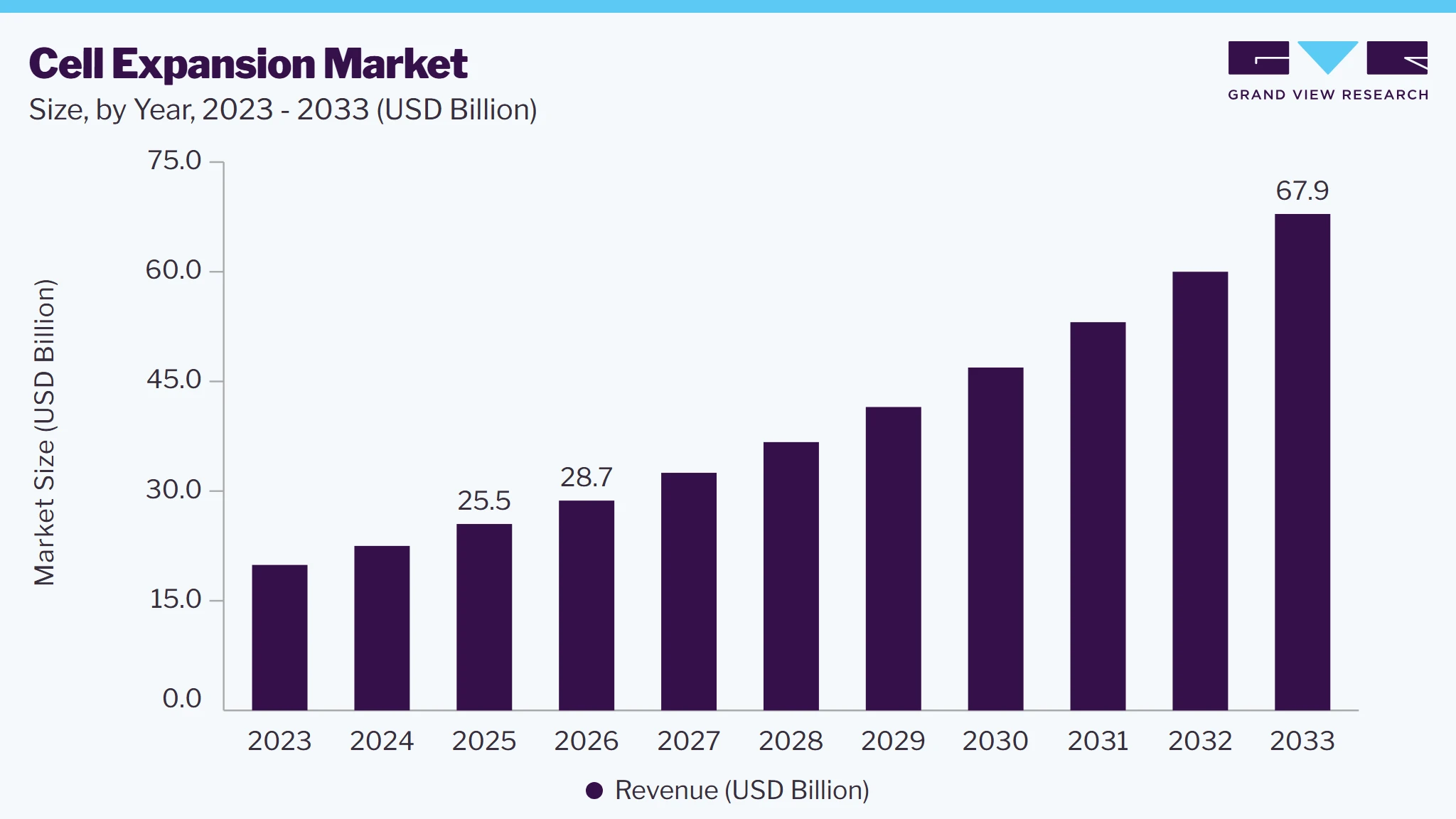
Key players engaged in CTP development are expanding their product lines to address the significant rise in global demand for these therapy products. For instance, in January 2021, Thermo Fisher Scientific introduced the Gibco CTS OpTmizer Pro Serum Free Media platform for developing and expanding human T lymphocytes for cell therapy developers using allogeneic workflows. This platform targets donor cell metabolism, making it suitable for allogeneic, off-the-shelf cell therapies.
The paradigm shift toward Single-Use Systems (SUS) offers substantial production advantages in CTP manufacturing. SUS eliminates concerns of cross-contamination and culture contamination caused due to inappropriate sterilization. SUS also allows the production of CTP with high cell densities and offers cost savings in the long run. Thus, a rise in the adoption of SUS surges the development of CTP, which boosts market growth.
Cellular therapies are constantly gaining popularity in the life sciences industry. A significant rise in funding from private & government organizations and initiatives undertaken by them to encourage the development of cellular therapies act as drivers for the market. The International Society for Stem Cell Research is involved in identifying stem cell-related funding opportunities across biomedical research applications.
Substitution of serum and other incompatible reagents is essential to control the quality of the product in CTP manufacturing. Several research studies have validated that applying serum-free media controls product quality. Researchers have also developed an optimization platform that integrates high-throughput tools with a differential evolution-based algorithm, which acts as an automated effective optimization strategy for serum-free culture formulations.
Market Dynamics
The shift toward Single-Use Systems (SUS) offers substantial production advantages in Cell Therapy Products (CTP) manufacturing. SUS eliminates concerns of cross-contamination and culture contamination caused due to inappropriate sterilization. SUS also allows the production of CTP with high cell densities and offers cost savings in the long run. Thus, a rise in the adoption of SUS surges the development of CTP, which boosts market growth. In addition, the reduced cleaning and validation needs associated with single-use systems facilitate streamlining of the manufacturing process, thus enhancing process efficiency. Their scalability and flexibility allow them to meet the increasing demand for commercial production for cell and gene therapy manufacturers.
Despite the growing significance of regenerative medicines and cell-based therapies, cell expansion requires significant resource investments; the cost implications of such developments include the purchase of specialized bioprocessing equipment, environmental control, and the provision of culture media and personnel to a certain quality standard. Maintaining cell viability, purity, and consistency can be difficult and complex. Resulting in increased development times and running costs. As a result, it can hinder the growth of the cell expansion market.
Cellular therapies are constantly gaining popularity in the life sciences industry. A significant rise in funding from private & government organizations and initiatives undertaken by them to encourage the development of cellular therapies. For instance, in May 2026, the Maryland Stem Cell Research Commission, announced 38 new awards, comprising USD 12,665,189 through the Maryland Stem Cell Research Fund (MSCRF). Such initiatives are likely to support research, development, and commercialization of cell and regenerative medicine, presenting lucrative growth opportunities for this market.
Analyst Perspective
The profound shifts in healthcare industry dynamics and growing demand associated with regenerative medicine, personalized oncology therapies, and advanced biopharmaceutical production are contributing to growth experienced by this market. Availability of significant funds provided by governments and organizations are adding strength to R&D efforts and product developments. Shift from traditional manual workflows to automated operations also fuels the pace of advancements in this industry. A key factor that may hinder the growth in future include high costs associated with regulatory compliance and clinical safety. However, major market participants are likely to rely on collaborations and partnership to navigate to through challenges.
Product Insights
Consumables led the product segment in 2025, accounting for more than 45.0%. The segment is estimated to retain its dominant position throughout the forecast years. The availability of a wide range of commercial media and reagent products that are dedicated to specific types of cells contributes to the large revenue share of this segment. In addition, these products are convenient, ready to use, and are also available as serum-free formulations.
The instruments segment is expected to register the fastest CAGR over the forecast period, owing to the automation trend in bioreactors and other expansion platforms to enhance the efficiency of culturing procedures. The advent of automated platforms standardizes the process and facilitates process tracking while reducing hands-on time; therefore, it enables more effective use of the time of skilled personnel.
Cell Type Insights
The mammalian cells segment held the highest revenue share in 2025 and is expected to remain dominant during the forecast period, as these culture systems are highly preferred in the production of complex protein therapeutics. This is because these systems are pharmacokinetically and functionally relevant to post-translational modifications in humans. Therefore, most of the biopharmaceuticals, including monoclonal antibodies, specific interferons, thrombolytics, and various therapeutic enzymes, are produced using these culture systems.
Differentiated human cells accounted for a substantial share of revenue, as they perform specific functions in the body. Differentiated cells, such as fibroblasts, have gained immense importance in cutaneous wound healing and skin bioengineering, augmenting segment growth. Moreover, the evaluation of 3D Gingival Fibroblast (GF) toroids as a feasible, simple in vitro assay for biomaterial testing has increased their use.
Human stem cells have gained significant traction and are expected to witness the fastest CAGR during the forecast period. The exponential growth in research activities in this sector and the huge success of regenerative medicines are among the key factors attributed to the segment’s rapid growth rate. Furthermore, the implementation of automated, robotic, and closed production systems in the production of clinical-grade mesenchymal stem cells drives the segment’s expansion.
End-use Insights
The biotechnology & biopharmaceutical companies segment held the largest share, exceeding 45.0% in 2025, and is poised to expand at a significant growth rate. The broadening horizon of cell-based therapeutics in the healthcare industry is one of the major factors contributing to the large share of biopharmaceutical companies.
For instance, cellular-based therapies have gained immense popularity in regenerative medicine, with constant improvements in injectable cell delivery systems for various clinical applications. The research institutes segment is poised to register the fastest CAGR as researchers are engaged in several studies in the biomedical field.
The research institutes segment is poised to register the fastest CAGR of 14.37% through 2030, as researchers are engaged in several studies in the biomedical field. In March 2022, an infrastructure network was established at seven university hospitals in North Rhine-Westphalia, Germany, to implement novel cell therapies against COVID-19 and future viral pandemics. The University Hospital of Cologne is conducting research into COVID-19 cell therapy. The Ministry of Economic Affairs, Innovation, Digitalization and Energy of North Rhine-Westphalia funded the projects with 7.75 million euros.
Application Insights
The biopharmaceutical segment captured the largest revenue share owing to an increase in the approval rate of biopharmaceutical products in the past few years. The entry of new biopharmaceutical companies and the proliferation of bioprocessing technologies further drive the development of biopharmaceuticals, which, in turn, boost the expansion procedures conducted during bio-production.
In addition, single-use technologies are gaining immense traction in manufacturing cellular therapies on a commercial level. The introduction of alternative planar cell expansion technologies, such as compact multi-layer bioreactors, has been witnessed in recent years. This has satisfied the requirement of closed systems that limit the potential risks associated with contamination and maintain control of large-scale upstream production and unit production.
On the other hand, the vaccine production segment is expected to experience the fastest growth rate in the cell expansion market during the forecast period, due to the rapid advancement of cell-based vaccine production in recent years. The production of these vaccines offers a cost-effective manufacturing solution while accelerating the development process.
Regional Insights
North America accounted for the largest revenue share, at 39.0%, in 2025. The region is anticipated to retain its leading position in the coming years due to a rise in funding initiatives by government agencies, which has accelerated the manufacturing of stem cells and the development of regenerative medicines and cellular therapy products. This, in turn, drives the demand for cell expansion platforms in this region.
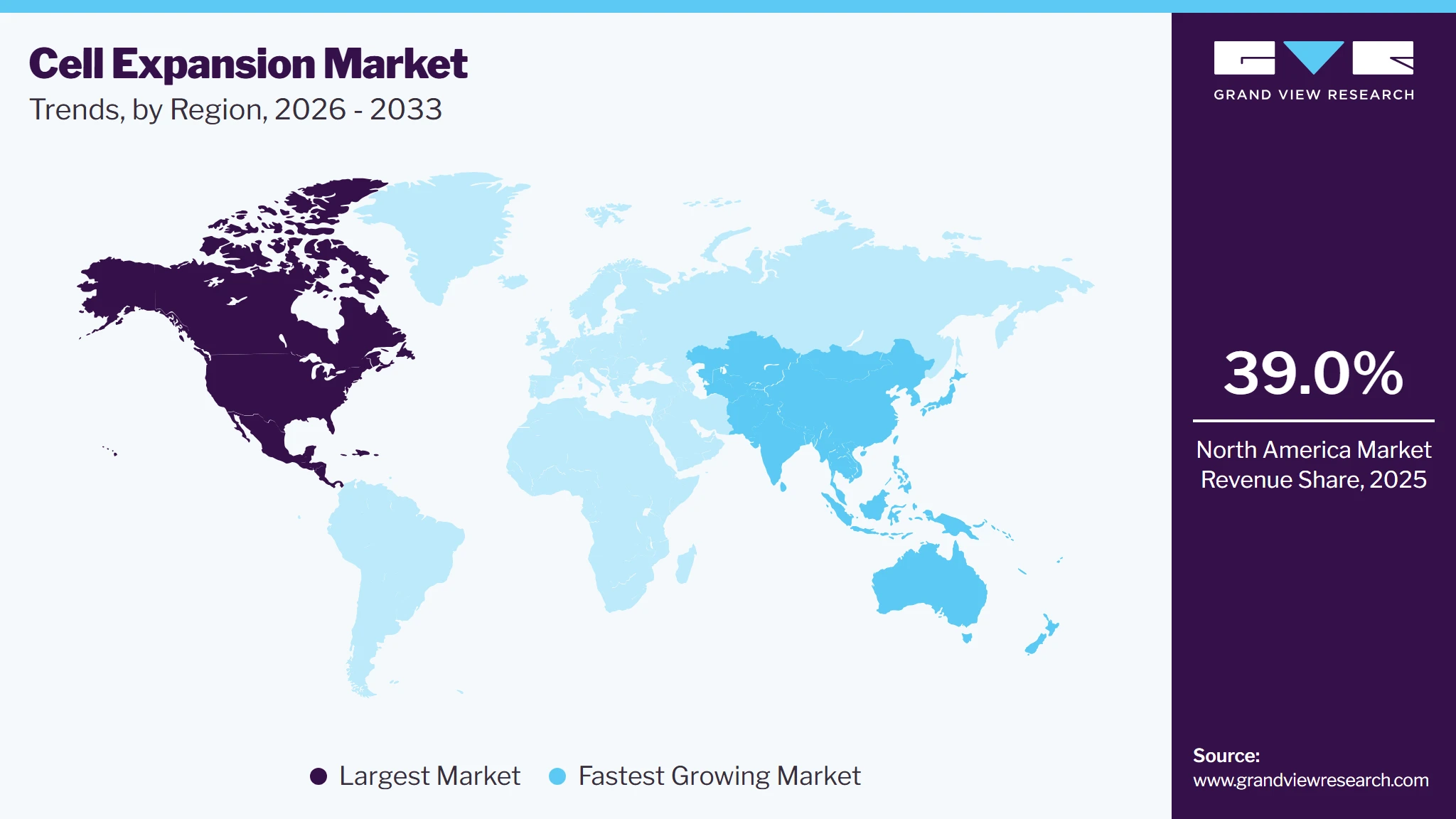
Asia Pacific is expected to witness the fastest CAGR during the forecast period, driven by growing initiatives by local pharmaceutical and biotechnology companies to develop and commercialize cellular therapies.
Key Cell Expansion Company Insights
The competitive environment of the market is highly fragmented, with the presence of multiple companies. Key market participants are undertaking several initiatives to expand their market presence and maintain a competitive edge. Moreover, they are involved in collaborations & partnership models, product development, agreements, and business expansion strategies in untapped regions.
Key Cell Expansion Companies
The following key companies have been profiled for this study on the cell expansion market.
-
Thermo Fisher Scientific, Inc.
-
Corning Incorporated
-
Merck KGaA
-
Miltenyi Biotec
-
BD.
-
Terumo BCT, Inc.
-
Sartorius AG
-
Takara Bio Inc.
-
TRINOVA BIOCHEM GmbH
-
upcyte technologies GmbH
Recent Developments
-
In May 2026, Thermo Fisher Scientific Inc., a prominent company in the life sciences industry, launched the Single Use Bioreactor Gibco CTS DynaXS. This newly designed expansion platform is expected to assist cell therapy developers in scaling manufacturing activities while ensuring flexibility, precision control, and regulatory compliance.
-
In March 2026, PHC Corporation’s Biomedical Division, PHCbi announced launch of LiCellGrow. This newly designed cell expansion system was launched for research use in Japan and a few other countries.
-
In March 2025, Limula SA announced launch of LimONE, advanced cell therapy manufacturing solution with capabilities to automate multiple processes associated with end-to-end production.
Cell Expansion Market Report Scope
Report Attribute
Details
Market size in 2025
USD 25.5 billion
Estimated market size in 2026
USD 28.7 billion
Projected market size by 2033
USD 67.9 billion
Growth rate
CAGR of 13.1% from 2026 to 2033
Base year for estimation
2025
Historical data
2021 - 2024
Forecast period
2026 - 2033
Quantitative units
Revenue in USD million, and CAGR from 2026 to 2033
Report coverage
Revenue forecast, company ranking, competitive landscape, growth factors, and trends
Segments covered
Product, cell type, application, end use, and region
Regional Scope
North America; Europe; Asia Pacific; Latin America; Middle East & Africa
Key companies profiled
Thermo Fisher Scientific, Inc.; Corning Incorporated; Merck KGaA; Miltenyi Biotec; BD; Terumo BCT, Inc.; Sartorius AG; Takara Bio Inc.; TRINOVA BIOCHEM GmbH; upcyte technologies GmbH.
Customization scope
Free report customization (equivalent up to 8 analysts working days) with purchase. Addition or alteration to country, regional & segment scope.
Pricing and purchase options
Avail of customized purchase options to meet your exact research needs. Explore purchase options
Global Cell Expansion Market Report Segmentation
This report forecasts revenue growth at the regional, and country levels and provides an analysis on the latest industry trends and opportunities in each of the sub-segments from 2021 to 2033. For the purpose of this study, Grand View Research has segmented the global cell expansion market report on the basis of product, cell type, application, end use, and region:
-
Product Outlook (Revenue, USD Million, 2021 - 2033)
-
Consumables
-
Reagents, Media, & Serum
-
Other Consumables
-
-
Culture Flasks and Accessories
-
Tissue Culture Flasks
-
Bioreactor Accessories
-
Other Culture Flasks and Accessories
-
-
Instruments
-
Automated Cell Expansion Systems
-
Cell Counters
-
Centrifuges
-
Bioreactors
-
Other Instruments
-
-
-
Cell Type Outlook (Revenue, USD Million, 2021 - 2033)
-
Mammalian
-
Human
-
Stem Cells (SCs)
-
Adult SCs
-
Embryonic SCs
-
Induced Pluripotent SCs
-
-
Differentiated Cells
-
-
Animal
-
-
Microbial
-
Others
-
-
Application Outlook (Revenue, USD Million, 2021 - 2033)
-
Biopharmaceuticals
-
Tissue Culture & Engineering
-
Vaccine Production
-
Drug Development
-
Gene Therapy
-
Cancer Research
-
Stem Cell Research
-
Others
-
-
End-use Outlook (Revenue, USD Million, 2021 - 2033)
-
Biopharmaceutical & Biotechnology Companies
-
Research Institutes
-
Cell Banks
-
Others
-
-
Regional Outlook (Revenue, USD Million, 2021 - 2033)
-
North America
-
U.S.
-
Canada
-
-
Europe
-
UK
-
Germany
-
France
-
Italy
-
Spain
-
Denmark
-
Sweden
-
Norway
-
-
Asia Pacific
-
Japan
-
China
-
India
-
Australia
-
Thailand
-
South Korea
-
-
Latin America
-
Brazil
-
Mexico
-
Argentina
-
-
Middle East and Africa
-
South Africa
-
Saudi Arabia
-
UAE
-
Kuwait
-
-
Frequently Asked Questions About This Report
Some key players operating in the cell expansion market include Thermo Fisher Scientific, Inc; GE Healthcare; Corning Incorporated; STEMCELL Technologies Inc.; Merck KGaA; Miltenyi Biotec; Becton, Dickinson and Company; TERUMO BCT, INC.; Sartorius AG; Takara Bio Inc.; TRINOVA BIOCHEM GmbH; and upcyte Technologies GmbH.
Key factors that are driving the market growth include growing trends of tissue engineering, regenerative medicine, and biopharmaceuticals, technological advancements in the field of cell culturing, increase in funding for cell-based research, and advantages of single-use technologies for commercial manufacturing of cell-based products.
The global cell expansion market was valued at USD 25.5 billion in 2025 and is projected to grow from USD 28.7 billion in 2026
The global cell expansion market is expected to grow at a CAGR of 13.1% from 2026 to 2033, reaching USD 67.9 billion by 2033.
North America dominated the cell expansion market with a share of 39.0% in 2025. A rise in funding initiatives initiated by government agencies has accelerated the manufacture of stem cells and the development of regenerative medicine and cellular therapy products in this region.
About the Author(s)
Medical Devices Research Team
Healthcare · Medical DevicesThis report was authored by the medical devices research team at Grand View Research - comprising two research analysts, one senior research analyst, and one industry expert - with specialized expertise in the medical devices segment of the healthcare industry. All findings are based on proprietary healthcare databases, executive interviews, and regulatory analysis, subject to internal peer review prior to publication.
Last Updated:
Speak to Analyst


Customize this report to your needs — add regions, segments, or data points, with 20% free customization.
Or view our licence options:


ISO 9001:2015 & 27001:2022 Certified
We are GDPR and CCPA compliant! Your transaction & personal information is safe and secure. For more details, please read our privacy policy.


