
- Home
- »
- Plastics, Polymers & Resins
- »
-
Circular Polymer Films Market Size, Share Report,2026-2033GVR Report cover
![Circular Polymer Films Market (2026 - 2033)Report]()
Circular Polymer Films Market (2026 - 2033)
Size, Share & Trends Analysis Report By Material Type (Polyethylene, Polypropylene, Polyethylene Terephthalate, Polyvinyl Chloride, Polyamide), By Thickness, By End-use (Food & Beverage), By Region, And Segment Forecasts
Market Size, 2025
$28.9BMarket Estimate, 2026
$31.8BMarket Forecast, 2033
$62.0BCAGR, 2026–2033
10.0%Circular Polymer Films Market Summary
The global circular polymer films market size was valued at USD 28.9 billion in 2025 and is projected to grow from USD 31.8 billion in 2026 to USD 62.0 billion by 2033, at a CAGR of 10.0% from 2026 to 2033. The market in Asia Pacific dominated with a revenue share of 38.0% in 2025. The growing awareness regarding sustainability among end users is driving demand for circularity in polymer films.

Key Market Trends & Insights
- By material type: Polyethylene (PE) segment held the largest market share of 40.7% in 2025.
- By thickness: 20 to 50 microns segment held the largest market share of 46.1% in 2025.
- By end-use: Food and beverage segment held the largest market share of 56.5% in 2025.
Regional Highlights
- Largest regional market: Asia Pacific (38.0% revenue share, 2025)
- Fastest-growing regional market: Asia Pacific (highest CAGR, 2026-2033)
- By country: China held the largest market share in 2025
Market Size & Forecast
- Market size in 2025: USD 28.9 Billion
- Estimated market size in 2026: USD 31.8 Billion
- Projected market size by 2033: USD 62.0 Billion
- CAGR (2026-2033): 10.0%
The plastics industry is undergoing a transition toward a circular economy, with increasing focus on sustainable and recyclable materials. One major trend is the adoption of advanced bio-based and biodegradable films to reduce dependence on fossil fuel-based feedstocks. These films are produced from renewable materials such as cellulose, starch, chitosan, and polylactic acid (PLA). They are widely used in food packaging and agricultural applications because they can naturally degrade without generating microplastic waste. At the same time, the industry is moving away from complex multi-layer packaging structures toward mono-material films that provide similar barrier strength and durability while improving recyclability and supporting more efficient waste management systems.
Key drivers in the circular polymer films market include increasing adoption across food packaging, consumer goods, healthcare, and industrial applications due to rising sustainability requirements and tightening waste regulations. The growing implementation of recycled-content mandates under the EU PPWR and state-level EPR frameworks in the U.S. is accelerating demand for recyclable and recycled polymer films. Manufacturers are shifting towards mono-material flexible packaging to improve recyclability and meet corporate sustainability targets. In addition, increasing restrictions on single-use plastics are encouraging wider adoption of circular film solutions across global packaging supply chains.
Technological advancements in the circular polymer films market are supporting the development of high-performance mono-material and nanolayer films with improved recyclability and barrier performance. Conventional multilayer films are difficult to recycle due to complex material separation requirements. Manufacturers are developing nanolayer coextrusion technologies that fold polymers such as PLLA and PVOH into hundreds of nanoscale layers while maintaining a single material base. This approach delivers high strength, oxygen-barrier protection, and lightweight properties comparable to traditional multilayer packaging. Growing investment in sustainable packaging innovation is further expanding the adoption of recyclable circular polymer solutions across food, healthcare, and consumer packaging applications.
Market Dynamics
The food and beverage industry represents a major demand contributor to the circular polymer films market due to the rising consumption of packaged foods and convenience-based products. Increasing urbanization and higher disposable income levels are supporting demand for flexible packaging formats used in ready-to-eat meals, frozen foods, snack products, dairy items, and bottled beverages. The rapid expansion of quick commerce, online grocery platforms, and food delivery services is further increasing the requirement for lightweight, durable, and recyclable film packaging solutions. Brand owners are increasingly incorporating food-grade circular polymer films to achieve sustainability targets, improve recycled content utilization, and comply with packaging waste regulations. Demand remains particularly strong for high-barrier and high-clarity films used in applications such as beverage packaging, confectionery wraps, stand-up pouches, and multilayer food packaging.
The pharmaceutical, alcoholic beverage, and personal care industries are also supporting market expansion. Rising pharmaceutical production and healthcare expenditure are increasing demand for recyclable and certified circular polymer films used in blister packaging, sachets, medical pouches, and protective packaging applications. In the alcoholic beverage segment, manufacturers are focusing on sustainable flexible packaging formats and recyclable labeling films to reduce material consumption and improve environmental performance. Growing consumption of premium beverages and functional drinks is further driving the use of high-performance circular films with enhanced strength, transparency, and barrier properties. In addition, companies across the packaging value chain are investing in advanced recycling technologies, mono-material film structures, and closed-loop packaging systems to strengthen circularity objectives and meet evolving regulatory and consumer sustainability expectations.
Regulatory and food-contact compliance requirements are emerging as a major restraint for the circular polymer films market due to increasing concerns regarding material safety, contamination, and recyclability performance. Recycled polymer films produced through mechanical recycling processes often contain residual inks, multilayer material residues, adhesives, additives, and other contaminants that limit their use in direct food-contact and pharmaceutical packaging applications. The challenge is particularly significant for flexible films, where complex material structures and barrier coatings reduce recycling efficiency and affect material purity. Regulatory authorities across Europe and North America are implementing stricter migration limits, recycled content verification standards, and traceability requirements for circular packaging materials used in sensitive applications. These regulations are increasing compliance, testing, sorting, and certification costs for film manufacturers while also extending product approval timelines. In addition, maintaining consistent quality and transparency levels in recycled-content films remains a challenge for converters and brand owners operating in high-performance packaging segments.
Market Concentration & Characteristics
The market growth stage is high, and growth is accelerating. The market exhibits fragmentation with key players dominating the industry landscape. Major companies such as Berry Global, Amcor plc, Dow Inc., Jindal Films, Trioworld, Sealed Air, Novolex, Cosmo Films, UFlex, Polyplex, and others play a significant role in shaping the market dynamics. These leading players often drive innovation in the market by introducing new products, technologies, and materials to meet the industry's evolving demands.
The degree of innovation in the circular polymer films market is high, driven by ongoing developments in recyclable film structures, advanced recovery technologies, and the integration of bio-based polymers. Companies are introducing mono-material films, high-barrier coatings, and chemically recycled resins to improve durability, shelf life, and recyclability. Smart sorting technologies and digital tracking systems are also improving waste collection and material recovery efficiency across the packaging value chain. In addition, compatibility with existing converting and packaging systems supports faster commercial adoption. These innovations are reducing virgin plastic consumption, lowering waste generation, and strengthening compliance with evolving sustainability regulations.
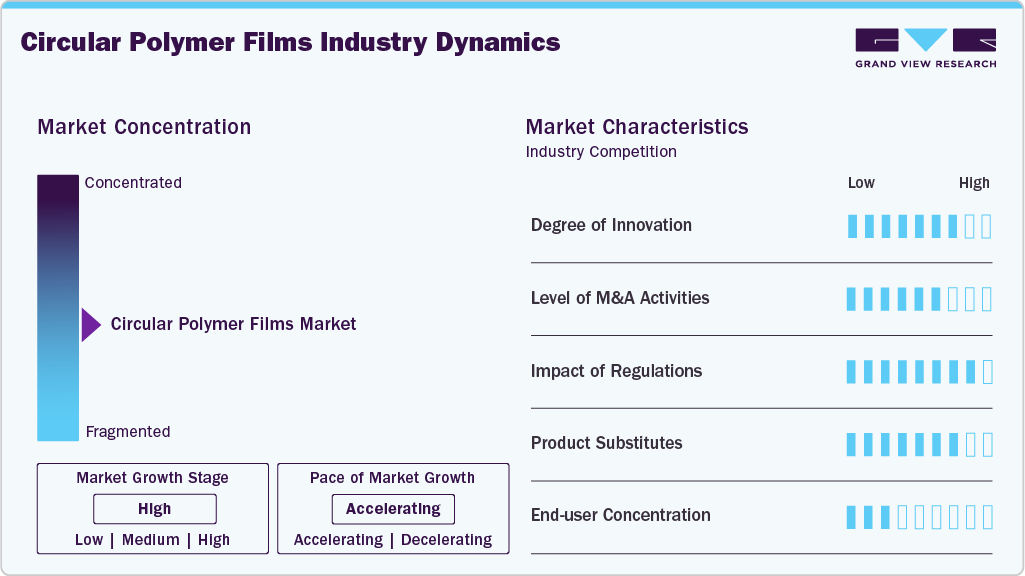
Regulations and regulatory frameworks play a major role in shaping the circular polymer films market by influencing material selection, recycling practices, and packaging sustainability standards. Policies related to extended producer responsibility, recycled content mandates, and single-use plastic restrictions are encouraging manufacturers to increase the use of recyclable and bio-based polymer films. Food-contact and packaging safety regulations also require strict quality control, traceability, and compliance testing across the supply chain. These regulations raise operational and certification costs but support market growth by improving recycling infrastructure, increasing demand for sustainable films, and accelerating investment in advanced circular packaging technologies.
Material Type Insights
The polyethylene (PE) segment led the circular polymer films market by material type in terms of revenue, with a 40.7% share in 2025. It is expected to expand at a CAGR of 10.4% from 2026 to 2033. Growth in the circular polymers market is primarily driven by the packaging sector, where polyethylene-based materials are widely used for their lightweight properties, moisture resistance, and cost efficiency. Rising demand from quick commerce and e-commerce platforms is further driving the need for sustainable recyclable packaging solutions. Market expansion is also supported by growing pharmaceutical demand, particularly for protective and high-purity packaging applications. In the automotive sector, increasing electric vehicle production is driving the use of lightweight polymer components to improve battery efficiency and vehicle range.
The polypropylene (PP) segment in the circular polymer films market is expected to expand at a CAGR of 10.7% during the forecast period. Growth in the circular polymers market is supported by the rising demand for healthcare and medical disposables, driven by the increasing prevalence of lifestyle diseases and growing healthcare spending. Demand is expanding for products such as medical syringes, IV bags, pharmaceutical packaging, diagnostic devices, and sterile containers, where hygiene, durability, and chemical resistance are essential. Polypropylene-based circular polymers are gaining strong adoption due to their lightweight structure, moisture resistance, thermal stability, and fatigue resistance. Market growth is also supported by stricter medical waste management regulations and increasing focus on sustainable healthcare packaging. Rising investments in advanced healthcare infrastructure are further accelerating demand across global medical applications.
Thickness Insights
Based on thickness, the 20 to 50 microns segment dominated the market in 2025, accounting for 46.1% of the total market share. The segment is witnessing strong demand across flexible packaging, industrial lamination, consumer goods, and selected agricultural applications, driven by its balance of material strength and lightweight performance. These films are widely used in high-speed packaging and converting operations because they offer good machinability, seal integrity, and cost efficiency. BOPP and PE-based film grades within this thickness range provide effective moisture resistance and enhanced product protection, particularly in food and consumer packaging applications. Market growth is further supported by the increasing adoption of recyclable mono-material structures, downgauging initiatives, and closed-loop recovery systems that aim to reduce plastic consumption while maintaining packaging performance.
The below 20 microns segment is gaining momentum and is projected to expand at the fastest rate over the forecast period. Growth in the below-20-micron segment is supported by increasing demand for lightweight, recyclable packaging solutions designed for material recovery and compliance with the circular economy. Packaging manufacturers are developing advanced circular polymer film structures with improved sealability, moisture resistance, and recyclability to meet sustainability targets and regulatory requirements. Flexible packaging applications such as snack pouches, confectionery wrappers, and bakery packaging are driving adoption, driven by high production volumes and a growing focus on plastic reduction through downgauging initiatives. Demand is also increasing for mono-material laminates and recyclable film formats that simplify waste sorting, reprocessing, and closed-loop recycling operations.
End-use Insights
The food and beverage segment dominated the market in 2025, accounting for 56.5% of total demand in the end use segment in 2025. Growth in the food and beverage segment is driven by rising demand for food and beverage packaging that meets food-grade certification and recyclability standards across global markets. Strong consumption of energy drinks, ready-to-drink teas, soy beverages, fruit juices, yogurt drinks, sports drinks, beer, and alcoholic beverages continues to increase the need for recycled and reusable plastic packaging solutions. The rapid expansion of quick commerce and e-commerce platforms is further accelerating packaging demand amid higher volumes of delivery-based consumption.
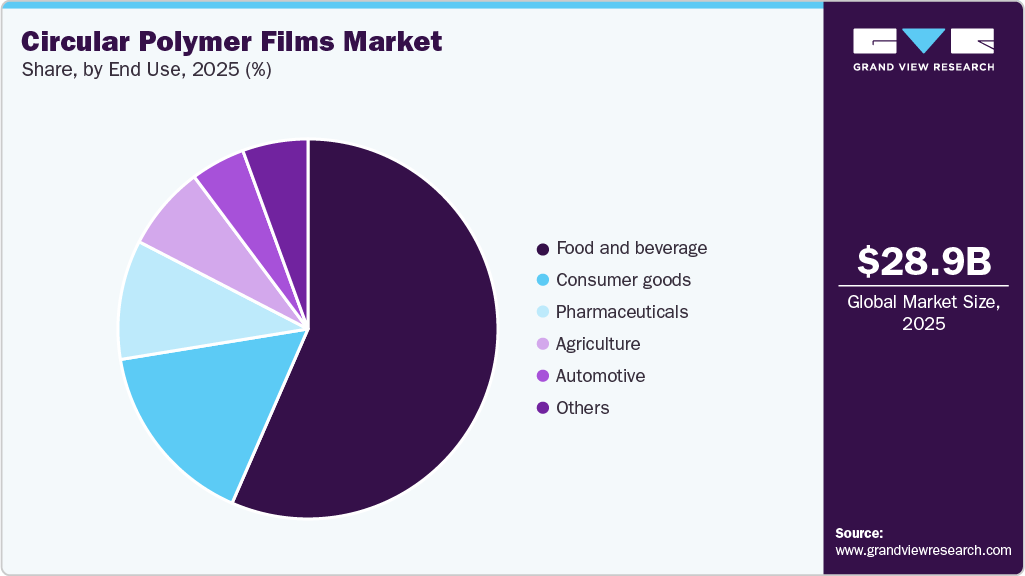
The pharmaceuticals segment is a growing end-use sector in the circular polymer films market, driven by increasing demand for sustainable, high-performance medical packaging solutions. Circular polymer films are used in applications such as blister packs, sachets, pouches, medical wraps, and protective packaging, where barrier protection, durability, and product safety are critical. Rising pharmaceutical production, expanding healthcare expenditure, and growing regulatory focus on sustainable packaging are supporting market growth. Manufacturers are increasingly developing recyclable and mono-material film structures to improve packaging circularity while maintaining compliance with strict pharmaceutical safety and hygiene standards.
Regional Insights
The Asia Pacific region dominated the market, accounting for over 38.0% of revenue in 2025. The region's growth is supported by rapid urbanization, rising disposable incomes, and increasing demand for packaged food, beverages, and consumer goods across major economies such as China and India. The expansion of the packaging industry, coupled with growing awareness of sustainable materials, is driving the adoption of circular polymer films in flexible packaging applications. In addition, government initiatives promoting waste management, recycling, and circular economy practices, along with investments in recycling infrastructure and advanced film production technologies, are further supporting market growth across the Asia Pacific during the forecast period.

China Circular Polymer Films Market Trends
China represents a major market for circular polymers in the Asia Pacific region, supported by strong manufacturing activity, expanding packaging demand, and rising investments in recycling infrastructure. The growing adoption of recycled polyethylene, polypropylene, and PET across the food packaging, consumer goods, automotive, and electronics industries is accelerating market growth. The rapid expansion of e-commerce and flexible packaging applications is further increasing demand for sustainable polymers with high durability and improved process efficiency. In addition, government policies promoting plastic waste reduction, closed-loop recycling systems, and circular economy targets are encouraging large-scale adoption of recycled and reusable polymer solutions across industrial value chains.
North America Circular Polymer Films Market Trends
The North America circular polymer films market is growing steadily due to the rapid expansion of the flexible packaging industry and the strengthening regulatory landscape across the region. Rising demand for lightweight, recyclable, and sustainable packaging solutions in the food, beverage, healthcare, and consumer goods sectors is increasing the adoption of circular polymer films. Government regulations and environmental policies in the United States and Canada are encouraging the reduction of plastic waste and the greater use of recycled materials in packaging applications. In addition, companies are investing in advanced recycling technologies and sustainable film production to meet regulatory requirements and consumer demand for eco-friendly packaging solutions.
The U.S. circular polymer films market accounted for 65.08% of the North America circular polymer films market, supported by strong demand for recyclable and bio-based films across packaging, agriculture, healthcare, and industrial applications. Owing to its lightweight structure, flexibility, moisture resistance, and compatibility with circular packaging systems. Increasing regulations on plastic waste management are also accelerating investments in mechanical and chemical recycling infrastructure. In addition, growing consumer preference for sustainable packaging solutions is strengthening demand for circular polymer films across retail and e-commerce supply chains.
Europe Circular Polymer Films Market Trends
The Europe circular polymer films market is expanding steadily due to the region’s strong focus on resource efficiency and sustainable material management. Strict regulations on plastic waste reduction and recycled content usage are encouraging manufacturers to increase the adoption of recycled and bio-based polymers across the packaging, automotive, and consumer goods industries. Growing investment in advanced sorting, mechanical recycling, and chemical recycling infrastructure is improving material recovery rates and supporting closed-loop production systems. In addition, rising collaboration between polymer producers, recyclers, and brand owners is accelerating innovation in high-quality circular polymer solutions, further strengthening market growth across Europe.
Germany circular polymer films market remains one of the most advanced markets for circular polymer films in Europe, supported by strong packaging waste collection, established recycling systems, and strict regulatory pressure for recyclable packaging. The European Union’s Packaging and Packaging Waste Regulation entered into force in February 2025 and is pushing packaging toward recyclability and higher recycled content, while Germany’s environment agency reported that packaging waste recycling remained above key targets. This is supporting demand for recyclable mono-material film structures across food, consumer goods, and industrial packaging.
Central & South America Circular Polymer Films Market Trends
Central and South America are emerging markets for circular polymer films, with demand shaped by rising packaging consumption, improving sustainability policies, and growing pressure to reduce plastic leakage. At the same time, waste management infrastructure is still developing in many countries across Central & South America and the Caribbean, and UNEP has noted that open dumping remains significant in the region. This creates both a challenge and an opportunity for circular films, especially in flexible packaging formats where recyclability and material recovery are becoming more important.
Middle East & Africa Circular Polymer Films Market Trends
The Middle East and Africa market is at an earlier stage of circular polymer film adoption, but it is gaining momentum through waste management reforms, circular economy planning, and rising concern over plastic pollution. The World Bank has stated that solid waste management systems in MENA need stronger circular economy solutions, and UNEP has highlighted persistent open dumping and burning challenges across Africa. As a result, demand for recyclable packaging films is gradually increasing, particularly in consumer goods, food packaging, and urban retail channels.
Key Circular Polymer Films Company Insights
Some of the key players operating in the market include Berry Global and Amcor plc.
-
Berry Global is a mature participant in the circular polymer films market with a strong focus on recyclable flexible packaging, post-consumer recycled content integration, and closed-loop film recycling solutions. The company offers mono-material film structures and sustainable packaging technologies across food, healthcare, and consumer packaging applications. Its global manufacturing footprint and investments in advanced recycling capabilities support its strong position in circular flexible packaging development.
-
Amcor plc is a mature player in the market, known for its extensive portfolio of recyclable and high-barrier flexible packaging solutions. The company focuses on developing mono-material films, lightweight packaging formats, and recycled-content solutions to meet evolving sustainability regulations and brand-owner requirements. Its strong research and development capabilities and collaborations across the packaging value chain support continued expansion in circular packaging applications.
Novolex and Jindal Films are some of the emerging participants in the industry.
-
Novolex is an emerging player in the circular polymer films market with increasing investments in sustainable packaging and film recycling infrastructure. The company is expanding its recyclable film product offerings and circular packaging initiatives across foodservice and consumer packaging applications. Its focus on plastic film collection and recycling programs is supporting gradual growth in the circular flexible packaging segment.
-
Jindal Films is an emerging participant in the circular polymer films market with a growing focus on recyclable polyolefin-based film structures and sustainable flexible packaging solutions. The company is developing mono-material packaging films designed to improve recyclability and support circular economy objectives in food and consumer goods packaging. Its expertise in BOPP film manufacturing and expanding its sustainable product portfolio is supporting its market presence in circular polymer films.
Key Circular Polymer Films Companies:
The following key companies have been profiled for this study on the circular polymer films market.
- Berry Global
- Amcor plc
- Dow Inc.
- Jindal Films
- Trioworld
- Sealed Air
- Novolex
- Cosmo Films
- UFlex
- Polyplex
Competitive Benchmarking
Operating Strategies
Competitive Edge
Weakness
Mature Players: Berry Global, Amcor plc, Dow Inc.
- Broad portfolio of recyclable and mono-material film structures for food, personal care, healthcare, and industrial packaging.
- Strong investments in recycled content integration, closed-loop systems, and circular packaging formats.
- Global production footprint supports large-scale supply and consistent product availability.
- Strong brand recognition and long-standing customer relationships across major packaging end uses.
- Established R&D capability supports development of high-performance circular polymer films with barrier and sealing properties.
- Scale advantages improve cost efficiency, supply stability, and qualification with global brand owners.
- Large operating structures can slow transition speed in newer circular film technologies.
- Higher capital intensity is required to upgrade assets, recycling systems, and certification capabilities.
- Exposure to mature packaging markets can limit flexibility in fast-changing niche formats.
Emerging Players: Novolex, Jindal Films, Cosmo Films
- Focus on recyclable film structures, lightweight packaging formats, and sustainable packaging innovation.
- Active development of mono-material solutions and circular packaging initiatives for food and consumer applications.
- Partnerships and targeted investments are used to expand presence without broad legacy asset burdens.
- Greater flexibility in adapting to evolving recyclability standards and customer specifications.
- Ability to move quickly in niche film applications and sustainability-driven product development.
- Lower organizational complexity supports faster market response and product customization.
- Smaller circular film portfolios compared with global packaging leaders.
- Limited scale may restrict penetration into high-volume contracts with multinational buyers.
- Ongoing need for stronger brand positioning, recycling infrastructure, and regulatory qualification in premium packaging applications.
Recent Developments
-
In February 2026, Peak Nano announced a new development initiative focused on producing advanced nanolayered biodegradable multilayer polymer films for food, beverage, and medical packaging applications. The project aims to support sustainable packaging solutions by improving material performance, product protection, and environmental compatibility across multiple industries.
-
In April 2025, Hydro-PRT® introduced an advanced recycling solution designed to process a wider range of plastic materials, including flexible plastics and rigid multi-layer multilayer structures that are often difficult to recycle through conventional methods. The technology supports improved plastic recovery, sustainability goals, and circular economy initiatives across multiple industries.
Circular Polymer Films Market Report Scope
Report Attribute
Details
Market size in 2025
USD 28.9 billion
Estimated market size in 2026
USD 31.8 billion
Projected market size by 2033
USD 62.0 billion
Growth Rate
CAGR of 10.0% from 2026 to 2033
Base year for estimation
2025
Historical data
2021 - 2024
Forecast period
2026 - 2033
Quantitative units
Revenue in USD billion/million, volume in kilotons, and CAGR from 2026 to 2033
Report coverage
Revenue forecast, company ranking, competitive landscape, growth factors, and trends
Segments covered
Material type, thickness, end-use, region
Regional Scope
North America, Europe, Asia Pacific, Central & South America, Middle East & Africa
Key companies profiled
Berry Global, Amcor plc, Dow Inc., Jindal Films, Trioworld, Sealed Air, Novolex, Cosmo Films, UFlex, Polyplex
Customization scope
Free report customization (equivalent up to 8 analysts working days) with purchase. Addition or alteration to country, regional & segment scope.
Pricing and purchase options
Avail of customized purchase options to meet your exact research needs. Explore purchase options
Global Circular Polymer Films Market Report Segmentation
This report forecasts revenue growth at the regional and country levels and provides an analysis of the latest industry trends and opportunities in each of the sub-segments from 2021 to 2033. For the purpose of this study, Grand View Research has segmented the global circular polymer films market report on the basis of material type, thickness, end-use, and region:

-
Material Type Outlook (Revenue, USD Million; Volume, Kilotons; 2021 - 2033)
-
Polyethylene (PE)
-
Polypropylene (PP)
-
Polyethylene terephthalate (PET)
-
Polyvinyl chloride (PVC)
-
Polyamide (PA)
-
Others
-
-
Thickness Outlook (Revenue, USD Million; Volume, Kilotons; 2021 - 2033)
-
Below 20 microns
-
20 to 50 microns
-
50 to 100 microns
-
Above 100 microns
-
-
End-use Outlook (Revenue, USD Million; Volume, Kilotons; 2021 - 2033)
-
Food and beverage
-
Consumer goods
-
Pharmaceuticals
-
Agriculture
-
Automotive
-
Others
-
-
Regional Outlook (Revenue, USD Million; Volume, Kilotons; 2021 - 2033)
-
North America
-
U.S.
-
Canada
-
Mexico
-
-
Europe
-
Germany
-
France
-
UK
-
Italy
-
Spain
-
-
Asia Pacific
-
China
-
India
-
Japan
-
South Korea
-
Australia
-
-
Central & South America
-
Brazil
-
Argentina
-
-
Middle East & Africa
-
Saudi Arabia
-
UAE
-
South Africa
-
-
Delivered Customizations
This report has been delivered with the following In-depth customizations
Client Request
Customization Delivered
Value Adds
Opportunity Assessment
Conducted a detailed assessment of growth opportunities across recyclable flexible packaging, mono-material structures, downgauged films, food packaging, e-commerce packaging, and industrial applications. The analysis evaluated regional sustainability regulations, recycled-content adoption trends, emerging end-use demand, and investment activity in advanced recycling-compatible film technologies.
Supported long-term growth strategy and product portfolio prioritization. Identified high-growth application areas and emerging sustainable packaging opportunities. Improved understanding of regional demand shifts and circular economy-driven market potential. Enabled targeted investment and innovation planning.
Trade Assessment
Assessed global trade dynamics for circular polymer films through analysis of export-import flows, regional sourcing trends, logistics networks, tariff structures, and supply chain dependencies. The study also examined cross-border trade of recyclable film materials, recycled polymers, and packaging substrates across major manufacturing regions.
Supported procurement planning and supply chain optimization. Identified key exporting and importing regions for recyclable film products. Improved visibility into regional trade dependencies and logistics risks. Enabled proactive sourcing diversification and market expansion planning.
Pricing Analysis
Delivered pricing analysis for recyclable and circular polymer film categories across major regions. The assessment covered virgin and recycled resin cost trends, production economics, regional pricing variations, import-export price differences, energy cost impacts, and sustainability-related premium pricing trends. It also evaluated the influence of recycled-content availability and advanced processing technologies on market pricing.
Supported procurement optimization and pricing strategy development. Improved understanding of recycled resin cost exposure and regional pricing behavior. Assisted in supplier comparison and margin management. Enabled better planning against feedstock volatility and sustainability-driven cost fluctuations.
Frequently Asked Questions About This Report
The global circular polymer films market size was valued at USD 28.9 billion in 2025 and is estimated at USD 31.8 billion for 2026.
The global circular polymer films market is expected to grow at a CAGR of 10.0% from 2026 to 2033, reaching USD 62.0 billion by 2033.
Asia Pacific dominated with a 38.0% revenue share in 2025.
Asia Pacific is the fastest-growing region over the forecast period.
Key players include Berry Global, Amcor plc, Dow Inc., Jindal Films, Trioworld, Sealed Air, Novolex, Cosmo Films, UFlex, Polyplex
The growing awareness regarding sustainability among end users is driving demand for circularity in polymer films.
The polyethylene (PE) segment led with a 40.7% revenue share in 2025, while the polypropylene (PP) segment is the fastest-growing.
The 20 to 50 microns segment led with a 46.1% revenue share in 2025, while the below 20 microns segment is the fastest-growing.
The food and beverage segment led with a 56.5% revenue share in 2025, while the pharmaceuticals segment is the fastest-growing.
About the Author(s)
Plastics, Polymers & Resins Research Team
Bulk Chemicals · Plastics, Polymers & ResinsThis report was authored by the plastics, polymers & resins research team at Grand View Research - comprising two research analysts, one senior research analyst, and one industry expert - with specialized expertise in the plastics, polymers & resins segment of the bulk chemicals industry. All findings are based on proprietary bulk chemicals databases, executive interviews, and regulatory analysis, subject to internal peer review prior to publication.
Last Updated:
Speak to Analyst


Customize this report to your needs — add regions, segments, or data points, with 20% free customization.
Or view our licence options:


ISO 9001:2015 & 27001:2022 Certified
We are GDPR and CCPA compliant! Your transaction & personal information is safe and secure. For more details, please read our privacy policy.


