
- Home
- »
- Next Generation Technologies
- »
-
Connected Hardhats Market Size & Share Report, 2026-2033GVR Report cover

Connected Hardhats Market (2026 - 2033)
Size, Share & Trends Analysis Report By Component (Communication, Navigation, Camera), By End Use (Consumer, Manufacturing), By Region (North America, Europe, Asia Pacific, Latin America, MEA), And Segment Forecasts
Market Size, 2025
$136.1MMarket Estimate, 2026
$156.6MMarket Forecast, 2033
$397.4MCAGR, 2026–2033
14.2%Connected Hardhats Market Summary
The global connected hardhats market size was valued at USD 136.1 million in 2025 and is projected to grow from USD 156.6 million in 2026 to USD 397.4 million by 2033, at a CAGR of 14.2% from 2026 to 2033. North America dominated the global market with the largest revenue share of 42.8% in 2025. The increasing focus on workplace safety is a major growth factor in the market.
 Source: Grand View Research, IR Documents, Primary Interviews, Paid DatabasesTo learn more about this report,
 Download Free Sample Report
 Key Market Trends & Insights
- By component: Communication segment held the largest market share of 32.8% in 2025.
- By end use: Construction segment held the largest market share of 52.2% in 2025.
Regional Highlights
- Largest regional market: North America (42.8% revenue share, 2025)
- Fastest-growing regional market: Asia Pacific (highest CAGR, 2026-2033)
- By country: The U.S. held the largest market share in 2025.
Market Size & Forecast
- Market size in 2025: USD 136.1 Million
- Estimated market size in 2026: USD 156.6 Million
- Projected market size by 2033: USD 397.4 Million
- CAGR (2026-2033): 14.2%
Three ways to get this report
Buy it, customize it, or ask a question.Ask an Analyst
A direct answer, usually in 1 working day
- AccessReport author, directly
- Reply timeWithin 1 working day
- No sales callDirect answer only
- FormatEmail reply
- CostFree, no cost
Get the Full Report
What the study covers
- FormatsPDF · Excel · Dashboard
- Timeline2026–2033 annual, 2025 base
- Coverage20+ countries, 5 regions
- Companies10+ key players profiled
Customize the Report
20% free customization
- IncludeCountries, segments, points
- TailorTo your product definition
- ExtendDeeper competitor detail
- OrA fully bespoke study
- Turnaround5–10 working days
The demand for connected hardhats equipped with sensors and real-time monitoring capabilities is growing in industries such as construction, mining, and manufacturing to reduce accidents and comply with stringent safety regulations, thereby propelling the growth of the market. In addition, these smart hardhats can detect environmental hazards, monitor worker vitals, and provide alerts in case of emergencies, significantly enhancing on-site safety.
The rapid advancements in internet of things (IoT) technology are transforming traditional hardhats into smart, hard hats that offer a range of features, such as GPS tracking, communication tools, and data analytics. These technologies enable real-time monitoring of worker locations and health status, advancing improved situational awareness. With IoT capabilities, employers can collect and analyze data to optimize workflow and productivity while ensuring safety. Furthermore, some connected hardhats feature augmented reality (AR) technologies that enable users to access their biodata, check emails, search for information, or review blueprints and other images. This AR functionality is usually delivered through a transparent visor or mask. Thus, growing technological advancements in connected hardhats are propelling the growth of the market.
 To learn more about this report, Download Free Sample Report
 Growing investments in construction and infrastructure development are fueling market growth. Governments and private companies worldwide are committing substantial resources to build and upgrade transportation networks, utilities, and residential projects. As construction sites become more complex and require advanced safety measures, the demand for connected hardhats is expected to increase in the coming years. These hardhats enhance safety and contribute to operational efficiency, making them a vital tool for organizations looking to complete projects on time and within budget.
The development of safety regulations and standards supporting the use of smart personal protective equipment (PPE) is another key growth factor. Regulatory bodies are increasingly recognizing the benefits of connected technologies in enhancing workplace safety. For instance, in November 2023, the Occupational Safety and Health Administration (OSHA) released a Safety and Health Information Bulletin outlining the major differences between traditional hardhats and modern safety helmets. The bulletin highlights advancements in design, materials, and features that enhance overall head protection for workers.
The high cost and price volatility of raw materials used in manufacturing connected hardhats could hamper the growth of the market. Fluctuations in the prices of high-performance plastics and metals can affect production costs, leading to increased prices for end consumers. This can discourage potential buyers, especially in industries with limited budgets, where companies might prioritize cost savings over advanced safety features. However, manufacturers are navigating these challenges through effective supply chain management and strategic sourcing to maintain competitive pricing while ensuring product quality.
Market Dynamics
The connected hardhats market is experiencing significant growth due to increasing workplace safety requirements, rising adoption of industrial IoT technologies, and growing investments in smart personal protective equipment (PPE). Industries such as construction, mining, oil & gas, and manufacturing are increasingly deploying connected hardhats to monitor worker safety, location, and environmental conditions in real time. These devices help reduce workplace accidents and improve operational efficiency through data-driven insights. However, high implementation costs and concerns regarding data privacy and connectivity reliability could hamper the growth of the market. In addition, advancements in wearable technologies and the growing trend toward smart industrial workplaces are expected to contribute to the growth of the market.
Organizations are increasingly seeking solutions that provide real-time visibility into workforce activities and site conditions. Connected hardhats enable supervisors to monitor worker locations, movement patterns, and safety status across complex job sites. This visibility helps improve operational coordination and workforce productivity. Real-time communication features facilitate faster decision-making and incident response. Data collected from connected hardhats can also be used to identify workflow inefficiencies and optimize resource deployment. Businesses are recognizing the value of combining safety monitoring with operational intelligence. Thus, demand for connected hardhats continues to increase across industrial environments.
Large construction projects and industrial facilities require effective workforce management tools. Connected hardhats support enhanced situational awareness and site supervision. Companies are increasingly investing in technologies that improve both safety and productivity. Real-time workforce monitoring has become a key component of modern industrial operations. These factors contribute to the growth of the market.
Connected hardhats generate large volumes of workforce and operational data, raising concerns related to privacy, security, and data management. Employees may be concerned about continuous monitoring and the collection of personal location or performance information. Organizations must ensure compliance with data privacy regulations while maintaining transparent policies regarding data usage. Additionally, connected hardhats depend on reliable wireless connectivity for real-time communication and monitoring. Connectivity disruptions can reduce system effectiveness and limit operational benefits. Cybersecurity threats targeting connected devices also present potential risks to industrial operations. These concerns could hamper the adoption of connected hardhats and create implementation challenges.
The growing adoption of smart construction practices and Industry 4.0 technologies offers major opportunities for the connected hardhats market. Construction companies, manufacturers, and industrial operators are increasingly investing in connected infrastructure and digital workplace solutions. Connected hardhats play an important role in these initiatives by providing real-time workforce data and enhancing worker safety. Integration with building information modeling (BIM), digital twins, and smart site management platforms further increases their value. Governments and private organizations are supporting digital transformation programs aimed at improving industrial productivity and safety. Demand for intelligent wearable technologies is expected to rise alongside these initiatives. This trend is expected to drive significant market growth.
Industry 4.0 strategies emphasize connectivity, automation, and data-driven decision-making. Connected hardhats contribute to broader digital workforce management systems. Organizations increasingly recognize the benefits of integrating wearable technologies into smart workplace ecosystems. Investments in digital infrastructure continue to increase globally. These developments are expected to contribute to the growth of the market during the forecast period.
Analyst Perspective
The connected hardhats market is growing steadily due to increasing focus on worker safety and the adoption of smart workplace technologies. Industries such as construction, manufacturing, and mining are deploying IoT-enabled hardhats to improve real-time monitoring, communication, and hazard detection. Growing investments in Industry 4.0 and connected safety solutions are expected to contribute to the growth of the market during the forecast period.
Component Insights
Based on component, the communication segment led the market with the largest revenue share of 32.8% in 2025. Increasing adoption of technologically advanced connected hardhats for communication purposes is driving the segment’s growth. The integration of advanced communication systems allows for real-time audio and video interactions, enabling workers to maintain contact with supervisors and emergency services while on-site. Technologies such as voice-activated controls and text-to-speech functionalities enhance hands-free operation, which is essential in environments where manual tasks are prevalent. For instance, United Safety’s Communicator is a smart hardhat that offers sensor-based contextual awareness of the worker’s environment. Featuring multi-modal, high-precision real-time positioning (RTLS) and robust audio-visual communication capabilities, this ergonomically designed hardhat effectively turns an ordinary worker into a connected worker. Thus, the availability of communication-based connected hardhats across the globe is boosting the segment’s growth.
The navigation segment is expected to register significant growth from 2026 to 2033. Navigation is rapidly emerging as a vital component of connected hardhats, particularly with the integration of global positioning system (GPS) and AR interfaces. This segment is expected to witness significant growth due to its ability to provide precise indoor and outdoor location tracking, which is essential in complex industrial settings. In addition, smart hardhats equipped with navigation features enable workers to navigate challenging environments safely, reducing the risk of accidents caused by disorientation or lack of situational awareness, thereby driving the segment’s growth.
End-use Insights
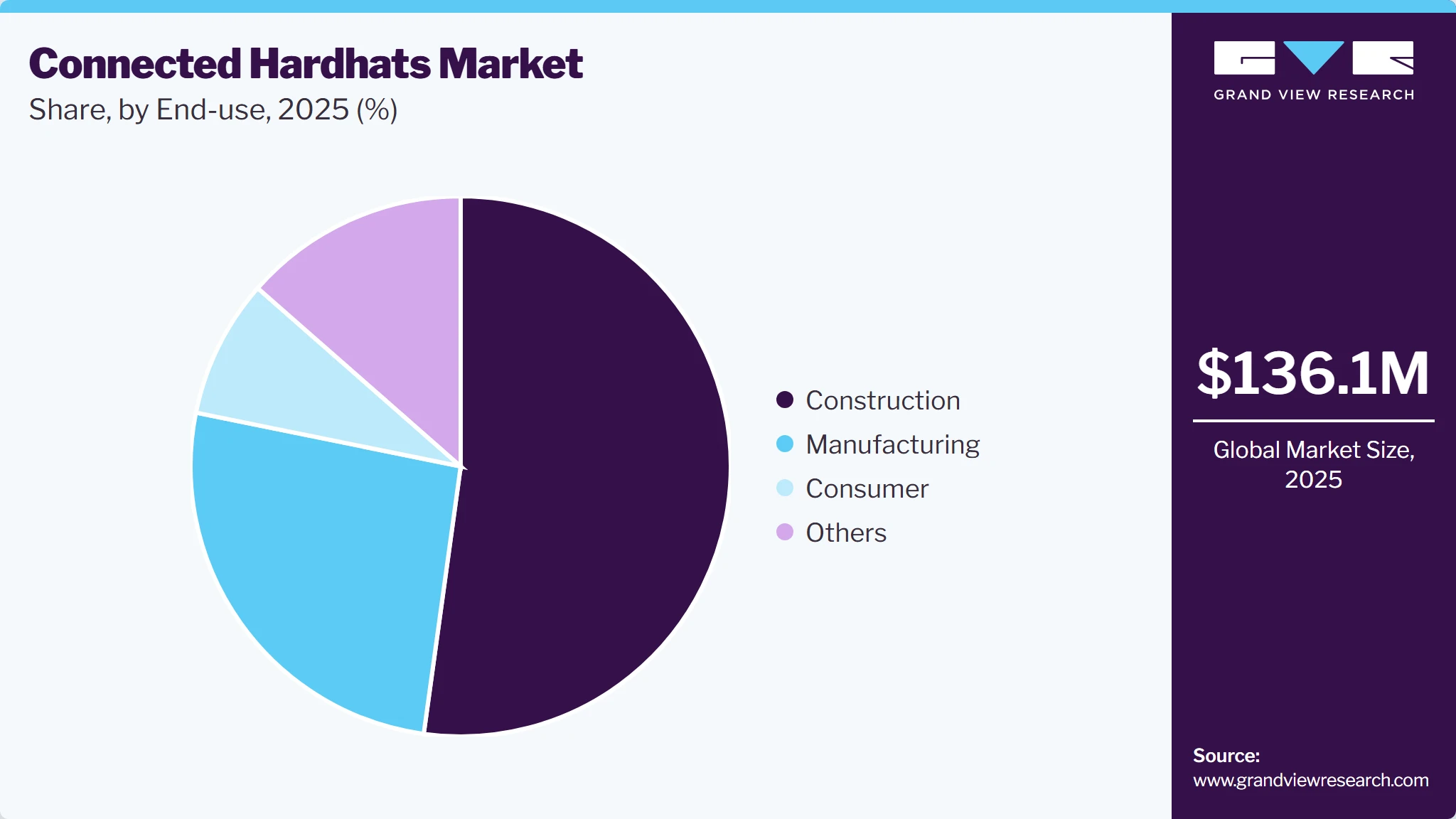
Based on end use, the construction segment led the market with the largest revenue share of 52.2% in 2025. Increasing awareness about the importance of worker health and well-being in the construction sector is driving the adoption of connected hardhats. In the construction sector, connected hardhats equipped with advanced sensors and communication technologies can monitor environmental conditions, detect falls, and alert workers to potential hazards in real time. In addition, increasing urbanization and infrastructure projects across the globe are further driving the demand for connected hardhats in the construction industry, promoting safer working environments and reducing accident-related costs.
 To learn more about this report, Download Free Sample Report
 The manufacturing segment is expected to register significant growth from 2026 to 2033. In the manufacturing sector, connected hardhats are gaining traction as companies prioritize worker safety and operational efficiency. The integration of smart technologies in hardhats allows for real-time monitoring of workers' health and safety conditions, which is critical in environments where heavy machinery is used. In addition, with the ongoing advancements in smart technology, the manufacturing sector's reliance on connected hardhats is expected to increase, thereby driving the growth of the segment.
Regional Insights
North America dominated the global connected hardhats market with the largest revenue share of 42.8% in 2025. The construction and manufacturing sectors in North America are rapidly adopting connected hardhats to enhance worker safety and efficiency, thereby driving the market’s growth. In addition, the integration of IoT technology in these hardhats allows for improved data collection and analysis, further driving market growth as organizations seek to mitigate risks and enhance productivity.
 To learn more about this report, Download Free Sample Report
 U.S. Connected Hardhats Market Trends
The connected hardhats market in the U.S. held the largest share in the North America region in 2025. Stringent workplace safety regulations and a strong emphasis on occupational health drive the market’s growth in the country. The U.S. OSHA mandates the use of personal protective equipment (PPE), which includes hardhats, in various industries. This regulatory environment encourages companies to invest in advanced safety technologies, including connected hardhats that offer features such as real-time monitoring and communication capabilities, which in turn drive the growth of the market.
Europe Connected Hardhats Market Trends
The Europe connected hardhats market is poised for moderate growth from 2026 to 2033. The region’s stringent safety standards encourage companies to invest in advanced safety equipment, including connected hardhats that offer enhanced communication and navigation features. Furthermore, the increasing focus on sustainability and worker health is prompting industries to adopt innovative solutions that improve safety outcomes. This, in turn, propels the growth of the market in the region.
Asia Pacific Connected Hardhats Market Trends
The Asia Pacific connected hardhats market is anticipated to register the fastest growth from 2026 to 2033. The rapid industrialization and urbanization in countries such as India and China are major driving factors behind the growth of the market in the region. The increasing focus on worker safety amid growing construction activities is further propelling demand for connected hardhats equipped with advanced features such as fall detection and environmental monitoring.
Key Connected Hardhats Company Insights
The key companies are focusing on various strategic initiatives, including new product development, partnerships & collaborations, and agreements to gain a competitive advantage over their rivals.
Key Connected Hardhats Companies
The following key companies have been profiled for this study on the connected hardhats market.
- United Safety
- Technosoft Engineering Projects Ltd.
- MSA Safety Incorporated
- Westinghouse Electric Company LLC
- Luceque
- WakeCap Technologies
- Knowit
- GuangZhou Jepower Technology Co., Ltd.
- Excellent Webworld
- Twiceme Technology AB
Competitive Benchmarking
Category
Operating Strategies
Competitive Edge
Weakness
Established Players (MSA Safety Incorporated, United Safety, Technosoft Engineering Projects Ltd.)
- Established players focus on expanding smart PPE portfolios, integrating IoT-enabled safety technologies, strengthening industrial partnerships, and enhancing worker monitoring capabilities. They leverage their experience in occupational safety and industrial protection to develop connected hardhat solutions for high-risk environments.
- Strong brand recognition, established customer relationships, extensive safety expertise, broad distribution networks, and compliance with industry safety standards provide significant competitive advantages.
- Higher product costs, longer product development cycles, and dependence on industrial capital expenditure may impact growth. Adoption can also be influenced by budget constraints among end users.
Emerging Players (Luceque, Knowit, GuangZhou Jepower Technology Co., Ltd.)
- Emerging players focus on innovation in wearable technologies, IoT connectivity, real-time monitoring, location tracking, and digital safety management solutions. They emphasize customized offerings and agile product development to address evolving workplace safety requirements.
- Faster innovation cycles, flexibility in product design, specialized expertise in connected technologies, and the ability to rapidly adapt to market needs help these companies compete effectively.
- Compared to larger safety equipment manufacturers, these companies generally have smaller customer bases, limited global reach, lower brand awareness, and fewer resources for large-scale commercialization and expansion.
Recent Developments
-
In May 2023, Malta Dynamics, a prominent provider of safety solutions, unveiled its highly anticipated ANSI Type 2 APEX Safety Helmet, equipped with innovative WaveOn smart technology. This cutting-edge head protection system establishes a new industry benchmark by merging outstanding safety features with advanced connectivity, addressing the evolving requirements of professionals in diverse sectors.
Connected Hardhats Market Report Scope
Report Attribute
Details
Market size in 2025
USD 136.1 million
Estimated market size in 2026
USD 156.6 million
Projected market size by 2033
USD 397.4 million
Growth rate
CAGR of 14.2% from 2026 to 2033
Base year for estimation
2025
Historical data
2021 - 2024
Forecast period
2026 - 2033
Quantitative units
Revenue in USD million and CAGR from 2026 to 2033
Report coverage
Revenue forecast, company market share, competitive landscape, growth factors, and trends
Segments covered
Component, end use, region
Regional scope
North America; Europe; Asia Pacific; Latin America; MEA
Country scope
U.S.; Canada; Mexico; U.K; Germany; France; China; Japan; India; South Korea; Australia; Brazil; Saudi Arabia; UAE; and South Africa
Key companies profiled
United Safety, Technosoft Engineering Projects Ltd., MSA Safety Incorporated, Luceque, Knowit, GuangZhou Jepower Technology Co., Ltd., Excellent Webworld, Magnum Health And Safety Pvt. Ltd.
Customization scope
Free report customization (equivalent up to 8 analysts' working days) with purchase. Addition or alteration to country, regional & segment scope.
Pricing and purchase options
Avail customized purchase options to meet your exact research needs. Explore purchase options
Global Connected Hardhats Market Report Segmentation
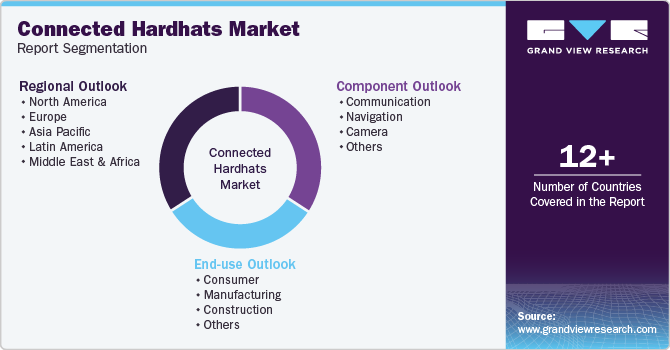
The report forecasts revenue growth at global, regional, and country levels and provides an analysis of the latest industry trends in each of the sub-segments from 2021 to 2033. For this study, Grand View Research has segmented the global connected hardhats market report based on component, end-use, and region.
 To learn more about this report, Download Free Sample Report
 -
Component Outlook (Revenue, USD Million, 2021 - 2033)
-
Communication
-
Navigation
-
Camera
-
Others
-
-
End-use Outlook (Revenue, USD Million, 2021 - 2033)
-
Consumer
-
Manufacturing
-
Construction
-
Others
-
-
Regional Outlook (Revenue, USD Million, 2021 - 2033)
-
North America
-
U.S.
-
Canada
-
Mexico
-
-
Europe
-
Germany
-
UK
-
France
-
-
Asia Pacific
-
China
-
India
-
Japan
-
South Korea
-
Australia
-
-
Latin America
-
Brazil
-
-
Middle East & Africa (MEA)
-
UAE
-
Kingdom of Saudi Arabia (KSA)
-
South Africa
-
-
Research Methodology
The connected hardhats market figures in this report are based on a proven research process that combines executive interviews with secondary research from proprietary databases, company filings, and recognized regulatory and institutional sources. Market size is built through value-chain sizing - reconciling supply-side and demand-side estimates - and triangulated with bottom-up and top-down approaches. Every estimate passes multiple levels of expert validation before publication, with each connected hardhats segment quantified using the revenue-capture definitions in the table below.
Segment Definition
Segment - Component
Revenue capture definition
Communication
This segment captures revenue generated from connected hardhats equipped with communication technologies such as microphones, speakers, push-to-talk systems, wireless communication modules, and voice-enabled features.
Navigation
This segment captures revenue generated from connected hardhats integrated with navigation and location-tracking technologies such as GPS, GNSS, Bluetooth beacons, RFID, and indoor positioning systems.
Camera
This segment captures revenue generated from connected hardhats equipped with built-in cameras, video recording systems, and live-streaming capabilities.
Others
This segment captures revenue generated from additional connected hardhat functionalities such as environmental sensors, biometric monitoring, augmented reality (AR) displays, gas detection sensors, temperature monitoring, and emergency alert features.
Segment - End Use
Revenue capture definition
Consumer
This segment captures revenue generated from connected hardhats used by individual consumers and recreational users for activities requiring enhanced safety, communication, navigation, or monitoring capabilities.
Manufacturing
This segment captures revenue generated from connected hardhats deployed in manufacturing facilities to improve worker safety, monitor environmental conditions, facilitate communication, and support operational efficiency.
Construction
This segment captures revenue generated from connected hardhats used across construction sites for worker safety, location tracking, hazard detection, communication, and project management.
Others
This segment captures revenue generated from connected hardhat deployments across industries such as mining, oil & gas, utilities, energy, warehousing, and other industrial sectors where worker safety and real-time monitoring are critical.
Estimation Model
Layer Name
Key Question
Description
Industrial Workforce & Safety Equipment Base Layer
Which workers require head protection and safety equipment?
Establish the total potential demand base by identifying workers employed across construction, manufacturing, mining, oil & gas, utilities, transportation, and other industrial sectors where hardhat usage is mandatory. It evaluates factors such as workforce size, industrial employment levels, workplace safety regulations, and PPE utilization rates.
Addressable Connected Hardhats Market Layer
Which workplaces can realistically adopt connected hardhat solutions?
Refine the total safety equipment market into the serviceable connected hardhats market by considering factors such as digital transformation initiatives, industrial IoT adoption, workplace safety investments, wireless connectivity availability, regulatory compliance requirements, and smart PPE adoption trends. It determines the share of organizations that can potentially deploy connected hardhats.
Connected Hardhat Adoption Layer
Who is actively utilizing connected hardhats?
Estimate annual demand generation by analyzing the adoption of connected hardhats with communication, navigation, camera, and other advanced features across construction, manufacturing, and other industrial sectors. It converts the addressable market into measurable device deployments, replacement demand, and enterprise contracts.
Revenue Layer
How does connected hardhat adoption translate into market revenue?
Convert device adoption into market revenue through hardware sales. Revenue is generated by applying average selling prices across different end-user industries.
Delivered Customizations
This report has been delivered with the following In-depth customizations
Client Request
Customization Delivered
Value Adds
Technology Analysis (IoT, AI & Wearable Integration)
Delivered analysis of IoT-enabled hardhats, AI-based worker monitoring, sensor technologies, GPS tracking, proximity detection, fatigue monitoring, and edge computing capabilities
Assessment of emerging technology adoption trends
Supported technology roadmap development
Identified next-generation innovation opportunities
Regional & Country Opportunity Analysis
Delivered region-wise and country-wise market sizing, forecasts, and growth analysis across North America, Europe, Asia Pacific, Latin America, and Middle East & Africa
Assessment of workplace safety regulations, industrialization trends, and infrastructure investments
Identification of high-growth countries and emerging opportunities
Supported regional expansion and investment prioritization
Enabled market opportunity assessment
Competitive Benchmarking & Strategic Landscape Analysis
Delivered benchmarking of major connected hardhat manufacturers based on product portfolio, sensor capabilities, AI integration, connectivity technologies, partnerships, geographic presence, and innovation initiatives
Analysis of acquisitions, product launches, strategic collaborations, and funding activities
Supported competitive intelligence and strategic decision-making
Enabled identification of market gaps and growth opportunities
Frequently Asked Questions About This Report
Key players operating in the connected hardhats market include United Safety, Technosoft Engineering Projects Ltd., MSA Safety Incorporated, Westinghouse Electric Company LLC, Luceque, WakeCap Technologies, Knowit, GuangZhou Jepower Technology Co.,Ltd., Excellent Webworld, and Twiceme Technology AB.
The increasing focus on workplace safety and rapid advancements in Internet of Things (IoT) technology are major driving factors behind the market's growth.
North America dominated the global connected hardhats market with the largest revenue share of 42.8% in 2025.
Asia Pacific is the fastest-growing region over the forecast period.
The construction segment led with a 52.2% revenue share in 2025.
The U.S. held the largest market share in 2025.
The global connected hardhats market size was valued at USD 136.1 million in 2025 and is estimated at USD 156.6 million for 2026.
The global connected hardhats market is expected to grow at a CAGR of 14.2% from 2026 to 2033, reaching USD 397.4 million by 2033.
The communication segment held the largest market share of 32.8% in 2025. Increasing adoption of technologically advanced connected hardhats for communication purposes is driving the segment’s growth.
About the Author(s)
Next Generation Technologies Research Team
Technology · Next Generation TechnologiesThis report was authored by the next generation technologies research team at Grand View Research - comprising two research analysts, one senior research analyst, and one industry expert - with specialized expertise in the next generation technologies segment of the technology industry. All findings are based on proprietary technology databases, executive interviews, and regulatory analysis, subject to internal peer review prior to publication.
Last Updated:
Speak to Analyst

Customize this report to your needs - add regions, segments, or data points, with 20% free customization.
Or view our licence options:


ISO 9001:2015 & 27001:2022 Certified
We are GDPR and CCPA compliant! Your transaction & personal information is safe and secure. For more details, please read our privacy policy.


