
- Home
- »
- Advanced Interior Materials
- »
-
Copper Alloys For Connector Market Size Report, 2026-2033GVR Report cover

Copper Alloys For Connector Market (2026 - 2033)
Size, Share & Trends Analysis Report By Alloy Type (High-conductivity Copper Alloys, Beryllium Copper Alloys), By End-use (Telecommunications & Data Centers, Medical Equipment), By Region, And Segment Forecasts
Market Size, 2025
$3.1BMarket Estimate, 2026
$3.3BMarket Forecast, 2033
$5.5BCAGR, 2026–2033
7.7%Copper Alloys For Connector Market Summary
The global copper alloys for connector market size was valued at USD 3.1 billion in 2025 and is projected to grow from USD 3.3 billion in 2026 to USD 5.5 billion by 2033, growing at a CAGR of 7.7% from 2026 to 2033. Asia Pacific dominated the market, accounting for the largest global share of 66.1% in 2025. The market's growth is propelled by the rapid expansion of the electronics and electrical industry, especially in Asia Pacific and North America.
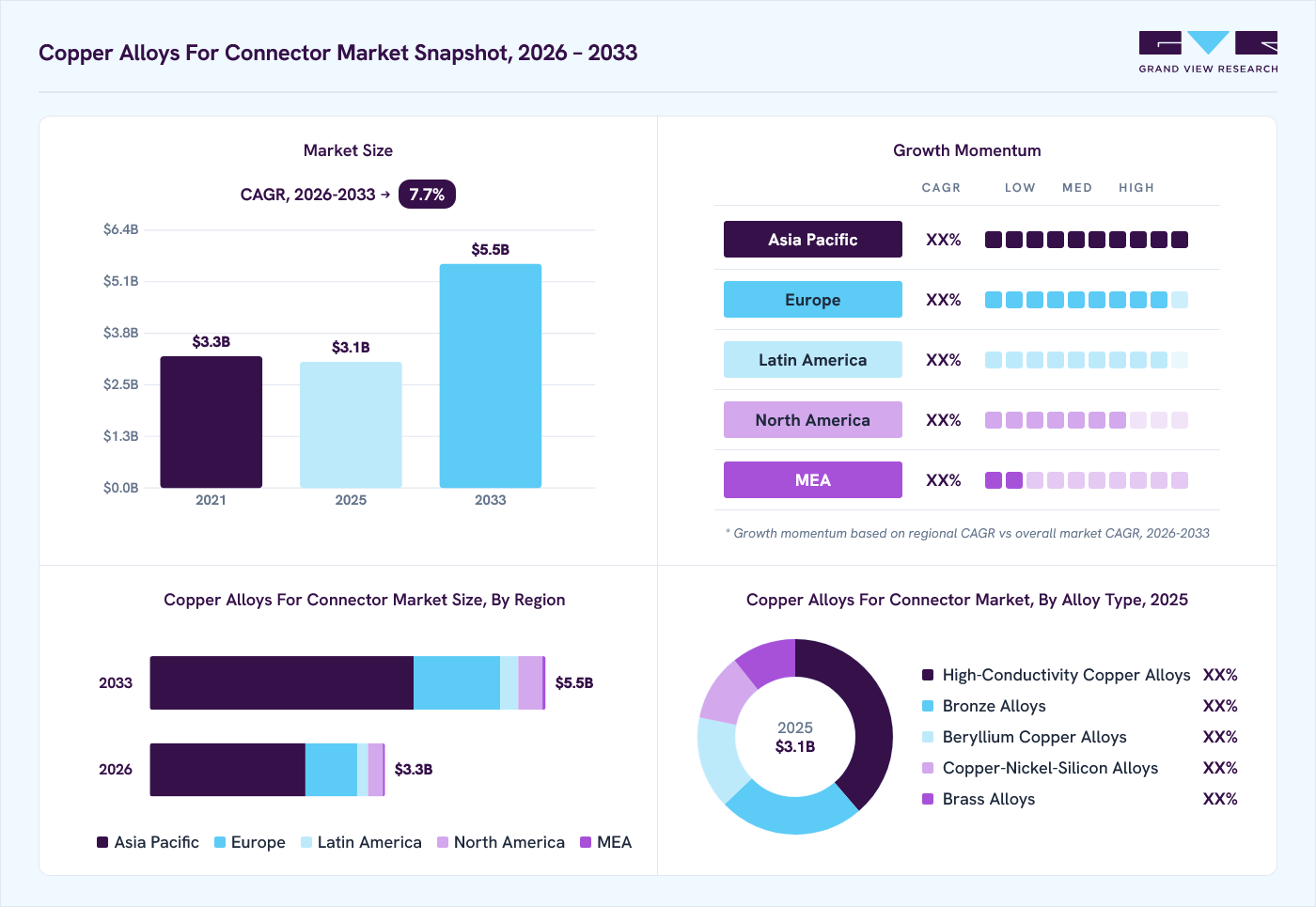 Source: Grand View Research, IR Documents, Primary Interviews, Paid DatabasesTo learn more about this report,
 Download Free Sample Report
Key Market Trends & Insights
- By alloy type: High-conductivity copper alloys segment held the largest share of 38.7% in 2025.
- By end-use: Telecommunication & data centers segment held the largest share of 29.6% in 2025.
Regional Highlights
- Largest regional market: Asia Pacific (66.1% revenue share, 2025)
- By country: China held the largest share of Asia pacific in 2025.
Market Size & Forecast
- Market size in 2025: USD 3.1 Billion
- Estimated market size in 2026: USD 3.3 Billion
- Projected market size by 2033: USD 5.5 Billion
- CAGR (2026-2033): 7.7%
Three ways to get this report
Buy it, customize it, or ask a question.Ask an Analyst
Analyst response in 1 business day
- AccessReport author, directly
- Reply timeWithin 1 working day
- No sales callDirect answer only
- FormatEmail reply
- CostFree, no cost
Get the Full Report
What the study covers
- FormatsPDF · Excel · Dashboard
- Timeline2026–2033 annual, 2025 base
- Coverage20+ countries, 5 regions
- Companies10+ key players profiled
Customize the Report
20% free customization
- IncludeCountries, segments, points
- TailorTo your product definition
- ExtendDeeper competitor detail
- OrA fully bespoke study
- Turnaround5–10 working days
The proliferation of smartphones, tablets, wearable devices, and smart appliances has significantly boosted the demand for miniature, high-performance connectors. Copper alloys are preferred in these applications due to their superior electrical conductivity, thermal stability, and mechanical resilience. As consumer electronics evolve toward smaller and more powerful designs, the need for compact, efficient connectors made from advanced copper alloys will continue to rise.The EV ecosystem demands a robust electrical architecture with highly reliable connectors for battery systems, charging infrastructure, and powertrain components. Alloys such as beryllium copper and copper-nickel-silicon offer the performance and durability required in these high-stress applications. With governments offering incentives and implementing regulations to accelerate EV adoption, the demand for connector-grade materials is expected to grow rapidly in the automotive segment.
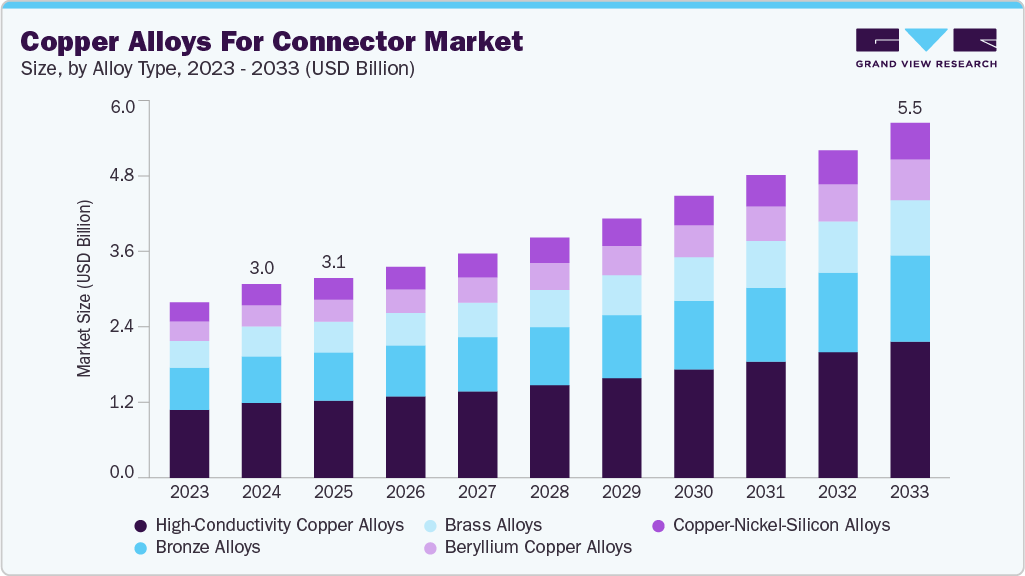 To learn more about this report, Download Free Sample Report
The ongoing development of renewable energy infrastructure, especially solar and wind power, also catalyzes market growth. These systems rely heavily on electrical connectivity for energy transmission, conversion, and storage. Copper-based alloys provide corrosion resistance and electrical efficiency for harsh outdoor environments. Additionally, the growth of smart grids and energy-efficient buildings leads to increased deployment of sophisticated connectors and terminals, further boosting demand.
Technological advancements in telecommunication networks, including the global rollout of 5G and the expansion of data centers, are further contributing to market expansion. These applications require connectors with high-frequency performance, low signal loss, and excellent durability. Alloys such as phosphor bronze and copper-tin are widely used in high-speed data connectors, RF components, and fiber optics. The need for consistent signal integrity in high-bandwidth systems reinforces the demand for premium-grade materials.
Lastly, industrial automation and robotics are emerging as important growth drivers for the copper alloys for connector industry. As manufacturing facilities transition to Industry 4.0 and deploy more automated machinery, the need for reliable electrical connectors increases substantially. These environments demand components that can withstand vibration, wear, and high operating temperatures-characteristics well-matched by advanced copper alloys. As automation and smart manufacturing trends continue to reshape industrial operations, the market is set to benefit from robust long-term demand.
Market Dynamics
The growth of the copper alloys for connectors market is being driven by rising demand for high-performance electrical and electronic connectivity solutions across automotive, telecommunications, consumer electronics, industrial automation, and renewable energy sectors. Copper alloys such as copper-nickel-silicon, copper-chromium-zirconium, phosphor-bronze, and beryllium copper are increasingly preferred for connector applications due to their superior electrical conductivity, mechanical strength, corrosion resistance, and thermal stability.
The rapid electrification of the automotive industry is a major factor driving demand for copper alloys used in connector applications. Electric vehicles (EVs), hybrid electric vehicles (HEVs), and plug-in hybrid electric vehicles (PHEVs) require significantly more electrical connections than conventional internal combustion engine vehicles due to the presence of battery packs, power electronics, electric motors, charging systems, and advanced electronic control units. Copper alloys are widely utilized in connectors because they combine high electrical conductivity with excellent mechanical strength, enabling reliable current transmission while maintaining dimensional stability under demanding operating conditions.
The growing integration of advanced vehicle technologies is further accelerating demand for copper alloy connectors. Modern vehicles increasingly incorporate advanced driver assistance systems (ADAS), infotainment systems, vehicle-to-everything (V2X) communication modules, and autonomous driving technologies, all of which require robust electrical connectivity. Copper alloys such as copper-nickel-silicon, copper-chromium-zirconium, and phosphor-bronze are preferred for these applications due to their superior fatigue, thermal, and corrosion resistance.
Prices of copper, nickel, tin, chromium, and other alloying elements are influenced by factors such as global supply-and-demand imbalances, mining disruptions, geopolitical tensions, energy costs, and trade policies. Sudden increases in raw material prices can reduce profit margins for connector manufacturers and create challenges in maintaining stable pricing for end users, particularly in industries such as automotive, consumer electronics, and telecommunications, where cost competitiveness is critical. Additionally, price uncertainty complicates procurement planning and long-term supply agreements, making it difficult for manufacturers to forecast production costs and investment returns accurately. As a result, prolonged fluctuations in metal prices can slow purchasing decisions, increase operational risks, and limit the adoption of advanced copper alloy connector solutions in price-sensitive applications.Solar power installations, wind farms, battery energy storage systems, and smart grid infrastructure require highly reliable electrical connectors to ensure efficient power transmission and long-term operational stability. Copper alloys are widely used in these applications due to their excellent electrical conductivity, corrosion resistance, thermal performance, and ability to withstand harsh environmental conditions. As governments and private organizations continue to invest in clean energy projects to achieve decarbonization and energy security goals, the demand for high-performance connectors is expected to rise substantially.Analyst Perspective
The copper alloys for the connector market are benefiting from the rapid expansion of digital infrastructure, electrification, and advanced electronics, making the connector market a critical segment within the broader specialty metals industry. The growing deployment of 5G networks, cloud computing facilities, data centers, electric vehicles, industrial automation systems, and high-performance consumer electronics is driving demand for connectors that offer superior electrical conductivity, durability, and reliability.
Drivers, Opportunities & Restraints
The copper alloys for the connector market’s growth is primarily driven by the rising demand for high-performance and miniaturized electronic devices across sectors such as automotive, consumer electronics, and industrial automation. These alloys offer superior conductivity, thermal resistance, and mechanical strength, making them ideal for connectors that withstand high temperatures and electrical loads. Additionally, the increasing penetration of electric vehicles (EVs) and the growing shift toward renewable energy infrastructure are creating a surge in the demand for reliable, durable connectors, further fueling the need for specialized copper alloys.
Significant growth opportunities lie in the ongoing technological advancements in 5G communication, Internet of Things (IoT), and data centers, which require robust high-frequency connectors. Emerging markets, especially in Asia-Pacific and the Middle East & Africa, are witnessing increased infrastructure investments and industrial automation, creating a favorable environment for copper alloy connector adoption. Moreover, the trend toward lightweight and energy-efficient materials in the aerospace and defense sectors opens avenues for developing novel copper-based alloys with enhanced performance characteristics.
Despite its promising outlook, the market faces certain restraints. Fluctuating raw material prices, particularly copper and alloying metals like beryllium and nickel, can significantly impact production costs and pricing strategies. Environmental regulations and health concerns regarding using certain alloying elements, such as beryllium, may also limit material selection and usage. Additionally, competition from alternative materials like aluminum or conductive polymers in low-cost applications may restrain market penetration in price-sensitive segments.
Alloy Type Insights
Based on alloy type, the high-conductivity copper alloys segment led the market with the largest revenue share of 38.7% in 2025. High-conductivity copper alloys are gaining attention from various industries as demand for faster data transmission and miniaturized electronics exhibits significant growth. Copper alloy-based connectors offer an ideal balance of electrical performance, mechanical strength, and corrosion resistance, while serving numerous industries, including automotive, telecom, and consumer electronics. The significant pace of digital transformation, growing automation, and rising demand for electrical components, such as power connectors, terminals, and busbars, across industries are expected to support the growth of this segment.
The copper-nickel-silicon alloys segment is anticipated to register the significant CAGR over the forecast period, as manufacturers seek materials that combine high strength, high thermal dissipation, and good conductivity. These alloys offer excellent stress relaxation, corrosion resistance, and fatigue strength. They are ideal for high-density, high-reliability connectors in electric vehicles, telecom infrastructure, industrial automation, and aerospace systems. CuNiSi alloys are preferred for their ability to maintain contact force and signal performance in compact, high-temperature environments.
End Use Insights
Based on end use, the telecommunication & data centers segment led the market with the largest revenue share of 29.6% in 2025. The growing demand for sophisticated technology-powered networks and high-performance, high-speed data transfer has resulted in various changes in the telecommunications industry. The increasing global penetration of smartphone devices and appliances compatible with IoT and smart technology has created a need for reliable, high-performance connectors across sectors. For instance, in July 2025, Alibaba Cloud announced its new data centers in Malaysia and the Philippines to meet the growing demand for cloud services. It already has two data centers in Malaysia. It also announced the launch of the AI Global Competency Center (AIGCC) in Singapore. Such developments are expected to support segment growth over the forecast period.
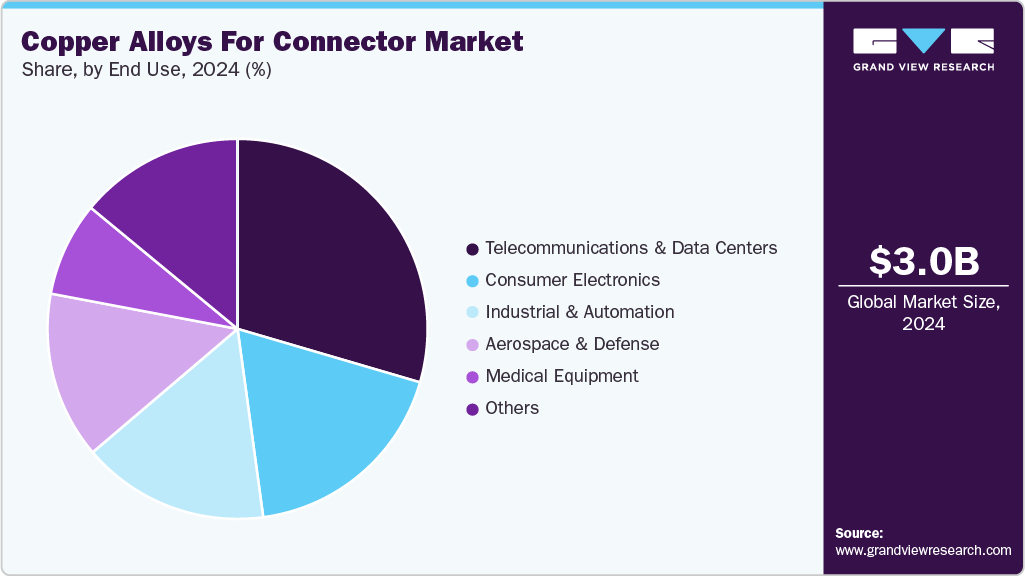 To learn more about this report, Download Free Sample Report
The medical equipment segment is anticipated to grow significantly over the forecast period. The growing adoption of various medical devices, driven by advances in healthcare technology and the focus of healthcare systems on improved patient outcomes, is contributing to the rising demand for copper alloy-based connectors. Materials used in manufacturing medical devices in critical categories, such as implantable, are of greater significance. Biocompatibility and longevity of these materials play a crucial role in such cases. Copper alloys are recognized for their superior electrical conductivity, strong mechanical durability, and natural antimicrobial effects that reduce microbial transmission, making them a preferred choice for medical devices.
Regional Insights
Asia Pacific dominated the copper alloys for connector market with the largest revenue share of 66.1% in 2025. Asia Pacific is a major regional market in the global copper alloys for connector industry. The regional growth is driven by significant pace of industry transition to digitization and automation, rising adoption of digital technologies by customers and businesses, and presence of multiple manufacturing industry participants from sectors such as automotive, chemical & materials, electronics, household appliances, and consumer goods. Countries such as China, Japan, South Korea, and India play a vital role in expanding the application scope of copper alloys. According to the U.S. International Trade Commission, EV exports from China to the U.S. increased approximately 1,016% from 2018 to 2023, with nearly 1.6 million EVs exported in 2023. Such developments are projected to influence this market and generate greater opportunities for the copper alloys industry.
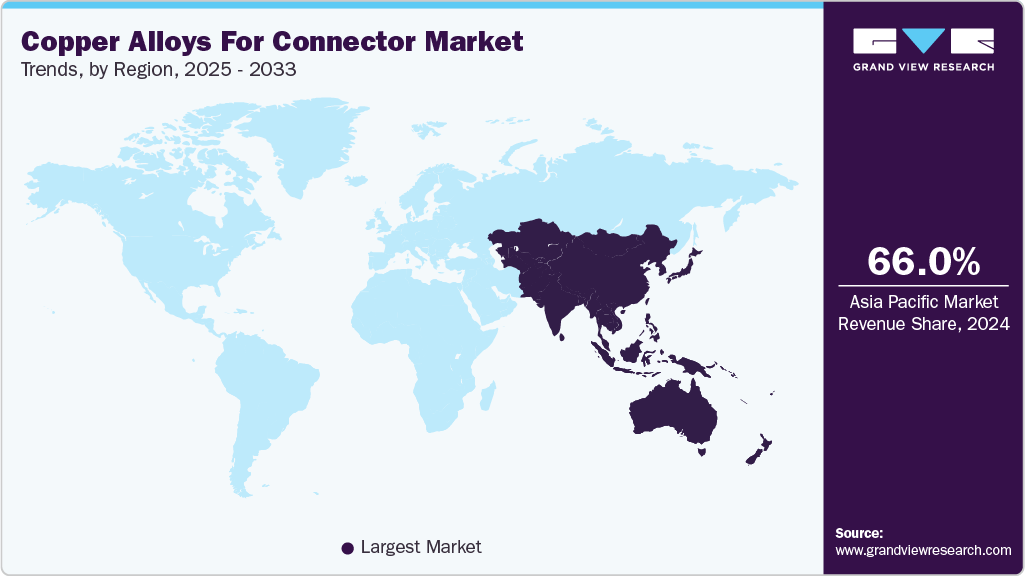 To learn more about this report, Download Free Sample Report
China Copper Alloys for Connector Market Trends
The copper alloys for connector market in China held the largest share in the Asia Pacific region in 2025.
North America Copper Alloys For Connector Market Trends
The North America copper alloys for connector industry experienced substantial growth, primarily driven by increasing electrification and digitalization across several industries. The rise of EVs and ongoing advancements in aerospace, defense, and data center infrastructure significantly boost demand for connectors made from copper alloys. These materials offer excellent electrical conductivity, thermal stability, and durability, essential for managing high power loads and ensuring reliable signal transmission in demanding applications. As these sectors push for higher performance and miniaturization, copper alloys remain critical.
The U.S. copper alloys for connector industry’s growth is fueled by growing electrification and adoption of renewable energy adoption. The excellent conductivity of copper drives demand from industries, such as industrial automation, telecommunication, consumer electronics, and aerospace & defense. Advances in alloy technology enhance the mechanical strength and corrosion resistance of copper alloys, broadening their scope of application across the aerospace, automotive, and electronics industries.
Europe Copper Alloys For Connector Market Trends
Europe is one of the key regions in the global copper alloys for connector industry. A strong manufacturing sector operating across countries such as Germany, France, the UK, and others facilitates the growth of this market. In recent years, the EU has increased its focus on becoming carbon neutral and reducing 90.0% of its greenhouse gas emissions by 2050. Such initiatives by governing authorities stimulate industries and organizations to embrace digitalization and electrification, leading to a growing demand for copper alloy-based connectors.
Latin America Copper Alloys For Connector Market Trends
Latin America is the most significant region for raw materials supply in the copper alloys for connector industry, as about 65.0% of identified copper that is yet to be unearthed is found in just five key countries, including Chile and Peru. According to the U.S. Geological Survey, Mineral Commodity Summaries published in January 2025, Chile's estimated copper mine production in 2024 was 5,300 thousand metric tons, which accounted for nearly 23.0% of the global estimated copper mine production of 23,000 thousand metric tons.
Middle East & Africa Copper Alloys For Connector Market Trends
The Middle East & Africa region is starting to embrace copper alloys for connectors, driven by growing investments in infrastructure development, expanding telecommunications networks, and the rising adoption of electric vehicles and renewable energy systems that require reliable and efficient electrical connectivity solutions. Countries such as Zambia and Congo (Kinshasa) play a notable role in raw material and supply chain efficiencies of this market. According to the U.S. Geological Survey, Mineral Commodity Summaries, January 2025, the estimated copper mine production of Congo (Kinshasa) in 2024 was 3,300 thousand metric tons, and it was 680 thousand metric tons for Zambia.
Key Copper Alloys For Connector Company Insights
Some of the key players operating in the market include AMPCO METAL, KME Group, and others
-
AMPCO METAL is a global engineering materials provider renowned for its advanced alloy solutions. It caters to a broad spectrum of high-performance industries, such as aerospace, automotive, defense, marine, oil and gas, and electronics. The company stands out for its deep metallurgical expertise and consistent commitment to innovation in non-ferrous metals. AMPCO METAL's research-driven approach enables it to develop tailored alloys that meet stringent operational demands, such as high conductivity, corrosion resistance, and mechanical strength under extreme conditions.
-
KME Group is a global manufacturer of copper and copper-alloy semi-finished products recognized for its extensive metallurgical know-how and innovation-driven approach. As one of the world’s largest producers, the company fabricates rolled products, tubes, bars, cables, and custom-engineered components using advanced alloys. With a network of state‑of‑the‑art production plants across Europe and China, KME delivers tailored solutions for diverse industries, ranging from architecture and plumbing to electronics, automotive, and energy sectors.
Key Copper Alloys For Connector Companies:
The following key companies have been profiled for this study on the copper alloys for connector market.
- AMPCO METAL
- KME Group
- Lebronze Alloys
- Materion Corporation
- Mitsubishi Materials Corporation
- Nexans
- NGK INSULATORS, LTD.
- Proterial, Ltd.
- thyssenkrupp Materials Services GmbH
- Wieland Group
Competitive Benchmarking
Category
Operating Strategies
Competitive Edge
Weakness
Established Players (e.g. AMPCO METAL, KME Group, Lebronze Alloys, Materion Corporation)
- Mature participants in the copper alloys for connector market primarily focus on vertically integrated production, advanced alloy development, and long term partnerships with automotive, electronics, telecommunications, aerospace, and industrial equipment manufacturers.
- These companies operate across multiple stages of the value chain, including copper refining, alloy production, rolling, strip processing, and precision connector material manufacturing.
- Established players possess significant competitive advantages through their extensive metallurgical expertise, advanced processing technologies, and large scale manufacturing infrastructure.
- Their ability to produce highly engineered copper alloy materials with precise mechanical and electrical properties enables them to meet stringent performance requirements in critical applications.
- Despite their strong market positions, mature players face challenges associated with fluctuations in copper and alloying metal prices.
- Changes in raw material costs can affect profitability and pricing competitiveness, particularly in long term supply agreements
Emerging & Regional Players (e.g. Nexans, Wieland Group)
- Emerging participants in the copper alloys for connector market generally focus on specialized alloy development, niche applications, and technology driven differentiation.
- Rather than competing directly with established producers on production volume, these companies often target high growth sectors .
- Emerging companies benefit from operational agility and the ability to rapidly develop and commercialize new copper alloy formulations.
- Their smaller organizational structures often allow faster decision making, shorter development cycles, and greater flexibility in addressing specialized customer requirements.
- Emerging participants face significant challenges related to limited production capacity, lower economies of scale, and restricted access to raw materials.
- Competing with established manufacturers that possess integrated supply chains, extensive customer networks, and proven production capabilities can be difficult, particularly in applications requiring large volumes and consistent global supply.
Recent Development
-
In March 2025, Lebronze alloys has acquired two companies, Allied Copper Alloys (ACA) and AW Fraser, as a significant move in its growth strategy. This acquisition aims to enhance Lebronze alloys' global expansion, improve production and service capabilities, and strengthen its position in the specialty alloys market.
-
In December 2024, AMPCO METAL acquired Schmelzmetall Group, a Swiss-based producer of high-performance copper alloys. This acquisition, finalized in October 2024, marks a significant milestone for both companies, enabling them to combine their technological expertise and product portfolios. The integration expands AMPCO METAL's offerings to include Schmelzmetall's specialized copper alloys, such as Beryllium-containing powders and other high-purity materials, which are highly valued in aerospace, defense, additive manufacturing, and other advanced sectors.
Copper Alloys For Connector Market Report Scope
Report Attribute
Details
Market definition
Market size represents the annual sales value of refined copper alloys consumed in the production of electrical and electronic connectors across various end-use applications.
Market size value in 2025
USD 3.1 billion
Market size value in 2026
USD 3.3 billion
Revenue forecast in 2033
USD 5.5 billion
Growth rate
CAGR of 7.7% from 2026 to 2033
Base year for estimation
2025
Historical data
2021 - 2024
Forecast period
2026 - 2033
Quantitative units
Revenue in USD million, volume in kilotons, and CAGR from 2026 to 2033
Report coverage
Revenue forecast, volume forecast, company ranking, competitive landscape, growth factors, and trends
Segments covered
Alloy type, end-use, region
Regional scope
North America; Europe; Asia Pacific; Latin America; Middle East & Africa
Country scope
U.S., Canada, Mexico, Germany, UK, France, Italy, India, China, Japan, South Korea, Brazil
Key companies profiled
AMPCO METAL, KME Group, Lebronze Alloys, Materion Corporation, Mitsubishi Materials Corporation, Nexans, NGK Insulators, Ltd., Proterial, Ltd., thyssenkrupp Materials Services GmbH, Wieland Group.
Customization scope
Free report customization (equivalent up to 8 analysts' working days) with purchase. Addition or alteration to country, regional & segment scope.
Pricing and purchase options
Avail customized purchase options to meet your exact research needs. Explore purchase options
Global Copper Alloys For Connector Market Report Segmentation
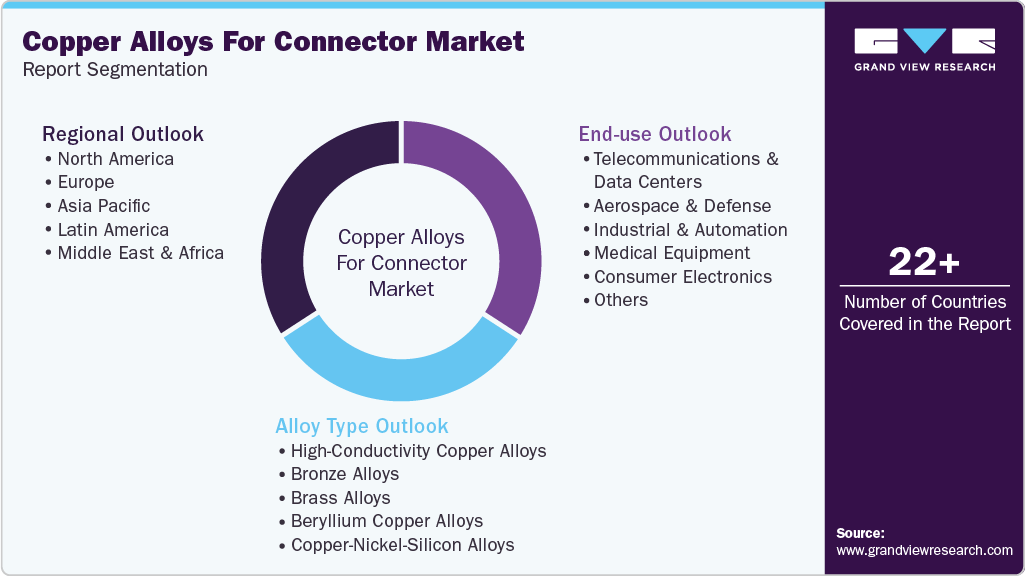
This report forecasts volume & revenue and volume growth at the global, regional, and country levels and provides an analysis of the latest industry trends in each of the sub-segments from 2021 to 2033. For this study, Grand View Research has segmented the global copper alloys for connector market report based on alloy type, end use, and region:
 To learn more about this report, Download Free Sample Report
-
Alloy Type Outlook (Volume, Kilotons; Revenue, USD Million, 2021 - 2033)
-
High-Conductivity Copper Alloys
-
Bronze Alloys
-
Brass Alloys
-
Beryllium Copper Alloys
-
Copper-Nickel-Silicon Alloys
-
-
End Use Outlook (Volume, Kilotons; Revenue, USD Million, 2021 - 2033)
-
Telecommunications & Data Centers
-
Aerospace & Defense
-
Industrial & Automation
-
Medical Equipment
-
Consumer Electronics
-
Others
-
-
Regional Outlook (Volume, Kilotons; Revenue, USD Million, 2021 - 2033)
-
North America
-
U.S.
-
Canada
-
Mexico
-
-
Europe
-
Germany
-
UK
-
Italy
-
France
-
-
Asia Pacific
-
China
-
India
-
Japan
- South Korea
-
-
Latin America
-
Brazil
-
-
Middle East & Africa
-
Research Methodology
The copper alloys for connector market figures in this report are based on a proven research process that combines executive interviews with secondary research from proprietary databases, company filings, and recognized regulatory and institutional sources. Market size is built through value-chain sizing - reconciling supply-side and demand-side estimates - and triangulated with bottom-up and top-down approaches. Every estimate passes multiple levels of expert validation before publication, with each copper alloys for connector segment quantified using the revenue-capture definitions in the table below.
Segment Definition
Alloy Type
Revenue Capture Definition
High-Conductivity Copper Alloys
Revenue in this segment is generated from the sale of copper alloys with superior electrical and thermal conductivity used in high performance electrical and electronic connectors. Market value is driven by demand from automotive, telecommunications, power distribution, and consumer electronics applications.
Bronze Alloys
The market captures revenue from bronze based connector alloys supplied for applications requiring enhanced wear resistance, corrosion resistance, and mechanical durability. Demand from industrial equipment, marine systems, and heavy electrical connectors contributes to segment growth.
Brass Alloys
Revenue is derived from the production and supply of brass alloys used in cost effective electrical connectors, terminals, and precision components. Growth is supported by widespread use in consumer electronics, automotive wiring, and electrical hardware.
Beryllium Copper Alloys
The segment generates revenue through the sale of high strength and high conductivity beryllium copper alloys designed for premium connector applications. Market demand is influenced by aerospace, defense, automotive, and high reliability electronic systems requiring superior fatigue resistance.
Copper-Nickel-Silicon Alloys
Revenue is captured from copper nickel silicon alloys used in advanced connectors that require a balance of electrical conductivity, strength, and heat resistance. The segment benefits from increasing adoption in electric vehicles, telecommunications infrastructure, and miniaturized electronic devices.
End Use
Revenue Capture Definition
Telecommunications & Data Centers
Revenue in this segment is generated from copper alloys used in high speed connectors, network infrastructure, servers, and data center equipment. Market growth is supported by expanding cloud computing, 5G deployment, and rising demand for reliable signal transmission.
Aerospace & Defense
The market captures revenue from copper alloy connectors supplied for aircraft, spacecraft, military electronics, and defense communication systems. Demand is driven by stringent performance requirements, durability, and reliability in harsh operating environments.
Industrial & Automation
Revenue is derived from copper alloys used in connectors for industrial machinery, robotics, factory automation, and process control systems. Increasing industrial automation and smart manufacturing investments contribute to segment expansion.
Medical Equipment
The segment generates revenue through the use of copper alloy connectors in diagnostic devices, patient monitoring systems, imaging equipment, and surgical instruments. Market demand is supported by the need for precision, reliability, and compliance with medical performance standards.
Consumer Electronics
Revenue is captured from copper alloys used in connectors for smartphones, laptops, wearable devices, gaming systems, and household electronics. Segment growth is influenced by rising electronics production, device miniaturization, and frequent product upgrades.
Others
This segment includes electric vehicles (EVs), conventional automotive systems, and railway applications. Copper alloy connectors are used in battery packs, charging stations, control modules, infotainment systems, and signaling equipment.
Estimation Model
Layer Name
Key Question
Description
Electronics & Electrical Demand Base Layer
What forms the demand base?
Identify global demand from major connector consuming industries including automotive, consumer electronics, telecommunications, data centers, industrial automation, aerospace & defense, and renewable energy. Assess production volumes of electrical and electronic equipment requiring connectors. This layer establishes the total addressable demand for copper alloys used in connector manufacturing.
Connector Application Penetration Layer
Where are copper alloys utilized?
Estimate the penetration of copper alloys across key connector applications including automotive wiring harnesses, EV battery connectors, USB and charging connectors, telecommunications equipment, industrial control systems, aerospace connectors, and power distribution systems. Analyze the adoption of copper based alloys such as brass, phosphor bronze, beryllium copper, and copper nickel silicon alloys across end use industries.
Copper Alloy Consumption Intensity Layer
How much copper alloy is consumed?
Analyze copper alloy consumption intensity based on connector production volumes, miniaturization trends, electrical conductivity requirements, signal transmission performance, and durability specifications. Evaluate material usage per connector type and application. Consumption intensity varies according to connector design complexity, technological advancements, and performance requirements in high speed and high power applications.
Revenue Layer
How is market revenue generated?
Market revenue is quantified through the sale of copper alloy strips, sheets, rods, and precision engineered materials used in connector manufacturing. Revenue generation is driven by demand from automotive, electronics, telecommunications, industrial, aerospace, and energy sectors. Market value is influenced by copper prices, alloy composition, processing technology, performance characteristics, and regional manufacturing activity.
Delivered Customizations
This report has been delivered with the following In-depth customizations
Client Request
Customization Delivered Value Adds Regional Segmentation
Detailed regional analysis of the copper alloys for connector market across North America, Europe, Asia Pacific, Latin America, and Middle East & Africa. Included evaluation of electronics manufacturing output, automotive electrification trends, telecommunications infrastructure investments, semiconductor production, renewable energy installations, and industrial automation activities influencing connector demand.
Identified high growth manufacturing hubs and emerging demand centers for connector materials. Enabled strategic expansion planning based on EV production, electronics manufacturing growth, and digital infrastructure investments. Supported regional demand forecasting and market entry strategies.
Cross Segmentation
Comprehensive cross segmentation analysis by alloy type and end use industry, including copper nickel silicon alloys in automotive connectors, copper chromium zirconium alloys in industrial applications, beryllium copper alloys in high performance electronics, and phosphor bronze alloys in telecommunications connectors. Evaluated consumption patterns, conductivity requirements, mechanical performance characteristics, and regional demand trends across automotive, electrical & electronics, telecommunications, aerospace, and industrial sectors.
Enabled identification of the most attractive alloy end use combinations and emerging application opportunities. Supported product portfolio optimization, customer targeting, and investment prioritization strategies.
Opportunity Assessment
Identification of high growth opportunities across electric vehicles, advanced driver assistance systems, charging infrastructure, 5G networks, data centers, artificial intelligence hardware, consumer electronics, industrial automation systems, aerospace electronics, and renewable energy applications.
Enabled prioritization of high return growth segments and emerging regional opportunities. Supported long term investment planning, capacity expansion decisions, and strategic business development initiatives aligned with global digitalization and electrification trends.
Frequently Asked Questions About This Report
The key factor driving the growth of the global copper alloys for connector market is the increasing demand for high-performance electrical and electronic components that require materials with excellent conductivity, strength, and corrosion resistance.
Asia Pacific is anticipated to register the fastest CAGR over the forecast period.
Based on alloy type, high-conductivity copper alloys accounted for largest revenue share of 38.7% in 2025, while copper-nickel-silicon alloys registered a CAGR of 8.1% over the forecast period.
Based on end use, telecommunications & data centers accounted for largest revenue share of 29.6% in 2025.
The key players operating in the copper alloys for connector market are AMPCO METAL, KME Group, Lebronze Alloys, Materion Corporation, Mitsubishi Materials Corporation, Nexans, NGK Insulators, Ltd., Proterial, Ltd., thyssenkrupp Materials Services GmbH, Wieland Group.
The copper alloys for connector market size was valued at USD 3.1 billion in 2025 and is estimated at USD 3.3 billion in 2026.
The copper alloys for connector market is expected to grow at a compound annual growth rate of 7.7% from 2026 to 2033 to reach USD 5.5 billion by 2033.
Asia Pacific dominated the market with revenue share of 66.1% in 2025.
China dominated the Asia Pacific market with revenue share of 73.9% in 2025.
About the Author(s)
Advanced Interior Materials Research Team
Advanced Materials · Advanced Interior MaterialsThis report was authored by the advanced interior materials research team at Grand View Research - comprising two research analysts, one senior research analyst, and one industry expert - with specialized expertise in the advanced interior materials segment of the advanced materials industry. All findings are based on proprietary advanced materials databases, executive interviews, and regulatory analysis, subject to internal peer review prior to publication.
Last Updated:
Speak to Analyst

Customize this report to your needs - add regions, segments, or data points, with 20% free customization.
Or view our licence options:


ISO 9001:2015 & 27001:2022 Certified
We are GDPR and CCPA compliant! Your transaction & personal information is safe and secure. For more details, please read our privacy policy.


