
- Home
- »
- Next Generation Technologies
- »
-
Data Center Auxiliary Equipment Market Market Report 2026-2033GVR Report cover

Data Center Auxiliary Equipment Market (2026 - 2033)
Size, Share & Trends Analysis Report By Component (Power Systems, Cooling Systems, Monitoring & Management Systems), By Facility Type (Enterprise Data Centers, Edge Data Centers), By End-use, By Region, And Segment Forecasts
Market Size, 2025
$67.5BMarket Estimate, 2026
$76.1BMarket Forecast, 2033
$164.5BCAGR, 2026–2033
11.6%Data Center Auxiliary Equipment Market Summary
The global data center auxiliary equipment market market size was valued at USD 67.5 billion in 2025 and is projected to grow from USD 76.1 billion in 2026 to USD 164.5 billion by 2033, at a CAGR of 11.6% from 2026 to 2033. The market in North America dominated with a revenue share of 43.0% in 2025. The growing complexity of supply chains and third-party vendor ecosystems is driving cybersecurity in the critical infrastructure protection market.
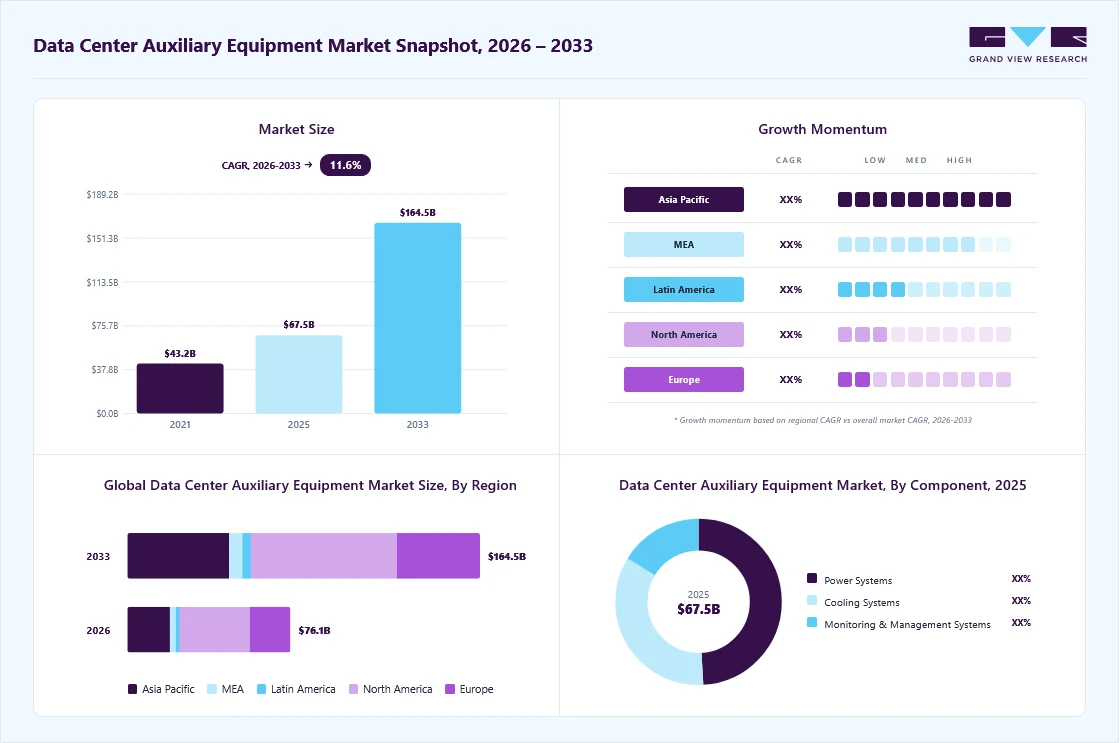 Source: Grand View Research, IR Documents, Primary Interviews, Paid DatabasesTo learn more about this report,
 Download Free Sample Report
Key Market Trends & Insights
- By component: Power systems segment held the largest market share of 49.0% in 2025.
- By facility type: Hyperscale data centers segment held the largest market share in 2025.
- By end-use: Cloud service providers segment held the largest market share in 2025.
Regional Highlights
- Largest regional market: North America (43.0% revenue share, 2025)
- Fastest-growing regional market: Asia Pacific (highest CAGR, 2026-2033)
- By country: The U.S. held the largest market share in 2025
Market Size & Forecast
- Market size in 2025: USD 67.5 Billion
- Estimated market size in 2026: USD 76.1 Billion
- Projected market size by 2033: USD 164.5 Billion
- CAGR (2026-2033): 11.6%
Prism AI by Grand View Research Free to tryAsk a question about the data center auxiliary equipment marketTry asking✓Every figure cited from GVR research Prefer the report? Download free sample →
The expansion of hyperscale, edge, and colocation data centers is a major driver shaping the growth of the data center auxiliary equipment market. Hyperscale operators, driven by soaring cloud adoption, AI workloads, and enterprise digital transformation, are constructing massive campuses capable of supporting tens of thousands of high-performance servers. These facilities require a broad array of auxiliary equipment, including backup generators, cooling towers, air handling units, pumps, and environmental monitoring systems, to ensure uninterrupted operation, optimal thermal management, and energy efficiency. As these campuses scale in both size and density, auxiliary systems must evolve to handle higher mechanical loads, increased airflow requirements, and the complex distribution of utilities across multiple zones. The demand for modular, high-capacity, and energy-efficient auxiliary solutions is therefore escalating, with operators prioritizing reliability, redundancy, and performance to safeguard mission-critical workloads while optimizing operational expenditure.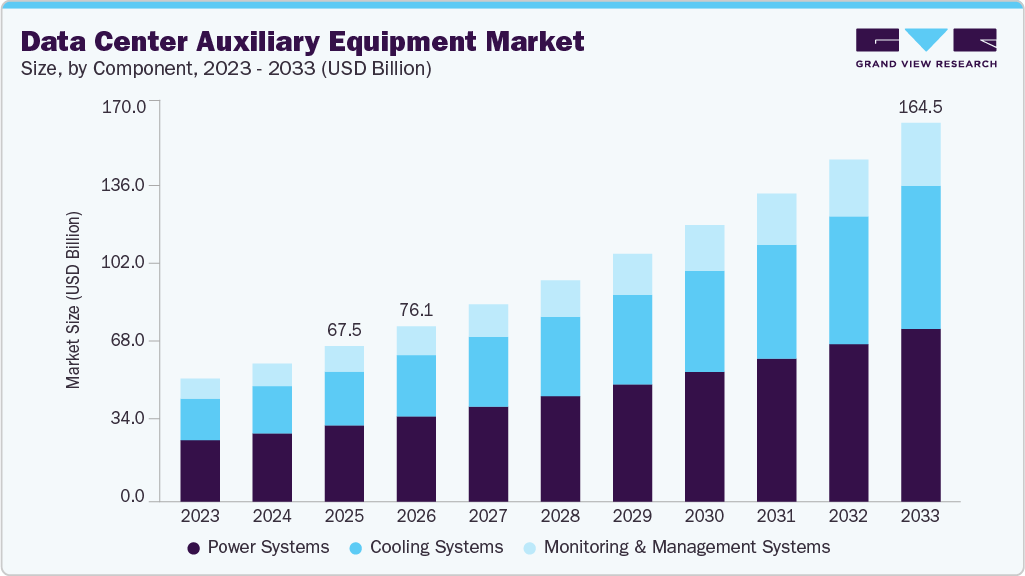 To learn more about this report, Download Free Sample Report
The emergence of AI-powered cyber threats is driving the data center auxiliary equipment industry. Attackers are beginning to leverage machine learning to automate reconnaissance, evade detection, and launch more targeted, persistent threats against industrial systems. These advanced techniques make traditional signature-based defenses inadequate, especially in high-value infrastructure environments. To counter this, infrastructure operators are turning to AI-driven threat detection platforms capable of analyzing vast volumes of data, learning behavioral baselines, and flagging anomalies in real time. These solutions improve response time and help identify zero-day vulnerabilities and previously unknown attack patterns, reinforcing security in increasingly complex digital ecosystems.
The shift toward edge computing and distributed digital infrastructure is another compelling driver. Edge facilities, which are often deployed in non-traditional or constrained environments such as urban buildings, industrial sites, and telecom hubs, require auxiliary equipment that is compact, energy-efficient, and highly reliable. Unlike large hyperscale campuses, edge nodes often lack direct access to centralized cooling or power infrastructure, necessitating self-contained, modular, and autonomous auxiliary systems. Equipment such as localized micro-cooling units, small-capacity UPS modules, and intelligent environmental monitoring systems enable edge facilities to maintain operational continuity while minimizing space and energy consumption. As the number of edge facility types grows to support low-latency applications, industrial IoT, and 5G networks, auxiliary equipment tailored to these environments is increasingly in demand.
Furthermore, the integration of intelligent monitoring and automation in liquid and immersion cooling systems is expanding the scope and complexity of auxiliary equipment. Modern auxiliary systems incorporate sensors, flow meters, and fluid quality monitoring tools that provide real-time data on operational status, enabling predictive maintenance and system optimization. This reduces the risk of downtime, enhances equipment lifespan, and ensures that cooling performance remains consistent even during periods of peak demand. By combining automation, analytics, and high-performance auxiliary infrastructure, data center operators can fully leverage the advantages of liquid and immersion cooling technologies, driving continuous investment in this critical segment of the market. TrendForce’s report highlights that the introduction of NVIDIA’s Blackwell platform is expected to boost the adoption of liquid cooling solutions, increasing their share from approximately 10% in 2024 to more than 20% in 2025.
Component Insights
The power systems segment dominated the data center auxiliary equipment market with a market share of 49.0% in 2025. The power systems segment is experiencing strong momentum in the data center auxiliary equipment market as operators confront the rapidly increasing power demands of AI, HPC, and hyperscale facility types. Modern data centers are transitioning from traditional kilowatt-scale racks to multi-kilowatt and even megawatt-scale compute clusters fueled by GPU accelerators. This shift is driving demand for more resilient, higher-capacity, and precision-engineered power systems that can ensure stable delivery under unprecedented electrical loads. Advanced switchgear, intelligent UPS systems, modular PDUs, and high-voltage distribution units are essential for maintaining power quality, preventing voltage sags, and handling the extreme density fluctuations typical of AI workloads. As computational intensity accelerates across cloud, enterprise, and edge environments, the need for power systems with superior load-balancing capabilities, higher fault tolerance, and rapid scalability remains a major market driver.
The cooling systems segment is projected to be the fastest-growing segment from 2026 to 2033. The shift toward predictive maintenance and intelligent data center operation is contributing to rising investments in cooling infrastructure. Modern cooling systems are increasingly equipped with sensors, digital twins, AI-driven controllers, and remote monitoring capabilities, enabling granular thermal optimization and early detection of inefficiencies or failures. These technologies transform cooling from a reactive mechanical function into a dynamic, insight-driven operational layer, allowing operators to reduce downtime, optimize capacity planning, and extend equipment lifespan. The value proposition of intelligent cooling reduces OPEX, improves equipment reliability, and enhances automation, making it a major driver of market growth, especially as operators prioritize long-term operational resilience.
Facility Type Insights
The hyperscale data centers segment dominated the data center auxiliary equipment market in 2025. The rapid shift toward edge-integrated hyperscale ecosystems, where centralized hyperscale campuses are increasingly interconnected with thousands of micro-edge sites that handle latency-sensitive workloads, is propelling market growth. This distributed model requires hyperscalers to coordinate power and cooling efficiency across both massive and compact facilities. The need for seamless operational synchronization between central and peripheral compute locations intensifies the demand for unified auxiliary systems, such as smart cooling controllers, multi-site power management platforms, portable battery modules, and compact precision cooling units, all engineered for edge coexistence. Hyperscalers are investing in auxiliary equipment that can bridge this multi-layered ecosystem, ensuring that edge and core nodes operate with consistent stability, efficiency, and resilience. This convergence between hyperscale and edge infrastructure is creating new market opportunities for vendors offering scalable, cross-environment auxiliary solutions.
The AI & HPC data centers segment is projected to be the fastest-growing segment from 2026 to 2033. The consolidation of AI workloads into hyperscale, colocation, and specialized AI data centers is also accelerating the need for sophisticated auxiliary systems. These facilities often host multi-tenant GPU clusters, shared HPC resources, or AI training workloads for cloud service providers, creating extremely high utilization levels with little tolerance for downtime. To meet service-level requirements and ensure predictable performance, operators are investing heavily in resilient auxiliary equipment, including redundant UPS topologies, high fault current switchgear, advanced energy storage systems, and automated failover mechanisms. This shift is driving demand for intelligent monitoring and management systems that can track thermal, electrical, mechanical, and operational data in real-time. The interdependency between compute reliability and auxiliary infrastructure is becoming more pronounced as AI workloads scale, pushing operators to modernize their entire facility ecosystem.
End-use Insights
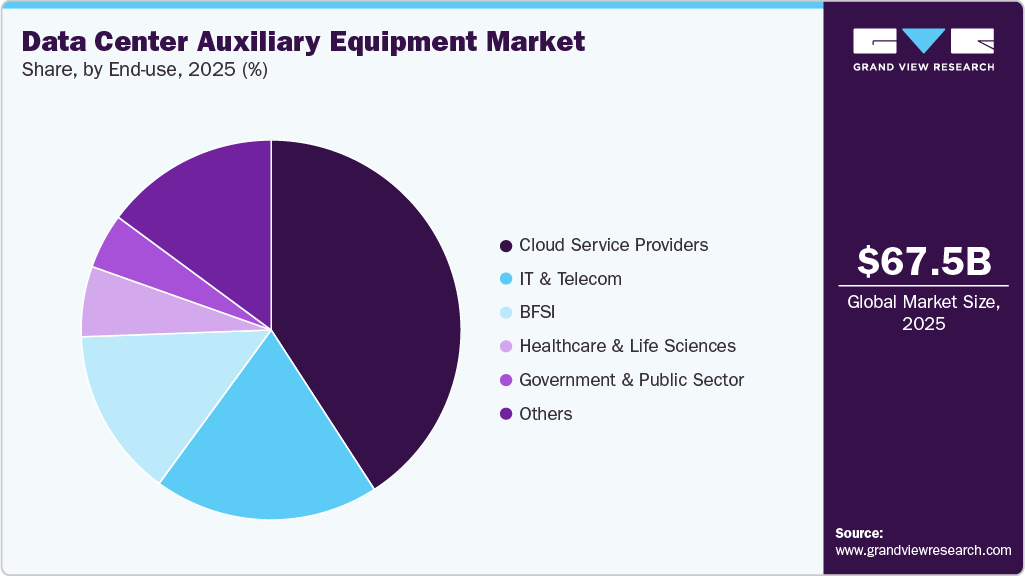
The cloud service providers segment dominated the data center auxiliary equipment market in 2025. The increasing dominance of cloud-native applications and always-on digital services drives the adoption of data center auxiliary equipment. Cloud service providers must guarantee extremely high uptime levels to support enterprise workloads, financial transactions, streaming platforms, and mission-critical applications. This requirement places immense pressure on power continuity, thermal stability, and fault detection systems within data centers. As a result, cloud operators invest in redundant generators, advanced battery storage systems, fault-tolerant switchgear, and real-time monitoring solutions that can identify and mitigate risks before service disruptions occur. The emphasis on uptime and service-level agreements elevates auxiliary equipment from a supporting role to a strategic component of cloud infrastructure.
 To learn more about this report, Download Free Sample Report
The IT & Telecom segment is projected to grow significantly during the forecast period. The rapid growth of digital payments, mobile banking, and real-time transaction platforms is also driving the need for scalable and high-density data center environments supported by robust auxiliary equipment. Instant payments, UPI-like architectures, blockchain-based settlement layers, algorithmic trading, and mobile-first financial services require extremely low-latency processing and uninterrupted power supply. As transaction volumes surge, IT & Telecom organizations are expanding their compute resources and deploying denser server racks, which creates higher power demands and more complex cooling challenges. This trend is fueling the adoption of scalable power distribution solutions, efficient CRAC/CRAH systems, liquid cooling in high-density zones, and advanced airflow containment solutions that maintain thermal stability in increasingly compact and high-performance financial data center environments.
Regional Insights
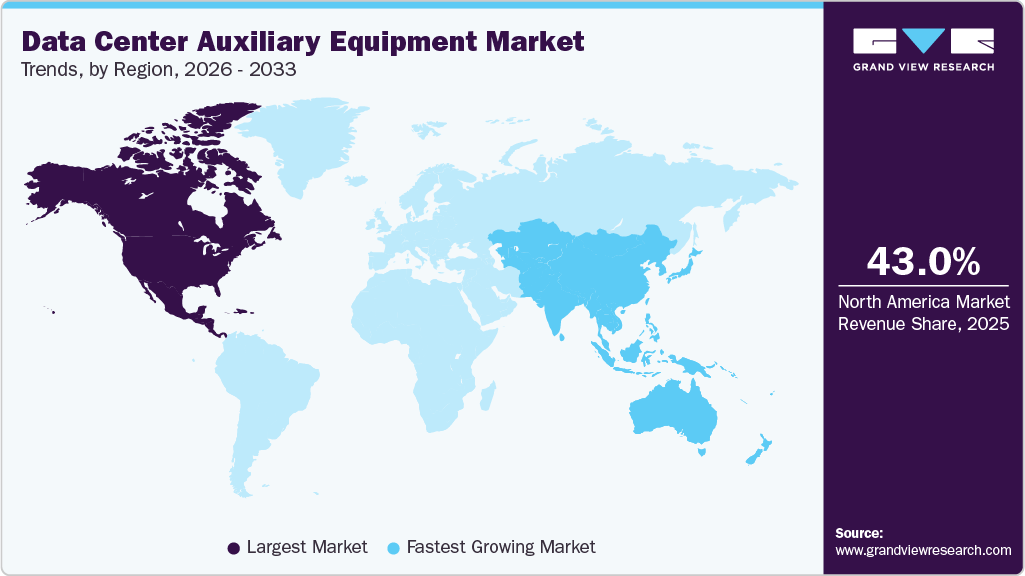
North America dominated the data center auxiliary equipment market with a revenue share of 43.0% in 2025. North America’s DCEA market is driven by hyperscale expansions from cloud majors and the rapid shift toward AI-intensive workloads that require high-density power and advanced cooling infrastructure. The region is also witnessing accelerated modernization of legacy facilities, fueling demand for smart PDUs, advanced switchgear, and next-generation UPS systems designed for energy resiliency. The growing need for edge data centers to support low-latency applications in autonomous mobility, fintech, and real-time analytics further drives the facility type for auxiliary equipment. In addition, North America’s regulatory focus on uptime compliance, energy efficiency, and carbon reduction is compelling operators to integrate intelligent cooling solutions, DCIM platforms, and sensor-driven monitoring systems. Investments in renewable-powered data centers and microgrid integration also support the adoption of adaptive transformers, battery systems, and liquid cooling distribution units tailored for sustainability-focused operations.
 To learn more about this report, Download Free Sample Report
U.S. Data Center Auxiliary Equipment Market Trends
The data center auxiliary equipment industry in the U.S. is projected to grow during the forecast period. The U.S. market is driven by large-scale investments in AI and cloud infrastructure by hyperscalers, colocation giants, and enterprise operators digitizing financial services, retail, and government workloads. The expanding use of GPU-based clusters significantly increases power density, driving the purchase of UPS systems, PDUs, lithium-ion battery storage, and high-capacity generators. The surge in 5G and edge computing nodes across states further accelerates installations of modular power and cooling auxiliary equipment.
Asia Pacific Data Center Auxiliary Equipment Market Trends
The data center auxiliary equipment industry in Asia Pacific is expected to be the fastest-growing market, with a CAGR of 14.4% over the forecast period, driven by cloud expansion, AI workload adoption, digitalization of enterprises, and the rapid growth of 5G networks. These trends accelerate the facility type of power systems, generators, PDUs, and next-gen cooling architectures across hyperscale and colocation facilities. High-density computing in AI and HPC clusters further drives demand for liquid cooling and airflow containment systems.
Japan data center auxiliary equipment industry is projected to grow during the forecast period. Japan’s DCAE market is driven by the modernization of aging data center infrastructure, the increasing adoption of AI workloads, and ongoing cloud expansion that supports the country’s advanced financial and manufacturing sectors. These trends are driving strong demand for next-generation UPS systems, power distribution units (PDUs), and advanced battery technologies that can handle high-density computing environments.
Europe Data Center Auxiliary Equipment Market Trends
The data center auxiliary equipment industry in Europe is expected to grow during the forecast period. Europe’s data center clusters are facing growing pressure from limited grid availability and long lead times for new power connections. As hyperscale and colocation demand escalates but national grids struggle to keep pace, operators increasingly rely on robust on-site energy infrastructure to ensure uninterrupted growth. This drives strong investment in high-capacity diesel and gas gensets, modular power distribution units (PDUs), switchgear, and smart energy management platforms that optimize power flows and smooth peak loads. Battery energy storage systems (BESS) are gaining rapid adoption as operators seek alternatives to grid-tied stability and aim to support higher power densities for AI workloads. These constraints make auxiliary equipment not just a supporting component but a strategic enabler of data center expansion, especially in metros where securing new megawatts is becoming a competitive bottleneck.
Germany data center auxiliary equipment industry is expected to grow during the forecast period. Germany benefits from its strong industrial and manufacturing sector, which is undergoing rapid digital transformation supported by automation, IoT, and cloud adoption. This drives investments in robust power backup, switchboards, and PDUs for mission-critical workloads. It continues to expand, fueling demand for UPS systems, transformers, and advanced cooling setups.
Key Data Center Auxiliary Equipment Companies Insights
Key players operating in the data center equipment market are undertaking various initiatives to strengthen their presence and increase the reach of their products and services. Strategies such as expansion activities and partnerships are key in propelling the market growth. Some of the key companies operating in the market, include Schneider Electric, and Vertiv Group Corp., among others are some of the leading participants in the market.
-
Schneider Electric is a global company focused on energy and digital technologies, helping industries, businesses, homes, and data centers run more efficiently and sustainably. It offers smart devices, automation systems, software, and digital services that make operations more connected and reliable. With a decentralized model spanning regions such as North America, China, India, and Europe, the company collaborates closely with local markets to develop solutions tailored to their specific needs.
-
Vertiv Group Corp. is a global company that builds and supports the essential digital infrastructure used in data centers, communication networks, and industrial facilities. It provides power, cooling, monitoring, and modular solutions that help organizations keep their critical systems running smoothly. With operations in more than 40 countries, Vertiv serves major industries, including cloud services, finance, healthcare, manufacturing, and government.
Airedale International Air Conditioning Ltd., and Asetek Inc. A/S are some of the emerging market participants in the data center auxiliary equipment market.
-
Airedale International Air Conditioning Ltd., a subsidiary of Modine Manufacturing Company, is a manufacturer and distributor of innovative HVAC and cooling solutions. Its product portfolio includes precision air conditioning units, IT cooling systems, chillers (air-cooled, water-cooled, and remote condenser components), condensers and dry coolers, air handling units, and advanced thermal management controls such as the IQity IoT framework for optimized performance.
-
Asetek A/S specializes in developing liquid cooling technology for computers and data centers. It offers all-in-one liquid coolers for gaming PCs and workstations, as well as advanced cooling systems for servers, including direct-to-chip cooling, in-rack coolant distribution units, and warm-water cooling solutions that can manage high heat loads in modern data centers.
Key Data Center Auxiliary Equipment Companies:
The following are the leading companies in the data center equipment market. These companies collectively hold the largest Market share and dictate industry trends.
- ABB
- Airedale International Air Conditioning Ltd.
- ALFA LAVAL
- Asetek Inc. A/S
- Canovate Group
- Caterpillar Inc.
- Cummins Inc.
- Delta Electronics, Inc.
- Vertiv Group Corp.
- Eaton
- Hitachi, Ltd.
- Johnson Controls
- Legrand
- Mitsubishi Electric Corporation
- Rittal GmbH & Co. KG
- Schneider Electric
Recent Developments
-
In November 2025, Caterpillar and Vertiv entered into a strategic collaboration to develop advanced energy-optimization solutions for data centers, combining Vertiv’s cooling and power-distribution technologies with Caterpillar’s and Solar Turbines’ expertise in power generation and CCHP systems. The partnership will deliver standardized architectures designed to streamline facility type, speed up time-to-power, and enhance operational performance for data center operators.
-
In October 2025, Airedale International Air Conditioning Ltd. launched a modular, skid-based CDU designed for liquid-cooling capacities of 2MW and above, offering greater facility type flexibility for high-density data centers. Manufactured across Europe, North America, and the Asia Pacific, the new design expands the CDU range to three footprints with scalable capacities from 400kW to beyond 2MW at a 4K approach. Featuring stainless steel piping, 25-micron filtration, and active harmonic filtration, the unit delivers a durable, efficient cooling solution with an expected lifespan of over 15 years.
-
In October 2025, Delta Electronics, Inc. launched a new AI Data Center Microgrid Solution at Energy Taiwan 2025, designed to support power-intensive AI workloads with fast, resilient on-site energy management. The system combines energy storage, a microgrid controller, renewable energy sources, generators, and hydrogen fuel cells, enabling a millisecond-level response to 100% step-load changes while maintaining stable voltage. Built with a unified hardware-software architecture and plant-grade simulation, it also features a solid-state transformer for high-voltage DC integration, boosting efficiency to as high as 98.5% and reducing the number of power-conversion stages.
-
In August 2025, Vertiv acquired Great Lakes Data Racks & Cabinets, strengthening its position in providing high-density integrated infrastructure solutions for data centers. This acquisition enhances Vertiv's capabilities in delivering comprehensive power and cooling solutions.
Data Center Auxiliary Equipment Market Report Scope
Report Attribute
Details
Market size in 2025
USD 67.5 billion
Estimated market size in 2026
USD 76.1 billion
Projected market size by 2033
USD 164.5 billion
Growth rate
CAGR of 11.6% from 2026 to 2033
Actual data
2021 - 2024
Forecast period
2026 - 2033
Quantitative units
Revenue in USD million/billion, and CAGR from 2026 to 2033
Report coverage
Revenue forecast, company share, competitive landscape, growth factors, and trends
Segments covered
Component, facility type, end-use, region
Regional scope
North America; Europe; Asia Pacific; Latin America; MEA
Country scope
U.S.; Canada; Mexico UK; Germany; France; China; India; Japan; Australia; South Korea; Brazil; UAE; Saudi Arabia; South Africa
Key companies profiled
ABB; Airedale International Air Conditioning Ltd.; ALFA LAVAL; Asetek Inc. A/S; Canovate Group; Caterpillar Inc.; Cummins Inc.; Delta Electronics, Inc.; Vertiv Group Corp.; Eaton; Hitachi, Ltd.; Johnson Controls; Legrand; Mitsubishi Electric Corporation; Rittal GmbH & Co. KG; Schneider Electric
Customization scope
Free report customization (equivalent to 8 analysts working days) with purchase. Addition or alteration to country, regional & segment scope.
Pricing and purchase options
Avail customized purchase options to meet your exact research needs. Explore purchase options
Global Data Center Auxiliary Equipment Market Report Segmentation
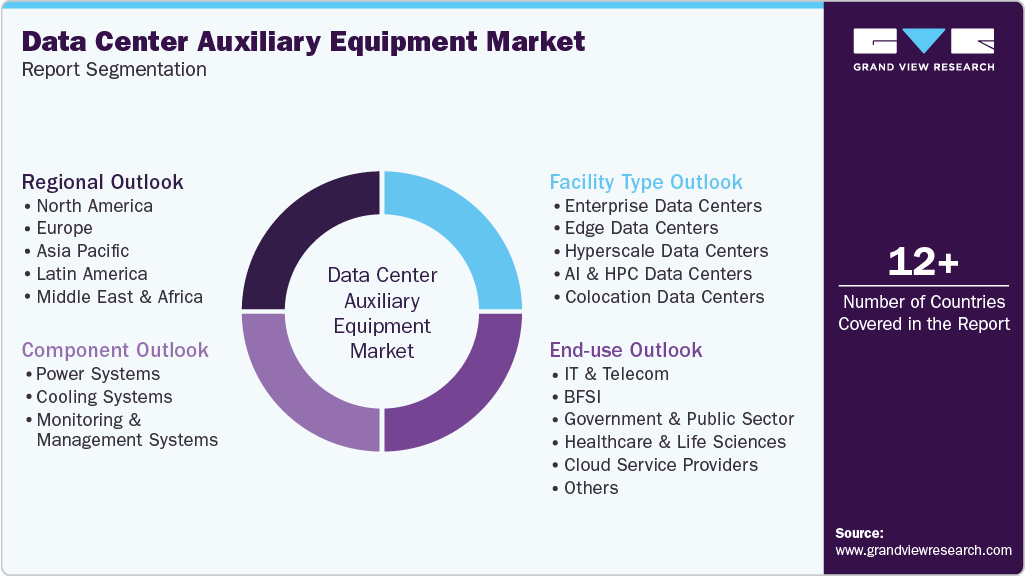
This report forecasts revenue growth at global, regional, and country levels and provides an analysis of the latest industry trends in each of the sub-segments from 2021 to 2033. For this study, Grand View Research has segmented the global data center auxiliary equipment market report based on component, facility type, end-use, and region.
 To learn more about this report, Download Free Sample Report
-
Component Outlook (Revenue, USD Billion, 2021 - 2033)
-
Power Systems
-
Uninterruptible Power Supply (UPS)
-
Generators
-
Transformers
-
Power Distribution Units (PDUs & Smart PDUs)
-
Switchgear & Switchboards
-
Battery Systems
-
-
Cooling Systems
-
CRAC/CRAH Units
-
Chillers
-
Liquid Cooling Systems
-
Airflow Management & Containment Solutions
-
Cooling Distribution Units
-
-
Monitoring & Management Systems
-
Data Center Infrastructure Management (DCIM)
-
Energy Management Systems
-
Sensors & Remote Monitoring Tools
-
-
-
Facility Type Outlook (Revenue, USD Billion, 2021 - 2033)
-
Enterprise Data Centers
-
Edge Data Centers
-
Hyperscale Data Centers
-
AI & HPC Data Centers
-
Colocation Data Centers
-
-
End-use Outlook (Revenue, USD Billion, 2021 - 2033)
-
IT & Telecom
-
BFSI
-
Government & Public Sector
-
Healthcare & Life Sciences
-
Cloud Service Providers
-
Others
-
-
Regional Outlook (Revenue, USD Billion, 2021 - 2033)
-
North America
-
U.S.
-
Canada
-
Mexico
-
-
Europe
-
Germany
-
UK
-
France
-
-
Asia Pacific
-
China
-
India
-
Japan
-
South Korea
-
Australia
-
-
Latin America
-
Brazil
-
-
Middle East & Africa
-
UAE
-
Saudi Arabia
-
South Africa
-
-
Frequently Asked Questions About This Report
The global data center auxiliary equipment market is expected to grow at a CAGR of 11.6% from 2026 to 2033, reaching USD 164.5 billion.
Power systems segment led with a 49.0% revenue share in 2025, while cooling systems is the fastest-growing segment.
Factors such as the growing complexity of supply chains and third-party vendor ecosystems and the expansion of hyperscale, edge, and colocation data centers are the key factors driving the market growth.
Hyperscale data centers held the largest revenue share in 2025, while AI & HPC data centers is the fastest-growing area.
Cloud service providers held the largest revenue share in 2025.
North America dominated with a 43.0% revenue share in 2025.
Asia Pacific is the fastest-growing region over the forecast period.
The global data center auxiliary equipment market size was valued at USD 67.5 billion in 2025 and is estimated at USD 76.1 billion for 2026.
Key players include ABB, Airedale International Air Conditioning Ltd., ALFA LAVAL, Asetek Inc. A/S, Canovate Group, Caterpillar Inc., Cummins Inc., Delta Electronics, Inc., Vertiv Group Corp., Eaton, Hitachi, Ltd., Johnson Controls, Legrand, Mitsubishi Electric Corporation, Rittal GmbH & Co. KG, Schneider Electric
About the Author(s)
Next Generation Technologies Research Team
Technology · Next Generation TechnologiesThis report was authored by the next generation technologies research team at Grand View Research - comprising two research analysts, one senior research analyst, and one industry expert - with specialized expertise in the next generation technologies segment of the technology industry. All findings are based on proprietary technology databases, executive interviews, and regulatory analysis, subject to internal peer review prior to publication.
Last Updated:
Speak to Analyst

Customize this report to your needs - add regions, segments, or data points, with 20% free customization.
Or view our licence options:


ISO 9001:2015 & 27001:2022 Certified
We are GDPR and CCPA compliant! Your transaction & personal information is safe and secure. For more details, please read our privacy policy.


