
- Home
- »
- Next Generation Technologies
- »
-
Digital Insurance Market Size & Share Report, 2026-2033GVR Report cover

Digital Insurance Market (2026 - 2033)
Size, Share & Trends Analysis Report By Component (Solution, Services), By Insurance Type (Life & Health), By Distribution Channel (Tied Agents & Branches, Brokers), By End User, By Enterprise Size, By Region, And Segment Forecasts
Market Size, 2025
$431.8BMarket Estimate, 2026
$534.4BMarket Forecast, 2033
$1,546.1BCAGR, 2026–2033
16.4%Digital Insurance Market Summary
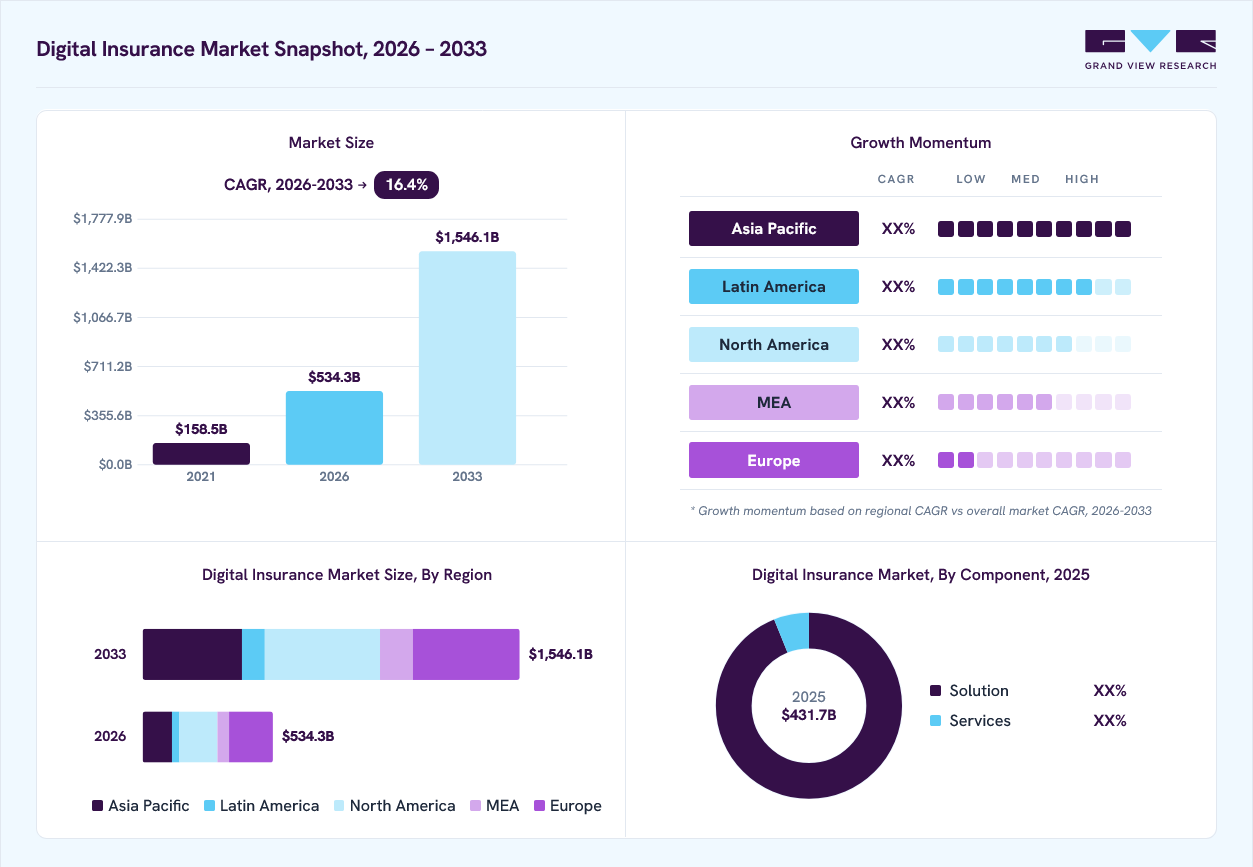
The global digital insurance market was valued at USD 431.8 billion in 2025 and is projected to grow from USD 534.4 billion in 2026 to USD 1,546.1 billion by 2033, at a CAGR of 16.4% from 2026 to 2033. Europe dominated the market, accounting for the largest revenue share of 34.5% in 2025. The digital insurance industry’s growth is driven by the rapid digital transformation of the insurance industry, increasing adoption of cloud-based insurance platforms, rising demand for personalized customer experiences, and the growing integration of artificial intelligence (AI), machine learning (ML), big data analytics, and automation across insurance operations.
 Source: Grand View Research, IR Documents, Primary Interviews, Paid DatabasesTo learn more about this report,
 Download Free Sample Report
Key Market Trends & Insights
- By component: Solution held the largest share of 93.8% in 2025
- By insurance type: Life & health held the largest market share in 2025
- By distribution channel: Brokers dominated the market in 2025
- By end user: Individual segment held the largest market share in 2025
- By enterprise size: Small & medium enterprises (SMEs) held the largest market share in 2025
Regional Highlights
- Largest regional market: Europe (34.5% revenue share, 2025)
- Fastest-growing regional market: Asia Pacific (fastest CAGR, 2026-2033)
- By Country: UK held the largest market share in 2025
Market Size & Forecast
- Market Size in 2025: USD 431.8 Billion
- Estimated Market Size in 2026: USD 534.4 Billion
- Projected Market Size by 2033: USD 1,546.1 Billion
- CAGR (2026-2033): 16.4%
Three ways to get this report
Buy it, customize it, or ask a question.Ask an Analyst
Analyst response in 1 business day
- AccessReport author, directly
- Reply timeWithin 1 working day
- No sales callDirect answer only
- FormatEmail reply
- CostFree, no cost
Get the Full Report
What the study covers
- FormatsPDF · Excel · Dashboard
- Timeline2026–2033 annual, 2025 base
- Coverage20+ countries, 5 regions
- Companies10+ key players profiled
Customize the Report
20% free customization
- IncludeCountries, segments, points
- TailorTo your product definition
- ExtendDeeper competitor detail
- OrA fully bespoke study
- Turnaround5–10 working days
The digital insurance industry’s growth is driven by the rapid digital transformation of the insurance industry, increasing adoption of cloud-based insurance platforms, rising demand for personalized customer experiences, and the growing integration of artificial intelligence (AI), machine learning (ML), big data analytics, and automation across insurance operations. Insurers are increasingly investing in digital solutions to streamline policy administration, automate underwriting and claims processing, enhance fraud detection, and improve customer engagement. Furthermore, the growing penetration of smartphones, digital payment platforms, and InsurTech innovations is accelerating the adoption of digital insurance solutions across both developed and emerging economies.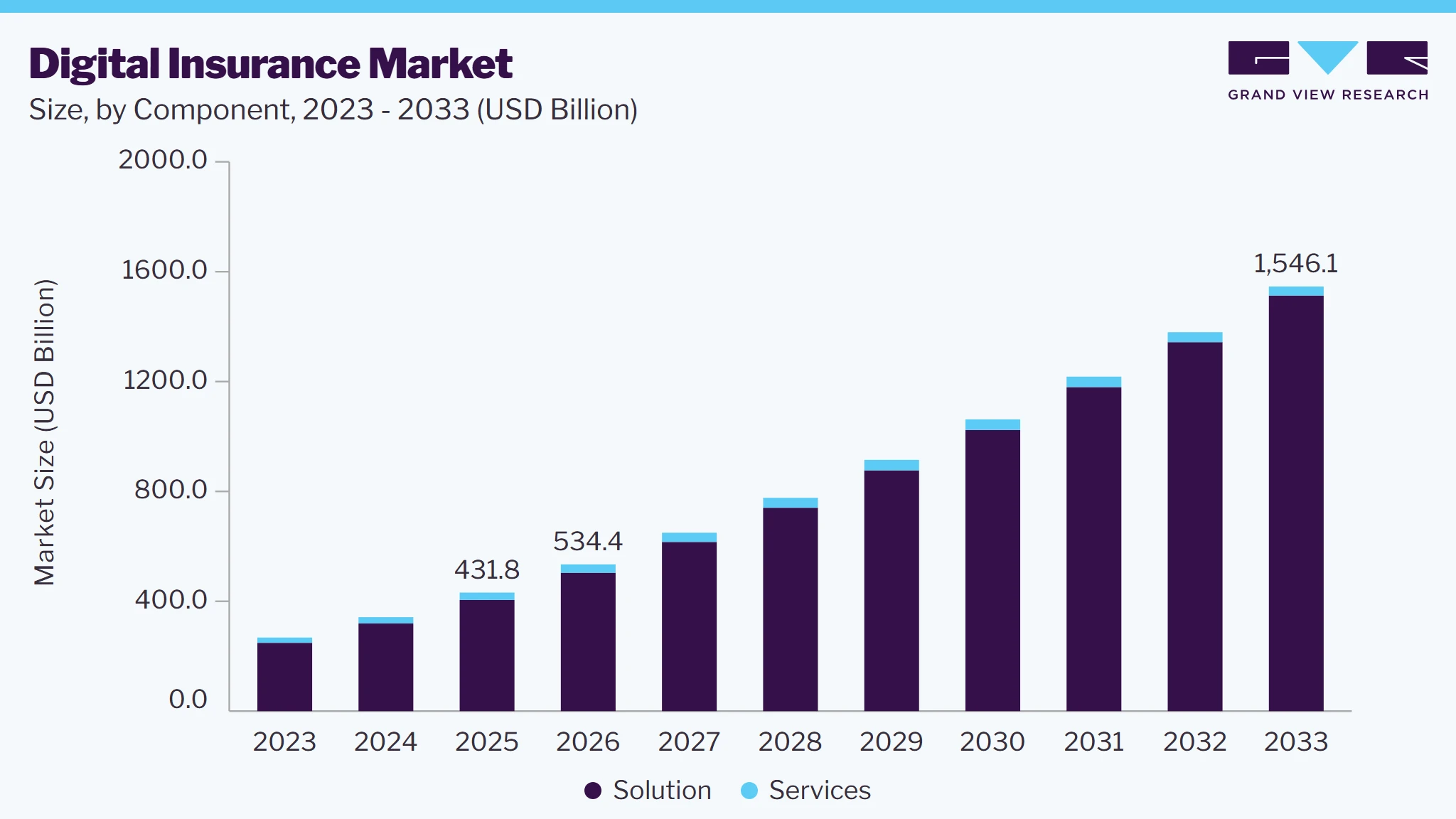 To learn more about this report, Download Free Sample Report
The increasing adoption of digital technologies across the insurance value chain is significantly driving the market growth. Insurance providers are increasingly modernizing legacy systems and implementing cloud-native platforms, AI-powered underwriting engines, robotic process automation (RPA), and advanced analytics solutions to improve operational efficiency and customer experience. Digital insurance platforms enable insurers to accelerate policy issuance, automate claims settlement, improve risk assessment, and deliver personalized insurance products while reducing administrative costs. As customer expectations continue to shift toward seamless digital experiences, insurers are increasingly investing in end-to-end digital transformation initiatives, creating strong demand for digital insurance solutions worldwide.
The rapid expansion of InsurTech companies is further accelerating market development. Emerging InsurTech providers are introducing innovative business models leveraging artificial intelligence, blockchain, the Internet of Things (IoT), telematics, and embedded insurance, enabling insurers to deliver real-time, data-driven insurance services.
Digital ecosystems are facilitating faster customer onboarding, automated fraud detection, usage-based insurance models, and omnichannel customer engagement. These technological advancements are improving operational agility while enabling insurers to develop customized products that better address evolving consumer and business requirements.
Additionally, increasing regulatory support for digital financial services and rising internet and smartphone penetration are creating favorable conditions for market expansion. Governments and regulatory authorities across multiple regions are encouraging digital financial inclusion and electronic documentation, enabling insurers to offer fully digital policy management and claims processing services.
The growing demand for cyber insurance, digital health insurance, embedded insurance, and on-demand insurance products is further expanding the market landscape. As insurers continue to prioritize digital innovation, customer-centric services, and data-driven decision-making, the digital insurance market is expected to witness sustained growth throughout the forecast period.
Market Dynamics
The rapid digital transformation of the global insurance industry is one of the primary drivers of the digital insurance market. Insurance companies are increasingly replacing legacy systems with cloud-native platforms, AI-powered underwriting engines, automated claims management systems, and digital customer engagement solutions to improve operational efficiency and enhance customer experience. Digital insurance solutions enable insurers to streamline policy administration, accelerate claims settlement, improve risk assessment, and reduce operational costs through automation and advanced analytics. As insurers continue to prioritize customer-centric digital services and operational agility, investments in digital insurance platforms are increasing across life, health, property & casualty, and commercial insurance segments.
Furthermore, insurers are integrating artificial intelligence, machine learning, robotic process automation (RPA), and big data analytics into core insurance operations to improve decision-making and deliver personalized insurance products. These technologies enable faster underwriting, real-time fraud detection, automated customer support, and predictive risk analysis, helping insurers improve profitability while enhancing policyholder satisfaction. The growing demand for seamless digital experiences continues to accelerate the adoption of digital insurance solutions worldwide.
Despite strong market growth, concerns about data privacy, cybersecurity, and regulatory compliance remain major restraints for the digital insurance market. Insurance companies manage large volumes of sensitive customer information, making them attractive targets for cyberattacks and data breaches. Increasing regulatory requirements related to data protection, customer consent, and digital identity verification necessitate that insurers invest heavily in cybersecurity infrastructure, compliance management, and data governance frameworks. These additional investments can increase operational complexity and implementation costs.
Despite strong market growth, concerns about data privacy, cybersecurity, and regulatory compliance remain major restraints for the digital insurance market. Insurance companies manage large volumes of sensitive customer information, making them attractive targets for cyberattacks and data breaches. Increasing regulatory requirements related to data protection, customer consent, and digital identity verification necessitate that insurers invest heavily in cybersecurity infrastructure, compliance management, and data governance frameworks. These additional investments can increase operational complexity and implementation costs.
The rapid expansion of InsurTech companies and embedded insurance models presents significant growth opportunities for the digital insurance market. Financial institutions, e-commerce platforms, automotive manufacturers, healthcare providers, and digital marketplaces are increasingly embedding insurance products directly into their customer journeys, creating new distribution channels and improving insurance accessibility. Embedded insurance enables consumers to purchase personalized insurance products seamlessly during digital transactions, significantly enhancing customer convenience and market penetration.
In addition, growing adoption of artificial intelligence, Internet of Things (IoT), blockchain, telematics, and advanced analytics is enabling insurers to introduce innovative insurance products, including usage-based insurance, pay-as-you-go coverage, digital health insurance, and cyber insurance. The increasing availability of real-time customer data is allowing insurers to improve underwriting accuracy, personalize policy offerings, and automate claims processing. As digital ecosystems continue to evolve and customer expectations shift toward fully digital insurance experiences, the demand for advanced digital insurance platforms is expected to increase substantially throughout the forecast period.
Market Concentration & Characteristics
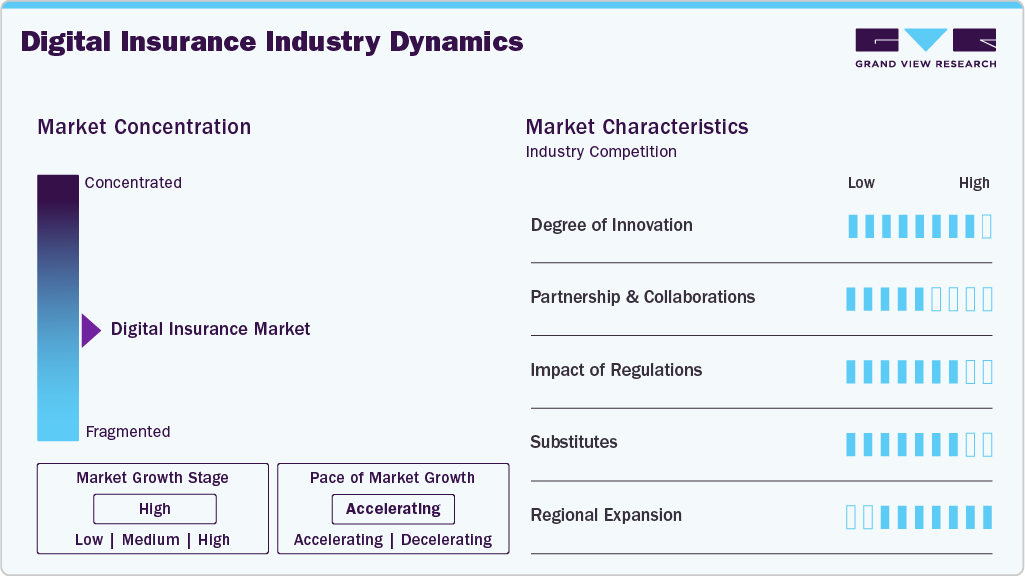
The digital insurance market is moderately fragmented, with the presence of several global enterprise software providers, IT service companies, insurance technology vendors, and specialized InsurTech solution providers competing across the insurance ecosystem. Leading companies maintain strong market positions through comprehensive digital insurance platforms, cloud-based policy administration systems, AI-powered underwriting solutions, and long-term partnerships with insurance carriers worldwide. At the same time, emerging InsurTech companies continue to introduce innovative cloud-native solutions focused on improving customer engagement, claims automation, fraud detection, and digital distribution.
 To learn more about this report, Download Free Sample Report
The digital insurance industry is characterized by rapid technological innovation, increasing cloud adoption, and growing investments in artificial intelligence, predictive analytics, blockchain, and automation technologies. Companies are focusing on expanding SaaS-based insurance platforms, enhancing omnichannel customer engagement capabilities, integrating advanced analytics, and strengthening cybersecurity features to improve operational efficiency and customer satisfaction. Strategic acquisitions, technology partnerships, product innovation, and expansion into emerging markets remain the primary competitive strategies adopted by leading market participants.
Analyst Perspective
The digital insurance market is entering a phase of accelerated transformation as insurers increasingly modernize legacy systems, enhance customer experience, and automate core insurance operations through cloud-native technologies and artificial intelligence. Rising consumer demand for digital-first insurance services, faster claims settlement, personalized policy offerings, and omnichannel customer engagement is driving significant investment in intelligent insurance platforms. Advancements in AI-powered underwriting, predictive analytics, machine learning, robotic process automation (RPA), cloud computing, API-based ecosystems, and embedded insurance are enabling insurers to improve operational efficiency while reducing processing costs and fraud risks. Growing collaboration between traditional insurers, InsurTech companies, technology providers, and financial institutions is reshaping the competitive landscape. Competitive differentiation is increasingly centered on cloud-native core insurance platforms, low-code development capabilities, intelligent claims automation, real-time data analytics, and personalized digital customer experiences, with continued investments expected in AI-driven insurance innovation, ecosystem partnerships, and next-generation digital insurance platforms throughout the forecast period.
Component Insights
The solution segment accounted for the largest market share of 93.8% in 2025 and is expected to grow at the fastest CAGR during the forecast period. The increasing adoption of cloud-based insurance platforms, policy administration systems, claims management software, underwriting automation, customer relationship management (CRM) solutions, fraud detection platforms, and AI-powered analytics is driving the growth of this segment. Insurance providers are increasingly investing in integrated digital solutions to streamline operations, enhance customer experiences, improve underwriting accuracy, and accelerate claims processing. The growing demand for end-to-end digital insurance ecosystems continues to strengthen the dominance of the Solution segment.
The services segment held a significant share of the digital insurance market in 2025. The growth of this segment is supported by increasing demand for consulting, implementation, system integration, cloud migration, managed services, maintenance, and technical support. As insurers continue to modernize legacy infrastructure and implement digital transformation strategies, the need for professional and managed services is increasing to ensure the successful deployment, customization, and optimization of digital insurance platforms.
Insurance Type Insights
The life & health segment held the largest share of the digital insurance industry in 2025 and is expected to register the fastest CAGR during the forecast period. Growing consumer awareness regarding health and financial protection, increasing adoption of digital health insurance platforms, and rising demand for personalized insurance products are driving market growth. Insurance companies are increasingly leveraging artificial intelligence, predictive analytics, wearable device integration, and digital customer engagement platforms to enhance underwriting efficiency, simplify claims management, and deliver customized life and health insurance products.
The others segment held a significant market share in 2025. This segment includes property & casualty, travel, motor, cyber, and specialty insurance products that are increasingly being digitized through online policy management, automated claims settlement, and AI-powered risk assessment solutions. Growing digital adoption across these insurance categories continues to support steady market expansion.
Distribution Channel Insights
The brokers segment accounted for the largest market share in 2025 and is also expected to grow at the fastest CAGR during the forecast period. Digital transformation has enabled insurance brokers to provide seamless policy comparison, personalized recommendations, digital documentation, and faster customer onboarding through advanced brokerage platforms. AI-enabled advisory services, omnichannel engagement, and cloud-based policy management solutions are helping brokers improve customer acquisition and retention while enhancing overall operational efficiency.
The tied agents & branches segment is expected to grow at a significant CAGR during the forecast period. Insurance providers continue to strengthen their digital branch infrastructure by integrating mobile applications, digital customer service platforms, electronic documentation, and remote advisory capabilities. The adoption of hybrid sales models that combine digital platforms with personalized customer support is expected to drive continued growth in this segment.
End User Insights
The individual segment held the largest share of the digital insurance industry in 2025 and is expected to grow at the fastest CAGR during the forecast period. Rising consumer preference for digital policy purchasing, self-service insurance platforms, mobile applications, and personalized insurance offerings is driving adoption among individual policyholders. AI-powered underwriting, instant policy issuance, digital claims settlement, and 24/7 customer support are significantly improving customer experiences and accelerating market growth.
The business segment is expected to grow at a significant CAGR during the forecast period. Enterprises across various industries are increasingly adopting digital insurance solutions to manage employee benefits, commercial insurance policies, cyber insurance, liability coverage, and business risk management. The growing digitalization of corporate insurance processes and increasing regulatory compliance requirements continue to support the expansion of this segment.
Enterprise Size Insights
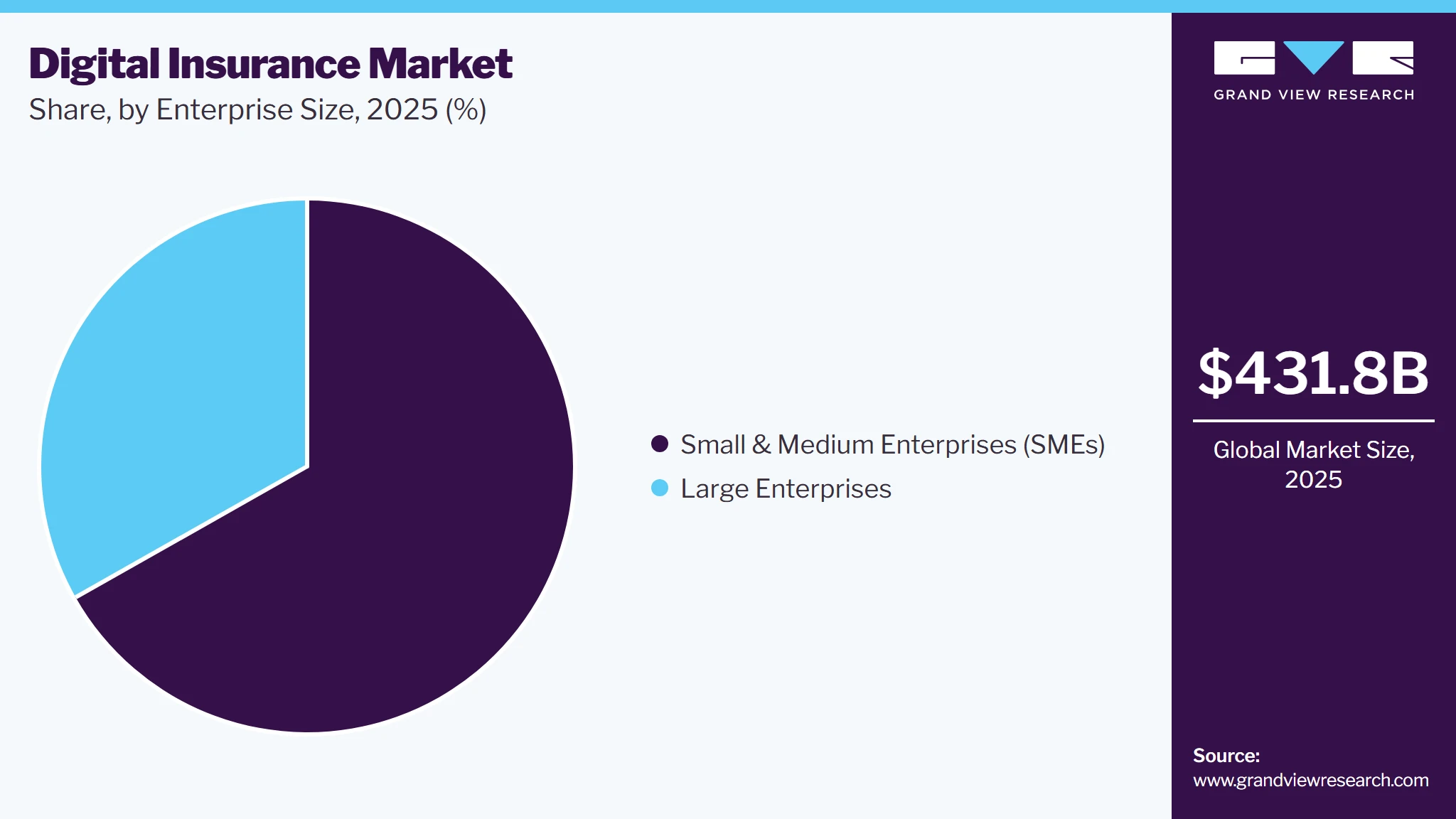
The small & medium enterprises (SMEs) segment accounted for the largest share of the digital insurance market in 2025, and is also expected to register the fastest CAGR during the forecast period. SMEs are increasingly adopting cloud-based digital insurance platforms due to their affordability, scalability, ease of deployment, and ability to simplify policy administration and claims management. The growing availability of subscription-based insurance software and digital financial services is further accelerating adoption among small and medium-sized businesses.
 To learn more about this report, Download Free Sample Report
The large enterprises segment held a significant market share in 2025. Large insurance providers continue to invest heavily in enterprise-wide digital transformation initiatives, including AI-enabled underwriting platforms, advanced analytics, fraud detection systems, customer engagement solutions, and cloud-based policy administration platforms. These investments enable insurers to improve operational efficiency, manage high transaction volumes, and deliver personalized insurance experiences across diverse customer segments.
Regional Insights
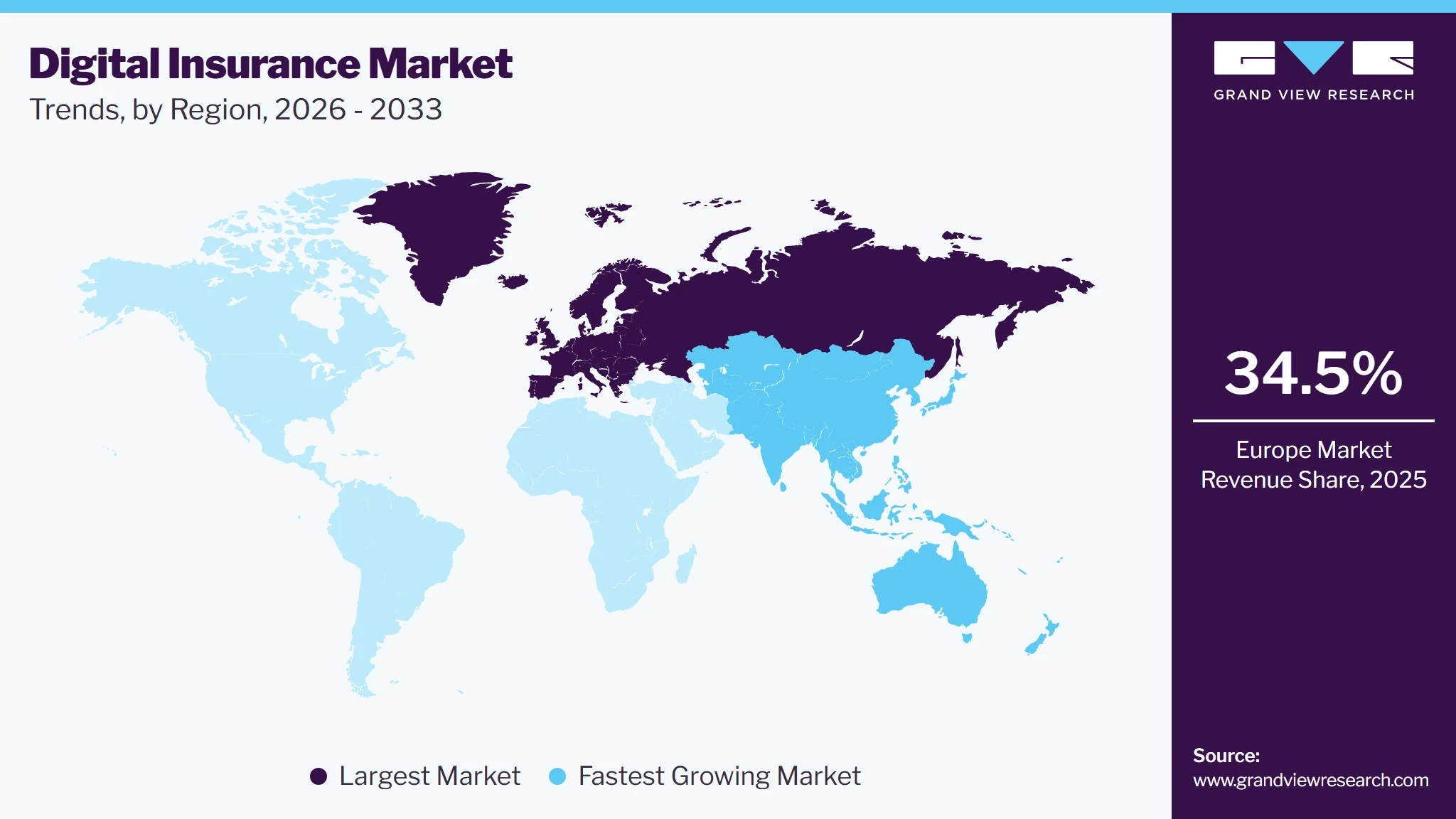
The Europe digital insurance industry accounted for the largest revenue share of 34.5% in 2025, and is projected to maintain strong growth throughout the forecast period. The region's leadership is driven by high digital maturity, widespread adoption of cloud-based insurance platforms, favorable regulatory frameworks supporting digital financial services, and increasing investments in artificial intelligence and automation across the insurance sector. Insurance providers across Europe are increasingly modernizing legacy systems, expanding digital distribution channels, and implementing AI-powered underwriting and claims management solutions to improve customer experience and operational efficiency. The growing presence of established insurers and InsurTech companies continues to strengthen regional market growth.
 To learn more about this report, Download Free Sample Report
The UK digital insurance market is one of Europe's most mature, supported by a well-developed financial services ecosystem and a thriving InsurTech landscape. Insurance companies are increasingly adopting cloud-native insurance platforms, digital customer engagement solutions, automated claims processing, and AI-driven underwriting technologies. The growing demand for embedded insurance, usage-based insurance, and fully digital policy management is further accelerating market expansion. Continuous investments in digital innovation and strategic collaborations between insurers and technology providers continue to strengthen the UK's position within the European market.
North America Digital Insurance Market Trends
North America continues to represent a significant market for digital insurance owing to high technology adoption, advanced insurance infrastructure, and increasing investments in digital transformation initiatives. Insurance providers across the region are rapidly deploying artificial intelligence, machine learning, robotic process automation, and predictive analytics to improve underwriting accuracy, claims processing, fraud detection, and customer engagement. The increasing adoption of cloud computing, API-driven insurance ecosystems, and omnichannel customer experiences continues to support market growth across both the U.S. and Canada.
U.S. Digital Insurance Market Trends
The U.S. remains the largest contributor in the North America digital insurance industry, due to the presence of leading insurance carriers, technology providers, and InsurTech startups. Insurance companies are increasingly leveraging AI-powered risk assessment, digital claims automation, telematics, and advanced analytics to enhance operational efficiency and deliver personalized insurance products. Growing demand for cyber insurance, digital health insurance, and embedded insurance solutions is further contributing to market expansion.
Asia Pacific Digital Insurance Market Trends
The Asia Pacific digital insurance industry is expected to grow at the fastest CAGR of 19.0% during the forecast period. Rapid digitalization, expanding smartphone penetration, increasing internet accessibility, and supportive government initiatives promoting digital financial inclusion are driving market growth across the region. Insurance companies are increasingly investing in mobile-first insurance platforms, AI-enabled customer engagement, digital payment integration, and cloud-based policy management systems to meet the growing demand for convenient, personalized insurance services.
The China digital insurance market continues to lead the regional growth due to its rapidly expanding digital economy, strong presence of technology companies, and increasing adoption of online financial services. Insurance providers are leveraging artificial intelligence, big data analytics, and digital ecosystems to streamline underwriting, automate claims processing, and enhance customer engagement. The country's expanding InsurTech ecosystem continues to drive innovation across the insurance industry.
The digital insurance market in Japan maintains a strong position in the region, owing to its advanced technological infrastructure and high digital adoption across financial services. Insurance companies are increasingly implementing AI-powered underwriting, robotic process automation, and digital policy administration platforms to improve efficiency and customer satisfaction. Growing demand for digital health insurance and aging population-related insurance solutions further support market growth.
The India digital insurance market is emerging as one of the fastest-growing digital insurance spaces, due to increasing internet penetration, rapid smartphone adoption, expanding digital payment infrastructure, and government initiatives promoting digital financial services. The rapid growth of InsurTech startups, increasing demand for affordable digital insurance products, and rising awareness of financial protection are accelerating market adoption across both urban and rural populations.
Key Digital Insurance Company Insights
The digital insurance market is highly competitive, with leading technology providers focusing on cloud-native insurance platforms, AI-enabled underwriting, digital claims management, policy administration modernization, and customer engagement solutions. Companies are investing heavily in artificial intelligence, machine learning, advanced analytics, low-code development platforms, and automation technologies to improve operational efficiency and support insurers' digital transformation initiatives. Strategic partnerships, mergers & acquisitions, cloud expansion, and continuous product innovation remain the primary growth strategies adopted by major market participants.
-
Guidewire Software, Inc. is one of the players of cloud-based insurance software, offering comprehensive solutions for policy administration, billing, claims management, underwriting, analytics, and digital customer engagement. The company continues to expand its cloud platform capabilities through AI integration, advanced analytics, and ecosystem partnerships, enabling insurers to accelerate digital transformation and improve operational performance.
-
Duck Creek Technologies specializes in SaaS-based insurance platforms that support policy administration, claims management, billing, underwriting, and customer engagement across property & casualty, life, and health insurance markets. The company continues to strengthen its market position through cloud-native innovation, API-driven architecture, and artificial intelligence capabilities that enable insurers to modernize legacy systems and improve business agility.
Key Digital Insurance Companies
The following key companies have been profiled for this study of the digital insurance market.
-
Guidewire Software, Inc.
-
Accenture plc
-
DXC Technology
-
Tata Consultancy Services (TCS)
-
Oracle Corporation
-
Duck Creek Technologies
-
Majesco
-
SAP SE
-
Pegasystems Inc.
-
Sapiens International Corporation
Company Categorization
Operating Strategies
Competitive Edge
Weaknesses
Mature Players: Guidewire Software, Inc.; Accenture plc; Oracle Corporation; SAP SE; Tata Consultancy Services (TCS); DXC Technology
Mature players are expanding their digital insurance portfolios by integrating artificial intelligence, cloud-native policy administration platforms, advanced analytics, claims automation, and low-code development capabilities. Strategic priorities include strengthening SaaS offerings, expanding ecosystem partnerships, supporting insurers' digital transformation initiatives, and enhancing customer experience through intelligent automation.
Mature companies benefit from strong global customer bases, comprehensive product portfolios, extensive implementation expertise, well-established partner ecosystems, and significant investments in research & development. Their ability to deliver end-to-end insurance transformation solutions provides a strong competitive advantage across global insurance markets.
These companies face challenges, including lengthy implementation cycles, high deployment and maintenance costs, complex integration with insurers' legacy IT infrastructure, evolving regulatory compliance requirements across multiple jurisdictions, and increasing competition from agile InsurTech vendors offering cloud-native and specialized digital insurance solutions.
Emerging Players: Duck Creek Technologies; Majesco; Pegasystems Inc.; Sapiens International Corporation
Emerging players focus on cloud-first insurance platforms, AI-driven underwriting, digital claims management, API-based integration, low-code application development, and embedded insurance capabilities. Their strategies emphasize continuous innovation, faster product deployment, flexible SaaS business models, and strategic partnerships with insurers and InsurTech providers.
Emerging companies gain market traction through agile product development, rapid cloud innovation, flexible deployment models, strong customer customization capabilities, and faster implementation compared with traditional enterprise software providers.
Emerging players face challenges, including comparatively lower global brand recognition, limited enterprise-scale implementation resources, smaller partner ecosystems, lower market penetration among large insurers, and the need for continuous investment in product innovation and international expansion to compete effectively with established technology vendors.
Recent Developments
-
In June 2025, Guidewire Software reported a quarterly record of 17 new Guidewire Cloud deals, reflecting strong demand from insurers, accelerating cloud migration and digital transformation initiatives across global insurance markets.
-
In November 2025, Millers Mutual Insurance selected Duck Creek OnDemand to modernize its core insurance operations, enabling cloud-based policy administration, advanced analytics, and future AI/ML integration to enhance digital customer experiences and operational efficiency.
Digital Insurance Market Report Scope
Report Attribute
Details
Market size in 2025
USD 431.8 billion
Estimated market size in 2026
USD 534.4 billion
Projected market size by 2033
USD 1,546.1 billion
Growth Rate
CAGR of 16.4% from 2026 to 2033
Base year for estimation
2025
Historical data
2021 - 2024
Forecast period
2026 - 2033
Quantitative units
Revenue in USD billion and CAGR from 2026 to 2033
Report coverage
Revenue forecast, company ranking, competitive landscape, growth factors, and trends
Segments covered
Component, insurance type, distribution channel, end user, enterprise size, region
Regional scope
North America; Europe; Asia Pacific; Latin America; MEA
Country scope
U.S.; Canada; Mexico; Germany; UK; France; China; Japan; India; South Korea; Australia; Brazil; KSA; UAE; South Africa
Key companies profiled
Guidewire Software, Inc.; Accenture plc; DXC Technology; Tata Consultancy Services (TCS); Oracle Corporation; Duck Creek Technologies; Majesco; SAP SE; Pegasystems Inc.; Sapiens International Corporation
Customization scope
Free report customization (equivalent up to 8 analysts working days) with purchase. Addition or alteration to country, regional & segment scope.
Pricing and purchase options
Avail customized purchase options to meet your exact research needs. Explore purchase options
Global Digital Insurance Market Report Segmentation
This report forecasts revenue growth at the global, regional, and country levels and provides an analysis of the latest industry trends in each of the sub-segments from 2021 to 2033. For this study, Grand View Research has segmented the global digital insurance market report based on component, insurance type, distribution channel, end user, enterprise size, and region:
-
Component Outlook (Revenue, USD Billion, 2021 - 2033)
-
Solution
-
Services
-
-
Insurance Type Outlook (Revenue, USD Billion, 2021 - 2033)
-
Life & Health
-
Others
-
-
Distribution Channel Outlook (Revenue, USD Billion, 2021 - 2033)
-
Tied Agents & Branches
-
Brokers
-
Others
-
-
End User Outlook (Revenue, USD Billion, 2021 - 2033)
-
Individual
-
Government
-
Business
-
-
Enterprise Size Outlook (Revenue, USD Billion, 2021 - 2033)
-
Small & Medium Enterprises (SMEs)
-
Large Enterprises
-
-
Regional Outlook (Revenue, USD Billion, 2021 - 2033)
-
North America
-
U.S.
-
Canada
-
Mexico
-
-
Europe
-
Germany
-
UK
-
France
-
-
Asia Pacific
-
China
-
Japan
-
India
-
South Korea
-
Australia
-
-
Latin America
-
Brazil
-
-
Middle East and Africa (MEA)
-
KSA
-
UAE
-
South Africa
-
-
Research Methodology
The digital insurance market figures in this report are based on a proven research process that combines executive interviews with secondary research from proprietary databases, company filings, and recognized regulatory and institutional sources. Market size is built through value-chain sizing—reconciling supply-side and demand-side estimates—and triangulated with bottom-up and top-down approaches. Every estimate passes multiple levels of expert validation before publication, with each digital insurance segment quantified using the revenue-capture definitions in the table below.
Segment Definition
Segment - Component
Revenue capture definition
Solution
The segment revenue is generated from digital insurance software platforms, including policy administration systems, digital underwriting solutions, claims management platforms, customer engagement applications, fraud detection software, AI-powered analytics, insurance core systems, cloud-based insurance platforms, and API-enabled digital insurance solutions deployed by insurers and intermediaries.
Services
The segment revenue is generated from professional and managed services supporting digital insurance transformation, including consulting, system integration, cloud migration, implementation, customization, application support, managed services, training, maintenance, and ongoing platform optimization for insurance organizations.
Segment - Insurance Type
Revenue capture definition
Life & Health
The segment revenue is generated from digital insurance solutions supporting life insurance and health insurance operations, including digital policy issuance, underwriting, claims processing, customer self-service portals, telematics, AI-enabled risk assessment, digital distribution, and personalized insurance products.
Others
The segment revenue is generated from digital solutions supporting property & casualty, motor, travel, home, commercial, cyber, marine, liability, and specialty insurance products, including policy administration, digital claims, customer engagement, and risk management platforms.
Segment - Distribution Channel
Revenue capture definition
Tied Agents & Branches
The segment revenue is generated from digital insurance platforms supporting insurer-owned branch networks and tied agents through digital policy sales, customer relationship management, mobile sales applications, policy servicing, claims support, and omnichannel customer engagement.
Brokers
The segment revenue is generated from digital insurance platforms used by brokers and independent intermediaries for policy comparison, digital customer onboarding, automated quotations, underwriting support, policy management, and claims processing across multiple insurance providers.
Others
The segment revenue is generated from digital insurance distribution through bancassurance, direct-to-consumer (D2C) platforms, insurance marketplaces, embedded insurance providers, affinity partners, fintech platforms, InsurTech companies, and other digital distribution ecosystems.
Segment - End User
Revenue capture definition
Individual
The segment revenue is generated from digital insurance platforms serving individual policyholders through online policy purchase, digital claims management, mobile applications, customer self-service portals, AI-powered customer support, and personalized insurance offerings.
Government
The segment revenue is generated from digital insurance platforms supporting government-backed insurance schemes, public health insurance programs, social insurance administration, digital beneficiary management, claims processing, and regulatory reporting systems.
Business
The segment revenue is generated from digital insurance solutions supporting commercial insurance, employee benefits, corporate risk management, fleet insurance, property insurance, cyber insurance, and enterprise insurance administration across organizations of various sizes.
Segment - Enterprise Size
Revenue capture definition
Small & Medium Enterprises (SMEs)
The segment revenue is generated from digital insurance solutions adopted by small and medium-sized insurers, InsurTech firms, brokers, managing general agents (MGAs), and insurance intermediaries to improve operational efficiency, automate policy administration, and enhance customer engagement through cloud-based platforms.
Large Enterprises
The segment revenue is generated from digital insurance platforms deployed by large insurance companies and multinational insurers to support enterprise-wide policy administration, digital underwriting, AI-driven claims management, customer experience transformation, regulatory compliance, and large-scale insurance operations.
Estimation Model
Layer Name
Key Question
Description
Insurance Digitalization Assessment
Where is the demand for digital insurance solutions generated?
This layer evaluates digital transformation across life, health, property & casualty, and commercial insurance markets. It assesses insurer digital maturity, policy digitization, customer adoption of digital channels, cloud migration, and regulatory modernization to estimate demand across developed and emerging insurance markets.
Solution & Technology Mapping
Which digital insurance technologies are being deployed?
This layer analyzes adoption across policy administration, digital underwriting, claims management, fraud detection, AI-powered analytics, customer engagement platforms, cloud-native insurance systems, and API-enabled ecosystems. Technology adoption, automation trends, and digital customer experience initiatives are incorporated to estimate market demand by solution category.
Vendor Ecosystem & Competitive Analysis
How is market supply structured?
This layer evaluates leading insurance software vendors, cloud platform providers, system integrators, InsurTech companies, and digital transformation partners. The analysis incorporates product innovation, SaaS adoption, implementation services, strategic partnerships, pricing strategies, and regional deployment capabilities influencing overall market revenue.
Market Revenue Forecast
What is the future revenue potential of the market?
This layer integrates insurer IT spending, cloud adoption, digital insurance penetration, enterprise modernization initiatives, regulatory requirements, technology investments, vendor revenues, pricing models, and digital policy growth to estimate future market revenue across all major segments and regions.
Delivered Customizations
This report has been delivered with the following In-depth customizations
Client Request
Customization Delivered
Value Adds
Insurance Carrier / Insurance Company
- Evaluation of digital policy administration, underwriting, claims management, and customer engagement platforms.
- Assessment of AI-powered fraud detection, risk analytics, and workflow automation solutions.
- Benchmarking of leading digital insurance technology vendors.
- Accelerated digital transformation initiatives.
- Improved operational efficiency and claims processing accuracy.
- Enhanced customer experience and policyholder retention.
InsurTech Company / Technology Provider
- Analysis of cloud-native insurance platforms, embedded insurance models, API ecosystems, and AI-enabled insurance technologies.
- Competitive benchmarking of digital insurance innovations and technology adoption trends.
- Evaluation of strategic partnership opportunities across the insurance ecosystem.
- Identified high-growth digital insurance opportunities.
- Supported product innovation and go-to-market strategies.
- Strengthened competitive positioning in the evolving InsurTech landscape.
BFSI Organization / Enterprise Digital Transformation
- Assessment of enterprise-wide insurance modernization strategies, cloud migration, low-code platforms, cybersecurity capabilities, and regulatory technology integration.
- Evaluation of omnichannel customer engagement and digital financial service ecosystems.
- Supported enterprise modernization initiatives.
- Improved digital operational resilience and regulatory compliance.
- Enabled scalable, customer-centric digital insurance operations.
Frequently Asked Questions About This Report
The global Digital Insurance market size was valued at USD 431.8 billion in 2025 and is estimated to reach USD 534.4 billion in 2026.
The global digital insurance market is projected to grow at a CAGR of 16.4% from 2026 to 2033, reaching approximately USD 1,546.1 billion by 2033.
Key growth drivers include increasing digital transformation across the insurance industry, rising adoption of cloud-based insurance platforms, growing demand for personalized customer experiences, expanding use of artificial intelligence and data analytics, increasing smartphone and internet penetration, and the growing adoption of InsurTech solutions for policy administration, claims processing, underwriting, and customer engagement.
Europe dominated the Digital Insurance market with a 34.5% revenue share in 2025.
Asia Pacific is expected to register the fastest growth during the forecast period with a CAGR of 19.0%, driven by rapid digitalization, expanding InsurTech ecosystems, increasing internet penetration, supportive government initiatives, and rising demand for digital insurance services across emerging economies.
The Solution segment accounted for the largest market share of 93.8% in 2025 and is also expected to grow at the fastest CAGR during the forecast period, driven by increasing adoption of digital insurance platforms, AI-powered underwriting solutions, claims management systems, policy administration software, and customer engagement applications.
The Life & Health segment dominated the market in 2025 and is also expected to register the fastest CAGR during the forecast period due to growing demand for digital health insurance, online life insurance policies, telemedicine integration, and AI-driven underwriting and claims processing solutions.
The Brokers segment held the largest market share in 2025 and is also expected to grow at the fastest CAGR during the forecast period, owing to the increasing adoption of digital brokerage platforms, omnichannel customer engagement, and technology-enabled advisory services that improve policy comparison, purchasing, and claims management.
Key market participants include Guidewire Software, Inc., Accenture plc, DXC Technology, Tata Consultancy Services (TCS), Oracle Corporation, Duck Creek Technologies, Majesco, SAP SE, Pegasystems Inc., and Sapiens International Corporation. These companies focus on digital insurance platforms, policy administration systems, claims management solutions, underwriting automation, customer engagement technologies, cloud-based insurance software, and AI-driven InsurTech solutions.
About the Author(s)
Next Generation Technologies Research Team
Technology · Next Generation TechnologiesThis report was authored by the next generation technologies research team at Grand View Research - comprising two research analysts, one senior research analyst, and one industry expert - with specialized expertise in the next generation technologies segment of the technology industry. All findings are based on proprietary technology databases, executive interviews, and regulatory analysis, subject to internal peer review prior to publication.
Last Updated:
Speak to Analyst

Customize this report to your needs - add regions, segments, or data points, with 20% free customization.
Or view our licence options:


ISO 9001:2015 & 27001:2022 Certified
We are GDPR and CCPA compliant! Your transaction & personal information is safe and secure. For more details, please read our privacy policy.


