
- Home
- »
- Next Generation Technologies
- »
-
Electric Last Mile Delivery Vehicle Market Report, 2026-2033GVR Report cover

Electric Last Mile Delivery Vehicle Market (2026 - 2033)
Size, Share & Trends Analysis Report By Vehicle Type (2 Wheeler, 3 Wheeler, 4 Wheeler), By Payload Capacity (Less Than 50 Kg , 50 To 500 Kg, Above 500 Kg ), By Application, By Region, And Segment Forecasts
Market Size, 2025
$33.7BMarket Estimate, 2026
$39.2BMarket Forecast, 2033
$139.4BCAGR, 2026–2033
19.9%Electric Last Mile Delivery Vehicle Market Summary
The global electric last mile delivery vehicle market size was valued at USD 33.7 billion in 2025 and is projected to grow from USD 39.2 billion in 2026 to USD 139.4 billion by 2033, at a CAGR of 19.9% from 2026 to 2033. The market in Asia Pacific dominated with a revenue share of 38.9% in 2025. Rising e-commerce demand and stringent urban emission regulations are accelerating the adoption of electric last mile delivery vehicles.
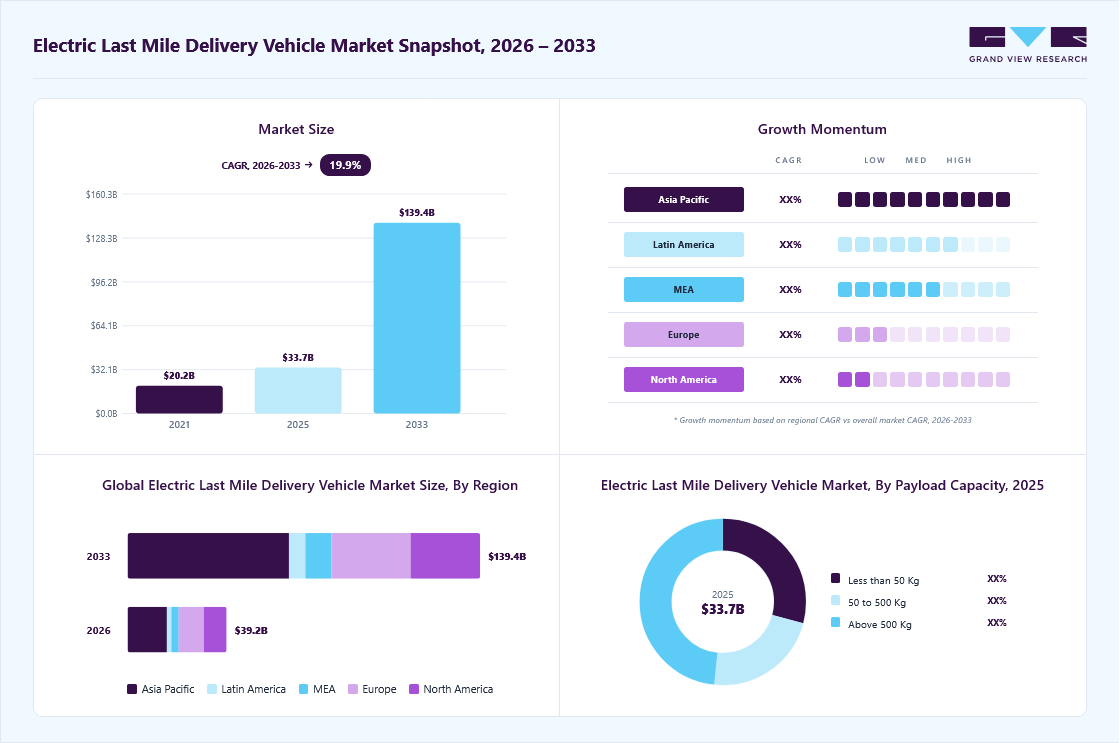 Source: Grand View Research, IR Documents, Primary Interviews, Paid DatabasesTo learn more about this report,
 Download Free Sample Report
 Key Market Trends & Insights
- By vehicle type: 4 wheeler segment held the largest market share of 57.0% in 2025.
- By payload capacity: Above 500 kg segment held the largest market share in 2025.
- By application: Retail & e-commerce segment held the largest market share in 2025.
Regional Highlights
- Largest regional market: Asia Pacific (38.9% revenue share, 2025)
- By country: China held the largest market share in 2025
Market Size & Forecast
- Market size in 2025: USD 33.7 Billion
- Estimated market size in 2026: USD 39.2 Billion
- Projected market size by 2033: USD 139.4 Billion
- CAGR (2026-2033): 19.9%
Three ways to get this report
Buy it, customize it, or ask a question.Ask an Analyst
Analyst response in 1 business day
- AccessReport author, directly
- Reply timeWithin 1 working day
- No sales callDirect answer only
- FormatEmail reply
- CostFree, no cost
Get the Full Report
What the study covers
- FormatsPDF · Excel · Dashboard
- Timeline2026–2033 annual, 2025 base
- Coverage20+ countries, 5 regions
- Companies10+ key players profiled
Customize the Report
20% free customization
- IncludeCountries, segments, points
- TailorTo your product definition
- ExtendDeeper competitor detail
- OrA fully bespoke study
- Turnaround5–10 working days
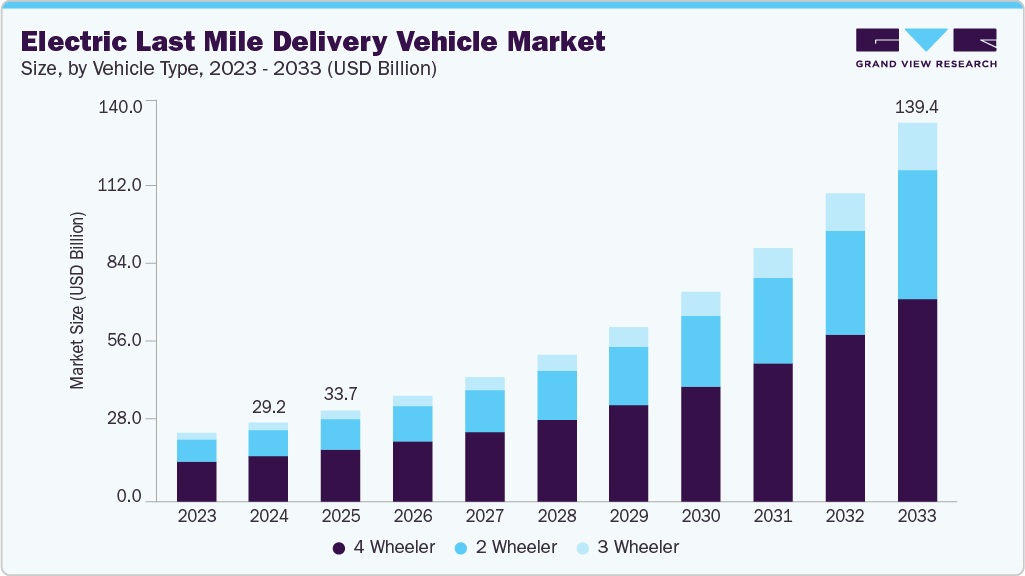
The major factor expected to drive the market growth is the reconfiguration of last-mile delivery cost structures, where electric vehicles materially improve unit economics at scale. Last-mile delivery is the most cost-intensive segment of logistics, driven by high stop density, idle time, and inefficient fuel consumption patterns in urban environments. Internal combustion engine (ICE) vehicles are structurally misaligned with these duty cycles due to high fuel costs during stop-go operations and frequent maintenance requirements. Also, electric vehicles, by contrast, are inherently optimized for low-speed, high-frequency stop cycles, resulting in significantly lower energy consumption per delivery. EVs decouple fleet operating costs from volatile fossil fuel prices, introducing cost predictability an increasingly critical factor for logistics operators working on thin margins.In addition, electrification enables new financial structures such as battery leasing, vehicle-as-a-service (VaaS), and pay-per-km models, reducing upfront capital burden and accelerating fleet turnover cycles. As logistics players transition toward asset-light models, EVs become integral to maintaining cost competitiveness. The shift from fuel-driven cost models to energy-optimized, utilization-driven logistics economics, is making electrification a necessity rather than a choice which is expected to support the market growth.
 To learn more about this report, Download Free Sample Report
 Stringent government regulations and low-emission zone (LEZ) mandates are playing a critical role in driving the adoption of electric vehicles for last mile delivery. Cities across Europe, North America, and parts of Asia are enacting policies to phase out internal combustion engine (ICE) vehicles from central urban areas, thereby creating a favorable environment for electric last mile delivery vehicles. Subsidies, tax exemptions, and vehicle scrappage incentives are further accelerating this shift by lowering the total cost of ownership for fleet operators transitioning to electric.
Recent improvements in battery technology especially in terms of energy density, charging speed, and lifecycle have made electric vehicles more viable for daily commercial use. Electric vans, mini trucks, and cargo bikes used for last-mile deliveries can now cover longer routes, carry heavier payloads, and recharge faster, making them suitable for multiple delivery cycles in a single day. In addition, the declining cost of lithium-ion batteries is helping reduce the upfront purchase price of electric delivery vehicles, making them more accessible to small and mid-sized logistics firms.
Vehicle Type Insights
The 4 wheeler segment accounted for the largest share of 57.03% in 2025. The 4-wheeler segment currently dominates the electric last mile delivery vehicle market due to its higher payload capacity, extended range, and suitability for structured, high-volume delivery operations. These vehicles typically electric vans, mini trucks, and light commercial vehicles (LCVs) are favored by large e-commerce, retail, and courier service providers for delivering goods across urban and suburban zones. Their ability to carry larger volumes in a single trip enhances operational efficiency and cost-effectiveness. With growing regulatory pressure to reduce emissions and the availability of subsidies and charging infrastructure, fleet operators are rapidly transitioning their conventional 4-wheeler fleets to electric alternatives, further reinforcing the segment’s market leadership.
The 3 wheeler segment is expected to grow at the fastest CAGR during the forecast period. These vehicles offer a lower total cost of ownership, maneuverability in narrow urban streets, and are ideal for short-distance, high-frequency deliveries. Small businesses, local vendors, and gig economy logistics platforms are increasingly adopting electric 3-wheelers for hyperlocal deliveries, such as groceries, parcels, and food. Government incentives for micro-mobility, expanding charging networks, and the entry of innovative OEMs are accelerating adoption, positioning the 3-wheeler segment as a critical driver of future growth in the electric last mile delivery market.
Payload Capacity Insights
The above 500 Kg segment held the largest market share in 2025. The segment of electric last mile delivery vehicles with a payload capacity above 500 kg continues to dominate the market, largely due to its ability to meet the operational demands of large e-commerce platforms, courier companies, and organized retail chains. These vehicles-mostly electric light commercial vans and trucks-enable bulk deliveries across longer distances with fewer trips, enhancing delivery efficiency and reducing total cost per shipment. Their suitability for hub-to-door and warehouse-to-store delivery models makes them an essential part of fleet electrification strategies for major logistics players. Furthermore, improvements in battery range and government incentives for heavy-duty EVs are further reinforcing this segment's stronghold in the market.
The 50 to 500 Kg segment is expected to grow at a significant CAGR during the forecast period. Electric last mile delivery vehicles with a payload capacity between 50 to 500 kg are emerging as a flexible and cost-effective solution for hyperlocal and intra-city deliveries. This segment, which includes electric cargo bikes, 3-wheelers, and small utility vehicles, is gaining traction among SMEs, food delivery platforms, and urban courier startups. Their low upfront and operating costs, compact size, and easy maneuverability in congested city areas make them ideal for last-meter deliveries. Rapid growth in quick-commerce, micro-fulfillment centers, and gig economy logistics is fueling demand for this segment, particularly in emerging markets across Asia and Latin America.
Application Insights
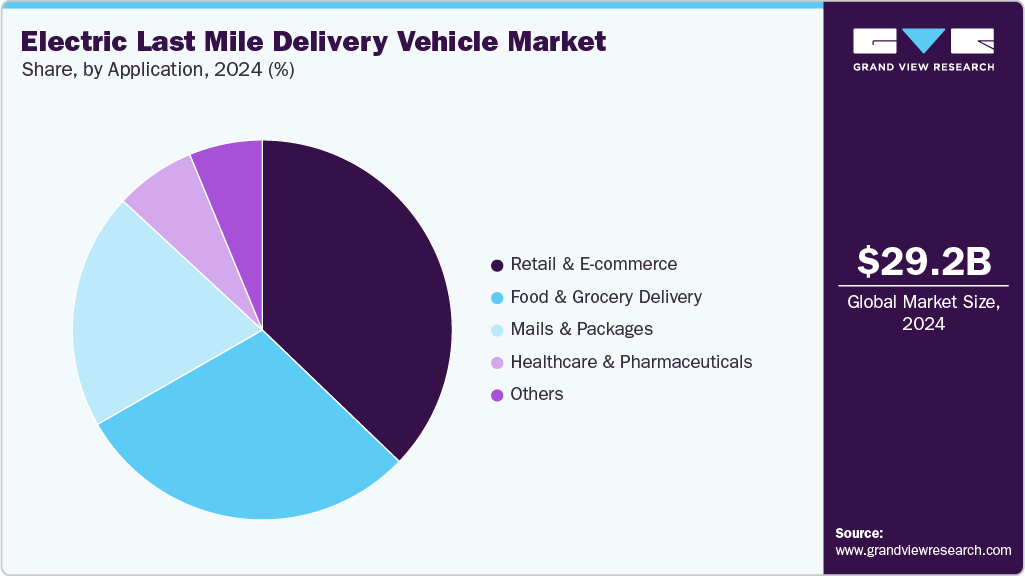
The retail & e-commerce segment dominated the market in 2025. Major e-commerce giants and third-party logistics providers are increasingly adopting electric vans and LCVs for urban fulfillment due to their higher load capacity, lower operating costs, and compliance with urban emission regulations. The push for same-day and next-day delivery services, combined with corporate sustainability commitments, is driving the deployment of large-scale electric fleets. In addition, robust logistics infrastructure and digital route optimization tools make e-commerce an ideal vertical for electric last mile vehicle integration.
 To learn more about this report, Download Free Sample Report
 The food & grocery delivery segment is projected to grow at the fastest over the forecast period. The food and grocery delivery segment is rapidly emerging as a key growth area for electric last mile delivery vehicles, especially in densely populated urban centers. With the surge in demand for online food ordering, instant grocery delivery, and quick-commerce (10-30 minute delivery windows), there is a growing need for compact, agile, and eco-friendly delivery solutions. Electric 2-wheelers, 3-wheelers, and mini cargo vehicles are becoming popular among restaurants, dark stores, and grocery chains, driven by their low cost of ownership, maneuverability, and ease of charging.
Regional Insights
The Asia Pacific electric last mile delivery vehicle market held a largest share of 38.91% in 2025. The growth in the region is driven by the rapid adoption of IoT and industrial automation across sectors such as healthcare, manufacturing, logistics, and smart infrastructure. The region benefits from advanced R&D capabilities, strong investment in energy harvesting technologies, and a high level of awareness regarding sustainable sensing solutions.
 To learn more about this report, Download Free Sample Report
 China Electric Last Mile Delivery Vehicle Market Trends
The China electric last mile delivery vehicle market held a dominant position in 2025. China electric last mile delivery vehicle market is primarily driven by state-directed electrification of urban logistics, where regulatory mandates and city-level restrictions on ICE vehicles create a forced transition toward electric fleets. The country’s highly integrated EV supply chain (batteries, components, and vehicle manufacturing) enables cost leadership, making electric 2W/3W and light commercial vehicles economically superior at scale. In addition, the dominance of platform-based e-commerce and instant delivery ecosystems necessitates high-frequency, short-radius delivery models that align structurally with EV operating characteristics. This is further reinforced by widespread deployment of battery swapping and dense urban charging infrastructure, reducing downtime and improving fleet utilization efficiency
Japan electric last mile delivery vehicle market is driven by urban logistics optimization under space and efficiency constraints, where compact EVs are better suited for narrow streets, high stop density, and strict delivery time windows. The market is further supported by strong policy alignment toward carbon neutrality (2050 targets), pushing logistics operators to electrify fleets as part of broader decarbonization commitments. In addition, Japan’s advanced automotive ecosystem and OEM-led innovation enable deployment of purpose-built electric mini commercial vehicles and kei-class delivery vans tailored for last-mile use cases. This is complemented by highly organized logistics networks and depot-based charging models, which improve operational predictability and accelerate EV integration into existing fleet systems.
Europe Electric Last Mile Delivery Vehicle Market Trends
The Europe Electric Last Mile Delivery Vehicle industry was identified as a lucrative region in 2025. The European Union’s ambitious climate targets and stringent carbon emission regulations are compelling logistics and e-commerce companies to accelerate the transition to electric delivery fleets. National and EU-wide incentives for fleet electrification, along with growing investment in urban mobility infrastructure and zero-emission zones, are driving large-scale deployment of electric last mile delivery vehicles across the region.
The UK electric last mile delivery vehicle market is driven by regulation-led fleet electrification, where ultra-low emission zones (ULEZ) and zero-emission mandates in cities like London are structurally phasing out ICE-based delivery fleets. The market also benefits from high e-commerce penetration and dense urban delivery networks, which create strong demand for low-operating-cost, short-range electric vans optimized for frequent stop-start usage. In addition, total cost of ownership parity is being achieved rapidly due to rising fuel costs, tax incentives, and lower maintenance of EVs, making electrification economically compelling for fleet operators. This is reinforced by well-developed public and depot-based charging infrastructure, enabling reliable multi-shift operations and accelerating large-scale fleet transition.
The Germany electric last mile delivery vehicle industry held a substantial market share in 2025. The country’s strong focus on sustainable mobility, combined with its leadership in Retail & E-commerce innovation, has created a robust environment for the growth of electric last mile delivery fleets. Urban emission restrictions and incentives for fleet electrification are encouraging logistics companies to transition from diesel-powered vans to electric LCVs and e-cargo bikes.
North America Electric Last Mile Delivery Vehicle Market Trends
The North America electric last mile delivery vehicle market is anticipated to grow at a CAGR of 16.9% during the forecast period. Rising fuel prices, tightening emission norms, and the rapid expansion of e-commerce and same-day delivery services are driving the need for cost-efficient, low-emission delivery solutions across the region. Governments at the federal and state levels are introducing favorable policies, including tax credits, fleet electrification mandates, and investment in EV charging infrastructure.
The U.S. electric last mile delivery vehicle market is driven by corporate-led fleet electrification at scale, where major logistics and e-commerce players are committing to large EV deployments to meet internal decarbonization targets and reduce long-term operating costs. The market is further supported by federal and state-level incentives and regulations, particularly in regions such as California, where zero-emission vehicle mandates and clean fleet rules are accelerating adoption. In addition, the U.S. benefits from high last-mile delivery intensity across suburban and urban sprawl, creating strong demand for electric vans with optimized route economics and predictable energy costs. This is complemented by rapid expansion of charging infrastructure and OEM-fleet partnerships, enabling scalable deployment of purpose-built electric delivery vehicles across large logistics networks.
Key Electric Last Mile Delivery Vehicle Company Insights
Some of the key companies in the Electric Last Mile Delivery Vehicle market include Ford Motor Company, Last Mile Mobility (Mahindra Group), GM Envolve, GreenPower Motor Company, Workhorse and others. To gain a competitive edge, organizations are increasingly focusing on expanding their customer base. As a result, key players are pursuing strategic initiatives such as mergers, acquisitions, and partnerships with other leading companies.
-
Ford Motor Company is one of the global Retail & E-commerce leader actively advancing the electrification of last mile delivery through purpose-built commercial EV solutions. Ford’s E-Transit van, part of its all-electric Transit lineup, is a cornerstone offering for fleet electrification, designed to meet the rigorous demands of urban logistics while reducing emissions. The company leverages its deep expertise in vehicle engineering, telematics, and fleet management systems to offer connected, energy-efficient solutions optimized for commercial delivery operations.
-
Last Mile Mobility (Mahindra Group) is one of the prominent player in India’s electric vehicle ecosystem, focusing on small-format, affordable electric vehicles designed specifically for last mile transportation. The division manufactures electric three-wheelers under brands like Treo and e-Alfa, which are widely adopted for cargo and passenger applications in urban and semi-urban markets.
Key Electric Last Mile Delivery Vehicle Companies:
The following key companies have been profiled for this study on the electric last mile delivery vehicle market.
- Last Mile Mobility (Mahindra Group)
- GM Envolve
- Ford Motor Company
- GreenPower Motor Company
- Workhorse
- Star EV Corporation, USA
- Rivian
- Chevrolet
- Gogoro Inc.
- Honda
- Tata Motors
Recent Developments
-
In October 2025, MoEVing announced the leasing of 700 Tata Electric CVs. MoEVing will lease 700 Tata Motors electric small commercial vehicles to support last-mile delivery operations across major Indian cities. This strategic initiative is expected to strengthen MoEVing share in the market.
-
In July 2025, Ford Pro has announced that the E‑Transit Custom will soon offer an advanced all‑wheel‑drive (AWD) variant debuting in spring 2026, enhancing traction in slippery or rugged conditions by adding a high‑power electric motor at the front axle to the existing rear‑wheel setup. Designed for challenging environments like Nordic or Alpine regions, the dual‑motor system ensures efficient torque distribution and improved vehicle dynamics. The AWD version retains the current model’s 64 kWh battery, which powers motors available in 100-, 160-, or 210-kW configurations offering up to 337 km WLTP range and supports 125 kW DC fast charging (10-80% in ~39 minutes). With a maximum payload of ~1,011 kg, 6.8 m³ cargo volume, and 2.3 ton towing capacity, it’s engineered to meet the demands of harsh weather delivery operations-especially in productivity‑critical environments.
-
In July 2024, Workhorse has introduced a 208‑inch extended-wheelbase version of its W56 electric step van, expanding the cargo volume to an impressive 1,200 ft³ while maintaining a zero-emission 150-mile range and approximately 10,000 lb payload capacity. Building on the original 178‑inch model, this extended variant incorporates over 100 enhancements, such as enhanced service access, additional charge port options, new entry and cargo doors, a revised rear-box structure, and modular accessories (liftgates, lighting), to support a wide range of commercial applications and easier upfitting.
Electric Last Mile Delivery Vehicle Market Report Scope
Report Attribute
Details
Market size in 2025
USD 33.7 billion
Estimated market size in 2026
USD 39.2 billion
Projected market size by 2033
USD 139.4 billion
Growth rate
CAGR of 19.9% from 2026 to 2033
Base year for estimation
2025
Historical data
2021 - 2024
Forecast period
2026 - 2033
Quantitative units
Revenue in USD million/billion and CAGR from 2026 to 2033
Report Payload Capacity
Revenue forecast, company ranking, competitive landscape, growth factors, and trends
Segments covered
Vehicle type, payload capacity, application, region
Regional scope
North America; Europe; Asia Pacific; Latin America; MEA
Country scope
U.S.; Canada; Mexico; Germany; UK; France; China; Japan; India; South Korea; Australia; Brazil; KSA; UAE; South Africa
Key companies profiled
Last Mile Mobility (Mahindra Group); GM Envolve; Ford Motor Company; GreenPower Motor Company; Workhorse; Star EV Corporation, USA; Rivian, Chevrolet, Gogoro Inc., Honda, Tata Motors
Customization scope
Free report customization (equivalent up to 8 analysts working days) with purchase. Addition or alteration to country, regional & segment scope.
Pricing and purchase options
Avail customized purchase options to meet your exact research needs. Explore purchase options
Global Electric Last Mile Delivery Vehicle Market Report Segmentation
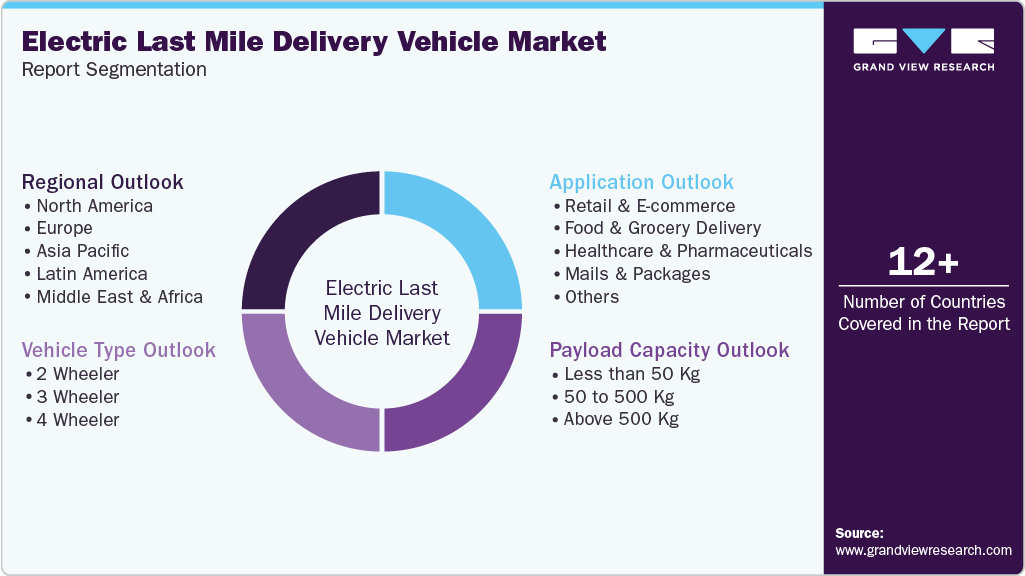
This report forecasts revenue growth at global, regional, and country levels and provides an analysis of the latest industry trends in each of the sub-segments from 2021 to 2033. For this study, Grand View Research has segmented the global electric last mile delivery vehicle market report based on vehicle type, payload capacity, application, and region:
 To learn more about this report, Download Free Sample Report
 -
Vehicle Type Outlook (Revenue, USD Million, 2021 - 2033)
-
2 Wheeler
-
3 Wheeler
-
4 Wheeler
-
-
Payload Capacity Outlook (Revenue, USD Million, 2021 - 2033)
-
Less than 50 Kg
-
50 to 500 Kg
-
Above 500 Kg
-
-
Application Outlook (Revenue, USD Million, 2021 - 2033)
-
Retail & E-commerce
-
Food & Grocery Delivery
-
Healthcare & Pharmaceuticals
-
Mails & Packages
-
Others
-
-
Regional Outlook (Revenue, USD Million, 2021 - 2033)
-
North America
-
U.S.
-
Canada
-
Mexico
-
-
Europe
-
Germany
-
UK
-
France
-
-
Asia Pacific
-
China
-
Japan
-
India
-
South Korea
-
Australia
-
-
Latin America
-
Brazil
-
-
Middle East and Africa (MEA)
-
KSA
-
UAE
-
South Africa
-
-
Frequently Asked Questions About This Report
The 4 wheeler segment led with a 57.0% revenue share in 2025, while the 3 wheeler segment is the fastest-growing.
The above 500 kg segment held the largest revenue share in 2025.
The retail & e-commerce segment held the largest revenue share in 2025, while the food & grocery delivery segment is the fastest-growing.
The global electric last mile delivery vehicle market is expected to grow at a CAGR of 19.9% from 2026 to 2033, reaching USD 139.4 billion by 2033.
The global electric last mile delivery vehicle market size was valued at USD 33.7 billion in 2025 and is estimated at USD 39.2 billion for 2026.
Asia Pacific dominated with a 38.9% revenue share in 2025.
Key players include Last Mile Mobility (Mahindra Group); GM Envolve; Ford Motor Company; GreenPower Motor Company; Workhorse; Star EV Corporation, USA; Rivian, Chevrolet, Gogoro Inc., Honda, Tata Motors
Rising e-commerce demand and stringent urban emission regulations are accelerating the adoption of electric last mile delivery vehicles.
About the Author(s)
Next Generation Technologies Research Team
Technology · Next Generation TechnologiesThis report was authored by the next generation technologies research team at Grand View Research - comprising two research analysts, one senior research analyst, and one industry expert - with specialized expertise in the next generation technologies segment of the technology industry. All findings are based on proprietary technology databases, executive interviews, and regulatory analysis, subject to internal peer review prior to publication.
Last Updated:
Speak to Analyst

Customize this report to your needs - add regions, segments, or data points, with 20% free customization.
Or view our licence options:


ISO 9001:2015 & 27001:2022 Certified
We are GDPR and CCPA compliant! Your transaction & personal information is safe and secure. For more details, please read our privacy policy.


