
- Home
- »
- Animal Health
- »
-
Equine Genetics Market Size & Share Report, 2026-2033GVR Report cover

Equine Genetics Market (2026 - 2033)
Size, Share & Trends Analysis Report By Type (Genetic Disease Testing, Genomics), By Application (Sports/Racing, Recreation), By Distribution Channel (Private, Public), By Region (North America, Europe, APAC, MEA), And Segment Forecasts
Market Size, 2025
$377.2MMarket Estimate, 2026
$402.7MMarket Forecast, 2033
$686.6MCAGR, 2026–2033
7.9%Equine Genetics Market Summary
The global equine genetics market size was valued at USD 377.2 million in 2025 and is projected to grow from USD 402.7 million in 2026 to USD 686.6 million by 2033, at a CAGR of 7.9% from 2026 to 2033. North America held the largest share of 39.4% of the global market in 2025. The market is significantly growing, driven by rising adoption of genomic tools in performance horse breeding and selection, regulatory mandates for parentage verification across breed registries, declining sequencing costs, expanding direct-to-consumer testing access, and strategic consolidation accelerating technology access across the value chain.
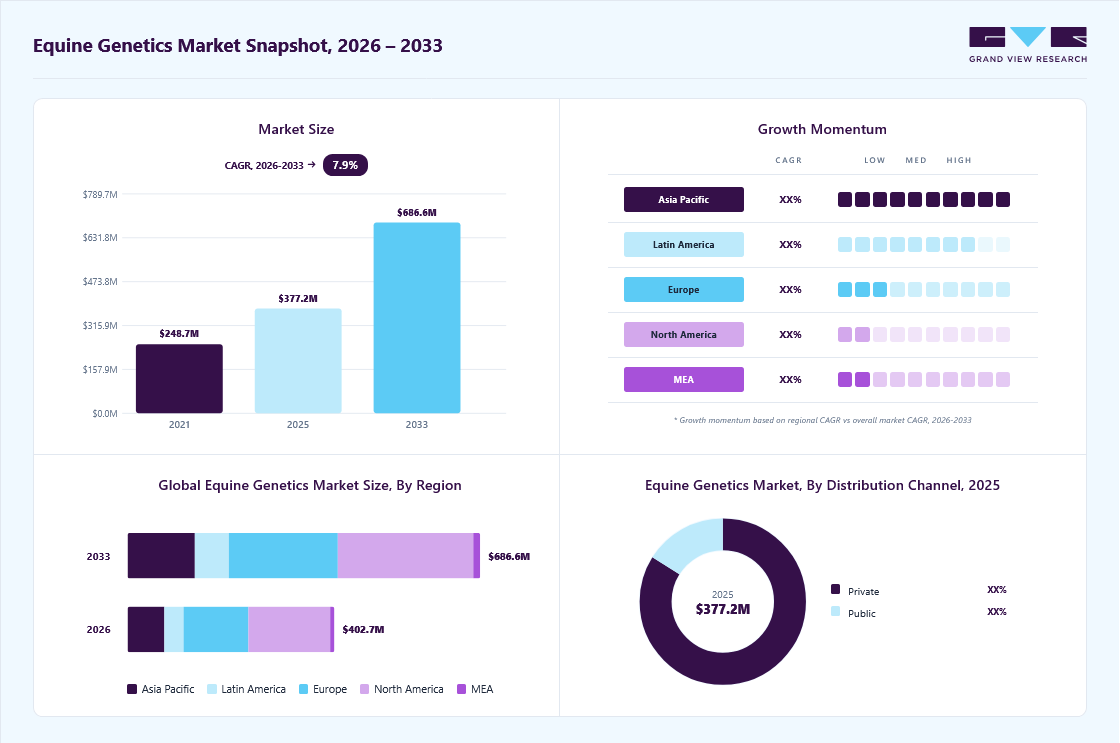 Source: Grand View Research, IR Documents, Primary Interviews, Paid DatabasesTo learn more about this report,
 Download Free Sample Report
 Key Market Trends & Insights
- By type: the genetic disease testing segment held the largest share of about 57% of the market in 2025.
- By application: the sports/racing segment held the largest market share of 60.3% in 2025.
- By distribution channel: the private segment held the largest market share in 2025.
Regional Highlights
- Largest regional market: North America (39.4% market share, 2025)
- Fastest-growing regional market: Asia Pacific (highest CAGR, 2026-2033)
- By country: The U.S. held the largest market share in 2025.
Market Size & Forecast
- Market size in 2025: USD 377.2 Million
- Estimated market size in 2026: USD 402.7 Million
- Projected market size by 2033: USD 686.6 Million
- CAGR (2026-2033): 7.9%
Three ways to get this report
Buy it, customize it, or ask a question.Ask an Analyst
A direct answer, usually in 1 working day
- AccessReport author, directly
- Reply timeWithin 1 working day
- No sales callDirect answer only
- FormatEmail reply
- CostFree, no cost
Get the Full Report
What the study covers
- FormatsPDF · Excel · Dashboard
- Timeline2026–2033 annual, 2025 base
- Coverage20+ countries, 5 regions
- Companies10+ key players profiled
Customize the Report
20% free customization
- IncludeCountries, segments, points
- TailorTo your product definition
- ExtendDeeper competitor detail
- OrA fully bespoke study
- Turnaround5–10 working days
Genomic testing has become a foundational component of performance horse management, particularly within racing and competitive equine sports. Breed registries, racing authorities, and private breeders are increasingly integrating whole-genome sequencing and SNP-based panels into standard breeding protocols, moving away from phenotype-only selection toward genotype-informed decision-making. The commercial availability of performance-oriented genetic panels has been a significant catalyst. For instance, Etalon Equine Genetics offers DNA-based assessments covering speed aptitude, surface preference, and injury susceptibility, allowing trainers and owners to make data-backed acquisition and breeding decisions. Similarly, Equinome Labs provides Thoroughbred-specific tests evaluating race distance suitability and performance potential, directly influencing breeding pair selection at the highest competitive levels.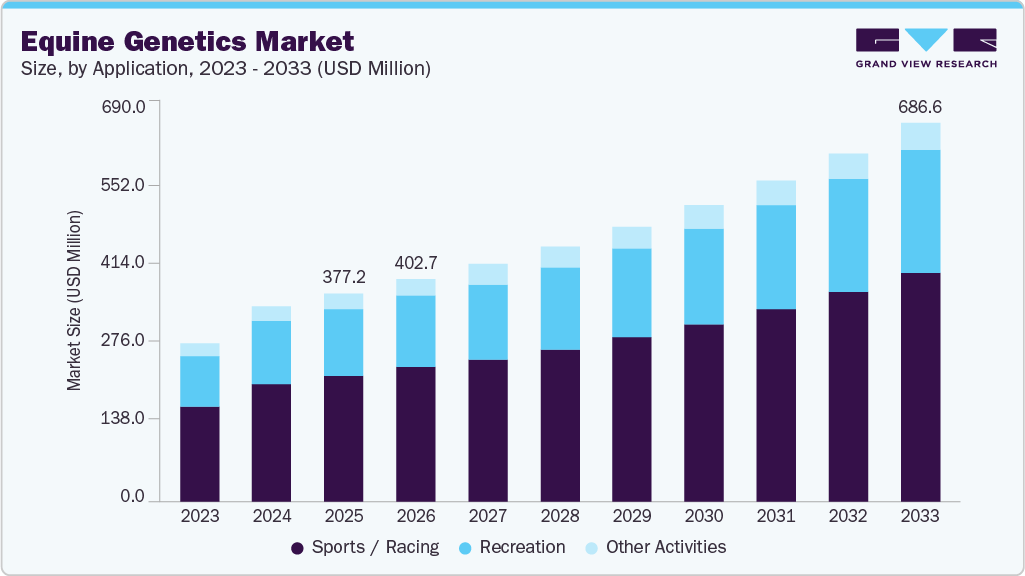 To learn more about this report, Download Free Sample Report
 Institutional activity further validates this trajectory. The International Association for the Future of Horse Breeding launched a genomic breeding value database in early 2026, consolidating multi-breed genetic data to support population-level selection decisions. Horse Sport Ireland introduced a genomic grade-up rule for Irish Draught horses, formally integrating genomic criteria into studbook eligibility. These developments signal a structural shift where genomic data is transitioning from an optional tool to a registry-level requirement. Research advancements also contribute meaningfully. Studies from the University of Kentucky identifying genetic determinants of equine stamina and Cornell University's work on genetic factors in mare pregnancy loss are expanding the applied utility of genomic tools beyond performance into reproductive health management. This broadening scope is widening the addressable market for genomic service providers across both private and institutional distribution channels.
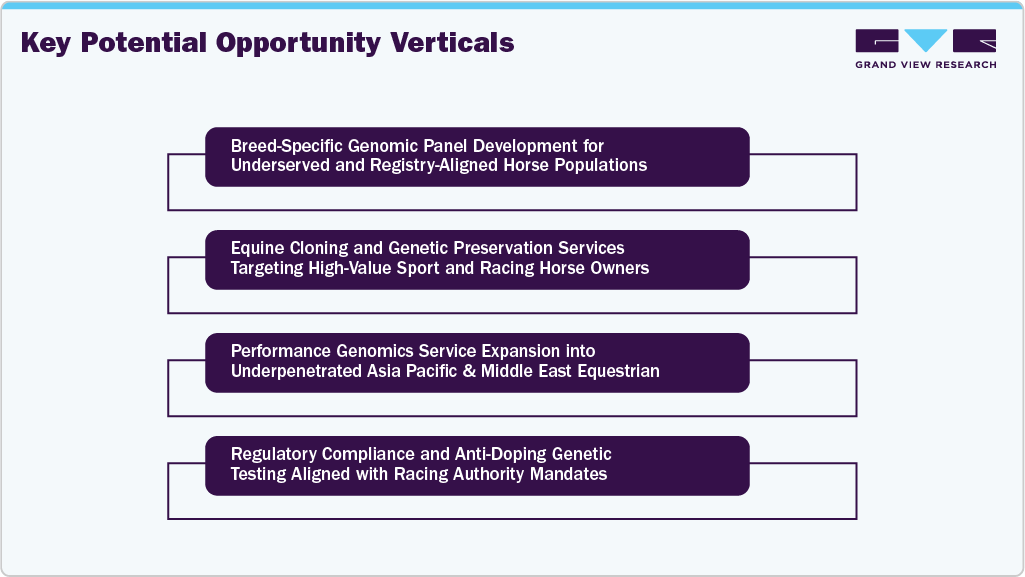
Declining next-generation sequencing costs represent another important driver, progressively lowering the financial barrier for individual horse owners and small-scale breeders to access genetic testing services. As per-sample sequencing costs continue to fall, commercial laboratories have expanded their service portfolios to include multi-trait panels at accessible price points, broadening market participation beyond professional racing operations. This cost compression has supported the growth of direct-to-consumer providers such as AffinityDNA, EasyDNA, and Animal Genetics, Inc., which offer parentage verification, breed identification, and disease screening without requiring institutional intermediaries. The resulting democratization of genetic data access is generating higher testing volumes across recreational and small-breeder segments, contributing to sustained revenue growth within the private distribution channel.
 To learn more about this report, Download Free Sample Report
 Industry Concentration
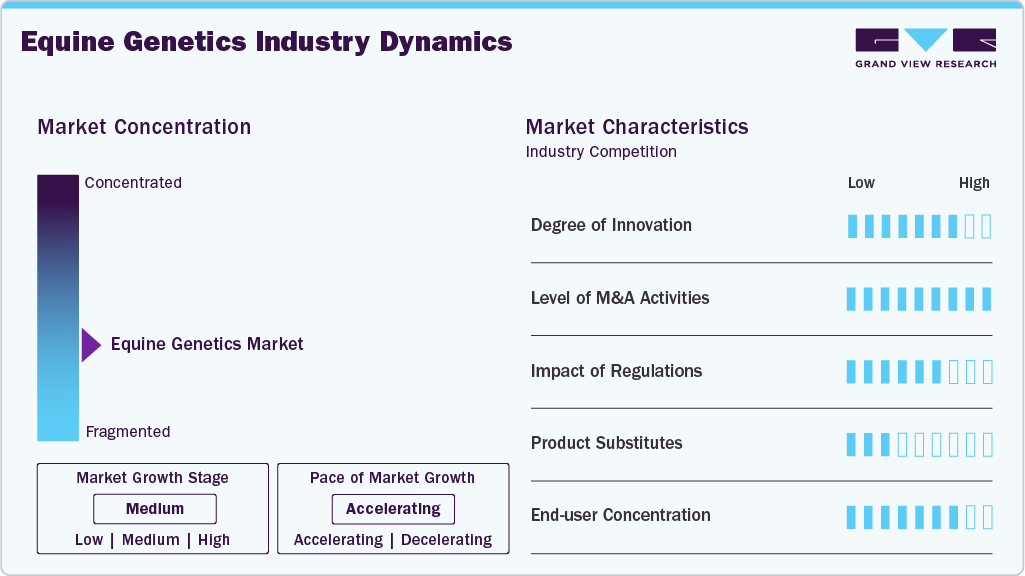
The global equine genetics market remains moderately fragmented, with a mix of specialized standalone providers and vertically integrated animal health companies competing across service segments. No single entity commands a dominant market share across all testing categories. However, consolidation activity is gradually altering this structure. Zoetis' acquisition of Neogen's animal genomics business and Colossal Biosciences' acquisition of ViaGen indicate a measurable shift toward concentration at the premium and advanced-application end of the market. Smaller niche players continue to retain relevance through breed-specific or region-specific service specialization.
Innovation within the equine genetics industry is progressing at a measured but accelerating pace. Advances in whole-genome sequencing, SNP panel development, and gene editing are expanding the applied scope of genetic services beyond conventional parentage and disease testing. EquiSeq's issuance of a U.S. patent for detecting muscle disease-causing genetic variants and the emergence of gene-edited polo horses in Argentina represent tangible innovation milestones. Furthermore, genomic breeding value databases and multi-trait performance panels are adding analytical depth to existing service offerings. Investment from larger animal health companies is expected to further intensify research and development activity across the industry in the near term.
 To learn more about this report, Download Free Sample Report
 M&A activity within the equine genetics market has gained visible momentum, particularly at the premium end of the value chain. Zoetis' acquisition of Neogen's animal genomics business represents one of the most strategically significant transactions, consolidating genomic testing capabilities within a global animal health platform. Colossal Biosciences' acquisition of ViaGen expanded its position in equine cloning and genetic preservation. These transactions indicate that larger animal health enterprises view equine genetics as a high-value adjacency worth acquiring rather than building organically. This trend is expected to continue as sequencing costs decline and demand for integrated genetic health solutions across breeding and performance applications grows.
Regulatory influence on the equine genetics industry operates through multiple channels, including breed registry requirements, anti-doping frameworks, and emerging oversight of gene editing applications. The British Horseracing Authority's introduction of gene doping testing within its anti-doping program directly shapes permissible genetic intervention boundaries in competitive racing. Parentage verification mandates from national studbook authorities create a consistent baseline demand for DNA-based testing services. However, regulatory frameworks governing cloning and gene editing remain inconsistent across geographies, generating compliance complexity for multinational service providers. In regions where regulatory clarity is limited, adoption of advanced genetic applications tends to remain constrained, affecting revenue potential for providers operating in those jurisdictions.
Direct substitutes for genetic testing within the equine genetics market are limited, given the specificity and diagnostic accuracy that DNA-based methods provide. Traditional phenotypic assessment and pedigree documentation represent the primary alternatives, but both carry meaningful limitations in detecting recessive disorders, confirming parentage, or predicting performance traits with statistical confidence. Microchip-based identification, while increasingly standardized for traceability, does not replicate the diagnostic or predictive utility of genomic testing. The absence of credible substitutes capable of delivering equivalent genetic insight reinforces consistent demand across testing categories, particularly where registry compliance or disease management decisions carry financial or competitive consequences for horse owners and breeders.
End user concentration within the equine genetics industry is moderate, with demand distributed across professional racing operations, private breeders, recreational horse owners, and institutional entities such as breed registries and veterinary research bodies. Racing and high-performance breeding segments account for a disproportionate share of premium testing volumes due to the financial stakes associated with genetic selection at that level. Recreational and small-breeder segments, while individually lower in spend, collectively represent a growing share of testing volume as direct-to-consumer pricing becomes more accessible. Public institutions, including universities and government-affiliated registries, contribute to demand primarily through population-level studies and mandatory parentage verification programs.
Type Insights
Genetic disease testing is among the largest segments in the market with a revenue share of around 57% in 2025. Demand is primarily driven by the increasing prevalence of hereditary conditions across breed populations and the financial consequences of disease transmission in high-value breeding programs. Mandatory DNA health screening requirements from breed registries, particularly in North America and Europe, generate consistent baseline testing volumes. Furthermore, technological advances such as EquiSeq's patented muscle disease detection methodology are expanding the diagnostic scope and clinical credibility of this segment.
The genomics segment is the fastest-growing category within the equine genetics market over the forecast period. Declining sequencing costs, broader registry adoption of SNP-based panels, and growing breeder demand for performance and trait prediction are collectively accelerating uptake. The launch of genomic breeding value databases and the integration of genomic criteria into formal studbook eligibility rules signal a structural expansion of this segment's utility. In addition, research linking specific genomic variants to stamina, reproductive outcomes, and injury risk is widening the applied scope of genomic services across both private and institutional channels.
Application Insights
Sports/racing represents the largest segment in the market with a share of 60.3% in 2025. The high financial value of performance horses in competitive racing creates strong economic incentives for genetic screening at both pre-purchase and breeding stages. Genetic panels assessing speed aptitude, surface preference, and injury predisposition are widely adopted by racing syndicates and professional breeding operations. Anti-doping frameworks, such as the BHA's gene doping testing program, are also generating incremental demand for genetic analysis within this segment's regulatory compliance requirements.
Recreation represents the fastest-growing segment in the global market, driven by rising horse ownership among non-professional riders and the growing availability of affordable direct-to-consumer testing services. Recreational owners are increasingly seeking genetic insights related to temperament, health predispositions, and breed composition to inform purchase and management decisions. The expansion of multi-trait panels at accessible price points by providers such as AffinityDNA and EasyDNA has made genetic testing viable for this segment. Growth is particularly visible in North America and Western Europe, where leisure riding participation rates remain high.
Distribution Channel Insights
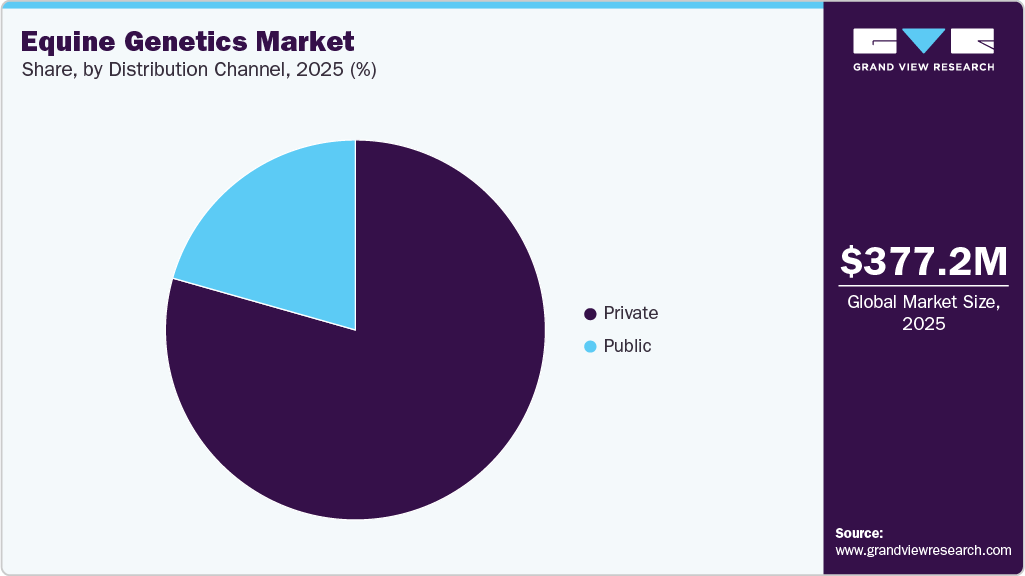
The private segment stands as both the largest and fastest-growing category in the market. Commercial laboratories and direct-to-consumer providers offer faster turnaround times, broader service portfolios, and stronger engagement with individual breeders and horse owners compared to public alternatives. The ongoing expansion of online sample submission platforms has further reduced friction in the testing process. M&A activity, including Zoetis' acquisition of Neogen's genomics business, is consolidating service capacity within the private channel and expanding its geographic and technological reach.
 To learn more about this report, Download Free Sample Report
 The public segment accounts for the second-largest share in the global market, with demand anchored in government-mandated parentage verification, national breed registry programs, and academic research institutions. Universities such as UC Davis and Cornell are active contributors through breed-specific panel development and population genetics research. Public entities are particularly relevant in regions where regulatory frameworks mandate state-administered genetic traceability for equine identification and studbook management. While growth in this segment is more measured, its role in establishing testing standards and supporting registry infrastructure remains foundational to overall industry operations.
Regional Insights
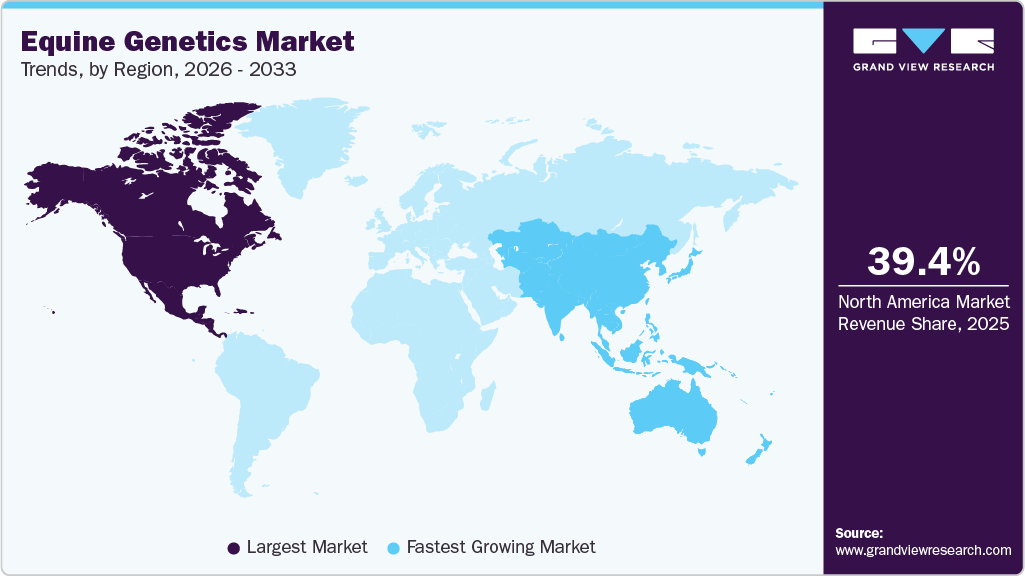
North America equine genetics market held the largest segment with a revenue of 39.4% in 2025. The region benefits from a well-established commercial testing infrastructure, high horse ownership density, and strong registry-driven demand for parentage and disease screening. The presence of leading private providers, active academic institutions such as UC Davis and the University of Kentucky, and significant M&A activity involving U.S.-headquartered entities collectively position North America as the dominant and most structurally mature regional market within the global equine genetics industry.
 To learn more about this report, Download Free Sample Report
 U.S. Equine Genetics Market Trends
The equine genetics industry in the U.S. is leading globally, driven by the highest concentration of commercial testing providers, a large performance horse population, and deeply integrated registry-mandated DNA verification requirements from organizations such as the American Quarter Horse Association and the Jockey Club. EquiSeq's patent issuance for muscle disease detection and UC Davis VGL's launch of the APHA Paint Horse panel in 2025 are recent domestic developments that directly advance diagnostic capabilities. Furthermore, substantial private investment and ongoing academic research continue to reinforce the U.S. position at the forefront of equine genomic innovation.
Canada equine genetics market is expanding, fueled by a notable population of sport and working horses across western provinces and a growing adoption of genomic tools among breeders engaged with national registry bodies. The country's proximity to U.S.-based commercial laboratories facilitates accessible testing for Canadian horse owners. In addition, agricultural research institutions in Canada are progressively incorporating equine genomics into broader livestock genetics programs, generating incremental institutional demand. The standardization of microchip-based identification systems is also creating complementary demand for DNA-linked traceability services across the Canadian equine population.
Europe Equine Genetics Market Trends
The equine genetics industry in Europe is expanding, fueled by robust regulatory frameworks governing studbook management, a high density of competitive equestrian activity, and progressive institutional adoption of genomic tools. The International Association for the Future of Horse Breeding's launch of a genomic breeding value database in early 2026 represents a notable regional development, consolidating multi-breed genetic data for population-level breeding decisions. European breed registries, particularly in dressage and warmblood disciplines, are among the earliest adopters of genomic selection criteria, positioning Europe as a key region for continued growth.
The UK equine genetics market is expanding, supported by a highly active Thoroughbred racing industry and a well-regulated anti-doping environment. The British Horseracing Authority's introduction of gene doping testing within its anti-doping program is a uniquely significant domestic development, creating formal regulatory demand for advanced genetic analysis in racing. Parentage verification requirements from Weatherbys, the Thoroughbred registry administrator, generate consistent baseline DNA testing volumes. The UK's combination of racing heritage, regulatory rigor, and proximity to European genomic research institutions positions it as a structurally important market within the regional landscape.
The equine genetics market in Sweden is expanding, supported by one of the highest per-capita horse ownership rates in Europe and a strong tradition of Warmblood and Standardbred breeding. Swedish breed associations have been progressive in adopting genomic selection tools within their studbook programs, generating institutional demand for genomic screening and trait testing services. Government support for agricultural biotechnology research further contributes to the industry's development. The country's well-organized equestrian infrastructure and alignment with broader EU-level genetic traceability standards create a stable foundation for continued testing adoption across both private and public distribution channels.
Asia Pacific Equine Genetics Market Trends
The equine genetics industry in the Asia Pacific is set to grow rapidly, driven by rising equestrian participation, expanding racing industries in Australia and Japan, and growing awareness of genetic tools among breeders across emerging economies. Australia's established horse racing industry and active engagement with equine cloning, as indicated by recent domestic developments, contribute meaningfully to regional demand. Japan's structured racing governance and high-value breeding programs support premium genomic testing adoption. In addition, increasing government investment in livestock genomics across China and India is generating parallel institutional interest in equine-specific genetic services.
China equine genetics market is expanding on the back of government-supported livestock genomics initiatives and a growing interest in equestrian sports following their formal inclusion in national sports development programs. The domestic horse population, concentrated in Inner Mongolia and northwestern provinces, presents a large and largely underpenetrated testing opportunity. International testing providers are beginning to establish regional partnerships to access this base. Furthermore, China's broader investment in biotechnology infrastructure is gradually creating domestic capacity for genomic services, reducing historical dependence on foreign laboratory testing for equine genetics applications.
The equine genetics market in India is in an early but emerging stage, driven by a structured horse racing industry concentrated in cities such as Mumbai, Bangalore, and Kolkata, where parentage verification and performance-related testing are gaining traction. Polo, a historically significant equestrian discipline in India, is also beginning to intersect with genetic selection practices. GeneTech, an India-based genomics provider, represents a domestic commercial presence within the industry. Growing veterinary awareness and increasing breeder engagement with international studbook standards are gradually building a foundation for broader genomic testing adoption across the country.
Latin America Equine Genetics Market Trends
The equine genetics industry in Latin America is expanding, driven by one of the world's largest horse populations, concentrated primarily in Brazil and Argentina, and a deeply rooted culture of equestrian sports including polo, rodeo, and racing. Argentina has emerged as a notable focal point following the development of gene-edited polo horses, positioning the country at the advanced application frontier of the regional industry. Growing interest from professional breeding operations in accessing genomic performance data, combined with increasing availability of international testing services, is supporting progressive demand growth across the region's private distribution channel.
Brazil equine genetics marketis witnessing growth due to its status as one of the largest horse-producing nations globally, with a substantial population engaged in agricultural work, rodeo, and competitive racing. The Brazilian Quarter Horse and Mangalarga Marchador breed registries represent institutional demand anchors for parentage verification and disease screening services. In addition, the country's expanding agribusiness sector is increasing awareness of genetic tools as productivity-enhancing instruments within equine breeding programs. Growing domestic veterinary infrastructure and improving laboratory accessibility are progressively reducing barriers to testing adoption among Brazilian breeders and horse owners.
Middle East & Africa Equine Genetics Market Trends
The equine genetics industry in MEA is expanding with notable variation in the development stage across sub-regions. Gulf Cooperation Council nations, particularly Saudi Arabia and the UAE, are driving premium demand through their Arabian horse breeding programs and structured racing industries. Genetic traceability and parentage verification are integral to Arabian horse registry management, generating consistent institutional demand. In Africa, growth remains nascent but is supported by South Africa's organized racing industry. Overall, the region's expansion is concentrated within high-value breeding and racing applications, with recreational and research-oriented demand at comparatively early stages of development.
South Africa equine genetics market is gradually advancing, anchored by a structured Thoroughbred racing industry and formal breed registration requirements that mandate DNA-based parentage verification. The National Horseracing Authority's governance framework creates a regulatory foundation for consistent testing demand within the racing segment. Moreover, South Africa's relatively developed veterinary and laboratory infrastructure compared to other sub-Saharan markets positions it as the primary access point for equine genetic services across the African continent. Growing interest in sport horse breeding and international equestrian competition participation is incrementally broadening demand beyond racing into performance and breed identification applications.
The equine genetics market in Saudi Arabia is emerging, supported by the country's deep cultural and economic investment in Arabian horse breeding and a rapidly growing equestrian sports sector aligned with Vision 2030 diversification objectives. The Arabian horse holds significant heritage value in Saudi Arabia, and genetic purity verification through parentage testing is a well-established practice within the country's breeding community. Government-backed equestrian development initiatives and the expansion of formal racing infrastructure are generating incremental demand for performance-oriented genomic testing. Saudi Arabia's investment capacity and institutional commitment to equine excellence position it as a high-potential growth market within the broader MEA region.
Key Equine Genetics Company Insights
Leading companies within the global equine genetics industry compete primarily on the basis of proprietary testing methodologies, breed registry partnerships, and breadth of service portfolios. The competitive landscape spans three distinct capability tiers: genetic disease testing specialists, comprehensive genomic profiling providers, and advanced application firms operating in cloning and genetic preservation. Patent holdings are increasingly serving as meaningful competitive differentiators within the industry.
Key Equine Genetics Companies:
The following key companies have been profiled for this study on the equine genetics market.
- EquiSeq Inc
- Animal Genetics, Inc.
- DDC
- AffinityDNA
- EasyDNA
- Etalon Equine Genetics
- Equinome Labs
- VHLGenetics
- Genomia s.r.o.
- GeneTech
- Equigerminal
- Victory Genomics
- ViaGen Pets (Colossal Biosciences)
- Clonargen Biotech
Recent Developments
-
In March 2026, Horse Sport Ireland launched an innovative genomic grade-up rule for Irish Draught horses, formally integrating genomic criteria into studbook eligibility assessment for the breed. This development represents a direct expansion of genomic testing demand within the public distribution channel and signals a broader institutional shift toward DNA-based breed registry governance across Europe.
-
In February 2026, the International Association for the Future of Horse Breeding launched a genomic breeding value database consolidating multi-breed genetic data for population-level selection decisions. This initiative accelerates institutional adoption of genomic tools across breed registries and expands the applied utility of the genomics segment globally.
-
In November 2025, Colossal Biosciences acquired ViaGen, the established leader in animal cloning, consolidating equine cloning and genetic preservation capabilities under a single advanced biotechnology platform.
Equine Genetics Market Report Scope
Report Attribute
Details
Market size in 2025
USD 377.2 million
Estimated market size in 2026
USD 402.7 million
Projected market size by 2033
USD 686.6 million
Growth rate
CAGR of 7.9% from 2026 to 2033
Actual data
2021 - 2025
Forecast period
2026 - 2033
Quantitative units
Revenue in USD million/billion and CAGR from 2026 to 2033
Report coverage
Revenue forecast, company ranking, competitive landscape, growth factors, and trends
Segments covered
Type, application, distribution channel, region
Regional scope
North America; Europe; Asia Pacific; Latin America; MEA
Country scope
U.S.; Canada; Mexico; UK; Germany; France; Italy; Spain; Denmark; Sweden; Norway; Japan; China; India; Australia; South Korea; Thailand; Brazil; Argentina; South Africa; Saudi Arabia; UAE; Kuwait; Qatar; Oman
Key companies profiled
EquiSeq Inc.; Animal Genetics, Inc.; DDC; AffinityDNA; EasyDNA; Etalon Equine Genetics; Equinome Labs; VHLGenetics; Genomia s.r.o.; GeneTech; Equigerminal; Victory Genomics; ViaGen Pets (Colossal Biosciences); Clonargen Biotech
Customization scope
Free report customization (equivalent up to 8 analysts working days) with purchase. Addition or alteration to country, regional & segment scope.
Pricing and purchase options
Avail customized purchase options to meet your exact research needs. Explore purchase options
Global Equine Genetics Market Report Segmentation
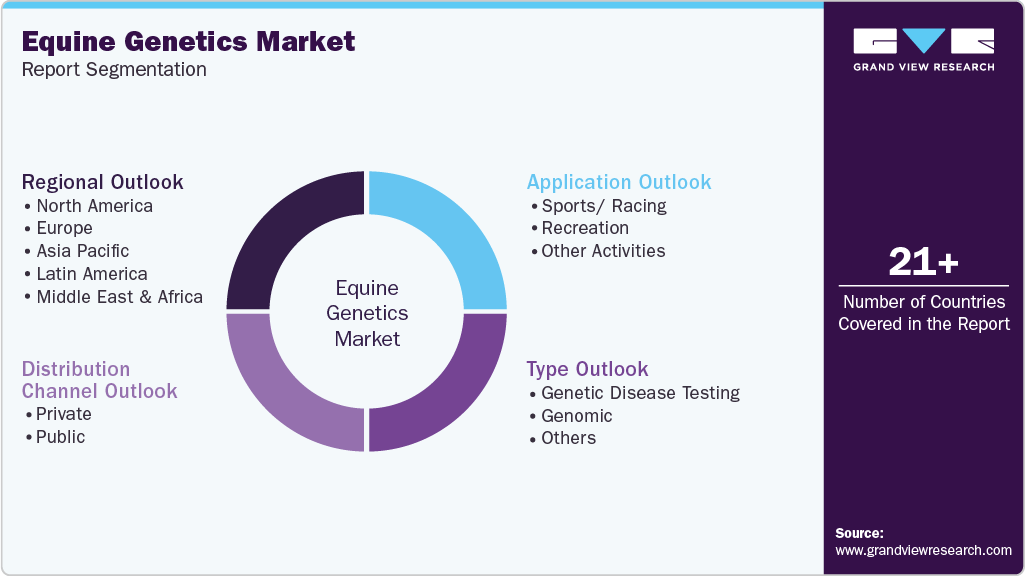
This report forecasts revenue growth at global, regional, and country levels and provides an analysis of the latest industry trends in each of the sub-segments from 2021 to 2033. For this study, Grand View Research has segmented the global equine genetics market report based on type, application, distribution channel, and region:
 To learn more about this report, Download Free Sample Report
 -
Type Outlook (Revenue, USD Million, 2021 - 2033)
-
Genetic Disease Testing
-
Genomic
-
Others
-
-
Application Outlook (Revenue, USD Million, 2021 - 2033)
-
Sports/ Racing
-
Recreation
-
Other Activities
-
-
Distribution Channel Outlook (Revenue, USD Million, 2021 - 2033)
-
Private
-
Public
-
-
Regional Outlook (Revenue, USD Million, 2021 - 2033)
-
North America
-
U.S.
-
Canada
-
Mexico
-
-
Europe
-
UK
-
Germany
-
France
-
Italy
-
Spain
-
Denmark
-
Sweden
-
Norway
-
-
Asia Pacific
-
Japan
-
India
-
China
-
South Korea
-
Australia
-
Thailand
-
-
Latin America
-
Brazil
-
Argentina
-
-
Middle East and Africa (MEA)
-
South Africa
-
Saudi Arabia
-
UAE
-
Kuwait
-
Qatar
-
Oman
-
-
Frequently Asked Questions About This Report
North America dominated the global equine genetics market with a revenue share of 39.4% in 2025, supported by a well-established commercial testing infrastructure, strong registry-driven demand, and the presence of leading genomic testing providers and academic institutions.
The private segment accounted for the largest market share in 2025, supported by faster turnaround times, broader service portfolios, direct-to-consumer access, and expanding online sample submission platforms.
The sports/racing segment held the largest market share of 60.3% in 2025 due to the high financial value of performance horses and widespread adoption of genetic screening for breeding and acquisition decisions.
The genetic disease testing segment led the market with a revenue share of approximately 57% in 2025, driven by increasing prevalence of hereditary conditions and mandatory DNA health screening requirements from breed registries.
Some of the key players operating in the equine genetics market include EquiSeq Inc., Animal Genetics, Inc., DDC, AffinityDNA, EasyDNA, Etalon Equine Genetics, Equinome Labs, VHLGenetics, Genomia s.r.o., GeneTech, Equigerminal, Victory Genomics, ViaGen Pets (Colossal Biosciences), and Clonargen Biotech.
Key factors driving the market include rising adoption of genomic tools in performance horse breeding and selection, regulatory mandates for parentage verification, declining sequencing costs, expanding direct-to-consumer testing access, increasing use of genomic breeding value databases, and strategic industry consolidation enhancing technology accessibility across the value chain.
The global equine genetics market size was valued at USD 377.2 million in 2025 and is estimated at USD 402.7 million in 2026.
The global equine genetics market is expected to grow at a CAGR of 7.9% from 2026 to 2033, reaching USD 686.6 million by 2033.
Asia Pacific is the fastest-growing regional market during the forecast period.
About the Author(s)
Animal Health Research Team
Healthcare · Animal HealthThis report was authored by the animal health research team at Grand View Research - comprising two research analysts, one senior research analyst, and one industry expert - with specialized expertise in the animal health segment of the healthcare industry. All findings are based on proprietary healthcare databases, executive interviews, and regulatory analysis, subject to internal peer review prior to publication.
Last Updated:
Speak to Analyst

Customize this report to your needs - add regions, segments, or data points, with 20% free customization.
Or view our licence options:


ISO 9001:2015 & 27001:2022 Certified
We are GDPR and CCPA compliant! Your transaction & personal information is safe and secure. For more details, please read our privacy policy.


