
- Home
- »
- Communications Infrastructure
- »
-
Ethernet Switch Market Size, Share & Trends Report, 2033GVR Report cover

Ethernet Switch Market (2026 - 2033)
Size, Share & Trends Analysis Report By Product (Fixed Configuration, Modular Switches), By Port Speed (1Gbps, 10 Gbps, 100 Gbps), By Application (Carrier Ethernet, Network Security), By End-use, By Region, And Segment Forecasts
Market Size, 2025
$44.5BMarket Estimate, 2026
$47.9BMarket Forecast, 2033
$88.8BCAGR, 2026–2033
9.2%Ethernet Switch Market Summary
The global ethernet switch market size was valued at USD 44.5 billion in 2025 and is projected to grow from USD 47.9 billion in 2026 to USD 88.8 billion by 2033, at a CAGR of 9.2% from 2026 to 2033. Asia Pacific dominated the market, accounting for the largest revenue share of 40.2% in 2025. The market is experiencing strong growth due to the rapid expansion of cloud computing, hyperscale data centers, enterprise digital transformation, 5G infrastructure, artificial intelligence workloads, and increasing demand for high-speed network connectivity.
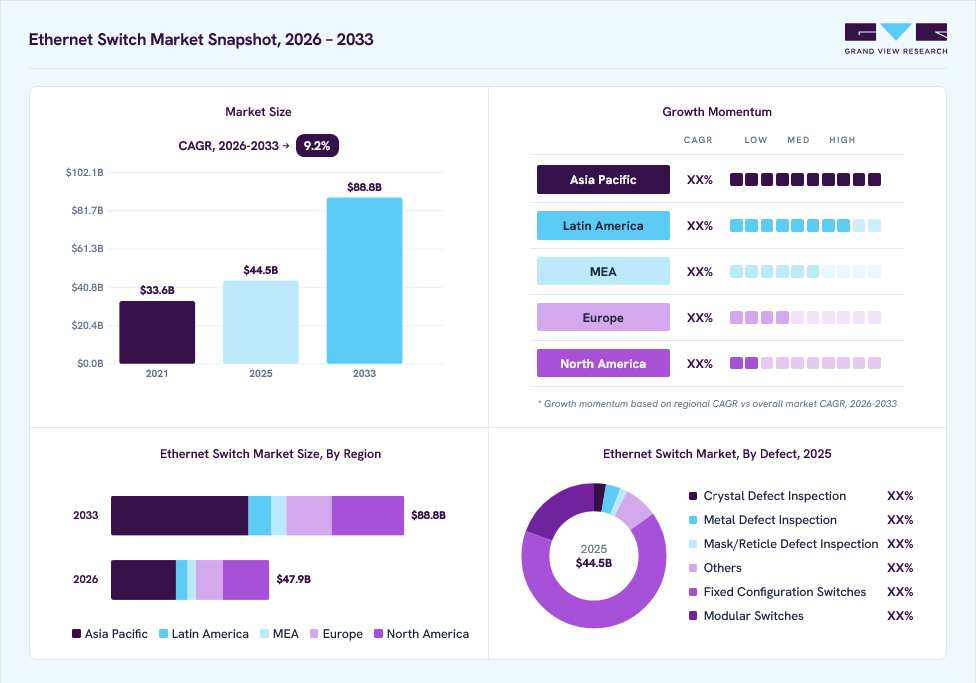 Source: Grand View Research, IR Documents, Primary Interviews, Paid DatabasesTo learn more about this report,
 Download Free Sample Report
 Key Market Trends & Insights
- By product: Fixed configuration switches accounted for the largest market share of 76.9% in 2025.
- By port speed: 1 Gbps segment accounted for the largest market share in 2025.
- By application: The data center segment held the largest revenue share in 2025.
- By end-use: The IT & Telecom segment held the largest revenue share in 2025.
Regional Highlights
- Largest regional market: Asia Pacific (40.2% revenue share, 2025)
- By country: China held the largest market share in 2025.
Market Size & Forecast
- Market size in 2025: USD 44.5 Billion
- Estimated market size in 2026: USD 47.9 Billion
- Projected market size by 2033: USD 88.8 Billion
- CAGR (2026-2033): 9.2%
Three ways to get this report
Buy it, customize it, or ask a question.Ask an Analyst
A direct answer, usually in 1 working day
- AccessReport author, directly
- Reply timeWithin 1 working day
- No sales callDirect answer only
- FormatEmail reply
- CostFree, no cost
Get the Full Report
What the study covers
- FormatsPDF · Excel · Dashboard
- Timeline2026–2033 annual, 2025 base
- Coverage20+ countries, 5 regions
- Companies10+ key players profiled
Customize the Report
20% free customization
- IncludeCountries, segments, points
- TailorTo your product definition
- ExtendDeeper competitor detail
- OrA fully bespoke study
- Turnaround5–10 working days
The market is witnessing a shift toward higher-speed switching technologies as organizations manage increasingly demanding workloads and growing network traffic. Data centers, cloud service providers, and enterprises are adopting higher-bandwidth switches to support applications such as artificial intelligence, cloud computing, and high-performance computing. Manufacturers are focusing on developing switches with higher port speeds, greater switching capacity, and lower latency to meet these requirements. This trend is also encouraging the development of advanced switch architectures that can support future network scalability.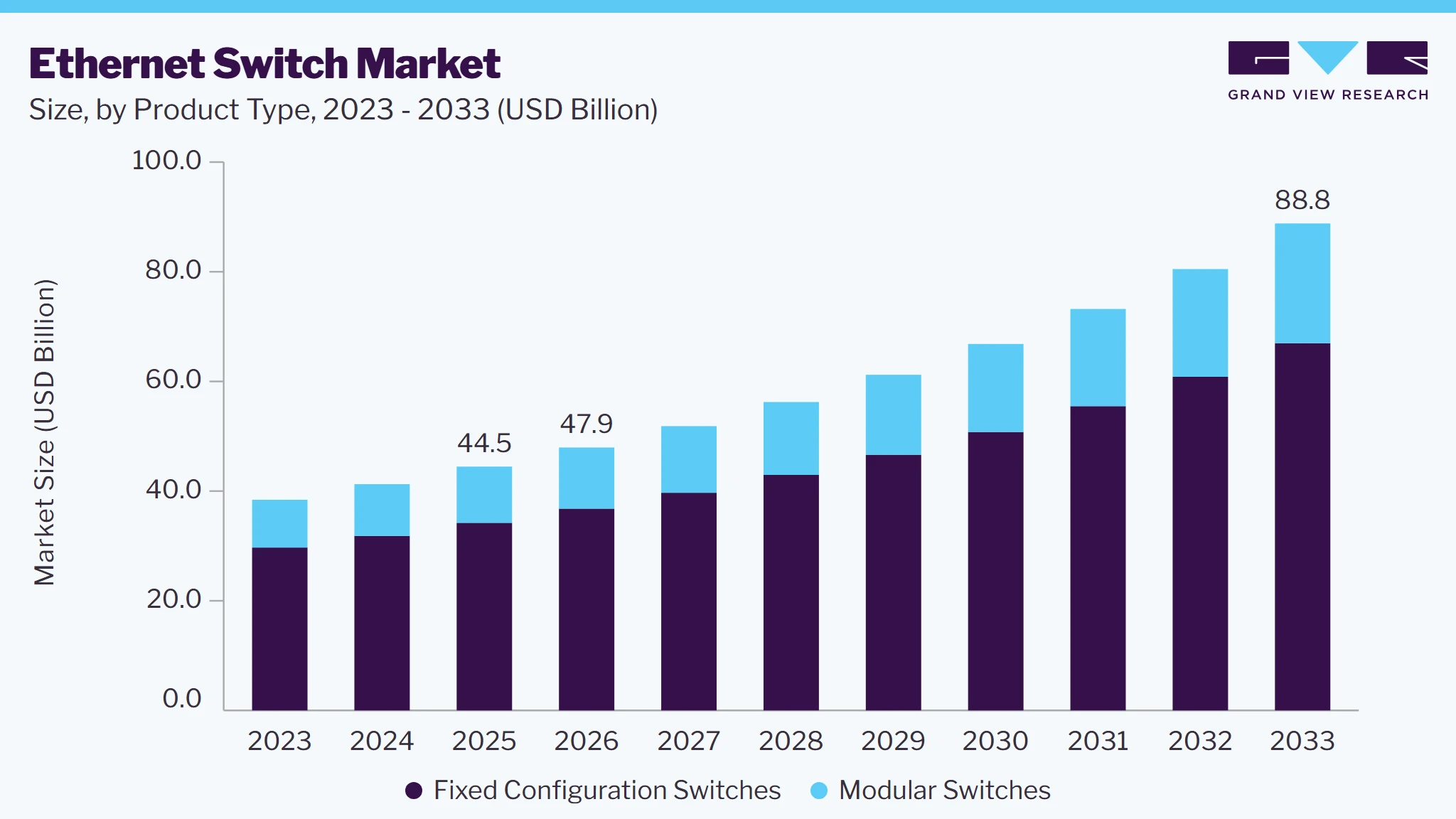 To learn more about this report, Download Free Sample Report
 The expansion of artificial intelligence and machine learning workloads is increasing the importance of Ethernet-based networking within data centers. AI infrastructure requires efficient communication between computing, storage, and networking resources, creating demand for switches capable of delivering high bandwidth, low latency, and reliable connectivity. Ethernet switch manufacturers are increasingly developing solutions optimized for AI workloads, including improved congestion management and network performance. The growing integration of AI into enterprise and cloud environments is expected to further strengthen demand for specialized Ethernet switching solutions.
Energy efficiency is becoming an increasingly important consideration in Ethernet switch design as network infrastructure becomes more powerful and densely deployed. Higher-performance switches can increase power consumption and generate additional heat, creating challenges for data-center operators and other large network environments. Companies are therefore focusing on improving performance per watt through more efficient switch ASICs, optical technologies, system architectures, and cooling solutions. Energy-efficient switching is also becoming an important factor for organizations seeking to reduce operating costs and meet broader sustainability objectives.
The Ethernet ecosystem is continually evolving toward higher-speed, more advanced networking technologies to meet the requirements of next-generation data centers. The development of higher-speed Ethernet interfaces is encouraging innovation across switch chips, optical components, cabling, and networking platforms. Vendors are increasingly designing modular and scalable switching architectures that allow customers to accommodate future bandwidth requirements. This technological evolution is expected to shorten product cycles and increase the importance of continuous innovation among Ethernet switch manufacturers.
Ethernet switches are increasingly deployed beyond traditional data-center environments, including enterprise campuses, branch offices, industrial facilities, and edge computing locations. The growing adoption of connected devices, cloud applications, wireless technologies, and distributed computing is increasing the need for reliable and higher-capacity network connectivity. This is driving demand for managed switches, multi-gigabit switching solutions, Power over Ethernet capabilities, and intelligent network management features. The expansion of digital infrastructure across different industries is therefore broadening the application landscape for Ethernet switching technologies.
Market Dynamics
The expansion of cloud computing, digital services, and data-intensive applications is driving demand for Ethernet switching infrastructure. Data centers require high-performance networking solutions to facilitate communication between servers, storage systems, computing resources, and external networks. As organizations increasingly migrate workloads to cloud and hybrid environments, the need for scalable and reliable network infrastructure continues to increase. This is encouraging data-center operators to upgrade their switching infrastructure and adopt more advanced Ethernet technologies.
The increasing adoption of artificial intelligence and other computationally intensive applications is further strengthening this demand. These workloads require networks that can efficiently handle large volumes of data while maintaining low latency and consistent performance. Ethernet switch vendors are responding by developing solutions with higher bandwidth, greater port density, advanced traffic management, and improved scalability. Continued investment in digital and computing infrastructure is therefore expected to support the long-term market expansion.
The increasing sophistication of Ethernet switching infrastructure creates significant challenges for organizations during network upgrades. High-performance switching solutions may require compatible optical modules, cabling, network adapters, power infrastructure, and cooling systems, thereby increasing deployment complexity. Organizations may also need to upgrade multiple components of their existing network infrastructure to fully utilize newer switching technologies. These requirements make network modernization more complex and may delay adoption among organizations with limited infrastructure budgets.
The integration and management of advanced switching technologies also require specialized technical expertise. Organizations deploying complex data-center or enterprise networks may need skilled personnel to configure, monitor, secure, and maintain the infrastructure. Compatibility considerations between switches, network operating systems, management platforms, and other network components can further complicate deployment. These factors increase implementation time and operational complexity, particularly for organizations transitioning from conventional networking environments.
The continued development of artificial intelligence and high-performance computing is creating opportunities for Ethernet switch manufacturers to develop specialized networking solutions. Vendors can differentiate their products through higher bandwidth, low-latency connectivity, intelligent traffic management, enhanced visibility, and advanced automation capabilities. There is also a growing scope to integrate switching hardware with network management and orchestration software to simplify the management of increasingly complex environments. These developments enable manufacturers to address the evolving networking requirements of modern data centers.
The expansion of edge computing, industrial automation, smart buildings, and connected enterprise environments also creates opportunities for Ethernet switch vendors. Distributed applications require reliable connectivity closer to users, devices, and operational environments, increasing demand for compact, intelligent, and ruggedized switching solutions. Features such as Power over Ethernet, remote management, network security, and automation can further increase the value of Ethernet switches in these applications. As organizations continue to build more distributed and connected infrastructure, vendors can expand their presence by offering solutions tailored to specific enterprise, industrial, and edge-networking requirements.
Market Concentration & Characteristics
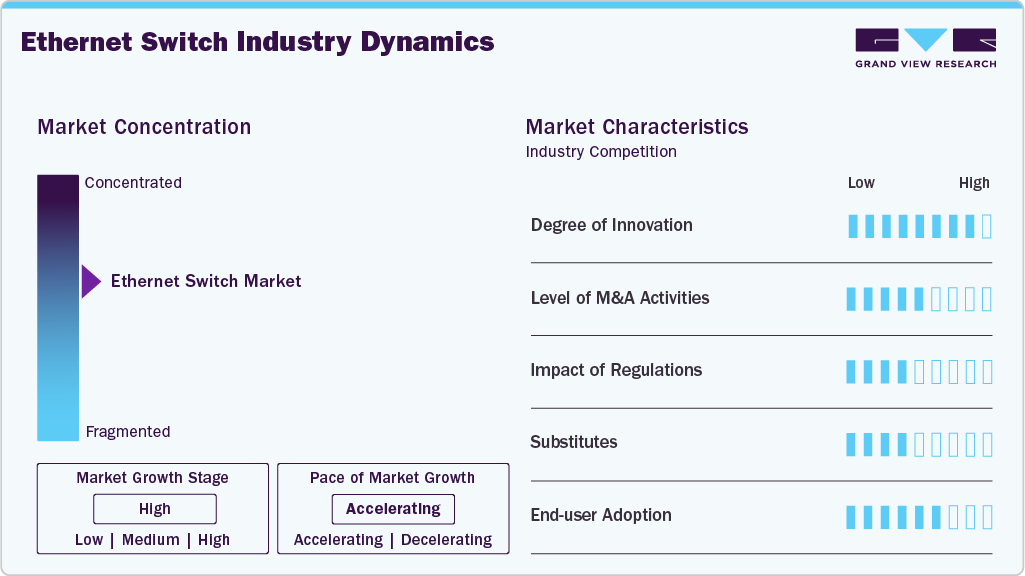
The Ethernet switch industry is moderately consolidated, with several well-established players holding significant competitive positions, while still leaving room for other vendors to participate. Leading networking companies benefit from established technology portfolios, strong brand recognition, extensive distribution networks, long-standing enterprise relationships, and substantial R&D capabilities, creating relatively high competitive barriers for new entrants. However, the market is not dominated by a single player or a very small group of companies, as multiple vendors compete across data center, enterprise, campus, industrial, and edge networking applications. Competition is therefore shaped by product performance, switching capacity, network management capabilities, interoperability, security features, energy efficiency, and the ability to support evolving networking requirements.
 To learn more about this report, Download Free Sample Report
 The market is characterized by a high degree of innovation and strong end-user adoption, while product launch activity is comparatively moderate to high. Continuous advances in networking architectures, higher-speed Ethernet, AI-oriented infrastructure, automation, and intelligent network management encourage established vendors to regularly enhance their product portfolios. In addition, regulatory influence and the threat from substitute technologies are relatively moderate, meaning these factors affect competitive dynamics but are not the primary forces shaping the market. The combination of strong innovation, ongoing product development, and expanding adoption allows established players to maintain their positions while creating opportunities for specialized and emerging vendors to compete in specific applications or technology segments.
Analyst Perspective
The market is experiencing strong momentum as cloud computing, data center expansion, AI workloads, and enterprise network modernization increase demand for high-speed connectivity. The rapid adoption of 200G, 400G, and higher-speed switches is particularly supporting market growth as AI infrastructure requires greater bandwidth and lower-latency networking.
Product Insights
The fixed configuration switches segment accounted for the largest market share of 76.9% in 2025. Fixed configuration switches are widely adopted because they offer a cost-effective and straightforward networking solution for enterprise, campus, branch, and edge environments. Their predefined port configurations simplify installation and network management, making them suitable for deployments with relatively predictable connectivity requirements. The growing need to expand network connectivity across distributed offices, access networks, and edge locations continues to drive demand for fixed-configuration switches. In addition, their compact form factor and lower deployment complexity make them attractive to organizations seeking reliable connectivity without the higher investment required by modular platforms.
The modular switches segment is expected to register the fastest CAGR during the forecast period. The increasing demand for scalable, high-capacity network infrastructure is driving the adoption of modular switches. These switches allow organizations to add or upgrade line cards and ports as bandwidth requirements increase, reducing the need for complete hardware replacement. The expansion of hyperscale data centers, AI infrastructure, and high-performance computing environments is particularly increasing the need for flexible switching architectures capable of supporting rapidly growing traffic volumes. Modular platforms also provide greater investment protection by allowing network operators to progressively increase capacity as workloads and network requirements evolve.
Port Speed Insights
The 1 Gbps segment accounted for the largest market share in 2025. The continued presence of legacy enterprise, campus, branch, and industrial network infrastructure remains a major driver for 1 Gbps Ethernet switches. Many endpoint devices, sensors, office systems, and conventional enterprise applications do not require extremely high bandwidth, making 1 Gbps sufficient for a broad range of connectivity requirements. Cost sensitivity also encourages organizations to continue using 1 Gbps infrastructure, even when higher-speed networking would provide only limited incremental benefits. In addition, the large installed base of existing 1 Gbps equipment supports demand for replacement and expansion as organizations gradually modernize their networks.
The 200 Gbps and 400 Gbps segment is expected to register the fastest CAGR during the forecast period. Rapid growth in AI workloads, high-performance computing, cloud services, and data-intensive applications is driving demand for 200 Gbps and 400 Gbps Ethernet switching. Increasing server and accelerator density is generating substantially higher east-west traffic within data centers, requiring higher-capacity network fabrics to prevent congestion and latency bottlenecks. Hyperscale and enterprise data centers are therefore upgrading their spine, leaf, and aggregation infrastructure toward higher-speed Ethernet connectivity. The expansion of AI training and inference infrastructure is further accelerating this transition, particularly where high throughput and low latency are critical.
Application Insights
The data centers segment accounted for the largest market share in 2025. The expansion of cloud computing, hyperscale infrastructure, colocation facilities, and AI-enabled applications is a major driver of demand for Ethernet switches in data centers. Increasing volumes of data and the deployment of high-density computing resources require switching infrastructure capable of providing high bandwidth, low latency, and efficient server-to-server connectivity. AI workloads are driving significant increases in traffic within data centers, prompting operators to deploy higher-capacity Ethernet fabrics and modernize existing switching infrastructure. The continued development of digital services and hybrid cloud environments is also supporting investment in scalable data center networking architectures.
The industrial networking segment is expected to register the fastest CAGR during the forecast period. The growing adoption of Industry 4.0, industrial automation, connected machinery, robotics, and real-time monitoring is driving demand for Ethernet switches in industrial environments. Manufacturing facilities increasingly require reliable communication between machines, controllers, sensors, cameras, and enterprise systems to enable real-time data exchange and operational visibility. Industrial networks are also becoming more connected as manufacturers integrate operational technology with IT infrastructure, increasing the need for secure and reliable network connectivity. Demand for ruggedized, low-latency, and highly reliable Ethernet switches is consequently increasing across manufacturing and process-oriented industries.
End-use Insights
The IT & Telecom segment accounted for the largest market share in 2025. IT and telecommunications organizations are a major source of demand for Ethernet switches because network connectivity underpins cloud services, enterprise applications, communications infrastructure, and digital services. The expansion of data traffic, cloud platforms, virtualization, and distributed IT environments is increasing the requirement for reliable and scalable switching infrastructure. Telecom operators are also modernizing network infrastructure to support increasing data consumption and evolving network architectures. In addition, ongoing network upgrades and data center expansion within the IT ecosystem continue to generate demand for both conventional and high-performance Ethernet switches.
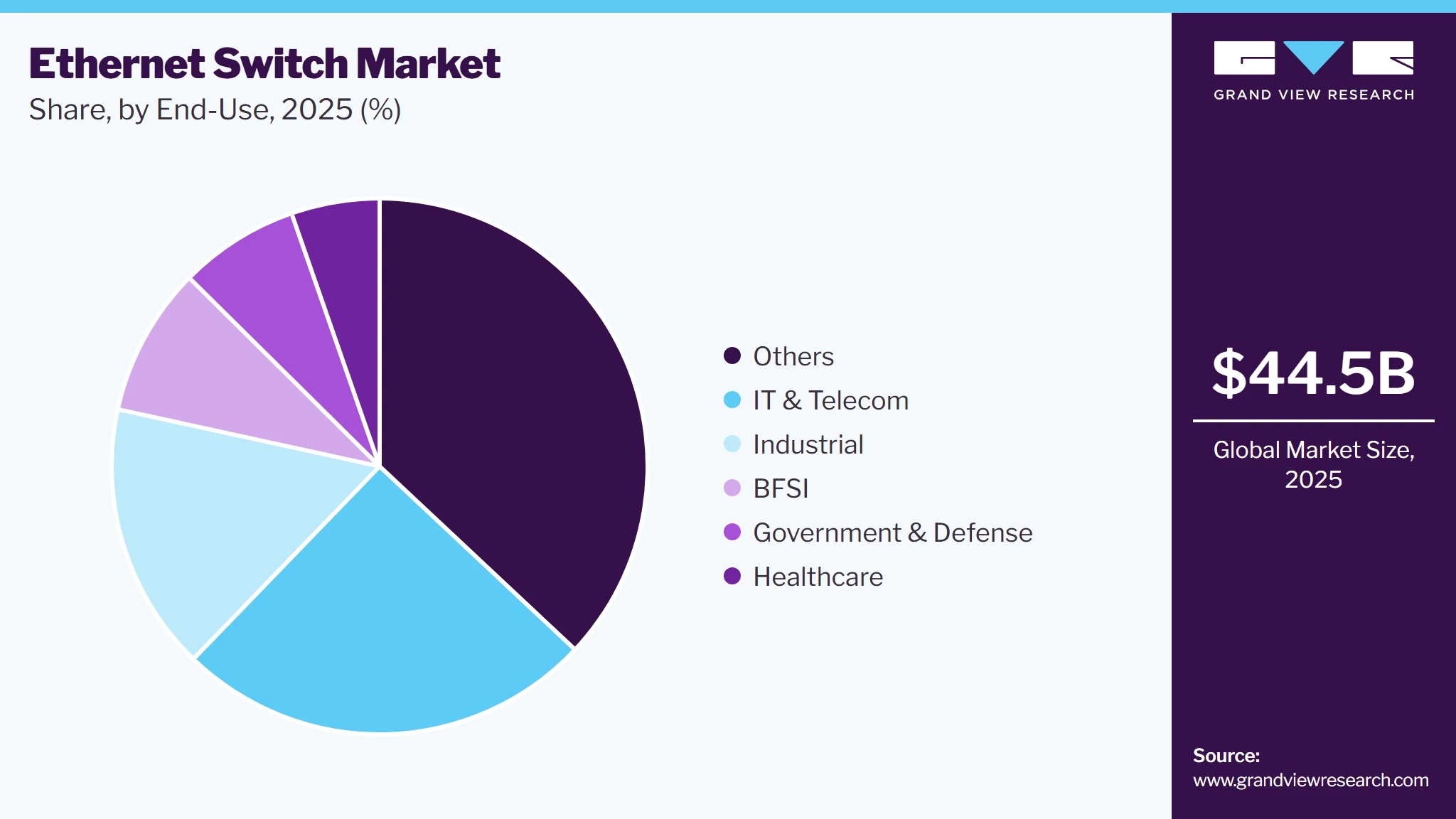 To learn more about this report, Download Free Sample Report
 The Industrial segment is expected to register the fastest CAGR during the forecast period. The increasing digitalization of manufacturing operations is driving Ethernet switch adoption among industrial end users. Manufacturers are deploying connected equipment, industrial IoT devices, robotics, machine vision, and automated control systems, creating a greater need for reliable communication networks. Ethernet-based industrial networks enable the integration of operational technology with enterprise IT systems and support real-time monitoring and data-driven decision-making. The need for secure, resilient, low-latency connectivity in increasingly automated production environments is therefore expected to accelerate the deployment of Ethernet switches across industrial applications.
Regional Insights
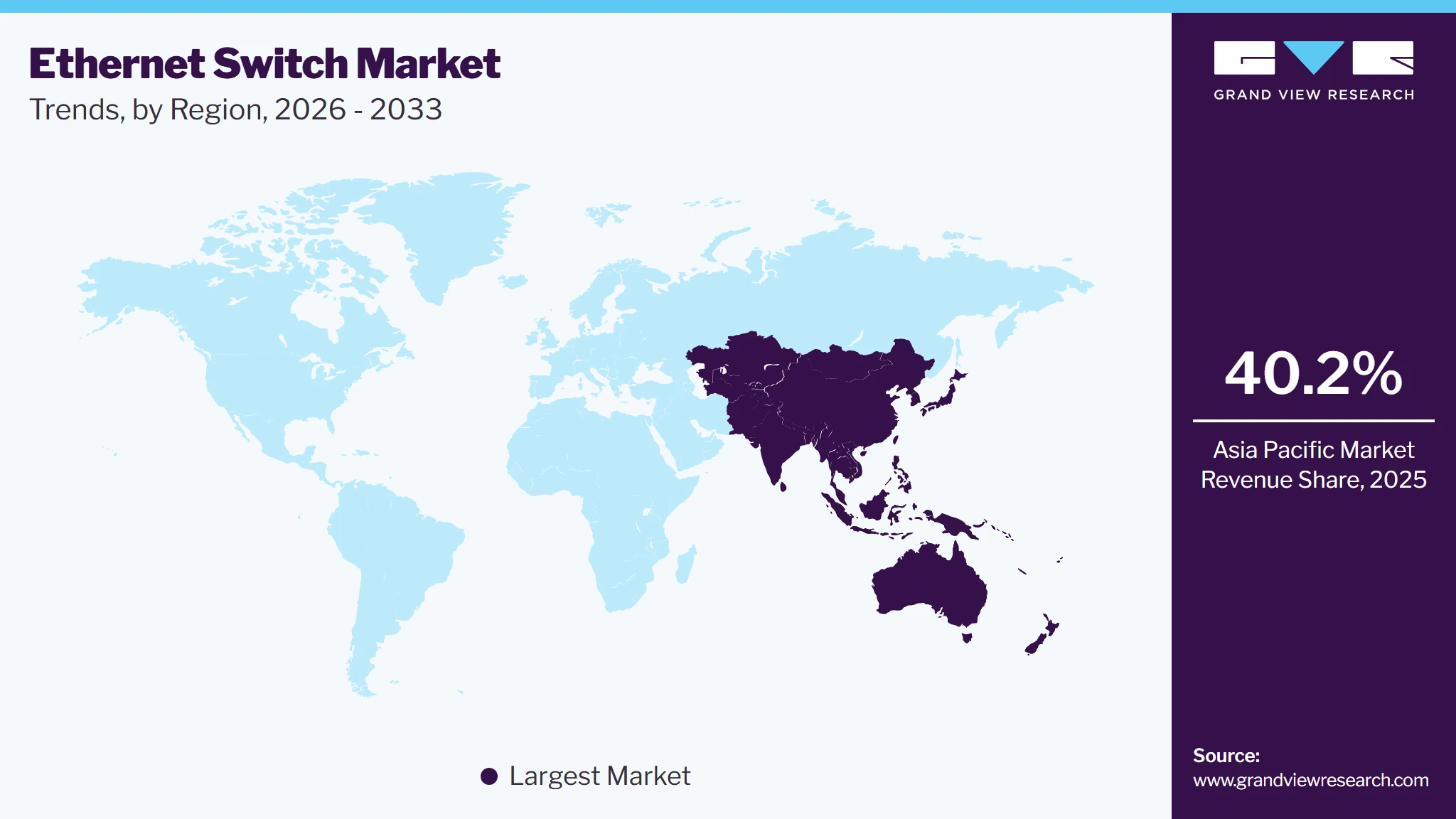
The Asia Pacific Ethernet switch market accounted for the largest revenue share, at 40.2%, in 2025 and is expected to register the fastest CAGR during the forecast period. The region's leadership is supported by rapid data center development, expanding telecommunications infrastructure, increasing cloud adoption, 5G network deployment, industrial digitalization, and strong investments in artificial intelligence infrastructure. China, Japan, South Korea, and India are increasingly deploying high-speed networking infrastructure to support enterprise digital transformation, connected devices, cloud services, and smart manufacturing.
 To learn more about this report, Download Free Sample Report
 China Ethernet Switch Market Trends
The Ethernet switch market in China held a dominant share in the Asia Pacific, supported by extensive telecommunications infrastructure, rapid data center construction, cloud computing adoption, and large-scale industrial digitalization. Increasing deployment of AI infrastructure, 5G networks, smart factories, and connected industrial systems is driving demand for high-capacity Ethernet switching.
India Ethernet switch market is expected to grow at the fastest CAGR over the forecast period, due to rapid digital transformation, expanding cloud infrastructure, 5G deployment, data center investments, and increasing adoption of enterprise networking technologies. The growth of e-commerce, financial technology, government digital services, and IT-enabled businesses is generating substantial requirements for reliable Ethernet connectivity.
North America Ethernet Switch Market Trends
The Ethernet switch market in North America is expected to grow at a moderate CAGR during the forecast period. The region benefits from a mature enterprise networking ecosystem, extensive cloud infrastructure, major hyperscale data center operations, and strong adoption of artificial intelligence and high-performance computing. Increasing investments in AI data centers are creating substantial demand for 100 Gbps, 200 Gbps, and 400 Gbps Ethernet switching technologies.
The U.S. Ethernet switch market held a substantial share in North America, supported by large-scale investments in cloud computing, hyperscale data centers, artificial intelligence, telecommunications, and enterprise digitalization. Increasing deployment of AI clusters and accelerated computing infrastructure is driving demand for high-speed Ethernet switches. Enterprise adoption of cloud-managed networking, software-defined networking, and network automation is further supporting market growth.
Europe Ethernet Switch Market Trends
The Ethernet switch market in Europe is expected to grow at the fastest CAGR from 2026 to 2033, supported by enterprise digitalization, data center expansion, telecommunications modernization, and increasing adoption of industrial networking technologies. The region's transition toward cloud computing, hybrid IT environments, edge computing, and connected industrial operations is generating demand for scalable and secure network infrastructure.
Germany Ethernet switch market dominated Europe, driven by its strong industrial base and ongoing adoption of Industry 4.0 technologies. Manufacturers are increasingly deploying industrial IoT, automation, robotics, machine vision, and connected production systems, creating demand for reliable and resilient Ethernet-based communication infrastructure.
The Ethernet switch market in the UK is expected to grow at a notable CAGR over the forecast period, supported by established enterprise IT infrastructure, telecommunications networks, cloud adoption, and data center development. Increasing digitalization across financial services, professional services, government, and other technology-intensive industries is driving continued investment in enterprise networking infrastructure, thereby driving demand for Ethernet switches.
Key Ethernet Switch Company Insights
Key players operating in the market include Cisco Systems, Inc., Huawei Technologies Co., Ltd., Arista Networks, and Dell Technologies Inc. These companies are increasingly focusing on AI-ready networking, high-speed Ethernet switching, data center modernization, and network automation.
-
Cisco Systems, Inc. is a major player in the market, offering a broad portfolio of switching solutions for enterprise networks, data centers, campus environments, and industrial applications. Its portfolio includes Catalyst, Nexus, Meraki, and industrial Ethernet switches, enabling the company to address diverse networking requirements across different end users. Cisco is also focusing on automation, security, cloud-managed networking, and high-performance data center infrastructure to support evolving connectivity requirements.
-
Huawei Technologies Co., Ltd. has a comprehensive Ethernet switching portfolio covering campus, access, aggregation, core, and cloud data center applications. Its CloudEngine series is designed to support scalable and programmable data center networks, while its broader switching portfolio addresses carrier, enterprise, and industrial connectivity requirements. The company emphasizes network automation, energy efficiency, security, and high-performance switching to support cloud computing and digital infrastructure deployments.
Key Ethernet Switch Companies:
The following key companies have been profiled for this study on the ethernet switch market.
-
Cisco Systems, Inc.
-
Huawei Technologies Co., Ltd.
-
Arista Networks
-
Dell Technologies Inc.
-
Hewlett-Packard Enterprise Company
-
NETGEAR
-
Moxa
-
Microchip Technology Inc.
-
Advantech
-
Ruckus Wireless LLC
Competitive Benchmarking
Operating Strategies
Competitive Edge
Weaknesses
Mature Players: Cisco Systems, Inc.; Huawei Technologies Co., Ltd.; Arista Networks; Dell Technologies Inc.;
- These companies focus on expanding enterprise, data center, campus, and cloud networking portfolios while investing in higher-speed switching, network automation, security, and cloud-based management. Their portfolios span managed, unmanaged, industrial, and data center Ethernet switches.
- These companies gain a competitive advantage through strong global presence, extensive R&D capabilities, broad product portfolios, established enterprise relationships, large distribution networks, and comprehensive networking ecosystems
- High R&D and infrastructure costs, intense competition, pricing pressure, complex enterprise procurement cycles, and the need for continuous technology upgrades are some of the weaknesses of these companies
Emerging Players: Moxa; Microchip Technology Inc.; Advantech; Ruckus Wireless LLC
- These companies focus on specialized Ethernet switching applications, including industrial networking, embedded networking, automation, edge connectivity, and wireless-integrated network environments. They emphasize application-specific solutions and reliable connectivity for demanding operating environments.
- These companies gain a competitive advantage through strong specialization in industrial and edge networking, application-specific expertise, flexible product development, and established positions in selected niche markets.
- Relatively narrower product portfolios and geographic reach compared with the largest global networking vendors, with greater exposure to specialized application segments and competitive pricing pressures, are some of the weaknesses of these companies.
Recent Developments
-
In August 2026, BotBlox launched SwitchCore, an ultra-compact, low-power eight-port Ethernet switch module designed for direct integration into carrier boards. The module combines Ethernet switching circuitry with a rugged aluminum chassis, making it suitable for space- and power-constrained applications such as robotics, UAVs, and industrial systems.
-
In October 2025, Cinch Connectivity Solutions, a Bel group company, launched the TFOCA-II Bulkhead Mount Ethernet Unmanaged Switch, model T2F-DTL002-SOHO, expanding its TFOCA-II product portfolio with enhanced Ethernet networking capabilities. The new switch is designed for rugged, mission-critical environments, ensuring reliable connectivity in demanding applications. It is particularly suited for defense and aerospace use cases, including radar systems, tactical vehicle networks, and other mission-critical communication platforms.
Ethernet Switch Market Report Scope
Report Attribute
Details
Market size in 2025
USD 44.5 billion
Estimated market size in 2026
USD 47.9 billion
Projected market size by 2033
USD 88.8 billion
Growth rate
CAGR of 9.2% from 2026 to 2033
Historical data
2021 - 2025
Forecast period
2026 - 2033
Quantitative units
Revenue in USD billion and CAGR from 2026 to 2033
Report coverage
Revenue forecast, company ranking, competitive landscape, growth factors, and trends
Segments covered
Product, port speed, application, end-use, region
Regional scope
North America; Europe; Asia Pacific; Latin America; MEA
Country scope
U.S.; Canada; Mexico; Germany; UK; France; China; Japan; India; South Korea; Australia; Brazil; KSA; UAE; South Africa
Key companies profiled
Cisco Systems, Inc.; Huawei Technologies Co., Ltd.; Arista Networks; Dell Technologies Inc.; Hewlett-Packard Enterprise Company; NETGEAR; Moxa; Microchip Technology Inc.; Advantech; Ruckus Wireless LLC
Customization scope
Free report customization (equivalent up to 8 analysts working days) with purchase. Addition or alteration to country, regional & segment scope.
Pricing and purchase options
Avail customized purchase options to meet your exact research needs. Explore purchase options
Global Ethernet Switch Market Report Segmentation
This report forecasts revenue growth at the global, regional, and country levels and provides an analysis of the latest industry trends in each of the sub-segments from 2021 to 2033. For this study, Grand View Research has segmented the global Ethernet switch market report based on product, port speed, application, end-use, and region:
-
Product Outlook (Revenue, USD Billion, 2021 - 2033)
-
Fixed Configuration Switches
-
Modular Switches
-
-
Port Speed Outlook (Revenue, USD Billion, 2021 - 2033)
-
1 Gbps
-
2.5 Gbps and 5 Gbps
-
10 Gbps
-
25 Gbps and 50 Gbps
-
100 Gbps
-
200 Gbps and 400 Gbps
-
-
Application Outlook (Revenue, USD Billion, 2021 - 2033)
-
Carrier Ethernet
-
Enterprise and Campus Network
-
Industrial Networking
-
Data Centers
-
Network Security
-
Others
-
-
End-use Outlook (Revenue, USD Billion, 2021 - 2033)
-
IT & Telecom
-
BFSI
-
Government & Defense
-
Industrial
-
Healthcare
-
Others
-
-
Regional Outlook (Revenue, USD Billion, 2021 - 2033)
-
North America
-
U.S.
-
Canada
-
Mexico
-
-
Europe
-
Germany
-
UK
-
France
-
-
Asia Pacific
-
China
-
Japan
-
India
-
South Korea
-
Australia
-
-
Latin America
-
Brazil
-
-
Middle East and Africa (MEA)
-
KSA
-
UAE
-
South Africa
-
-
Research Methodology
The ethernet switch market figures in this report are based on a proven research process that combines executive interviews with secondary research from proprietary databases, company filings, and recognized regulatory and institutional sources. Market size is built through value-chain sizing-reconciling supply-side and demand-side estimates-and triangulated with bottom-up and top-down approaches. Every estimate passes multiple levels of expert validation before publication, with each ethernet switch segment quantified using the revenue-capture definitions in the table below.
Segment Definition
Segment - Product
Revenue capture definition
Fixed Configuration Switches
This segment generates revenue from Ethernet switches with a predetermined number of ports and fixed hardware configurations, primarily used in enterprise, campus, branch office, industrial, and edge networking environments.
Modular Switches
This segment generates revenue from modular Ethernet switches that allow users to expand or modify switching capacity through interchangeable modules or line cards, primarily for large enterprise networks, carriers, and data centers.
Segment - Port Speed
Revenue capture definition
1 Gbps
This segment generates revenue from Ethernet switches supporting 1 Gbps connectivity, mainly used for standard enterprise, campus, branch-office, industrial, and general-purpose networking.
2.5 Gbps and 5 Gbps
This segment generates revenue from multi-gigabit Ethernet switches used for higher-bandwidth enterprise networks, wireless access points, and connected devices.
10 Gbps
This segment generates revenue from 10 Gbps Ethernet switches deployed for enterprise aggregation, server connectivity, data centers, storage environments, and high-performance campus networks.
25 Gbps and 50 Gbps
This segment generates revenue from high-speed Ethernet switches used in data centers, cloud infrastructure, server connectivity, and network aggregation applications.
100 Gbps
This segment generates revenue from high-capacity Ethernet switches deployed in data centers, cloud infrastructure, carrier networks, and enterprise core networks requiring high throughput.
200 Gbps and 400 Gbps
This segment generates revenue from ultra-high-speed Ethernet switches used in hyperscale data centers, AI infrastructure, high-performance computing, cloud networks, and network backbones.
Segment - Application
Revenue capture definition
Carrier Ethernet
This segment generates revenue from Ethernet switching equipment deployed by telecommunications operators and service providers for high-bandwidth transport, mobile backhaul, metropolitan networks, and business connectivity.
Enterprise and Campus Network
This segment generates revenue from Ethernet switches deployed across corporate offices, branch locations, educational campuses, and organizational networks to connect computers, servers, access points, and other endpoints.
Industrial Networking
This segment generates revenue from industrial Ethernet switches used in manufacturing, utilities, transportation, energy, mining, and automation environments to support machines, sensors, control systems, and Industrial IoT devices.
Data Centers
This segment generates revenue from high-performance Ethernet switches used to connect servers, storage systems, computing infrastructure, and networking equipment within data centers.
Network Security
This segment generates revenue from Ethernet switches supporting security functions such as traffic segmentation, access control, authentication, monitoring, and secure network management.
Others
This segment generates revenue from Ethernet switches deployed in smart buildings, transportation, surveillance, education, residential networking, and other specialized applications.
Segment - End Use
Revenue capture definition
IT & Telecom
This segment generates revenue from Ethernet switches purchased by IT companies, telecommunications operators, internet service providers, cloud providers, and network infrastructure operators.
BFSI
This segment generates revenue from Ethernet switches deployed by banks, financial institutions, insurance companies, and other financial service providers for data centers, branch connectivity, transaction systems, and secure communications.
Government & Defense
This segment generates revenue from Ethernet switches purchased for government offices, defense facilities, military networks, surveillance systems, and secure communications infrastructure.
Industrial
This segment generates revenue from Ethernet switches used across manufacturing, energy, utilities, mining, transportation, and other industrial facilities to support automation, machine communication, control systems, and Industrial IoT networks.
Healthcare
This segment generates revenue from Ethernet switches deployed in hospitals, clinics, laboratories, pharmaceutical facilities, and other healthcare environments to connect medical devices, imaging systems, patient monitoring systems, and digital health infrastructure.
Others
This segment generates revenue from Ethernet switches deployed across retail, education, hospitality, media and entertainment, transportation, and other industries not specifically covered above.
Estimation Model
Layer Name
Key Question
Description
Network Infrastructure Base Layer
Which organizations and infrastructure require Ethernet connectivity?
This layer establishes the total potential demand base by analyzing enterprise and campus networks, data centers, carrier networks, industrial facilities, government infrastructure, and other connected environments. Key factors include number of organizations, network endpoints, data traffic, server infrastructure, digitalization, and connectivity requirements.
Addressable Ethernet Switch Market Layer
Which network environments can realistically adopt Ethernet switches?
This layer narrows the overall networking ecosystem into the addressable Ethernet switch market by considering network modernization, cloud adoption, data center expansion, industrial automation, 5G infrastructure, bandwidth requirements, and replacement of legacy networking equipment. It determines the portion of network infrastructure requiring Ethernet switching solutions.
Ethernet Switch Adoption Layer
Who is actively deploying Ethernet switches?
This layer estimates actual Ethernet switch deployments across carrier Ethernet, enterprise and campus networks, industrial networking, data centers, network security, and other applications.
Monetization Layer
How does Ethernet switch adoption translate into market revenue?
This layer converts switch deployments into market revenue using average selling prices across fixed configuration and modular switches, different port-speed categories, and application segments.
Delivered Customizations
This report has been delivered with the following In-depth customizations
Client Request
Customization Delivered
Value Adds
Regional & Country Opportunity Analysis
Delivered region-wise and country-wise market sizing, forecasts, and growth analysis across North America, Europe, Asia Pacific, Latin America, and the Middle East & Africa
Supported geographic expansion strategies
Enabled identification of high-growth markets
AI Data Center Networking Analysis
Assessment of Ethernet switch requirements for AI training, inference, GPU clusters, high-performance computing, and distributed AI infrastructure
Analysis of high-speed switching and network architecture requirements
Supported AI infrastructure opportunity assessment
Identified demand for next-generation switching technologies
Competitive Benchmarking & Strategic Landscape Analysis
Delivered benchmarking of leading Ethernet switch manufacturers based on product portfolio, port speeds, switching capacity, management capabilities, data-center presence, industrial portfolio, geographic reach, and innovation capabilities
Analysis of product launches, partnerships, acquisitions, and expansion initiatives
Supported competitive intelligence
Identified market gaps and strategic opportunities
Frequently Asked Questions About This Report
The IT & Telecom segment accounted for the largest market share in 2025, while the industrial is the fastest-growing end-use.
The global ethernet switch market size was valued at USD 44.5 billion in 2025 and is estimated at USD 47.9 billion in 2026.
The global ethernet switch market is expected to grow at a CAGR of 9.2% from 2026 to 2033 to reach USD 88.8 billion by 2033.
Asia Pacific dominated the market, accounting for the largest revenue share of 40.2% in 2025.
TThe fixed configuration switches segment accounted for the largest market share of 76.9% in 2025, while modular switches is the fastest-growing segment.
The market is experiencing strong growth due to the rapid expansion of cloud computing, hyperscale data centers, enterprise digital transformation, 5G infrastructure, artificial intelligence workloads, and increasing demand for high-speed network connectivity.
Key players include Cisco Systems, Inc., Huawei Technologies Co., Ltd., Arista Networks, Dell Technologies Inc., Hewlett Packard Enterprise Company, NETGEAR, Moxa, Microchip Technology Inc., Advantech, and Ruckus Wireless LLC
The 1 Gbps segment accounted for the largest market share in 2025, while 200 Gbps and 400 Gbps segment is the fastest-growing port speed.
The data centers segment accounted for the largest market share in 2025, while the indistrial networking is the fastest-growing application.
About the Author(s)
Communications Infrastructure Research Team
Technology · Communications InfrastructureThis report was authored by the communications infrastructure research team at Grand View Research - comprising two research analysts, one senior research analyst, and one industry expert - with specialized expertise in the communications infrastructure segment of the technology industry. All findings are based on proprietary technology databases, executive interviews, and regulatory analysis, subject to internal peer review prior to publication.
Last Updated:
Speak to Analyst

Customize this report to your needs - add regions, segments, or data points, with 20% free customization.
Or view our licence options:


ISO 9001:2015 & 27001:2022 Certified
We are GDPR and CCPA compliant! Your transaction & personal information is safe and secure. For more details, please read our privacy policy.


