
- Home
- »
- Plastics, Polymers & Resins
- »
-
Europe Polyolefin Foam Materials Market Size Report, 2035GVR Report cover

Europe Polyolefin Foam Materials Market (2027 - 2035)
Size, Share & Trends Analysis Report By Resin Type (PE, PP, EVA), By Technology (Crosslinked Polyolefin Foam, Uncrosslinked Polyolefin Foam), By Application (Building & Construction, Automotive), By Country, And Segment Forecasts
Market Size, 2026
$3.7BMarket Estimate, 2027
$3.9BMarket Forecast, 2035
$5.7BCAGR, 2027–2035
4.7%Europe Polyolefin Foam Materials Market Summary
The Europe polyolefin foam materials market size was valued at USD 3.7 billion in 2026 and is projected to grow from USD 3.9 billion in 2027 to USD 5.7 billion by 2035, at a CAGR of 4.7% from 2027 to 2035. The European market is driven by rising demand for lightweight materials in automotive manufacturing, increasing adoption of energy-efficient building insulation, and growing use of protective packaging.
Key Market Trends & Insights
- By resin type: PE segment held the largest market share of 44.6% in 2026.
- By technology: Crosslinked polyolefin foam (XLPO) segment held the largest market share of 48.2% in 2026.
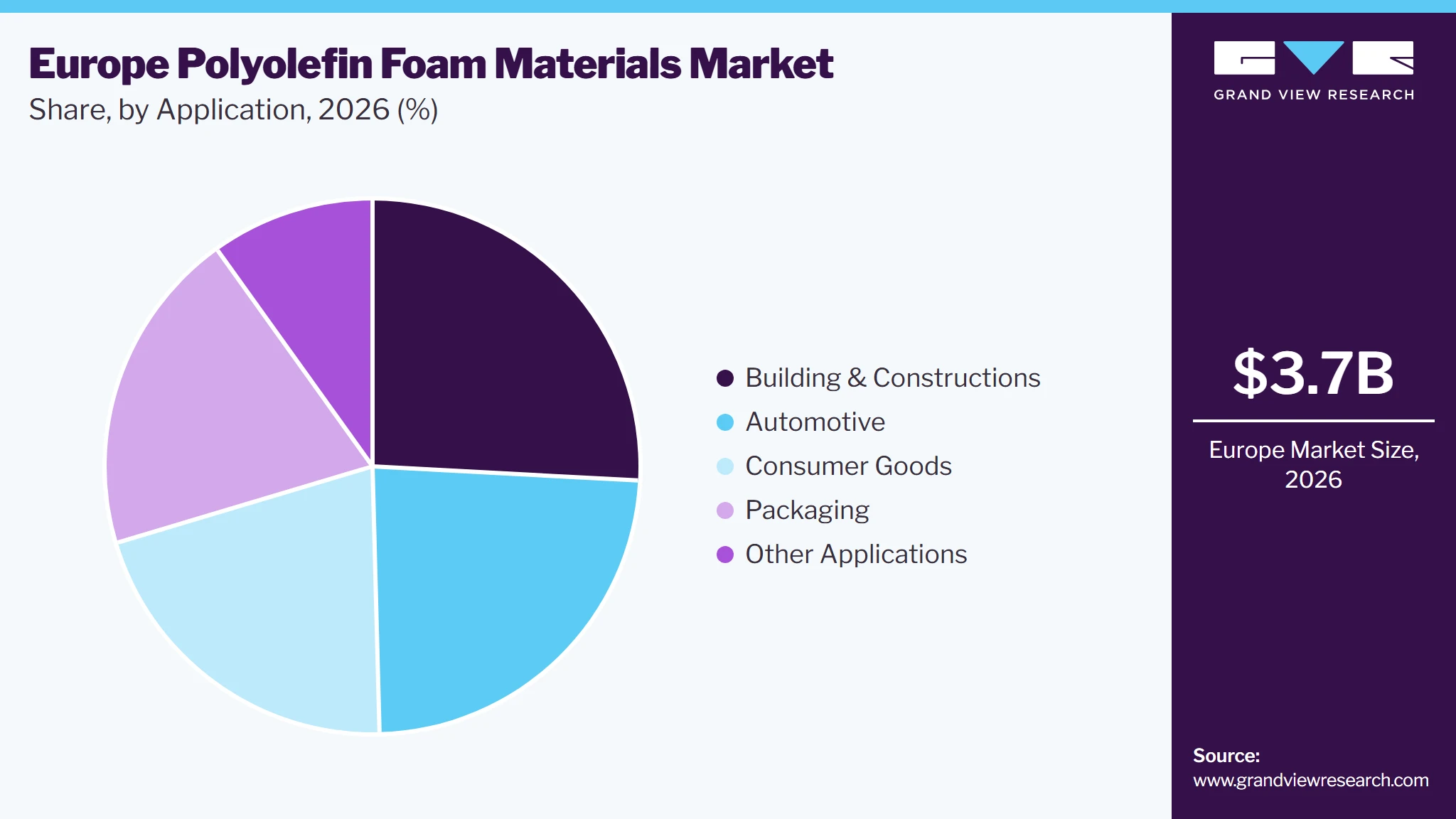
- By application: Building & constructions segment held the largest market share of 25.8% in 2026.
Market Size & Forecast
- Market size in 2026: USD 3.7 Billion
- Estimated market size in 2027: USD 3.9 Billion
- Projected market size by 2035: USD 5.7 Billion
- CAGR (2027-2035): 4.7%
Prism AI by Grand View Research Free to tryAsk a question about the europe polyolefin foam materials marketTry asking✓Every figure cited from GVR research Prefer the report? Download free sample →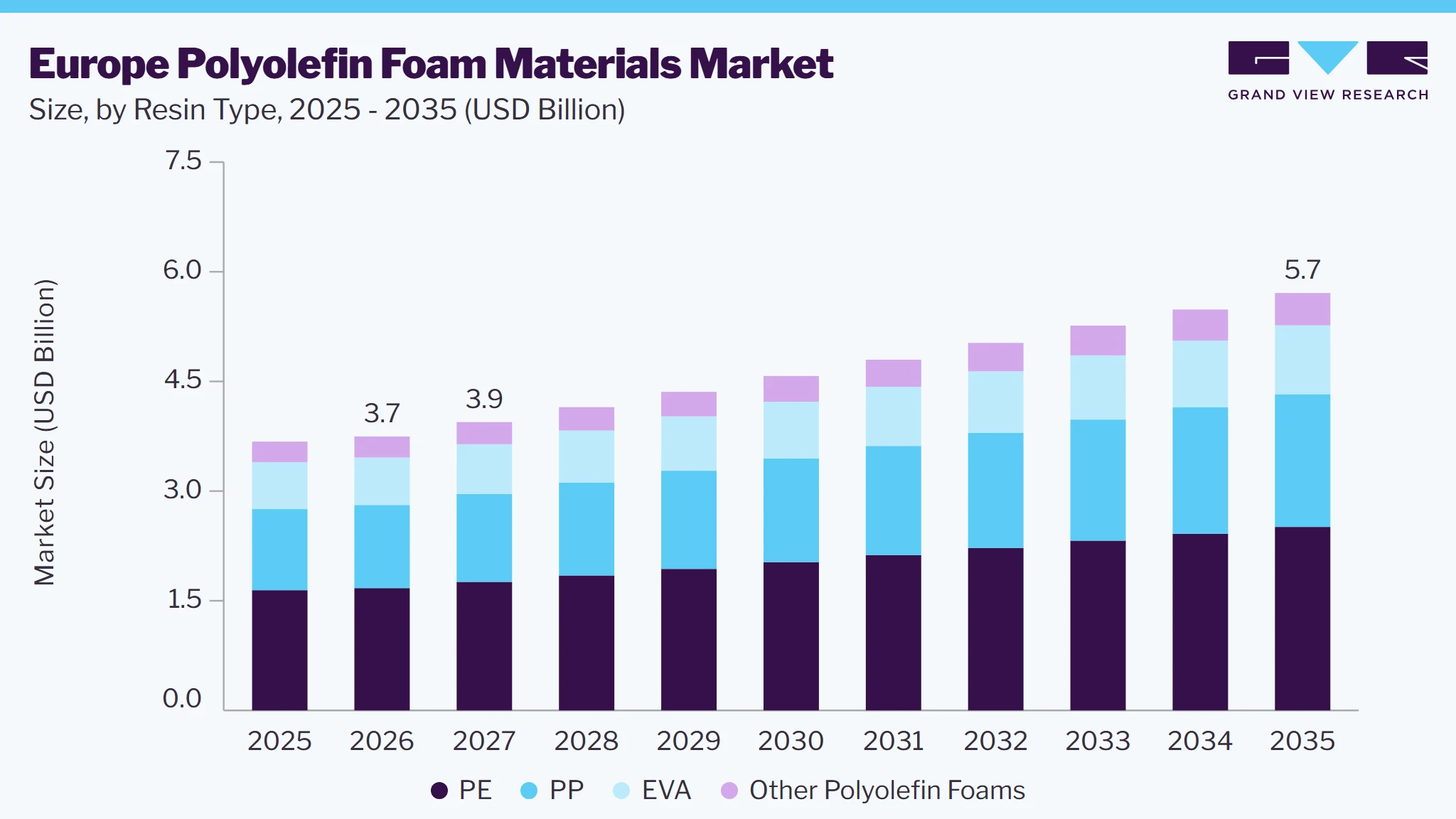 Source: Grand View Research, IR Documents, Primary Interviews, Paid DatabasesTo learn more about this report,
 Download Free Sample Report
The shift toward electric vehicles, stringent sustainability regulations, and demand for recyclable, durable foam materials further support market growth. The European market is witnessing a shift toward application-specific foam structures with improved density control, cell uniformity, thermal insulation, and impact absorption. Manufacturers are developing recyclable grades, recycled-content formulations, and reusable foam solutions to address sustainability requirements. Demand is also encouraging advancements in crosslinked polyethylene sheets, polypropylene beads, and expanded polyethylene formats. These developments are strengthening the suitability of materials across automotive interiors, protective packaging, construction insulation, and industrial applications.Market Dynamics
The European building and construction industry is generating sustained demand for polyolefin foam materials through energy-efficient construction, building renovation, and improved insulation requirements. PE foams are increasingly used in pipe insulation, floor underlays, expansion joints, and sealing applications because of their thermal insulation, moisture resistance, and dimensional stability. Renovation of existing residential and commercial buildings further supports consumption, particularly as property owners seek to improve insulation performance and reduce long-term heating and cooling costs.
The automotive industry is another major driver of demand, supported by requirements for vehicle lightweighting, passenger safety, and acoustic performance. EPP and PE foams are widely used in seat components, headrests, door panels, instrument panels, bumper systems, and battery protection structures. The expansion of electric vehicle production is creating additional demand for lightweight cushioning and impact-management materials. Their ability to provide energy absorption, vibration damping, and design flexibility strengthens their adoption across conventional and electric vehicle platforms.
High energy consumption, specialized processing requirements, and volatile polymer prices create cost pressures for European polyolefin foam manufacturers. Expansion of crosslinking, extrusion, expansion, and molding operations requires significant capital investment and process control. Recycling also remains technically challenging for crosslinked PE foams because their thermoset-like network structure restricts conventional remelting. In addition, contamination, mixed-material laminates, and inconsistent post-industrial waste streams can reduce the quality of recovered material, limiting the commercial viability of circular foam production.
The transition toward circular material systems present opportunities for manufacturers to expand the use of recycled-content polyolefin foams, establish closed-loop recovery systems, and develop reusable packaging formats. EPP is particularly suitable for returnable transport packaging because of its impact resistance, durability, and potential for repeated use. Manufacturers can also explore mechanically recycled PE and PP foam streams for suitable non-critical applications. The growing emphasis on packaging recyclability and material recovery across Europe creates opportunities for converters offering traceable, resource-efficient foam solutions.
Market Concentration & Characteristics
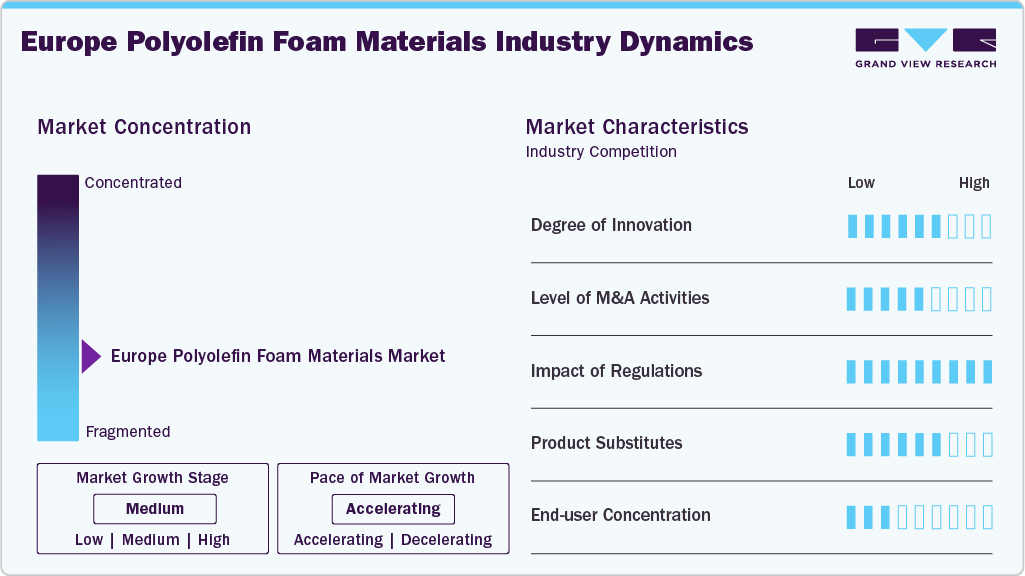
The market growth stage is moderate, and the pace of growth is accelerating. The market exhibits fragmentation, with key players dominating the industry landscape. Major companies such as Sekisui Alveo (Sekisui Chemicals), Arkema Group, Knauf Industries (Knauf Group), Armacell International SA, Borealis AG, TotalEnergies, Dow Inc., Intecfoams, Kaneka Corporation, SABIC, Zotefoams plc, and others play a significant role in shaping the market dynamics. These leading players often drive innovation in the market, introducing new resin types and technologies to meet the industry's evolving demands.
Innovation in the European polyolefin foam materials industry is increasingly focused on material circularity, lightweight performance, and advanced foam processing. Manufacturers are developing recyclable polypropylene foam structures, recycled-content polyethylene foams, and bio-based material alternatives without compromising mechanical strength or insulation properties. In June 2026, Borealis collaborated with IP Verpackungen to introduce KreislaufLeicht, an expanded polypropylene packaging solution incorporating 30% polypropylene produced using bio-based feedstock. Such developments indicate a shift toward mono-material foam structures and improved end-of-life recovery.
 To learn more about this report, Download Free Sample Report
European regulatory developments are increasing the importance of recyclability, material traceability, and sustainable product design across the polyolefin foam value chain. The Packaging and Packaging Waste Regulation (PPWR), applicable from August 2026, establishes requirements for packaging waste reduction, recyclability, and recycled plastic content, with major circularity obligations scheduled for 2030. These provisions are encouraging manufacturers to develop recyclable polyethylene and polypropylene foam packaging. Compliance requirements are also increasing the need for material assessment, product redesign, and investment in recycling-compatible foam formats.
Analyst Perspective
The Europe polyolefin foam materials market is expected to transition from volume-driven growth toward value-led expansion, supported by automotive lightweighting, electric vehicle production, energy-efficient construction, and demand for protective packaging. Over the next 5-10 years, adoption of EPP, crosslinked PE, and application-specific EVA foams is likely to strengthen as manufacturers prioritize impact absorption, thermal insulation, acoustic performance, and material efficiency. Regulatory emphasis on packaging recyclability, recycled content, and waste reduction will accelerate investment in recyclable foam structures, material recovery, and reusable packaging solutions. Competitive differentiation will increasingly depend on advanced expansion technologies, consistent cell structures, processing efficiency, application-specific product development and regional manufacturing capabilities.
Resin Type Insights
The PE segment led the market with the largest revenue share of 44.6% in 2026. PE foams are predominantly manufactured using low-density polyethylene (LDPE), linear low-density polyethylene (LLDPE), and, for selected applications, high-density polyethylene (HDPE). LDPE is particularly suitable for foam production because of its flexibility, low-temperature processing characteristics, and ability to develop a lightweight cellular structure. PE foams generally possess a closed-cell structure that restricts water penetration, provides thermal insulation, and offers effective cushioning against mechanical impacts.
The PP segment is anticipated to grow at the fastest CAGR of 5.3% through the forecast period. Polypropylene foam is an important performance-oriented category in the European polyolefin foam materials market, particularly for applications requiring a combination of lightweight construction, mechanical strength, chemical resistance, and high-temperature tolerance. PP is a semi-crystalline thermoplastic with a relatively low base-polymer density of approximately 0.905 g/cm³. Compared with conventional polyethylene, it generally offers higher rigidity, hardness, and thermal resistance.
Technology Insights
The crosslinked polyolefin foam (XLPO) segment accounted for the largest market revenue share of 48.2% in 2026. It is used in automotive insulation, sealing systems, vibration damping, industrial cushioning, construction insulation, footwear, and specialized protective components. However, the requirement for additional crosslinking equipment, controlled reaction conditions, and more complex processing increases manufacturing costs.
The uncrosslinked polyolefin foam (Non-XLPO) segment is expected to grow at the fastest CAGR of 4.9% over the forecast period. Uncrosslinked polyolefin foam offers manufacturing flexibility and relatively efficient production economics, although the achievable foam performance is strongly influenced by the melt strength of the selected resin and the effectiveness of process control.
Application Insights
The building & constructions segment held the largest revenue share of 25.8% in 2026. European building and construction industry is concentrated in supplementary insulation, sealing, flooring, and vibration-control applications rather than large-scale structural insulation. The material is widely incorporated into pipe insulation, HVAC duct insulation, floor underlays, expansion joints, partition wall tapes, window sealing systems, tile-mounting membranes, and thermal insulation laminates.
 To learn more about this report, Download Free Sample Report
The packaging segment is projected to grow at the fastest CAGR of 5.3% over the forecast period. Packaging represents a broad and established application area for polyolefin foam materials in Europe, supported by their ability to protect goods against mechanical damage, vibration, abrasion, and moisture during transportation and storage. Their use extends across consumer electronics, electrical equipment, household appliances, automotive components, furniture, glass products, ceramics, precision machinery, and medical devices.
Country Insights
Germany Polyolefin Foam Materials Market Trends
Germany dominated the Europe polyolefin foam materials market with the largest revenue share of 21.3% in 2026. Germany market benefits from the country's extensive industrial value chain, particularly its automotive, electrical equipment, mechanical engineering, and specialized packaging industries. One of the major demand drivers is the transition towards electric mobility, which is increasing the requirement for lightweight vehicle components, battery cushioning, thermal insulation, acoustic management, and impact-absorbing materials. According to the German Association of the Automotive Industry (VDA), Germany produced approximately 4.15 million passenger cars in 2025, of which 1.67 million were electric vehicles, representing 40% of domestic production. This creates opportunities for EPP in energy-management components and PE-based Crosslinked foams in vibration damping, interior insulation, sealing, and battery-related applications. Another important driver is Germany's concentration of plastics processors and specialized machinery manufacturers.
Key Europe Polyolefin Foam Materials Company Insights
Some of the key players operating in the market include Sekisui Alveo (Sekisui Chemicals) and Arkema Group
-
Sekisui Alveo is a leading manufacturer of polyolefin foam materials, with established production facilities in Germany and the Netherlands and an extensive regional sales network. Its product portfolio includes Alveolit, Alveolen, Alveocel, Alveosoft and Alveobloc, covering crosslinked and non-crosslinked foam formats. The company serves automotive, building and construction, packaging, flooring and industrial applications through application-specific foam solutions, product development and technical support.
-
Arkema participates in the European polyolefin foam materials industry through specialty foamable materials and performance-oriented polymer solutions. Its Pebax EVA+ range is designed for lightweight midsole foams used in running, hiking, trail, and safety footwear. These compounds are compatible with conventional EVA processing technologies, allowing foam manufacturers to improve product performance without significant equipment modifications. Its expertise in specialty materials, international operations, and product development capabilities support its position in application-specific foam materials.
Intecfoams is one of the emerging participants in the European market.
-
Intecfoams is a UK-based technical foam supplier and converter with a focused presence in polyethylene foam materials. Its portfolio includes crosslinked and non-crosslinked PE foams, as well as Plastazote, Evazote and Supazote grades. The company provides customized foam development and conversion services, including cutting, laminating, routing, and die-cutting. Its products serve protective packaging, medical devices, building insulation, seals and gaskets, positioning it as a specialized supplier catering to application-specific requirements.
Key Europe Polyolefin Foam Materials Companies:
-
Sekisui Alveo (Sekisui Chemicals)
-
Arkema Group
-
Knauf Industries (Knauf Group)
-
Armacell International SA
-
Borealis AG
-
TotalEnergies
-
Dow Inc.
-
Intecfoams
-
Kaneka Corporation
-
SABIC
-
Zotefoams plc
Competitive Benchmarking
Operating Strategies
Competitive Edge
Weakness
Mature Players: Sekisui Alveo (Sekisui Chemicals), Arkema Group, Knauf Industries (Knauf Group), Armacell International SA, Borealis AG, TotalEnergies, Dow Inc., Kaneka Corporation, SABIC, Zotefoams plc
- Expand polyolefin foam product portfolios across expanded polyethylene (EPE), expanded polypropylene (EPP), crosslinked polyethylene (XLPE), and specialized PE and PP foam grades to address diverse requirements across automotive, packaging, construction, insulation, sports, and industrial applications.
- Strengthen European manufacturing and supply capabilities through production capacity expansion, facility modernization, process optimization, strategic partnerships, and investments in regional distribution networks to improve supply reliability and customer proximity.
- Invest in advanced foaming technologies, lightweight material development, recycling-compatible foam structures, and manufacturing efficiency to improve cell uniformity, mechanical performance, material utilization, and product consistency while supporting evolving European sustainability and packaging requirements.
- Established manufacturing infrastructure, extensive European distribution networks, and strong technical capabilities support consistent foam material supply and access to major automotive, packaging, construction, and industrial customers.
- Broad product portfolios covering expanded, crosslinked, and specialty polyolefin foam materials enable suppliers to address varied requirements involving density, flexibility, cushioning, thermal insulation, impact absorption, and dimensional stability.
- Established relationships with automotive OEMs, component manufacturers, packaging converters, construction companies, and industrial processors support long-term customer retention and opportunities for customized foam development.
- Exposure to fluctuations in polyethylene, polypropylene, energy, and other input costs creates margin pressure and challenges in maintaining competitive pricing across foam grades and converted products.
- Competition from regional foam manufacturers, alternative materials such as polyurethane and polystyrene foams, and lower-cost imports can constrain market share, particularly in standardized packaging and insulation applications.
- High capital requirements associated with foam extrusion, expansion, crosslinking, molding, recycling infrastructure, and environmental compliance can increase operating costs and restrict flexibility during periods of fluctuating demand.
Emerging Players: Intecfoams
- Strengthen market participation through the development and customization of polyethylene-based foam portfolios, targeting protective packaging, automotive components, insulation, sports, leisure, and industrial applications requiring lightweight, cushioning, and impact-resistant materials.
- Improve manufacturing efficiency and customer coverage through production process optimization, product customization, distribution partnerships, and stronger relationships with regional converters and industrial end users to expand penetration across European markets.
- Develop value-added foam solutions with improved mechanical strength, cushioning performance, dimensional stability, and material efficiency while exploring opportunities in recyclable foam formats and lightweight alternatives for packaging, automotive, and industrial applications.
- Specialized foam manufacturing capabilities and focused product portfolios provide opportunities to address application-specific requirements involving density, flexibility, cushioning, thermal insulation, and impact absorption.
- Focused market positioning and relatively specialized product development capabilities can support responsiveness to customer requirements, shorter product development cycles, and customized foam specifications.
- Opportunities to differentiate through customized PE foam grades, application-oriented product development, and customer-specific technical support provide potential for expansion in specialized and value-added foam applications.
- Comparatively limited production scale, geographical reach, and brand visibility against established European foam manufacturers can restrict access to large multinational customers and high-volume supply contracts.
- Competition from vertically integrated polymer producers and established foam manufacturers creates pricing pressure and increases the need for continuous investment in manufacturing efficiency, product quality, and technical differentiation.
- Dependence on polyethylene feedstock availability, input price movements, distribution partnerships, and regional demand conditions can affect production economics, capacity utilization, and competitiveness across European markets.
Recent Developments
-
In March 2026, Sekisui Alveo introduced a high-performance polypropylene foam for high-temperature adhesive bonding applications, strengthening its specialized foam portfolio. The new material offers thermal resistance, mechanical strength, and flexibility while maintaining structural stability at temperatures up to 150°C. The product expands application opportunities across automotive interiors, appliances, mounting tapes, and insulation tapes, enhancing the availability of advanced foam solutions for demanding industrial applications.
-
In June 2026, Zotefoams appointed Polyformes as an Approved Fabricator under its Global Approved Partner Program for the EMEA region, strengthening regional access to specialized polyethylene foam conversion capabilities. The partnership expands the availability of protective packaging, customized inserts, engineered components, and technical foam solutions, enhances manufacturing and product-customization capabilities, and improves customer access to specialized foam products for European industrial and technical applications.
Europe Polyolefin Foam Materials Market Report Scope
Report Attribute
Details
Market size in 2026
USD 3.7 billion
Estimated market size in 2027
USD 3.9 billion
Projected market size by 2035
USD 5.7 billion
Growth rate
CAGR of 4.7% from 2027 to 2035
Base year for estimation
2026
Historical data
2023 - 2025
Forecast period
2027 - 2035
Quantitative units
Revenue in USD billion, Volume in kilotons, and CAGR from 2027 to 2035
Report coverage
Revenue forecast, competitive landscape, growth factors, and trends
Segments covered
Resin type, technology, application, region
Regional scope
Europe
Country scope
Germany; UK; France; Italy; Spain; Netherlands; Russia; Rest of Europe
Key companies profiled
Sekisui Alveo (Sekisui Chemicals); Arkema Group; Knauf Industries (Knauf Group); Armacell International SA; Borealis AG; TotalEnergies; Dow Inc.; Intecfoams; Kaneka Corporation; SABIC; Zotefoams plc
Customization scope
Free report customization (equivalent to up to 8 analyst working days) with purchase. Addition or alteration to country, regional & segment scope
Pricing and purchase options
Avail customized purchase options to meet your exact research needs. Explore purchase options
Europe Polyolefin Foam Materials Market Report Segmentation
This report forecasts revenue growth at the global, regional, and country levels and provides an analysis of the latest industry trends across sub-segments from 2023 to 2035. For this study, Grand View Research has segmented the Europe polyolefin foam materials market report based on resin type, technology, application, and region:
-
Resin Type Outlook (Volume, Kilotons; Revenue, USD Million, 2023 - 2035)
-
PE
-
Cross Linked Polyethylene (PE) Foam
-
Uncrosslinked Polyethylene (PE) Foam
-
-
PP
-
EPP Beads Polypropylene (PP) Foam
-
Extrusion-foamed Polypropylene (PP) Foam
-
-
EVA
-
Other Polyolefin Foams
-
-
Technology Outlook (Volume, Kilotons; Revenue, USD Million, 2023 - 2035)
-
Crosslinked Polyolefin Foam (XLPO)
-
Uncrosslinked Polyolefin Foam (Non-XLPO)
-
-
Application Outlook (Volume, Kilotons; Revenue, USD Million, 2023 - 2035)
-
Building & Constructions
-
Automotive
-
Packaging
-
Consumer Goods
-
Other applications
-
-
Country Outlook (Volume, Kilotons; Revenue, USD Million, 2023 - 2035)
-
Germany
-
UK
-
France
-
Italy
-
Spain
-
Netherlands
-
Russia
-
Rest of Europe
-
Research Methodology
The Europe polyolefin foam materials marketfigures in this report are based on a proven research process that combines executive interviews with secondary research from proprietary databases, company filings, and recognized regulatory and institutional sources. Market size is built through value-chain sizing-reconciling supply-side and demand-side estimates-and triangulated with bottom-up and top-down approaches. Every estimate passes multiple levels of expert validation before publication, with eachEurope polyolefin foam materials segment quantified using the revenue-capture definitions in the table below.
Segment Definition
Resin Type
Revenue capture definition
PE
Revenue is captured through polyethylene-based foam materials, including LDPE, HDPE, and crosslinked PE foams used in insulation, cushioning, protective packaging, and automotive components.
PP
Revenue is generated through polypropylene foam materials, including EPP beads and molded components used in automotive interiors, impact protection, reusable packaging and industrial applications.
EVA
Revenue is captured through EVA-based foam materials used in footwear, sports equipment, cushioning, automotive interiors, and protective packaging. These products provide flexibility, elasticity, impact absorption, and lightweight performance.
Other Polyolefin Foams
Revenue is generated from foam materials derived from other polyolefin blends and copolymers used in specialized insulation, cushioning, sealing, and protective applications that require customized mechanical and thermal properties.
Technology
Revenue capture definition
Crosslinked Polyolefin Foam (XLPO)
Revenue is captured through chemically or physically crosslinked polyolefin foams used in automotive interiors, insulation, flooring, and industrial applications. These products provide dimensional stability, fine-cell structure, thermal resistance, and mechanical durability.
Uncrosslinked Polyolefin Foam (Non-XLPO)
Revenue is generated from non-crosslinked polyolefin foams, including EPP and EPE, used in protective packaging, automotive components, and cushioning. These products offer lightweight construction, recyclability, impact absorption, and processing flexibility.
Application
Revenue capture definition
Building & Construction
Revenue is captured through polyolefin foams used in pipe insulation, floor underlays, expansion joints, sealing profiles, and building insulation. These products provide thermal insulation, moisture resistance, sound absorption and dimensional stability.
Automotive
Revenue is generated through polyolefin foams used in seat components, headrests, door panels, instrument panels, bumper systems and battery protection. These materials provide lightweight construction, impact absorption, vibration damping, and acoustic insulation.
Packaging
Revenue is generated from polyolefin foams used in protective packaging, transit cushioning, reusable containers, equipment inserts, and component packaging. These products provide shock absorption, surface protection, moisture resistance, and lightweight handling.
Consumer Goods
Revenue is generated through polyolefin foams used in footwear, sports equipment, fitness mats, toys, furniture cushioning, and household products. These materials provide flexibility, cushioning, comfort, durability, and lightweight performance.
Other Applications
Revenue is captured through polyolefin foams used in industrial insulation, marine equipment, healthcare products, electrical components, and specialized cushioning. Demand depends on thermal resistance, chemical stability, flexibility, and application-specific performance requirements.
Estimation Model
Layer Name
Key Question
Description
Top-Down Polyolefin Foam Demand Assessment Layer
What determines overall market demand?
Establishes European polyolefin foam demand by assessing polymer foam consumption, automotive production, construction activities, packaging requirements, electric vehicle manufacturing, industrial applications, and demand for lightweight insulation materials.
End-use Demand Validation Layer
Where is demand concentrated?
Maps polyolefin foam consumption across automotive, building and construction, packaging, consumer goods, and other applications by evaluating component manufacturing, insulation requirements, protective packaging demand, and cushioning applications.
Consumption-to-Revenue Conversion Layer
How is demand monetized?
Converts polyolefin foam consumption into market revenue based on PE, PP, EVA, and other foam categories, XLPO and non-XLPO technologies, product formats, density specifications, average selling prices, and regional pricing variations.
Regional Demand Verification Layer
Where is demand validated geographically?
Validates polyolefin foam demand across Germany, France, the UK, Italy, Spain, Poland, the Netherlands, and other European markets by examining manufacturing capacities, automotive production, construction activity, packaging consumption, trade flows, and regional demand patterns.
Delivered Customizations
This report has been delivered with the following In-depth customizations
Client Request
Customization Delivered
Value Adds
Regional Segmentation
Developed a detailed country-level assessment of the European polyolefin foam materials market, covering Germany, France, the UK, Italy, Spain, Poland, the Netherlands, and other European markets. Evaluated regional demand patterns, manufacturing presence, consumption trends, and key end-use industries.
Identified high-demand countries, regional manufacturing hubs and emerging consumption markets. Enabled comparison of country-level growth potential and competitive positioning.
Competitive Benchmarking
Assessed key market participants, including Sekisui Alveo, Arkema Group, Knauf Industries, Armacell, Borealis, TotalEnergies, Dow, Kaneka, SABIC, Zotefoams and Intecfoams. Compared their product portfolios, geographical presence, manufacturing capabilities, application coverage and competitive positioning.
Established a comparative understanding of mature and emerging participants, identified portfolio gaps and evaluated competitive strengths across foam manufacturing, material supply and conversion activities.
Trade Assessment
Evaluated European import and export patterns for relevant polyolefin foam materials and converted products. Assessed cross-border supply flows, major trading countries, import dependency, export opportunities and the influence of international sourcing on regional availability.
Identified potential supply chain vulnerabilities, import substitution opportunities, regional trade advantages and opportunities to strengthen sourcing and distribution networks.
About the Author(s)
Plastics, Polymers & Resins Research Team
Bulk Chemicals · Plastics, Polymers & ResinsThis report was authored by the plastics, polymers & resins research team at Grand View Research - comprising two research analysts, one senior research analyst, and one industry expert - with specialized expertise in the plastics, polymers & resins segment of the bulk chemicals industry. All findings are based on proprietary bulk chemicals databases, executive interviews, and regulatory analysis, subject to internal peer review prior to publication.
Last Updated:
Speak to Analyst

Customize this report to your needs - add regions, segments, or data points, with 20% free customization.
Or view our licence options:


ISO 9001:2015 & 27001:2022 Certified
We are GDPR and CCPA compliant! Your transaction & personal information is safe and secure. For more details, please read our privacy policy.


