
- Home
- »
- Automotive & Transportation
- »
-
Automotive Market Size, Share & Trends Report, 2026-2033GVR Report cover

Automotive Market (2026 - 2033)
Size, Share & Trends Analysis Report By Vehicle (Two-Wheeler, Three-Wheeler), By Propulsion (Internal Combustion Engine, Electric Vehicle), By Application (Personal, Commercial, Public Transport), By Region, And Segment Forecasts
Market Size, 2025
$2,750.0BMarket Estimate, 2026
$2,839.4BMarket Forecast, 2033
$3,724.8BCAGR, 2026–2033
4.0%Automotive Market Summary
The global automotive market size was valued at USD 2,750.0 billion in 2025 and is projected to grow from USD 2,839.4 billion in 2026 to USD 3,724.8 billion by 2033, at a CAGR of 4.0% from 2026 to 2033. Asia Pacific dominated the market, accounting for the largest revenue share of 33.3% in 2025. Increasing disposable incomes, urbanization, and expanding middle-class populations across emerging economies are supporting higher vehicle ownership and replacement demand.
 Source: Grand View Research, IR Documents, Primary Interviews, Paid DatabasesTo learn more about this report,
 Download Free Sample Report
 Key Market Trends & Insights
- By vehicle: The passenger cars segment led the market and accounted for 44.0% of the global revenue in 2025.
- By propulsion: The internal combustion engine segment led the market and accounted for 84.8% of the global revenue in 2025.
- By application: The personal segment accounted for the largest share of global revenue in 2025.
Regional Highlights
- Largest regional market: Asia Pacific (33.3% revenue share, 2025)
- By country: China held the largest share of Asia Pacific in 2025.
Market Size & Forecast
- Market Size in 2025: USD 2,750.0 Billion
- Estimated Market Size in 2026: USD 2,839.4 Billion
- Projected Market Size in 2033: USD 3,724.8 Billion
- CAGR (2026-2033): 4.0%
Three ways to get this report
Buy it, customize it, or ask a question.Ask an Analyst
Analyst response in 1 business day
- AccessReport author, directly
- Reply timeWithin 1 working day
- No sales callDirect answer only
- FormatEmail reply
- CostFree, no cost
Get the Full Report
What the study covers
- FormatsPDF · Excel · Dashboard
- Timeline2026–2033 annual, 2025 base
- Coverage20+ countries, 5 regions
- Companies10+ key players profiled
Customize the Report
20% free customization
- IncludeCountries, segments, points
- TailorTo your product definition
- ExtendDeeper competitor detail
- OrA fully bespoke study
- Turnaround5–10 working days
Increasing vehicle ownership and rapid urbanization are driving growth in the industry. Rising disposable incomes and improving living standards are enabling a larger share of the population to purchase personal vehicles. Urbanization is increasing the need for reliable and convenient transportation for commuting, business, and personal activities. Emerging economies in Asia, Latin America, and the Middle East are witnessing particularly strong growth in vehicle ownership as their middle-class populations expand. In addition, improvements in vehicle financing and the availability of affordable vehicle models are making automotive products accessible to a broader consumer base. Growing urban populations are also increasing daily mobility requirements and supporting demand for passenger cars and two-wheelers. To learn more about this report, Download Free Sample Report
 Furthermore, expanding suburban areas are increasing commuting distances and encouraging consumers to rely on private transportation. In developing countries, increasing road connectivity is further improving access to vehicles and supporting automotive demand in smaller cities and rural areas. Rising employment and household income levels are also encouraging first-time vehicle purchases. Moreover, replacement demand from existing vehicle owners is adding to overall vehicle sales as older vehicles reach the end of their useful life. As a result, the combination of urbanization, rising incomes, improving affordability, and increasing mobility requirements is creating a larger customer base for automotive manufacturers. Consequently, increasing vehicle ownership and urbanization are expected to remain important drivers of growth.
The growing adoption of electric vehicles is significantly driving transformation and growth in the industry. Increasing concerns regarding greenhouse gas emissions, air pollution, and dependence on fossil fuels are encouraging consumers and governments to shift toward cleaner transportation technologies. Automakers are therefore expanding their portfolios of battery electric vehicles, plug-in hybrids, and hybrid vehicles across passenger and commercial vehicle categories. Improvements in battery energy density are increasing vehicle driving ranges and improving the practicality of electric vehicles for consumers. At the same time, declining battery costs are helping manufacturers introduce EV models across a wider range of price segments.
Market Dynamics
The industry is evolving through increasing vehicle ownership, electrification, technological advancement, and growing demand for connected and fuel-efficient vehicles. Automakers are increasingly investing in electric powertrains, advanced driver-assistance systems, connected technologies, and software-defined vehicle platforms to address changing consumer preferences and regulatory requirements. Growing urbanization, rising disposable incomes, and expanding logistics and e-commerce activities are supporting demand for passenger and commercial vehicles across emerging and developed markets.
Increasing integration of advanced automotive technologies is driving growth in the industry by improving vehicle safety, connectivity, convenience, and performance. Automakers are increasingly incorporating advanced driver-assistance systems such as automatic emergency braking, adaptive cruise control, lane-keeping assistance, and blind-spot detection into new vehicles. Growing consumer awareness of vehicle safety is increasing demand for these technologies across different vehicle segments. In addition, connected vehicle technologies are enabling vehicles to communicate with smartphones, cloud platforms, infrastructure, and other vehicles. Infotainment systems, navigation, voice assistants, and connected services are also becoming important features in vehicle purchasing decisions.
High vehicle purchase prices are restraining market growth, particularly among price-sensitive consumers in emerging economies. Rising costs of raw materials, electronics, batteries, and other automotive components are increasing vehicle manufacturing costs. These higher costs are often reflected in the final prices of new vehicles, making vehicle ownership less affordable for some consumers. In addition, higher interest rates and financing costs can increase monthly loan payments and discourage consumers from purchasing new vehicles. Electric vehicles can also have relatively high upfront prices despite their potential for lower operating costs.
The increasing development of connected, software-defined, and autonomous vehicles is creating significant growth opportunities in the industry. Automakers are increasingly integrating advanced software, artificial intelligence, sensors, cameras, radar, and connectivity technologies into new vehicle models. The transition toward software-defined vehicles is enabling manufacturers to provide features that can be updated and enhanced throughout the vehicle lifecycle. Connected vehicles can also support digital services such as real-time navigation, remote vehicle monitoring, predictive maintenance, and personalized infotainment.
Market Concentration & Characteristics
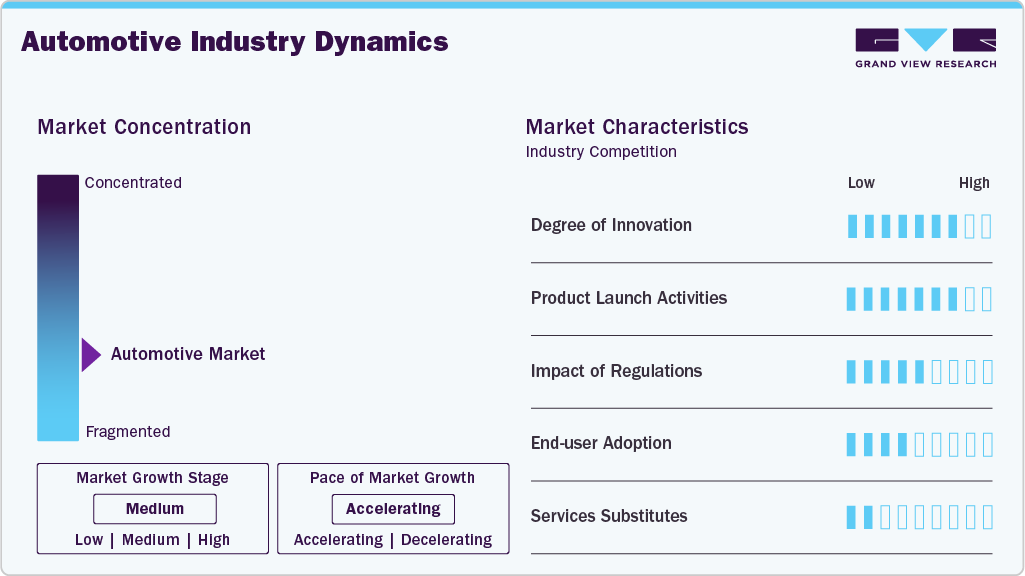
The industry is moderately fragmented, with a significant share of global vehicle sales concentrated among several large and well-established automotive manufacturers, while numerous regional, domestic, and emerging manufacturers also compete across different vehicle segments. Leading automakers benefit from strong brand recognition, extensive manufacturing and distribution networks, established supplier relationships, broad product portfolios, advanced technologies, and significant research and development capabilities. However, the market remains competitive because consumers can choose from a wide range of passenger cars, commercial vehicles, SUVs, electric vehicles, and other vehicle categories offered at different price points. This creates a competitive environment in which major global manufacturers maintain strong positions, while regional automakers, new-energy vehicle manufacturers, and emerging players continue to expand their presence.
The industry is characterized by high industry competition, high innovation, strong regulatory influence, and broad end-user adoption. Automakers compete through vehicle pricing, product design, performance, safety, fuel efficiency, technology features, brand positioning, and after-sales services. Increasing investments in electric vehicles, autonomous driving, connected vehicles, advanced driver-assistance systems (ADAS), and software-defined vehicle technologies are further intensifying technological competition. Partnerships with component suppliers, technology companies, dealerships, mobility platforms, and charging infrastructure providers also support product development and market expansion.
 To learn more about this report, Download Free Sample Report
 Government regulations related to vehicle emissions, fuel efficiency, safety standards, electrification, and vehicle manufacturing have a strong influence on market operations. Moreover, the combination of established global manufacturers, regional players, and rapidly expanding EV manufacturers results in a moderately fragmented and highly competitive market structure, while technological transformation and changing consumer preferences continue to reshape the competitive landscape.
Analyst Perspective
Technological advancements in electric vehicles, connected vehicles, advanced driver-assistance systems (ADAS), and software-defined vehicles are reshaping the traditional automotive industry. Electrification is expected to remain a key growth area, supported by government incentives, stricter emission regulations, and increasing consumer adoption. Automakers are likely to increase investments in battery technology, vehicle software, autonomous driving, digital platforms, and manufacturing automation. Competitive differentiation is expected to increasingly depend on vehicle pricing, product innovation, technology integration, energy efficiency, brand strength, and after-sales service capabilities.
Vehicle Insights
Based on vehicle, the passenger cars segment accounted for 44.0% of the total revenue share in 2025. Growing demand for convenient, flexible, and affordable personal transportation is driving the passenger cars market. Rising urbanization, increasing household incomes, expanding middle-class populations, and greater mobility requirements are encouraging consumers to purchase passenger vehicles for commuting, family transportation, and leisure activities. In emerging economies, improving road infrastructure and increasing vehicle affordability are further supporting first-time vehicle ownership.
The two-wheeler segment is projected to grow at the fastest CAGR over the forecast period. Growing demand for affordable and convenient personal transportation is driving the two-wheeler market. Rapid urbanization, traffic congestion, rising vehicle ownership costs, and increasing fuel expenses are encouraging consumers to adopt motorcycles and scooters as cost-effective mobility solutions. Two-wheelers generally require lower upfront investment, operating costs, and parking space compared with passenger cars, making them particularly attractive in densely populated urban areas and emerging markets.
Propulsion Insights
Based on propulsion, the ICE segment accounted for 84.8% of the total revenue share in 2025. The established infrastructure and cost advantages associated with internal combustion engine (ICE) vehicles continue to support demand for ICE-powered vehicles. Extensive fuel station networks, mature servicing infrastructure, readily available spare parts, and established repair capabilities provide consumers with convenient ownership and maintenance options.
The electric vehicle segment is projected to grow at the fastest CAGR over the forecast period. Increasing vehicle electrification is driving demand for electric vehicles (EVs) as governments, automakers, and consumers seek to reduce transportation-related emissions and dependence on fossil fuels. Government incentives, purchase subsidies, tax benefits, emission regulations, and zero-emission vehicle targets are encouraging the adoption of electric vehicles across major markets.
Application Insights
Based on application, the personal segment accounted for the largest revenue share in 2025. Increasing demand for convenient and flexible personal transportation is driving the personal application segment’s growth. Rising urbanization, population growth, increasing household incomes, and expanding mobility requirements are encouraging individuals to purchase vehicles for commuting, family transportation, leisure, and daily activities.
 To learn more about this report, Download Free Sample Report
 The commercial segment is expected to witness a significant CAGR over the forecast period. The expansion of e-commerce, logistics, construction, tourism, retail, and service industries is driving demand for vehicles used in commercial applications. Increasing urban deliveries, last-mile logistics, and movement of goods are creating greater requirements for commercial vehicles, including vans, pickups, trucks, and other utility vehicles. Growing business activity and infrastructure development are also increasing demand for vehicles used in transportation, construction, and service operations.
Regional Insights
The Asia Pacific automotive market led and accounted for 33.3% of the global revenue in 2025. The market is also expected to grow at the fastest CAGR from 2026 to 2033. The rapid urbanization, rising disposable incomes, expanding middle-class populations, and increasing mobility requirements are supporting automotive demand across the Asia Pacific region. The region also benefits from a large manufacturing base, extensive automotive supply chains, and growing investments in electric and connected vehicle technologies.
 To learn more about this report, Download Free Sample Report
 China Automotive Market Trends
The automotive market in China held the largest regional share in 2025, supported by its large consumer base, established vehicle manufacturing ecosystem, integrated supply chains, and strong domestic production capabilities. Rising demand for personal mobility and vehicle replacement continues to support overall vehicle sales, while government measures aimed at stimulating automobile consumption and vehicle trade-ins are supporting market activity.
The India automotive market accounted for a significant share in 2025, driven by rising household incomes, urbanization, increasing motorization, and growing demand for personal and commercial mobility. Expansion of road infrastructure and increasing vehicle affordability are supporting demand across passenger cars, two-wheelers, and commercial vehicles.
The automotive market in Australiaaccounted for a moderate share in 2025, supported by steady vehicle replacement demand, high vehicle ownership, and the country's geographically dispersed population, which creates continued demand for personal and utility vehicles. Consumer interest in fuel-efficient and electric vehicles is also increasing as EV model availability expands and charging infrastructure develops.
North America Automotive Market Trends
The automotive market in North Americais supported by high vehicle ownership, strong consumer purchasing power, established automotive manufacturing capabilities, and continued vehicle replacement demand. The region's mature automotive ecosystem, including extensive dealer networks, component suppliers, financing channels, and service infrastructure, supports sustained vehicle sales and aftermarket activity. Demand for SUVs, pickup trucks, crossovers, and commercial vehicles remains an important contributor to regional automotive activity.
The automotive market in the U.S. is driven by high vehicle ownership, strong consumer purchasing power, substantial replacement demand, and a well-developed automotive manufacturing and distribution ecosystem. Consumer preference for SUVs, pickup trucks, crossovers, and larger utility vehicles continues to support demand, while increasing adoption of connected vehicles, ADAS, hybrid powertrains, and EVs is encouraging automakers to expand technology-rich product portfolios.
Europe Automotive Market Trends
The automotive market in Europeis being driven by the transition toward lower-emission and electrified mobility, supported by stringent CO₂ regulations, expanding EV model availability, and increasing investment in charging infrastructure. The region also benefits from a strong automotive manufacturing base, established supplier networks, and continued demand for vehicle replacement and fleet modernization. At the same time, automakers are increasing investments in batteries, software, connected vehicles, and advanced driver-assistance technologies to comply with regulations and respond to changing consumer preferences.
The Germany automotive market is driven by its large domestic vehicle market, globally established OEMs, extensive supplier ecosystem, and increasing transition toward electrified vehicles. The country's strong automotive manufacturing base also supports demand for advanced powertrains, electronic, software, and vehicle technologies. Meanwhile, EU CO₂ fleet regulations are encouraging manufacturers to increase EV penetration, while the growing availability of BEV and PHEV models is expanding consumer choice.
The automotive market in the UK is supported by vehicle replacement demand, strong automotive manufacturing capabilities, and increasing adoption of electrified vehicles. Government zero-emission vehicle requirements and growing availability of EV and hybrid models are encouraging manufacturers and consumers to shift toward lower-emission powertrains. In addition, the UK's strong automotive export base and investments in EV technologies, battery production, and vehicle engineering are supporting long-term industry development.
Key Automotive Company Insights
Key players operating in the global automotive market include Toyota Motor Corporation, Volkswagen AG, Hyundai Motor Company, General Motors Company, Stellantis N.V., and Ford Motor Company. The global market remains competitive, with the leading manufacturers maintaining significant scale while Chinese automakers are rapidly increasing their global presence. In 2025, Toyota, Volkswagen, and Hyundai-Kia remained among the largest automotive groups by sales, while BYD, SAIC, and Geely continued to expand their positions.
-
Toyota Motor Corporation is a global automotive manufacturer engaged in the design, development, manufacture, assembly, and sale of passenger cars, minivans, commercial vehicles, and related parts and accessories. The company also operates financial services that primarily provide vehicle financing and leasing to dealers and customers. Toyota is expanding its focus beyond conventional vehicle manufacturing toward connected vehicles, mobility services, and data-enabled automotive solutions, while continuing to develop a broad portfolio of vehicle technologies and products.
-
Volkswagen AG is the parent company of the Volkswagen Group and operates as a major global automotive and financial services group. Its automotive activities cover the development, production, and sale of passenger cars, light commercial vehicles, trucks, and buses, along with vehicle software, batteries, components, and genuine parts. Volkswagen AG manages a broad portfolio of automotive brands, including Volkswagen, Audi, Škoda, SEAT/CUPRA, Porsche, Bentley, Lamborghini, and Volkswagen Commercial Vehicles, while its financial services activities include vehicle financing, leasing, fleet management, insurance, and mobility services.
Key Automotive Companies
The following key companies have been profiled for this study on the automotive market.
-
Toyota Motor Corporation
-
Volkswagen AG
-
Hyundai Motor Company
-
General Motors Company
-
Stellantis N.V.
-
Ford Motor Company
-
Honda Motor Co., Ltd.
-
BMW AG
-
Mercedes-Benz Group AG
-
SAIC Motor Corp., Ltd.
Competitive Benchmarking
Operating Strategies
Competitive Edge
Weaknesses
Mature Players: Toyota Motor Corporation, Volkswagen AG, General Motors Company, Ford Motor Company, Honda Motor Co., Ltd., BMW AG, Mercedes-Benz Group AG
- Mature automotive players focus on broad vehicle portfolios across passenger cars, SUVs, commercial vehicles, and multiple powertrain technologies, while investing in electrification, connected vehicles, ADAS, vehicle software, manufacturing automation, and global distribution networks.
- These companies benefit from strong global brands, large production capacities, established dealer and supplier networks, extensive geographic presence, strong R&D capabilities, and significant financial resources. Their broad product portfolios and established customer bases provide resilience across vehicle segments and markets.
- Mature players face challenges associated with large and complex operating structures, high manufacturing and R&D costs, legacy ICE production capacity, supply-chain complexity, and the need to transition rapidly toward EVs and software-defined vehicles.
Emerging Players: Hyundai Motor Company, Stellantis N.V., SAIC Motor Corp., Ltd.
- These players are focusing on expanding global vehicle portfolios, accelerating EV and hybrid offerings, strengthening regional manufacturing capabilities, developing connected and software-enabled vehicles, and expanding their presence in high-growth emerging markets.
- These companies benefit from competitive pricing, increasingly diversified product portfolios, growing EV capabilities, strong regional market positions, and greater flexibility in responding to changing consumer preferences.
- These players face challenges from intense competition with established global OEMs, regional regulatory requirements, technology investment needs, and varying levels of brand strength across international markets.
Recent Developments
-
In August 2026, Volkswagen announced the launch of a sub-4m compact SUV space. The new SUV will be built on the MQB-A0-IN platform that is developed for the Indian market specifically. The product launch is expected to help the company strengthen its position in the Indian market.
-
In July 2026, Toyota Kirloskar Motor Launched the All-New Hilux in India. Based on the IMV platform, the all-new Hilux has been developed to deliver exceptional all-round usability that is highly durable for heavy-duty tasks, yet comfortable for urban driving, and capable for light adventure. This product launch is expected to attract new customers and strengthens company's position in India.
Automotive Market Report Scope
Report Attribute
Details
Market size value in 2025
USD 2,750.0 billion
Estimated market size in 2026
USD 2,839.4 billion
Revenue forecast in 2033
USD 3,724.8 billion
Growth rate
CAGR of 4.0% from 2026 to 2033
Base year for estimation
2025
Historical data
2021 - 2024
Forecast period
2026 - 2033
Quantitative units
Revenue in USD billion, and CAGR from 2026 to 2033
Report coverage
Revenue forecast, company ranking, competitive landscape, growth factors, and trends
Segments covered
Vehicle, propulsion, application, region
Regional scope
North America; Europe; Asia Pacific; Latin America; MEA
Country scope
U.S.; Canada; Mexico; Germany; UK; France; China; Japan; India; South Korea; Australia; Brazil; KSA; UAE; South Africa
Key companies profiled
Toyota Motor Corporation; Volkswagen AG; Hyundai Motor Company; General Motors Company; Stellantis N.V.; Ford Motor Company; Honda Motor Co., Ltd.; BMW AG; Mercedes-Benz Group AG; SAIC Motor Corp., Ltd.
Customization scope
Free report customization (equivalent up to 8 analysts working days) with purchase. Addition or alteration to country, regional & segment scope.
Pricing and purchase options
Avail customized purchase options to meet your exact research needs. Explore purchase options
Global Automotive Market Report Segmentation
The report forecasts revenue growth at global, regional, and country levels and provides an analysis of the latest industry trends in each of the sub-segments from 2021 to 2033. For this study, Grand View Research has segmented the global automotive market report based on vehicle, propulsion, application, and region.
 To learn more about this report, Download Free Sample Report
 -
Vehicle Outlook (Revenue, USD Billion, 2021 - 2033)
-
Two-Wheeler
-
Three-Wheeler
-
Passenger Cars
-
Commercial Vehicles
-
Off-Highway Vehicles
-
-
Propulsion Outlook (Revenue, USD Billion, 2021 - 2033)
-
Internal Combustion Engine
-
Electric Vehicle
-
-
Application Outlook (Revenue, USD Billion, 2021 - 2033)
-
Personal
-
Commercial
-
Public Transport
-
Industrial
-
-
Regional Outlook (Revenue, USD Billion, 2021 - 2033)
-
North America
-
U.S.
-
Canada
-
Mexico
-
-
Europe
-
Germany
-
UK
-
France
-
-
Asia Pacific
-
China
-
India
-
Japan
-
South Korea
-
Australia
-
-
Latin America
-
Brazil
-
-
Middle East & Africa (MEA)
-
UAE
-
Kingdom of Saudi Arabia (KSA)
-
South Africa
-
-
Research Methodology
The automotive market figures in this report are based on a proven research process that combines executive interviews with secondary research from proprietary databases, company filings, and recognized regulatory and institutional sources. Market size is built through value-chain sizing-reconciling supply-side and demand-side estimates-and triangulated with bottom-up and top-down approaches. Every estimate passes multiple levels of expert validation before publication, with each automotive segment quantified using the revenue-capture definitions in the table below.
Segment Definition
Segment
Revenue capture definition
Segment - Vehicle
Two-Wheeler
The segment revenue is generated from the sale of motorcycles, scooters, mopeds, and other two-wheeled motor vehicles to individual consumers, businesses, and fleet operators.
Three-Wheeler
The segment revenue is generated from the sale of three-wheeled vehicles, including passenger and cargo three-wheelers, to individual owners, commercial operators, fleet owners, and other end users.
Passenger Cars
The segment revenue is generated from the sale of passenger cars, including sedans, hatchbacks, SUVs, crossovers, and other light passenger vehicles, to individual consumers, fleet operators, and other buyers.
Commercial Vehicles
The segment revenue is generated from the sale of commercial vehicles, including light commercial vehicles, trucks, buses, vans, and other vehicles primarily used for transportation of goods or passengers for commercial purposes.
Off-Highway Vehicles
The segment revenue is generated from the sale of vehicles primarily designed for operation outside conventional public roads, including construction, mining, agricultural, forestry, and material-handling vehicles such as tractors, excavators, loaders, and similar equipment.
Segment - Propulsion
Internal Combustion Engine
The segment revenue is generated from the sale of vehicles powered primarily by internal combustion engines using gasoline, diesel, natural gas, or other liquid or gaseous fuels.
Electric Vehicle
The segment revenue is generated from the sale of battery-electric, plug-in electric, and other externally chargeable electric vehicles powered primarily by electric motors and rechargeable battery systems.
Segment - Application
Personal
The segment revenue is generated from vehicle sales to individual consumers for personal mobility, commuting, family transportation, leisure, and other non-commercial transportation needs.
Commercial
The segment revenue is generated from vehicle sales to businesses, fleet operators, logistics companies, construction companies, rental companies, and other commercial users for goods transportation, deliveries, business operations, and revenue-generating activities.
Public Transport
The segment revenue is generated from the sale of vehicles used by public transportation authorities, transit operators, municipalities, and other organizations for scheduled passenger transportation, including buses and other public mobility vehicles.
Industrial
The segment revenue is generated from the sale of vehicles used primarily for industrial, construction, mining, agriculture, forestry, material handling, and other specialized operational activities, where the vehicle performs a specific industrial or work-related function.
Estimation Model
Layer Name
Key Question
Description
Vehicle Volume Base
How large is the addressable vehicle market?
Estimate vehicle production and sales across two-wheelers, three-wheelers, passenger cars, commercial vehicles, and off-highway vehicles.
Powertrain & Application Mix
What is the mix by propulsion and application?
Allocate vehicle volumes across ICE and EV, and personal, commercial, public transport, and industrial applications.
ASP & Revenue Pool
What is the revenue generated per vehicle?
Apply ASPs by vehicle type, powertrain, application, and country to derive total automotive market revenue.
Validation & Forecast
Does the estimate align with market evidence?
Validate against production, registration, OEM sales, and industry data, then apply volume, ASP, and penetration assumptions to forecast market revenue.
Delivered Customization
We have successfully delivered the following deep-dive customizations:
Client Request
Customization Delivered
Value Adds
Regional Automotive Market Opportunity Assessment
Country/region-wise market sizing and forecasts across key vehicle segments
Analysis of vehicle demand, production, sales, electrification, and regulatory trends
Identification of high-growth regions and automotive investment hotspots
Identified region-specific growth opportunities
Supported market entry and expansion strategies
Enabled informed regional investment decisions
Cross-Segmentation Analysis for the Automotive Market
Cross-segmentation by vehicle type, propulsion type, and application
Assessment of demand and adoption trends across ICE and EV segments
Benchmarking of segment attractiveness, growth potential, and market opportunity
Identified high-potential vehicle and propulsion segments
Supported product portfolio and market prioritization
Enabled targeted growth strategy development
Competitive Benchmarking and Strategic Positioning in the Automotive Market
Benchmarking of major automakers across vehicle portfolio, powertrain, technology, pricing, and geographic presence
Comparative assessment of market share, production scale, capabilities, and strategies
Analysis of competitive strengths, gaps, and differentiation opportunities
Identified competitive white spaces and growth opportunities
Supported strategic positioning and differentiation
Enabled data-driven competitive strategy development
Frequently Asked Questions About This Report
The global automotive market size was valued at USD 2,750.0 billion in 2025 and is estimated at USD 2,839.4 billion in 2026.
The passenger segment dominated the global automotive market by revenue share of 44.0% in 2025.
The global automotive market is expected to grow at a compound annual growth rate of 4.0% from 2026 to 2033 to reach USD 3,724.8 billion by 2033.
Asia Pacific dominated the automotive market with a share of 33.3% in 2025. Rapid urbanization, rising disposable incomes, expanding middle-class populations, and increasing mobility requirements are supporting automotive demand across the Asia Pacific region.
Increasing disposable incomes, urbanization, and expanding middle-class populations in China, India, Southeast Asia, Latin America, and other emerging economies are supporting higher vehicle ownership and replacement demand.
Some key players operating in the automotive market include Toyota Motor Corporation, Volkswagen AG, Hyundai Motor Company, General Motors Company, Stellantis N.V., Ford Motor Company, Honda Motor Co., Ltd., BMW AG, Mercedes-Benz Group AG, and SAIC Motor Corp., Ltd
The ICE segment dominated the global automotive market by revenue share of 84.8% in 2025.
The personal segment dominated the global automotive market by revenue share of 62.6% in 2025.
About the Author(s)
Automotive & Transportation Research Team
Technology · Automotive & TransportationThis report was authored by the automotive & transportation research team at Grand View Research - comprising two research analysts, one senior research analyst, and one industry expert - with specialized expertise in the automotive & transportation segment of the technology industry. All findings are based on proprietary technology databases, executive interviews, and regulatory analysis, subject to internal peer review prior to publication.
Last Updated:
Speak to Analyst

Customize this report to your needs - add regions, segments, or data points, with 20% free customization.
Or view our licence options:


ISO 9001:2015 & 27001:2022 Certified
We are GDPR and CCPA compliant! Your transaction & personal information is safe and secure. For more details, please read our privacy policy.


