
- Home
- »
- Automotive & Transportation
- »
-
Forecourt Market Size, Share & Trends Report, 2026-2033GVR Report cover
![Forecourt Market (2026 - 2033)Report]()
Forecourt Market (2026 - 2033)
Size, Share & Trends Analysis Report By Component (Fuel Dispensers, Payment Terminals, EV Chargers, Air & Water Machines), By Fuel Type (Diesel, Biofuels), By Service Type (Fuel Retailing, Car Wash Services), By Region, And Segment Forecasts
Market Size, 2025
$240.1BMarket Estimate, 2026
$250.4BMarket Forecast, 2033
$357.5BCAGR, 2026–2033
5.2%Forecourt Market Summary
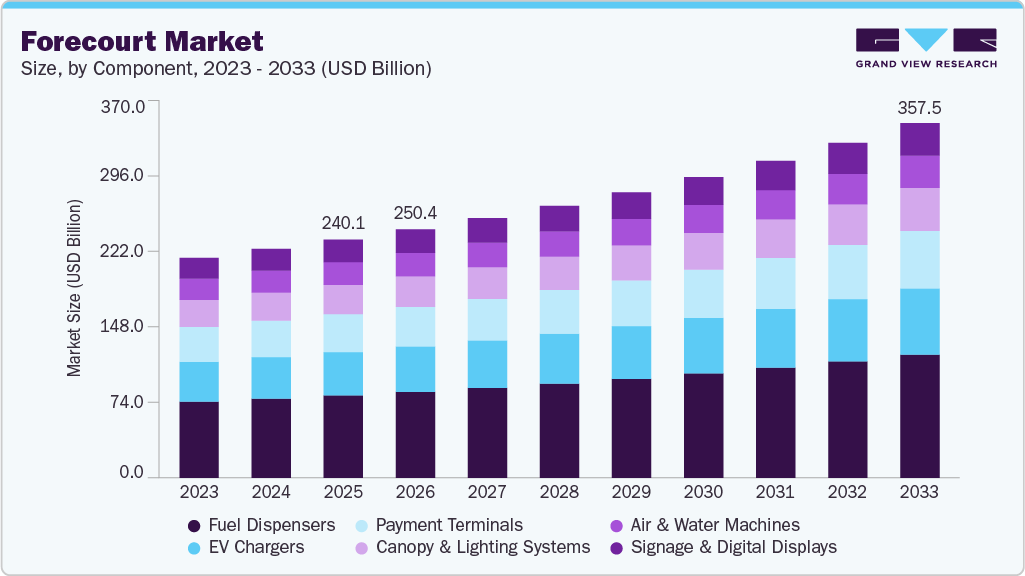
The global forecourt market size was valued at USD 240.1 billion in 2025 and is projected to grow from USD 250.4 billion in 2026 to USD 357.5 billion by 2033, at a CAGR of 5.2% from 2026 to 2033. The North America held the largest share of 49.5% of the global market in 2025.The rising integration of digital technologies, diversification of non-fuel revenue streams, and rapid expansion of EV charging infrastructure are driving market growth.

Key Market Trends & Insights
- By component: Fuel dispensers segment held the largest market share of 34.6%% in 2025.
- By fuel type: Gasoline segment held the largest market share in 2025.
- By service type: Fuel retailing segment held the largest market share in 2025.
Regional Highlights
- Largest regional market: North America (49.5% revenue share, 2025)
- Fastest-growing regional market: Asia Pacific (highest CAGR, 2026-2033)
- By country: The U.S. held the largest share in 2025
Market Size & Forecast
- Market size in 2025: USD 240.1 Billion
- Estimated market size in 2026: USD 250.4 Billion
- Projected market size by 2033: USD 357.5 Billion
- CAGR (2026-2033): 5.2%
Increasing consumer demand for convenience-based retail formats, coupled with investments in sustainable and smart forecourt modernization, is further propelling market expansion across developed and emerging regions. The global transition toward sustainable transportation is significantly propelling market growth. Government-led decarbonization goals have accelerated the integration of EV charging stations across traditional fuel forecourts.For instance, according to the U.S. Department of Energy, the number of public EV charging ports in the United States surpassed 183,000 by 2024, reflecting a sharp rise from just 75,000 in 2021. Similarly, the European Alternative Fuels Observatory reports that Europe has exceeded one million public charging points in 2024, supported by government subsidies and emission reduction mandates. This widespread installation of charging infrastructure is not only diversifying the revenue streams of forecourt operators but also boosting the modernization of service stations globally.
Supportive government policies promoting alternative fuels such as biofuels, hydrogen, and CNG are propelling market growth. The U.S. Energy Information Administration highlights that renewable diesel production capacity grew by over 60% between 2021 and 2024, driven by clean fuel standards. In parallel, the European Commission has advanced its “Fit for 55” policy package, mandating that fuel retailers offer sustainable fuel options. This policy shift is compelling fuel station operators to integrate multi-fuel dispensing systems, thereby driving forecourt investments and supporting the evolution toward cleaner energy ecosystems.
Digital transformation across retail and service operations is boosting the market. As per the UK’s Digital Economy Report (2024), over 85% of in-store transactions in the UK convenience sector are now contactless. This trend has rapidly extended to fuel retailing, where contactless payment and mobile app integration have enhanced operational efficiency and customer experience. The adoption of AI-enabled pricing systems, loyalty applications, and automated payment kiosks is helping forecourts minimize wait times and increase throughput, reinforcing profitability and customer retention.
Forecourts are increasingly becoming multifunctional convenience hubs rather than just refueling points. According to the UK Government Retail Analysis, forecourt convenience retailing now contributes nearly one-fifth of total convenience sales in the UK, reflecting changing consumer preferences for on-the-go shopping and quick-service food options. This evolution is propelling market growth as global fuel retailers partner with fast-food chains and grocery outlets to expand non-fuel revenues. Such diversification strategies not only strengthen profitability but also ensure resilience amid the gradual decline in fossil fuel demand.
Sustainability-driven modernization is another major force boosting the global market. Public and private initiatives promoting energy-efficient station design, solar canopies, and smart monitoring systems are gaining traction. For example, the U.S. Department of Energy’s Better Buildings Initiative reports that energy-efficient upgrades across retail forecourts can reduce power consumption by 20-30%. Moreover, automation technologies such as predictive maintenance sensors and digital forecourt management systems are improving uptime and operational safety. These advancements are driving long-term efficiency and sustainability, positioning the forecourt ecosystem as a critical component of future mobility infrastructure.
Component Insights
The fuel dispensers segment accounted for the largest share of 34.6% in 2025. The demand for modern and efficient fuel dispensers continues to increase as fuel retailers upgrade existing infrastructure to meet new safety and environmental standards. The U.S. Environmental Protection Agency (EPA) and Department of Energy (DOE) have implemented guidelines emphasizing vapor recovery systems, fuel metering accuracy, and leak detection technologies. These requirements have encouraged the integration of automated and IoT-enabled dispensers across retail forecourts. In many European and Asia-Pacific countries, the inclusion of contactless payment systems and real-time monitoring capabilities within dispensers is becoming a standard practice, reflecting the industry’s movement toward operational efficiency and compliance with sustainability norms.
The EV chargers segment is projected to grow at the fastest CAGR over the forecast period. Electric vehicle charging infrastructure has become a critical component of forecourt development. Government programs such as the U.S. National Electric Vehicle Infrastructure (NEVI) initiative and the European Alternative Fuels Infrastructure Regulation (AFIR) have significantly expanded public charging coverage. The number of public charging points in Europe, according to the European Alternative Fuels Observatory (EAFO), has surpassed one million as of 2024, indicating rapid adoption. Many fuel retailers are introducing hybrid forecourts that support both traditional fuels and EV charging, enabling a smoother transition toward electrified mobility and catering to a growing segment of environmentally conscious consumers.
Fuel Type Insights
The gasoline segment held the largest market share in 2025. Gasoline continues to account for a substantial portion of global forecourt transactions, supported by the large population of internal combustion engine (ICE) vehicles still in operation. Data from the International Energy Agency (IEA) indicates that gasoline-powered cars represent nearly half of the world’s light-duty vehicle fleet. In developing economies, increasing vehicle ownership and improving logistics infrastructure contribute to consistent demand. Forecourt operators are focusing on maintaining high service reliability and integrating digital payment and fleet management systems to enhance customer convenience and operational transparency.
The electric (EV Charging) segment is projected to grow at the fastest CAGR over the forecast period. The EV charging segment has expanded considerably over the past few years, driven by policy incentives, stricter emission regulations, and corporate sustainability goals. The U.S. Department of Energy (DOE) reports that public and workplace charging points have doubled between 2021 and 2024. Similarly, in Europe, national governments continue to fund fast-charging corridors along highways and urban zones. This shift has encouraged forecourt developers to allocate space for high-speed chargers and renewable energy-based charging hubs, reflecting the industry’s gradual alignment with the broader clean mobility agenda.
Service Type Insights
The fuel retailing segment dominated the market in 2025 and is projected to grow at a significant CAGR over the forecast period. Fuel retailing remains the core service category within the forecourt environment, supported by consistent consumer demand and the expansion of integrated convenience offerings. According to the UK Department for Energy Security and Net Zero (DESNZ), there are more than 8,000 forecourts across the United Kingdom, many of which now combine traditional fuel sales with grocery and café operations. The adoption of digital pricing systems, customer analytics tools, and mobile payment options is improving the retail experience and operational agility, particularly among leading operators in North America and Europe.
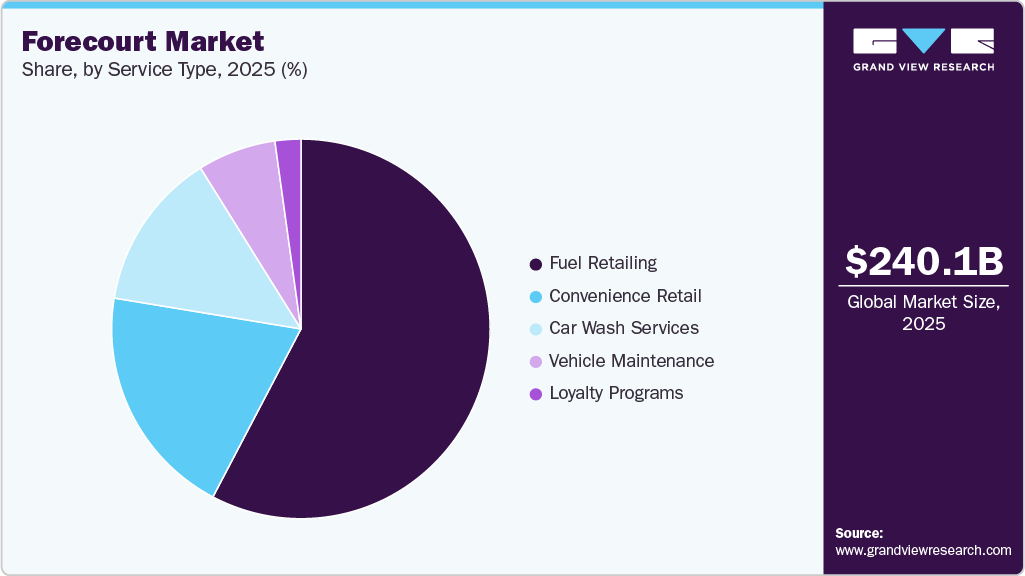
The Loyalty Programs segment is projected to grow at the fastest CAGR over the forecast period. Loyalty programs have become an essential feature of customer engagement strategies in the forecourt industry. Retailers are increasingly using data-driven personalization to retain customers and encourage cross-category purchases. The UK Government Retail Strategy Report (2024) highlights that the majority of forecourt customers are enrolled in at least one loyalty scheme. Companies such as BP and Shell have enhanced their platforms with mobile app integration, real-time reward tracking, and targeted promotions, which have led to improved customer interaction and long-term brand association within competitive retail environments.
Regional Insights
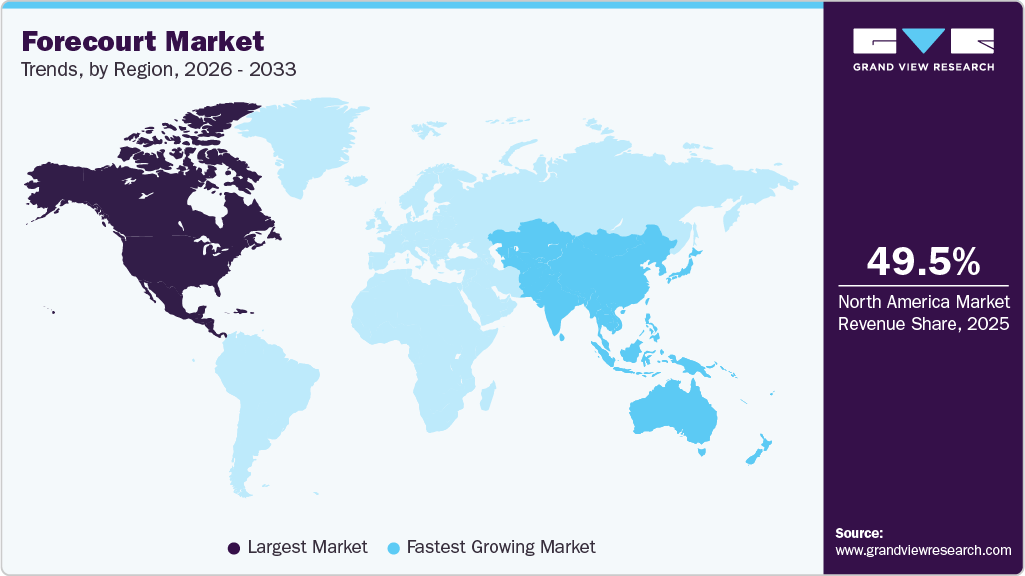
The North America forecourt market accounted for the largest market share of 49.5% of the overall market in 2025. Forecourts across North America are undergoing a transformation from conventional fuel stations into comprehensive energy and retail hubs. This shift is being driven by the need to accommodate both traditional fuels and electric charging infrastructure. The U.S. Department of Energy (DOE) highlights that convenience stores account for nearly 80% of all retail fuel sales in the region, showing how closely fuel and retail services are intertwined. With federal initiatives such as the Bipartisan Infrastructure Law funding the rollout of public EV chargers, forecourts are increasingly integrating high-speed charging, digital payments, and retail expansions to cater to changing mobility trends.
U.S. Forecourt Market Trends
The forecourt market in the U.S. remains the dominant contributor within North America. The Federal Highway Administration (FHWA) and DOE’s National Electric Vehicle Infrastructure (NEVI) program have allocated billions toward creating a nationwide EV charging network. As of 2024, the U.S. surpassed 190,000 public charging ports, nearly double the number available in 2021. This surge in infrastructure is prompting fuel retailers to redesign their forecourts, adding fast chargers, renewable energy solutions, and convenience offerings that align with the country’s clean transport objectives
Europe Forecourt Market Trends
The forecourt market in Europe is evolving rapidly due to stringent emission reduction policies and the rollout of the Alternative Fuels Infrastructure Regulation (AFIR). The European Alternative Fuels Observatory (EAFO) reports that Europe exceeded one million public charging points in 2024, reflecting significant investment in sustainable mobility. Many European forecourts are transitioning into mixed-use energy centers, offering both fuel and high-power charging options, alongside upgraded convenience stores. This evolution aligns with the EU’s target of achieving net-zero transport emissions by 2050, positioning forecourts as vital enablers in that transition.
Germany forecourt market is one of Europe’s most advanced markets in forecourt modernization. The federal government aims to install up to one million public chargers by 2030, creating new opportunities for forecourt operators. Although progress has been steady, regional disparities remain, with dense charger networks in major cities and slower development in rural areas. German fuel retailers are increasingly focusing on integrating high-capacity charging stations along highways and urban corridors, complementing ongoing efforts to improve interoperability and digital connectivity within the energy sector.
The forecourt market in the UK continues to strengthen its forecourt network by combining traditional fueling operations with convenience-led retail formats. According to the Association of Convenience Stores (ACS) Forecourt Report 2024, over 8,000 forecourts operate nationwide, generating approximately £5.9 billion in annual shop sales. Retailers are incorporating electric charging points, contactless payment systems, and quick-service food options to meet evolving consumer needs. Government-backed infrastructure programs and private investments are further supporting modernization, ensuring forecourts remain essential retail and service touchpoints across communities.
Asia Pacific Forecourt Market Trends
The forecourt market in the Asia Pacific is expected to grow at the fastest CAGR during the forecasted period. The Asia Pacific region presents a diverse forecourt landscape shaped by urbanization, economic growth, and rapid motorization. In markets such as China and South Korea, limited home-charging access has accelerated the deployment of public charging stations, while developing economies like India and Indonesia continue to expand traditional fuel networks. The IEA notes that APAC accounted for the majority of global charger installations between 2020 and 2024. This growth has encouraged regional forecourts to adopt hybrid service models, combining fuel dispensing, EV charging, and retail, to serve a wide spectrum of vehicle users.
China forecourt market has emerged as the global leader in forecourt electrification. According to the IEA, the country represents nearly two-thirds of global public charger additions and over 60% of the world’s electric vehicle stock. This scale has driven fuel retailers to integrate charging, e-payment systems, and retail amenities into single-site ecosystems. State-supported infrastructure expansion and urban planning policies continue to encourage the construction of multi-purpose forecourts capable of supporting both ICE and electric mobility.
The forecourt market in Japan’s approach to forecourt modernization has been methodical, guided by national energy and transport policies. The Ministry of Economy, Trade, and Industry (METI) has established roadmaps for expanding public charging access and improving grid coordination to support electric mobility. Operators are gradually upgrading highway forecourts with fast-charging units, ensuring compliance with grid stability standards. The focus on reliability, quality, and integration with renewable energy systems reflects Japan’s broader strategy toward sustainable and efficient mobility infrastructure.
Key Forecourt Company Insights
Some of the major market players include Shell plc, BP plc, ExxonMobil, Chevron Corporation, TotalEnergies SE, Alimentation Couche-Tard Inc., Indian Oil Corporation Limited, Repsol S.A., Eni S.p.A., and PetroChina Company Limited, among others. These companies hold a strong presence across fuel retailing, convenience store integration, and EV charging infrastructure, reflecting their ability to adapt to changing mobility patterns and energy transitions. Their extensive global networks, investment in digital forecourt technologies, and expansion into sustainable fuels and electric vehicle charging stations have positioned them at the forefront of innovation in the forecourt ecosystem.
-
Shell plc operates one of the world’s largest fuel retail networks, serving more than 55,000 forecourts globally. The company has been integrating renewable energy sources and EV charging stations into its service portfolio, notably through its “Recharge” network in Europe and Asia. Shell’s commitment to transforming traditional forecourts into multi-energy hubs aligns with its broader net-zero emission strategy and focus on customer-centric digital platforms.
-
BP plc has modernized its retail network with an emphasis on convenience partnerships and EV charging. Through its joint venture bp pulse, the company is developing rapid-charging infrastructure across the UK, U.S., and Europe. BP’s shift from a conventional fuel retailer to an integrated energy provider showcases its adaptability to changing mobility trends while maintaining a strong presence in traditional fuel dispensing and forecourt convenience services.
Key Forecourt Companies:
The following key companies have been profiled for this study on the forecourt market.
- Shell plc
- BP plc
- ExxonMobil
- Chevron Corporation
- TotalEnergies SE
- Alimentation Couche‑Tard Inc.
- Indian Oil Corporation Limited
- Repsol S.A.
- Eni S.p.A.
- PetroChina Company Limited
Recent Developments
-
In February 2025, BP plc announced the opening of its first “new format EV charging & convenience hub” at Cromwell Road in Hammersmith, London. The site features five ultra-fast 300 kW chargers (each capable of charging two cars simultaneously) and an upgraded convenience store offering, including a Wild Bean Café and M&S Food.
-
In December 2024, Shell’s EV division (“Shell Recharge Solutions EU”) entered into a strategic partnership with 50five (Netherlands-based charging-solutions provider) to merge a home- and workplace-charging contract portfolio across six European markets (UK, Netherlands, Germany, France, Belgium, Luxembourg). The collaboration covers over 10,000 lamp-posts and on-street charging locations, and supports Shell’s claim that it currently operates “around 70,000 public charge points globally.”
Forecourt Market Report Scope
Report Attribute
Details
Market size in 2025
USD 240.1 billion
Estimated market size in 2026
USD 250.4 billion
Projected market size by 2033
USD 357.5 billion
Growth rate
CAGR of 5.2% from 2026 to 2033
Historical data
2021 - 2025
Forecast period
2026 - 2033
Quantitative units
Revenue in USD million/billion and CAGR from 2026 to 2033
Report coverage
Revenue forecast, company ranking, competitive landscape, growth factors, and trends
Segments covered
Component, fuel type, service type, region
Regional scope
North America; Europe; Asia Pacific; Latin America; MEA
Country scope
U.S.; Canada; Mexico; Germany; UK; France; China; Japan; India; South Korea; Australia; Brazil; KSA; UAE; South Africa
Key companies profiled
Shell plc; BP plc; ExxonMobil; Chevron Corporation; TotalEnergies SE; Alimentation Couche‑Tard Inc.; Indian Oil Corporation Limited; Repsol S.A.; Eni S.p.A.; PetroChina Company Limited
Customization scope
Free report customization (equivalent up to 8 analysts working days) with purchase. Addition or alteration to country, regional & segment scope.
Pricing and purchase options
Avail customized purchase options to meet your exact research needs. Explore purchase options
Global Forecourt Market Report Segmentation
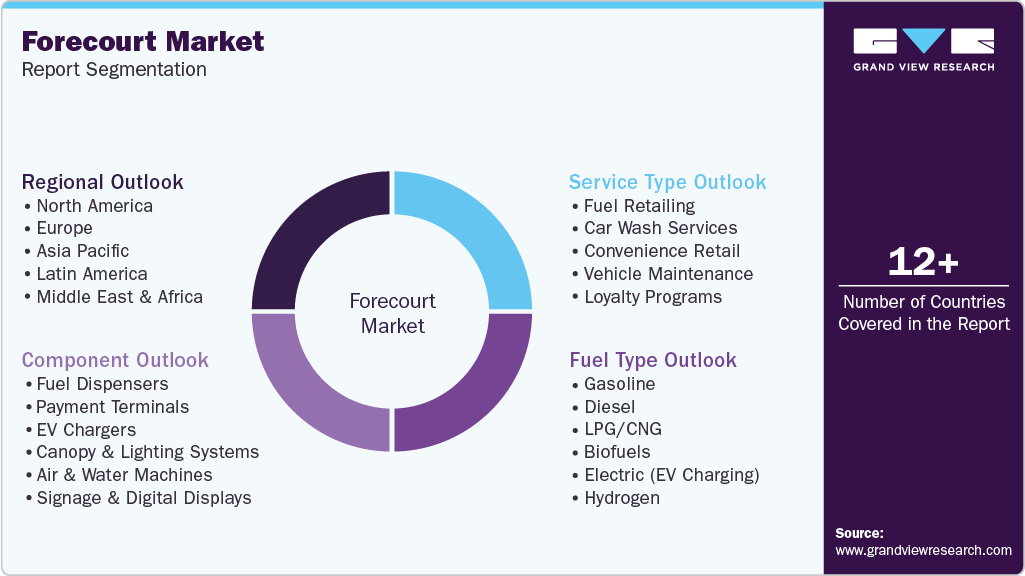
This report forecasts revenue growth at the global, regional, and country levels and provides an analysis of the latest industry trends in each of the sub-segments from 2021 to 2033. For this study, Grand View Research has segmented the global forecourt market report based on component, fuel type, service type, and region:
-
Component Outlook (Revenue, USD Million, 2021 - 2033)
-
Fuel Dispensers
-
Payment Terminals
-
EV Chargers
-
Canopy & Lighting Systems
-
Air & Water Machines
-
Signage & Digital Displays
-
-
Fuel Type Outlook (Revenue, USD Million, 2021 - 2033)
-
Gasoline
-
Diesel
-
LPG/CNG
-
Biofuels
-
Electric (EV Charging)
-
Hydrogen
-
-
Service Type Outlook (Revenue, USD Million, 2021 - 2033)
-
Fuel Retailing
-
Car Wash Services
-
Convenience Retail
-
Vehicle Maintenance
-
Loyalty Programs
-
-
Regional Outlook (Revenue, USD Million, 2021 - 2033)
-
North America
-
U.S.
-
Canada
-
Mexico
-
-
Europe
-
Germany
-
UK
-
France
-
-
Asia Pacific
-
China
-
Japan
-
India
-
South Korea
-
Australia
-
-
Latin America
-
Brazil
-
-
Middle East and Africa (MEA)
-
KSA
-
UAE
-
South Africa
-
-
Frequently Asked Questions About This Report
The global forecourt market size was estimated at USD 240.1 billion in 2025 and is expected to reach USD 250.4 billion in 2026.
Some of the players in the market are Shell plc, BP plc, ExxonMobil, Chevron Corporation, TotalEnergies SE, Alimentation Couche‑Tard Inc., Indian Oil Corporation Limited, Repsol S.A., Eni S.p.A., and PetroChina Company Limited.
The global forecourt market size is expected to grow at a significant CAGR of 5.2% to reach USD 357.5 billion in 2033.
Asia Pacific is the fastest-growing region over the forecast period.
The fuel dispensers segment led with a 34.6% revenue share in 2025, while the EV chargers segment is the fastest-growing.
The gasoline segment held the largest revenue share in 2025, while the electric (EV charging) segment is the fastest-growing.
The fuel retailing segment held the largest revenue share in 2025, while the loyalty programs segment is the fastest-growing.
North America held the largest market share of 49.5% in 2025. Forecourts across North America are undergoing a transformation from conventional fuel stations into comprehensive energy and retail hubs. This shift is being driven by the need to accommodate both traditional fuels and electric charging infrastructure.
The key driving trend in the global forecourt market is the integration of multi-energy and digital service ecosystems, transforming traditional fuel stations into advanced mobility hubs. Operators are increasingly combining EV charging, hydrogen refueling, and biofuel dispensing with digital payment solutions, smart loyalty programs, and convenience retail services to meet evolving consumer expectations. This transformation, driven by rising electric vehicle adoption and stricter emission targets, is enabling companies such as Shell, BP, and TotalEnergies to diversify revenue streams and enhance customer engagement through technology-enabled, sustainable, and experience-driven forecourt models.
About the Author(s)
Automotive & Transportation Research Team
Technology · Automotive & TransportationThis report was authored by the automotive & transportation research team at Grand View Research - comprising two research analysts, one senior research analyst, and one industry expert - with specialized expertise in the automotive & transportation segment of the technology industry. All findings are based on proprietary technology databases, executive interviews, and regulatory analysis, subject to internal peer review prior to publication.
Last Updated:
Speak to Analyst


Customize this report to your needs — add regions, segments, or data points, with 20% free customization.
Or view our licence options:


ISO 9001:2015 & 27001:2022 Certified
We are GDPR and CCPA compliant! Your transaction & personal information is safe and secure. For more details, please read our privacy policy.


