
- Home
- »
- Next Generation Technologies
- »
-
Gaming Console Market Size And Share Report, 2026-2033GVR Report cover

Gaming Console Market (2026 - 2033)
Size, Share & Trends Analysis Report, By Product (Nintendo, PlayStation, Xbox), By Application (Gaming, Non-gaming), By Distribution Channel (Online, Offline), By Type, By Component (Console Unit), By Region, And Segment Forecasts
Market Size, 2025
$28.3BMarket Estimate, 2026
$30.3BMarket Forecast, 2033
$47.6BCAGR, 2026–2033
6.6%Gaming Console Market Summary
The global gaming console market size was estimated at USD 28.3 billion in 2025 and is projected to grow from USD 30.3 billion in 2026 to USD 47.6 billion by 2033, growing at a CAGR of 6.6% from 2026 to 2033. Asia Pacific dominated the global market with the largest revenue share of 46.5% in 2025. The gaming console market is driven by increasing demand for immersive interactive entertainment and high-performance gaming experiences, with consumers proactively adopting next-generation consoles, cloud gaming services, and digital distribution platforms to enhance gameplay quality, improve accessibility, and enable seamless cross-device connectivity across increasingly connected digital entertainment ecosystems.
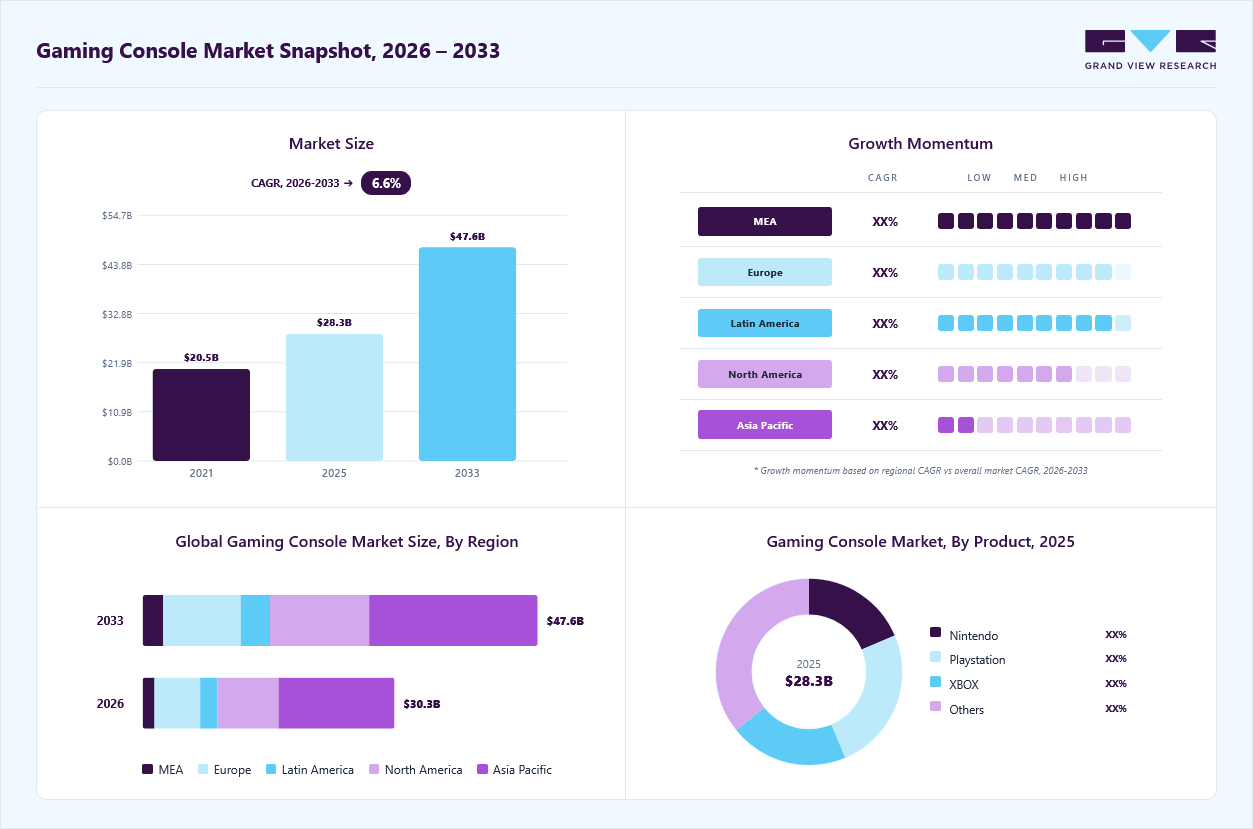 Source: Grand View Research, IR Documents, Primary Interviews, Paid DatabasesTo learn more about this report,
 Download Free Sample Report
 Key Market Trends & Insights
- By product: The PlayStation segment dominated the market, with a share of 25.6% in 2025.
- By application: The gaming segment accounted for the largest market share of 60.8% in 2025.
- By distribution channel: The offline segment held the largest market share in 2025.
- By type: The handheld game console segment accounted for the largest revenue share in 2025.
Key Market Trends & Insights
- Largest regional market: Asia Pacific (46.5% revenue share in 2025)
- By Country: The China held the largest market share in 2025
Market Size & Forecast
- Market size in 2025: USD 28.3 Billion
- Estimated market size in 2026: USD 30.3 Billion
- Projected market size by 2033: USD 47.6 Billion
- CAGR (2026-2033): 6.6%
Three ways to get this report
Buy it, customize it, or ask a question.Ask an Analyst
Analyst response in 1 business day
- AccessReport author, directly
- Reply timeWithin 1 working day
- No sales callDirect answer only
- FormatEmail reply
- CostFree, no cost
Get the Full Report
What the study covers
- FormatsPDF · Excel · Dashboard
- Timeline2026–2033 annual, 2025 base
- Coverage20+ countries, 5 regions
- Companies10+ key players profiled
Customize the Report
20% free customization
- IncludeCountries, segments, points
- TailorTo your product definition
- ExtendDeeper competitor detail
- OrA fully bespoke study
- Turnaround5–10 working days
The market growth is primarily driven by continuous technological advancements that enhance performance, visual fidelity, and user experience of gaming consoles. Significant improvements in graphics technology from early 8-bit visuals to today’s 4K resolutions have revolutionized the level of immersion and realism in gameplay. Innovations in hardware architecture, faster processing power, and integrated software ecosystems are enabling more dynamic, responsive, and engaging gaming experiences. These developments, along with growing support for cloud-based gaming, virtual reality integration, and seamless digital content delivery, are expected to drive the expansion of the gaming console market. To learn more about this report, Download Free Sample Report
 The advancement of high-performance hardware components is significantly fueling the growth of the gaming console market. The integration of multicore processors and powerful graphics processing units (GPUs) allows consoles to support complex game mechanics, detailed environments, and faster load times. These enhancements enable developers to create more immersive and realistic game experiences, elevating user engagement and satisfaction. Gaming content becomes increasingly sophisticated, demand for consoles with advanced computing and rendering capabilities continues to rise, driving market growth.
In addition, the rapid development and adoption of virtual reality (VR) and augmented reality (AR) technologies are emerging as major growth drivers in the gaming console industry. VR headsets and AR functionalities enable players to enter more interactive and lifelike virtual worlds, transforming traditional gameplay into a fully immersive experience. Developers innovate new ways to integrate VR/AR into console gaming, consumer interest in next-generation experiences is accelerating console adoption and fueling industry expansion.
Furthermore, the surge in online multiplayer gaming and digital connectivity is revolutionizing how users engage with the gaming console industry. Widespread access to high-speed internet and online platforms such as Xbox Live and PlayStation Network, gamers can easily connect, compete, and collaborate globally. Features such as matchmaking, voice chat, and social networking have made online gaming more social and engaging, significantly contributing to market growth. Popular titles such as Fortnite, FIFA, and Call of Duty exemplify how the demand for online, competitive, and cooperative gameplay continues to propel console sales and software subscriptions.
Moreover, the rising influence of game developers is reshaping the gaming console ecosystem. Developers push creative boundaries with innovative mechanics, captivating narratives, and cinematic visuals, the demand for hardware capable of supporting such advancements grows. Cross-platform game development is also expanding the console market by allowing developers to reach broader audiences. The push for high-quality engaging games encourages both new buyers and existing users to invest in the latest consoles, thereby accelerating the growth of the gaming console industry.
Market Dynamics
Gaming consoles are gaining strong traction as they offer advanced features such as high-performance graphics, immersive gameplay experiences, cloud gaming integration, online multiplayer connectivity, digital game distribution, and cross-platform compatibility. These platforms enable users to access extensive gaming libraries while enhancing engagement through real-time interactions, esports participation, and subscription-based content services. The growing popularity of interactive entertainment, coupled with rising consumer spending on gaming, increasing adoption of next-generation consoles, and continuous advancements in gaming technologies, is expected to continue driving growth in the gaming console market.
Modern gaming consoles have evolved beyond standalone hardware into comprehensive entertainment ecosystems that integrate online multiplayer services, digital game libraries, cloud gaming capabilities, subscription platforms, and social engagement features. Consumers increasingly seek immersive experiences enabled by advanced graphics processing, realistic gameplay mechanics, and seamless device connectivity. This shift has encouraged manufacturers to invest heavily in next-generation technologies that enhance user engagement and platform loyalty.
The growing popularity of esports competitions, live game streaming, and interactive online communities has further strengthened demand for advanced console platforms. Gamers are spending more time within integrated ecosystems that offer exclusive content, regular software updates, and value-added subscription services. As digital consumption habits continue to expand globally, gaming consoles are becoming central entertainment hubs, supporting sustained demand across both developed and emerging consumer markets.
The relatively high purchase cost of gaming consoles remains a significant barrier for many consumers, particularly in price-sensitive regions. Beyond the initial hardware investment, users often incur additional expenses for premium accessories, online subscriptions, digital content purchases, and game titles. These cumulative costs can discourage adoption among casual gamers and limit market penetration in lower-income demographic segments.
Frequent hardware refresh cycles and the introduction of premium console variants also create affordability challenges for existing users seeking upgrades. Economic uncertainties, inflationary pressures, and fluctuations in discretionary spending can further influence purchasing decisions. As alternative gaming options such as mobile gaming and low-cost cloud-based services become increasingly accessible, consumers may delay or reconsider investments in dedicated gaming hardware.
The integration of cloud technologies into gaming platforms is creating new opportunities for console manufacturers to expand their user base and service offerings. Cloud-enabled gaming reduces dependence on physical media while enabling instant access to extensive game libraries, remote gameplay functionality, and cross-device experiences. These capabilities improve convenience for users while supporting recurring revenue models through subscription-based services.
Advancements in broadband infrastructure, 5G deployment, and edge computing technologies are making cloud-supported gaming experiences more reliable and accessible. Console providers can leverage these developments to reach consumers who prioritize flexibility, digital accessibility, and content diversity. The ability to combine traditional hardware capabilities with cloud-delivered services positions platform operators to strengthen customer retention while expanding participation across a broader gaming audience.
Market Concentration & Characteristics
The gaming console market is highly concentrated, with a small number of global platform providers dominating hardware sales, digital game distribution, subscription services, and online gaming ecosystems. The market is driven by increasing consumer demand for immersive entertainment experiences, rising adoption of digital game purchases, and growing participation in multiplayer gaming and esports activities across both developed and emerging economies. Strategic collaborations with game developers, cloud infrastructure providers, content creators, and entertainment companies are becoming increasingly common as market participants seek to expand exclusive content offerings and strengthen user engagement. Continuous investments in advanced graphics processing, cloud gaming capabilities, artificial intelligence integration, and subscription-based gaming services are emerging as key competitive strategies across the market.
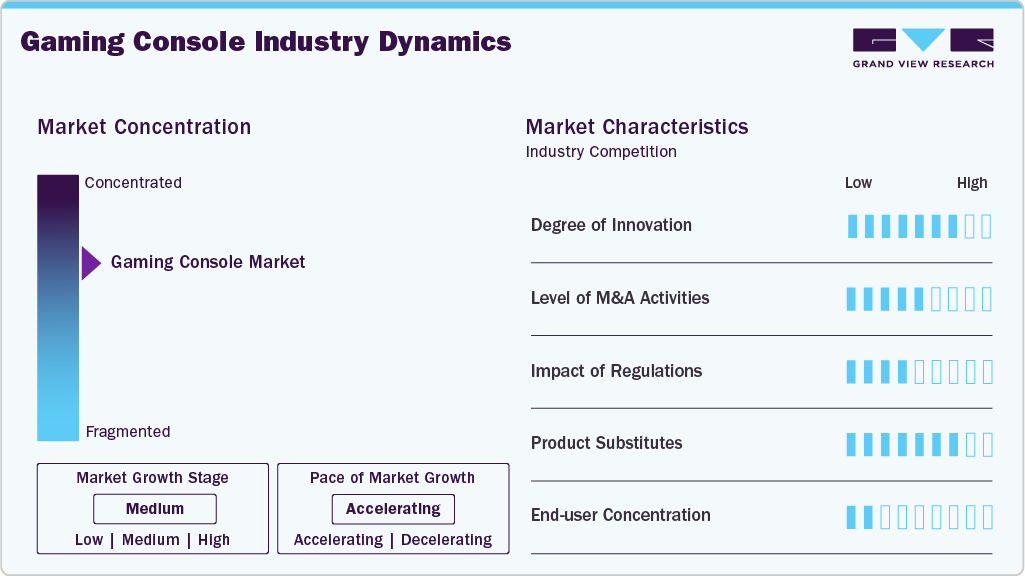 To learn more about this report, Download Free Sample Report
 The market is characterized by a very high level of innovation, supported by developments in next-generation hardware architecture, real-time rendering technologies, virtual reality compatibility, and cloud-enabled gaming experiences. The industry is witnessing moderate merger and acquisition activity as platform providers acquire game studios, technology developers, and digital content assets to enhance ecosystem competitiveness. Competition from gaming PCs, mobile gaming platforms, cloud gaming services, and other interactive entertainment options remains high, prompting console manufacturers to continuously improve performance and user experiences. Growing investments in cross-platform gaming, digital content ecosystems, subscription services, and connected entertainment environments are expected to further strengthen market development over the coming years.
Analyst Perspective
The gaming console market is benefiting from increasing demand for immersive gaming experiences, digital game distribution, and subscription-based services. Continuous advancements in hardware performance and online connectivity are strengthening consumer engagement worldwide. The leading platforms combine powerful hardware, exclusive content, cloud gaming capabilities, and integrated digital ecosystems. Strong platform loyalty and recurring subscription revenues remain key competitive differentiators. Future success will depend on ecosystem expansion, cross-platform accessibility, and continuous content innovation. Companies that deliver seamless gaming experiences across devices are expected to maintain a competitive advantage in the gaming console market.
Product Insights
Based on product, the PlayStation segment led the market with the largest revenue share of 25.6% in 2025 and is expected to grow at the highest CAGR over the forecast period, owing to its continuous hardware evolution across console generations, offering significant improvements in processing power, graphics capabilities, and overall user experience. This technological advancement has enabled more immersive and engaging gameplay, attracting a large and loyal consumer base. The segment’s dominance is further strengthened by a strong portfolio of exclusive titles developed by first-party studios with blockbuster franchises such as The Last of Us, God of War, and Horizon Zero Dawn driving consistent demand and brand loyalty within the global gaming community.
The Nintendo's product segment is expected to witness a significant CAGR of over 8% from 2025 to 2033. This growth is attributed to the company's ability to innovate and create unique gaming experiences. Nintendo has a reputation for developing consoles and games that are both accessible and fun, with a focus on innovation and creativity. Nintendo has also successfully built a strong lineup of exclusive game titles, leading to a high demand for its consoles. The company's first-party studios, including Nintendo EAD and Retro Studios, have produced some of the most popular and critically acclaimed games of recent years, including titles such as Super Mario and The Legend of Zelda.
Application Insights
Based on application, the gaming segment led the market with the largest revenue share of 60.8% in 2025, owing to the growing integration of diverse applications beyond traditional gaming within consoles. Console manufacturers and game developers are increasingly leveraging apps to offer innovative user experiences, ranging from fitness and media streaming services to social media connectivity. This trend reflects a broader shift toward multifunctional entertainment systems, where mobile companion apps enhance interactivity and extend gameplay beyond the console. The rising demand for cross-platform engagement and value-added services is propelling growth in this segment as console ecosystems evolve into comprehensive digital hubs.
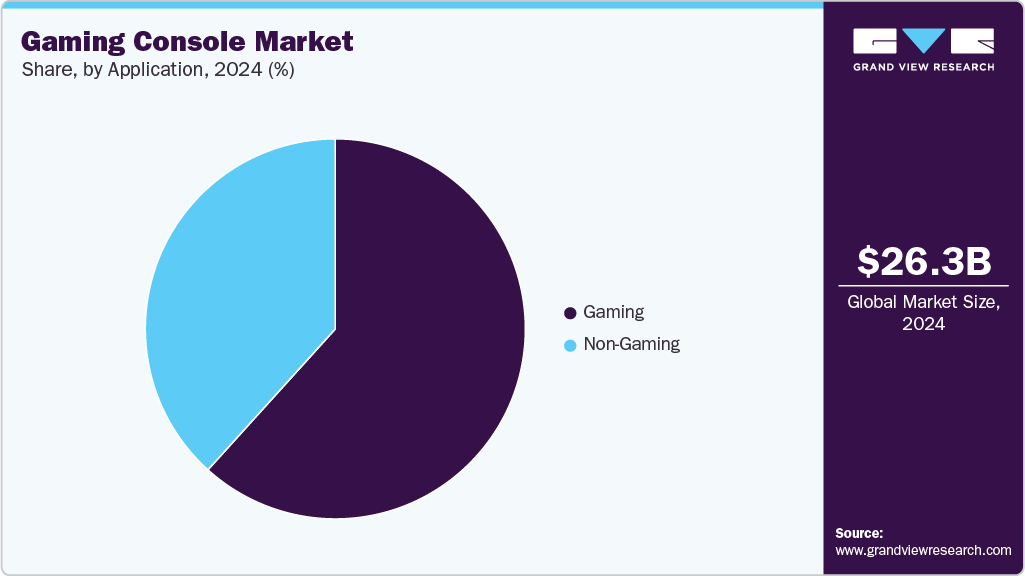 To learn more about this report, Download Free Sample Report
 The non-gaming segment is expected to witness the highest CAGR from 2025 to 2033. This growth is driven by the increasing demand for multifunctional entertainment experiences beyond traditional gameplay. Gaming consoles are evolving into all-in-one media hubs, offering access to streaming services, fitness applications, web browsing, and social networking platforms. The rise of smart TVs and the integration of cloud-based services have fueled user expectations for broader console capabilities. Advancements in app ecosystems and voice-controlled interfaces are enhancing user convenience. This diversification of console utility is encouraging both consumers and manufacturers to prioritize non-gaming functionalities, leading to sustained growth in this segment.
Distribution Channel Insights
Based on distribution channel, the offline segment held the largest market share in 2025, driven by the continued consumer preference for physical game ownership, bundled console packages, and in-store promotional offers. Many users value the tangible aspect of physical discs and the ability to trade, resell, or collect game titles. Offline retail channels also provide hands-on experiences, immediate product access, and personalized customer service, which contribute to higher purchase confidence, especially among casual or first-time gamers. In regions with limited or inconsistent internet connection, offline channels remain a crucial point of access for console hardware and software, supporting their sustained growth over the forecast period.
The online distribution channel segment expected to witness the highest CAGR from 2025 to 2033, owing to the rapid growth of digital distribution platforms, increasing internet penetration, and the widespread adoption of high-speed broadband and 5G networks. Gamers are increasingly favoring the convenience of downloading or streaming games directly to their consoles, eliminating the need for physical media. Subscription-based services, cloud gaming platforms, and frequent digital-only game releases are further fueling the shift toward online channels. The growing popularity of multiplayer and live-service games, which require constant online connectivity and regular content updates, supporting their sustained growth over the forecast period.
Type Insights
Based on type, the handheld game console segment accounted for the largest revenue share in 2025, driven by the rising popularity of mobile and on-the-go gaming experiences. The widespread adoption of smartphones and tablets, consumers have become more inclined toward portable gaming, creating strong demand for dedicated handheld consoles that offer superior performance, tactile controls, and enhanced battery life. These devices are specifically engineered for immersive gameplay, offering an edge over general-purpose mobile devices. The growing need for convenient, travel-friendly gaming solutions particularly among commuters is fueling this segment’s growth and continues to dominate the gaming console industry.
The hybrid game console segment is expected to witness the highest CAGR from 2025 to 2033. This growth is driven by the increasing demand for portable yet powerful gaming experiences that combine the benefits of both home consoles and handheld devices. Hybrid consoles provide flexibility for gamers to switch seamlessly between on-the-go and traditional TV-connected gameplay. Technological advancements in graphics processing, battery life, and display quality are enhancing the performance of these devices. The rising popularity of mobile gaming and consumer preference for versatile entertainment solutions are further boosting adoption. Leading players continue to innovate in this space, setting benchmarks for hybrid gaming experiences that cater to diverse user needs.
Component Insights
The console unit segment accounted for the largest market share in 2024, driven by the rise of esports and a growing number of developers producing high-quality, performance-intensive games. Gamers are increasingly demanding consoles with superior graphics, processing power, and overall performance, prompting manufacturers to launch more advanced models. Emerging markets such are witnessing a surge in console adoption due to a growing middle-class population with increased disposable income. Many consumers turn to gaming as a primary form of at-home entertainment, significantly boosting console unit sales and driving the market growth.
The controller segment is expected to witness the highest CAGR from 2025 to 2033, driven by the increasing technological advancements and demand for more immersive gaming experiences. The controller, such as gamepads, joysticks, and steering wheels, controls and interacts with games on consoles. These controllers play a critical role in providing a seamless and enjoyable gaming experience for users, and as a result, they have become a key component of the market. The growth is attributed to the increasing demand for more advanced and feature-rich controllers. Modern controllers come with various features, such as motion sensors, touchpads, and haptic feedback, which enhance the gaming experience and provide greater immersion for players. As game developers continue producing more sophisticated games, the demand for controllers supporting these games has also increased.
Regional Insights
The North America gaming console market accounted for a significant market share of over 24% in 2024, driven by the region’s high concentration of major gaming companies, strong consumer purchasing power, and early adoption of next-generation gaming technologies. The growing popularity of esports tournaments, increasing demand for immersive gaming experiences, and widespread availability of high-speed internet have fueled console gaming industry in the region. The presence of a large and engaged gaming community, coupled with the success of exclusive game titles and subscription-based gaming services, continues to drive console sales and user engagement across North America.
U.S. Gaming Console Market Trends
The U.S. gaming console market accounted for the largest market share of over 63% in 2024, driven by the country's robust gaming ecosystem and strong presence of major console manufacturers and game developers. The widespread availability of high-speed internet and early adoption of emerging technologies such as virtual reality (VR), augmented reality (AR), and cloud gaming are further accelerating growth. The U.S. market also benefits from strong retail infrastructure and high demand for next-generation consoles with enhanced graphics and performance capabilities.
Europe Gaming Console Market Trends
The Europe gaming console market is expected to grow at a significant CAGR of over 8% from 2025 to 2033. In Europe, the market is driven by a strong gaming culture, increasing popularity of esports tournaments, and growing adoption of next-generation consoles featuring. The rise of digital gaming and high-speed internet penetration across countries are supporting the shift toward online multiplayer and cloud gaming experiences. Favorable government policies and tax incentives aimed at supporting the gaming industry, coupled with a thriving community of independent game developers, are further fueling demand for gaming console industry.
The UK gaming console market is expected to grow at a significant rate in the coming years. The country benefits from a well-established gaming console industry, a strong network of game developers, and consistent government support through tax relief programs such as the Video Games Tax Relief (VGTR). High consumer spending on entertainment, combined with early adoption of cutting-edge technologies such as 5G and cloud gaming, is driving console sales. Increased investment in interactive media, digital infrastructure, and gaming-focused education programs is fostering innovation and accelerating the market's expansion in the UK
The Germany gaming console market is fueled by the country’s robust gaming culture, high penetration of broadband internet, and strong consumer appetite. Germany's well-established eSports ecosystem promotes the gaming industry as part of the digital economy is fostering rapid market growth. The increasing popularity of cross-platform gaming, localized game content, and console-based multiplayer titles is driving console adoption among German youth and families. The expansion of digital distribution channels and rising demand for immersive gaming experiences, including VR and AR integration, are encouraging both local and international console manufacturers to strengthen their presence in the German market.
Asia Pacific Gaming Console Market Trends
Asia Pacific dominated the gaming console market with the largest revenue share of 46.5% in 2025, driven by the region’s rapidly expanding gaming population, increasing disposable incomes, and strong presence of local game developers. The widespread availability of affordable broadband and mobile internet services is enhancing access to online gaming content. The cultural popularity of competitive gaming and character-based franchises, along with strategic partnerships between console makers and regional content creators, are further propelling demand. Government support for the digital economy and the emergence of tech-savvy youth is also contributing to the region’s dynamic growth in the gaming console industry.
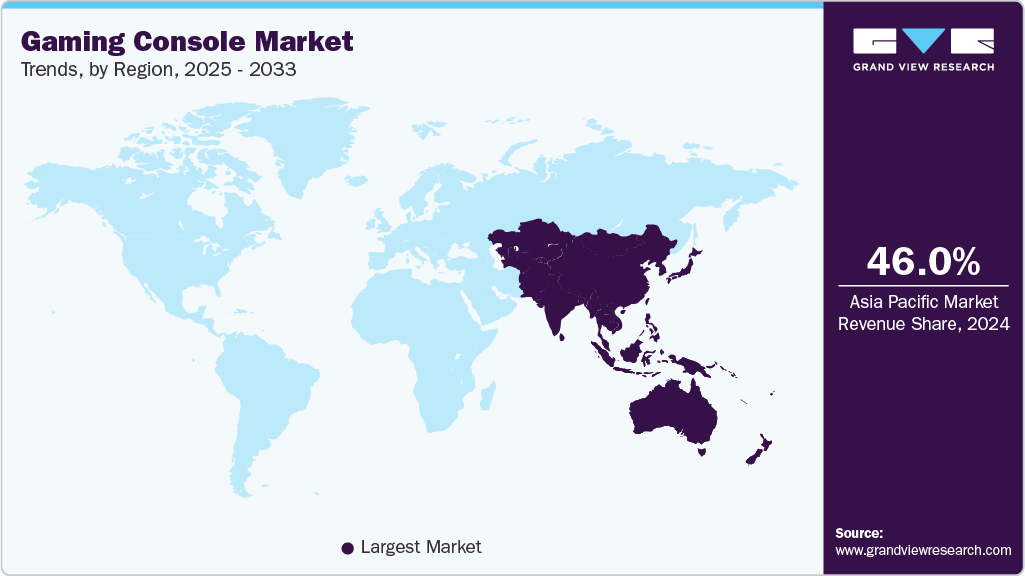 To learn more about this report, Download Free Sample Report
 The Japan gaming console market is gaining traction, driven by the country’s long-standing gaming heritage, cutting-edge technology ecosystem, and a highly engaged consumer base. Japan is home to some of the world’s leading gaming console manufacturers and game developers. The strong domestic demand for immersive and story-rich gaming experiences, coupled with a cultural affinity for both console and handheld gaming, fuels market growth. Japan’s rising adoption of cloud gaming and digital distribution platforms are further accelerating the expansion of the gaming console market in the country.
The gaming console market in China held the largest share in the Asia Pacific region in 2025. The China gaming console market is rapidly expanding. China's strong focus on technological innovation and advancements in hardware capabilities is driving the demand for high-performance gaming consoles. The lifting of the console ban in recent years has opened up the market, encouraging global and domestic brands to introduce advanced consoles tailored for Chinese consumers. The rising popularity of online multiplayer games and esports, combined with the country’s robust internet infrastructure and growing middle-class population, is significantly boosting console adoption.
Key Gaming Console Company Insights
Some of the key players operating in the market include Sony Corporation and Microsoft among others
-
Sony Corporation is a global leader in the gaming console market, best known for its PlayStation series. The PlayStation 5 (PS5) has set new standards in gaming performance with ultra-fast SSD storage, ray tracing, and adaptive triggers. Sony’s strong portfolio of exclusive titles and its PlayStation Network ecosystem, which includes PlayStation Plus and cloud gaming services, enhance user engagement and drive recurring revenue. With a loyal global user base and continued hardware innovation, Sony remains a dominant force in the gaming console industry.
-
Microsoft is a top-tier gaming console manufacturer, recognized for its Xbox Series X and Series S platforms. Through its Xbox Game Pass subscription service, cloud gaming via Xbox Cloud Gaming (xCloud), and aggressive content acquisitions like Bethesda and Activision Blizzard, Microsoft is reshaping the future of console gaming. Its emphasis on backward compatibility, cross-platform play, and integration with Windows PCs ensures a seamless gaming experience, reinforcing its leadership position in the global console ecosystem.
ASUSTeK Computer Inc. and Logitech are some of the emerging market participants in the gaming console market.
-
ASUSTeK Computer Inc. is an emerging player in the gaming console space, gaining traction with its handheld gaming device, the ROG Ally. Designed to cater to PC and console gamers alike, the ROG Ally offers high-end AMD processors, a full Windows OS, and compatibility with multiple game launchers, including Steam and Xbox Game Pass. ASUS leverages its strong reputation in gaming hardware to deliver a portable yet powerful experience, aligning with the rising demand for hybrid gaming solutions.
-
Logitech is gradually entering the gaming console segment with its cloud-focused handheld device, the Logitech G Cloud. Tailored for cloud gaming services like Xbox Cloud Gaming and NVIDIA GeForce NOW, the G Cloud emphasizes portability, long battery life, and access to titles without local hardware constraints. Focusing on the growing cloud-based gaming segment, Logitech is positioning itself as a next-gen gaming device provider aimed at casual and mobile-first gamers.
Key Gaming Console Companies
The following key companies have been profiled for this study on the gaming console market.
-
Sony Corporation
-
Microsoft
-
Nintendo
-
ASUSTeK Computer Inc.
-
NVIDIA Corporation
-
Atari, Inc.
-
Tencent.
-
SEGA.
-
Logitech.
-
Mad Catz Global Limited.
Competitive Benchmarking
Category
Operating Strategies
Competitive Edge
Weakness
Established Players (Sony Corporation, Microsoft, Nintendo)
- Focus on expanding integrated gaming ecosystems through hardware, software, and subscription services.
- Invest heavily in R&D to deliver advanced consoles and immersive gaming experiences.
- Strong global brand presence, loyal user base, and extensive gaming portfolios.
- Ability to provide exclusive content, online services, and scalable gaming platforms.
- Dependence on established platform ecosystems may limit strategic flexibility.
- High development costs can reduce responsiveness to rapidly changing gaming trends.
Emerging Players (ASUSTeK Computer Inc., Logitech)
- Focus on developing innovative gaming hardware with differentiated gameplay experiences.
- Establish partnerships with content developers to expand exclusive gaming ecosystems.
- Greater flexibility enables rapid adoption of emerging gaming technologies.
- Ability to target niche gamer segments with specialized product offerings.
- Limited brand recognition compared to established global console manufacturers.
- Smaller financial resources constrain large-scale platform development investments.
Recent Developments
-
In June 2025, Microsoft announced a strategic multi-year partnership with AMD to co-engineer custom silicon for its next-generation Xbox consoles. The new platform will support a broader ecosystem by offering an Xbox experience that is not locked to a single store or limited to one device. Designed to work seamlessly across living room consoles, handheld devices, and the cloud, this initiative reflects Microsoft’s vision of a unified, device-agnostic gaming platform. The company is also collaborating closely with the Windows team to position Windows as the leading platform for gaming, further reinforcing its commitment to cross-device gameplay and accessibility in the gaming console market.
-
In June 2025, Microsoft and ASUS announced the launch of the ROG Xbox Ally and ROG Xbox Ally X, two new handheld gaming consoles developed in collaboration to bring the power of Xbox to portable devices. Designed to support Xbox Play Anywhere, Game Pass, Xbox Cloud Gaming (Beta), and Remote Play, these handhelds allow gamers to enjoy high-performance console experiences on the go. Set to launch during the holiday season in select markets, the ROG Xbox Ally series combines ASUS’s hardware innovation with Microsoft’s expansive gaming ecosystem, marking a significant step forward in the gaming console industry.
-
In June 2025, Nintendo launched the Nintendo Switch 2. The new console features enhanced hardware performance and a broader content library. The launch of Nintendo rolled out a firmware update, introducing system stability improvements and expanding the Nintendo Classics catalog with legacy GameCube titles. This release reinforces Nintendo’s commitment to innovation and backward compatibility in the evolving gaming console market.
Gaming Console Market Report Scope
Report Attribute
Details
Market size value in 2025
USD 28.3 billion
Estimated market size in 2026
USD 30.3 billion
Projected market size by 2033
USD 47.6 billion
Growth rate
CAGR of 6.6% from 2026 to 2033
Base year for estimation
2025
Historical data
2021 - 2024
Forecast period
2026 - 2033
Quantitative units
Revenue in USD million/billion, volume in million units, and CAGR from 2025 to 2033
Report coverage
Revenue forecast, company ranking, competitive landscape, growth factors, and trends
Segments covered
Product, application, distribution channel, type, component, and region
Regional scope
North America; Europe; Asia Pacific; Latin America; MEA
Country scope
U.S.; Canada; Germany; U.K.; France; Italy; Spain; China; Japan; India; South Korea; Brazil; Mexico; Saudi Arabia; South Africa; UAE
Key companies profiled
Sony Corporation; Microsoft; Nintendo; ASUSTeK Computer Inc.; NVIDIA Corporation; Atari, Inc.; Tencent.; SEGA.; Logitech.; Mad Catz Global Limited.
Customization scope
Free report customization (equivalent up to 8 analysts' working days) with purchase. Addition or alteration to country, regional & segment scope.
Pricing and purchase options
Avail customized purchase options to meet your exact research needs. Explore purchase options
Global Gaming Console Market Report Segmentation
This report forecasts revenue growth at global, regional, and country levels and provides an analysis of the latest technological trends in each of the sub-segments from 2021 to 2033. For this study, Grand View Research has segmented the gaming console market report based on product, application, distribution channel, type, component, and region:
-
Product Outlook (Volume, Million Units; Revenue, USD Million, 2021 - 2033)
-
Nintendo
-
PlayStation
-
Xbox
-
Others
-
-
Application Outlook (Volume, Million Units; Revenue, USD Million, 2021 - 2033)
-
Gaming
-
Non-gaming
-
-
Distribution Channel Outlook (Volume, Million Units; Revenue, USD Million, 2021 - 2033)
-
Online Distribution Channel
-
Offline Distribution Channel
-
-
Type Outlook (Volume, Million Units; Revenue, USD Million, 2021 - 2033)
-
Home Video Game Console
-
Handheld Game Console
-
Portable
-
Non-Portable
-
-
Hybrid Video Game Console
-
Plug and Play/Retro Console
-
-
Component Outlook (Volume, Million Units; Revenue, USD Million, 2021 - 2033)
-
Console Unit
-
Controller
-
Paddle
-
Joystick
-
Gamepad
-
-
Game Media
-
Game Cartridge
-
Optical Media
-
Digital Distribution
-
Cloud Gaming
-
-
External Storage
-
-
Regional Outlook (Volume, Million Units; Revenue, USD Million, 2021 - 2033)
-
North America
-
U.S.
-
Canada
-
-
Europe
-
UK
-
Germany
-
France
-
Italy
-
Spain
-
-
Asia Pacific
-
China
-
Japan
-
India
-
South Korea
-
-
Latin America
-
Brazil
-
Mexico
-
-
Middle East & Africa
-
Saudi Arabia
-
UAE
-
South Africa
-
-
Research Methodology
The gaming console market figures in this report are based on a proven research process that combines executive interviews with secondary research from proprietary databases, company filings, and recognized regulatory and institutional sources. Market size is built through value-chain sizing - reconciling supply-side and demand-side estimates - and triangulated with bottom-up and top-down approaches. Every estimate passes multiple levels of expert validation before publication, with each gaming console segment quantified using the revenue-capture definitions in the table below.
Segment Definition
Segment - Product
Revenue capture definition
Nintendo
Revenue is generated through sales of Nintendo gaming consoles, first-party game titles, digital downloads, subscription services, accessories, and licensed gaming content. This segment benefits from strong demand for family-oriented gaming experiences, exclusive intellectual properties, and hybrid console offerings that appeal to a broad consumer base.
PlayStation
Revenue is generated through PlayStation console sales, digital game purchases, subscription memberships, downloadable content, cloud gaming services, and gaming accessories. The segment represents a major revenue contributor due to its extensive game ecosystem, strong developer support, and large global user community.
Xbox
Revenue is generated through Xbox console sales, digital content transactions, subscription-based gaming services, cloud gaming access, and accessory purchases. Growth is supported by expanding digital ecosystems, recurring subscription revenues, and integration of cloud-enabled gaming experiences.
Others
Revenue is captured through sales of niche gaming consoles, retro gaming devices, handheld gaming systems, accessories, and related software content. Additional monetization comes from specialized gaming experiences targeting specific consumer segments and regional markets.
Segment - Application
Revenue capture definition
Gaming
Revenue is generated through console hardware sales, game purchases, downloadable content, online multiplayer subscriptions, esports participation, and digital gaming services. This segment accounts for the largest share as consumers increasingly invest in immersive gaming experiences and interactive entertainment ecosystems.
Non-gaming
Revenue is captured through video streaming applications, multimedia playback, internet browsing, social entertainment services, and other digital content accessed through gaming consoles. Additional monetization comes from subscription-based entertainment services and connected home entertainment functionality.
Segment - Distribution Channel
Revenue capture definition
Online
Revenue is generated through direct-to-consumer e-commerce platforms, digital storefronts, online marketplaces, and official brand websites. This channel benefits from growing consumer preference for digital purchasing, instant content access, and convenient home delivery services.
Offline
Revenue is captured through electronics retailers, gaming specialty stores, department stores, and authorized distribution networks. Additional sales are supported by in-store product demonstrations, promotional campaigns, and consumer preference for physical retail purchasing experiences.
Segment - Type
Revenue capture definition
Home Video Game Console
Revenue is generated from the sale of dedicated gaming systems designed for television-based gameplay, along with associated software, digital content, accessories, and subscription services. This segment represents a significant revenue contributor due to strong demand for high-performance gaming experiences, online multiplayer functionality, and exclusive game titles.
Handheld Game Console
Revenue is generated from the sale of portable gaming devices, digital game downloads, accessories, and subscription-based gaming services. Growth is supported by increasing consumer preference for mobile entertainment and gaming experiences that can be accessed while traveling or away from home.
Hybrid Video Game Console
Revenue is generated through sales of gaming systems that support both handheld and television-connected gameplay, alongside digital content purchases and accessories. The segment benefits from growing demand for flexible gaming experiences that combine portability with traditional home gaming capabilities.
Plug and Play/Retro Console
Revenue is captured through sales of compact gaming devices featuring pre-installed classic games, retro gaming collections, and nostalgia-driven entertainment experiences. Additional monetization comes from limited-edition releases and collector-focused gaming products.
Segment - Component
Revenue capture definition
Console Unit
Revenue is generated through sales of core gaming hardware, including processors, storage systems, graphics components, and integrated operating platforms. This segment accounts for a substantial share of market revenue as it forms the foundation of the gaming ecosystem.
Controller
Revenue is generated through sales of wired and wireless gaming controllers, premium input devices, specialized gaming peripherals, and replacement accessories. Demand is supported by multiplayer gaming, esports participation, and continuous innovation in controller technologies.
Game Media
Revenue is generated through physical game discs, cartridges, digital game downloads, expansion packs, downloadable content, and premium game editions. The segment remains a key revenue source as consumers continue to invest in new gaming content and digital entertainment experiences.
External Storage
Revenue is captured through sales of memory cards, solid-state drives (SSDs), external hard drives, and storage expansion accessories designed for gaming consoles. Additional demand is driven by increasing game file sizes, digital content libraries, and cloud-synchronized gaming ecosystems.
Estimation Model
Layer Name
Key Question
Description
Addressable Consumer Layer
Who are the potential gaming console users?
Identify the total addressable gaming audience by estimating the population with access to digital entertainment, including internet users, smartphone users, PC gamers, esports enthusiasts, and households with entertainment devices across target regions. This establishes the potential consumer base for gaming console adoption.
Accessibility Layer
Who can access gaming console ecosystems?
Filter the potential audience based on access to gaming infrastructure, including broadband connectivity, digital payment systems, retail distribution networks, online gaming services, and compatible display devices such as televisions and monitors. This determines the realistically reachable console gaming market.
Adoption Layer
Who actively purchases and uses gaming consoles?
Apply gaming console adoption rates to the reachable audience and segment consumers into home console users, handheld console users, hybrid console users, casual gamers, and core gaming enthusiasts. This converts the reachable consumer base into active gaming console users and platform participants.
Revenue Layer
How much revenue is generated?
Estimate revenue from console hardware sales, digital and physical game purchases, downloadable content (DLC), subscription memberships, cloud gaming services, accessories, controllers, and in-platform transactions. Multiply active users by average annual spending to derive total gaming console market revenue.
Delivered Customizations
This report has been delivered with the following In-depth customizations
Client Request
Customization Delivered
Value Adds
Streaming-console and console ownership trends, including generation replacement cycles, and hardware lifecycle forecasts.
Analyzed global console installed base, buyer cohorts (early adopters, mid-market, budget buyers), replacement timing, and cross‑generation compatibility impacts on upgrade demand. Produced region‑segmented forecasts and sensitivity scenarios for component shortages and price promotions.
Identifies high-growth buyer segments and timing for hardware refresh programs; helps OEMs and retailers optimize inventory planning, targeted promotions, and pre‑order strategies to smooth revenue and manage supply constraints.
Gameplay consumption patterns and play‑time on connected devices.
Measured playtime distribution, peak concurrent usage, session length, and device mix. Evaluated cloud-streaming adoption on consoles vs cloud-only devices, and impact of subscription bundling on platform engagement.
Guides platform owners on where to invest (cloud vs local compute), how to structure time‑based or usage‑tiered subscriptions, and which device integrations (mobile second‑screen, companion apps) yield highest retention.
Distribution, retail channel shifts, and e‑commerce dynamics including hardware bundling and trade‑in programs.
Evaluated retail vs direct‑to‑consumer sales, impact of digital storefront growth on physical retail, effectiveness of bundles and trade‑ins for upsell, and regional logistics constraints. Provided channel mix optimization by region and customer cohort.
Supports go‑to‑market planning for launches, bundle pricing, and trade‑in incentives; helps distributors and retailers align promotions to maximize attach rates and margin recovery.
Frequently Asked Questions About This Report
The global gaming console market size was estimated at USD 28.3 billion in 2025 and is expected to reach USD 30.3 billion in 2026.
Growing penetration of internet services across the globe, coupled with easy availability and access to games on the Internet, is also expected to keep growth prospects upbeat over the coming years.
Key market participants include Sony Corporation, Microsoft, Nintendo, ASUSTeK Computer Inc., NVIDIA Corporation, Atari, Inc., Tencent., SEGA., Logitech., Mad Catz Global Limited. among others.
The gaming segment led with a 60.8% revenue share in 2025, while Non-Gaming is the fastest-growing segment.
The MEA is the fastest-growing region over the forecast period.
The Asia Pacific gaming console market dominated with a share of 46.5% in 2025.
The offline segment led with an 50.9% revenue share in 2025.
The global gaming console market is expected to grow at a compound annual growth rate of 6.6% from 2026 to 2033 to reach USD 47.6 billion by 2033.
The PlayStation segment led with an 25.6% revenue share in 2025 and is the fastest-growing segment.
About the Author(s)
Next Generation Technologies Research Team
Technology · Next Generation TechnologiesThis report was authored by the next generation technologies research team at Grand View Research - comprising two research analysts, one senior research analyst, and one industry expert - with specialized expertise in the next generation technologies segment of the technology industry. All findings are based on proprietary technology databases, executive interviews, and regulatory analysis, subject to internal peer review prior to publication.
Last Updated:
Speak to Analyst

Customize this report to your needs - add regions, segments, or data points, with 20% free customization.
Or view our licence options:


ISO 9001:2015 & 27001:2022 Certified
We are GDPR and CCPA compliant! Your transaction & personal information is safe and secure. For more details, please read our privacy policy.


