
- Home
- »
- Medical Devices
- »
-
Hearing Aids 3D Printing Device Market Size Report, 2033GVR Report cover
![Hearing Aids 3D Printing Device Market Size, Share & Trends Report]()
Hearing Aids 3D Printing Device Market (2025 - 2033) Size, Share & Trends Analysis Report By Technology (Stereolithography, Deposition Modeling), By Material (Polymers, Metals & Alloys), By Product Type, By Region, And Segment Forecasts
Hearing Aids 3D Printing Device Market Summary
The global hearing aids 3D printing device market size was estimated at USD 488.7 million in 2024 and is projected to reach USD 942.2 million by 2033, growing at a CAGR of 7.59% from 2025 to 2033. This growth is attributed to the rising prevalence of hearing loss worldwide, increasing adoption of personalized and custom-fit hearing devices, and rapid technological advancements in additive manufacturing.
Key Market Trends & Insights
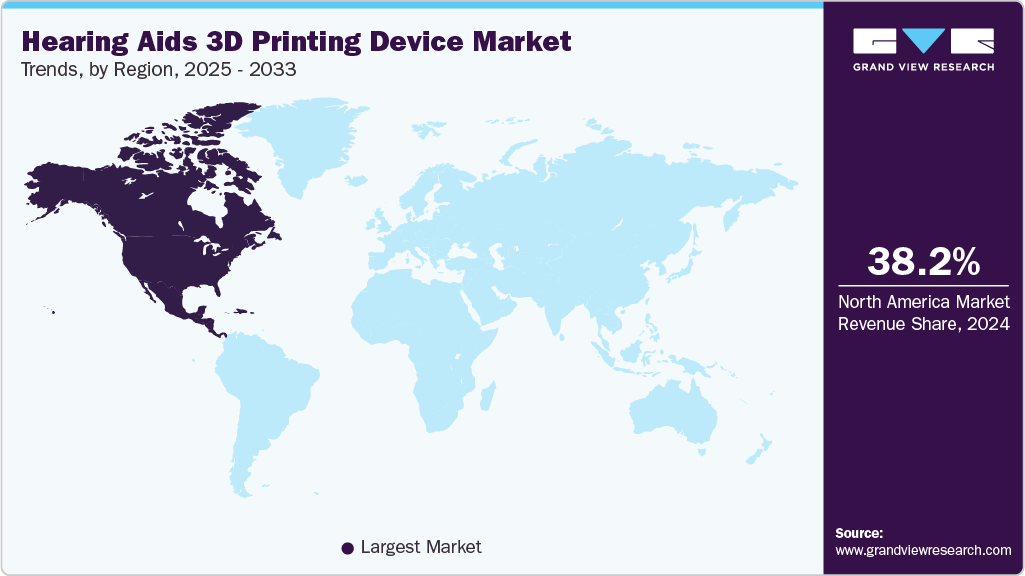
- North America dominated the hearing aids 3D printing device market with the largest revenue share of 38.17% in 2024.
- The U.S. hearing aids 3D printing device industry led North America, with the largest revenue share of 78.14% in 2024.
- By technology, the stereolithography segment led the market with the largest revenue share in 2024.
- By material, the polymers segment led the market with the largest revenue share in 2024.
- By product type, the hearing aid devices segment led the market with the largest revenue share in 2024.
Market Size & Forecast
- 2024 Market Size: USD 488.7 Million
- 2033 Projected Market Size: USD 942.2 Million
- CAGR (2025-2033): 7.59%
- North America: Largest market in 2024
The growing geriatric population and rising incidence of age-related and noise-induced hearing loss fuel the demand for hearing aids with enhanced comfort and precision. Moreover, integrating 3D ear scanning, CAD modeling, and advanced photopolymer printing technologies has enabled faster, cost-effective, and highly accurate production of hearing aid shells and earmolds. According to the WHO, by 2050, nearly 2.5 billion people are projected to have some degree of hearing loss, and more than 700 million are expected to require hearing rehabilitation.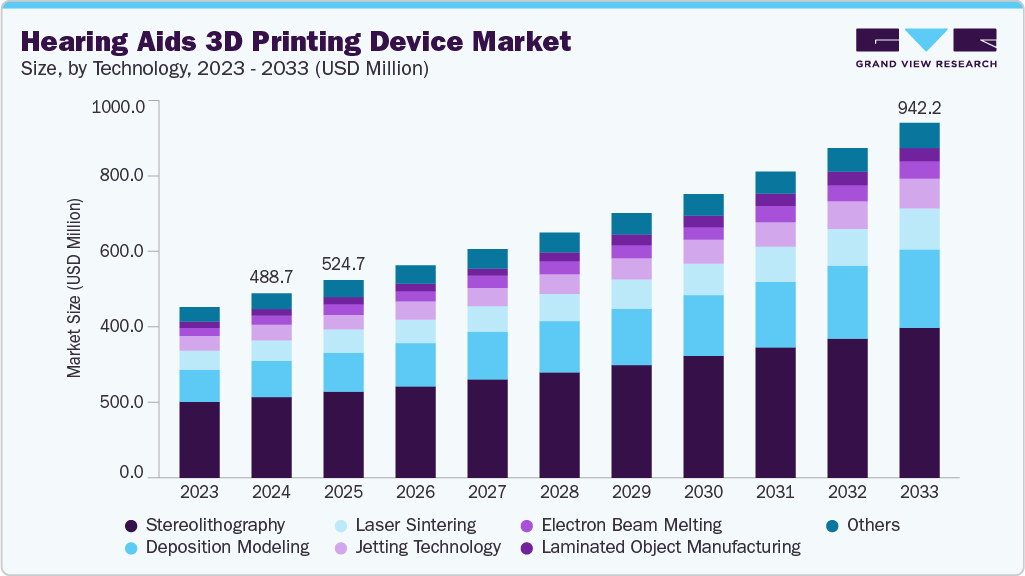
Growing government initiatives to improve access to hearing care and assistive technologies are significantly propelling the growth of the 3D printing device market for hearing aids. Governments worldwide are prioritizing hearing health as part of universal healthcare and disability inclusion policies, which has led to increased funding, public procurement programs, and strategic partnerships to enhance hearing aid accessibility. Initiatives such as the WHO guidance for hearing care in low- and middle-income countries, the UNICEF Assistive Products Catalogue expansion, and ATscale’s global assistive technology partnership have created a favorable environment for large-scale, cost-effective production of hearing devices. These programs encourage manufacturers to adopt 3D printing technologies to meet growing demand for affordable, custom-fit, high-quality hearing aids.
Initiative
Region/Country
Year & Month
Description
Relevance to 3D Printing Hearing Aid Devices
Rwanda / UNICEF Hearing Screening & Aid Program
Rwanda
Nov-24
Government partnership with UNICEF to establish a national program for hearing screening and distribution of affordable hearing aids for children.
Demonstrates how public procurement of hearing aids drives high-volume production, where 3D printing offers flexibility and cost advantages.
Ireland - Digital Assistive Technology Program (with WHO)
Ireland
Jun-24
The Irish government announced USD14.60 million funding to enhance equitable access to assistive technologies, including hearing aids, through digital systems, training, and improved supply chains.
Encourages large-scale, affordable hearing aid manufacturing; creates opportunities for producers to adopt 3D printing for cost-effective customization.
WHO Guidance on Hearing Care in Low- & Middle-Income Settings
Global / LMICs
Mar-24
WHO released new technical guidelines to strengthen hearing aid access and service delivery in low- and middle-income countries, focusing on affordability and quality.
Expands hearing care infrastructure, indirectly stimulating demand for mass-customized 3D-printed hearing aids to serve underserved populations.
Source: WHO, UNICEF, GVR Analysis
"Appropriate, quality assistive technology can change lives. A pair of eyeglasses can make the difference between a child thriving or failing at school. A wheelchair can determine whether someone can travel to work or not. A hearing aid can support an older person to remain active and engaged with their families and communities. As the global population ages, the number of people who need assistive products is expected to grow to over 3.5 billion by 2050. This agreement represents a valuable contribution from Ireland enabling WHO to take action - in particular in exploring the potential of digital health as a tool to streamline and enhance access."- Dr Tedros Ghebreyesus, WHO Director-General.
Technological innovations in 3D printing hardware, software, and materials are major catalysts fueling the growth of the hearing aid 3D printing device market. Integrating digital ear scanning, CAD/CAM modeling, and additive manufacturing enables manufacturers to produce highly accurate, custom-fit hearing aid shells and earmolds, significantly improving patient comfort and acoustic performance. Advancements in stereolithography and digital light processing printers allow the fabrication of small, intricate components with ultra-fine resolution and repeatable precision, essential for the complex geometries of in-ear devices. Meanwhile, developing biocompatible, hypoallergenic, and flexible photopolymers has expanded material options for durable, safe, and comfortable hearing aids. Software innovations streamline the workflow from 3D scanning to shell printing, reducing manual labor, minimizing errors, and accelerating production cycles.
Market Concentration & Characteristics
The hearing aids 3D printing device market is in a significant stage, characterized by rapid adoption of additive manufacturing technologies, increasing demand for personalized and custom-fit hearing solutions, and continuous technological innovation in 3D printing hardware, materials, and software.
The degree of innovation in the hearing aids 3D printing device industry is a critical driver of growth and differentiation. Manufacturers continuously develop new 3D printing technologies, such as high-resolution SLA and DLP printers, multi-material printing capabilities, and hybrid shell production methods, to produce highly accurate, comfortable, and durable hearing aid components. Innovations in biocompatible photopolymers, flexible resins, and embedded electronics have expanded the range of product functionalities, enabling features such as enhanced acoustic performance, lightweight designs, and customizable aesthetics.
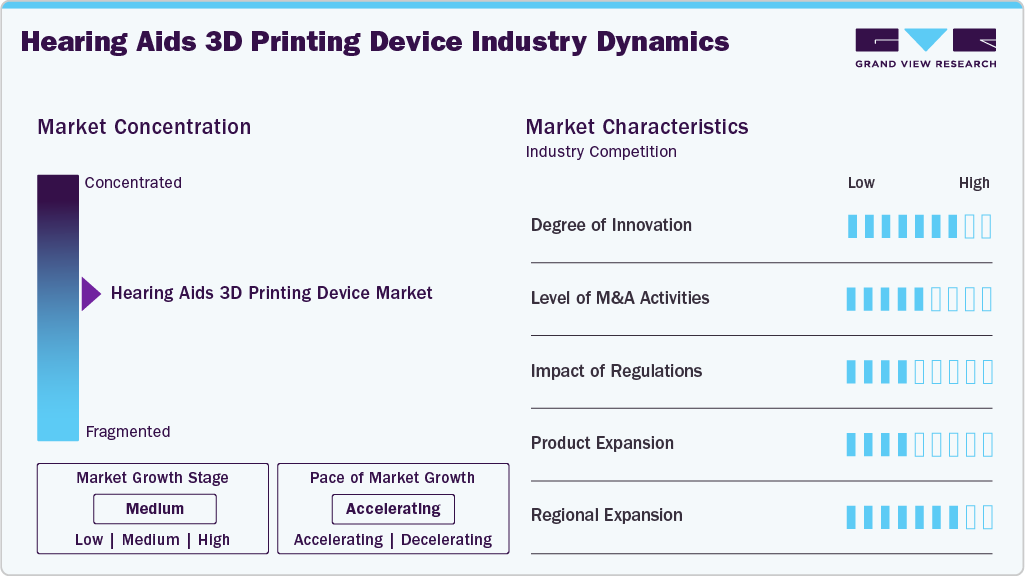
The level of mergers and acquisitions activities in the hearing aids 3D printing device market reflects industry consolidation and strategic growth. Leading hearing aid manufacturers have acquired or partnered with 3D printing technology companies and digital solution providers to strengthen their in-house additive manufacturing capabilities. These M&A activities facilitate access to advanced 3D printing equipment, proprietary materials, and software platforms while enhancing global distribution networks.
Regulatory frameworks significantly influence the growth and adoption of hearing aids produced via 3D printing. Governments and health authorities establish safety, quality, and biocompatibility standards for hearing devices, while providing guidelines for digital workflows and additive manufacturing processes. Compliance with such regulations ensures that 3D-printed hearing aids meet medical device certification standards and patient safety requirements. In addition, regulatory support, including subsidies, reimbursement policies, and national health programs, encourages manufacturers to adopt cost-effective 3D printing technologies for mass production.
Product expansion is a significant market growth strategy, as companies seek to diversify offerings and meet varying consumer needs. Hearing aid manufacturers are expanding their portfolios to include custom-fit in-ear devices, pediatric hearing aids, cochlear implants, and wearable assistive devices. 3D printing enables rapid design iterations, personalization, and integration of advanced features such as wireless connectivity, noise reduction, and ergonomic comfort. Continuous product innovation helps companies capture niche segments, strengthen brand loyalty, and respond to evolving patient demands.
Regional expansion drives growth by enabling manufacturers to tap into emerging markets with rising demand for hearing aids. Companies strategically establish production facilities, distribution centers, and partnerships in North America, Europe, Asia-Pacific, and Latin America to improve accessibility and reduce logistical costs. Expansion into countries with growing aging populations and rising prevalence of hearing loss, such as India, China, and Brazil, is particularly impactful.
Technology Insights
The stereolithography segment dominated the hearing aids 3D printing devices market in 2024, primarily due to its exceptional accuracy and ability to deliver highly customized products. This resin-based 3D printing method allows manufacturers to produce detailed, lightweight, and comfortable hearing aid shells perfectly shaped to an individual’s ear. The high-resolution output ensures that even the tiniest design features are precisely replicated, essential for comfort and fit. SLA also supports rapid prototyping, enabling quick design adjustments and faster production cycles. As a result, the use of SLA has significantly enhanced both the appearance and performance of hearing aids, catering to the increasing demand for personalized auditory devices.
The deposition modeling is expected to grow at the fastest CAGR over the forecast period, due to its cost-effectiveness and versatility. Unlike high-resolution methods like Stereolithography (SLA), FDM utilizes thermoplastic materials such as ABS and PLA, making it more accessible for mass production. This affordability allows for the widespread adoption of 3D printing in hearing aid manufacturing, particularly in regions with limited access to advanced technologies. FDM's adaptability to various materials and its scalability make it an attractive option for producing durable and functional hearing aid components.
Material Insights
The polymers segment dominated the hearing aids 3D printing device industry in 2024, due to their versatility, cost-effectiveness, and suitability for mass customization. Polymers such as nylon, photopolymers, and epoxy resins are widely utilized in additive manufacturing processes like stereolithography (SLA) and fused deposition modeling (FDM) to produce lightweight, durable, and comfortable hearing aid components. These materials enable the creation of personalized hearing aids tailored to individual ear anatomies, enhancing fit and performance. The growing demand for customized auditory solutions, coupled with advancements in 3D printing technologies, has led to increased adoption of polymer-based materials in hearing aid production, positioning the polymers segment as a key driver of market growth.
The metals and alloys segment is expected to grow at the fastest CAGR over the forecast period, due to the increasing demand for lightweight materials in transportation, the need for corrosion-resistant alloys in various industries, and the expansion of infrastructure projects globally. Additionally, innovations in alloy compositions and manufacturing processes are enhancing the performance and applicability of metal alloys, further fueling their adoption across diverse applications.
Product Type Insights
Hearing aid devices dominated the hearing aids 3D printing device market in 2024, due to the growing need for personalized and precise auditory solutions. Types like BTE, ITE, RIC, and CIC increasingly benefit from 3D printing, which allows each device to be custom-fit to a person’s unique ear shape. This technology enables rapid prototyping and the production of lightweight, comfortable, and visually appealing hearing aids, making them more accessible and attractive to users. Alongside this, rising awareness about hearing health, the increasing number of people with hearing loss, and advancements in digital scanning and printing are driving the market’s growth.
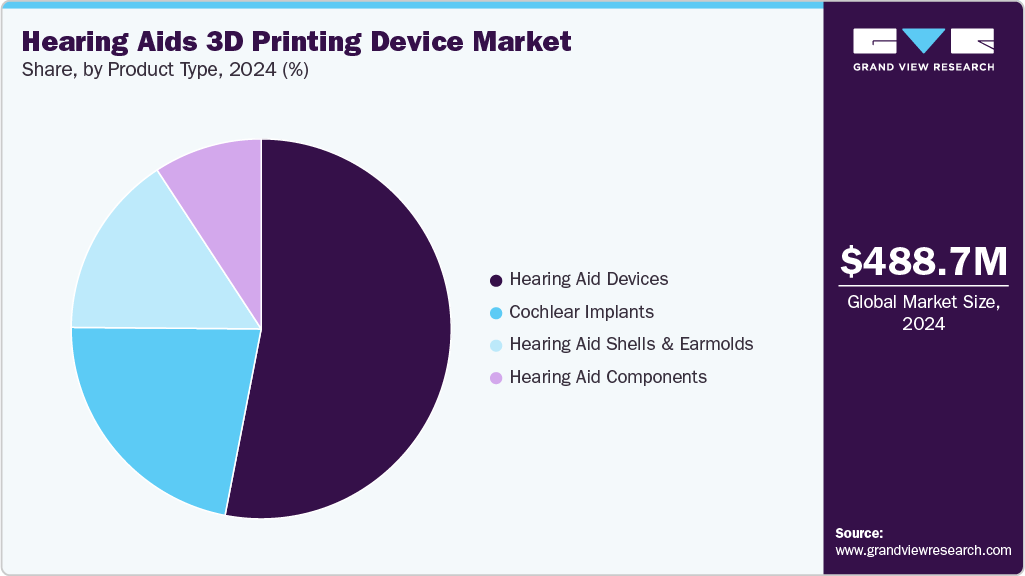
The cochlear implants segment is expected to grow at the fastest CAGR over the forecast years, due to the rising prevalence of hearing loss and demand for advanced auditory solutions. Technological advancements in implant design, improved surgical techniques, and enhanced post-operative outcomes are making cochlear implants more accessible and effective for patients of all ages. Growing awareness about hearing impairments, along with better healthcare infrastructure and insurance coverage, is further supporting adoption.
Regional Insights
North America led the global hearing aids 3D printing device market in 2024, driven by a high adoption of advanced technologies, a well-established healthcare infrastructure, and favorable regulatory frameworks. The region benefits from the presence of leading hearing aid manufacturers with fully integrated 3D printing into their production lines to deliver custom-fit, high-precision hearing aids. Technological leadership in digital ear scanning, CAD/CAM modeling, and additive manufacturing hardware and materials further strengthens the region’s competitive edge. In addition, government initiatives, insurance coverage, and public health programs in the U.S. and Canada support widespread adoption of hearing aids, increasing demand for efficient and scalable 3D-printed production. High consumer awareness, the rising prevalence of age-related hearing loss, and a growing geriatric population contribute to market growth.
U.S. Hearing Aids 3D Printing Device Market Trends
The U.S. hearing aid 3D printing deviceindustry’s growth is driven by the growing prevalence of hearing loss. The increasing geriatric population amplifies demand, as older adults require custom-fit, comfortable, and technologically advanced hearing aids. 3D printing addresses these needs by enabling exact, patient-specific ear molds and shells, improving acoustic performance and comfort. Awareness campaigns, early hearing screenings, and insurance coverage expansions in the U.S. have increased accessibility and adoption of hearing devices. The trend toward personalized, aesthetically optimized, and digitally manufactured hearing aids aligns directly with the capabilities of 3D printing, making the technology a preferred solution for manufacturers to meet rising demand.
-
According to the CDC, hearing loss is a significant health concern in the U.S., affecting individuals from infancy through adulthood and driving demand for hearing aids and related technologies, including 3D-printed devices. In 2022, more than 98% of U.S. newborns were screened for hearing loss, and over 6,000 infants were identified with permanent hearing impairment, representing a prevalence of 1.7 per 1,000 babies screened. Studies also indicate that approximately 15.2% of children and adolescents (ages 12-19) experience low- or high-frequency hearing loss, while 0.6% of children (ages 3-17) are affected by moderate to profound hearing loss.
-
According to the U.S. Census Bureau Vintage 2024 Population Estimates in June 2025, the U.S. population age 65 and older rose by 3.1% (to 61.2 million) while the population under age 18 decreased by 0.2% (to 73.1 million) from 2023 to 2024.
Europe Hearing Aids 3D Printing Devices Market Trends
The Europe hearing aids 3D printing device market is experiencing growth due to the rising prevalence of hearing loss among the aging population, increasing awareness of hearing health, and the demonstrated benefits of early intervention. Technological advancements in 3D printing, digital ear scanning, and CAD/CAM modeling allow manufacturers to produce custom-fit, comfortable, and high-precision hearing aids efficiently. Government initiatives and public health programs across Europe, including newborn and adult hearing screening programs, are improving accessibility and creating demand for advanced hearing solutions. According to the WHO and Hearing Health EU, in Europe, about one-third of people over 60 live with disabling hearing loss, with prevalence rising to over 56% in those over 90. Untreated hearing loss is linked to depression, anxiety, social isolation, and lower quality of life while also increasing healthcare costs. With Europe’s aging population, 236 million people are projected to have hearing loss by 2050, highlighting growing demand for personalized solutions such as 3D-printed hearing aids.
The UK hearing aids 3D printing device market’s growth is driven by the increasing demand for personalized, comfortable, and high-performance hearing solutions. The aging population and residents in care facilities create a strong need for devices that enhance communication, social engagement, and quality of life. Untreated hearing loss is linked to social isolation, mental health challenges, and reduced daily functioning, prompting healthcare providers and policymakers to prioritize effective interventions. Adopting 3D printing technologies allows manufacturers to produce custom-fit, precise, and rapidly deliverable hearing aids, addressing patient needs efficiently.
Hearing loss overview UK, 2024
Statistic
Value
Adults affected by hearing loss
1 in 6
Total people with hearing loss
11 million
People who would benefit from hearing aids
6.7 million
People actually using hearing aids
2 million
Severely or profoundly deaf
900,000
People with hearing loss living in care homes
60-70%
People aged 65+ with hearing loss
3-Jan
Ranking for disease burden
3rd
Projected age-related hearing loss by 2035
20% of the population
Source: WHO
The hearing aids 3D printing device market in Germany is growing, driven by a rising prevalence of hearing loss among the aging population, increasing awareness of hearing health, and strong government support for assistive technologies. Advanced 3D printing, digital ear scanning, and CAD/CAM modeling allow manufacturers to produce custom-fit, precise, and comfortable hearing aids, meeting the needs of diverse patient populations. Additionally, Germany’s well-established healthcare infrastructure, favorable reimbursement policies, and public health programs encourage the adoption of innovative hearing solutions. The market is further supported by research and development initiatives and collaborations between technology providers and hearing aid manufacturers, which enhance production efficiency and device performance. As a result, Germany remains a key market for personalized, high-quality 3D-printed hearing aids in Europe.
Asia Pacific Hearing Aids 3D Printing Device Market Trends
The Asia Pacific hearing aids 3D printing device industry is growing rapidly, driven by a rising prevalence of hearing loss, an expanding geriatric population, and increasing awareness of hearing health. Rapid urbanization, lifestyle changes, and higher exposure to noise pollution are contributing to the growing demand for advanced and personalized hearing solutions. The adoption of 3D printing technologies, including digital ear scanning and CAD/CAM modeling, allows manufacturers to produce custom-fit, precise, and cost-effective hearing aids, addressing both urban and rural populations. Additionally, improving healthcare infrastructure, government initiatives supporting assistive devices, and growing disposable incomes encourage broader adoption of hearing aids. Strategic investments by leading hearing aid manufacturers and collaborations with local technology providers are further accelerating market growth across the region. According to the WHO, an estimated 400 million people experience hearing problems in the Southeast Asia Region alone, a number that could rise to 660 million by 2050.
The hearing aids 3D printing device market in India is growing, driven by increasing awareness of hearing health, rising prevalence of hearing loss, and a rapidly aging population. Adopting 3D printing technologies, digital ear scanning, and CAD/CAM modeling enables manufacturers to produce custom-fit, precise, and affordable hearing aids, addressing the needs of diverse socioeconomic groups. Expansion of healthcare infrastructure, government initiatives promoting assistive devices, and rising disposable incomes further support market growth. According to the 2023 India Aging Report by the United Nations Population Fund (UNFPA) India, the decadal growth rate of the elderly population in the country is currently estimated at 41%, and the proportion of older people is projected to double to over 20% of the total population by 2050.
The China hearing aids 3D printing device market is growing, driven by a rapidly aging population, increasing prevalence of hearing loss, and rising awareness of hearing health among consumers. The adoption of 3D printing technologies, digital ear scanning, and CAD/CAM modeling allows manufacturers to produce custom-fit, precise, and cost-effective hearing aids, addressing the needs of a large and diverse population. Government initiatives to improve healthcare infrastructure and support assistive devices, along with rising disposable incomes and urbanization, further encourage adoption.
Middle East and Africa Hearing Aids 3D Printing Device Market Trends
The Middle East & Africa hearing aids 3D printing device industry is experiencing steady growth, driven by demographic trends, technological innovation, and healthcare development. The region’s aging population has increased the prevalence of hearing impairments, creating strong demand for personalized hearing solutions. Advances in 3D printing technology have produced custom-fit, cost-effective, and high-quality hearing aids, improving accessibility and patient satisfaction. In addition, investments in healthcare infrastructure across several countries enhance the availability and quality of audiology services. At the same time, government initiatives and policies supporting assistive devices encourage broader adoption of advanced hearing technologies. These factors support the continued expansion of 3D-printed hearing aids, focusing on personalized care, efficiency, and improved patient outcomes across the region.
Key Hearing Aids 3D Printing Device Company Insights
The industry players are undertaking several strategic initiatives such as acquisitions, partnerships, and collaborations. Moreover, the launch of novel products is anticipated to boost the competitive rivalry in the market.
Key Hearing Aids 3D Printing Device Companies:
The following are the leading companies in the hearing aids 3D printing device market. These companies collectively hold the largest market share and dictate industry trends.
- Asiga
- 3D Systems, Inc.
- Sonova
- Starkey Laboratories, Inc.
- Materialise
- Formlabs
- Rapid Shape GmbH
- Prodways Group
- EOS GmbH
- LuxCreo Inc.
Recent Developments
-
In April 2025, 3D Systems announced the completion of the sale of its Geomagic software portfolio to Hexagon's Manufacturing Intelligence Division for USD 123 million. This strategic move allows 3D Systems to concentrate on its core additive manufacturing software platforms, including 3D Sprint, 3DXpert, and the Oqton Industrial Manufacturing OS. The company plans to enhance these solutions by integrating artificial intelligence and automation to accelerate the adoption of 3D printing technologies in high-volume production environments.
-
In May 2025, Hansaton launched the Hansaton Essenz platform along with its first product, the sound E-R. This innovative receiver-in-canal hearing solution delivers outstanding sound quality from the first use. Designed for comfort and convenience, the stylish sound E-R features user-friendly magnetic chargers for effortless charging at home or on the go, combining reliability with modern functionality.
-
In July 2024, Formlabs announced the acquisition of Micronics, a Wisconsin-based 3D printing company, to expand its SLS 3D printing capabilities. Micronics, known for its desktop SLS printer Micron, brings compact, high-precision printing technology to Formlabs’ portfolio. The acquisition strengthens Formlabs’ mission to make powerful, accessible 3D printing available worldwide for engineers, designers, and manufacturers.
Hearing Aids 3D Printing Device Market Report Scope
Report Attribute
Details
Market size value in 2025
USD 524.7 million
Revenue forecast in 2033
USD 942.2 million
Growth rate
CAGR of 7.59% from 2025 to 2033
Actual data
2021 - 2024
Forecast period
2025 - 2033
Quantitative units
Revenue in USD million, and CAGR from 2025 to 2033
Segments covered
Technology, material, product type, region
Regional scope
North America; Europe; Asia Pacific; Latin America; MEA
Country scope
U.S.; Canada; Mexico; UK; Germany; France; Italy; Spain; Denmark; Sweden; Norway; Japan; China; India; Australia; South Korea; Thailand; Brazil; Argentina; South Africa; Saudi Arabia; UAE; Kuwait
Report coverage
Revenue, competitive landscape, growth factors, and trends
Key companies profiled
Asiga; 3D Systems, Inc.; Sonova; Starkey Laboratories, Inc.; Materialise; Formlabs; Rapid Shape GmbH; Prodways Group; EOS GmbH; LuxCreo Inc.
Customization scope
Free report customization (equivalent to 8 analysts working days) with purchase. Addition or alteration to country, regional & segment scope
Pricing and purchase options
Avail customized purchase options to meet your exact research needs. Explore purchase options
Global Hearing Aids 3D Printing Device Market Report Segmentation
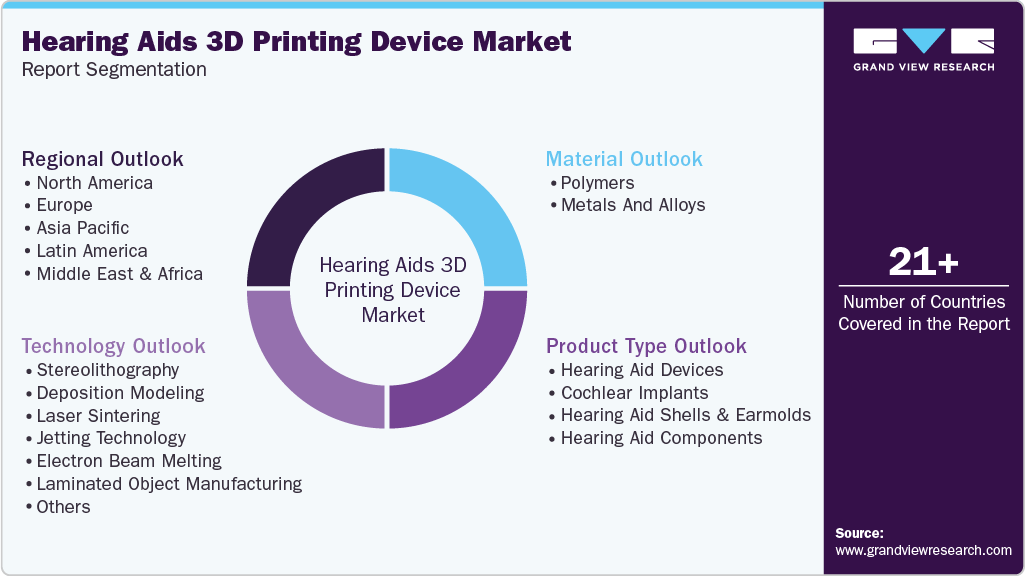
This report forecasts revenue growth at the global, regional, and country levels and provides an analysis of the latest industry trends in each of the sub-segments from 2021 to 2033. For this study, Grand View Research has segmented the global hearing aids 3D printing device market report based on technology, material, product type, and region:
-
Technology Outlook (Revenue, USD Million, 2021 - 2033)
-
Stereolithography
-
Deposition Modeling
-
Laser Sintering
-
Jetting Technology
-
Electron Beam Melting
-
Laminated Object Manufacturing
-
Others
-
-
Material Outlook (Revenue, USD Million, 2021 - 2033)
-
Polymers
-
Nylon
-
Glass-filled Polyamide
-
Epoxy Resins
-
Photopolymers
-
Plastics
-
Others
-
-
Metals and Alloys
-
Steel
-
Titanium
-
Others
-
-
-
Product Type Outlook (Revenue, USD Million, 2021 - 2033)
-
Hearing Aid Devices
-
Cochlear Implants
-
Hearing Aid Shells & Earmolds
-
Hearing Aid Components
-
-
Regional Outlook (Revenue, USD Million, 2021 - 2033)
-
North America
-
U.S.
-
Canada
-
Mexico
-
-
Europe
-
Germany
-
UK
-
France
-
Italy
-
Spain
-
Norway
-
Denmark
-
Sweden
-
-
Asia Pacific
-
Japan
-
China
-
India
-
Australia
-
South Korea
-
Thailand
-
-
Latin America
-
Brazil
-
Argentina
-
-
Middle East and Africa (MEA)
-
South Africa
-
Saudi Arabia
-
UAE
-
Kuwait
-
-
Frequently Asked Questions About This Report
The global hearing aids 3D printing device market size was estimated at USD 488.7 million in 2024 and is expected to reach USD 524.7 million in 2025.
The global hearing aids 3D printing device market is expected to grow at a compound annual growth rate of 7.59% from 2025 to 2033 to reach USD 942.2 million by 2033.
North America dominated the hearing aids 3D printing device market with a share of 38.17% in 2024. This is attributable to a high adoption of advanced technologies, a well-established healthcare infrastructure, and favorable regulatory frameworks. The region benefits from the presence of leading hearing aid manufacturers with fully integrated 3D printing into their production lines to deliver custom-fit, high-precision hearing aids. Technological leadership in digital ear scanning, CAD/CAM modeling, and additive manufacturing hardware and materials further strengthens the region’s competitive edge.
Some key players operating in the hearing aids 3D printing device market include Asiga; 3D Systems, Inc.; Sonova; Starkey Laboratories, Inc.; Materialise; Formlabs; Rapid Shape GmbH; Prodways Group; EOS GmbH; LuxCreo Inc.
Key factors that are driving the market growth include the rising prevalence of hearing loss worldwide, increasing adoption of personalized and custom-fit hearing devices, and rapid technological advancements in additive manufacturing.
About the Author(s)
Medical Devices Research Team
Healthcare · Medical DevicesThis report was authored by the medical devices research team at Grand View Research - comprising two research analysts, one senior research analyst, and one industry expert - with specialized expertise in the medical devices segment of the healthcare industry. All findings are based on proprietary healthcare databases, executive interviews, and regulatory analysis, subject to internal peer review prior to publication.
Last Updated:
Speak to Analyst


Customize this report to your needs — add regions, segments, or data points, with 20% free customization.
Or view our licence options:


ISO 9001:2015 & 27001:2022 Certified
We are GDPR and CCPA compliant! Your transaction & personal information is safe and secure. For more details, please read our privacy policy.


