
- Home
- »
- Next Generation Technologies
- »
-
Industrial Access Control Market Size & Share Report, 2033GVR Report cover
![Industrial Access Control Market (2026 - 2033)Report]()
Industrial Access Control Market (2026 - 2033)
Size, Share & Trends Analysis Report By Component (Hardware, Software, Services), By End-use (Manufacturing, Energy & Utilities, Warehouse & Logistics, Transportation, Pharmaceuticals & Healthcare), By Region, And Segment Forecasts
Market Size, 2025
$4.1BMarket Estimate, 2026
$4.4BMarket Forecast, 2033
$8.7BCAGR, 2026–2033
10.3%Industrial Access Control Market Trends
The global industrial access control market size was valued at USD 4.1 billion in 2025 and is projected to grow from USD 4.4 billion in 2026 to USD 8.7 billion by 2033, at a CAGR of 10.3% from 2026 to 2033. North America dominated the market, accounting for a revenue share of 37.7% in 2025. The market is witnessing strong growth, driven by increasing investments in industrial cybersecurity, the expansion of smart manufacturing facilities, stringent regulatory compliance requirements, rising adoption of biometric authentication and multi-factor authentication (MFA) systems, and growing deployment of cloud-based industrial access control solutions across critical infrastructure and industrial facilities.

Key Market Trends & Insights
- By component: Hardware segment dominated the market, with a revenue share of over 62% in 2025.
- By end-use: Manufacturing segment held the largest revenue share of over 30% in 2025.
Regional Highlights
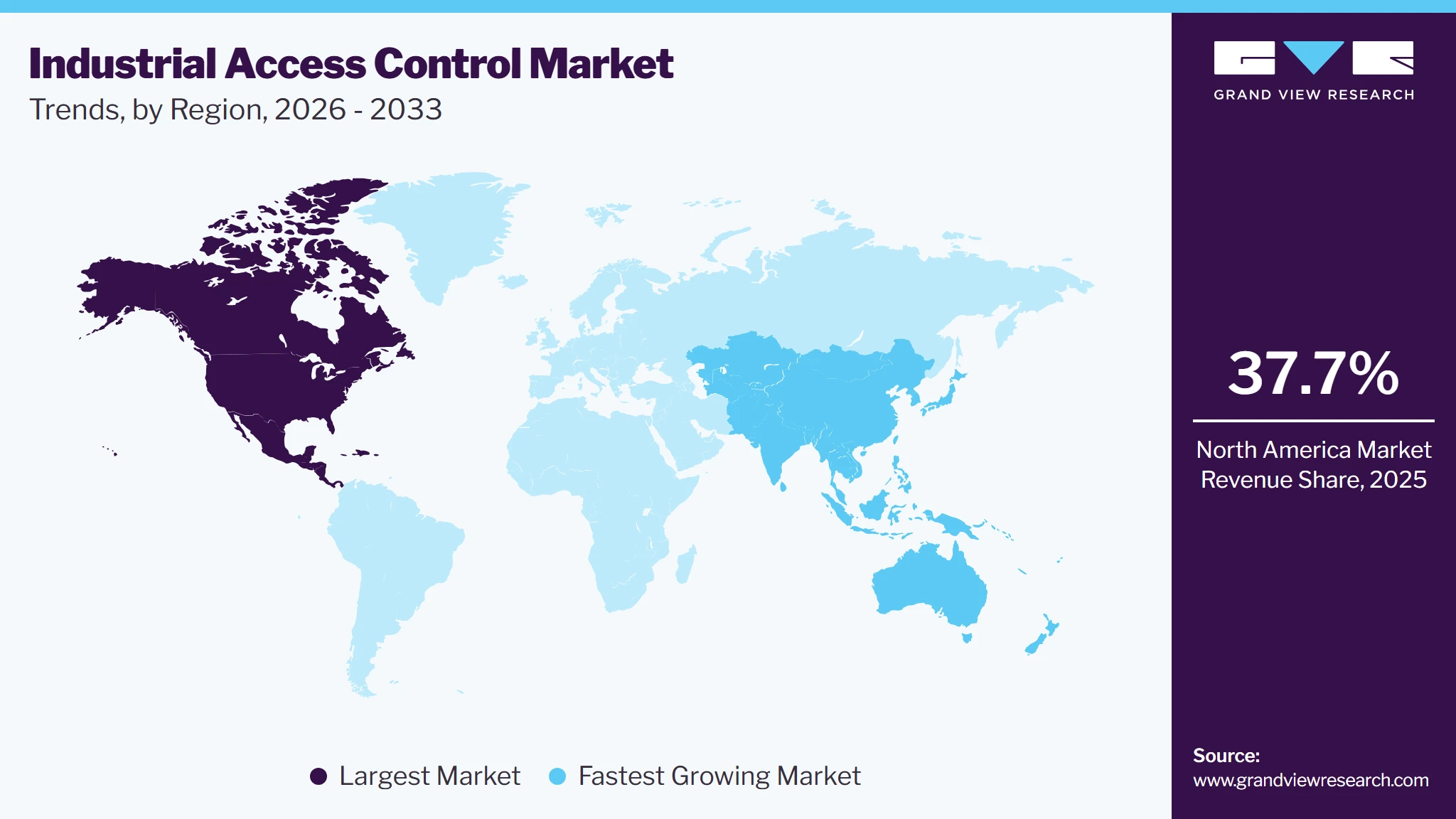
- Largest regional market: North America (37.7% revenue share, 2025)
- Fastest growing regional market: Asia Pacific (highest CAGR, 2026-2033)
- By country: The U.S. held the largest market share in 2025.
Market Size & Forecast
- Market size in 2025: USD 4.1 Billion
- Estimated market size in 2026: USD 4.4 Billion
- Projected market size by 2033: USD 8.7 Billion
- CAGR (2026-2033): 10.3%
Three ways to get this report
Buy it, customize it, or ask a question.Ask an Analyst
A direct answer, usually in 1 working day
- AccessReport author, directly
- Reply timeWithin 1 working day
- No sales callDirect answer only
- FormatEmail reply
- CostFree, no cost
Get the Full Report
What the study covers
- FormatsPDF · Excel · Dashboard
- Timeline2026–2033 annual, 2025 base
- Coverage20+ countries, 5 regions
- Companies10+ key players profiled
Customize the Report
20% free customization
- IncludeCountries, segments, points
- TailorTo your product definition
- ExtendDeeper competitor detail
- OrA fully bespoke study
- Turnaround5–10 working days
Innovations in biometric authentication, IoT, and AI are enhancing the capabilities of industrial access control systems. These technological advancements enable more secure, efficient, and flexible access management solutions. Moreover, the integration of access control systems with other smart building technologies, such as building management systems (BMS) and energy management systems (EMS), is driving market growth. This integration offers enhanced security, efficiency, and operational control. The increasing automation of industrial processes requires advanced access control systems to manage and monitor access to automated equipment, control rooms, and sensitive areas.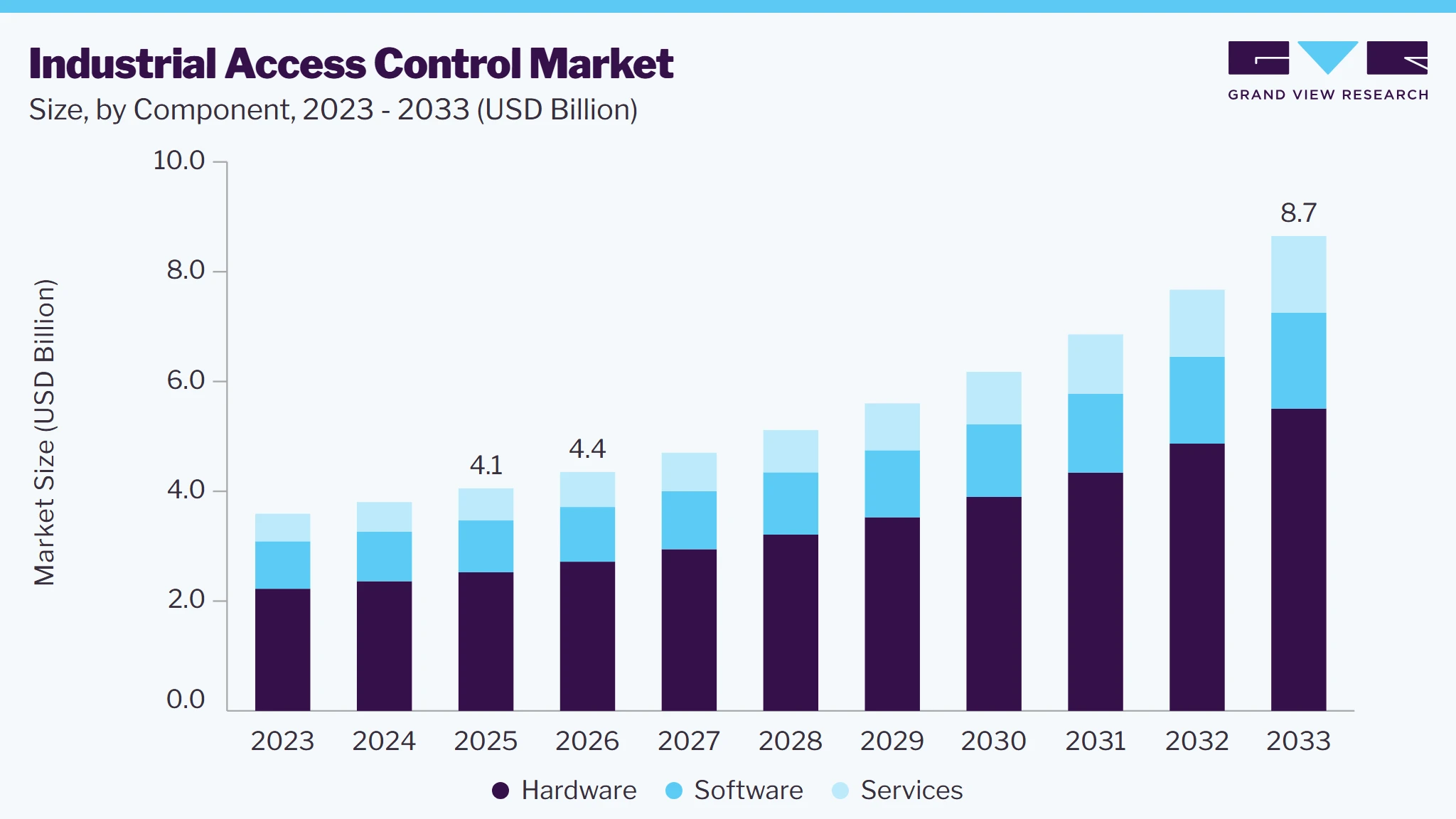
Stricter regulations and standards for industrial security and safety are driving the adoption of access control systems. Compliance with standards such as the International Organization for Standardization (ISO), the Occupational Safety and Health Administration (OSHA), and data protection regulations necessitates robust access control measures. Moreover, the need for remote monitoring and management of access control systems, driven by the rise in remote work and distributed operations, is fueling the adoption of cloud-based and networked access control solutions.
Market Dynamics
The industrial access control market is growing steadily as organizations seek to protect critical infrastructure, manufacturing plants, warehouses, and energy facilities from unauthorized access and evolving cyber-physical threats. The rapid adoption of smart manufacturing, Industrial Internet of Things (IIoT) technologies, and connected industrial environments is driving demand for intelligent access control systems with centralized monitoring and real-time authentication. Wider use of biometric authentication, multi-factor authentication (MFA), RFID, and cloud-based access control solutions help organizations strengthen security, improve operational efficiency, and support regulatory compliance. In addition, investments in industrial automation, digital transformation, and modernization of legacy security infrastructure are creating growth opportunities for solution providers across developed and emerging markets. However, high implementation costs, integration challenges with existing industrial systems, and cybersecurity risks linked to connected access control platforms continue to restrain market expansion.
The industrial access control market is being significantly driven by the rapid adoption of smart manufacturing and Industry 4.0 initiatives across industrial facilities worldwide. As manufacturing plants become increasingly connected through the Industrial Internet of Things (IIoT), organizations are prioritizing advanced industrial access control systems to protect personnel, equipment, and critical production assets. Growing investments in industrial cybersecurity, combined with the increasing deployment of biometric authentication, multi-factor authentication (MFA), and RFID-based access control, are strengthening physical and digital security across industrial environments. Regulatory requirements related to workplace safety, data protection, and critical infrastructure security are further encouraging enterprises to modernize legacy access control infrastructure. These factors are collectively supporting sustained demand for intelligent and integrated industrial access control solutions.
Modern industrial facilities are increasingly adopting cloud-based access control, AI-enabled identity management, and centralized security platforms to improve operational visibility and incident response. The convergence of physical security with cybersecurity is enabling organizations to implement unified security frameworks that reduce unauthorized access risks and improve compliance management. Industrial sectors including manufacturing, oil & gas, energy, chemicals, logistics, and utilities are expanding investments in advanced security technologies to safeguard high-value assets and maintain business continuity. Rising automation and digital transformation initiatives are also increasing the need for scalable and remotely managed industrial security systems. Consequently, technology advancements and growing security awareness continue to accelerate the expansion of the industrial access control market.
The growth of the industrial access control market is constrained by the high initial investment required for deploying advanced industrial access control systems across large industrial facilities. Comprehensive implementations involving biometric authentication, smart card readers, electronic locks, cloud connectivity, and security management software require substantial capital expenditure. Small and medium-sized industrial enterprises often face budget limitations that delay modernization of legacy security infrastructure. Additionally, ongoing maintenance, software upgrades, cybersecurity management, and employee training increase the total cost of ownership. These financial considerations remain a significant barrier to wider adoption of advanced industrial security solutions.
Integration challenges also limit the deployment of modern access control systems within existing industrial environments. Many industrial facilities continue to operate legacy operational technology (OT) and security infrastructure that may not be fully compatible with new digital access management platforms. Integrating physical security systems with enterprise IT networks, identity management platforms, and industrial automation systems require specialized technical expertise and extended deployment timelines. Concerns regarding operational disruption during system migration further discourage rapid implementation. As a result, integration complexity continues to slow the pace of adoption in portions of the industrial access control market.
The increasing adoption of cloud-based industrial access control solutions presents substantial growth opportunities for the industrial access control market. Organizations are shifting toward cloud-managed security platforms that enable centralized administration, remote monitoring, and scalable access management across multiple industrial locations. The growing demand for flexible security infrastructure is encouraging vendors to develop subscription-based and software-as-a-service (SaaS) access control platforms. Integration of artificial intelligence (AI) and advanced analytics is further enhancing threat detection, identity verification, and security automation. These technological advancements are expanding the addressable market for next-generation industrial access control solutions.
Emerging economies are also creating attractive opportunities as governments and private industries increase investments in industrial modernization and critical infrastructure development. Rapid expansion of manufacturing facilities, logistics hubs, renewable energy projects, and smart industrial parks is generating new demand for advanced access control systems. Vendors are introducing AI-powered facial recognition, mobile credentials, contactless authentication, and predictive security management capabilities to address evolving customer requirements. Increasing emphasis on regulatory compliance, operational resilience, and workforce safety is further supporting long-term adoption across multiple industrial sectors. These developments position cloud-enabled and intelligent industrial access control technologies as a major growth opportunity throughout the forecast period.
Market Concentration & Characteristics
The industrial access control market is moderately consolidated, with a mix of global security technology providers and specialized industrial security vendors competing through product innovation, integrated platforms, and long-term enterprise contracts. Leading companies focus on expanding their portfolios with biometric authentication, cloud-based access control, mobile credentials, and AI-enabled identity management solutions to strengthen their competitive positioning. Strategic partnerships, acquisitions, and investments in industrial cybersecurity capabilities have become key strategies for increasing market share and enhancing comprehensive security offerings. Large multinational vendors maintain a competitive advantage through extensive distribution networks, strong brand recognition, and the ability to deliver end-to-end industrial access control solutions across multiple industry verticals.
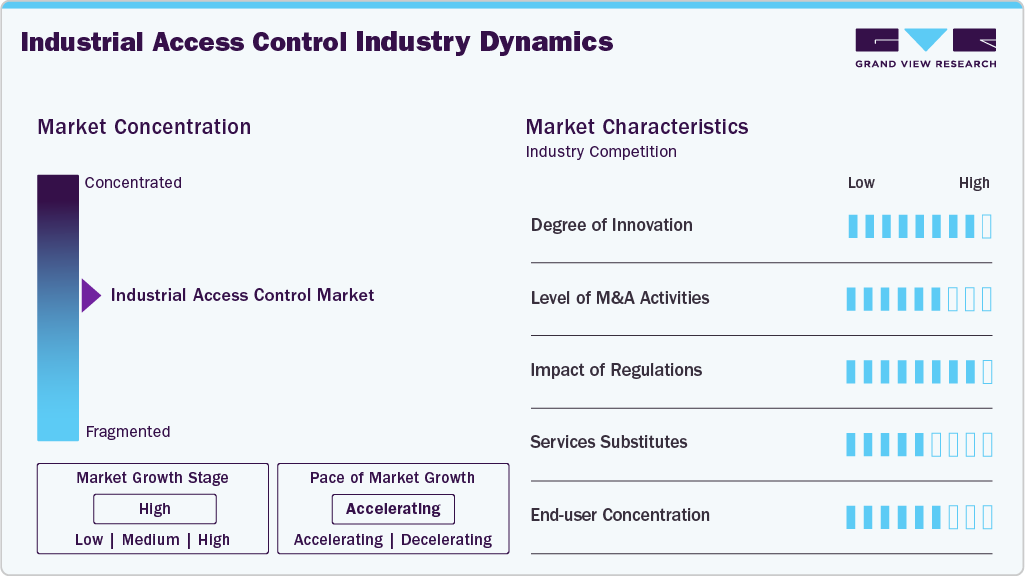
The market is characterized by continuous technological advancements driven by the increasing adoption of smart manufacturing, Industrial Internet of Things (IIoT), and digital transformation initiatives. Demand is shifting toward scalable, cloud-managed, and interoperable access control systems that seamlessly integrate with video surveillance, visitor management, and enterprise security platforms. Customers are increasingly prioritizing multi-factor authentication (MFA), contactless access technologies, and centralized security management to improve operational efficiency and regulatory compliance. As industrial organizations modernize their physical security infrastructure, vendors are differentiating themselves through AI-powered analytics, cybersecurity integration, and industry-specific industrial access control capabilities.
Analyst Perspective
The industrial access control market is expected to witness sustained expansion as industrial organizations increasingly prioritize resilient physical security alongside digital infrastructure modernization. The growing integration of zero trust security architecture, physical identity and access management (PIAM), edge computing, and digital identity verification is reshaping the next generation of industrial security solutions. Vendors are focusing on interoperable platforms that seamlessly connect access control systems with video surveillance, intrusion detection, and building management systems to deliver unified security operations. Increasing investments in smart factories, critical infrastructure resilience, and remote facility management are creating significant opportunities for advanced and scalable industrial security technologies. Over the long term, continuous innovation in AI-driven automation, contactless authentication, and intelligent security orchestration is expected to strengthen the competitive landscape and accelerate the adoption of industrial access control solutions across global industries.
Component Insights
Based on component, the hardware segment led the market with the largest revenue share of over 62% in 2025. Various factors such as advancements in technologies, growing security concerns, and expansion of industrial infrastructure are primarily contributing to the growth of the segment. The incorporation of Internet of Things (IoT) technologies and smart features in access control hardware enhances functionality and attracts investments. Innovations in fingerprint, facial recognition, and iris scanning technologies improve security and reliability. Stricter regulations and standards for physical security necessitate upgraded access control hardware to meet compliance requirements.
The services segment is anticipated to exhibit a significant CAGR over the forecast period. Growing concerns over physical security and the need to protect valuable assets in industrial environments drive demand for comprehensive access control services. Thus, organizations seek expert services to ensure robust and effective security measures. Moreover, modern access control systems are increasingly complex, integrating various technologies such as biometrics, RFID, and IoT. This complexity necessitates professional services for installation, configuration, and maintenance to ensure optimal functionality.
End-use Insights
Based on end-use, the manufacturing segment led the market with the largest revenue share of over 30% in 2025. Manufacturing facilities house valuable machinery, equipment, and intellectual property that require robust security measures to prevent theft and unauthorized access. Moreover, the rise of smart manufacturing and Industry 4.0 initiatives drives the need for advanced access control systems that integrate with smart technologies and digital infrastructure. Furthermore, modern access control solutions offer scalability and flexibility to adapt to changes in manufacturing processes, facility expansion, and evolving security needs.
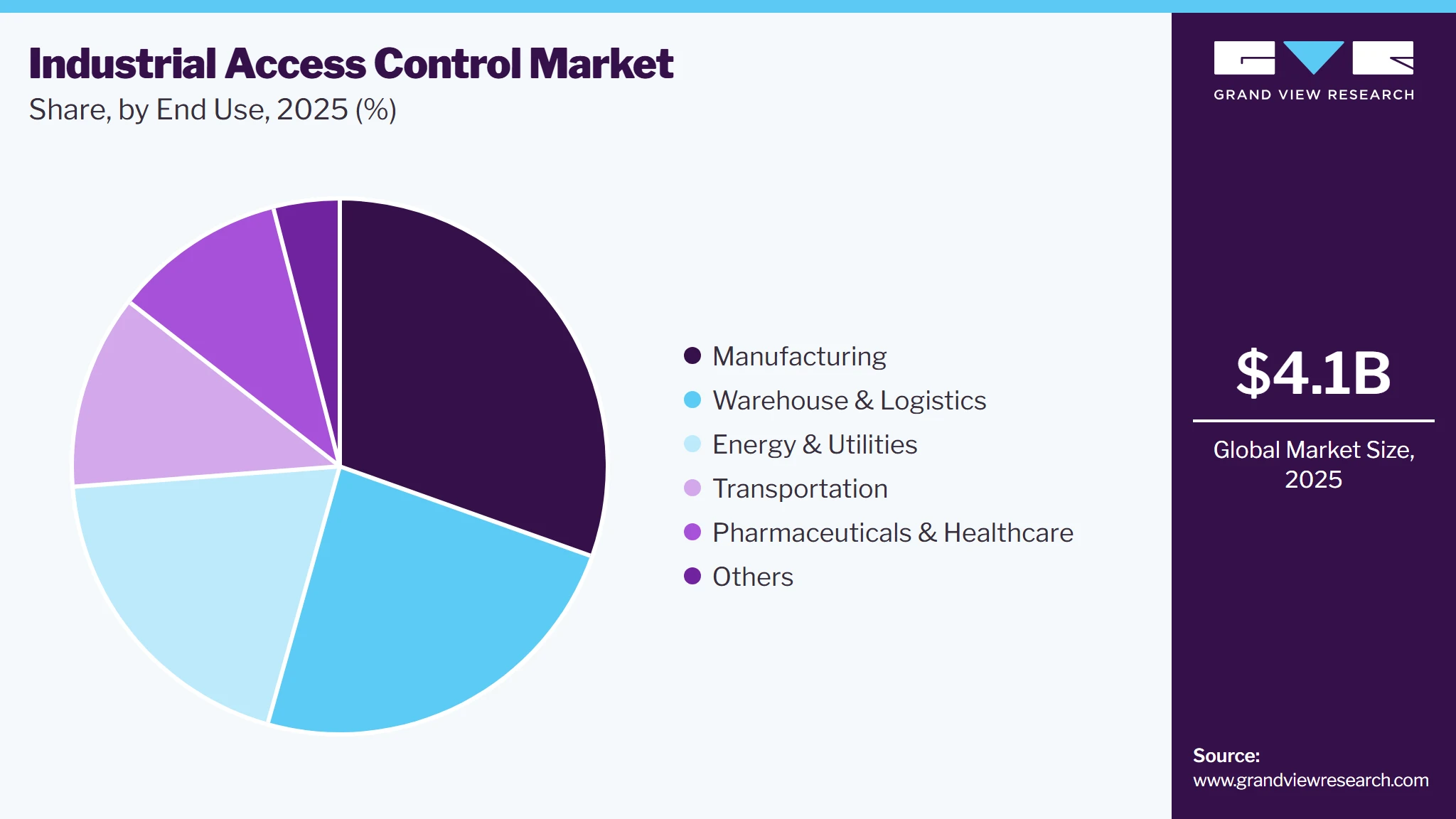
The warehouse & logistics segment is anticipated to exhibit the fastest CAGR over the forecast period. The rapid expansion of e-commerce has increased the need for larger and more secure warehouses and distribution centers. As leading companies such as Amazon and Alibaba continue to expand, there is a growing demand for advanced access control systems to efficiently manage entry points, secure inventory, and monitor personnel movement. These solutions are essential to maintaining operational security and efficiency in large-scale logistics environments. Furthermore, the rise of automation and smart technologies in warehouses requires advanced access control solutions that integrate with automated systems, robotics, and IoT devices. These systems ensure only authorized personnel can access specific areas, safeguarding valuable assets and sensitive operations.
Regional Insights
North America dominated the industrial access control market with the largest revenue share of 37.7% in 2025. North America has been at the forefront of security technology advancements, including the development and adoption of biometrics, IoT-based access control solutions, and AI-driven security systems. Local companies and startups are playing a key role in implementing and expanding these technologies, contributing to the growth of the industrial access control market in the region.
U.S. Industrial Access Control Market Trends
The industrial access control market in the U.S. held the largest share in the North America region in 2025. The shift towards contactless access control systems, such as facial recognition and mobile-based access, gained significant momentum in the country. The emphasis on reducing physical interaction in industrial settings has driven long-term changes in security infrastructure, with companies in the country adopting advanced, touchless solutions at a higher rate.
Europe Industrial Access Control Market Trends
The industrial access control market in Europe is expected to witness significant growth over the forecast period. The European Union's push towards Industry 4.0 and smart manufacturing is fueling demand for advanced access control systems. The integration of automation and digital technologies in manufacturing and industrial processes requires secure access control to protect these systems and ensure safe operations.
Asia Pacific Industrial Access Control Market Trends
The industrial access control market in Asia Pacific is anticipated to register the fastest CAGR over the forecast period. The Asia-Pacific region is experiencing fast-paced industrialization and urbanization. This rapid development drives the need for advanced access control systems to secure new industrial facilities, warehouses, and infrastructure projects. Moreover, the development of smart cities and smart infrastructure in the Asia-Pacific region involves integrating advanced technologies, including access control systems, to enhance security and operational efficiency. These initiatives boost the adoption of modern access control solutions.
Key Industrial Access Control Company Insights
Key players operating in the industrial access control market are undertaking various initiatives to strengthen their presence and increase the reach of their products and services. Strategies such as expansion activities and partnerships are key in propelling the market growth.
Key Industrial Access Control Companies
The following key companies have been profiled for this study on the industrial access control market.
-
Allegion plcA
-
ASSA ABLOY
-
Bosch Sicherheitssysteme GmbH
-
dormakaba Group
-
Hirsch Secure, Inc
-
Honeywell International Inc
-
Johnson Controls
-
Schneider Electric
-
Siemens
-
Thales
Competitive Benchmarking
Operating Strategies
Competitive Edge
Weaknesses
Mature Players: Honeywell International, Johnson Controls, Siemens, Schneider Electric, ASSA ABLOY.
- Mature players focus on expanding industrial access control systems, biometric authentication, cloud-based access control, AI-enabled security, and integrated physical security platforms.
- Their competitive advantage lies in strong global presence, broad product portfolios, established enterprise customer relationships, and continuous investments in industrial cybersecurity and smart security technologies.
- These companies may face challenges related to legacy system integration, higher implementation complexity, and comparatively slower product innovation cycles.
Emerging Players: Allegion plc, Bosch Sicherheitssysteme GmbH, dormakaba Group, Hirsch Secure, Inc., Thales.
- Emerging players focus on developing innovative cloud-based access control, mobile credentials, AI-powered identity management, and flexible security platforms for industrial applications.
- Their strength comes from specialized expertise, cloud-native architectures, rapid product development, and faster innovation in intelligent access control solutions.
- Limited global presence, a smaller enterprise customer base, and comparatively lower financial resources may constrain large-scale market expansion.
Recent Developments
-
In January 2025, Acre Security acquired REKS, an AI-driven access control solution, strengthening its platform with advanced generative AI features. This move allows for more intuitive, natural language interactions with access control systems, boosting both user insights and operational efficiency. The founders of REKS have joined Acre’s AI Development Team, helping to accelerate innovation in AI-powered security solutions.
-
In July 2024, Dahua Technology Co., Ltd., video-centric AIoT service and solution provider, introduced DSS Professional V8.5, the latest enhancement to its industry specific security management software. The software is designed to streamline security operations. This version introduces enhanced interactive AR monitoring, user interface, enhanced integration, and advanced access management, all tailored to meet the evolving needs of various industries.
-
In June 2024, Honeywell International Inc. acquired Carrier Global Corporation’s global access solutions segment for USD 4.95 billion. Carrier Global Corporation plans to use the net proceeds from the sales to reduce debt, aiming to achieve approximately 2x net leverage by the end of 2024.
-
In April 2024, Siemens launched Siemens Xcelerator, a new Siemens software that automatically identifies vulnerable production assets. The software automatically links identified vulnerabilities of cybersecurity to the production assets of industries. This helps industrial automation and operators professionals, even those without specialized cybersecurity knowledge, detect risks within their OT assets on the shop floor and receive a prioritized threat analysis.
Industrial Access Control Market Report Scope
Report Attribute
Details
Market size in 2025
USD 4.1 billion
Estimated market size in 2026
USD 4.4 billion
Projected market size by 2033
USD 8.7 billion
Growth rate
CAGR of 10.3% from 2026 to 2033
Base year for estimation
2025
Historical data
2021 - 2024
Forecast period
2026 - 2033
Quantitative units
Revenue in USD million/billion and CAGR from 2026 to 2033
Report coverage
Revenue forecast, company ranking, competitive landscape, growth factors, and trends
Segments covered
Component, end-use, region
Regional scope
North America; Europe; Asia Pacific; Latin America; MEA
Country scope
U.S.; Canada; Mexico; Germany; UK; France; China; Japan; India; South Korea; Australia; Brazil; Saudi Arabia; South Africa; UAE
Key companies profiled
Allegion plcA; ASSA ABLOY; Bosch Sicherheitssysteme GmbH; dormakaba Group; Hirsch Secure, Inc; Honeywell International Inc.; Johnson Controls; Schneider Electric; Siemens; Thales
Customization scope
Free report customization (equivalent up to 8 analysts' working days) with purchase. Addition or alteration to country, regional & segment scope.
Pricing and purchase options
Avail customized purchase options to meet your exact research needs. Explore purchase options
Global Industrial Access Control Market Report Segmentation
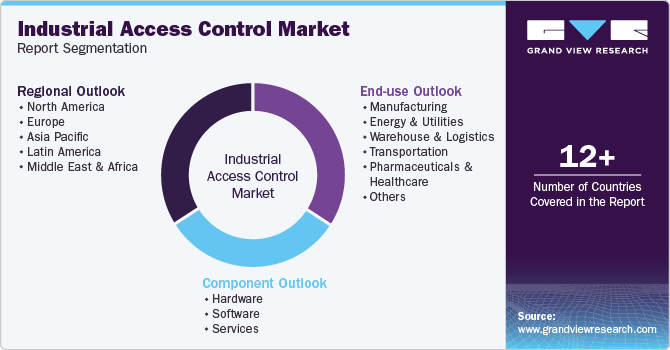
This report forecasts revenue growth at the global, regional, and country levels and provides an analysis of the latest industry trends in each of the sub-segments from 2021 to 2033. For this study, Grand View Research has segmented the global industrial access control market report based on the component, end-use, and region.
-
Component Outlook (Revenue, USD Million, 2021 - 2033)
-
Hardware
-
Software
-
Services
-
-
End-use Outlook (Revenue, USD Million, 2021 - 2033)
-
Manufacturing
-
Energy & Utilities
-
Warehouse & Logistics
-
Transportation
-
Pharmaceuticals & Healthcare
-
Others
-
-
Regional Outlook (Revenue, USD Million, 2021 - 2033)
-
North America
-
U.S.
-
Canada
-
Mexico
-
-
Europe
-
U.K.
-
Germany
-
France
-
-
Asia Pacific
-
China
-
India
-
Japan
-
Australia
-
South Korea
-
-
Latin America
-
Brazil
-
-
MEA
-
UAE
-
South Africa
-
KSA
-
-
Research Methodology
The industrial access control market figures in this report are based on a proven research process that combines executive interviews with secondary research from proprietary databases, company filings, and recognized regulatory and institutional sources. Market size is built through value-chain sizing-reconciling supply-side and demand-side estimates-and triangulated with bottom-up and top-down approaches. Every estimate passes multiple levels of expert validation before publication, with each industrial access control segment quantified using the revenue-capture definitions in the table below.
Segment Definition
Segment - Component
Revenue capture definition
Hardware
The hardware segment includes physical devices used to control, monitor, and secure access to industrial facilities. This segment comprises biometric readers, card readers, controllers, electronic locks, access panels, keypads, sensors, and related access control equipment.
Software
The software segment consists of applications and platforms that manage user authentication, access permissions, identity administration, monitoring, and reporting functions. This segment enables centralized management, real-time access control, system integration, and security analytics across industrial environments.
Services
The services segment includes professional and managed services supporting the deployment, operation, and maintenance of industrial access control systems. This segment covers consulting, system integration, installation, training, maintenance, technical support, and software upgrades.
Segment - End Use
Revenue capture definition
Manufacturing
The manufacturing segment includes industrial facilities that utilize access control systems to secure production areas, equipment, personnel, and intellectual property. This segment focuses on improving operational security, workforce management, and compliance within manufacturing plants.
Energy & Utilities
The energy & utilities segment comprises power generation facilities, substations, oil & gas sites, renewable energy plants, and utility infrastructure that deploy industrial access control solutions. This segment emphasizes protecting critical infrastructure, ensuring regulatory compliance, and preventing unauthorized access to high-risk assets.
Warehouse & Logistics
The warehouse & logistics segment includes distribution centers, warehouses, fulfillment centers, and logistics hubs that implement access control systems to secure inventory, facilities, and personnel. This segment supports controlled access, asset protection, and efficient workforce management across logistics operations.
Transportation
The transportation segment includes airports, rail networks, ports, transit facilities, and transportation infrastructure utilizing industrial access control solutions. This segment focuses on securing restricted areas, safeguarding operational assets, and managing employee and contractor access.
Pharmaceuticals & Healthcare
The pharmaceuticals & healthcare segment includes pharmaceutical manufacturing facilities, laboratories, hospitals, and healthcare production sites that deploy industrial access control technologies. This segment supports regulatory compliance, protection of sensitive materials, and secure access to critical operational areas.
Others
The others segment includes industrial facilities across sectors such as mining, chemicals, food & beverages, construction, water treatment, and defense manufacturing. This segment utilizes industrial access control systems to strengthen facility security, workforce safety, and operational resilience.
Estimation Model
Layer Name
Key Questions
Description
Industrial Infrastructure & Security Demand Layer
Who creates demand for Industrial Access Control solutions?
Identify industrial enterprises, critical infrastructure operators, government facilities, and commercial organizations requiring secure physical access management. This layer establishes the demand base by assessing industrial expansion, facility modernization, regulatory compliance, workforce security requirements, and investments in industrial cybersecurity.
Access Control Infrastructure Deployment Layer
Who invests in Industrial Access Control infrastructure?
Apply adoption rates of biometric readers, RFID systems, smart cards, electronic locks, controllers, mobile credentials, cloud platforms, and identity management infrastructure. This layer measures investments supporting secure authentication, centralized access management, and connected industrial security environments.
Industrial Access Control Software & Services Adoption Layer
Who deploys Industrial Access Control software and services?
Apply penetration rates of access management software, identity and access management (IAM) platforms, cloud-based access control, visitor management systems, authentication software, system integration, and managed security services across industrial sectors. This layer captures enterprise adoption of digital access control technologies that improve security, compliance, and operational efficiency.
Industrial Access Control Market Revenue Realization Layer
How much revenue is generated through Industrial Access Control adoption?
Estimate market revenue by combining hardware deployments with spending on software licenses, cloud subscriptions, installation, system integration, consulting, maintenance, and support services. This layer captures total revenue generated from industrial access control solutions across manufacturing, energy & utilities, warehouse & logistics, transportation, pharmaceuticals & healthcare, and other industrial end-use sectors.
Delivered Customizations
This report has been delivered with the following In-depth customizations
Client Request
Customization Delivered
Value Adds
Industrial Access Control Technology Adoption & Growth Assessment
Performed a comprehensive analysis of industrial access control market trends, including artificial intelligence (AI), biometric authentication, multi-factor authentication (MFA), cloud-based access control, Industrial Internet of Things (IIoT), mobile credentials, and identity & access management (IAM) technologies across major industry verticals.
This assessment enables stakeholders to identify high-growth industrial access control technology segments, evaluate digital security adoption trends, prioritize investment opportunities, and strengthen competitive positioning within the rapidly evolving market.
Industry-Specific Industrial Access Control Deployment Analysis
Assessed demand for industrial access control solutions across manufacturing, energy & utilities, warehouse & logistics, transportation, pharmaceuticals & healthcare, and other industrial sectors, including workforce security, critical infrastructure protection, regulatory compliance, visitor management, and facility access management applications.
Provides strategic insights into industry-specific deployment patterns, security requirements, compliance initiatives, and long-term revenue opportunities, supporting market expansion planning and targeted growth strategies.
Cloud, AI & Industrial Cybersecurity Opportunity Assessment
Evaluated adoption trends for cloud-based access control, AI-powered security analytics, biometric authentication, identity management, mobile access solutions, Industrial IoT (IIoT) integration, and industrial cybersecurity technologies across global industrial markets.
Supports investment and product development strategies by identifying emerging technology opportunities, accelerating innovation roadmaps, enabling solution differentiation, and facilitating business expansion across high-growth segments of the industrial access control market.
Frequently Asked Questions About This Report
The global industrial access control market size was valued at USD 4.1 billion in 2025 and is estimated at USD 4.4 billion in 2026.
The industrial access control market is driven by increasing security concerns, advancements in technology, and growing demand for remote access management. As industrial environments face growing threats from theft, vandalism, and cyberattacks, there is a heightened demand for advanced access control systems to protect physical and digital assets.
The hardware segment led the market with the largest revenue share of over 62% in 2025.
The manufacturing segment led the market with the largest revenue share of over 30% in 2025.
Asia Pacific is the fastest-growing region over the forecast period.
The global industrial access control market is expected to grow at a CAGR of 10.3% from 2026 to 2033, reaching 8.7 billion by 2033.
North America dominated the market, accounting for a revenue share of 37.7% in 2025.
Some key players operating in the industrial access control market include Allegion; ASSA ABLOY; Bosch Sicherheitssysteme GmbH; dormakaba Group; Hirsch, Inc.; Honeywell International Inc.; Johnson Controls Inc.; Schneider Electric; Siemens; Thales.
About the Author(s)
Next Generation Technologies Research Team
Technology · Next Generation TechnologiesThis report was authored by the next generation technologies research team at Grand View Research - comprising two research analysts, one senior research analyst, and one industry expert - with specialized expertise in the next generation technologies segment of the technology industry. All findings are based on proprietary technology databases, executive interviews, and regulatory analysis, subject to internal peer review prior to publication.
Last Updated:
Speak to Analyst


Customize this report to your needs - add regions, segments, or data points, with 20% free customization.
Or view our licence options:


ISO 9001:2015 & 27001:2022 Certified
We are GDPR and CCPA compliant! Your transaction & personal information is safe and secure. For more details, please read our privacy policy.


