
- Home
- »
- Plastics, Polymers & Resins
- »
-
Injection Molded Plastic Market Size Report, 2026-2033GVR Report cover

Injection Molded Plastic Market (2026 - 2033)
Size, Share & Trends Analysis Report By Raw Material (PP, ABS, HDPE, PS), By Application (Packaging, Automotive & Transportation, Electronics, Medical), By Region, And Segment Forecasts
Market Size, 2025
$362.5BMarket Estimate, 2026
$367.0BMarket Forecast, 2033
$481.4BCAGR, 2026–2033
4.0%Injection Molded Plastic Market Summary
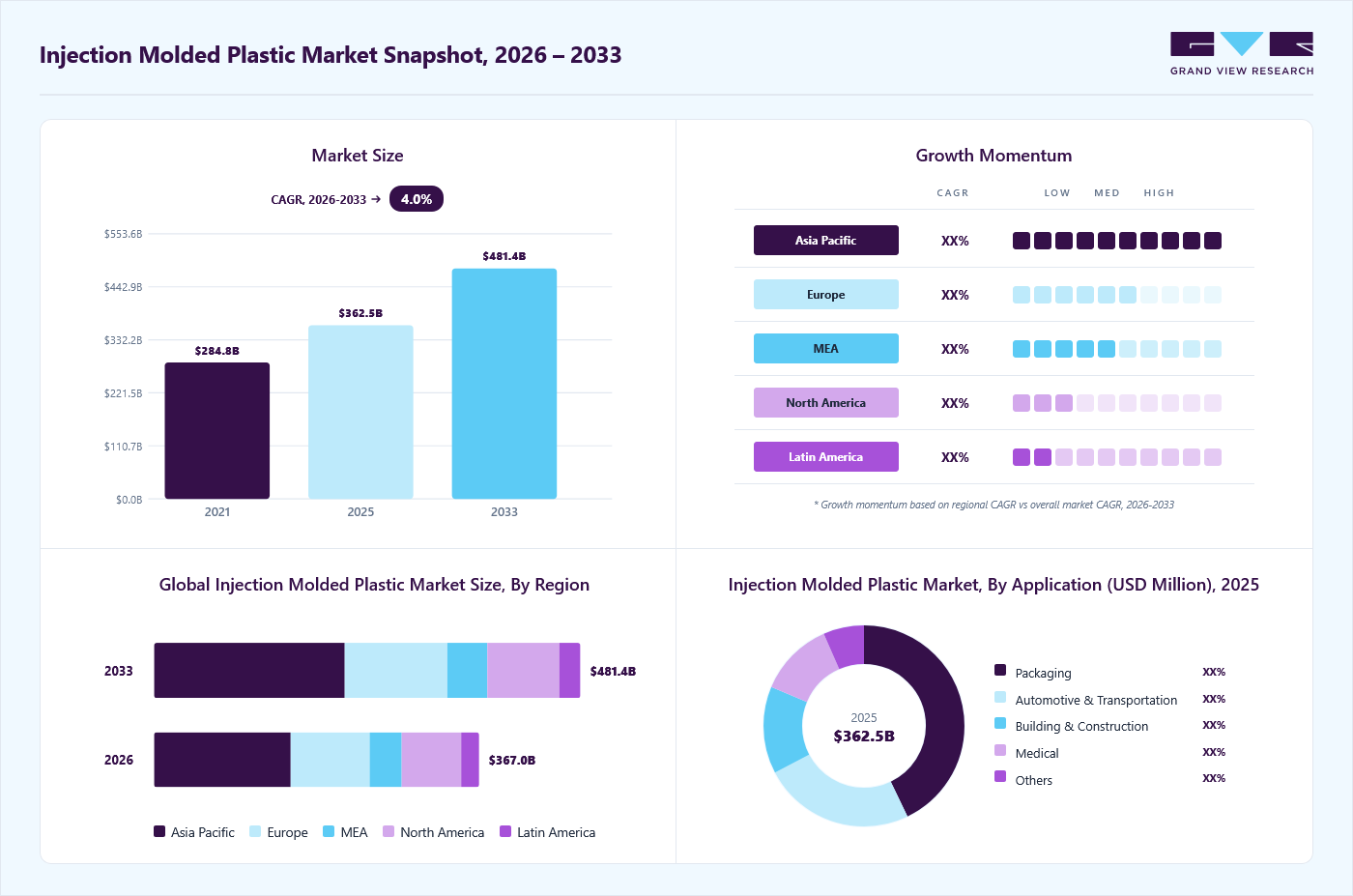
The global injection molded plastic market size was valued at USD 362.5 billion in 2025 and is projected to grow from USD 367.0 billion in 2026 to USD 481.4 billion by 2033, at a CAGR of 4.0% from 2026 to 2033. The market in Asia Pacific dominated with a revenue share of 40.7% in 2025. Rising demand for mass-produced, cost-efficient components in consumer goods and packaging is another key driver.
 Source: Grand View Research, IR Documents, Primary Interviews, Paid DatabasesTo learn more about this report,
 Download Free Sample Report
 Key Market Trends & Insights
- By raw material: Polypropylene segment is expected to grow at the fastest CAGR of 4.4% from 2026 to 2033.
- By application: Medical segment is expected to grow at the fastest CAGR of 4.6% from 2026 to 2033.
Regional Highlights
- Largest regional market: Asia Pacific (40.7% revenue share, 2025)
- By country: South Korea held the largest market share in 2025.
Market Size & Forecast
- Market size in 2025: USD 362.5 Billion
- Estimated market size in 2026: USD 367.0 Billion
- Projected market size by 2033: USD 481.4 Billion
- CAGR (2026-2033): 4.0%
Three ways to get this report
Buy it, customize it, or ask a question.Ask an Analyst
Analyst response in 1 business day
- AccessReport author, directly
- Reply timeWithin 1 working day
- No sales callDirect answer only
- FormatEmail reply
- CostFree, no cost
Get the Full Report
What the study covers
- FormatsPDF · Excel · Dashboard
- Timeline2026–2033 annual, 2025 base
- Coverage20+ countries, 5 regions
- Companies10+ key players profiled
Customize the Report
20% free customization
- IncludeCountries, segments, points
- TailorTo your product definition
- ExtendDeeper competitor detail
- OrA fully bespoke study
- Turnaround5–10 working days
Injection molding enables high output, consistent quality, and low per-unit costs, making it ideal for large-volume manufacturing. The injection molded plastics industry is increasingly shaped by the demand for lightweight, high-performance materials across key end-use industries. Automotive OEMs are substituting metal parts with engineered thermoplastics to improve fuel efficiency and EV range. Packaging players are adopting thin-wall and precision molds to meet e-commerce and consumer demands. Sustainable material adoption, including recycled and bio-based resins, is increasing as companies align with circular-economy goals. Digital integration and smart manufacturing also enhance throughput and quality control.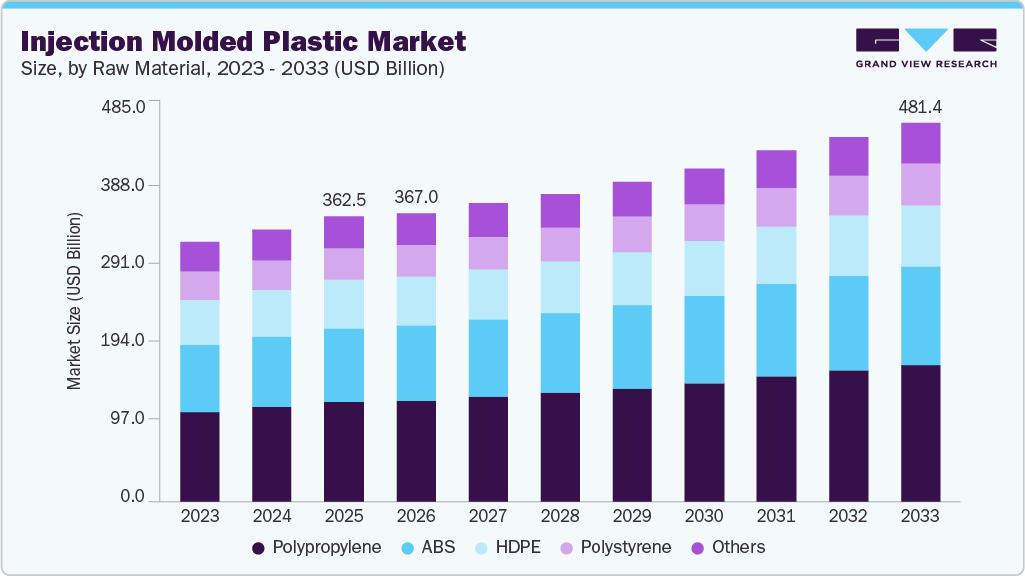 To learn more about this report, Download Free Sample Report
 Drivers, Opportunities & Restraints
Rapid growth in automotive production, particularly electric vehicles, is a prominent driver for injection molded plastics. Lightweight polymer components help OEMs meet stringent fuel economy and emissions standards while reducing overall vehicle weight. The need for high-precision housings, connectors, and structural parts supports broader adoption of advanced injection molding processes. In addition, expanding usage in medical devices, consumer electronics, and packaging sectors further fuels demand, given the technology’s ability to deliver complex geometries at scale.
Emerging demand for sustainable and high-value applications presents a significant opportunity for the injection-molded plastics industry. Adopting recyclable and bio-based polymers enables manufacturers to meet environmental regulations and consumer preferences for greener products. Growth in high-precision sectors, such as medical devices and advanced electronics, opens new revenue streams. Expansion in emerging economies, driven by rising industrialization and increased consumer spending, further broadens the market potential for differentiated, value-added plastic components.
Volatility in raw material prices and supply chain dependencies constrain market expansion. Major feedstock’s like polypropylene and polyethylene are tied to crude oil and natural gas pricing, leading to cost uncertainty and margin pressure for manufacturers. Geopolitical factors and logistics disruptions exacerbate supply instability. In addition, tightening environmental regulations and waste management requirements increase compliance costs, complicating production planning and material selection. These factors collectively restrain investment and operational flexibility within the market.
Market Concentration & Characteristics
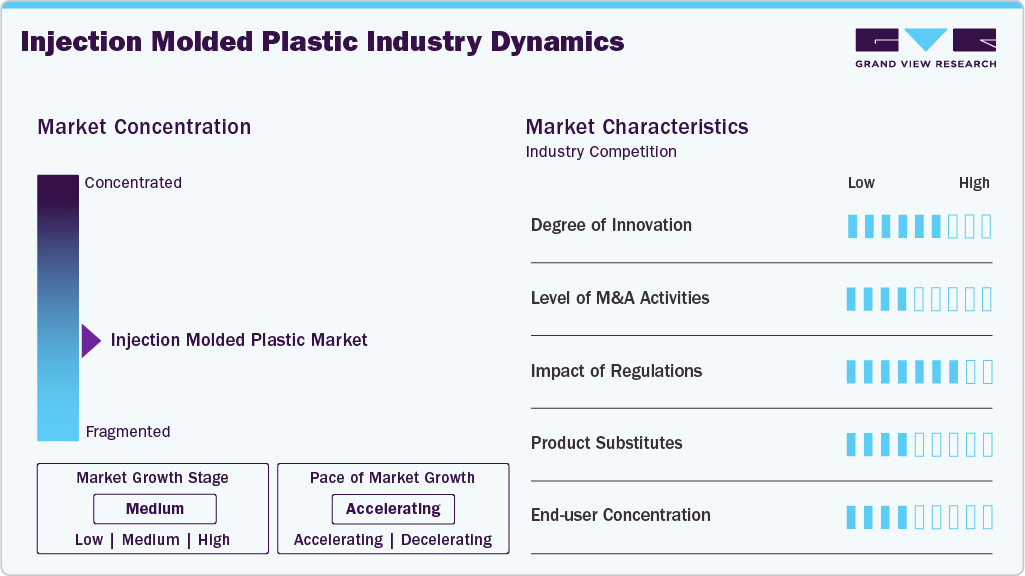
The market growth stage is moderate, and pace of growth is accelerating. The injection molded plastics industry in exhibits fragmentation, with key players dominating the industry landscape. Major companies such as ExxonMobil Corporation, BASF SE, DuPont de Nemours, Inc., Dow, Inc., Huntsman International LLC., Eastman Chemical Company, INEOS Group, LyondellBasell Industries Holdings B.V., SABIC, Magna International, Inc., IAC Group, Berry Global, Inc., Master Molded Products Corporation, HTI Plastics Inc., Rutland Plastics, AptarGroup, Inc., LACKS ENTERPRISES, INC., The Rodon Group, Heppner Molds, and others play a significant role in shaping the market dynamics. These leading players often drive innovation in the market, introducing new products, technologies, and product types to meet the industry's evolving demands.
The injection molded plastics industry is witnessing rapid innovation driven by advancements in materials, processes, and digital manufacturing technologies. Manufacturers are integrating Industry 4.0 tools such as IoT, artificial intelligence, and real-time process monitoring to optimize cycle times, enhance quality, and reduce defects. Novel material developments include high-performance polymers and hybrid compounds that deliver superior strength and thermal resistance for automotive, aerospace, and medical applications. Sustainable innovations, such as recyclable and bio-based resins, also address regulatory and consumer expectations for environmentally responsible products.
 To learn more about this report, Download Free Sample Report
 Injection molded plastics face pressure to be replaced by alternative materials and manufacturing processes that can deliver similar functionality under specific conditions. Additive manufacturing (3D printing) and CNC machining offer design flexibility and low tooling costs for prototyping and low-volume production, reducing the need for traditional molds. Other plastic forming technologies, such as thermoforming, blow molding, and rotational molding, provide cost-effective solutions for larger or hollow parts. In select high-performance markets, metals and composite materials are also considered when superior mechanical or thermal properties are required.
Raw Material Insights
The polypropylene segment led the market with the largest revenue share of 34.97% in 2025, and is forecasted to grow at the fastest CAGR of 4.4% from 2026 to 2033. Polypropylene (PP) continues to gain traction as a preferred raw material in the injection molded plastics industry, due to its strong value proposition across cost, performance, and sustainability metrics. PP’s inherent chemical resistance, low density, and thermal stability make it especially attractive for high-volume automotive interior parts, consumer goods, and packaging closures. Manufacturers benefit from shorter cycle times and lower production costs with high-flow PP grades, supporting expanded use in electrification and multi-component assemblies. The material’s recyclability also aligns with corporate sustainability targets.
The ABS segment is anticipated to grow at a substantial CAGR of 4.1% through the forecast period. Acrylonitrile butadiene styrene (ABS) is emerging as a growth driver in the injection-molded plastics industry, due to its superior mechanical strength and surface finish. The resin’s rigidity and high impact resistance are ideal for housings in consumer electronics, power tools, and structural automotive components. ABS also supports aesthetic customization, enabling painted and plated finishes that appeal to consumer preferences. The expansion of ABS demand is pronounced in emerging markets, where electronics and appliance production are rising.
Application Insights
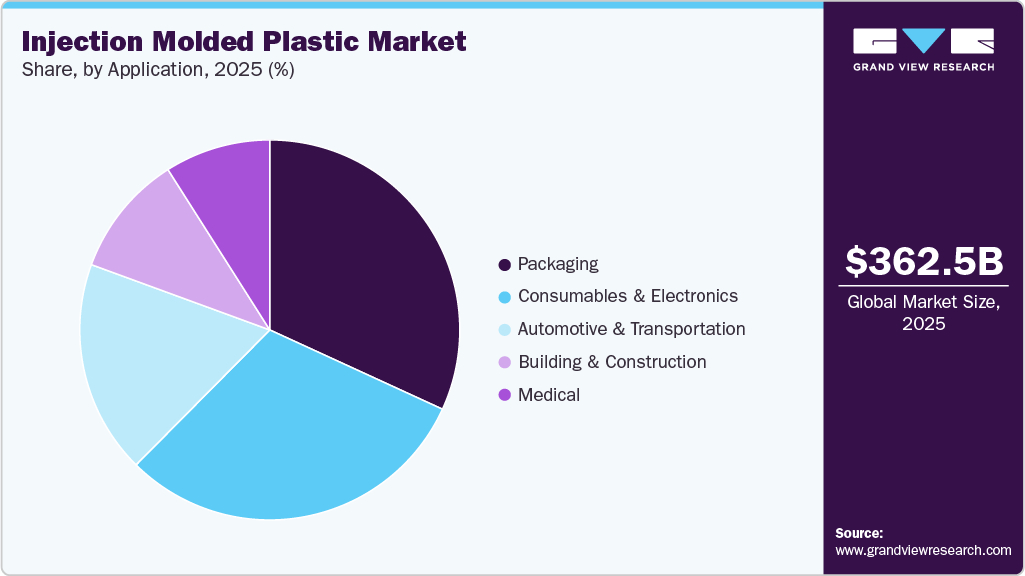
The packaging segment led the market with the largest revenue share of 30.35% in 2025. The packaging segment remains a cornerstone application for injection-molded plastics, driven by escalating demand for lightweight, durable, and customizable packaging solutions. Growth in e-commerce and consumer packaged goods intensifies the need for precision-molded containers, closures, and protective components. Injection molding facilitates high-speed, consistent production that meets rigorous food safety and regulatory standards. Packaging converters are increasingly integrating recyclable polymers to address sustainability mandates from global retailers and regulatory bodies.
 To learn more about this report, Download Free Sample Report
 The medical segment is expected to expand at the fastest 4.6% CAGR over the forecast. The medical application segment is a significant growth driver for injection-molded plastics, driven by robust expansion in healthcare infrastructure and rising demand for disposable medical products. Injection molding delivers the high precision and biocompatibility required for syringes, diagnostic device housings, and surgical instruments. Advances in materials that withstand sterilization protocols enhance adoption. Market expansion is further supported by demographic trends and increasing healthcare expenditure in developed and developing regions, driving consistent demand for quality-assured molded components.
Regional Insights
The injection molded plastic market in North America is anticipated to grow at a lucrative CAGR during the forecast period. In North America, strong demand for high-precision, regulated applications drives consumption of injection-molded plastics. The automotive industry’s focus on light weighting and electrification is driving increased use of engineered polymers in structural and interior parts. Healthcare and medical device production further fuel growth, supported by advanced cleanroom facilities. Technology adoption, including smart manufacturing and automation, enhances yield and quality while boosting competitiveness against imports. This combination of technical complexity and end-use demand sustains market momentum in the region.
U.S. Injection Molded Plastic Market Trends
The injection molded plastic market in the U.S. is driven by the reshoring of manufacturing to enhance supply-chain resilience and reduce logistics costs. Automotive OEMs are increasing local sourcing of injection-molded parts for EVs and advanced systems. Growth in medical devices and diagnostic consumables requires high-quality, compliant molded plastics. Federal initiatives to support domestic manufacturing technologies improve capital investment in advanced molding facilities. Strong consumer electronics and industrial demand further solidify the U.S. position as a core driver within the broader North American landscape.
Asia Pacific Injection Molded Plastic Market Trends
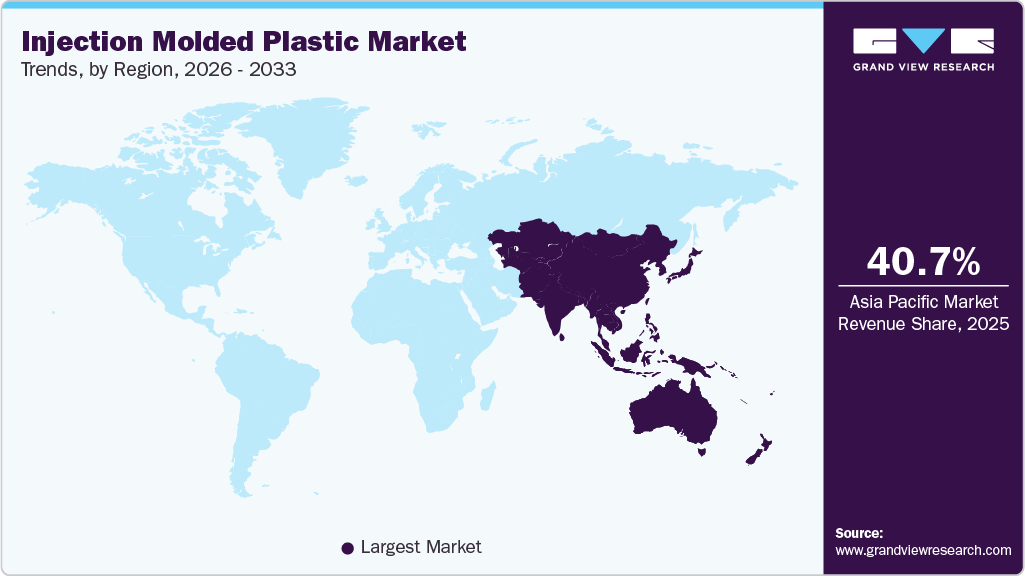
Asia Pacific dominated the global injection molded plastic market with the largest revenue share of 40.74% in 2025, and is expected to grow at the fastest CAGR of 4.9% over the forecast period. Growth in the Asia Pacific market is driven by the region’s dominant manufacturing base and rising industrial activity. The rapid expansion of the automotive, consumer electronics, and packaging sectors in China, India, and Southeast Asia underpins robust demand for injection-molded components. Lower production costs and supportive government policies further attract investment from global OEMs. The region’s increasing adoption of automation and advanced molding technologies also enhances productivity, reinforcing Asia Pacific’s leadership in global output.
 To learn more about this report, Download Free Sample Report
 The injection molded plastic market in China remains a central growth engine for the Asia Pacific region, driven by its vast industrial ecosystem and export-oriented manufacturing. High production volumes in automotive, electronics, and packaging sectors create persistent demand for injection-molded components. China’s robust output of tooling and plastic machinery supports both domestic and international supply chains. Government initiatives to modernize manufacturing infrastructure and increase automation accelerate capacity expansion. Strong local demand paired with competitive cost structures maintains China’s dominant market position.
Europe Injection Molded Plastic Market Trends
The injection molded plastic market in Europe is underpinned by stringent environmental standards and the transition to sustainable materials. Regulatory frameworks are pushing converters to adopt recyclable and bio-based polymers, expanding market scope across automotive, packaging, and consumer goods. Mature automotive supply chains continue integrating high-performance plastics to reduce vehicle weight and emissions. Investments in advanced molding technologies and circular economy initiatives reinforce European competitiveness while aligning with sustainability objectives that shape procurement and design strategies.
Key Injection Molded Plastic Company Insights
The injection molded plastic industry is highly competitive, with several key players dominating the landscape. Major companies include ExxonMobil Corporation, BASF SE, DuPont de Nemours, Inc., Dow, Inc., Huntsman International LLC., Eastman Chemical Company, INEOS Group, LyondellBasell Industries Holdings B.V., SABIC, Magna International, Inc., IAC Group, Berry Global, Inc., Master Molded Products Corporation, HTI Plastics Inc., Rutland Plastics, AptarGroup, Inc., LACKS ENTERPRISES, INC., The Rodon Group, and Heppner Molds.
The injection molded plastic industry is characterized by a competitive landscape with several key players driving innovation and market growth. Major companies in this sector are investing heavily in research and development to enhance the performance, cost-effectiveness, and sustainability of their products.
Key Injection Molded Plastic Companies:
The following key companies have been profiled for this study on the injection molded plastic market.
- ExxonMobil Corporation
- BASF SE
- DuPont de Nemours, Inc.
- Dow, Inc.
- Huntsman International LLC.
- Eastman Chemical Company
- INEOS Group
- LyondellBasell Industries Holdings B.V.
- SABIC
- Magna International, Inc.
- IAC Group
- Berry Global, Inc.
- Master Molded Products Corporation
- HTI Plastics Inc.
- Rutland Plastics
- AptarGroup, Inc.
- LACKS ENTERPRISES, INC.
- The Rodon Group
- Heppner Molds
Recent Developments
-
In October 2024, Milacron debuted an all-electric injection molding machine with mono-sandwich technology at Fakuma 2024. The launch combines energy efficiency with advanced process control to serve high-volume and precision markets, including medical and electronics.
-
In March 2024, Krones completed its acquisition of Netstal, strengthening Krones’ injection-molding technology portfolio and enabling integrated blow and injection molding solutions for beverage and packaging customers. The deal accelerates Krones’ vertical offering and tooling capabilities.
Injection Molded Plastic Market Report Scope
Report Attribute
Details
Market size in 2025
USD 362.5 billion
Market size value in 2026
USD 367.0 billion
Revenue forecast in 2033
USD 481.4 billion
Growth rate
CAGR of 4.0% from 2026 to 2033
Base year for estimation
2025
Historical data
2021 - 2024
Forecast period
2026 - 2033
Quantitative units
Revenue in USD million/billion, volume in kilotons, and CAGR from 2026 to 2033
Report coverage
Revenue forecast, competitive landscape, growth factors, and trends
Segment included
Raw material, application, region
Regional scope
North America; Europe; Asia Pacific; Central & South America; Middle East & Africa
Country Scope
U.S.; Canada; Mexico; Germany; UK; France; Italy; Spain; Asia Pacific; China; India; Japan; South Korea; Brazil; Argentina; Saudi Arabia
Key companies profiled
ExxonMobil Corporation; BASF SE; DuPont de Nemours, Inc.; Dow, Inc.; Huntsman International LLC.; Eastman Chemical Company; INEOS Group; LyondellBasell Industries Holdings B.V.; SABIC; Magna International, Inc.; IAC Group; Berry Global, Inc.; Master Molded Products Corporation; HTI Plastics Inc.; Rutland Plastics; AptarGroup, Inc.; LACKS ENTERPRISES, INC.; The Rodon Group; Heppner Molds
Customization scope
Free report customization (equivalent to up to 8 analyst working days) with purchase. Addition or alteration to country, regional & segment scope
Pricing and purchase options
Avail customized purchase options to meet your exact research needs. Explore purchase options
Global Injection Molded Plastic Market Report Segmentation
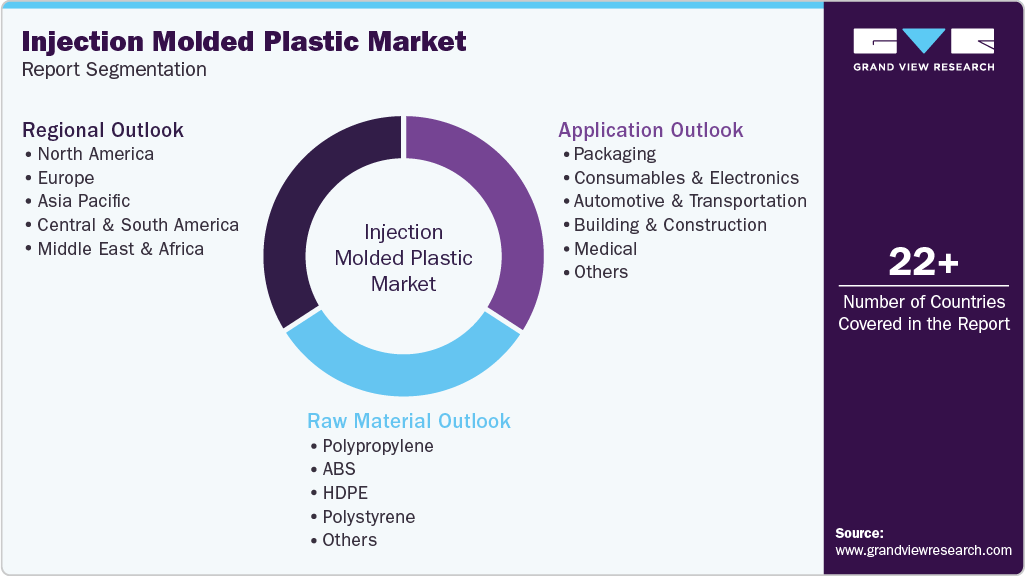
This report forecasts revenue growth at the global, regional, and country levels and provides an analysis of the latest industry trends across sub-segments from 2021 to 2033. For this study, Grand View Research has segmented the global injection molded plastic market report based on raw material, application, and region:
 To learn more about this report, Download Free Sample Report
 -
Raw Material Outlook (Volume, Kilotons; Revenue, USD Million, 2021 - 2033)
-
Polypropylene
-
ABS
-
HDPE
-
Polystyrene
-
Others
-
-
Application Outlook (Volume, Kilotons; Revenue, USD Million, 2021 - 2033)
-
Packaging
-
Consumables & Electronics
-
Automotive & Transportation
-
Building & Construction
-
Medical
-
Others
-
-
Regional Outlook (Volume, Kilotons; Revenue, USD Million, 2021 - 2033)
-
North America
-
U.S.
-
Canada
-
Mexico
-
-
Europe
-
Germany
-
UK
-
France
-
Italy
-
Spain
-
-
Asia Pacific
-
China
-
India
-
Japan
-
South Korea
-
-
Central & South America
-
Brazil
-
Argentina
-
-
Middle East & Africa
-
Saudi Arabia
-
-
Frequently Asked Questions About This Report
Key factors include rising demand for mass-produced and cost-efficient components, increasing adoption of lightweight materials in automotive applications, growing demand from the packaging industry, expansion of consumer goods manufacturing, and increasing use of sustainable and recyclable plastic materials.
The global injection molded plastic market is expected to grow at a CAGR of 4.0% from 2026 to 2033, reaching USD 481.4 billion.
The polypropylene segment led with a (35.0%) revenue share in 2025 and is the fastest-growing segment.
The packaging segment led with a 30.4% revenue share in 2025, while the medical segment is the fastest-growing segment.
Asia Pacific dominated with a 40.7% revenue share in 2025.
Key players include ExxonMobil Corporation, BASF SE, DuPont de Nemours, Inc., Dow, Inc., Huntsman International LLC, Eastman Chemical Company, INEOS Group, LyondellBasell Industries Holdings B.V., SABIC, Magna International, Inc., IAC Group, Berry Global, Inc., AptarGroup, Inc., The Rodon Group, and Heppner Molds.
The global injection molded plastic market size was valued at USD 362.5 billion in 2025 and is estimated at USD 367.0 billion for 2026.
About the Author(s)
Plastics, Polymers & Resins Research Team
Bulk Chemicals · Plastics, Polymers & ResinsThis report was authored by the plastics, polymers & resins research team at Grand View Research - comprising two research analysts, one senior research analyst, and one industry expert - with specialized expertise in the plastics, polymers & resins segment of the bulk chemicals industry. All findings are based on proprietary bulk chemicals databases, executive interviews, and regulatory analysis, subject to internal peer review prior to publication.
Last Updated:
Speak to Analyst

Customize this report to your needs - add regions, segments, or data points, with 20% free customization.
Or view our licence options:


ISO 9001:2015 & 27001:2022 Certified
We are GDPR and CCPA compliant! Your transaction & personal information is safe and secure. For more details, please read our privacy policy.


