
- Home
- »
- Automotive & Transportation
- »
-
Interconnect, Passive & Electromechanical (IP&E) Component Market Report 2033GVR Report cover

Interconnect, Passive And Electromechanical (IP&E) Component Market (2026 - 2033)
Size, Share & Trends Analysis Report By Product Type (Interconnect Components, Passive Components), By Mounting Type (On-board, Off-board), By Sales Channel, By End-use, By Region, And Segment Forecasts
Market Size, 2025
$237.4BMarket Estimate, 2026
$248.5BMarket Forecast, 2033
$361.6BCAGR, 2026–2033
5.5%Interconnect, Passive & Electromechanical (IP&E) Component Market Summary
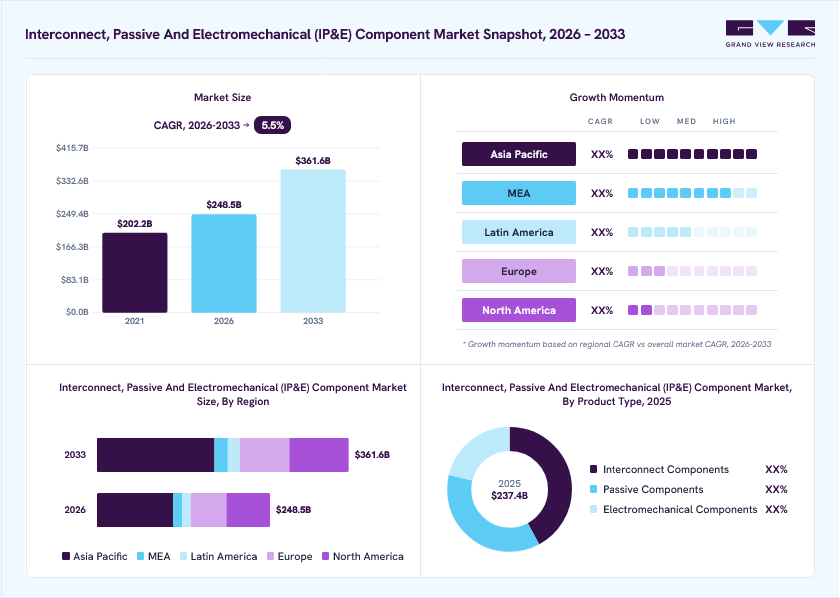
The global Interconnect, Passive and Electromechanical (IP&E) component market size was valued at USD 237.4 billion in 2025 and is projected to grow from USD 248.5 billion in 2026 to USD 361.6 billion by 2033, at a CAGR of 5.5% from 2026 to 2033. Asia Pacific dominated the market with the largest revenue share of 43.8% in 2025. The IP&E components market is experiencing steady growth, driven by the increasing adoption of advanced electronic systems across industries such as automotive, consumer electronics, telecommunications, industrial automation, aerospace & defense, healthcare, and data centers.
 Source: Grand View Research, IR Documents, Primary Interviews, Paid DatabasesTo learn more about this report,
 Download Free Sample Report
 Key Market Trends & Insights
- By product type: Interconnect Components segment held the largest revenue share of 42.1% in 2025.
- By mounting type: On-Board segment held largest share of 68.5% in 2025.
- By sales channel: Distribution Sales segment led the market with the largest revenue share of 61.3% in 2025.
- By end use: Consumer Electronics segment led the market with the largest revenue share of 24.6% in 2025.
Regional Highlights
- Largest regional market: Asia Pacific (43.8% revenue share, 2025)
- By country: China held the largest market share in 2025
Market Size & Forecast
- Market size in 2025: USD 237.4 Billion
- Estimated market size in 2026: USD 248.5 Billion
- Projected market size by 2033: USD 361.6 Billion
- CAGR (2026-2033): 5.5%
Three ways to get this report
Buy it, customize it, or ask a question.Ask an Analyst
A direct answer, usually in 1 working day
- AccessReport author, directly
- Reply timeWithin 1 working day
- No sales callDirect answer only
- FormatEmail reply
- CostFree, no cost
Get the Full Report
What the study covers
- FormatsPDF · Excel · Dashboard
- Timeline2026–2033 annual, 2025 base
- Coverage20+ countries, 5 regions
- Companies10+ key players profiled
Customize the Report
20% free customization
- IncludeCountries, segments, points
- TailorTo your product definition
- ExtendDeeper competitor detail
- OrA fully bespoke study
- Turnaround5–10 working days
The rapid proliferation of electric vehicles (EVs), 5G infrastructure, AI-enabled computing, IoT devices, and Industry 4.0 technologies is significantly increasing the demand for high-performance connectors, passive components, relays, switches, sensors, and power distribution devices.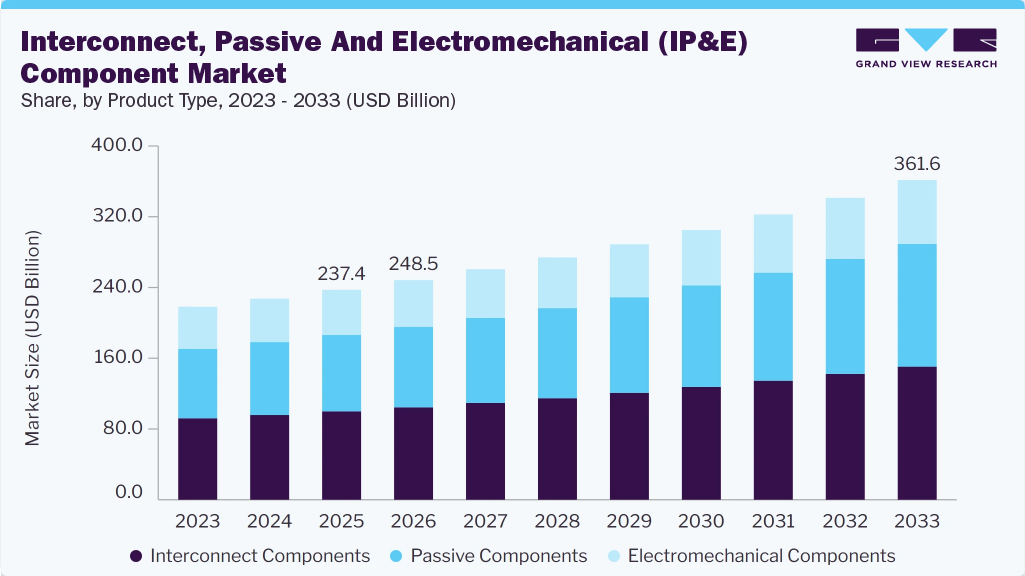 To learn more about this report, Download Free Sample Report
 The demand for IP&E components is rising rapidly due to the increasing integration of electronic systems across automotive, consumer electronics, industrial automation, telecommunications, aerospace & defense, healthcare, and data center applications. The growing adoption of electric vehicles (EVs), 5G networks, artificial intelligence (AI), Internet of Things (IoT) devices, and Industry 4.0 technologies has significantly increased the need for reliable connectors, passive components, relays, switches, sensors, and power distribution devices that ensure efficient power delivery, signal transmission, and system reliability.
The ongoing trend toward miniaturization, higher power density, and enhanced electronic functionality has accelerated the demand for advanced IP&E components capable of supporting compact device architectures and high-speed communication. Manufacturers are increasingly developing high-performance components with improved thermal management, electromagnetic compatibility (EMC), and durability to meet the evolving requirements of next-generation electronic systems. Additionally, rapid growth in cloud computing, hyperscale data centers, renewable energy infrastructure, and industrial automation is creating substantial opportunities for IP&E component suppliers.
Market Dynamics
The Interconnect, Passive & Electromechanical (IP&E) Components Market is witnessing significant growth, driven by the rapid expansion of electronics manufacturing, increasing adoption of electric vehicles (EVs), deployment of 5G networks, growth in AI-driven data centers, and the accelerating digital transformation across industries. IP&E components-including connectors, passive components, relays, switches, sensors, and power distribution devices-serve as the backbone of modern electronic systems by enabling reliable power distribution, signal transmission, and circuit protection. The growing demand for compact, energy-efficient, and high-performance electronic devices is encouraging manufacturers to develop miniaturized, high-speed, and highly reliable IP&E solutions. However, raw material price volatility, supply chain disruptions, and geopolitical uncertainties continue to pose challenges for market participants. Meanwhile, increasing investments in semiconductor manufacturing, renewable energy, industrial automation, and next-generation communication infrastructure are creating significant growth opportunities.
The rapid growth of electric vehicles, autonomous driving technologies, AI computing infrastructure, and Industry 4.0 is significantly driving demand for IP&E components. Modern electronic systems require high-performance connectors, capacitors, resistors, inductors, relays, switches, and sensors to ensure efficient power management, reliable connectivity, and signal integrity. The expansion of hyperscale data centers, cloud computing, 5G base stations, industrial robotics, and IoT-enabled devices has further increased the need for advanced IP&E solutions capable of supporting higher power density, faster data transmission, and improved thermal performance. Continuous innovation in component miniaturization and high-speed connectivity is further accelerating market growth.
Despite strong demand, the IP&E Components Market faces challenges associated with supply chain disruptions and fluctuations in the prices of key raw materials such as copper, aluminum, nickel, rare earth elements, and specialty ceramics. Global geopolitical tensions, semiconductor shortages, and logistics constraints can impact component availability, increase manufacturing costs, and extend lead times. In addition, the growing complexity of electronic systems requires continuous investment in research and development to meet evolving performance, reliability, and regulatory requirements, increasing operational costs for manufacturers.
The ongoing adoption of Industry 4.0, smart factories, renewable energy systems, AI infrastructure, and advanced telecommunications networks presents substantial growth opportunities for the IP&E Components Market. Increasing investments in electric vehicles, energy storage systems, charging infrastructure, data centers, industrial automation, and smart grid technologies are driving demand for high-performance interconnect, passive, and electromechanical components. Furthermore, advancements in miniaturized components, high-speed connectors, intelligent sensors, and high-efficiency power management solutions are enabling manufacturers to address the evolving requirements of next-generation electronic applications, creating long-term growth opportunities across global markets
Market Concentration & Characteristics
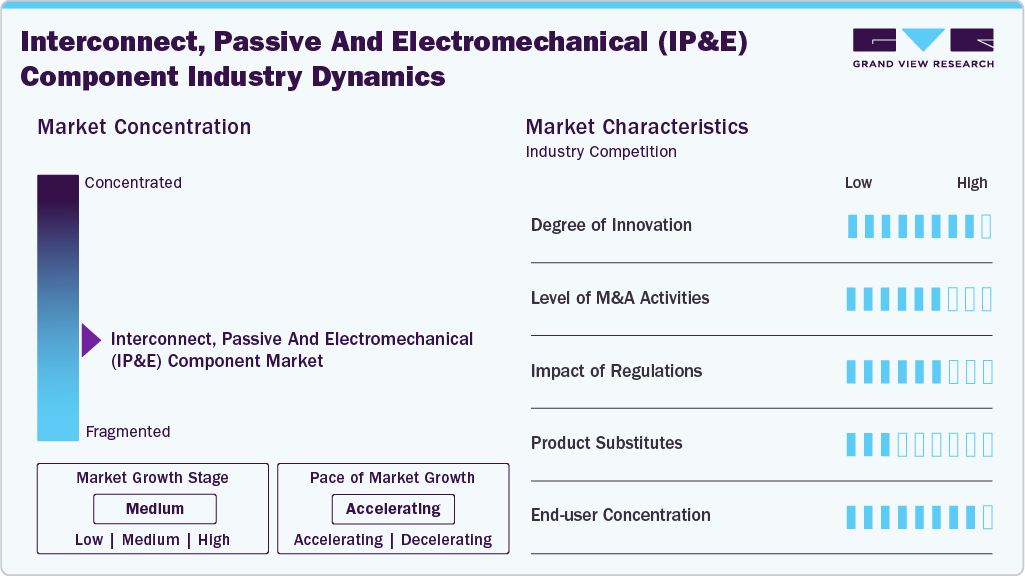
The Interconnect, Passive & Electromechanical (IP&E) Components Market is moderately concentrated, with competition led by a combination of global component manufacturers specializing in interconnect, passive, and electromechanical technologies. The market is characterized by continuous innovation in high-speed connectivity, miniaturized passive components, advanced sensing technologies, high-reliability electromechanical devices, and power management solutions. Although regional manufacturers and niche suppliers continue to expand their presence, established players maintain a competitive advantage through broad product portfolios, strong manufacturing capabilities, extensive global distribution networks, long-term OEM relationships, and significant investments in research and development.
 To learn more about this report, Download Free Sample Report
 Major companies including TE Connectivity, Amphenol, Molex, Aptiv, Yazaki, Sumitomo Electric, Foxconn Interconnect Technology, Murata Manufacturing, TDK Corporation, Yageo Corporation, Vishay Intertechnology, KYOCERA AVX, Littelfuse, Samtec, and Rosenberger continue to strengthen their market position through product innovation, capacity expansion, strategic acquisitions, and partnerships with automotive, telecommunications, industrial automation, consumer electronics, aerospace & defense, and data center customers. These companies are increasingly focusing on developing high-speed connectors, advanced passive components, intelligent sensors, circuit protection devices, and high-efficiency power distribution solutions to support next-generation applications such as electric vehicles, AI infrastructure, 5G communications, cloud computing, and Industry 4.0. As demand for advanced electronic systems continues to increase, the market is expected to witness sustained investments in manufacturing expansion, supply chain localization, and technological innovation throughout the forecast period.
Analyst Perspective
The Interconnect, Passive & Electromechanical (IP&E) Components Market is poised for sustained growth, driven by the rapid expansion of electric vehicles (EVs), AI infrastructure, 5G networks, industrial automation, and consumer electronics. Increasing demand for high-speed connectivity, efficient power management, and miniaturized electronic systems is accelerating the adoption of advanced connectors, passive components, and electromechanical devices. Continuous innovation in component design, materials, and manufacturing technologies is improving product reliability, thermal performance, and energy efficiency. Additionally, investments in semiconductor manufacturing, data centers, renewable energy, and smart infrastructure are creating significant opportunities for market participants. Despite challenges related to supply chain disruptions and raw material price volatility, the market outlook remains positive, supported by ongoing digital transformation and the growing electrification of industries worldwide.
Product Types Insights
Based on Product Type, the Interconnect Components segment accounted for the largest revenue share of 42.1% in 2025. The segment includes connectors, cable assemblies, sockets, and other connectivity solutions used across electronic systems. Growing demand for high-speed data transmission, reliable connectivity, and compact electronic designs is supporting segment growth. Increasing adoption across automotive, consumer electronics, industrial automation, telecommunications, and data center applications continues to drive demand. Continuous product innovation focused on miniaturization, higher bandwidth, and improved durability further strengthens the segment's market position.
The Passive Components segment is expected to witness significant growth during the forecast period. Rising demand for capacitors, resistors, inductors, and other passive devices across automotive, consumer electronics, industrial, and telecommunications applications is supporting market expansion. Increasing electronic content in modern devices and the trend toward miniaturization are driving component adoption. Manufacturers are focusing on developing high-performance, compact, and energy-efficient passive components to meet evolving industry requirements. Continuous advancements in electronic technologies are expected to sustain the segment's growth over the forecast period.
Mounting Type Insights
Based on Mounting Type, the on-board segment led the market with the largest revenue share of 68.5% in 2025. The segment's growth is driven by the increasing integration of electronic components directly into automotive systems, consumer electronics, industrial equipment, telecommunications hardware, medical devices, and aerospace & defense platforms. The rapid adoption of electric vehicles (EVs), advanced driver assistance systems (ADAS), AI-enabled computing, and IoT devices has significantly increased the demand for on-board connectors, passive components, sensors, relays, and power management devices.
The Off-board segment is expected to witness significant growth during the forecast period. The growth is driven by increasing investments in electric vehicle charging infrastructure, data centers, industrial automation, renewable energy systems, and telecommunications networks. Rising demand for external connectivity solutions, cable assemblies, power distribution devices, and charging interfaces is accelerating the adoption of off-board IP&E components.
Sales Channel Insights
Based on Sales Channel, the distribution sales segment led the market with the largest revenue share of 61.3% in 2025. The segment's growth is driven by the extensive global distribution networks that enable manufacturers to efficiently serve a broad customer base, including OEMs, electronics manufacturing services (EMS) providers, industrial customers, and small and medium-sized enterprises. Authorized distributors provide access to a wide portfolio of IP&E components, technical support, inventory management, and rapid product availability, helping customers streamline procurement and reduce supply chain complexities.
The direct sales segment is expected to witness significant growth during the forecast period. The growth is driven by increasing procurement of IP&E components by large OEMs and multinational manufacturers through long-term supply agreements and strategic partnerships. Direct sales enable customized product offerings, technical collaboration, reliable supply, and better pricing for high-volume customers across the automotive, telecommunications, industrial automation, aerospace & defense, and data center industries.
End Use Insights
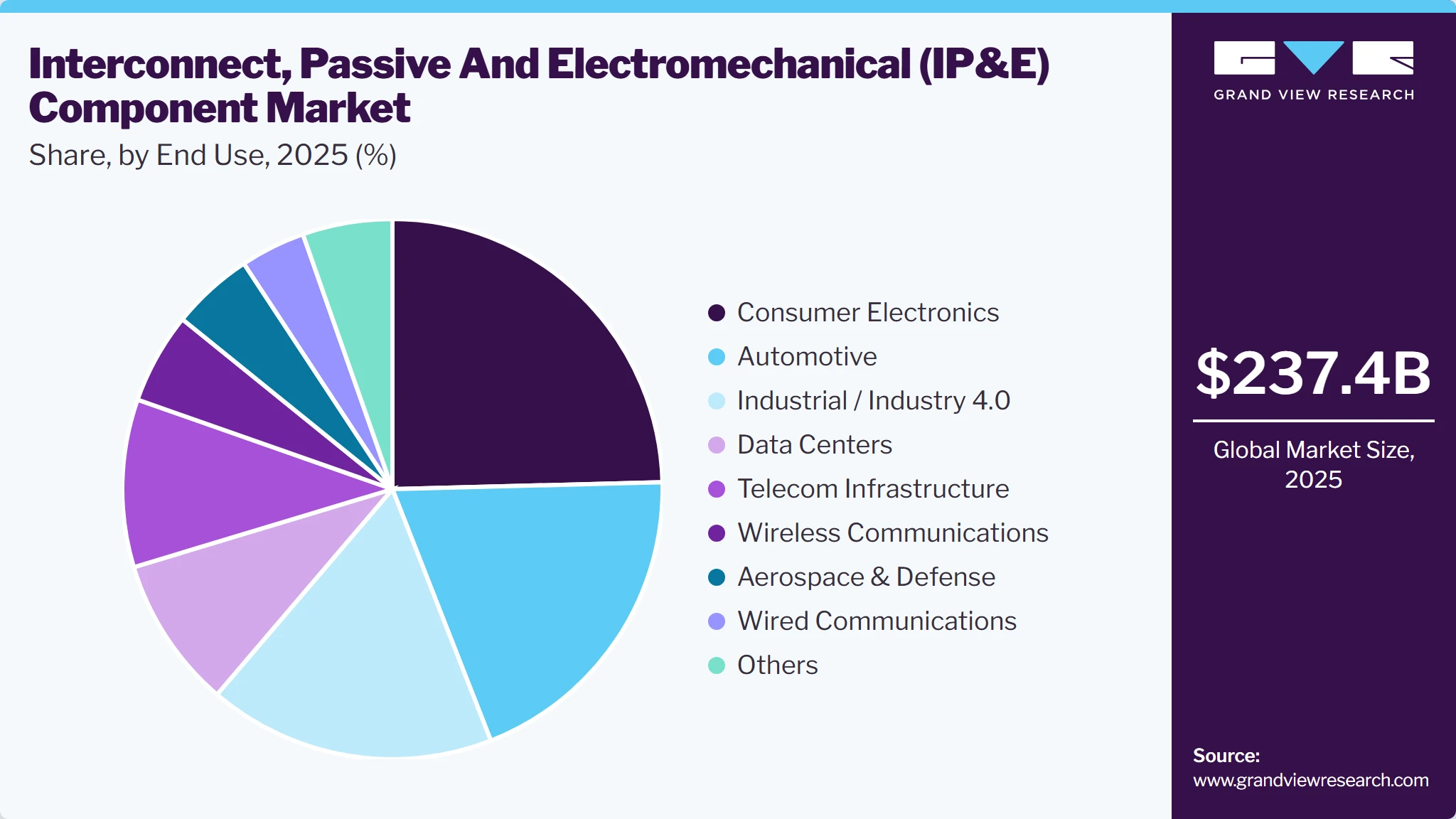
Based on end use, the consumer electronics segment led the market with the largest revenue share of 24.6% in 2025. The segment's growth is driven by the rising production and adoption of smartphones, laptops, tablets, wearables, gaming devices, smart home products, and other connected consumer electronics. These devices require a wide range of connectors, passive components, switches, sensors, and power management solutions to ensure reliable performance, compact designs, and energy efficiency.
 To learn more about this report, Download Free Sample Report
 The Data Centers segment is expected to witness significant growth during the forecast period. Rising deployment of cloud computing, artificial intelligence (AI), and high-performance computing infrastructure is increasing demand for advanced IP&E components. High-speed connectors, cable assemblies, passive components, and power distribution solutions are essential for ensuring reliable data transmission and efficient power management. Growing investments in hyperscale and edge data centers are further supporting segment growth. Continuous advancements in high-speed connectivity and power-efficient infrastructure are expected to drive demand over the forecast period.
Regional Insights
Asia Pacific dominated the interconnect, passive & electromechanical (IP&E) components market, accounting for the largest revenue share of 43.8% in 2025. The region's leadership is driven by its strong electronics manufacturing base, expanding automotive production, and growing demand for consumer electronics and industrial equipment. Countries such as China, Japan, South Korea, and Taiwan serve as major manufacturing hubs for electronic components and devices. Increasing investments in semiconductor production, electric vehicles, and communication infrastructure continue to support regional market growth.
 To learn more about this report, Download Free Sample Report
 U.S. Interconnect, Passive & Electromechanical (IP&E) Component Market Trends
The U.S. Interconnect, Passive & Electromechanical (IP&E) Components Market is characterized by strong demand from the automotive, aerospace & defense, telecommunications, data center, industrial automation, and medical technology sectors. The rapid expansion of AI infrastructure, hyperscale cloud data centers, electric vehicles (EVs), advanced driver assistance systems (ADAS), and 5G networks is driving the adoption of high-performance connectors, passive components, sensors, relays, and power distribution devices.
Europe Interconnect, Passive & Electromechanical (IP&E) Component Market Trends
The Europe Interconnect, Passive & Electromechanical (IP&E) Components Market is characterized by increasing investments in automotive electrification, industrial automation, renewable energy, aerospace & defense, and advanced telecommunications infrastructure. The region is witnessing growing demand for high-performance connectors, passive components, sensors, relays, and power distribution devices as manufacturers accelerate the adoption of Industry 4.0 technologies, electric vehicles (EVs), smart factories, and energy-efficient electronic systems.
North America Interconnect, Passive & Electromechanical (IP&E) Component Market Trends
North America holds a significant share of the Interconnect, Passive & Electromechanical (IP&E) Components market, supported by the presence of leading component manufacturers and a well-established electronics ecosystem. The region has strong demand from data centers, aerospace and defense, automotive, industrial automation, telecommunications, and healthcare industries. Increasing adoption of advanced electronic systems, AI infrastructure, cloud computing, and electric vehicles continues to support demand for high-performance interconnect, passive, and electromechanical components.
Key Interconnect, Passive & Electromechanical (IP&E) Component Company Insights
Key Interconnect, Passive & Electromechanical (IP&E) Components Market companies include TE Connectivity, Amphenol, Molex, and Murata Manufacturing, among others.
-
TE Connectivity is a provider of connectivity and sensor solutions, offering an extensive portfolio of connectors, relays, sensors, antennas, and passive components. The company serves automotive, industrial, aerospace & defense, medical, data communications, and energy markets, with a strong focus on high-speed connectivity, miniaturization, and next-generation electronic systems.
-
Amphenol specializes in the design and manufacture of advanced interconnect solutions, including connectors, cable assemblies, antennas, sensors, and high-speed communication products. The company serves diverse industries such as automotive, telecommunications, data centers, aerospace & defense, industrial automation, and mobile devices, continuously expanding its portfolio through innovation and strategic acquisitions.
Key Interconnect, Passive & Electromechanical (IP&E) Component Companies
The following key companies have been profiled for this study of the interconnect, passive & electromechanical (IP&E) component market.
-
TE Connectivity
-
Amphenol
-
Molex
-
Aptiv
-
Yazaki
-
Sumitomo Electric
-
Foxconn Interconnect Technology
-
Murata Manufacturing
-
TDK Corporation
-
Yageo Corporation
-
Vishay Intertechnology
-
KYOCERA AVX
-
Littelfuse
-
Samtec
-
Rosenberger
Competitive Benchmarking
Operating Strategies
Competitive Edge
Weaknesses
Established Players (TE Connectivity, Amphenol, Molex, Murata Manufacturing, TDK Corporation, Sumitomo Electric, Yazaki)
- Focus on expanding product portfolios across interconnect, passive, and electromechanical components through continuous investments in R&D, advanced manufacturing, product miniaturization, high-speed connectivity, and power management technologies.
- Emphasize strategic acquisitions, long-term OEM partnerships, global manufacturing expansion, and supply chain optimization to strengthen market presence.
- Strong global brand recognition, diversified product portfolios, extensive manufacturing capabilities, well-established distribution networks, long-standing relationships with automotive, industrial, telecommunications, aerospace & defense, and consumer electronics OEMs, along with significant financial resources that support continuous innovation.
- High capital expenditure requirements, exposure to raw material price volatility, global supply chain disruptions, geopolitical risks, and the need for continuous investment in advanced manufacturing technologies to remain competitive.
Emerging & Specialized Players (Aptiv, Foxconn Interconnect Technology, Yageo Corporation, Vishay Intertechnology, KYOCERA AVX, Littelfuse, Samtec, Rosenberger)
- Focus on specialized high-performance IP&E solutions for electric vehicles, AI infrastructure, industrial automation, data centers, telecommunications, and high-speed networking.
- Invest in product innovation, application-specific designs, manufacturing expansion, strategic collaborations, and customer-specific engineering solutions to strengthen competitive positioning.
- Strong technical expertise in niche product segments, faster product development cycles, flexibility in serving specialized applications, expanding global customer base, and the ability to capitalize on growing demand for advanced connectivity and power management solutions.
- Comparatively smaller global footprint than leading diversified manufacturers, dependence on specific end-use industries, increasing pricing pressure, supply chain challenges, and the need for ongoing investment in capacity expansion, technology development, and global market penetration.
Recent Developments
-
In February 2026, TE Connectivity acquired key electric vehicle (EV) charging inlet assets from Phoenix Contact E-Mobility GmbH to strengthen its e-mobility portfolio and expand its capabilities in EV charging connectivity solutions. The acquisition enhances TE Connectivity's ability to support global automotive OEMs and reinforces its position in the rapidly growing electric mobility market.
-
In January 2026, Amphenol Corporation completed the acquisition of CommScope's Connectivity and Cable Solutions (CCS) business. The acquisition significantly expands Amphenol's fiber-optic interconnect and cable solution portfolio for AI data centers, communications networks, and industrial applications, further strengthening its position in the global interconnect market.
Interconnect, Passive And Electromechanical (IP&E) Component Market Report Scope
Report Attribute
Details
Market size in 2025
USD 237.4 billion
Estimated market size in 2026
USD 248.5 billion
Projected market size by 2033
USD 361.6 billion
Growth rate
CAGR of 5.5% from 2026 to 2033
Base year for estimation
2025
Actual data
2021 - 2024
Forecast period
2026 - 2033
Quantitative units
Revenue in USD billion/million and CAGR from 2026 to 2033
Report coverage
Revenue forecast, company ranking, competitive landscape, growth factors, and trends
Segments covered
Product types, mounting type, sales channel, end use and region
Regional scope
North America; Europe; Asia Pacific; Latin America; and MEA
Country scope
U.S.; Canada; Europe; UK; Germany; France; China; Japan; India; South Korea; Australia; Brazil; KSA; UAE; South Africa
Key companies profiled
TE Connectivity; Amphenol; Molex; Aptiv; Yazaki; Sumitomo Electric; Foxconn Interconnect Technology; Murata Manufacturing; TDK Corporation; Yageo Corporation; Vishay Intertechnology; KYOCERA AVX; Littelfuse; Samtec; Rosenberger
Customization scope
Free report customization (equivalent up to 8 analysts working days) with purchase. Addition or alteration to country, regional & segment scope.
Pricing and purchase options
Avail customized purchase options to meet your exact research needs. Explore purchase options
Global Interconnect, Passive & Electromechanical (IP&E) Components Market Segmentation
This report forecasts revenue growth at global, regional, and country levels and provides an analysis of the latest industry trends in each of the sub-segments from 2021 to 2033. For this study, Grand View Research has segmented the global interconnect, passive & electromechanical (IP&E) components market report based on product type, mounting type, sales channel, end use, and region:
-
Product Type Outlook (Revenue, USD Billion, 2021 - 2033)
-
Interconnect Components
-
Connectors
-
Cable Assemblies
-
Sockets & Backplanes
-
-
Passive Components
-
Capacitors
-
Resistors
-
Magnetics
-
Circuit Protection
-
Others
-
-
Electromechanical Components
-
Switches
-
Relays
-
Sensors
-
Power Distribution Devices
-
Others
-
-
-
Mounting Type Outlook (Revenue, USD Billion, 2021 - 2033)
-
On-board
-
Off-board
-
-
Sales Channel Outlook (Revenue, USD Billion, 2021 - 2033)
-
Distribution Sales
-
Direct Sales
-
-
End Use Outlook (Revenue, USD Billion, 2021 - 2033)
-
Consumer Electronics
-
Automotive
-
Industrial / Industry 4.0
-
Telecom Infrastructure
-
Data Centers
-
Wired Communications
-
Wireless Communications
-
Aerospace & Defense
-
Others
-
-
Regional Outlook (Revenue, USD Billion, 2021 - 2033)
-
North America
-
U.S.
-
Canada
-
Mexico
-
-
Europe
-
UK
-
Germany
-
France
-
-
Asia Pacific
-
China
-
Japan
-
India
-
South Korea
-
Australia
-
-
Latin America
-
Brazil
-
-
Middle East and Africa (MEA)
-
KSA
-
UAE
-
South Africa
-
-
Research Methodology
The interconnect, passive & electromechanical (IP&E) components market figures in this report are based on a proven research process that combines executive interviews with secondary research from proprietary databases, company filings, and recognized regulatory and institutional sources. Market size is built through value-chain sizing-reconciling supply-side and demand-side estimates-and triangulated with bottom-up and top-down approaches. Every estimate passes multiple levels of expert validation before publication, with each interconnect, passive & electromechanical (IP&E) components segment quantified using the revenue-capture definitions in the table below.
Segment Definition
Segment - Product Type
Revenue capture definition
Interconnect Components
Revenue in the Interconnect Components segment is generated through the design, manufacturing, and sale of components that enable reliable electrical and data connectivity between electronic systems and devices. These products include connectors, cable assemblies, sockets, and backplanes, which are essential for power transmission, high-speed data transfer, and signal integrity across a wide range of applications. The segment serves industries such as automotive, consumer electronics, telecommunications, data centers, industrial automation, aerospace & defense, healthcare, and renewable energy.
Passive Components
Revenue in the Passive Components segment is generated through the design, manufacturing, and sale of electronic components that regulate, store, filter, and protect electrical energy within electronic circuits. These components include capacitors, resistors, magnetics (inductors and transformers), and circuit protection devices used across a broad range of applications. The segment serves diverse end-use industries, including consumer electronics, automotive, industrial automation, telecommunications, aerospace & defense, healthcare, data centers, and renewable energy.
Electromechanical Components
Revenue in the Electromechanical Components segment is generated through the design, manufacturing, and sale of components that provide switching, sensing, control, and power distribution functions in electronic and electrical systems. These products include switches, relays, sensors, and power distribution devices, which are essential for ensuring reliable operation, automation, safety, and power management across diverse applications. The segment serves industries such as automotive, industrial automation, telecommunications, aerospace & defense, consumer electronics, healthcare, data centers, and renewable energy.
Segment - Mounting Type
Revenue capture definition
On-board
Revenue in the On-board segment is generated through the integration of interconnect, passive, and electromechanical components directly into electronic systems and equipment. These components are embedded within applications such as automotive electronics, consumer devices, industrial machinery, telecommunications equipment, medical devices, aerospace & defense systems, and data center hardware to enable power management, signal transmission, sensing, switching, and circuit protection.
Off-board
Revenue in the Off-board segment is generated through the deployment of interconnect, passive, and electromechanical components in external infrastructure and peripheral systems that support power distribution, connectivity, and communication. These applications include EV charging infrastructure, data centers, telecommunications networks, industrial control systems, renewable energy installations, smart grid infrastructure, and external power management equipment.
Segment - Sales Channel
Revenue capture definition
Distribution Sales
Revenue in the Distribution Sales segment is generated through the sale of interconnect, passive, and electromechanical components via authorized distributors, value-added resellers, and global component distribution networks. These channels provide a broad portfolio of products, including connectors, passive components, relays, switches, sensors, and power distribution devices, along with inventory management, technical support, logistics, and rapid product availability
Direct Sales
Revenue in the Direct Sales segment is generated through the direct supply of interconnect, passive, and electromechanical components from manufacturers to original equipment manufacturers (OEMs), large enterprises, and strategic customers. This sales channel supports high-volume procurement, long-term supply agreements, customized component solutions, engineering collaboration, and dedicated technical support. Direct sales are widely adopted across automotive, telecommunications, industrial automation, aerospace & defense, data centers, healthcare, and consumer electronics industries, where customers require application-specific products, assured supply, and close collaboration with component manufacturers
Segment - End Use
Revenue capture definition
Consumer Electronics
Revenue in the Consumer Electronics segment is generated through the use of interconnect, passive, and electromechanical components in a wide range of electronic devices, including smartphones, laptops, tablets, wearable devices, gaming consoles, smart TVs, home appliances, and smart home products. These components enable reliable power management, signal transmission, connectivity, sensing, and circuit protection, ensuring the performance and efficiency of modern consumer devices.
Automotive
Revenue in the Automotive segment is generated through the integration of interconnect, passive, and electromechanical components in conventional, hybrid, and electric vehicles. These components are used in battery management systems (BMS), advanced driver assistance systems (ADAS), infotainment systems, powertrain electronics, lighting systems, vehicle connectivity, safety systems, and onboard charging applications
Industrial / Industry 4.0
Revenue in the Industrial / Industry 4.0 segment is generated through the deployment of interconnect, passive, and electromechanical components in industrial automation systems, robotics, programmable logic controllers (PLCs), factory equipment, industrial IoT (IIoT) devices, motor drives, and smart manufacturing infrastructure. These components enable reliable power distribution, high-speed data transmission, sensing, switching, and circuit protection, ensuring efficient and uninterrupted industrial operations.
Telecom Infrastructure
Revenue in the Telecom Infrastructure segment is generated through the deployment of interconnect, passive, and electromechanical components in 5G and 4G base stations, fiber-optic networks, communication towers, small cells, network switches, routers, and transmission equipment. These components provide reliable power distribution, high-speed signal transmission, connectivity, circuit protection, and thermal management essential for modern telecommunications networks
Data Centers
Revenue in the Data Centers segment is generated through the deployment of interconnect, passive, and electromechanical components in servers, storage systems, networking equipment, power distribution units (PDUs), cooling systems, and rack infrastructure. These components enable high-speed data transmission, reliable power management, circuit protection, and efficient system connectivity required for uninterrupted data center operations.
Wired Communications
Revenue in the Wired Communications segment is generated through the deployment of interconnect, passive, and electromechanical components in Ethernet networks, fiber-optic communication systems, broadband infrastructure, enterprise networking equipment, routers, switches, and communication cables. These components ensure reliable signal transmission, high-speed connectivity, power management, and circuit protection across wired communication networks.
Wireless Communications
Revenue in the Wireless Communications segment is generated through the deployment of interconnect, passive, and electromechanical components in wireless base stations, antennas, small cells, Wi-Fi equipment, IoT devices, satellite communication systems, and mobile communication infrastructure. These components enable reliable RF signal transmission, high-speed connectivity, power management, sensing, and circuit protection required for modern wireless networks.
Aerospace & Defense
Revenue in the Aerospace & Defense segment is generated through the deployment of interconnect, passive, and electromechanical components in aircraft systems, military vehicles, satellites, radar systems, avionics, communication equipment, navigation systems, and defense electronics. These components provide high-reliability connectivity, power management, signal integrity, sensing, switching, and circuit protection required for mission-critical applications operating in harsh environments.
Others
Revenue in the Others segment is generated through the deployment of interconnect, passive, and electromechanical components across a diverse range of applications, including healthcare and medical devices, renewable energy systems, railways, marine electronics, building automation, smart infrastructure, consumer appliances, and energy & utilities
Estimation Model
Layer Name
Key Question
Description
Addressable Electronics Manufacturing Base Layer
Which industries require IP&E components?
Identify the global addressable base of industries utilizing IP&E components, including automotive, consumer electronics, industrial automation, telecommunications, data centers, aerospace & defense, healthcare, renewable energy, and networking equipment manufacturers.
IP&E Component Adoption Layer
Which industries are adopting IP&E components?
Apply component penetration rates across end-use industries based on the adoption of connectors, passive components, electromechanical devices, sensors, relays, switches, and power distribution products in electronic systems and equipment.
Component Consumption & Production Layer
How extensively are IP&E components utilized?
Estimate component demand based on electronic device production volumes, average IP&E components per device/system, replacement demand, manufacturing output, and deployment across automotive, industrial, telecom, consumer electronics, and data center applications.
Revenue Generation Layer
How much revenue is generated?
Estimate market revenue by multiplying the shipment volume of interconnect, passive, and electromechanical components by their average selling prices (ASPs), while accounting for OEM sales, distribution channels, aftermarket demand, and value-added products across different end-use industries.
Delivered Customizations
This report has been delivered with the following In-depth customizations
Client Request
Customization Delivered
Value Adds
Competitive Landscape & Strategic Benchmarking
Conducted a comprehensive assessment of leading IP&E component manufacturers, including interconnect, passive, and electromechanical component suppliers. Evaluated competitive positioning, product portfolios, manufacturing capabilities, technology innovations, geographic presence, end-use industry focus, strategic partnerships, acquisitions, distribution networks, and recent product developments to benchmark performance across the global Interconnect, Passive & Electromechanical (IP&E) Components Market.
Enables stakeholders to identify market leaders, benchmark competitors, evaluate strategic partnerships and acquisition opportunities, assess product differentiation, and gain visibility into the evolving competitive landscape of the global IP&E Components Market.
End-Use Demand & Sales Channel Analysis
Assessed demand trends across major end-use industries, including automotive, consumer electronics, industrial automation, telecommunications, data centers, aerospace & defense, healthcare, and renewable energy. Evaluated procurement patterns across direct sales and distribution channels, component demand trends, customer preferences, and key market growth drivers.
Provides actionable insights into demand dynamics, high-growth end-use industries, procurement strategies, and evolving customer requirements, supporting market entry, expansion, and commercialization decisions.
Technology Innovation & Growth Opportunity Assessment
Analyzed the impact of component miniaturization, high-speed connectivity, advanced passive technologies, intelligent sensors, power management solutions, EV electrification, AI infrastructure, 5G deployment, and Industry 4.0 on market evolution. Identified emerging growth opportunities, high-potential application areas, and technology trends shaping the future of the IP&E Components Market.
Supports strategic planning by identifying high-growth investment opportunities, prioritizing product development initiatives, evaluating future revenue streams, and understanding the long-term technological trends driving the global IP&E Components Market.
Frequently Asked Questions About This Report
Asia Pacific is the fastest-growing region over the forecast period.
Key factors that are driving the market growth include rising electronics production, increasing semiconductor investments, growing EV adoption, and expanding data center infrastructure.
Some key players operating in the IP&E Components market include TE Connectivity, Amphenol, Molex, Aptiv, Yazaki, Sumitomo Electric, Foxconn Interconnect Technology, Murata Manufacturing, TDK Corporation, Yageo Corporation, Vishay Intertechnology, KYOCERA AVX, Littelfuse, Samtec, Rosenberger
On-board held the largest revenue share in 2025 and is also the fastest-growing area.
The global Interconnect, Passive and Electromechanical (IP&E) component market size was estimated at USD 237.4 billion in 2025 and is expected to reach USD 248.5 billion in 2026.
The global Interconnect, Passive And Electromechanical Component market is expected to grow at a compound annual growth rate of 5.5% from 2026 to 2033 to reach USD 361.6 billion by 2033.
Asia Pacific dominated the IP&E component market with a share of 43.8% in 2025. This is attributable to the region's strong electronics manufacturing base, expanding semiconductor production, and increasing demand from the automotive and consumer electronics industries.
Interconnect Components held the largest revenue share in 2025, while Passive Components is the fastest-growing area.
Distribution Sales held the largest share in 2025 and is the fastest-growing model.
About the Author(s)
Automotive & Transportation Research Team
Technology · Automotive & TransportationThis report was authored by the automotive & transportation research team at Grand View Research - comprising two research analysts, one senior research analyst, and one industry expert - with specialized expertise in the automotive & transportation segment of the technology industry. All findings are based on proprietary technology databases, executive interviews, and regulatory analysis, subject to internal peer review prior to publication.
Last Updated:
Speak to Analyst

Customize this report to your needs - add regions, segments, or data points, with 20% free customization.
Or view our licence options:


ISO 9001:2015 & 27001:2022 Certified
We are GDPR and CCPA compliant! Your transaction & personal information is safe and secure. For more details, please read our privacy policy.


