
- Home
- »
- Communications Infrastructure
- »
-
Japan Edge Data Center Services Market Report 2026-2033GVR Report cover

Japan Edge Data Center Services Market (2026 - 2033)
Size, Share & Trends Analysis Report By Service Type (Colocation, Hosting & Managed Hosting Services), By Facility Type, By Capacity (Less than 1 MW, 1-5 MW), By End-user (Telecom, Enterprises, Government), And Segment Forecasts
Market Size, 2025
$683.1MMarket Estimate, 2026
$779.6MMarket Forecast, 2033
$2,256.9MCAGR, 2026–2033
16.4%Japan Edge Data Center Services Market Summary
The Japan edge data center services market size was valued at USD 683.1 million in 2025 and is projected to grow from USD 779.6 million in 2026 to USD 2,256.9 million by 2033, at a CAGR of 16.4% from 2026 to 2033.
Key Market Trends & Insights
- By service type: Colocation held the largest revenue share of 54.2% in 2025
- By facility type: Metro edge data centers held the largest market share of 50.2% in 2025
- By capacity: 1-5 MW segment held the largest revenue share of 47.6% in 2025
- By end user: Enterprises held the largest revenue share in 2025
Market Size & Forecast
- Market size in 2025: USD 683.1 Million
- Estimated market size in 2026: USD 779.6 Million
- Projected market size by 2033: USD 2,256.9 Million
- CAGR (2026-2033): 16.4%
Prism AI by Grand View Research Free to tryAsk a question about the japan edge data center services marketTry asking✓Every figure cited from GVR research Prefer the report? Download free sample →
The market is expanding, driven by the rapid acceleration of distributed computing architectures and the increasing demand for ultra-low-latency digital infrastructure. The widespread rollout of 5G networks, coupled with the adoption of Multi-access Edge Computing (MEC), is significantly reshaping network architectures by pushing compute and storage capabilities closer to end users and data generation points.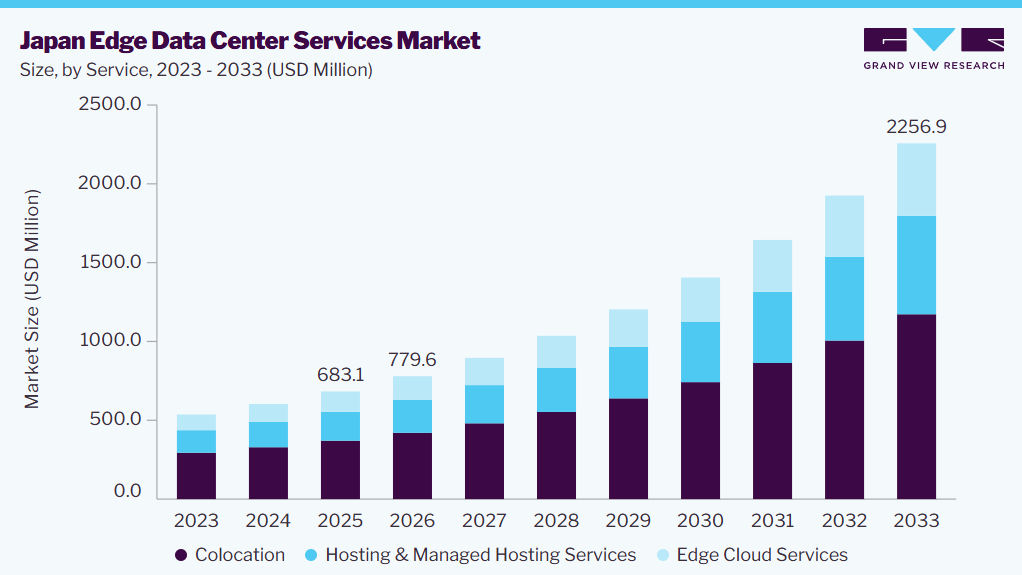 Source: Grand View Research, IR Documents, Primary Interviews, Paid DatabasesTo learn more about this report,
 Download Free Sample Report
The rising demand for real-time analytics is accelerating investments in edge computing infrastructure across Japan. Businesses increasingly depend on immediate access to operational insights to improve decision-making, optimize processes, and enhance customer experiences. Delays associated with transferring data to centralized facilities can limit the effectiveness of real-time analytics applications. Edge data centers allow organizations to process information locally and generate actionable insights with minimal latency. This capability is becoming increasingly valuable in sectors such as manufacturing, transportation, healthcare, finance, and retail. Companies are prioritizing infrastructure solutions that support rapid data analysis and operational responsiveness. This is expanding the deployment of edge data centers and strengthening market demand.
Market Dynamics
The Japan edge data center services market is witnessing robust growth as enterprises, telecom operators, cloud providers, and government agencies accelerate investments in distributed digital infrastructure to support latency-sensitive applications, AI workloads, and next-generation connectivity. The nationwide rollout of 5G networks, combined with increasing adoption of IoT, Industry 4.0, autonomous systems, and smart city initiatives, is driving demand for edge data center services that bring compute, storage, networking, and security closer to end users and connected devices. The growing deployment of hybrid and multi-cloud environments is encouraging organizations to leverage edge facilities for localized data processing, workload distribution, disaster recovery, and seamless cloud integration. The rapid advancement of artificial intelligence (AI), machine learning (ML), and real-time analytics is increasing the need for high-performance edge infrastructure capable of supporting AI inference, computer vision, predictive maintenance, and industrial automation with minimal latency. Organizations are increasingly adopting managed edge services, colocation, edge cloud platforms, and software-defined infrastructure integrated with advanced cybersecurity, Zero Trust architectures, and data sovereignty compliance to enhance operational resilience and regulatory adherence. Rising demand for digital services, including video streaming, online gaming, digital banking, e-commerce, connected healthcare, and enterprise collaboration, is further accelerating investment in scalable, highly available edge infrastructure. Additionally, expanding investments in hyperscale data centers, regional edge nodes, renewable energy-powered facilities, and energy-efficient cooling technologies are strengthening Japan's edge ecosystem, driving widespread adoption of edge data center services across industries such as IT & telecommunications, manufacturing, BFSI, healthcare, retail, government, transportation, and media & entertainment.
The increasing deployment of AI-powered edge data centers across Japan is driven by the growing need for real-time AI processing across industries such as manufacturing, transportation, healthcare, retail, and telecommunications. AI applications continuously generate and analyze massive volumes of data, often requiring immediate processing to deliver meaningful outcomes. Sending all data to centralized cloud facilities can introduce latency and increase bandwidth consumption, making real-time decision-making less efficient. AI-powered edge data centers address this challenge by bringing computing resources closer to data sources and end users. This enables faster inference, quicker response times, and more efficient handling of mission-critical workloads. Organizations are increasingly investing in AI-enabled edge infrastructure to improve operational agility and support advanced digital applications. This is leading to higher demand for edge data center services, increased infrastructure investments, expansion of distributed computing networks, and accelerated growth of the Japanese edge data center services market.
The high capital expenditure required to develop edge data centers poses a significant financial challenge for service providers seeking to expand their infrastructure footprint across Japan. Unlike large, centralized data centers that benefit from economies of scale, edge facilities often require multiple smaller deployments distributed across numerous locations to deliver low-latency service. Each facility requires substantial investments in land acquisition or leasing, power infrastructure, cooling systems, networking equipment, servers, storage solutions, security systems, and ongoing maintenance capabilities. The distributed nature of edge computing increases overall infrastructure costs because operators must replicate critical systems across multiple sites rather than concentrating resources in a single location. Smaller service providers may struggle to secure the financial resources necessary to compete with larger organizations that possess stronger capital reserves. This financial burden can delay expansion plans, reduce the number of new facilities being developed, limit service availability in emerging locations, and slow the overall pace of market expansion.
The expansion of edge infrastructure specifically designed for cloud gaming platforms presents a substantial opportunity for the Japanese edge data center services market. Cloud gaming requires game processing to occur in remote computing environments while gameplay is streamed directly to user devices in real time. Any delay in data transmission can negatively affect player responsiveness, visual quality, and overall gaming experiences. Edge data centers positioned closer to gaming communities help minimize latency and improve game streaming performance. As Japanese consumers increasingly adopt cloud-based gaming services across smartphones, PCs, tablets, and smart televisions, service providers are expanding distributed infrastructure to ensure consistent performance. Gaming companies are investing heavily in localized computing resources to support larger user bases and increasingly sophisticated gaming content. This is encouraging new edge facility deployments, increasing demand for localized computing services, expanding infrastructure investments, and creating significant revenue opportunities for edge data center operators.
Analyst Perspective
The Japan edge data center services market is becoming a critical pillar of the country's digital infrastructure as enterprises, telecom operators, hyperscale cloud providers, and government organizations increasingly prioritize ultra-low-latency computing, data sovereignty, operational resilience, and AI-ready infrastructure. The rapid expansion of 5G networks, AI inference workloads, IoT deployments, Industry 4.0, and smart city initiatives is accelerating demand for distributed edge facilities that provide localized compute, storage, networking, and security services closer to end users and connected devices. The primary competitive advantage will belong to providers that can deliver scalable, energy-efficient, and AI-optimized edge infrastructure by combining high-density computing, advanced cooling technologies, renewable energy integration, carrier-neutral connectivity, cloud interconnection, intelligent infrastructure management, and comprehensive managed services within a unified platform.
Service Type Insights
The colocation segment dominated the Japan edge data center services industry, accounting for the largest revenue share of 54.2% in 2025. The growth of the segment is primarily driven by the increasing need for low-latency infrastructure, hybrid cloud deployments, business continuity requirements, and the rising costs and complexity associated with building and operating proprietary data centers. Colocation services enable customers to deploy IT infrastructure closer to end users while benefiting from scalable capacity, high network density, and access to cloud ecosystems, making them particularly suitable for edge computing, AI inference, content delivery, and latency-sensitive enterprise applications.
The edge cloud services segment is anticipated to grow at the fastest CAGR during the forecast period, driven by the rapid shift toward distributed cloud architectures and the growing need to process data closer to end users and connected devices. Enterprises and cloud service providers are progressively moving away from centralized cloud dependency toward hybrid and multi-edge cloud environments that enable real-time processing, reduced latency, and improved application performance.
Facility Type Insights
The metro edge data centers segment dominated the Japan edge data center services market, accounting for the largest revenue share of 50.2% in 2025. The growth is primarily driven by the enterprise adoption of hybrid IT architectures, wherein organizations deploy workloads across a combination of on-premises infrastructure, public cloud platforms, and colocation-based edge facilities to optimize application performance, resilience, and cost efficiency. Metro edge data centers serve as the critical interconnection layer within these hybrid environments, providing carrier-neutral facilities with direct cloud on-ramp capabilities, high-density interconnection ecosystems, and low-latency access to major cloud platforms. Japan's high concentration of enterprise demand in the Greater Tokyo and Osaka metropolitan regions has created particularly deep and commercially mature markets for metro-edge colocation services, anchored by established operators including Equinix, KDDI Telehouse, NTT Global Data Centers, SoftBank IDC Frontier, Colt Data Center Services, and AT TOKYO.
The industrial edge data centers segment is expected to grow at a significant CAGR during the forecast period, owing to the country's strong manufacturing base and increasing adoption of Industry 4.0 technologies. Industrial facilities, logistics hubs, utilities, and critical infrastructure operators are increasingly deploying localized computing resources to process data closer to the point of generation, enabling real-time decision-making, predictive maintenance, machine automation, and AI-driven operational analytics. Unlike traditional centralized data center architectures, industrial edge deployments reduce network dependency and latency while improving operational reliability for mission-critical applications.
Capacity Insights
The 1-5 MW segment dominated the Japan edge data center services industry, accounting for the largest revenue share of 47.6% in 2025, reflecting the dominant role of mid-scale metro edge colocation facilities in Japan's distributed digital infrastructure ecosystem. Facilities within this capacity band offer a commercially viable balance between infrastructure scale, operational efficiency, and latency-optimized proximity to demand centers. The segment's leadership position is closely aligned with the structural characteristics of Japan's edge data center market, where the concentration of enterprise demand within the Greater Tokyo and Osaka metropolitan regions has driven sustained investment in mid-scale colocation facilities capable of supporting diverse, multi-tenant workload profiles, including AI inference, hybrid cloud interconnection, content delivery, and real-time analytics.
The less than 1 MW segment is expected to grow at a significant CAGR during the forecast period, owing to the increasing deployment of compact, energy-efficient edge computing infrastructure across Japan's diverse industrial, urban, and network environments. Facilities within this capacity band, encompassing network edge nodes, micro data centers, and small-scale colocation deployments, are well-suited to edge computing use cases where localized data processing, ultra-low latency, and rapid deployment are prioritized over large-scale capacity
End-user Insights
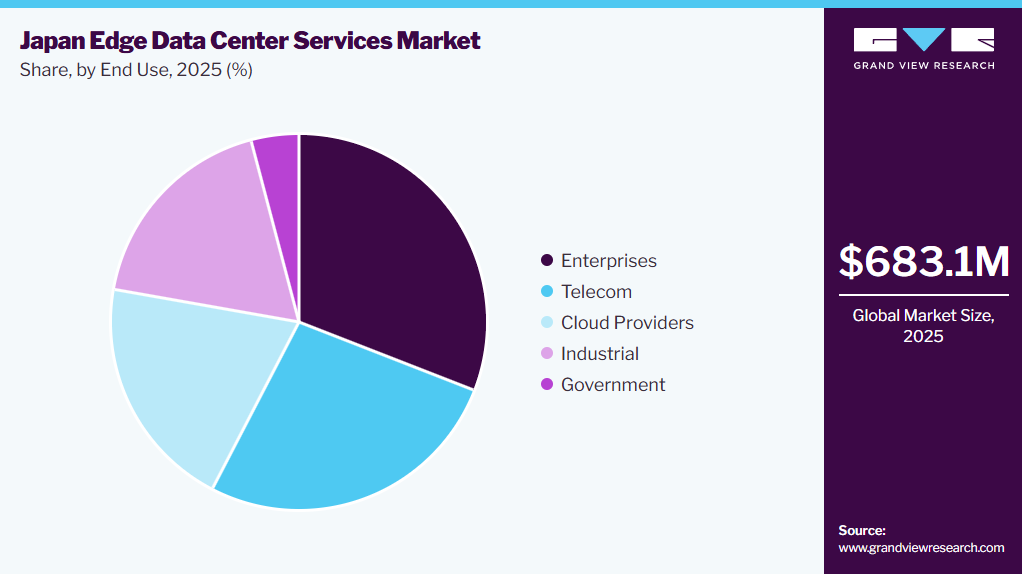
The enterprises segment dominated the market, accounting for the largest revenue share in 2025 as organizations increasingly adopted distributed computing architectures to support AI applications, data-intensive workloads, and real-time business operations. Enterprises across the manufacturing, financial services, retail, healthcare, logistics, and media sectors are deploying workloads closer to end users and operational sites to improve application responsiveness, strengthen data governance, and reduce dependence on centralized infrastructure. The growing use of industrial AI, digital twins, predictive analytics, computer vision, and business-critical applications is encouraging enterprises to utilize colocation, hosting, and edge cloud services that provide scalable computing resources near major demand centers.
 To learn more about this report, Download Free Sample Report
The cloud providers segment is expected to grow at a significant CAGR over the forecast period, driven by the increasing adoption of distributed cloud architectures, edge-native applications, and latency-sensitive digital services. Cloud providers are increasingly leveraging edge data center infrastructure to extend computing, storage, and networking resources closer to end users, enabling faster application response times and improved service performance. The segment benefits from rising demand for AI inference, content delivery, real-time analytics, gaming, video streaming, and IoT applications, which require localized processing capabilities that cannot be efficiently supported through centralized cloud regions alone. Furthermore, the expansion of hybrid and multi-cloud strategies among enterprises is encouraging cloud providers to strengthen their edge infrastructure presence across major metropolitan and regional markets in Japan.
Key Japan Edge Data Center Services Company Insights
Key players operating in the Japan edge data center services industry are AT TOKYO Corporation, Colt Data Center Services Holdings, Digital Realty, Equinix Inc., Fujitsu, Internet Initiative Japan Inc., KDDI Corporation, NTT DATA Group Corporation, Orange Business, SoftBank Corp., STT GDC Pte Ltd, Telstra International, and Zayo Group, LLC. The companies are focusing on various strategic initiatives, including new product development, partnerships & collaborations, and agreements to gain a competitive advantage over their rivals. The following are some instances of such initiatives.
-
In June 2026, AT TOKYO Corporation and Zadara K.K. announced a strategic partnership to establish the Zadara Cloud AT TOKYO Region within AT TOKYO's data center infrastructure, with commercial availability planned for August 2026 under the service name "ATBeX Edge Compute powered by Zadara." The new offering integrates compute, storage, and networking into a unified edge cloud platform, addressing the growing demand for AI-ready infrastructure and sovereign cloud services in Japan. By combining Zadara's Federated Edge Cloud platform with AT TOKYO's ATBeX connectivity ecosystem, the solution enables secure in-country data residency, high-performance private connectivity to public clouds, and seamless access for existing ATBeX and AT TOKYO customers, while expanding Japan's digital infrastructure for enterprise cloud adoption and AI workloads.
-
In January 2026, KDDI Corporation announced the start of operations at its Osaka Sakai Data Center, positioning it as an AI-focused facility with strong accessibility due to its proximity to the urban area of Osaka, a major center for industry and commerce. The data center is designed to support advanced AI use cases by providing GPU resources and on-premises capabilities for Google’s high-performance generative AI model, Gemini. Through this facility, KDDI aims to accelerate the adoption of AI across sectors such as pharmaceuticals and manufacturing, while strengthening Japan’s digital infrastructure by integrating network capabilities with AI technologies. The company also plans to collaborate with multiple partners to promote broader AI adoption and enhance Japan's industrial competitiveness.
-
In December 2025, SoftBank Group Corp. announced a definitive agreement to acquire DigitalBridge Group, Inc., a global investment manager specializing in digital infrastructure assets such as data centers, telecom towers, fiber networks, and edge infrastructure, for an enterprise value of approximately $4.0 billion. The deal is aimed at expanding SoftBank Group’s presence in the digital infrastructure sector and strengthening its strategic footprint across assets that support cloud computing, connectivity networks, and edge computing ecosystems.
Key Japan Edge Data Center Services Companies
-
AT TOKYO Corporation
-
Colt Data Centre Services Holdings
-
Digital Realty
-
Equinix Inc.
-
Fujitsu
-
Internet Initiative Japan Inc.
-
KDDI Corporation
-
NTT DATA Group Corporation
-
Orange Business
-
SoftBank Corp.
-
STT GDC Pte Ltd
-
Telstra International
-
Zayo Group, LLC.
Competitive Benchmarking
Category
Operating Strategies
Competitive Edge
Weakness
Established Players (Equinix Inc., Digital Realty, NTT DATA Group Corporation, KDDI Corporation, SoftBank Corp., Fujitsu, AT TOKYO Corporation, Colt Data Centre Services Holdings)
Established providers focus on expanding high-performance edge and colocation infrastructure across Japan's major metropolitan and regional markets. Their strategies emphasize AI-ready edge facilities, hybrid and multi-cloud connectivity, carrier-neutral ecosystems, managed infrastructure services, renewable energy adoption, liquid cooling technologies, and strategic partnerships with hyperscale cloud providers, telecom operators, content providers, and enterprises.
These companies benefit from extensive data center footprints, robust fiber connectivity, strong enterprise and telecom customer bases, high service reliability, and comprehensive managed service portfolios. Their integrated ecosystems provide direct interconnection with major cloud platforms, advanced security, disaster recovery, and scalable infrastructure that supports mission-critical workloads. Strong financial resources, proven operational expertise, and long-term customer relationships enable continuous expansion and technology innovation across Japan's edge computing ecosystem.
Established providers face significant capital expenditure requirements for expanding edge infrastructure, increasing power availability constraints in major metropolitan areas, lengthy facility development timelines, and rising energy costs. They also face challenges in balancing sustainability goals with growing AI-driven power demands, while competition from hyperscale cloud providers, telecom-owned edge platforms, and regional data center operators continues to intensify.
Emerging Players (Internet Initiative Japan Inc. (IIJ), STT GDC Pte Ltd, Orange Business, Telstra International, Zayo Group, LLC)
Emerging providers primarily focus on expanding regional edge connectivity, managed edge services, network integration, cloud interconnection, and enterprise digital infrastructure solutions. Their strategies emphasize flexible colocation, hybrid cloud integration, software-defined networking (SDN), managed connectivity, AI-enabled monitoring, and partnerships with telecom carriers, cloud providers, and system integrators to address growing enterprise demand for distributed computing and low-latency applications.
Emerging companies offer agile deployment models, flexible service offerings, robust network connectivity, and customized enterprise solutions. Their expertise in managed network services, cloud integration, international connectivity, and software-defined infrastructure enables organizations to accelerate digital transformation while reducing infrastructure complexity. Their partnership-driven approach and scalable service models make them attractive for multinational enterprises, regional businesses, and organizations adopting hybrid IT environments.
Emerging providers generally have smaller edge infrastructure footprints in Japan than leading colocation operators and telecom providers. They often rely on strategic partnerships for facility expansion and interconnection services, have relatively low brand recognition in the domestic colocation market, and face strong competition from well-established Japanese operators with larger ecosystems, broader service portfolios, and deeper relationships with enterprise customers.
Japan Edge Data Center Services Report Scope
Report Attribute
Details
Market size in 2025
USD 683.1 million
Market size in 2026
USD 779.6 million
Revenue forecast in 2033
USD 2,256.9 million
Growth Rate
CAGR of 16.4% from 2026 to 2033
Actual data
2021 - 2025
Forecast period
2025 - 2033
Quantitative units
Revenue in USD million and CAGR from 2026 to 2033
Report coverage
Revenue forecast, company share, competitive landscape, growth factors, and trends
Segments covered
Service type, facility type, capacity, end-user
Country scope
Japan
Key companies profiled
AT TOKYO Corporation; Colt Data Centre Services Holdings; Digital Realty; Equinix Inc.; Fujitsu; Internet Initiative Japan Inc.; KDDI Corporation; NTT DATA Group Corporation; Orange Business; SoftBank Corp.; STT GDC Pte Ltd; Telstra International; Zayo Group, LLC.
Customization scope
Free report customization (equivalent to 8 analysts working days) with purchase. Addition or alteration to country, regional & segment scope.
Pricing and purchase options
Avail customized purchase options to meet your exact research needs. Explore purchase options
Japan Edge Data Center Services Market Report Segmentation
This report forecasts revenue growth at the country level and provides an analysis of the latest industry trends in each of the sub-segments from 2021 to 2033. For this study, Grand View Research has segmented the Japan edge data center services market report based on service type, facility type, capacity, and end-user:
-
Service Type Outlook (Revenue, USD Million, 2021 - 2033)
-
Colocation
-
Hosting & Managed Hosting Services
-
Edge Network Edge Data Centers
-
-
Facility Type Outlook (Revenue, USD Million, 2021 - 2033)
-
Network Edge Data Centers
-
Industrial Edge Data Centers (Micro Data Centers)
-
Metro Edge Data Centers
-
-
Capacity Outlook (Revenue, USD Million, 2021 - 2033)
-
Less than 1 MW
-
1-5 MW
-
More than 5 MW
-
-
End-user Outlook (Revenue, USD Million, 2021 - 2033)
-
Telecom
-
Cloud Providers
-
Enterprises
-
Government
-
Industrial
-
Research Methodology
The Japan edge data center services market figures in this report are based on a proven research process that combines executive interviews with secondary research from proprietary databases, company filings, and recognized regulatory and institutional sources. Market size is built through value-chain sizing-reconciling supply-side and demand-side estimates-and triangulated with bottom-up and top-down approaches. Every estimate passes multiple levels of expert validation before publication, with each Japan edge data center services segment quantified using the revenue-capture definitions in the table below.
Segment Definition
Segment - Service Type
Revenue capture definition
Colocation
Colocation services refer to the provision of physical space, power, cooling, and network connectivity within an edge data center facility, enabling customers to deploy and operate their own IT infrastructure while leveraging the operator’s data center environment. Customers retain ownership and management responsibility for servers, storage systems, and networking equipment.
Hosting & Managed Hosting Services
Hosting and managed hosting services refer to offerings in which the service provider supplies and manages the underlying IT infrastructure on behalf of customers. These services may include server provisioning, infrastructure management, monitoring, maintenance, security management, backup services, and operational support, enabling customers to outsource part or all their infrastructure management requirements.
Edge Cloud Services
Edge cloud services are cloud-based compute, storage, and networking resources delivered from edge data centers to support low-latency and geographically distributed workloads. These services enable applications and data processing to be deployed closer to end users or devices while maintaining integration with centralized cloud environments.
Segment - Facility Type
Revenue capture definition
Network Edge Data Centers
Network Edge Data Centers are facilities embedded within telecommunications and network infrastructure that primarily support network-centric workloads, including Multi-access Edge Computing (MEC), 5G applications, traffic processing, content delivery, content caching, and network function virtualization. These facilities are positioned within the communications network to enable low-latency service delivery closer to end users and connected devices.
Industrial Edge Data Centers (Micro Data Centers)
Industrial edge data centers are compact facilities deployed at or immediately adjacent to operational environments such as manufacturing plants, logistics centers, utility sites, municipal facilities, agricultural operations, and other industrial locations. These facilities primarily support localized processing of operational technology (OT) data, IoT workloads, industrial automation, AI inference, machine vision, and real-time operational analytics.
Metro Edge Data Centers
Metro edge data centers are facilities deployed within metropolitan service areas to support enterprise, cloud, digital content, and other latency-sensitive commercial workloads. These facilities provide localized computing, storage, and connectivity resources closer to urban demand centers than centralized regional or hyperscale facilities, enabling improved application performance and reduced network latency.
Segment - Capacity
Revenue capture definition
Less than 1 MW
Facilities with an installed IT power capacity below 1 MW. These facilities are typically deployed to support highly localized workloads, distributed edge computing requirements, industrial applications, and network-edge use cases requiring proximity to data generation points or end users.
1-5 MW
Facilities with an installed IT power capacity ranging from 1 MW to 5 MW. These facilities generally support a mix of enterprise, telecom, cloud, and edge computing workloads and represent a significant share of metro-edge deployments that serve urban and regional demand centers.
More than 5 MW
Facilities with an installed IT power capacity exceeding 5 MW. These facilities support large-scale edge computing, colocation, cloud connectivity, AI inference, and digital service workloads while maintaining proximity to key demand centers compared with traditional hyperscale campuses.
Segment - End User
Revenue capture definition
Telecom
Telecom end users include telecommunications operators and network service providers utilizing edge data center services to support 5G deployments, MEC platforms, content delivery, traffic management, network virtualization, and other communications-related applications.
Cloud Providers
Cloud providers include public cloud operators, hyperscale cloud companies, and distributed cloud service providers utilizing edge data center facilities to deliver localized cloud computing, storage, AI, and application services closer to end users.
Enterprises
Enterprise end users include organizations across sectors such as BFSI, retail, healthcare, information technology, media, transportation, and professional services that utilize edge data center services to support business applications, digital transformation initiatives, data processing, and low-latency computing requirements.
Government
Government end users include central government agencies, local governments, public sector organizations, and smart city initiatives utilizing edge data center services for digital governance, public service delivery, surveillance systems, disaster management, and other public infrastructure applications.
Industrial
Industrial end users include manufacturing companies, logistics operators, utilities, energy providers, transportation operators, and other industrial organizations utilizing edge data center services to support industrial automation, IoT deployments, machine-to-machine communications, AI-enabled operations, and real-time analytics.
Estimation Model
Layer
Question
Analysis
Digital Infrastructure & Edge Computing Demand Layer
Who can benefit from Japan Edge Data Center Services?
Identify organizations requiring ultra-low-latency, high-availability, and localized computing infrastructure. This includes hyperscale cloud providers, telecom operators, content delivery networks (CDNs), OTT and streaming platforms, manufacturing enterprises, automotive companies, BFSI institutions, healthcare providers, government agencies, retail & e-commerce companies, gaming providers, logistics firms, AI solution providers, and smart city operators. Evaluate the rapid growth of AI inference, 5G adoption, IoT deployments, Industry 4.0, autonomous mobility, and digital transformation initiatives to determine the total addressable market.
Edge Infrastructure & Network Modernization Layer
Where is the demand for Edge Data Center Services generated?
Evaluate growth in 5G infrastructure, fiber network expansion, regional edge nodes, hybrid and multi-cloud environments, hyperscale data center expansion, CDN deployments, AI-ready infrastructure, edge cloud platforms, and distributed computing architectures. Assess increasing investments in edge facilities supporting real-time analytics, autonomous systems, industrial automation, content delivery, disaster recovery, and localized data processing to determine the operationally reachable market.
Edge Services Adoption & Deployment Layer
Who actively adopts Edge Data Center Services?
Analyze adoption across hyperscale cloud providers, telecom operators, enterprises, manufacturing companies, BFSI institutions, healthcare organizations, government agencies, media & entertainment providers, retailers, gaming companies, transportation & logistics firms, and energy & utility companies. Evaluate demand for colocation, managed edge infrastructure, edge cloud services, network connectivity, cybersecurity, disaster recovery, hybrid cloud integration, and AI-enabled edge platforms to identify primary deployment opportunities and buyer segments.
Revenue Generation Layer
How is revenue generated?
Assess revenue generated through edge colocation services, managed infrastructure services, edge cloud computing, dedicated racks and cages, network interconnection and connectivity services, managed security services, remote infrastructure management, disaster recovery and backup services, hybrid & multi-cloud integration, consulting, professional services, maintenance & support, and recurring subscription or contract-based service agreements.
Customization Table
This report has been delivered with the following In-depth customizations
CLIENT REQUEST
CUSTOMIZATION DELIVERED
VALUE ADDS
Japan Edge Data Center Service Provider Competitive Benchmarking
Assessed leading edge data center service providers based on edge colocation capabilities, managed infrastructure services, cloud interconnection, AI-ready infrastructure, network connectivity, carrier neutrality, power capacity, edge locations, sustainability initiatives, security certifications, disaster recovery capabilities, partnerships, pricing models, customer base, and expansion strategies.
Enables stakeholders to benchmark against leading providers, identify competitive differentiators, evaluate service capabilities, assess infrastructure maturity, and formulate strategic investment, partnership, and market-positioning decisions.
Regional Edge Infrastructure Opportunity Assessment (Japan)
Evaluated market opportunities across Tokyo, Osaka, Nagoya, Fukuoka, Sapporo, and other emerging regional hubs based on enterprise digitalization, 5G deployment, AI adoption, cloud investments, industrial clusters, power availability, network connectivity, and government digital transformation initiatives.
Helps organizations prioritize regional expansion, identify high-growth edge deployment locations, optimize infrastructure investments, and align business strategies with regional demand and connectivity requirements.
Technology & Infrastructure Innovation Benchmarking
Analyzed emerging technologies, including AI-ready edge infrastructure, liquid cooling, modular and prefabricated edge data centers, software-defined infrastructure (SDI), software-defined networking (SDN), hybrid and multi-cloud integration, GPU-enabled edge computing, renewable energy integration, intelligent infrastructure management (DCIM), and advanced cybersecurity solutions across leading providers.
Enables stakeholders to understand technology evolution, identify innovation opportunities, evaluate future-ready infrastructure, optimize operational efficiency, and develop long-term roadmaps aligned with AI, edge computing, and sustainability trends.
Frequently Asked Questions About This Report
The global Japan edge data center services market size was estimated at USD 683.1 million in 2025 and is expected to reach USD 779.6 million in 2026.
Key factors include the rapid acceleration of distributed computing architectures and the increasing demand for ultra-low-latency digital infrastructure.
The colocation segment led with a 54.2% revenue share in 2025, while the edge cloud services segment is the fastest-growing segment.
The metro edge data centers segment led with a 54.2% revenue share in 2025, while the industrial edge data centers (micro data centers) segment is the fastest-growing segment.
The 1-5 MW segment held the largest share of 47.6% in 2025, while the less than 1 MW segment is the fastest-growing segment.
The enterprises segment held the largest share in 2025, while the cloud providers segment is the fastest-growing segment.
The Japan edge data center services market is expected to grow at a compound annual growth rate of 16.4% from 2026 to 2033, reaching USD 2,256.9 million by 2033.
Key players operating in the Japan edge data center services market include AT TOKYO Corporation, Colt Data Centre Services Holdings, Digital Realty, Equinix Inc., Fujitsu, Internet Initiative Japan Inc., KDDI Corporation, NTT DATA Group Corporation, Orange Business, SoftBank Corp., STT GDC Pte Ltd, Telstra International, and Zayo Group, LLC.
About the Author(s)
Communications Infrastructure Research Team
Technology · Communications InfrastructureThis report was authored by the communications infrastructure research team at Grand View Research - comprising two research analysts, one senior research analyst, and one industry expert - with specialized expertise in the communications infrastructure segment of the technology industry. All findings are based on proprietary technology databases, executive interviews, and regulatory analysis, subject to internal peer review prior to publication.
Last Updated:
Speak to Analyst

Customize this report to your needs - add regions, segments, or data points, with 20% free customization.
Or view our licence options:


ISO 9001:2015 & 27001:2022 Certified
We are GDPR and CCPA compliant! Your transaction & personal information is safe and secure. For more details, please read our privacy policy.


