
- Home
- »
- Clothing, Footwear & Accessories
- »
-
Luggage Market Size, Share & Trends Report, 2026-2033GVR Report cover

Luggage Market (2026 - 2033) Size, Share & Trends Analysis Report By Type (Travel Bags, Business Bags, Casual Bags), By Material (Soft-Sided, Hard-Sided), By Distribution Channel (Online, Offline), By Region, And Segment Forecasts
Market Size, 2025
$43.1BMarket Estimate, 2026
$45.8BMarket Forecast, 2033
$82.0BCAGR, 2026–2033
8.7%Luggage Market Summary
The global luggage market size was valued at USD 43.1 billion in 2025 and is projected to grow from USD 45.8 billion in 2026 to USD 82.0 billion by 2033, at a CAGR of 8.7% from 2026 to 2033. North America led the global market and accounted for the largest revenue share of 35.4% in 2025. The market is being increasingly driven by rising disposable incomes, rapid urbanization, brand awareness, and a resurgence in both domestic and international travel.
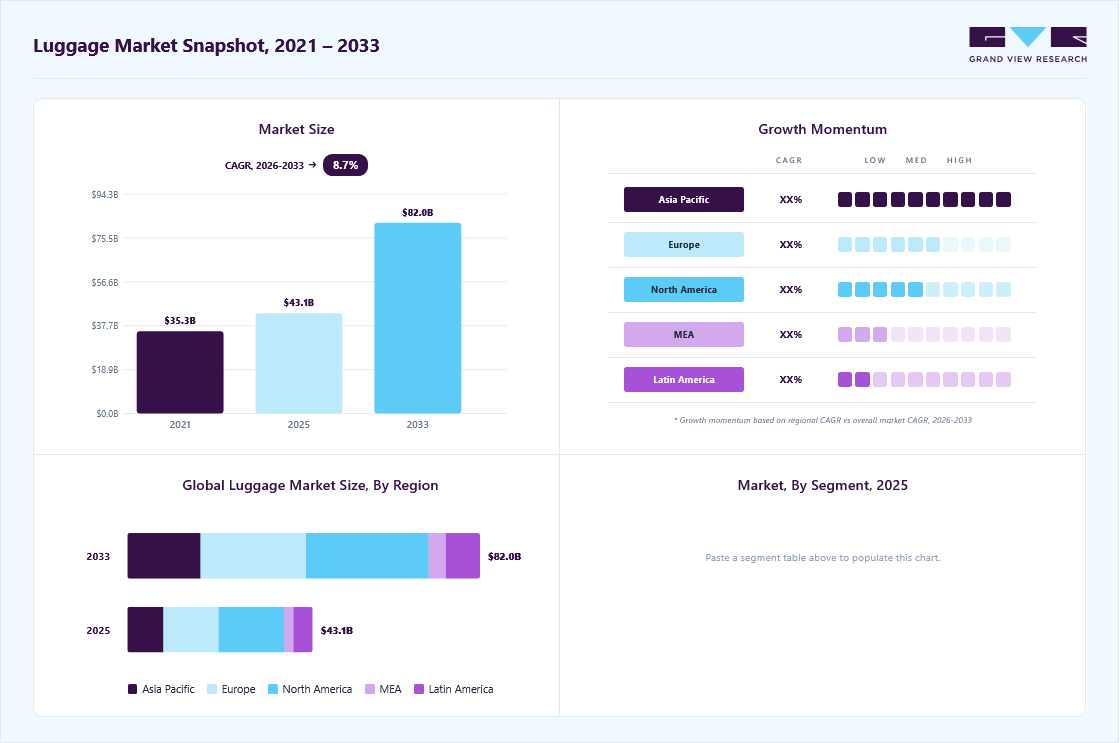 Source: Grand View Research, IR Documents, Primary Interviews, Paid DatabasesTo learn more about this report,
 Download Free Sample Report
 Key Market Trends & Insights
- By type: Travel bags accounted for a revenue share of 56.8% in 2025.
- By material: Soft-sided holds the largest market share of about 68.0% in 2025.
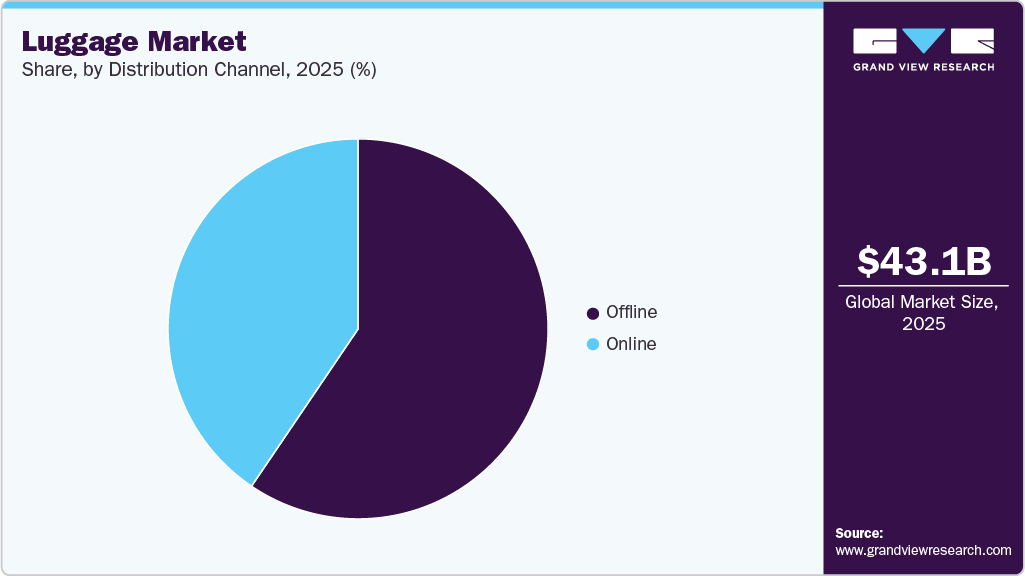
- By distribution channel: Sales through offline channel accounted for a revenue share of 59.5% in 2025.
Regional Highlights
- Largest regional market: North America (35.4% revenue share, 2025)
- Fastest-growing regional market: Asia Pacific (highest CAGR, 2026-2033)
- By country: India luggage market is expected to grow at a CAGR of 10.1% from 2026 to 2033.
Market Size & Forecast
- Market size in 2025: USD 43.1 Billion
- Estimated market size in 2026: USD 45.8 Billion
- Projected market size by 2033: USD 82.0 Billion
- CAGR (2026-2033): 8.7%
Three ways to get this report
Buy it, customize it, or ask a question.Ask an Analyst
Analyst response in 1 business day
- AccessReport author, directly
- Reply timeWithin 1 working day
- No sales callDirect answer only
- FormatEmail reply
- CostFree, no cost
Get the Full Report
What the study covers
- FormatsPDF · Excel · Dashboard
- Timeline2026–2033 annual, 2025 base
- Coverage20+ countries, 5 regions
- Companies10+ key players profiled
Customize the Report
20% free customization
- IncludeCountries, segments, points
- TailorTo your product definition
- ExtendDeeper competitor detail
- OrA fully bespoke study
- Turnaround5–10 working days
The ongoing shift from unbranded to branded products, driven by product innovation, premiumization, and e-commerce expansion, is set to create robust growth in the organized luggage segment as well as the broader premium market and rolling luggage bag market. Moreover, industry experts note that luggage is increasingly viewed as a status symbol, further fueled by evolving social trends. Demand growth across the Indian luggage and suitcases market and the Mexican luggage and suitcases market is also contributing significantly to branded luggage adoption and organized retail expansion.Consumers are traveling more often through short-duration trips, multi-city itineraries, and hybrid work-related mobility, which has strengthened demand for carry-on suitcases, cabin-approved travel bags, and lightweight expandable formats within the broader trolley market and rolling luggage bag market. The rising cost of checked baggage and tighter airline size regulations are also pushing travelers to invest in premium carry-ons that maximize internal capacity while remaining compliant and easy to handle. As a result, cabin luggage has become one of the most dynamic and high-turnover categories within the broader luggage industry and the expanding smart luggage market, where technology-enabled mobility features are gaining stronger consumer attention.
 To learn more about this report, Download Free Sample Report
 Purchase decisions in the global market are increasingly driven by functional reliability and long-term travel performance rather than aesthetics alone. Consumers today treat luggage as a high-utility travel asset that must withstand repeated handling across airports, rail stations, taxis, and hotel transfers. Durability under stress has become a primary evaluation point, with buyers focusing closely on shell impact resistance, zipper strength, seam reinforcement, and wheel endurance across uneven surfaces. Hard-side polycarbonate luggage has gained strong traction among frequent flyers because it maintains structural shape, protects fragile contents, and performs well under airline baggage handling pressure. These trends continue to support innovation across the premium and trolley market and rolling luggage bag market globally.
At the same time, soft-side luggage continues to appeal to travelers who prioritize flexibility, external pocket access, and compression capacity, particularly for short trips or carry-on-heavy travel. In both formats, consumers increasingly expect features that reduce friction during transit, such as smooth 360-degree spinner wheels, stable multi-stage trolley handles, reinforced corner guards, expandable compartments, integrated garment organizers, and secure locking systems. These functional differentiators are especially influential in mid-range and premium tiers, where buyers are willing to pay more for products that offer consistency, comfort of movement, and reduced risk of travel disruption. Such trends are increasingly shaping the smart market and the evolving premium market, where innovation and travel convenience remain key purchase drivers.
Retail dynamics are also evolving rapidly, reshaping how luggage is researched, compared, and purchased globally. Digital platforms have become central to category discovery, as consumers rely heavily on verified traveler reviews, durability testing feedback, and real-world usage comparisons before committing to higher-value suitcase investments. Unlike low-cost accessories, luggage purchases are often infrequent and high-consideration, prompting buyers to spend more time evaluating warranty coverage, brand credibility, repair support, and long-term performance expectations. At the same time, brands are strengthening direct-to-consumer strategies through modular luggage systems, coordinated multi-piece sets, personalization services, and limited-edition drops that encourage repeat engagement and premium positioning. Online-exclusive colorways, bundle pricing, and extended trial-return policies are further improving conversion by reducing hesitation around fit-for-purpose selection across the premium, smart, and global rolling luggage bag market.
Brand Market Share Insights
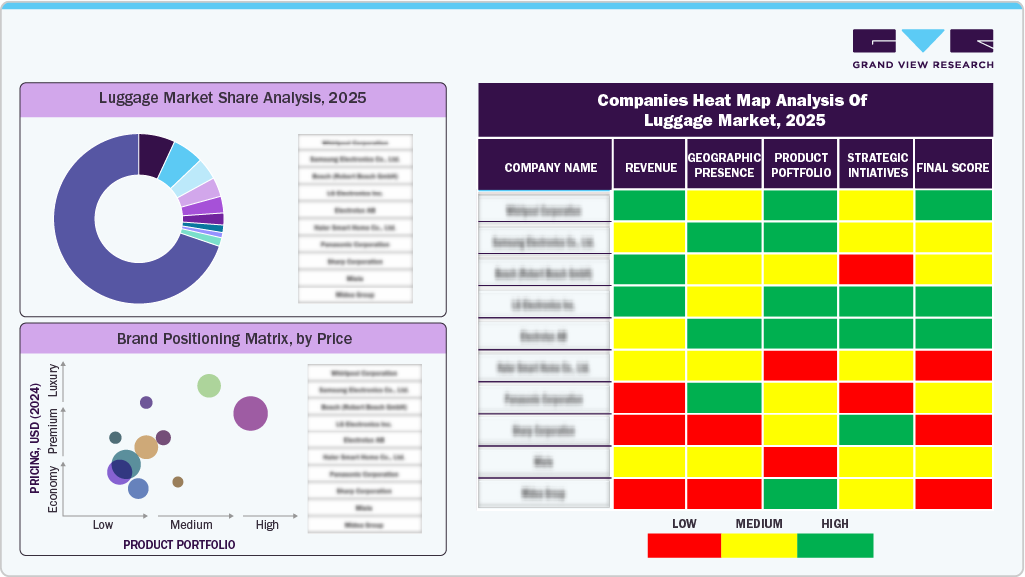
The global market is characterized by the presence of long-established travel goods leaders alongside a fast-growing base of modern, lifestyle-oriented brands, all competing to meet evolving consumer expectations around durability, mobility, and design. For instance, Samsonite continues to anchor the premium-mass segment and is widely credited with popularizing innovations like four-wheeled spinner luggage, which has now become a standard expectation across product tiers within the trolley market. Similarly, TUMI has built its positioning around premium durability materials such as FXT ballistic nylon and aluminum travel cases, reinforcing its association with business and frequent flyers as well as the broader leather luggage and goods market.
Manufacturers are increasingly developing luggage products that integrate performance-driven engineering features such as lightweight polycarbonate shells, reinforced corner protection, smooth 360-degree spinner wheels, ergonomic multi-stage handles, and optimized interior organization systems. Brands like Away Travel illustrate this shift clearly, with products featuring durable polycarbonate exteriors, 360° wheels, built-in compression systems, and airline-compatible sizing designed for standardized global travel requirements. Similarly, Samsonite’s newer product lines emphasize lightweight construction and recycled material usage, including circular design initiatives in selected collections, reflecting the growing sustainability focus in travel goods and the wider smart market.
These innovations are designed to enhance traveler convenience across airports, rail networks, and multi-destination travel, positioning luggage as a functional mobility product rather than a simple storage accessory. Even premium European brands such as RIMOWA reinforce this positioning through their signature grooved polycarbonate and aluminum designs, which combine structural rigidity with lightweight mobility for frequent international travelers. Rising road-trip culture and utility-driven travel trends are also indirectly supporting adjacent segments such as the automotive luggage carrier market, particularly among family travelers and outdoor mobility consumers.
 To learn more about this report, Download Free Sample Report
 Leading players such as Samsonite, TUMI, and American Tourister continue to strengthen their portfolios through premium materials, advanced locking systems, and business-travel-focused innovations, while emerging direct-to-consumer brands are reshaping competition through modern aesthetics, modular suitcase sets, and digital-first distribution. For example, Away and Monos have gained visibility through online-first branding and minimalist product design, targeting younger consumers who prioritize aesthetics alongside function. Product development is also increasingly focused on airline-compliant carry-on formats, expandable constructions, and hybrid designs that support both short-haul and long-haul travel needs within the market.
Consumer Insights
Rising international mobility, airport congestion, and the growth of short-duration travel are directly influencing how consumers evaluate luggage globally. Shoppers are no longer purchasing suitcases only for annual holidays; instead, frequent weekend trips, destination weddings, and work-linked travel are creating demand for luggage that is compact, easy to maneuver, and airline-compliant. Younger travelers, especially those aged 18-35, increasingly prefer sleek cabin trolleys, duffel-backpack hybrids, and modular carry-ons that support fast movement through metro stations and crowded terminals. Buying decisions are heavily shaped by digital proof points, with consumers relying on wheel-performance demos, packing-capacity walkthroughs, and travel creator reviews that highlight real usage under airport handling conditions. These trends are significantly contributing to the expansion of the rolling luggage bag and trolley market.
Product performance in the luggage segment is defined less by appearance and more by structural reliability. Consumers repeatedly cite frustrations around cracked hard shells, jammed telescopic handles, and zipper failures after limited use, making durability a primary driver of brand loyalty. Manufacturers are responding with thicker polycarbonate builds, reinforced corner protection, and enhanced locking systems. Interior design has also become more competitive, with demand rising for compression panels, laptop-ready compartments, expandable volume, and stain-resistant linings. Brands such as Samsonite and American Tourister emphasize tested resilience at scale, while premium players like Tumi and Rimowa differentiate through craftsmanship, repair programs, and long-term performance positioning within the leather luggage and goods market and broader premium market.
 To learn more about this report, Download Free Sample Report
 Spending patterns across the market reflect sharp segmentation by travel frequency and consumer lifestyle. Budget shoppers tend to prioritize value sets and discount-led purchases during peak travel seasons, whereas business travelers and premium consumers invest in lighter, long-lasting luggage with strong warranty coverage and elevated materials. Sustainability is gaining attention through recycled shell plastics, responsible sourcing, and repair-first initiatives that extend product life beyond replacement cycles. Retail strategies such as bundled travel kits, monogram personalization, subscription-style warranty services, and direct-to-consumer online launches are increasingly shaping how luggage brands drive conversion. With demand spiking around summer travel, festive migration periods, and business rebound cycles, luggage is becoming a high-rotation lifestyle category tied closely to global movement rather than occasional vacation use. These dynamics are also positively influencing the Indian luggage and suitcases market, the Mexican luggage and suitcases market, and the emerging smart market trends globally.
Type Insights
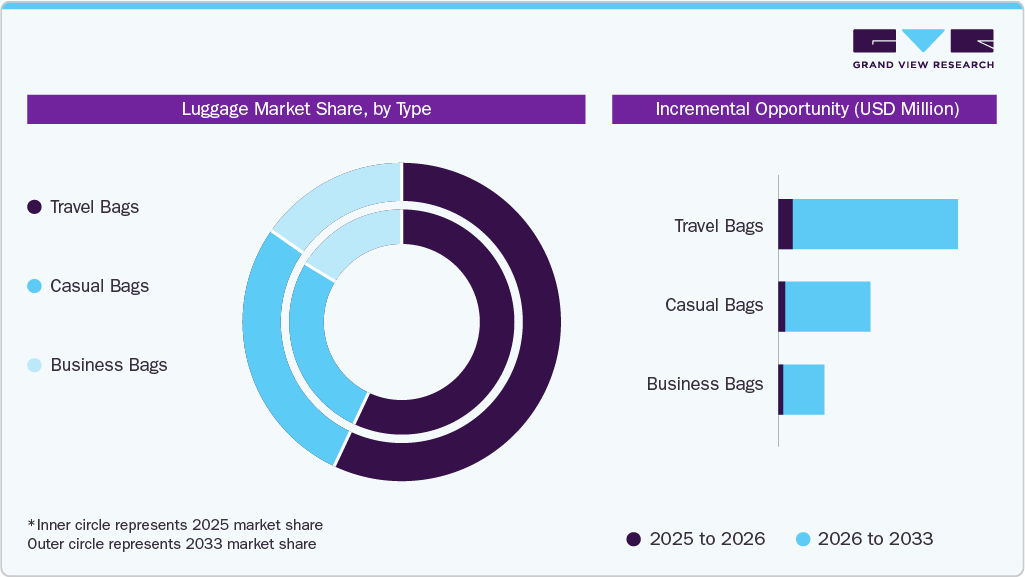
Travel bags led the market with the largest revenue share of 56.8% in 2025, supported by consistent consumer demand for lightweight, flexible, and easy-to-carry travel solutions. This is reflected in strong product visibility on platforms like Amazon’s “Best Sellers in Travel Bags” category, where brands such as Samsonite, American Tourister, and Wildcraft consistently appear among top-selling listings due to their focus on durability and affordability. For instance, Samsonite Travel Bags Collection emphasizes lightweight construction and multi-compartment designs, while American Tourister Duffel Bags highlights budget-friendly, youth-oriented travel duffels widely adopted by students and short-trip travelers.
This category benefits from strong adoption among students, young professionals, and frequent domestic travelers who prioritize convenient storage, multiple compartments, and compact designs for short trips and everyday mobility. Brands in this segment typically compete through accessible pricing, durable fabrics, and functional features such as water resistance, padded straps, and trolley sleeve compatibility. High visibility across sports retailers like Decathlon, department stores, airport outlets, and e-commerce platforms such as Amazon and Flipkart further reinforces volume sales, especially in metro and tier-2 urban travel corridors.
 To learn more about this report, Download Free Sample Report
 Casual bags are anticipated to grow at the fastest CAGR of 9.0% from 2026 to 2033. Demand is being shaped by young professionals, students, and urban commuters who prefer backpacks, sling bags, and tote-style casual bags that support daily use across work, leisure, and short travel. For example, Herschel Supply Co Backpacks have gained strong traction among urban consumers due to their minimalist design and laptop-friendly compartments, while Fjallraven Kanken Bags have become a globally popular casual backpack choice for students and commuters due to their lightweight Vinylon fabric and simple functional layout.
Premium sportswear brands such as Nike and Adidas are also expanding this segment through lifestyle backpacks featuring padded laptop sleeves, anti-theft zippers, and ergonomic support systems, often marketed through flagship stores and online channels. Additionally, lifestyle blogs like REI Co-op’s expert guides frequently highlight how modern backpacks now blend outdoor durability with urban aesthetics, reinforcing the shift toward multi-use casual carry solutions in daily consumer behavior.
Material Insights
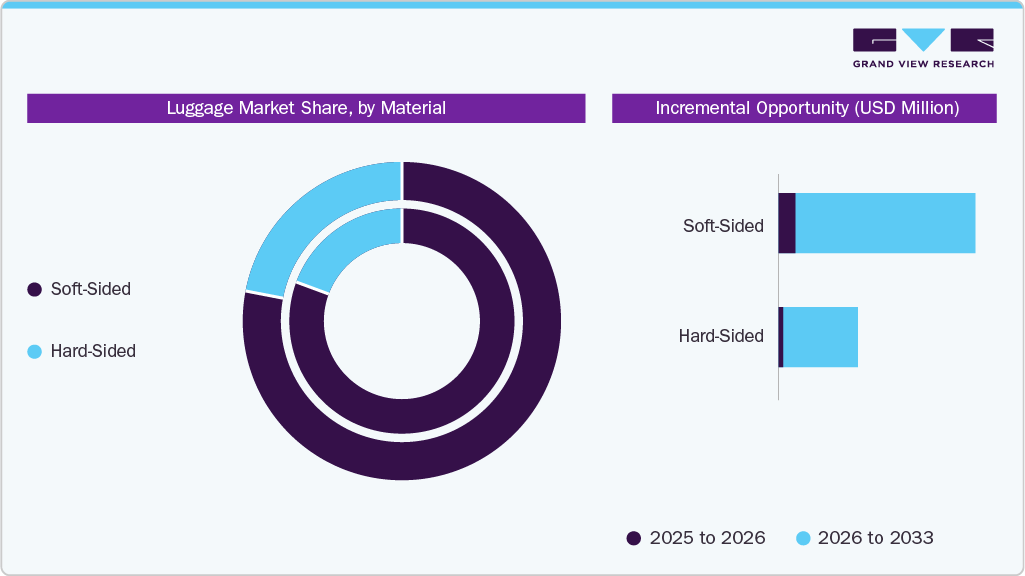
Soft-sided luggage led the market with the largest revenue share of 68.04% in 2025. These bags are usually made from durable woven fabrics such as polyester or nylon, which give the suitcase a more adaptable shape. For instance, American Tourister Soft Luggage and Samsonite Softside Collections prominently market lightweight polyester-based suitcases designed for flexible packing and frequent mobility. Because the exterior is flexible, travelers can pack more efficiently and often fit extra items when space becomes tight, making these products particularly popular for domestic trips, train travel, and short-haul flights where packing flexibility is important. Soft-sided options are also typically lighter in weight, which makes them easier to lift into overhead compartments, carry through terminals, and move during short journeys. Retail travel guides from platforms such as Travel & Leisure and Wirecutter also frequently recommend soft-sided luggage for travelers prioritizing expandability and lightweight handling over rigid protection. This combination of lightweight handling and practical packing comfort keeps soft-sided luggage as the preferred choice for many everyday and frequent travelers.
 To learn more about this report, Download Free Sample Report
 The hard-sided market is projected to grow at the fastest CAGR of 9.0% from 2026 to 2033. Consumers increasingly prefer hard-shell suitcases made with impact-resistant polycarbonate or aluminum finishes that help safeguard valuables during air travel and rough handling. For example, RIMOWA Original Collection is widely recognized for its aluminum-shell luggage engineered for premium durability, while Away Polycarbonate Carry-On markets lightweight polycarbonate hard-shell cases with compression systems and 360° spinner wheels aimed at modern air travelers. Features such as lightweight rigid frames, scratch-resistant surfaces, smooth spinner wheels, and secure built-in locking systems are especially valued for improving durability and travel confidence. Premium brands such as Rimowa, Tumi, and Samsonite have strengthened demand by offering sleek hard-sided collections that combine high-performance protection with refined designs suited for both business and leisure travel. Samsonite’s C-Lite and Proxis collections, for instance, emphasize lightweight polycarbonate engineering and shock resistance, while TUMI continues to position its hard-shell luggage around premium business-travel functionality and integrated TSA-approved locking systems.
Distribution Channel Insights
The sale of luggage through offline channels led the market with the largest revenue share of 59.48% in 2025. Physical retail remains highly influential in luggage purchasing, as consumers prefer to evaluate suitcase size, material strength, wheel movement, and handle comfort in person before investing. For instance, brands such as Samsonite Store Locator and TUMI Retail Stores continue expanding through department stores, branded outlets, travel retail locations, and airport stores to strengthen physical consumer engagement.
Airport retail remains especially important for premium luggage purchases, with travel hubs increasingly featuring dedicated Samsonite, American Tourister, and TUMI stores targeting business and international travelers. Brands continue to expand in department stores, specialty luggage outlets, and airport retail by offering broad assortments across soft-sided and hard-sided formats, multiple size options, and premium finish variations. From lightweight cabin trolleys to structured check-in cases with protective shells and organized interiors, in-store variety supports higher conversion. Retailers such as Macy’s, Lifestyle, and Shoppers Stop also dedicate significant floor space to travel gear categories, reflecting continued offline demand where tactile evaluation and immediate product comparison influence purchasing decisions.
 To learn more about this report, Download Free Sample Report
 Online sales of luggage are projected to grow at a substantial CAGR of 9.1% from 2026 to 2033. Digital-first purchasing is rising as consumers increasingly rely on e-commerce platforms to access wider brand selections, compare prices, and evaluate product features through reviews and detailed video demonstrations. For example, Away Travel and Monos Travel built strong brand visibility primarily through direct-to-consumer online models supported by influencer marketing, Instagram-focused campaigns, and minimalist digital merchandising. Amazon has also emerged as a major luggage sales channel globally, with categories such as “carry-on luggage” and “travel duffel bags” consistently ranking among high-volume travel accessories.
Shoppers are placing greater emphasis on luggage that balances durability, lightweight handling, and practical storage, with strong demand for carry-ons, expandable suitcases, and travel bag sets that fit evolving travel routines. Convenience factors such as doorstep delivery, easy returns, EMI options, and frequent promotional events are key purchase drivers, particularly among younger travelers and first-time buyers. Events such as Amazon Prime Day, Flipkart Big Billion Days, and Black Friday promotions further accelerate online luggage sales by encouraging price-sensitive consumers to upgrade travel gear through discounted bundled offerings.
Regional Insights
The North America luggage market accounted for a revenue share of 35.36% in 2025. Strong travel frequency across business, leisure, and domestic mobility continues to support steady demand across both premium and mass luggage categories. Consumers in the region place high emphasis on build quality, brand reliability, and functional features such as lightweight construction, durable wheels, secure locking systems, and organized storage, encouraging repeat upgrades. The market also benefits from high disposable incomes, strong penetration of premium hard-sided and soft-sided formats, and a well-developed retail landscape combining department stores, specialty luggage outlets, and advanced e-commerce channels.
 To learn more about this report, Download Free Sample Report
 U.S. Luggage Market Trends
The luggage industry in the U.S. is expected to grow at a CAGR of 9.1% from 2026 to 2033. The U.S. market is facing intense competition and innovation. Manufacturers are increasingly using impact-resistant polycarbonate, recycled polyester linings, and reinforced wheel and handle systems to meet consumer expectations for long-term reliability under frequent air travel conditions. Companies are also restructuring product development to reduce material waste and improve repair and reuse potential.
Canada luggage market is expected to grow at a CAGR of 8.1% from 2026 to 2033. Growth is supported by strong domestic and cross-border travel, with consumers showing consistent demand for practical, weather-resistant, and lightweight luggage formats. The market also benefits from rising interest in premium hard-shell cases and compact travel bags suited to short trips, winter travel, and frequent airport use.
Asia Pacific Luggage Market Trends
The luggage industry in the Asia Pacific is expected to grow at a CAGR of 9.6% from 2026 to 2033. Rising domestic travel, expanding air connectivity, and increasing consumer spending are driving strong demand for luggage across both travel and everyday mobility needs. IATA reported that Asia-Pacific airlines posted a 10.9% increase in full-year international traffic in 2025, and its 2026 outlook again led with Asia-Pacific growth of 7.3%, underscoring the region’s momentum. UN Tourism also highlighted continued recovery across Asia and the Pacific, while Reuters reported that Southeast Asian budget airlines are expanding fleets to capture rising demand. Along with that, shoppers in the region are also actively seeking lightweight suitcases, cabin-sized trolleys, and versatile travel bags that fit short trips, business travel, and frequent urban movement. Growing middle-class incomes, wider exposure to global lifestyle brands, and the influence of social media travel content are further accelerating adoption, particularly among younger consumers.
China luggage market is expected to grow at a CAGR of 9.7% from 2026 to 2033. China continues to be one of the strongest growth markets globally due to expanding middle-class travel spending, rising outbound tourism, and rapid urban mobility growth. Consumers are increasingly purchasing lightweight polycarbonate luggage, smart carry-ons, and premium travel accessories through digital channels such as Tmall and JD.com. The market is also seeing stronger demand for aesthetically designed luggage from brands such as RIMOWA and Samsonite, particularly among younger affluent travelers and business professionals.
The luggage market in India is expected to grow at a CAGR of 10.1% from 2026 to 2033. India is likely to grow slightly above the Asia Pacific average because of rapid expansion in domestic air travel, rising urban mobility, and growing demand for affordable yet durable travel bags and suitcases. Strong participation from value-conscious consumers, along with increasing online retail penetration, is supporting faster adoption across both mass and mid-premium segments.
Europe Luggage Market Trends
The luggage industry in Europe is expected to grow at a CAGR of 8.8% from 2026 to 2033. The region’s strength comes from heavy cross-border travel, strong tourism flows, and a consumer base that places high value on design, durability, and brand prestige. UN Tourism said Europe welcomed about 625 million international tourist arrivals in January to September 2025, around 4% more than the same period of 2024, supporting steady demand for both leisure and business travel luggage. Premium names such as RIMOWA and Bric’s continue to reinforce this market with lightweight polycarbonate, aluminum, and travel-ready formats that fit the region’s appetite for refined, functional luggage.
The UK luggage market is expected to grow at a CAGR of 8.9% from 2026 to 2033. Growth is supported by strong international travel frequency, increasing adoption of cabin-sized luggage for short-haul European travel, and rising online luggage purchases. UK consumers increasingly prefer compact, lightweight, and airline-compliant luggage formats that support frequent city breaks and leisure travel. The market is also benefiting from strong airport retail presence and expanding digital-first luggage brands targeting younger consumers through social media and influencer-led marketing. Europe remains one of the world’s strongest tourism regions, with international tourist spending projected to rise significantly, further supporting luggage demand across the UK travel ecosystem.
The luggage market in Germany is expected to grow at a CAGR of 8.7% from 2026 to 2033. Demand is supported by a mature travel culture, strong business travel activity, and consumer preference for high-quality, functional, and long-lasting luggage. German buyers typically value engineering, durability, and product reliability, which supports steady sales of both premium hard-shell suitcases and practical soft-sided travel bags.
Central & South America Luggage Market Trends
The luggage industry in CSA represented 10.42% of the global market in 2025 and is expected to grow at a 7.8% CAGR. The region is being supported by rising intra-regional travel, stronger air connectivity, and a growing preference for affordable, practical luggage suited to frequent short trips. IATA reported that Latin American airlines posted an 8.6% traffic rise in 2025, while ALTA noted that total passenger traffic in Latin America and the Caribbean reached 477.3 million in 2025, with 84% of net growth coming from intra-regional traffic. This travel pattern favors durable, easy-to-carry luggage formats such as soft-sided cases and lightweight carry-ons that work well for regional leisure, family, and business travel.
Middle East & Africa Luggage Market Trends
The luggage industry in MEA accounted for 5.05% of the global market in 2025 and is expected to grow at an 8.0% CAGR. The region is supported by long-haul travel, hub-based transit traffic, and tourism growth, especially in major aviation and hospitality centers. IATA said Middle Eastern carriers grew 6.7% in 2025, while African airlines saw international traffic rise 7.8% in 2025, showing healthy travel demand across both subregions. UN Tourism also reported that Africa welcomed 73.9 million international tourists in 2024, reinforcing the region’s travel expansion base. This environment supports demand for premium hard-shell luggage, secure locking systems, and durable travel cases designed for airport handling and extended journeys.
Key Luggage Companies:
The following key companies have been profiled for this study on the luggage market.
- Samsonite International S.A.
- VIP Industries Ltd.
- VF Corporation (Travel Gear segment)
- Tumi Holdings Inc.
- Delsey Paris
- Rimowa GmbH
- Briggs & Riley Travelware
- Herschel Supply Co.
- Safari Industries (India) Ltd.
- Away (JRSK Inc.)
Recent Developments
-
In December 2025, Nike introduced its first hard-shell suitcase collection, expanding into travel gear designed around the needs of active consumers. Developed over five years of research and real-world testing, the line features three sizes launching in spring 2026, starting at USD 260 for the carry-on. Each suitcase is built with 360-degree spinner wheels, a padded handle, internal dividers, and a removable washable liner designed to handle athletic gear.
-
In September 2025, Away entered a multi-year collaboration with Sabrina Ionescu, marking the first tie-up between a luggage brand and a WNBA athlete. The deal includes a limited-edition product launch, team outfitting, and community initiatives. It reflects rising commercial interest in women’s sports while positioning Away to strengthen brand visibility, cultural relevance, and consumer engagement through athlete-led storytelling.
-
In September 2025, Samsonite launched its new Paralux collection worldwide, positioning it as a next-generation travel system focused on sustainable materials and smarter organization. The range features suitcase shells made with at least 50% post-consumer recycled polypropylene, along with recycled aluminum components and fully recycled interior fabrics. Paralux also introduces a dual-access opening design for easier packing, modular, removable packing cubes, and user-replaceable wheels to extend product life.
-
In August 2025, Antler expanded its multi-brand strategy by adding Paravel to its portfolio alongside Antler (UK) and Nere (Australia), aiming to diversify its global travel offerings. Each brand retains a distinct identity, targeting different consumer segments: Paravel with a fashion-forward edge, Antler with heritage appeal, and Nere with a youthful focus.
-
In April 2025, Tumi launched its lightest-ever luggage line, the 19 Degree Lite collection, signaling continued innovation in premium travel gear. The product features advanced lightweight materials like Tegris and a redesigned structure for improved mobility without sacrificing durability. The launch is supported by a global marketing campaign featuring Xenia Adonts, with Lando Norris set to appear next, reinforcing brand visibility and appeal among modern, style-conscious travelers.
Luggage Market Report Scope
Report Attribute
Details
Market size in 2025
USD 43.1 billion
Estimated Market size in 2026
USD 45.8 billion
Projected Market size by 2033
USD 82.0 billion
Growth rate (revenue)
CAGR of 8.7% from 2026 to 2033
Actuals
2021 - 2025
Forecast period
2026 - 2033
Quantitative units
Revenue in USD million/billion, and CAGR from 2026 to 2033
Report coverage
Revenue forecast, company ranking, competitive landscape, growth factors, and trends
Segments covered
Type, material, distribution channel, region
Regional scope
North America; Europe; Asia Pacific; CSA; MEA
Country scope
U.S.; Canada; Mexico; Germany; UK; France; Italy; Spain; China; Japan; India; Australia & New Zealand; South Korea; Brazil; Argentina; South Africa; Saudi Arabia
Key companies profiled
Samsonite International S.A.; VIP Industries Ltd.; VF Corporation (Travel Gear segment); Tumi Holdings Inc.; Delsey Paris; Rimowa GmbH; Briggs & Riley Travelware; Herschel Supply Co.; Safari Industries (India) Ltd.; Away (JRSK Inc.)
Customization scope
Free report customization (equivalent up to 8 analysts working days) with purchase. Addition or alteration to country, regional & segment scope.
Pricing and purchase options
Avail customized purchase options to meet your exact research needs. Explore purchase options
Global Luggage Market Report Segmentation
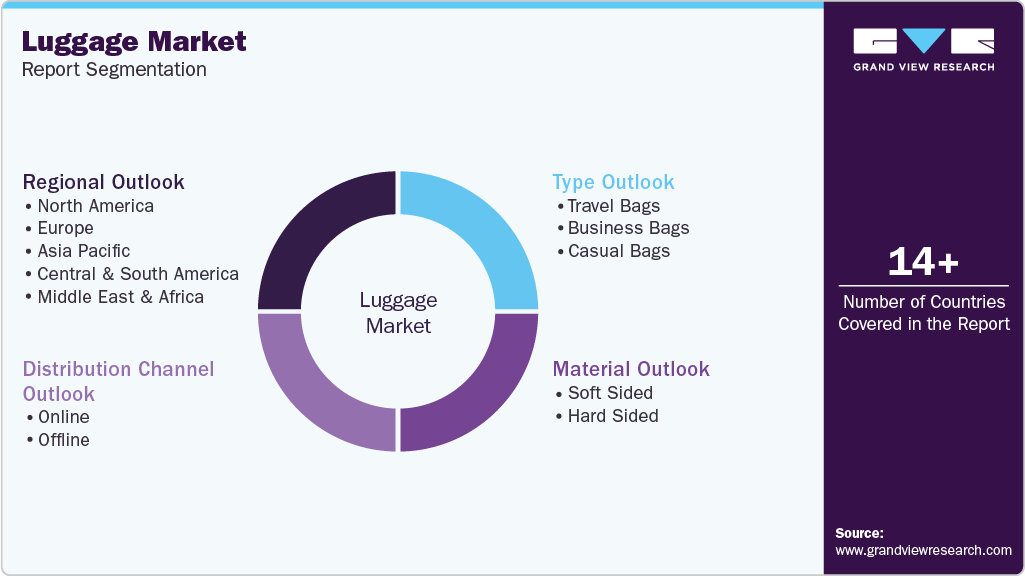
This report forecasts revenue growth at the global, regional, and country levels and provides an analysis of the latest industry trends and opportunities in each of the sub-segments from 2021 to 2033. For this study, Grand View Research has segmented the global luggage market based on type, material, distribution channel, and region:
 To learn more about this report, Download Free Sample Report
 -
Type Outlook (Revenue, USD Million, 2021 - 2033)
-
Travel Bags
-
Business Bags
-
Casual Bags
-
-
Material Outlook (Revenue, USD Million, 2021 - 2033)
-
Soft Sided
-
Hard Sided
-
-
Distribution Channel Outlook (Revenue, USD Million, 2021 - 2033)
-
Online
-
Offline
-
Supermarkets & hypermarkets
-
Specialty Stores
-
Others
-
-
Regional Outlook (Revenue, USD Million, 2021 - 2033)
-
North America
-
U.S.
-
Canada
-
Mexico
-
-
Europe
-
Germany
-
UK
-
France
-
Italy
-
Spain
-
-
Asia Pacific
-
China
-
Japan
-
India
-
Australia & New Zealand
-
South Korea
-
-
Central & South America
-
Brazil
-
Argentina
-
-
Middle East & Africa
-
South Africa
-
Saudi Arabia
-
-
Frequently Asked Questions About This Report
The global luggage market is expected to grow at a compounded growth rate of 7.1% from 2026 to 2033 to reach USD 82.0 billion by 2033.
Based on type, the travel bags segment led the market with the largest revenue share of 56.8% in 2025, supported by consistent consumer demand for lightweight, flexible, and easy-to-carry travel solutions.
Key players include Samsonite International S.A., VIP Industries Ltd., VF Corporation (Travel Gear segment), Tumi Holdings Inc., Delsey Paris, Rimowa GmbH, Briggs & Riley Travelware, Herschel Supply Co., Safari Industries (India) Ltd., and Away (JRSK Inc.).
Key factors include the rising disposable incomes, rapid urbanization, brand awareness, and a resurgence in both domestic and international travel. The ongoing shift from unbranded to branded products is driven by product innovation, premiumization, and e-commerce expansion.
North America led the global market accounted for the largest revenue share of 35.4% in 2025.
Soft-sided luggage led the market with the largest revenue share of 68.0% in 2025.
The sale of luggage through offline channels led the market with the largest revenue share of 59.5% in 2025.
The global luggage market size was valued at USD 43.1 billion in 2025 and is expected to reach USD 45.8 billion in 2026.
About the Author(s)
Clothing, Footwear & Accessories Research Team
Consumer Goods · Clothing, Footwear & AccessoriesThis report was authored by the clothing, footwear & accessories research team at Grand View Research - comprising two research analysts, one senior research analyst, and one industry expert - with specialized expertise in the clothing, footwear & accessories segment of the consumer goods industry. All findings are based on proprietary consumer goods databases, executive interviews, and regulatory analysis, subject to internal peer review prior to publication.
Last Updated:
Speak to Analyst

Customize this report to your needs - add regions, segments, or data points, with 20% free customization.
Or view our licence options:


ISO 9001:2015 & 27001:2022 Certified
We are GDPR and CCPA compliant! Your transaction & personal information is safe and secure. For more details, please read our privacy policy.


