
- Home
- »
- Biotechnology
- »
-
Middle East Life Science Tools Market, Industry Report, 2033GVR Report cover
![Middle East Life Science Tools Market Size, Share & Trends Report]()
Middle East Life Science Tools Market (2025 - 2033) Size, Share & Trends Analysis Report By Technology (Cell Biology, Proteomics, Genomic), By Product & Service (Liquid Chromatography, Mass Spectrometry, Flow Cytometry), By End-use, By Country, And Segment Forecasts
- Report ID: GVR-4-68040-735-8
- Number of Report Pages: 90
- Format: PDF
- Historical Range: 2021 - 2023
- Forecast Period: 2025 - 2033
- Industry: Healthcare
- Report Summary
- Table of Contents
- Segmentation
- Methodology
- Download FREE Sample
-
 Download Sample Report
Middle East Life Science Tools Market Trends
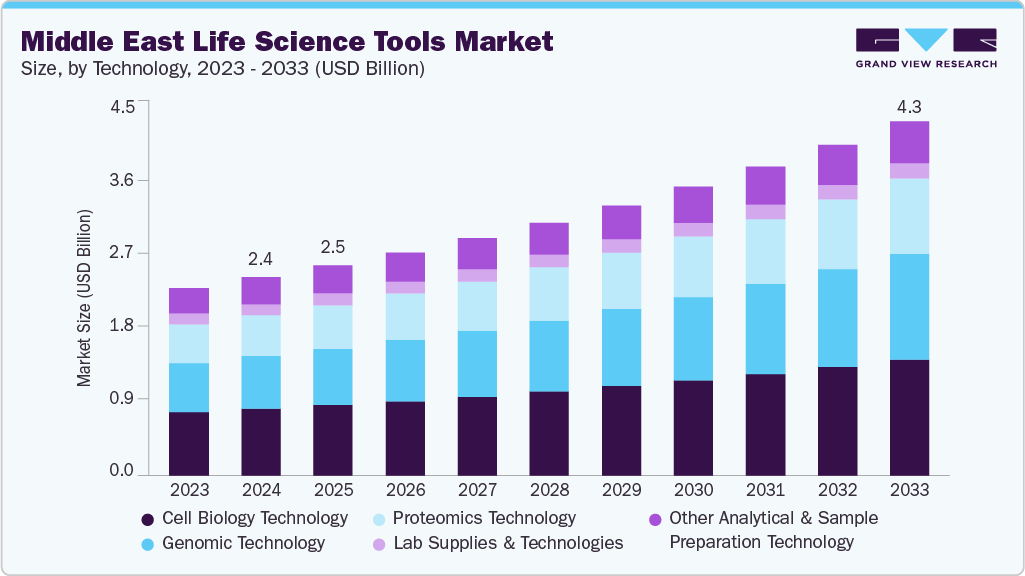
The Middle East life science tools market size was estimated at USD 2.40 billion in 2024 and is projected to reach USD 4.28 billion by 2033, growing at a CAGR of 6.7% from 2025 to 2033. The market is gaining significant traction, driven largely by strategic government investments and rapid healthcare expansion. Countries such as the UAE and Saudi Arabia are positioning themselves as regional hubs for scientific research and innovation, supported by national agendas such as UAE Vision 2031 and Saudi Vision 2030. These programs are not only strengthening healthcare infrastructure but also fueling demand for advanced genomics, proteomics, and diagnostic tools as research centers and clinical laboratories expand. The result is a strong foundation for sustained growth across life science tool segments.
Growth in Genomics, Biotech & R&D Activity
The surge in genomics and biotech activity, particularly following the COVID-19 pandemic. The widespread adoption of RT-PCR and next-generation sequencing (NGS) during the pandemic has accelerated investments in molecular diagnostics, precision medicine, and biotechnology R&D. Initiatives such as the Saudi and Emirati Genome Projects are reinforcing this momentum, creating consistent demand for sequencing platforms, cell culture systems, and bioinformatics solutions. The regional market for RT-PCR and NGS is projected to see robust double-digit growth over the next decade, signaling a long-term commitment to research and innovation.
Technological advancement and digital integration are reshaping the market landscape. The adoption of AI-enabled platforms, cloud-based research tools, and lab-on-a-chip solutions is driving laboratories toward high-throughput, data-driven workflows. Single-cell analysis, multi-omics integration, and advanced mass spectrometry applications are becoming critical to pharmaceutical research and drug discovery efforts in the region. These innovations are creating new opportunities for life science tool providers to offer flexible, interoperable, and scalable solutions that cater to the evolving needs of researchers and clinicians across the Middle East.
Expansion of the Biotechnology Sector Middle East
The expansion of the biotechnology sector is emerging as a cornerstone for the growth of the Middle East Life Science Tools Market. Governments across the region, particularly in Saudi Arabia, the UAE, and Qatar, are channeling substantial investments into biotech research and development, aligning with long-term economic diversification plans such as Saudi Vision 2030 and UAE Vision 2031. This push has created a fertile environment for genomics programs, biopharmaceutical development, and translational research initiatives. Large-scale projects such as the Saudi Genome Program and the Emirati Genome Project have accelerated demand for advanced sequencing technologies, molecular biology instruments, and bioinformatics platforms. In parallel, rising collaborations between Middle East Life Science Tools biotech companies and regional research institutions are expanding access to high-end tools and creating a robust innovation pipeline.
Beyond government initiatives, the private sector is also fueling biotech expansion through venture capital, start-up incubation, and the establishment of biotech parks and innovation hubs. The increased focus on precision medicine, regenerative therapies, and biologics manufacturing is driving the adoption of cutting-edge life science tools, ranging from cell culture systems and protein analysis platforms to advanced imaging and high-throughput screening solutions. As the biotech sector matures, the need for standardized workflows, automation, and integrated multi-omics platforms is set to intensify, further reinforcing the region’s growing reliance on sophisticated life science tools. This intersection of biotech advancement and tool adoption positions the Middle East as an emerging hub for scientific innovation with strong growth prospects in the Middle East Life Science Tools life sciences arena.
Market Concentration & Characteristics
The region is experiencing an accelerated innovation curve driven by large genomic programs, rapid adoption of NGS/RT-PCR, and increasing use of AI, single-cell and multi-omics workflows in both public and private labs; these capabilities are converting traditional diagnostic/clinical labs into R&D-grade facilities and creating demand for advanced analytical and automation platforms.
The life science industry is experiencing increasing mergers and acquisitions, driven by the need to expand product portfolios, access advanced technologies, and strengthen market positions. Companies are strategically consolidating to enhance research capabilities, achieve economies of scale, and accelerate innovation. This trend is also fueled by rising competition, the push for integrated solutions, and a focus on entering emerging markets with high growth potential.
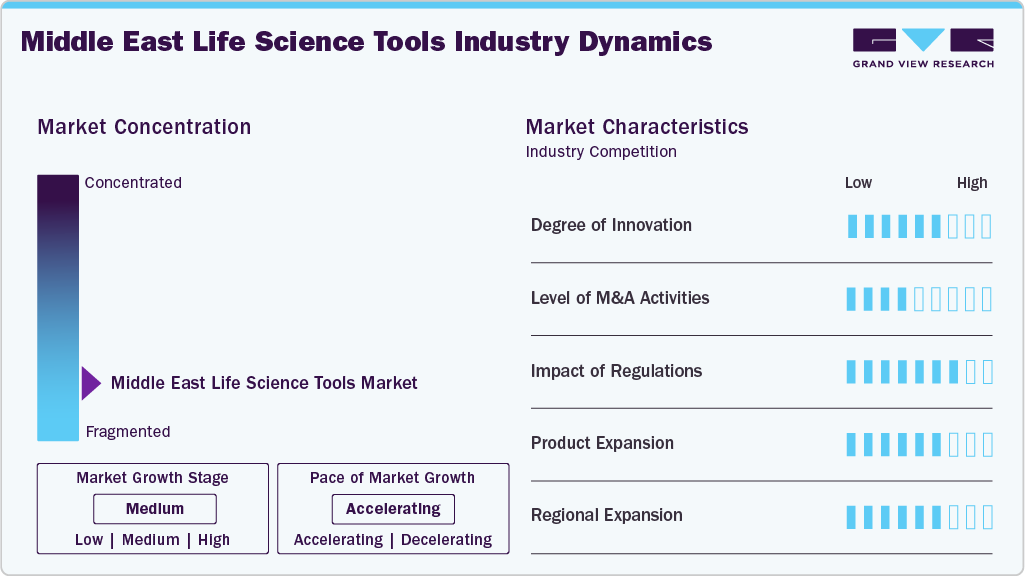
Regulation is evolving quickly, governments are strengthening medical-product laws and device oversight to support local production while protecting safety and data privacy; this regulatory tightening (and occasional enforcement actions) raises market entry hurdles and compliance costs but also boosts demand for validated, quality-assured instruments and for vendors that can provide GMP/compliance support.
Product demand is broadening from core diagnostics into genomics, bioprocessing and analytical instrumentation, think sequencers, bioreactors/CDMO-grade equipment, mass spectrometers, lab automation, and cloud-native software, as the region builds capacity for both discovery research and biologics manufacturing. Suppliers that offer integrated hardware-software solutions and service models are best positioned to capture this expansion.
Market concentration is highest in the UAE and Saudi Arabia, where sovereign funds, public-private partnerships and dedicated innovation zones (plus landmark genome and biomanufacturing projects) are clustering capacity and capital; secondary hubs (e.g., Egypt, Qatar) are growing but with more price-sensitive, volume-driven demand-so commercial strategies must be country-specific, balancing high-end systems in Gulf hubs with more cost-efficient offerings elsewhere.
Technology Insights
The cell biology technology segment captured the largest revenue share of 33.73% in 2024. The market for cell biology technology is gaining momentum as regional investments in research infrastructure and biopharma manufacturing expand rapidly. Governments in the UAE and Saudi Arabia are prioritizing cell and gene therapy, regenerative medicine, and vaccine development as part of their national biotech strategies, which is creating strong demand for advanced cell culture systems, flow cytometers, high-content imaging, and cell analysis platforms. Academic and translational research institutes are increasingly focused on stem cell research and immunology, while pharma and biotech companies are scaling up cell-based assays for drug discovery and quality control. Together, these factors are driving steady adoption of cell biology technologies, supported by public-private partnerships and growing collaborations with Middle East Life Science Tools life science tool providers.
The genomic technology segment is anticipated to grow at the fastest CAGR during the forecast period, driven by large-scale national genome initiatives and rising demand for precision medicine. Programs like the Saudi Genome Project and Emirati Genome Program are sequencing thousands of citizens to identify population-specific variants, driving the uptake of next-generation sequencing (NGS) platforms, PCR systems, and bioinformatics tools. The post-pandemic focus on molecular diagnostics has also accelerated investment in genomics infrastructure, with hospitals, academic institutes, and reference labs upgrading to high-throughput sequencing and digital PCR workflows.
Product & Service Insights
The cell culture systems & 3D cell culture segment captured the largest revenue share of 16.75% in 2024. Governments in Saudi Arabia and the UAE are investing heavily in biomanufacturing hubs and GMP-compliant facilities, creating a strong need for scalable, automated cell culture platforms that support monoclonal antibody production, vaccine development, and cell therapy pipelines. At the same time, academic and translational research centers are increasingly adopting 3D cell culture models to better replicate in-vivo environments for cancer research, toxicology, and personalized medicine applications. This combination of industrial bioprocessing requirements and next-generation research needs is driving steady growth for suppliers of bioreactors, consumables, and high-content analysis tools across the region.
The next generation sequencing segment is expected to grow at the fastest CAGR during the forecast period. Next-generation sequencing (NGS) is a key growth driver for the Middle East Life Science Tools Market, propelled by ambitious national genomics initiatives and the rising focus on precision medicine. Projects such as the Saudi Genome Program and the Emirati Genome Program are sequencing large populations to map hereditary diseases, creating sustained demand for high-throughput sequencers, library preparation kits, and bioinformatics pipelines. The post-COVID expansion of molecular diagnostics has further strengthened NGS adoption for infectious disease surveillance, oncology panels, and rare disease research.
End-use Insights
The healthcare segment dominated the market with the largest revenue share of 32.50% in 2024. Saudi Arabia’s Vision 2030 and the UAE’s National Health Strategy are channeling billions into building advanced healthcare infrastructure, upgrading diagnostic capacity, and integrating precision medicine into routine care. This surge in healthcare spending is boosting demand for molecular diagnostics, sequencing technologies, and analytical instruments needed for early disease detection, oncology testing, and personalized treatment planning. As non-communicable diseases such as cancer, diabetes, and cardiovascular disorders rise, the need for sophisticated life science tools to support clinical decision-making and population health management continues to accelerate.
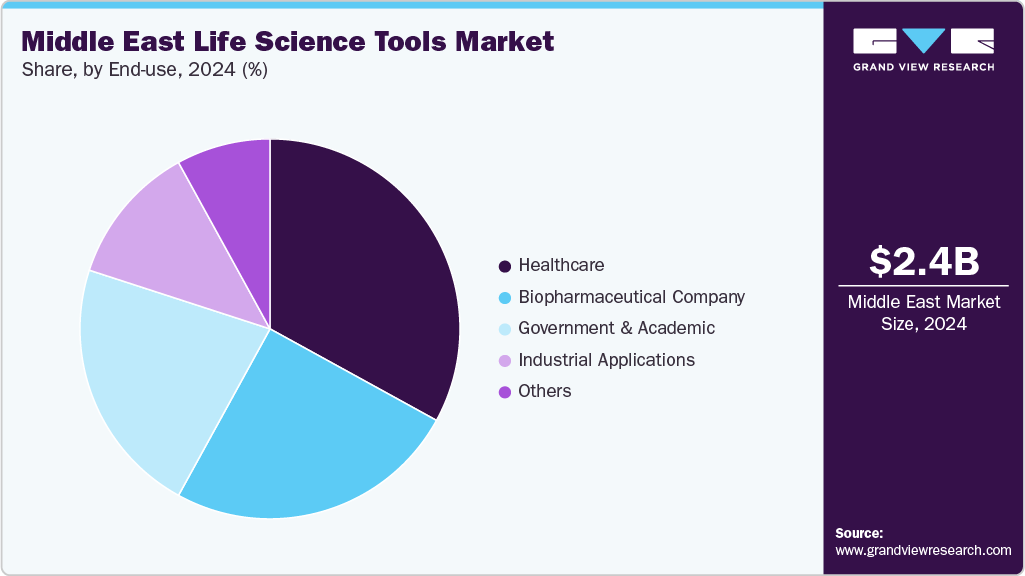
The biopharmaceutical company segment is anticipated to witness fastest growth over the forecast period, driven by Saudi Arabia’s National Biotechnology Strategy and the UAE’s push to develop a domestic biopharma sector are driving investments in GMP manufacturing facilities, CDMOs, and innovation hubs. This expansion is fueling demand for bioprocessing equipment, cell culture systems, chromatography and purification tools, as well as quality control and analytical technologies to support large-scale production. Partnerships between local players and Middle East Life Science Tools pharma leaders, along with government incentives to reduce dependency on imports, are creating a robust ecosystem where life science tool providers play a critical enabling role.
Country Insights
Saudi Arabia Life Science Tools Market Trends
Saudi Arabia life science tools market dominated the Middle East region with the largest revenue share of 35.66% in 2024. The market is being propelled by ambitious national initiatives under Vision 2030, which emphasize healthcare modernization, biotechnology development, and local biopharmaceutical manufacturing. Large-scale projects, such as the Saudi Genome Program and new biomanufacturing hubs, are driving demand for genomic sequencing platforms, cell culture systems, and analytical instruments. Government investment in public research centers, translational medicine, and clinical diagnostics is creating a favorable environment for both international and domestic life science tool providers to expand their footprint.
Kuwait Life Science Tools Market Trends
Kuwait’s market growth is largely driven by investments in healthcare infrastructure and a growing focus on research and diagnostics. Hospitals and academic research institutions are upgrading laboratories with advanced molecular diagnostics, genomics, and cell biology tools to support population health initiatives and disease surveillance. The government’s strategic emphasis on healthcare quality and modernization, coupled with partnerships with Middle East Life Science Tools suppliers, is increasing adoption of high-throughput laboratory equipment and analytical platforms.
UAE Life Science Tools Market Trends
The UAE stands out as a regional innovation hub, fueled by strong government support through programs such as the National Genome Program and substantial investment in biopharma, genomics, and advanced diagnostics. Dubai Science Park, Abu Dhabi Biotech Zone, and other innovation clusters are attracting Middle East Life Science Tools collaborations, fostering rapid adoption of next-generation sequencing, cell culture systems, and AI-enabled analytical tools. Public-private partnerships and a focus on precision medicine are driving sustained demand for high-end life science instruments across clinical, research, and industrial laboratories.
Key Middle East Life Science Tools Company Insights
The Middle East life science tools industry is shaped by several established players that dominate through broad product portfolios, strategic collaborations, and sustained investments in healthcare innovation.
Thermo Fisher Scientific, QIAGEN, Roche, and Merck KGaA collectively represent the dominant forces in the Middle East life science tools market, each with a distinct strategic approach. Thermo Fisher maintains the most extensive regional presence, with a well-established footprint across the Gulf. Its dedicated Middle East Customer Experience Centre and regional offices, particularly in Dubai, enable robust customer engagement, technical training, and service support. This infrastructure positions Thermo Fisher to effectively drive demand for high-value solutions such as next-generation sequencing systems, mass spectrometry platforms, and laboratory automation equipment, catering to government research institutes, academic organizations, and pharmaceutical manufacturing hubs.
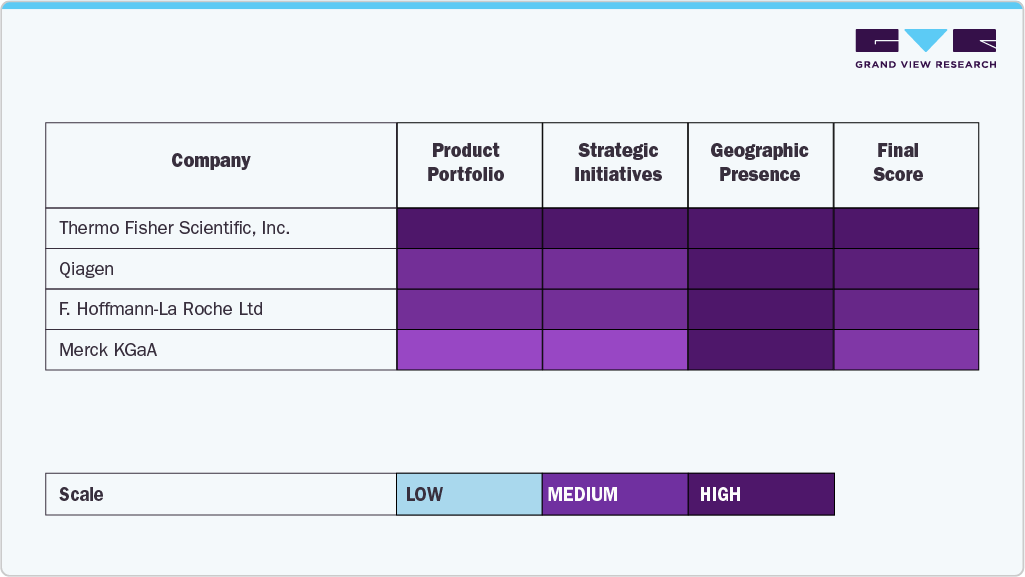
QIAGEN recently moved to deepen regional ties with a Riyadh regional headquarters and MoU activity in Saudi Arabia, a clear signal they’re targeting public-health and clinical genomics projects. Roche maintains a formal Diagnostics & Life-Science presence out of Dubai/JAFZA which gives it reach into Gulf and Levant markets for both clinical diagnostics and upstream research tools. Merck (including Millipore/Sigma brands) rounds out the map with a strong reagent, consumables and lab-chemicals distribution network and recent regional office expansion in Saudi Arabia, together these dynamics reflect a Middle-East market that’s growing fast and favoring suppliers who offer local service, regulatory support and training, not just product lists.
Key Middle East Life Science Tools Companies:
- Agilent Technologies, Inc.
- Becton, Dickinson and Company
- F. Hoffmann-La Roche Ltd.
- Bio-Rad Laboratories, Inc.
- Danaher Corporation
- Illumina, Inc.
- Thermo Fisher Scientific, Inc.
- QIAGEN N.V.
- Merck KGaA
- Shimadzu Corporation
Recent Developments
-
In July 2025, Bedfont Scientific Limited had announced a strategic collaboration with Medvision for Medical Services Company in Kuwait. Medvision, a prominent distributor of medical equipment, disposables, and healthcare services across both public and private sectors, has successfully obtained registration for Bedfont’s Gastrolyzer range of Hydrogen-Methane Breath Testing (HMBT) devices, enabling wider market access in the region.
-
In April 2025, The Institute for Healthier Living Abu Dhabi (IHLAD) and Singleron Biotechnologies have announced the launch of AD-Omics, a pioneering joint venture aimed at transforming precision medicine diagnostics across the Middle East. The initiative likely to leverage advanced genomic and single-cell multi-omics technologies to introduce personalized healthcare solutions to the region, supporting the UAE’s strategic vision of becoming a global hub for innovative healthcare, driving research excellence, and improving patient outcomes.
Middle East Life Science Tools Market Report Scope
Report Attribute
Details
Market size value in 2025
USD 2.54 billion
Revenue forecast in 2033
USD 4.28 billion
Growth rate
CAGR of 6.7% from 2025 to 2033
Base year for estimation
2024
Historical data
2021 - 2023
Forecast period
2025 - 2033
Quantitative units
Revenue in USD million/billion and CAGR from 2025 to 2033
Report coverage
Revenue forecast, company ranking, competitive landscape, growth factors, and trends
Segments covered
Technology, product & service, end-use, country
Country scope
Saudi Arabia; UAE; Kuwait; Qatar; Oman
Key companies profiled
Agilent Technologies, Inc.; Becton; Dickinson and Company; F. Hoffmann-La Roche Ltd.; Bio-Rad Laboratories Inc.; Danaher Corporation; Illumina, Inc.; Thermo Fisher Scientific, Inc; QIAGEN N.V.; Merck KGaA; Shimadzu Corporation
Customization scope
Free report customization (equivalent up to 8 analyst’s working days) with purchase. Addition or alteration to country, regional & segment scope.
Middle East Life Science Tools Market Report Segmentation
This report forecasts revenue growth and provides an analysis on the latest trends in each of the sub-segments from 2021 to 2033. For this report, Grand View Research has segmented the Middle East life science tools market based on technology, product & service, end-use, and country:
-
Technology Outlook (Revenue, USD Million, 2021 - 2033)
-
Genomic Technology
-
Proteomics Technology
-
Cell Biology Technology
-
Other Analytical & Sample Preparation Technology
-
Lab Supplies & Technologies
-
-
Product & Service Outlook (Revenue, USD Million, 2021 - 2033)
-
Cell Culture Systems & 3D Cell Culture
-
Instruments
-
Consumables
-
Cell & Tissue Culture Services
-
-
Liquid Chromatography
-
Instruments
-
Consumables
-
Services
-
-
Mass Spectrometry
-
Instruments
-
Consumables
-
Services
-
-
Flow Cytometry
-
Instruments
-
Consumables
-
Services
-
-
Cloning & Genome Engineering
-
Kits, Reagents, and Consumables
-
Services
-
-
Microscopy & Electron Microscopy
-
Instruments
-
Consumables
-
Services
-
-
Next Generation Sequencing
-
Instruments
-
Consumables
-
Services
-
-
PCR & qPCR
-
Instruments
-
Consumables
-
Services
-
-
Nucleic Acid Preparation
-
Instruments
-
Consumables
-
Services
-
-
Nucleic Acid Microarray
-
Instruments
-
Consumables
-
Services
-
-
Sanger Sequencing
-
Instruments
-
Consumables
-
Services
-
-
Transfection Devices & Gene Delivery Technologies
-
Equipment
-
Reagents
-
-
NMR
-
Instruments
-
Consumables
-
Services
-
-
Other Separation Technologies
-
Instruments
-
Consumables
-
Services
-
-
Other Products & Services
-
Antibodies
-
General Supplies
-
Others
-
Instruments
-
Consumables
-
Services
-
-
-
-
End-use Outlook (Revenue, USD Million, 2021 - 2033)
-
Government & Academic
-
Biopharmaceutical Company
-
Healthcare
-
Industrial Applications
-
Others
-
-
Country Outlook (Revenue, USD Million, 2021 - 2033)
-
Saudi Arabia
-
UAE
-
Kuwait
-
Qatar
-
Oman
-
Frequently Asked Questions About This Report
b. The Middle East life science tools market size was estimated at USD 2.40 billion in 2024 and is expected to reach USD 2.54 billion in 2025.
b. The Middle East life science tools market is expected to grow at a compound annual growth rate of 6.75% from 2025 to 2033 to reach USD 4.28 billion by 2033.
b. The cell biology technology segment dominated the Middle East life science tools market, with a share of 33.73% in 2024. This is attributable to rising technological developments and increasing demand for analytical tools in the region.
b. Some key players operating in the Middle East life science tools market include Eurofins Scientific, Inc., Sartorius AG, Merck KGaA, Thermo Fisher Scientific Inc., Lonza, Thermo Fisher Scientific Inc., Danaher Corporation, Charles River Laboratories, SGS S.A., Toxikon Corporation, Cobetter Filtration Equipment Co., Ltd.
b. The Middle East life science tools market is gaining significant traction, driven largely by strategic government investments and rapid healthcare expansion.


Share this report with your colleague or friend.
Need a Tailored Report?
Customize this report to your needs — add regions, segments, or data points, with 20% free customization.


ISO 9001:2015 & 27001:2022 Certified
We are GDPR and CCPA compliant! Your transaction & personal information is safe and secure. For more details, please read our privacy policy.
Trusted market insights - try a free sample
See how our reports are structured and why industry leaders rely on Grand View Research. Get a free sample or ask us to tailor this report to your needs.













