
- Home
- »
- Next Generation Technologies
- »
-
Middle East Private 5G Network Market, Industry Report 2033GVR Report cover

Middle East Private 5G Network Market (2026 - 2033) Size, Share & Trends Analysis Report By Component (Software, Hardware), By Frequency, By Spectrum (Licensed, Unlicensed/Shared), By Enterprise Size, By Vertical (Transportation & Logistics), By Country, And Segment Forecasts
Middle East Private 5G Network Market Summary
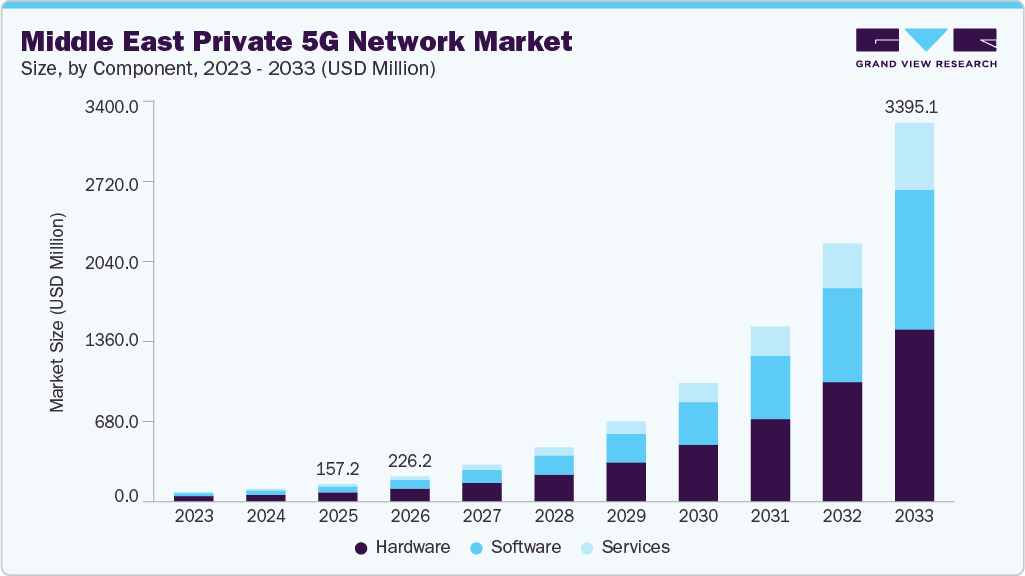
The Middle East private 5G network market size was estimated at USD 157.2 million in 2025, and is projected to reach USD 3,395.1 million by 2033, growing at a CAGR of 47.3% from 2026 to 2033. Driven by accelerating Industry 4.0 deployments across oil & gas, smart city investments, digital transformation mandates, and growing adoption of ultra-reliable low-latency connectivity across enterprises.
Key Market Trends & Insights
- The UAE Private 5G Network market accounted for a 47.1% share of the overall market in 2025.
- By component, the hardware segment accounted for the largest share of 52.3% in 2025.
- By frequency, the sub-6 GHz segment held the largest market share in 2025.
- By spectrum, the unlicensed/shared segment dominated the market in 2025.
Market Size & Forecast
- 2025 Market Size: USD 157.2 Million
- 2033 Projected Market Size: USD 3,395.1 Million
- CAGR (2026-2033): 47.3%
Three ways to get this report
Buy it, customize it, or ask a question.Ask an Analyst
Analyst response in 1 business day
- AccessReport author, directly
- Reply timeWithin 1 working day
- No sales callDirect answer only
- FormatEmail reply
- CostFree, no cost
Get the Full Report
What the study covers
- FormatsPDF · Excel · Dashboard
- Timeline2026–2033 annual, 2025 base
- Coverage20+ countries, 5 regions
- Companies10+ key players profiled
Customize the Report
20% free customization
- IncludeCountries, segments, points
- TailorTo your product definition
- ExtendDeeper competitor detail
- OrA fully bespoke study
- Turnaround5–10 working days
Large-scale government-led digital transformation missions across the Middle East are substantially propelling the market growth of private 5G networks. As part of national economic diversification strategies, governments in the region have prioritized advanced connectivity infrastructures to modernize industrial zones, logistics clusters, energy corridors, and public-sector platforms. For instance, the UAE Government’s Digital Government Strategy and Saudi Arabia’s Digital Government Authority initiatives emphasize accelerating ultra-reliable, low-latency connectivity to enable automation, smart manufacturing, and mission-critical communication systems. These nationwide programs boost the adoption of private 5G among enterprises requiring secured, isolated, and high-performance networks.Industrial modernization mandates from national authorities, covering sectors such as oil & gas, utilities, mining, and transportation, are significantly boosting the growth of the Middle East private 5G network industry. Governments are actively promoting smart industrial infrastructure, automation systems, and intelligent asset-monitoring platforms that rely heavily on 5G’s high device density and ultra-low latency capabilities. The Saudi Ministry of Industry and Mineral Resources and Qatar’s Ministry of Communications and Information Technology have published frameworks that encourage the use of advanced wireless systems to support remote operations, worker safety, and real-time analytics, thereby directly accelerating enterprise-level private 5G deployments.
 Source: Grand View Research, IR Documents, Primary Interviews, Paid DatabasesTo learn more about this report,
 Download Free Sample Report
 Strengthening security, defense communication, and critical infrastructure resilience is another trend propelling the market growth of private 5G networks across the Middle East. Government agencies in countries such as the UAE and Saudi Arabia have emphasized the need for secure, standalone 5G systems in airports, border control, emergency services, and public-safety command centers. Government-authorized organizations, including the UAE Cyber Security Council and the Saudi National Cybersecurity Authority, emphasize the importance of sovereign, private wireless networks in supporting encrypted communication, autonomous drones, and advanced surveillance, thereby driving accelerated investment in private 5G solutions.
Government-funded smart city programs, such as Saudi Arabia’s NEOM, the UAE’s Smart Dubai initiative, and Qatar’s Smart Qatar Program (TASMU), are boosting the market by embedding private 5G networks into urban infrastructure, transportation systems, and public-sector innovation hubs. These initiatives require secure, high-capacity private 5G to support autonomous mobility, AI-powered traffic systems, smart utilities, and IoT-driven urban management. The integration of private 5G into smart grids, digital ports, and intelligent logistics ecosystems is creating strong enterprise-level demand across government-backed development zones in the region.
Component Insights
The hardware segment dominated the Middle East private 5G network market in 2025, capturing an estimated 52.3% share of the regional revenue. This leadership is primarily driven by rapid deployments of Radio Access Network (RAN) systems, private 5G core networks, and high-capacity backhaul and transport infrastructure across the Gulf countries. Governments and large enterprises in Saudi Arabia, the UAE, Qatar, and Oman are heavily investing in standalone (SA) 5G core hardware to support ultra-reliable, low-latency communication (URLLC) for energy fields, industrial zones, digital ports, and smart-city districts. Regional operators such as stc, Etisalat by e&, Ooredoo, and Omantel, along with Middle East technology providers including Nokia, Ericsson, and Qualcomm, are supplying robust equipment to strengthen transport and backhaul capacity. These deployments ensure high-speed connectivity for mission-critical applications, directly propelling the hardware segment’s dominance across the region.
The services segment is projected to witness the fastest CAGR from 2026 to 2033, driven by a surge in enterprise-grade private 5G deployments across oil & gas facilities, logistics hubs, manufacturing clusters, and government-led smart-infrastructure megaprojects. This segment includes installation & integration, data services, and support & maintenance, all of which are increasingly in demand as organizations shift toward dedicated 5G cores for secure data environments. The rapid uptake of industrial automation, smart surveillance, autonomous mobility, and IoT platforms in Saudi Arabia’s NEOM, the UAE’s free zones, Qatar’s smart transport corridors, and Oman’s industrial estates is boosting demand for installation and integration services. As enterprises require highly customized, cyber-secure, and performance-optimized private 5G architectures, the services segment is expected to expand at the highest CAGR through 2033, supported by sustained government digitalization initiatives and rising reliance on specialized system integrators.
Frequency Insights
The Sub-6 GHz segment dominated the Middle East private 5G network industry in 2025, underpinned by its ability to deliver wide-area coverage and stable connectivity across large industrial environments. Sub-6 GHz bands, ranging roughly from 1 GHz to 6 GHz, do not match mmWave in raw speed. Still, their superior propagation characteristics make them ideal for refineries, utility corridors, seaports, logistics terminals, and expansive smart-city zones commonly found across Saudi Arabia, the UAE, Qatar, and Oman. Additionally, many of these frequencies have historically been used for previous mobile generations, making device ecosystems, infrastructure, and licensing far more mature and cost-efficient. This accessibility, combined with broader coverage, is propelling the market growth of the Sub-6 GHz segment across the region.
The mmWave segment is projected to witness the fastest CAGR from 2026 to 2033, driven by increasing government-backed spectrum releases and enterprise demand for ultra-high-capacity, low-latency networks. Countries such as Saudi Arabia (CITC/CRA), the UAE (TRA), Qatar (CRA), and Kuwait (CITRA) are progressively opening higher-band frequency allocations for industrial 5G use cases, particularly for dense environments such as smart airports, autonomous transport corridors, smart stadiums, and mission-critical control systems. The growing focus on enabling high-throughput private networks for robotics, AR/VR operations, and real-time analytics at industrial sites is boosting the market adoption of mmWave bands. As spectrum reforms accelerate and device compatibility expands, the mmWave segment is projected to record the highest growth rate through 2033, driven by national digital transformation agendas and the increasing adoption of performance-intensive enterprise applications.
Spectrum Insights
The unlicensed/shared spectrum segment dominated the Middle East private 5G network market in 2025, driven by its affordability, rapid deployability, and suitability for large-scale IoT connectivity. Enterprises across Saudi Arabia, the UAE, Qatar, and Oman are increasingly opting for unlicensed/shared spectrum bands, as they eliminate the need for time-consuming spectrum licensing processes and reduce deployment costs. This makes them ideal for smart-city applications, smart ports, stadiums, industrial sensors, and other massive machine-type communication (mMTC) environments. The ability to quickly activate private 5G networks for high-density IoT devices without regulatory delays is propelling the market growth of this segment across Middle Eastern industrial and urban applications. Moreover, the rising emphasis on cost-effective digital infrastructure within manufacturing zones, logistics hubs, and public-sector projects is further boosting the market for unlicensed/shared 5G deployments.
The licensed spectrum segment is projected to experience significant growth from 2026 to 2033, driven by the rising adoption of secure and interference-free private 5G networks for mission-critical operations by enterprises. Licensed spectrum allocations, typically acquired through national telecom authorities such as Saudi Arabia’s CST, the UAE’s TDRA, Qatar’s CRA, and Oman’s TRA, provide guaranteed bandwidth, higher reliability, and stronger cybersecurity, making them essential for applications such as automated guided vehicles (AGVs), remote operations in oil & gas fields, autonomous logistics systems, and real-time industrial automation. As Middle Eastern governments continue to formalize 5G-specific licensing frameworks and enterprises shift toward high-priority applications requiring strict SLAs and dedicated bandwidth, demand for licensed spectrum is expected to accelerate sharply through 2033. This growing reliance on secure connectivity and controlled network environments is expected to propel the expansion of the licensed spectrum segment across the region.
Enterprise Size Insights
The large enterprises segment dominated the Middle East private 5G network industry in 2025, driven by extensive digital transformation initiatives across various sectors, including oil & gas, energy & utilities, mining, logistics, aviation, and smart healthcare. Large enterprises in Saudi Arabia, the UAE, Qatar, and Oman are increasingly deploying private 5G systems to enhance operational security, achieve real-time automation, and enable high-bandwidth, mission-critical workflows that conventional Wi-Fi networks cannot reliably support. These organizations typically manage data-heavy activities such as industrial robotics, predictive maintenance, autonomous asset management, and remote field operations, all of which require the ultra-low latency and deterministic performance offered by private 5G. The growing emphasis on resilient, scalable, and enterprise-controlled networks is propelling the market growth of this segment across the Middle East.
The small & medium enterprises (SMEs) segment is expected to witness significant expansion from 2026 to 2033, driven by the gradual reduction in deployment complexity and cost barriers traditionally associated with private 5G networks. Historically, SMEs in the region have faced challenges due to the high upfront investment, specialized integration requirements, and the need for advanced network management capabilities. However, the emergence of Open RAN architectures, ORAN-compliant chipsets, cloud-native 5G cores, and modular deployment models is making private 5G increasingly accessible to smaller organizations. As vendors introduce more simplified, cost-efficient, and plug-and-play solutions tailored for SME environments, such as warehouses, small industrial workshops, utilities subcontractors, and mid-sized logistics operators, the adoption rate is expected to accelerate. These advancements are boosting the market for SME-driven private 5G deployments and are projected to drive strong growth across the region through 2033.
Vertical Insights
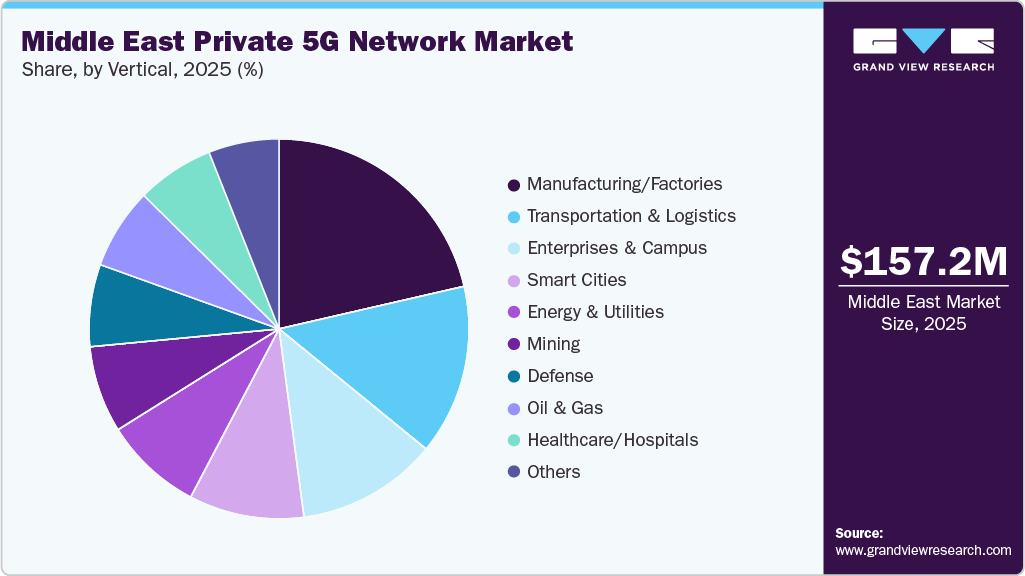
The manufacturing and factory segment dominated the Middle East Private 5G Networks market in 2025 and is expected to grow at the fastest CAGR during the forecast period. This dominance is driven by the rising demand for private 5G networks to enable seamless connectivity across multiple devices, including Ultra-HD cameras, extended reality (XR) headsets, and Automated Guided Vehicle Systems (AGVs). Furthermore, the increasing need for uninterrupted machine-to-machine communication is propelling segment growth, with sustained expansion expected from 2026 through 2033.
 To learn more about this report, Download Free Sample Report
 The transportation and logistics segment is projected to register a significant CAGR from 2026 to 2033. Middle East Private 5G Networks are enabling trucking companies, warehouse operators, courier services, railway companies, port authorities, and other transportation and logistics players to monitor the location and condition of their assets in real time. Key features, including ultra-high speed, higher bandwidth, real-time data collection, and cloud-native architecture, are propelling the adoption of private 5G networks across the transportation and logistics sector.
Country Insights
UAE Private 5G Network Market Trends
The UAE private 5G network market is expected to grow at the fastest CAGR from 2026 to 2033 and held the largest market share of 47.1% in 2025. The UAE’s smart city strategies, particularly in Dubai and Abu Dhabi, are accelerating the adoption of private 5G networks across enterprises and government entities. Ultra-low latency, high bandwidth, and cloud-native capabilities enable critical sectors, including ports, logistics, healthcare, and energy, to adopt connected solutions. Real-world deployments and pilot projects demonstrate how private 5G networks are enhancing operational efficiency, driving digital transformation, and fostering innovation across the UAE, thereby reinforcing its position as a regional hub for advanced private wireless networks.
KSA Private 5G Network Market Trends
The Saudi Arabia private 5G network market held a significant share in 2025, supported by the country’s strong push for digital transformation and smart industrial initiatives. Saudi Arabia represents the core of the regional landscape, driven by its industrial zones, smart cities, and manufacturing sectors that require seamless connectivity for automation and IoT applications. Partnerships, such as those between Zain Saudi Arabia and Nokia for cloud-native 5G deployments, highlight the nation’s strategic focus on enabling ultra-reliable, low-latency networks. Governmental initiatives and regulatory support are fostering the adoption of private 5G networks for mission-critical operations in manufacturing, logistics, and smart city infrastructure, positioning Saudi Arabia as a leader in enterprise-grade 5G implementation in the Middle East.
Key Middle East Private 5G Network Company Insights
Market players are characterized by their extensive telecommunications infrastructure portfolios, sustained investments in next-generation network technologies, and collaborations with regional operators and enterprise customers. These companies have consistently demonstrated leadership in deploying and commercializing advanced connectivity solutions, including 5G, private networks, cloud-native architectures, IoT platforms, and software-defined networks. Their capabilities across radio access networks (RAN), core networks, network security, and edge computing enable them to support high-performance, low-latency, and scalable communication ecosystems in various sectors, including manufacturing, transportation, logistics, energy, and smart cities. Furthermore, their regional presence, ongoing R&D initiatives, and integration of sustainable and energy-efficient network practices reinforce their strategic importance and competitiveness in a rapidly transitioning Middle East market toward intelligent, automated, and converged digital infrastructure.
-
Telefonaktiebolaget LM Ericsson provides information and communication technology (ICT) services in the Middle East, including private 5G and IoT-powered networks, managed services, and digital solutions. The company undertakes strategic initiatives involving new product deployments and partnerships with regional operators to expand its presence across key markets, including the UAE, Saudi Arabia, and Qatar.
-
Nokia Corporation is a leading provider of mobile and fixed network infrastructure in the Middle East, combining hardware, software, and services. The company focuses on private 5G deployments, digital automation, and network portfolio integration platforms through its Nokia Software, Networks, and Technologies segments. Nokia has established collaborations with operators like Etisalat (UAE) and STC (Saudi Arabia), delivering enterprise-grade connectivity solutions and maintaining a strong regional presence.
Key Middle East Private 5G Network Companies:
- Telefonaktiebolaget LM Ericsson
- Nokia Corporation
- Samsung
- Huawei Technologies Co., Ltd.
- ZTE Corp.
- Vodafone Group Ltd.
- Juniper Networks
- Cisco Systems, Inc.
- Mavenir
- BT Group
- T-Systems International GmbH
Recent Developments
-
In October 2025, Ericsson signed a Memorandum of Understanding (MoU) with e& at GITEX Middle East 2025 in Dubai to accelerate the deployment and monetization of private 5G networks for enterprises across the UAE. The collaboration will leverage Ericsson Private 5G (EP5G) solutions to deliver scalable, high‑performance private connectivity to manufacturing, logistics, and smart infrastructure verticals.
-
In March 2024, SoftBank Corp. announced the service launch of its Private 5G (dedicated type). This service enables local governments, organizations, and other enterprises to establish customized 5G networks on their premises, featuring a dedicated base station. The service is optimal for customers who require low latency and advanced network solutions, making it suitable for smart factory applications.
Middle East Private 5G Network Market Report Scope
Report Attribute
Details
Market size value in 2026
USD 226.2 million
Revenue forecast in 2033
USD 3,395.1 million
Growth rate
CAGR of 47.3% from 2026 to 2033
Base year for estimation
2025
Actual Data
2021 - 2024
Forecast period
2026 - 2033
Quantitative units
Revenue in USD million and CAGR from 2026 to 2033
Report coverage
Revenue forecast, company market share, competitive landscape, growth factors, and trends
Segments covered
Component, frequency, spectrum, enterprise size, vertical, region
Country scope
KSA; UAE; Turkey; Qatar
Key companies profiled
Telefonaktiebolaget LM Ericsson; Nokia Corporation; Samsung; Huawei Technologies Co., Ltd.; ZTE Corp.; Vodafone Group Ltd.; Juniper Networks; Cisco Systems, Inc.; Mavenir; BT Group; T-Systems International GmbH
Customization scope
Free report customization (equivalent to up to 8 analysts working days) with purchase. Addition or alteration to the country, regional, and segment scope
Pricing and purchase options
Avail customized purchase options to meet your exact research needs. Explore purchase options
Middle East Private 5G Network Market Report Segmentation
The report forecasts revenue growth at the regional and country levels and provides an analysis of the latest industry trends in each of the sub-segments from 2021 to 2033. For this study, Grand View Research has segmented the Middle East private 5G network market report based on component, frequency, spectrum, enterprise size, vertical, and country:
-
Component Outlook (Revenue, USD Million, 2021 - 2033)
-
Hardware
-
Radio Access Network
-
Core Network
-
Backhaul & Transport
-
-
Software
-
Services
-
Installation & Integration
-
Data Services
-
Support & Maintenance
-
-
-
Frequency Outlook (Revenue, USD Million, 2021 - 2033)
-
Sub-6 GHz
-
mmWave
-
-
Spectrum Outlook (Revenue, USD Million, 2021 - 2033)
-
Licensed
-
Unlicensed/Shared
-
-
Enterprise Size Outlook (Revenue, USD Million, 2021 - 2033)
-
Small & Medium Enterprises
-
Large Enterprises
-
-
Vertical Outlook (Revenue, USD Million, 2021 - 2033)
-
Manufacturing/Factories
-
Automotive
-
Electrical & Electronics
-
Food & Beverages
-
Pharmaceuticals
-
Heavy Machinery
-
Clothing & Accessories
-
Others
-
-
Energy & Utilities
-
Transportation & Logistics
-
Defense
-
Enterprises & Campus
-
Mining
-
Healthcare/Hospitals
-
Oil & Gas
-
Retail
-
Agriculture
-
Smart Cities
-
Others
-
-
Country Outlook (Revenue, USD Million, 2021 - 2033)
-
Kingdom of Saudi Arabia (KSA)
-
UAE
-
Turkey
-
Qatar
-
Frequently Asked Questions About This Report
The key driving trend in the Middle East private 5G network market is the accelerating enterprise adoption of private 5G to support mission-critical digital transformation use cases, driven by the need for ultra-low latency, high reliability, enhanced cybersecurity, and full network control across industries such as oil & gas, manufacturing, logistics, ports, mining, and smart cities, particularly in Saudi Arabia and the UAE, where government-backed initiatives, large-scale industrial automation, and mega smart-city projects like NEOM are accelerating private 5G deployments to enable IoT at scale, autonomous operations, real-time analytics, and edge computing within dedicated, interference-free network environments.
The Middle East private 5G network market size was estimated at USD 157.2 million in 2025 and is expected to reach USD 226.2 million in 2026.
The Middle East private 5G network Market size is expected to grow at a significant CAGR of 47.3% to reach USD 3,395.1 million in 2033.
UAE held the largest market share of 47.1% in 2025. The UAE’s smart city strategies, particularly in Dubai and Abu Dhabi, are accelerating the adoption of private 5G networks across enterprises and government entities.
Some of the players in the market are Telefonaktiebolaget LM Ericsson, Nokia Corporation, Samsung, Huawei Technologies Co., Ltd., ZTE Corp., Vodafone Group Ltd., Juniper Networks, Cisco Systems, Inc., Mavenir, BT Group, and T-Systems International GmbH.
About the Author(s)
Next Generation Technologies Research Team
Technology · Next Generation TechnologiesThis report was authored by the next generation technologies research team at Grand View Research - comprising two research analysts, one senior research analyst, and one industry expert - with specialized expertise in the next generation technologies segment of the technology industry. All findings are based on proprietary technology databases, executive interviews, and regulatory analysis, subject to internal peer review prior to publication.
Last Updated:
Speak to Analyst

Customize this report to your needs - add regions, segments, or data points, with 20% free customization.
Or view our licence options:


ISO 9001:2015 & 27001:2022 Certified
We are GDPR and CCPA compliant! Your transaction & personal information is safe and secure. For more details, please read our privacy policy.


