
- Home
- »
- Plastics, Polymers & Resins
- »
-
Mobile Robotics Polymer Materials Market Report 2026-2033GVR Report cover

Mobile Robotics Polymer Materials Market (2026 - 2033)
Size, Share & Trends Analysis Report By Material Type (Commodity Plastics, Engineering Thermoplastics, High Performance Polymers, Fiber-reinforced Composites), By Robotics Platform, By Region, And Segment Forecasts
Market Size, 2025
$228.7MMarket Estimate, 2026
$261.5MMarket Forecast, 2033
$678.0MCAGR, 2026–2033
14.6%Mobile Robotics Polymer Materials Market Summary
The global mobile robotics polymer materials market size was valued at USD 228.7 million in 2025 and is projected to grow from USD 261.5 million in 2026 to USD 678.0 million by 2033, at a CAGR of 14.6% from 2026 to 2033. Asia Pacific held the largest share of 45.0% of the global market in 2025. The growing demand for automation in various end-use industries, driven by rapid development in artificial intelligence and machine learning, is propelling the market.
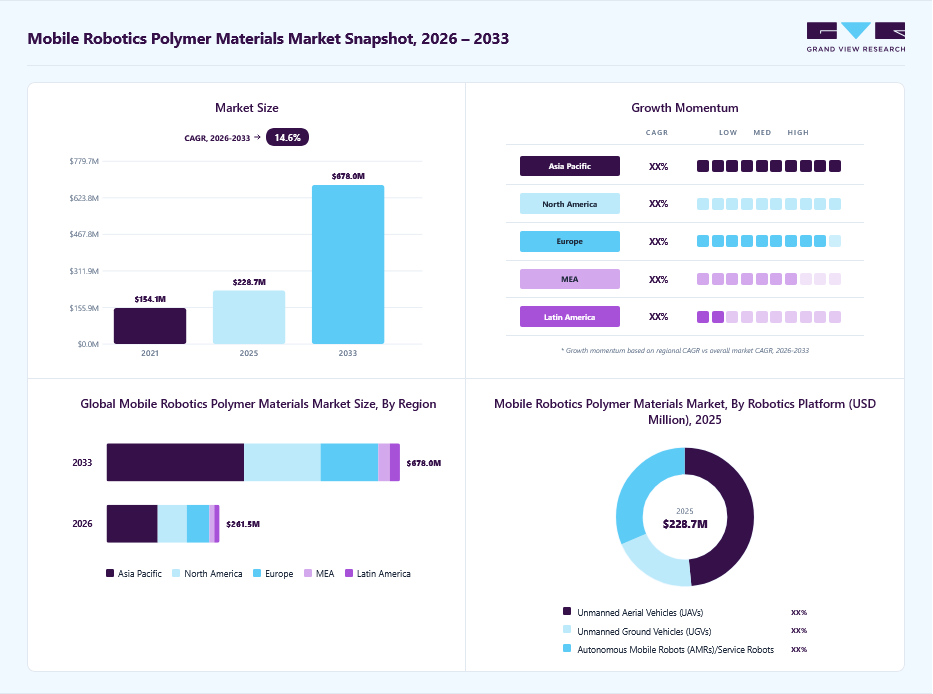 Source: Grand View Research, IR Documents, Primary Interviews, Paid DatabasesTo learn more about this report,
 Download Free Sample Report
 Key Market Trends & Insights
- By material type: Engineering thermoplastics segment held the largest market share of 33.8% in 2025.
- By material type: High-performance polymers segment is anticipated to grow at a CAGR of 14.9% from 2026 to 2033.
- By robotics platform: Unmanned aerial vehicles (UAVs) segment accounted for the largest market share of 48.4% in 2025.
Regional Highlights
- Largest regional market: Asia Pacific (45.0% market share, 2025)
- By country: China dominated the market in 2025..
Market Size & Forecast
- Market size in 2025: USD 228.7 Million
- Estimated market size in 2026: USD 261.5 Million
- Projected market size by 2033: USD 678.0 Million
- CAGR (2026-2033): 14.6%
Three ways to get this report
Buy it, customize it, or ask a question.Ask an Analyst
A direct answer, usually in 1 working day
- AccessReport author, directly
- Reply timeWithin 1 working day
- No sales callDirect answer only
- FormatEmail reply
- CostFree, no cost
Get the Full Report
What the study covers
- FormatsPDF · Excel · Dashboard
- Timeline2026–2033 annual, 2025 base
- Coverage20+ countries, 5 regions
- Companies10+ key players profiled
Customize the Report
20% free customization
- IncludeCountries, segments, points
- TailorTo your product definition
- ExtendDeeper competitor detail
- OrA fully bespoke study
- Turnaround5–10 working days
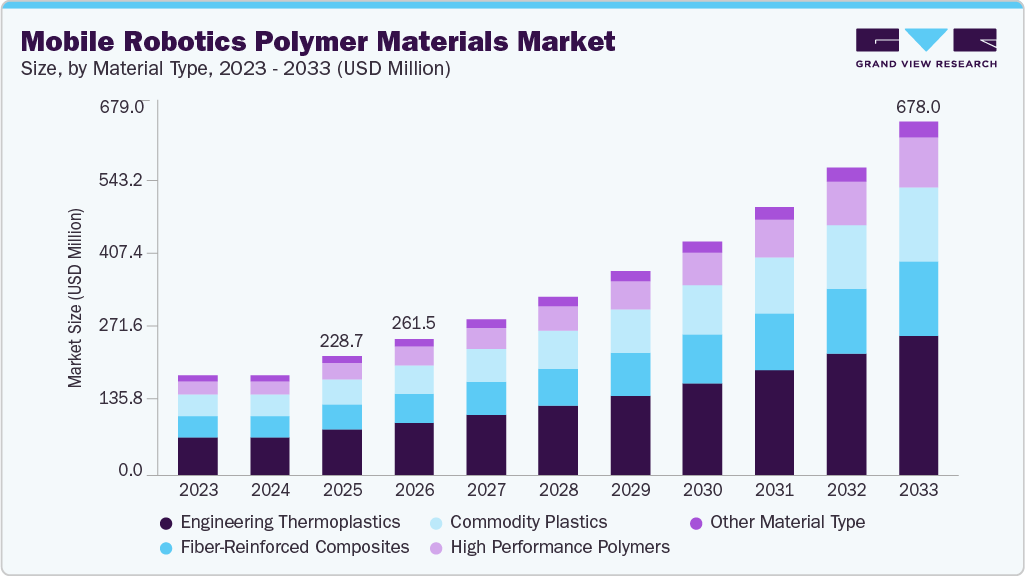 To learn more about this report, Download Free Sample Report
The mobile robotics polymer materials market is expected to experience substantial growth, driven by the shortage of labor in developed countries as well as the cost and efficiency benefits of mobile robotics, leading to an increased usage of polymers for components.Drivers, Opportunities & Restraints
Demand is being supported by commodity plastics such as polyethylene, polypropylene, PVC, polystyrene, and PET, which dominate global volumes due to their cost efficiency and versatility, while engineering and high-performance plastics are gaining importance in applications that require strength, thermal stability, and chemical resistance. The industry’s scale, process integration, and capital intensity create high barriers to entry, particularly at the resin production level. Automotive and electrical applications increasingly rely on plastics to support lightweighting, design flexibility, and electrification trends, especially as EV adoption accelerates. Healthcare demand, including medical devices and sterile packaging, provides a relatively resilient growth pillar, driven by strict performance and hygiene requirements.
Advancements in AI, sensors, and autonomous navigation are accelerating the mobile robotics polymer materials market by increasing both robot penetration and the material performance envelope required by each robot. In practice, today’s mobile robots are no longer simple motorized carriers. They are sensor-dense, software-defined systems that depend on real-time perception, localization, and path planning to operate safely in warehouses, factories, kitchens, hospitals, and outdoor environments. AI in mobile robotics is used to combine data from multiple sensors, such as LiDAR and cameras, for SLAM navigation, while reinforcement learning is increasingly used for motion and path planning in dynamic environments. That shifts the materials requirement toward lighter, more precise, and more protective polymer parts around sensors, electronics, and moving subsystems.
Multi-layer compliance is a critical restraint, as a single industrial or commercial mobile robot can sit under machinery law, robot safety standards, AI governance, cybersecurity rules, and material qualification tests at the same time. ISO 3691-4 explicitly covers driverless industrial trucks, including AGVs and AMRs, and the EU AI framework is designed so that the AI component is checked during the sectoral conformity assessment, creating a single combined conformity path rather than a clean split between “robot law” and “AI law.” That may reduce formal duplication, though it does not reduce the evidence burden. The OEM still must demonstrate mechanical safety, software behavior, and operational risk control in a single integrated file, which slows design-in and makes material approval more conservative.
Market Concentration & Characteristics
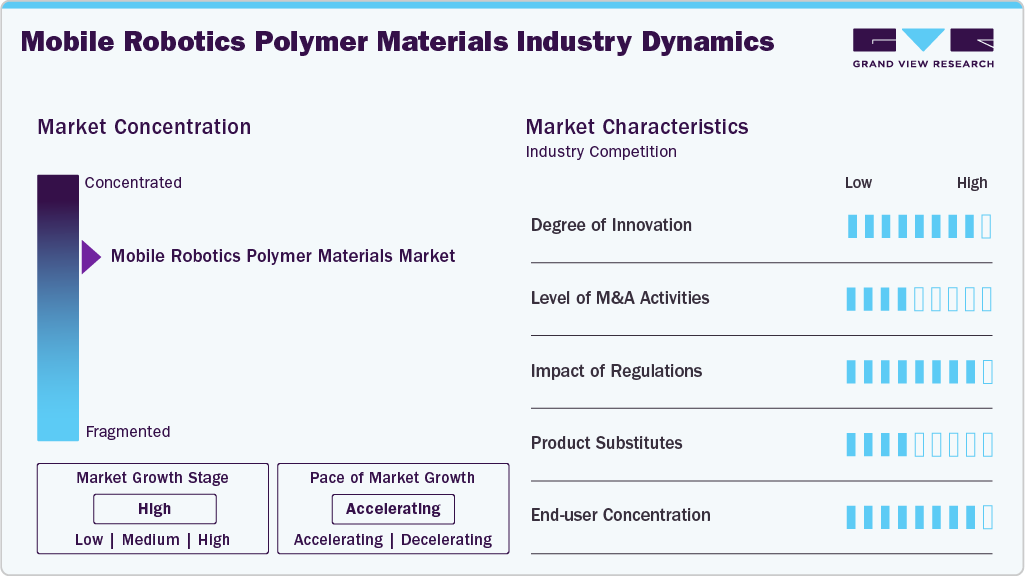
The market is in a high-growth stage, and growth is accelerating. The market exhibits fragmentation, with key players dominating the industry landscape. Major companies such as BASF SE, SABIC, Dow Inc., DuPont de Nemours, Inc., Covestro AG, Solvay S.A., and others play a significant role in shaping the market dynamics. These leading players often drive innovation in the market by introducing new products, technologies, and materials to meet the industry's evolving demands.
Commodity plastics such as PE, PP, and ABS are the baseline materials for cost-sensitive robot parts where moderate mechanical performance is acceptable. PE offers low moisture uptake, chemical resistance, and electrical insulation, making it useful for non-critical covers and insulation-related parts. PP brings low density, good fatigue behavior, and useful stiffness-to-weight balance, while ABS provides better impact resistance, surface finish, and design flexibility. In mobile robots, these polymers are mainly used where the design priorities are lightweighting, easy part integration, and lower system cost, rather than high-heat or high-load performance.
 To learn more about this report, Download Free Sample Report
 In the market for polymer materials used in mobile robotics, the risk of substitutes is moderate at both the application and material levels. Traditional automation systems, such as conveyors and manual handling equipment, remain viable alternatives in environments where cost is a critical factor. At the material level, polymers compete with metals and carbon fiber composites for high-strength or high-temperature applications, but their benefits in lightweighting, design flexibility, and cost-effectiveness continue to support their widespread use.
The concentration of end users is moderately elevated, with demand largely influenced by major industries such as e-commerce, logistics, automotive, and electronics. Significant consumption is attributed to major firms and system integrators due to their extensive robotics deployments. However, a rising adoption in the healthcare, retail, and service sectors is slowly expanding the customer base and diminishing overall concentration.
Material Type Insight
The engineering thermoplastics segment dominated the market across material type segmentation in terms of revenue, accounting for 33.8% market share in 2025. Engineering plastics are fundamental in the mobile robotics polymer materials sector, as they effectively combine mechanical strength with lightweight properties. Polymers such as polyamide, polycarbonate, ABS, POM, and high-performance types such as PEEK and PPS are commonly used in structural parts, casings, gears, bearings, and electrical housings. These materials offer excellent strength-to-weight ratios, abrasion resistance, dimensional consistency, and chemical resistance, which are crucial to the longevity and efficiency of autonomous mobile robots and automated guided vehicles. Moreover, their straightforward processing and design flexibility enable the incorporation of intricate shapes and functional elements, facilitating compact, energy-efficient robotic systems.
The high-performance polymers segment is expected to expand at a 14.9% CAGR in the mobile robotics polymer materials market over the forecast period. High-performance plastics are an essential part of the polymer materials market for mobile robotics, especially in sectors that demand exceptional mechanical strength, thermal stability, and chemical resistance. Materials like PEEK, PPS, PEI, and LCP are being more frequently employed in high-load structural parts, precision gears, electronic enclosures, and components that face severe operating environments
Robotics Platform Insight
The unmanned aerial vehicles (UAVs) segment led the market by robotics platform, accounting for 48.4% of revenue in 2025. UAV demand is being driven by intelligence, surveillance, and reconnaissance (ISR), surveillance, inspection, mapping, and defense payload delivery, with the strongest material pull coming from longer-endurance and higher-payload platforms rather than consumer drones. According to the Federal Aviation Administration, unmanned aircraft systems (UAS) activity has been growing in the U.S. and globally over the last decade, and its 2025 forecast continues to treat UAS as a live growth segment in the aerospace system, with new registrations reaching 1,613,285 in Q4 of 2024.
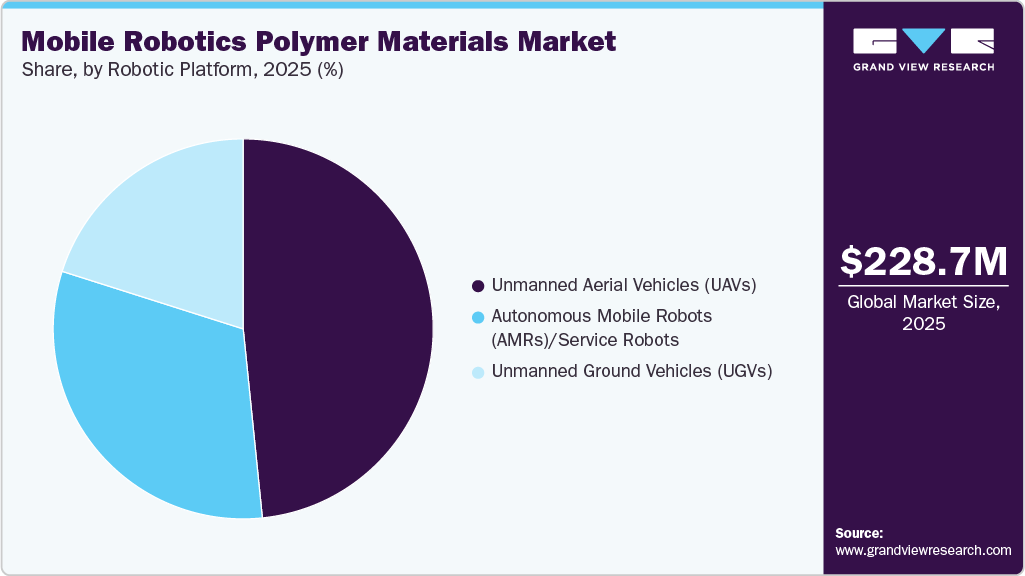 To learn more about this report, Download Free Sample Report
 The autonomous mobile robots (AMRs)/service robots segment is expected to grow at the fastest CAGR of 14.9% over the forecast period in the mobile robotics polymer materials market. AMR demand is being driven by warehouse automation, intralogistics, labor pressure, shorter deployment cycles, and the need to retrofit existing facilities without major infrastructure changes. For instance, in October 2025, Rockwell Automation, Inc. launched its first AMR in the U.S., which also signals that OEMs are localizing manufacturing and trying to shorten supply chains.
Regional Insights
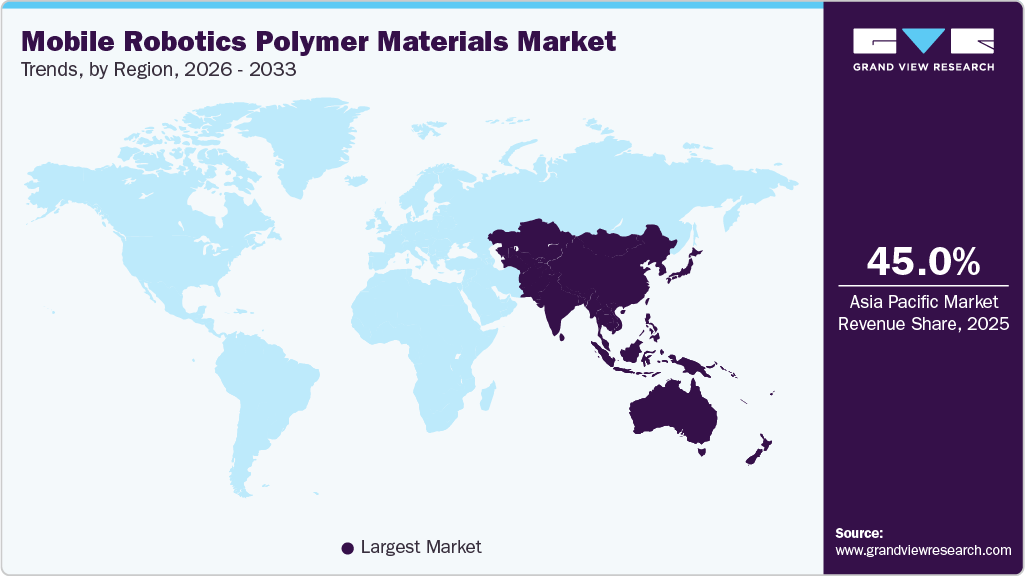
The Asia Pacific mobile robotics polymer materials market held the largest revenue share of 45.0% in 2025. The region is expected to grow at a CAGR of 15.1% over the forecast period. Asia Pacific is the largest demand center for mobile robotics polymers, and the driver is clearly manufacturing automation, especially in electronics, automotive, and mid-market industrial production. IFR stated that Asia accounted for 74% of new industrial robot deployments in 2024, with China alone taking 54% of global deployments, while India reached a record 9,100 installations, and automotive remained its strongest end-use driver at 45%. The higher deployment rates are leading to an increased utilization of polymers in critical components, including housings, connector bodies, load-bearing enclosures, sensor modules, and lightweight structural parts. This factor is primarily driven by the need for faster system implementation, improved integration capabilities, and a decreased reliance on manual labor, which collectively enhance the role of polymers in supporting efficient, scalable, and high-performance robotic solutions.
 To learn more about this report, Download Free Sample Report
 China has developed the most vertically integrated mobile robotics ecosystem globally, supported by close coordination across manufacturing, electronics, battery production, and component supply chains. Market growth is driven by large-scale industrial automation and strong domestic robotics manufacturing capabilities, as factories increasingly transition toward automated production lines to address rising labor costs and improve operational consistency. This has accelerated the deployment of AMRs for intralogistics, UAVs for inspection and surveillance, and emerging humanoid robotic platforms for assembly and support functions.
North America Mobile Robotics Polymer Materials Market Trends
North America is the more commercially concentrated market for mobile robotics polymers, with demand shaped primarily by warehouse automation, broader manufacturing automation, and defense-adjacent unmanned systems. Association for Advancing Automation (A3) reported 36,766 robot orders in 2025, up 6.6% year on year, and stated general industries, including food and consumer goods, semiconductors and electronics, and life sciences, accounted for most of the growth. IFR also shows North America at 204 robots per 10,000 manufacturing employees, with the U.S. at 307, which indicates a large installed base and continued need for replacement parts, platform upgrades, and lightweight assemblies. This favors PP and ABS for covers and housings, PA and PBT for structural and electrical parts, POM for rollers and gears, and PPS, PEI, and PEEK, where heat and electrical reliability are more demanding.
U.S. Mobile Robotics Polymer Materials Market Trends
The mobile robotics polymer materials industry in U.S. is a mature market for mobile robotics, supported by widespread deployment across warehousing, logistics, defense, and advanced industrial manufacturing. Growth is primarily driven by the need to improve labor productivity and streamline supply chain operations, prompting companies to adopt AMRs and UAVs for higher operational efficiency and reduced manual intervention. This has created substantial demand for durable and economical polymer materials such as PP and ABS in outer enclosures, while PA, PC, and PBT are widely utilized in load-bearing and electrical components.
Europe Mobile Robotics Polymer Materials Market Trends
In the European market for mobile robotics polymer materials, the demand for polymers is heavily influenced by the increasing use of autonomous mobile robots in the logistics, manufacturing, and healthcare industries. The widespread adoption of industrial automation, with many manufacturing plants and logistics providers actively utilizing mobile robotic systems, is contributing to a steady consumption of materials for robotic platforms. International Federation of Robotics (IFR) reported a Western European robot density of 267 robots per 10,000 manufacturing employees in 2024, above North America’s 204, while the EU average reached 231; the European Commission also says robotics is central to maintaining a competitive manufacturing base and supports uses in smart transport, security, energy, and environment.
Key Mobile Robotics Polymer Materials Company Insights
The mobile robotics polymer materials industry is highly competitive, with several key players dominating the landscape. Major companies include BASF SE, Dow Inc., SABIC, DuPont de Nemours, Inc., Covestro AG, Solvay S.A., Celanese Corporation, Evonik Industries AG, Mitsubishi Chemical Group Corporation, LG, and Chem Ltd. The mobile robotics polymer materials industry is characterized by a competitive landscape with several key players driving innovation and market growth. Major companies in this sector are investing heavily in research and development to enhance the performance, cost-effectiveness, and sustainability of their products.
Key Mobile Robotics Polymer Materials Companies:
The following key companies have been profiled for this study on the mobile robotics polymer materials market.
- BASF SE
- Dow Inc.
- SABIC
- DuPont de Nemours Inc
- Covestro AG
- Solvay S.A.
- Celanese Corporation
- Evonik Industries AG
- Mitsubishi Chemical Group Corporation
- LG Chem Ltd.
Recent Developments
-
In March 2026, Covestro AG expanded its Specialty Films Technical Competence Center in Shanghai to strengthen smart surface innovation. The upgraded center can process larger polycarbonate film formats, which improves prototyping for advanced components and shortens development loops for electronics and mobility-related applications. The move also reinforces local customer support in Asia, which is important for high-spec polymer parts used in compact automated systems and mobile robots.
-
In August 2025, BASF SE and Shanghai Fourier Intelligence signed an MoU to evaluate and develop material solutions for next-generation humanoid robots. The scope covers engineering plastics, polyurethanes, and TPU for robot parts and components. This is one of the clearest direct links between specialty polymers and robotics in the period covered, as it aligns material design with robot hardware requirements from the start.
Mobile Robotics Polymer Materials Market Report Scope
Report Attribute
Details
Market size in 2025
USD 228.7 million
Estimated market size in 2026
USD 261.5 million
Projected market size by 2033
USD 678.0 million
Growth rate
CAGR of 14.6% from 2026 to 2033
Historical data
2021 - 2025
Forecast period
2026 - 2033
Quantitative units
Revenue in USD million/billion, volume in tons, and CAGR from 2026 to 2033
Report coverage
Revenue & volume forecast, competitive landscape, growth factors, and trends
Segments covered
Material type, robotics platform, region
Regional scope
North America; Europe; Asia Pacific; Central & South America; Middle East & Africa
Country Scope
U.S.; Canada; Mexico; Europe; Germany; UK; France; Italy; Spain; China; India; Japan; Australia; South Korea; Brazil; Argentina; South Africa; Saudi Arabia; UAE
Key companies profiled
BASF SE; Dow Inc.; SABIC; DuPont de Nemours, Inc.; Covestro AG; Solvay S.A.; Celanese Corporation; Evonik Industries AG; Mitsubishi Chemical Group Corporation; LG Chem Ltd
Customization scope
Free report customization (equivalent to up to 8 analyst working days) with purchase. Addition or alteration to country, regional & segment scope
Pricing and purchase options
Avail customized purchase options to meet your exact research needs. Explore purchase options
Global Mobile Robotics Polymer Materials Market Report Segmentation
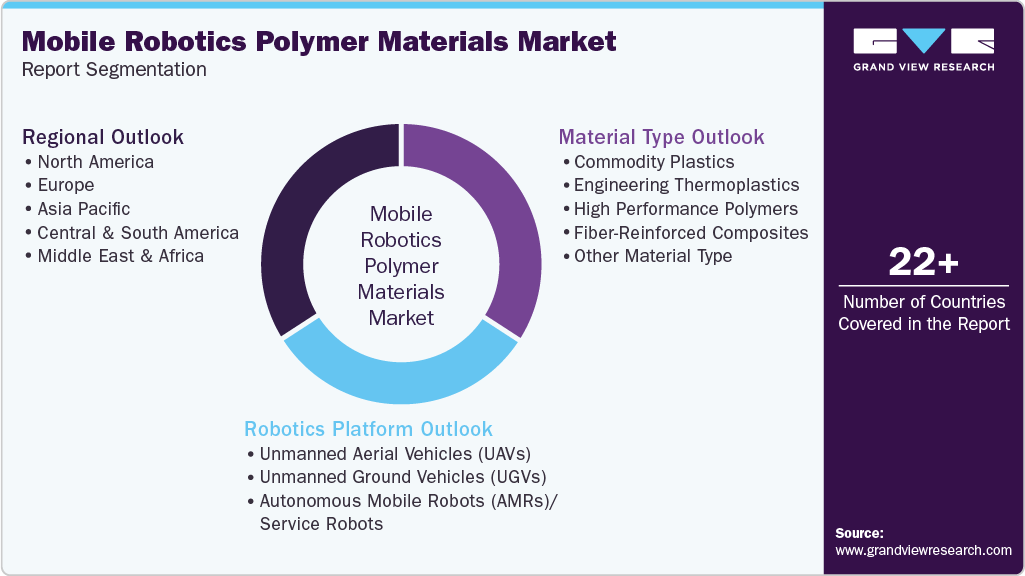
This report forecasts revenue growth at the global, regional, and country levels and provides an analysis of the latest industry trends across sub-segments from 2021 to 2033. For this study, Grand View Research has segmented the global mobile robotics polymer materials market report based on material type, robotic platform, and region:
 To learn more about this report, Download Free Sample Report
 -
Material Type Outlook (Volume, Tons; Revenue, USD Million; 2021 - 2033)
-
Commodity Plastics
-
PE
-
PP
-
ABS
-
-
Engineering Thermoplastics
-
PA
-
PC
-
POM
-
PBT
-
PET
-
-
High Performance Polymers
-
PEEK
-
PPS
-
PEI
-
-
Fiber-Reinforced Composites
-
Other Material Type
-
-
Robotics Platform Outlook (Volume, Tons; Revenue, USD Million; 2021 - 2033)
-
Unmanned Aerial Vehicles (UAVs)
-
Unmanned Ground Vehicles (UGVs)
-
Autonomous Mobile Robots (AMRs)/Service Robots
-
-
Regional Outlook (Volume, Tons; Revenue, USD Million; 2021 - 2033)
-
North America
-
U.S.
-
Canada
-
Mexico
-
-
Europe
-
Germany
-
UK
-
France
-
Italy
-
Spain
-
-
Asia Pacific
-
China
-
India
-
Japan
-
Australia
-
South Korea
-
-
Central & South America
-
Brazil
-
Argentina
-
-
Middle East & Africa
-
South Africa
-
Saudi Arabia
-
UAE
-
-
Frequently Asked Questions About This Report
Asia Pacific dominated the global mobile robotics polymer materials market with a revenue share of 45.0% in 2025, supported by rapid manufacturing automation, strong robotics deployment rates, and expanding electronics and automotive industries.
The autonomous mobile robots (AMRs)/service robots segment is projected to grow at the fastest CAGR of 14.9% from 2026 to 2033, supported by warehouse automation, intralogistics expansion, labor shortages, and the need for flexible deployment solutions.
The unmanned aerial vehicles (UAVs) segment held the largest market share of 48.4% in 2025, driven by increasing demand for intelligence, surveillance, reconnaissance, inspection, mapping, and defense applications.
Key factors driving the market include increasing automation across industries, advancements in artificial intelligence and machine learning, rising deployment of mobile robots and UAVs, growing demand for lightweight and durable materials, expansion of warehouse automation, and increasing adoption of robotics in logistics, healthcare, retail, and manufacturing sectors.
The global mobile robotics polymer materials market size was valued at USD 228.7 million in 2025 and is estimated at USD 261.5 million in 2026.
The global mobile robotics polymer materials market is expected to grow at a CAGR of 14.6% from 2026 to 2033, reaching USD 678.0 million by 2033.
Some of the key players operating in the mobile robotics polymer materials market include BASF SE, Dow Inc., SABIC, DuPont de Nemours, Inc., Covestro AG, Solvay S.A., Celanese Corporation, Evonik Industries AG, Mitsubishi Chemical Group Corporation, and LG Chem Ltd.
The engineering thermoplastics segment led the market with a revenue share of 33.8% in 2025, owing to its combination of mechanical strength, lightweight properties, abrasion resistance, dimensional stability, and design flexibility for robotic applications.
About the Author(s)
Plastics, Polymers & Resins Research Team
Bulk Chemicals · Plastics, Polymers & ResinsThis report was authored by the plastics, polymers & resins research team at Grand View Research - comprising two research analysts, one senior research analyst, and one industry expert - with specialized expertise in the plastics, polymers & resins segment of the bulk chemicals industry. All findings are based on proprietary bulk chemicals databases, executive interviews, and regulatory analysis, subject to internal peer review prior to publication.
Last Updated:
Speak to Analyst

Customize this report to your needs - add regions, segments, or data points, with 20% free customization.
Or view our licence options:


ISO 9001:2015 & 27001:2022 Certified
We are GDPR and CCPA compliant! Your transaction & personal information is safe and secure. For more details, please read our privacy policy.


