
- Home
- »
- Advanced Interior Materials
- »
-
North America Dry Cooler Market Size & Share Report, 2033GVR Report cover

North America Dry Cooler Market (2026 - 2033)
Size, Share & Trends Analysis Report By Product (Vertical Dry Coolers, V-Type Dry Coolers), By Technology, By End-use (Food & Beverage, Data Centers, Power Generation & Utilities, Chemical & Petrochemical), By Region, And Segment Forecasts
Market Size, 2025
$949.1MMarket Estimate, 2026
$1,013.0MMarket Forecast, 2033
$1,762.7MCAGR, 2026–2033
8.2%North America Dry Cooler Market Summary
The North America dry cooler market size was valued at USD 949.1 million in 2025 and is projected to grow from USD 1,013.0 million in 2026 to USD 1,762.7 million by 2033, at a CAGR of 8.2% from 2026 to 2033. The U.S. dominated the market, accounting for the largest revenue share of 79.7% in 2025. The rapid expansion of data centers, AI infrastructure, and high-density computing facilities is increasing demand for reliable heat-rejection systems across North America. Rising computing loads generate greater heat within data center environments, requiring cooling systems that can operate continuously while maintaining equipment reliability.
Key Market Trends & Insights
- By product: The V-Type dry coolers segment led the market with the largest revenue share of 46.0% in 2025.
- By technology: The standard dry coolers segment led the market with the largest revenue share of 63.4% in 2025.
- By end-use: The data centers segment led the market with the largest revenue share of 19.1% in 2025.
Market Size & Forecast
- Market size in 2025: USD 949.1 Million
- Estimated market size in 2026: USD 1,013.0 Million
- Projected market size by 2033: USD 1,762.7 Million
- CAGR (2026-2033): 8.2%
Prism AI by Grand View Research Free to tryAsk a question about the north america dry cooler marketTry asking✓Every figure cited from GVR research Prefer the report? Download free sample →
The expansion and modernization of manufacturing and industrial facilities is also supporting demand for dry coolers. Industries such as food & beverage, chemicals, pharmaceuticals, power generation, and general manufacturing require cooling for process equipment, compressors, heat exchangers, and other heat-generating machinery.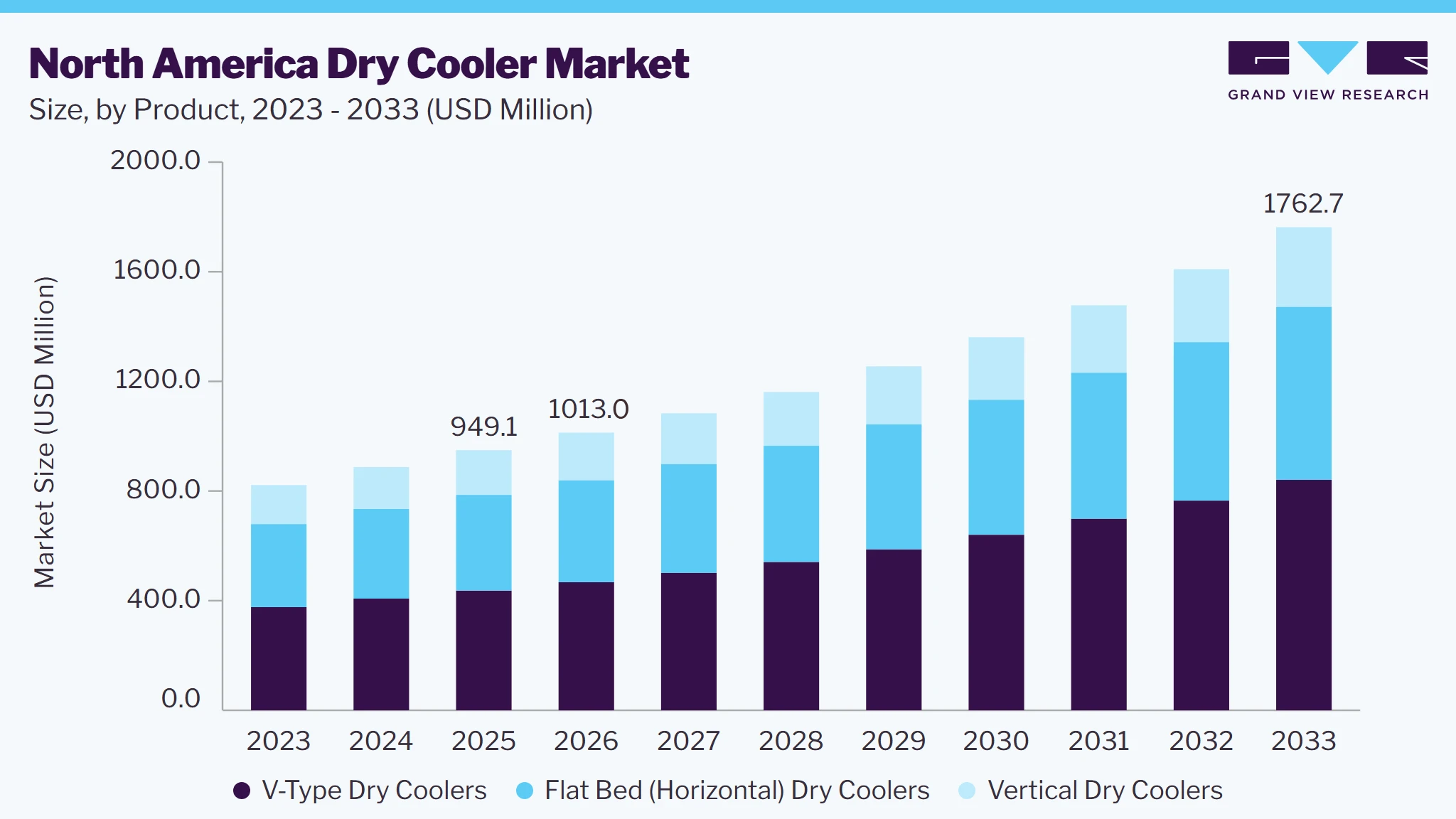 Source: Grand View Research, IR Documents, Primary Interviews, Paid DatabasesTo learn more about this report,
 Download Free Sample Report
At the same time, growing emphasis on energy efficiency, water conservation, and reliable plant operations is encouraging industrial users to consider air-based heat-rejection systems. These factors are broadening the application of dry coolers beyond traditional cooling requirements and supporting market growth across North America.
Market Dynamics
The North America market for dry cooler is being shaped by the expansion of data centers and AI infrastructure, industrial process cooling, water-conservation requirements, and the modernization of commercial and utility facilities. Dry coolers are increasingly considered for applications where closed-loop heat rejection, lower water dependence, reliable operation, and flexible installation are important. Demand is also supported by the broad application base across data centers, food & beverage, power generation, healthcare, chemical & petrochemical, pharmaceuticals, agriculture, and commercial buildings.
The rapid development of AI, cloud computing, and high-density data centers is increasing the amount of heat that must be continuously removed from computing infrastructure. As rack densities and overall computing loads increase, operators require reliable heat-rejection systems capable of maintaining stable operating temperatures. This is supporting demand for dry coolers, particularly in facilities where water availability, water treatment, or sustainability requirements influence cooling-system selection.
Data center developers are also evaluating cooling architectures that can provide high reliability while reducing dependence on water-intensive systems. Dry coolers can be integrated with chilled-water or liquid-cooling loops to reject heat to the outdoor environment, creating opportunities across hyperscale, colocation, and other large-scale facilities. The growing deployment of AI infrastructure is therefore expanding the potential application of dry coolers beyond conventional data center cooling requirements.
Dry coolers depend on ambient air for heat rejection, so their thermal performance can decline as outdoor temperatures increase. During hot-weather periods, maintaining the required cooling capacity may require greater airflow and higher fan operation, increasing auxiliary electricity consumption. This can make dry coolers less attractive than evaporative alternatives in locations with prolonged high ambient temperatures.
The expanding use of dry coolers for industrial process cooling provides an opportunity across chemical, pharmaceutical, food & beverage, power generation, and other process-intensive facilities. Equipment such as compressors, heat exchangers, production machinery, and hydraulic systems requires continuous heat removal, creating demand for reliable closed-loop cooling solutions. Dry coolers can serve these applications while limiting dependence on evaporative cooling water, making them suitable for facilities seeking simpler water management and reliable heat rejection.
Market Concentration & Characteristics
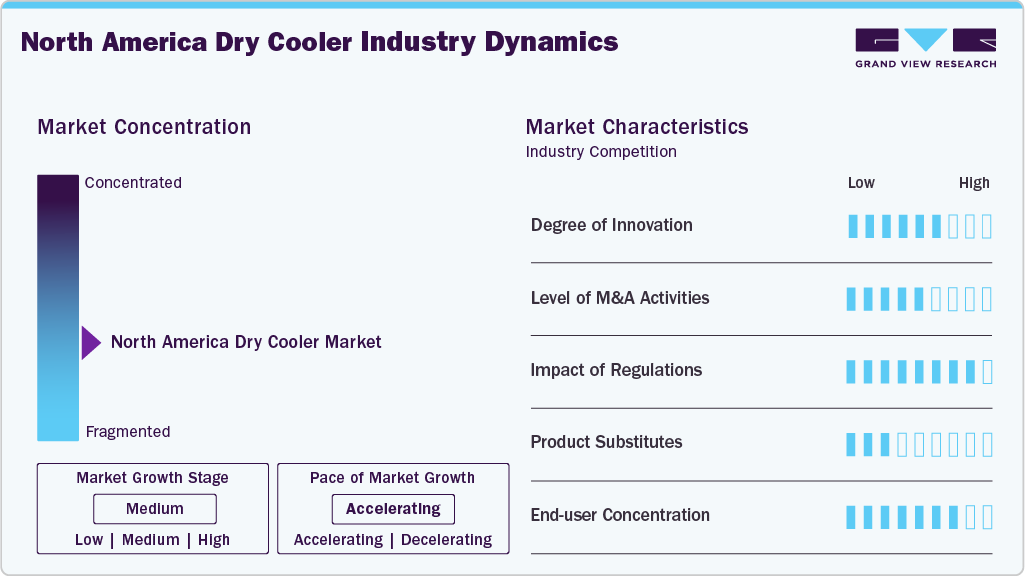
The North America dry cooler industry is fragmented, with competition spread across established global cooling-equipment manufacturers, specialized dry cooler producers, and regional suppliers. Major players compete across different product configurations and applications, while smaller and specialized companies serve customized industrial and process-cooling requirements. The presence of multiple suppliers offering V-type, flat-bed, vertical, standard, and adiabatic configurations limits the dominance of any single manufacturer. Competition is primarily based on thermal performance, energy efficiency, customization, reliability, product footprint, and service capabilities, particularly for data centers and industrial facilities.
The North America dry cooler industry has a moderate to high degree of innovation, driven by demand for higher thermal efficiency, lower water consumption, compact equipment, and improved operating flexibility. Manufacturers are developing improved coil and fin designs, variable-speed and electronically commutated fans, advanced controls, and adiabatic configurations to improve performance under changing ambient conditions. The development of CTI certification programs for dry and adiabatic fluid coolers also reflects continued advancement in equipment performance and verification.
 To learn more about this report, Download Free Sample Report
Regulations and industry standards have a moderate impact on the market, particularly through requirements related to building energy efficiency, equipment performance, noise, and system design. Dry cooler manufacturers and suppliers need to consider applicable building codes and performance standards, while CTI thermal certification provides independent verification of published equipment performance. The introduction of additional CTI certification for sound performance and adiabatic fluid coolers indicates that performance and compliance expectations are continuing to evolve.
The North America dry cooler industry has a moderate level of end-user concentration, as demand is distributed across data centers, food & beverage facilities, healthcare, power generation, agriculture, chemical and petrochemical plants, commercial buildings, and pharmaceuticals. However, large data centers, utilities, and industrial facilities can account for significant individual project volumes and may have substantial influence over equipment specifications, performance requirements, and supplier selection. This creates stronger negotiating power among large project buyers while maintaining a broad overall customer base.
Analyst Perspective
The North America market for dry coolers is positioned for steady growth as demand for water-efficient, reliable, and low-maintenance heat-rejection systems expands across data centers, industrial facilities, power generation, pharmaceuticals, food & beverage, and commercial buildings. Data center and AI infrastructure expansion is creating demand for higher-capacity cooling solutions, while industrial facility development and modernization are broadening applications for dry coolers. At the same time, adoption is influenced by ambient temperature limitations, competition from alternative cooling technologies, and the need to balance thermal performance with energy efficiency. Overall, manufacturers offering high-efficiency designs, flexible configurations, advanced controls, and application-specific solutions are likely to be well positioned as end users increasingly prioritize operational reliability and reduced water dependence.
Product Insights
The V-type dry coolers segment dominated the market with the largest revenue share of 46.0% in 2025, supported by their ability to provide a high heat-transfer surface within a relatively compact footprint. The inclined coil arrangement allows greater heat-rejection capacity while optimizing equipment space, making V-type configurations suitable for data centers, industrial process cooling, power facilities, and other applications with high thermal loads. Their modular configuration also supports deployment of multiple units where cooling capacity needs to be scaled.
The flat bed (horizontal) dry coolers segment is expected to register strong growth at a CAGR of 7.9% over the forecast period, as their low-profile configuration makes them suitable for rooftop installations, industrial platforms, commercial facilities, and sites with height restrictions. Their horizontal coil arrangement provides installation flexibility where equipment height is a key consideration, while the closed-loop design enables heat rejection without continuous evaporative water consumption. Growing demand for retrofit and space-constrained cooling installations is expected to support adoption of this configuration.
Technology Insights
The standard dry coolers segment dominated the market with the largest revenue share of 63.4% in 2025, due to their simple operating principle, established design, and ability to reject heat without continuous water consumption. They use ambient air and finned heat-exchanger coils to remove heat from circulating water or glycol, making them suitable for industrial processes, commercial buildings, power facilities, hospitals, and data center cooling loops. Their relatively straightforward operation, lower system complexity, and reduced water-management requirements support their widespread adoption across North America.
The adiabatic dry coolers segment is expected to register the fastest CAGR of 9.4% over the forecast period, as end users seek improved heat-rejection performance during periods of high ambient temperature while maintaining lower water consumption than conventional evaporative systems. These systems can operate in dry mode under favorable conditions and activate adiabatic pre-cooling when additional capacity is required, providing greater operating flexibility. Their growing suitability for data centers, industrial process cooling, and other high-load applications is expected to support adoption across North America.
End-use Insights
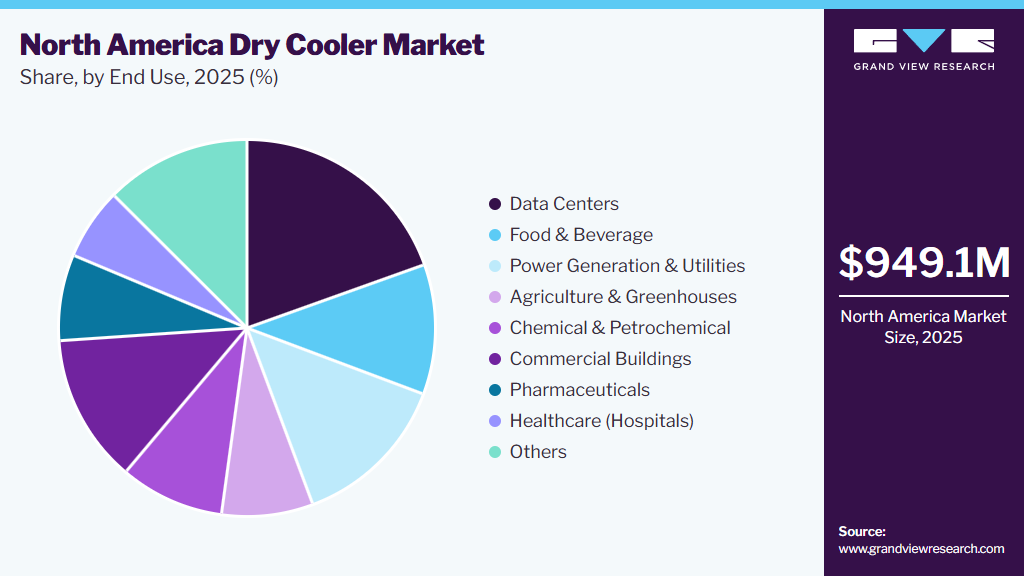
The data centers segment dominated the market with the largest revenue share of 19.1% in 2025, driven by the continued expansion of cloud computing, hyperscale facilities, and AI infrastructure across North America. Increasing computing density and higher heat loads are creating greater requirements for reliable heat-rejection systems that can operate continuously. Dry coolers are particularly suitable for data center applications where closed-loop cooling, reduced water consumption, and dependable thermal management are important considerations.
 To learn more about this report, Download Free Sample Report
The pharmaceuticals segment is expected to register strong growth at a CAGR of 8.4% over the forecast period, as pharmaceutical manufacturing and processing facilities require precise temperature control for production equipment, process fluids, and supporting systems. Dry coolers can provide closed-loop heat rejection for process cooling, compressors, heat exchangers, and other temperature-sensitive equipment, while reducing reliance on water-intensive cooling methods. The increasing development and modernization of pharmaceutical production facilities is therefore expected to expand the application of dry coolers within this end-use segment.
Country Insights
The U.S. dry cooler market growth is driven the emerging data center expansions, which is an important growth driver, supported by rising AI workloads, cloud computing, and high-density computing that are increasing data center heat loads and cooling requirements. The U.S. EIA projects data center server electricity consumption to reach 446-818 billion kWh by 2050, while data center floor-space cooling can be up to 2.9 times more energy intensive than non-data-center space. Virginia and Texas represent major opportunities, with 674 and 537 listed data centers, respectively, while the South Atlantic and West South Central regions are projected to experience the fastest growth in data center server electricity use. This expansion is increasing demand for scalable heat-rejection solutions, including dry and adiabatic cooling systems.
The Canada dry cooler market is supported by demand from power generation, industrial processing, mining, oil & gas, food & beverage, manufacturing, and commercial facilities, with water conservation becoming an increasingly important consideration in cooling-system selection. The country's extensive electricity-generation infrastructure provides a significant application base for heat-rejection equipment. In 2025, Canada generated 625.2 million MWh of electricity, up 2.6% from 2024, with hydroelectricity remaining the largest source at 343.4 million MWh. Wind generation increased 10.1% to 50.5 million MWh, while solar generation rose 13.9% to 6.0 million MWh, reflecting continued expansion of Canada's power-generation infrastructure and supporting demand for reliable cooling and heat-rejection systems.
Key North America Dry Cooler Company Insights
Some of the key players operating in the market include Baltimore Aircoil Company, Inc., Modine Manufacturing Company, and Dry Coolers, Inc.
-
Baltimore Aircoil Company (BAC) develops and manufactures cooling and refrigeration equipment for comfort cooling, process cooling, and industrial refrigeration applications. Its product portfolio includes cooling towers, evaporative condensers, closed-circuit cooling towers, and other heat-transfer equipment. BAC serves data centers, manufacturing, heavy industrial and energy, food and beverage, commercial and institutional buildings, and district cooling applications.
-
Modine Manufacturing Company offer products through two primary business segments: Performance Technologies and Climate Solutions. Its Climate Solutions segment includes heat-transfer products, commercial and industrial HVAC&R systems, and data center cooling technologies. Modine operates 46 manufacturing facilities across 14 countries. In FY26, the company announced plans to separate its Performance Technologies business and retain its Climate Solutions businesses, with a focus on data center and commercial HVAC&R applications.
Key North America Dry Cooler Companies:
-
Modine Manufacturing Company
-
Baltimore Aircoil Company, Inc.
-
SPX Cooling Tech, LLC
-
Dry Coolers, Inc.
-
Evapco Inc.
-
SPG Dry Cooling
-
MITA Cooling Technologies S.r.l.
-
Colmac Coil Manufacturing, Inc.
-
Güntner GmbH & Co. KG
-
ALFA LAVAL
Competitive Benchmarking
Category
Operating Strategies
Competitive Edge
Weakness
Established Players (e.g., Modine Manufacturing Company, Baltimore Aircoil Company, Inc., Alfa Laval, Güntner GmbH & Co. KG.)
- Focus on expanding dry cooler portfolios across data centers, industrial process cooling, power generation, HVAC, and refrigeration applications.
- Invest in high-efficiency heat-transfer designs, advanced fan and control technologies, and customized cooling configurations to address varying customer requirements.
- Strengthen market presence through established manufacturing, distribution, engineering, and service networks across North America. Modine, for example, specifically identifies dry coolers among its data center thermal-management products.
- Strong brand recognition, established customer relationships, and technical expertise provide an advantage in large-scale and specification-driven projects.
- Broad product portfolios allow these companies to offer different dry cooler configurations, capacities, and cooling technologies, supporting applications ranging from industrial facilities to high-density data centers.
- Larger organizational structures and broader product portfolios can make customization and rapid response more complex compared with specialized suppliers.
- Higher operating and manufacturing infrastructure costs can create pressure when competing for price-sensitive projects and standardized cooling applications.
Emerging & Regional Players (e.g., SPX Cooling Tech, LLC, SPG Dry Cooling, Colmac Coil Manufacturing, Inc., EVAPCO Inc., MITA Cooling Technologies S.r.l.)
- Focus on specialized dry cooler designs, application-specific engineering, and customized solutions for industrial, commercial, refrigeration, and process-cooling requirements.
- Compete by serving regional customers with flexible configurations, shorter supply channels, and more application-focused technical support. Regional and specialized suppliers such as Dry Coolers Inc., SPG Dry Cooling, and Colmac Coil are represented in North American market coverage.
- Greater flexibility in product configuration and customer requirements can help these companies address niche applications and smaller or customized projects.
- Specialized expertise in heat-transfer equipment and dry cooling enables them to compete effectively where customers prioritize application-specific performance, compact designs, or customized engineering.
- Smaller production capacity and geographic coverage can limit their ability to compete for very large data center, utility, and industrial projects requiring high-volume equipment supply.
- Lower brand visibility and fewer established distribution or service networks can make customer acquisition more difficult compared with major established manufacturers.
Recent Developments:
-
In April 2026, SPX Cooling Tech launched the Marley OlympusMAX Fluid Cooler for data centers, industrial plants, and other high-density cooling applications. The product combines dry and adiabatic cooling configurations, providing flexibility for different operating requirements.
-
In March 2026, MITA Cooling Technologies expanded its PAD-XL Adiabatic Dry Cooler range to capacities of up to 2,500 kW. The expansion increases the product’s applicability to larger cooling requirements and strengthens MITA’s offering for industrial and commercial applications requiring higher heat-rejection capacity with adiabatic cooling.
North America Dry Cooler Market Report Scope
Report Attribute
Details
Market size value in 2025
USD 949.1 million
Estimated market size in 2026
USD 1,013.0 million
Projected market size by 2033
USD 1,762.7 million
Growth rate
CAGR of 8.2% from 2026 to 2033
Historical data
2021 - 2024
Forecast period
2026 - 2033
Quantitative units
Revenue in USD million and CAGR from 2026 to 2033
Report coverage
Revenue forecast, company ranking, competitive landscape, growth factors, and trends
Segments covered
Product, technology, end-use, country
Country scope
U.S.; Canada; Mexico
Key companies profiled
Modine Manufacturing Company; Baltimore Aircoil Company, Inc.; SPX Cooling Tech, LLC; Dry Coolers, Inc.; EVAPCO Inc.; SPG Dry Cooling; MITA Cooling Technologies S.r.l.; Colmac Coil Manufacturing, Inc.; Güntner GmbH & Co. KG; Alfa Laval.
Customization scope
Free report customization (equivalent up to 8 analysts working days) with purchase. Addition or alteration to country, regional & segment scope.
Pricing and purchase options
Avail customized purchase options to meet your exact research needs. Explore purchase options
North America Dry Cooler Market Report Segmentation
This report forecasts revenue growth at regional and country levels and provides an analysis of the latest industry trends in each of the sub-segments from 2021 to 2033. For this study, Grand View Research has segmented the North America dry cooler market report based on product, technology, end-use, and country:
-
Product Outlook (Revenue, USD Million, 2021 - 2033)
-
V-Type Dry Coolers
-
Flat Bed (Horizontal) Dry Coolers
-
Vertical Dry Coolers
-
-
Technology Outlook (Revenue, USD Million, 2021 - 2033)
-
Standard Dry Coolers
-
Adiabatic Dry Coolers
-
-
End-use Outlook (Revenue, USD Million, 2021 - 2033)
-
Data Centers
-
By Product
-
V-Type Dry Coolers
-
Flat Bed (Horizontal) Dry Coolers
-
Vertical Dry Coolers
-
-
By Technology
-
Standard Dry Coolers
-
Adiabatic Dry Coolers
-
-
-
Food & Beverage
-
By Product
-
V-Type Dry Coolers
-
Flat Bed (Horizontal) Dry Coolers
-
Vertical Dry Coolers
-
-
By Technology
-
Standard Dry Coolers
-
Adiabatic Dry Coolers
-
-
-
Power Generation & Utilities
-
By Product
-
V-Type Dry Coolers
-
Flat Bed (Horizontal) Dry Coolers
-
Vertical Dry Coolers
-
-
By Technology
-
Standard Dry Coolers
-
Adiabatic Dry Coolers
-
-
-
Agriculture & Greenhouses
-
By Product
-
V-Type Dry Coolers
-
Flat Bed (Horizontal) Dry Coolers
-
Vertical Dry Coolers
-
-
By Technology
-
Standard Dry Coolers
-
Adiabatic Dry Coolers
-
-
-
Chemical & Petrochemical
-
By Product
-
V-Type Dry Coolers
-
Flat Bed (Horizontal) Dry Coolers
-
Vertical Dry Coolers
-
-
By Technology
-
Standard Dry Coolers
-
Adiabatic Dry Coolers
-
-
-
Commercial Buildings
-
By Product
-
V-Type Dry Coolers
-
Flat Bed (Horizontal) Dry Coolers
-
Vertical Dry Coolers
-
-
By Technology
-
Standard Dry Coolers
-
Adiabatic Dry Coolers
-
-
-
Pharmaceuticals
-
By Product
-
V-Type Dry Coolers
-
Flat Bed (Horizontal) Dry Coolers
-
Vertical Dry Coolers
-
-
By Technology
-
Standard Dry Coolers
-
Adiabatic Dry Coolers
-
-
-
Healthcare (Hospitals)
-
By Product
-
V-Type Dry Coolers
-
Flat Bed (Horizontal) Dry Coolers
-
Vertical Dry Coolers
-
-
By Technology
-
Standard Dry Coolers
-
Adiabatic Dry Coolers
-
-
-
Others
-
By Product
-
V-Type Dry Coolers
-
Flat Bed (Horizontal) Dry Coolers
-
Vertical Dry Coolers
-
-
By Technology
-
Standard Dry Coolers
-
Adiabatic Dry Coolers
-
-
-
-
Country Outlook (Revenue, USD Million, 2021 - 2033)
-
U.S.
-
Alabama
-
Alaska
-
Arizona
-
Arkansas
-
California
-
Colorado
-
Connecticut
-
Delaware
-
Florida
-
Georgia
-
Hawaii
-
Idaho
-
Illinois
-
Indiana
-
Iowa
-
Kansas
-
Kentucky
-
Louisiana
-
Maine
-
Maryland
-
Massachusetts
-
Michigan
-
Minnesota
-
Mississippi
-
Missouri
-
Montana
-
Nebraska
-
Nevada
-
New Hampshire
-
New Jersey
-
New Mexico
-
New York
-
North Carolina
-
North Dakota
-
Ohio
-
Oklahoma
-
Oregon
-
Pennsylvania
-
Rhode Island
-
South Carolina
-
South Dakota
-
Tennessee
-
Texas
-
Utah
-
Vermont
-
Virginia
-
Washington
-
West Virginia
-
Wisconsin
-
Wyoming
-
-
Canada
-
Ontario
-
Quebec
-
British Columbia
-
Alberta
-
Manitoba
-
Nova Scotia
-
New Brunswick
-
Saskatchewan
-
Prince Edward Island
-
Newfoundland & Labrador
-
-
Mexico
-
Northern Mexico
-
Central Mexico
-
Southern Mexico
-
-
Research Methodology
The North America dry cooler market figures in this report are based on a proven research process that combines executive interviews with secondary research from proprietary databases, company filings, and recognized regulatory and institutional sources. Market size is built through value-chain sizing—reconciling supply-side and demand-side estimates—and triangulated with bottom-up and top-down approaches. Every estimate passes multiple levels of expert validation before publication, with each North America dry cooler segment quantified using the revenue-capture definitions in the table below.
Segment Definition
Product
Revenue Capture Definition
V-Type Dry Coolers
Revenue generated from the sale of dry cooler systems featuring inclined or V-shaped heat-exchanger coils designed to maximize heat-transfer surface area while optimizing equipment footprint.
Flat Bed (Horizontal) Dry Coolers
Revenue generated from the sale of horizontally configured dry cooler systems designed for applications requiring low-profile installation and flexible equipment placement.
Vertical Dry Coolers
Revenue generated from the sale of vertically configured dry cooler systems designed to provide efficient heat rejection while minimizing the required installation footprint, particularly in space-constrained commercial, industrial, refrigeration, and process-cooling applications.
Technology
Revenue Capture Definition
Standard Dry Coolers
Revenue generated from the sale of conventional air-cooled dry cooler systems that reject heat directly to ambient air without continuous evaporative water use.
Adiabatic Dry Coolers
Revenue generated from the sale of dry cooler systems equipped with adiabatic pre-cooling components that improve heat rejection during elevated ambient-temperature conditions.
End Use
Revenue Capture Definition
Data Centers
Revenue generated from the sale of dry cooler systems used for heat rejection in data center cooling loops serving servers, computing equipment, and associated thermal-management infrastructure.
Food & Beverage
Revenue generated from the sale of dry cooler systems used for process cooling and heat rejection in food and beverage production, processing, storage, and supporting operations.
Power Generation & Utilities
Revenue generated from the sale of dry cooler systems used for heat rejection in power-generation equipment, utility systems, generators, and associated cooling circuits.
Agriculture & Greenhouses
Revenue generated from the sale of dry cooler systems used for temperature management and cooling of equipment, circulating fluids, and controlled agricultural environments.
Chemical & Petrochemical
Revenue generated from the sale of dry cooler systems used for process cooling, equipment cooling, heat exchangers, compressors, and other heat-generating operations in chemical and petrochemical facilities.
Commercial Buildings
Revenue generated from the sale of dry cooler systems used for building cooling, HVAC systems, chilled-water loops, and other commercial heat-rejection applications.
Pharmaceuticals
Revenue generated from the sale of dry cooler systems used for process cooling, equipment cooling, and temperature-controlled operations in pharmaceutical manufacturing and related facilities.
Healthcare (Hospitals)
Revenue generated from the sale of dry cooler systems used for cooling equipment, process systems, and building-related thermal-management applications within hospitals and healthcare facilities.
Others
Revenue generated from the sale of dry cooler systems used for process cooling and heat rejection in semiconductor fabrication facilities, battery manufacturing plants, electric vehicle manufacturing facilities, and other specialized industrial operations.
Estimation Model
Layer No.
Layer Name
Key Question
Description
01
Market Demand & Installation Base
What drives demand for dry coolers across North America?
Assessment of demand across data centers, industrial facilities, power generation, food & beverage, healthcare, pharmaceuticals, commercial buildings, and other end uses, including new installations, facility expansions, replacements, and regional demand across the U.S., Canada, and Mexico.
02
Segment & Product Mix
What types of dry coolers are being purchased and where?
Market estimation by product configuration, technology, and end use, including V-type, flat-bed, vertical, standard, and adiabatic dry coolers, based on their application, adoption, and demand across different industries.
03
Company & Market Share Assessment
How is market demand distributed among key manufacturers?
Assessment of key manufacturers, product portfolios, market presence, competitive positioning, and participation across major applications and geographic markets to determine their contribution to the overall dry cooler market.
04
Revenue
What is the total market revenue?
Calculation of the North America dry cooler market revenue by aggregating demand across product, technology, end-use, and country-level segments. The final market value is presented in USD million, with historical and forecast estimates for the defined study period.
Delivered Customizations
This report has been delivered with the following In-depth customizations
CLIENT REQUEST
CUSTOMIZATION DELIVERED
VALUE ADDS
Segmentation Snapshot
Delivered a comprehensive segmentation analysis covering product type, technology, end use, and geography, including V-Type, Flat Bed (Horizontal), Vertical, Standard and Adiabatic Dry Coolers, along with key end-use industries such as data centers, food & beverage, healthcare, power generation & utilities, agriculture & greenhouses, chemical & petrochemical, commercial buildings, pharmaceuticals, and other specialized applications.
Provides a clear view of market structure, segment positioning, growth areas, and application-specific demand, enabling identification of dominant and faster-growing segments across North America.
Competitive Benchmarking
Delivered an assessment of key market participants, including Modine Manufacturing Company, Baltimore Aircoil Company, Alfa Laval, Güntner, SPX Cooling Tech, SPG Dry Cooling, Colmac Coil Manufacturing, EVAPCO, and MITA Cooling Technologies, covering their operating strategies, competitive advantages, and market limitations.
Enables comparison of competitive positioning, product capabilities, customization strengths, and market presence, while distinguishing established players from emerging and regional suppliers.
Opportunity Assessment
Delivered a comprehensive assessment of key market opportunities, including the expansion of data centers and AI infrastructure, manufacturing and industrial facility expansion, and broader adoption of dry coolers for industrial process cooling. Country-level analysis for the U.S., Canada, and Mexico and their states was also incorporated to identify regional demand drivers and application opportunities.
Highlights high-potential demand areas, emerging applications, regional growth pockets, and investment-driven opportunities, supporting strategic decisions related to market entry, product development, and expansion.
Frequently Asked Questions About This Report
Key players include Modine Manufacturing Company; Baltimore Aircoil Company, Inc.; SPX Cooling Tech, LLC; Dry Coolers, Inc.; EVAPCO Inc.; SPG Dry Cooling; MITA Cooling Technologies S.r.l.; Colmac Coil Manufacturing, Inc.; Güntner GmbH & Co. KG; Alfa Laval.
The V-type dry coolers segment dominated the market with the largest revenue share of 46.0% in 2025, while flat bed (horizontal) dry coolers segment is the fastest growing product.
The North America dry cooler market size was valued at USD 949.1 million in 2025 and is estimated at USD 1,013.0 million in 2026.
The North America dry cooler market is expected to grow at a CAGR of 8.2% from 2026 to 2033 to reach USD 1,762.7 million by 2033.
The North America dry cooler market is primarily driven by the expansion of data centers and AI infrastructure, growth of manufacturing and industrial facilities, increasing demand for water-efficient cooling systems, and the modernization of power generation and commercial infrastructure.
The standard dry coolers segment dominated the market with the largest revenue share of 63.4% in 2025, while adiabatic dry coolers segment is the fastest growing technology.
The data centers segment dominated the market with the largest revenue share of 19.1% in 2025, while pharmaceuticals segment is the fastest growing end-use.
About the Author(s)
Advanced Interior Materials Research Team
Advanced Materials · Advanced Interior MaterialsThis report was authored by the advanced interior materials research team at Grand View Research - comprising two research analysts, one senior research analyst, and one industry expert - with specialized expertise in the advanced interior materials segment of the advanced materials industry. All findings are based on proprietary advanced materials databases, executive interviews, and regulatory analysis, subject to internal peer review prior to publication.
Last Updated:
Speak to Analyst

Customize this report to your needs - add regions, segments, or data points, with 20% free customization.
Or view our licence options:


ISO 9001:2015 & 27001:2022 Certified
We are GDPR and CCPA compliant! Your transaction & personal information is safe and secure. For more details, please read our privacy policy.


