
- Home
- »
- Advanced Interior Materials
- »
-
North America HVAC Distribution Market Size Report, 2030GVR Report cover

North America HVAC Distribution Market (2025 - 2030) Size, Share & Trends Analysis Report By Equipment (Heat Pump, Furnace), By Application (New Construction, Retrofit & Renovation), By End Use, By Distribution Channel, By Country, And Segment Forecasts
Market Size & Trends
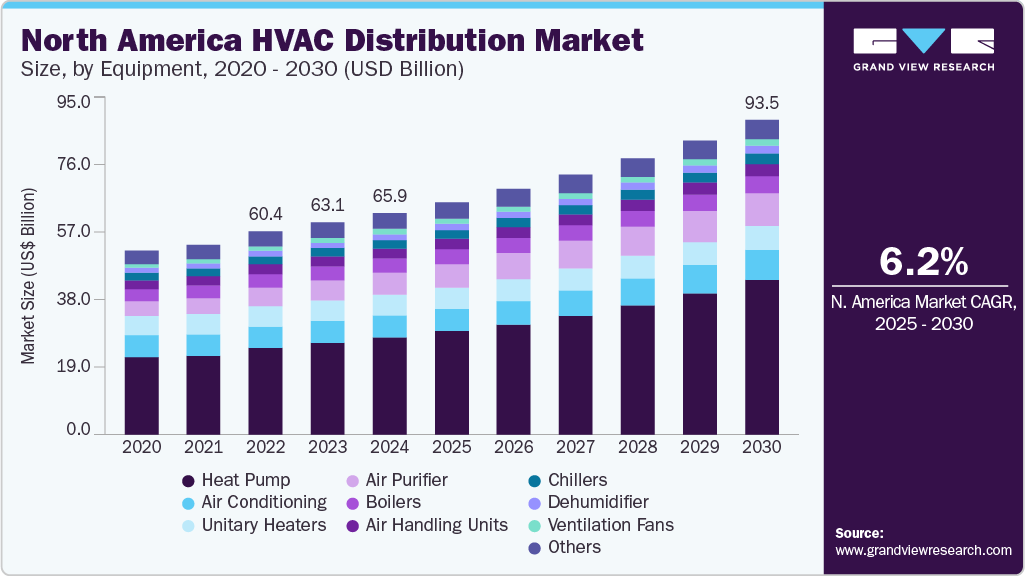
The North America HVAC distribution market size was estimated at USD 65.93 billion in 2024 and is projected to grow at a CAGR of 6.2% from 2025 to 2030. The market is experiencing significant transformation driven by evolving consumer preferences, regulatory mandates, and technological advancements. Moreover, increasing demand for energy-efficient systems, propelled by stringent regulations such as the U.S. Department of Energy's new minimum efficiency standards is further driving the demand for North America HVAC Distribution Market. In addition, the integration of smart technologies, including IoT-enabled devices and AI-powered automation, is revolutionizing HVAC systems, enhancing energy management and user control.
 Source: Grand View Research, IR Documents, Primary Interviews, Paid DatabasesTo learn more about this report,
 Download Free Sample Report
 In recent years, the North America HVAC distribution market has seen a significant shift toward integrated solutions that combine heating, cooling, and air quality management, driving increased demand for advanced systems. Distribution networks are adapting to meet the needs of modern consumers who emphasize both high performance and sustainability in their HVAC systems. In addition, the growing adoption of smart technologies is contributing to a shift toward digitally connected products, offering enhanced control and automation features.
The trade landscape of the North America HVAC distribution market is shaped by a strong reliance on both domestic manufacturing and international imports, particularly for components such as compressors, coils, thermostats, and refrigerants. The U.S. and Canada collectively import HVAC parts and equipment from key trading partners including China, Mexico, Germany, Japan, and South Korea. However, geopolitical tensions, trade tariffs on specific components, and disruptions in global supply chains have introduced volatility in pricing and lead times.
Market Concentration & Characteristics
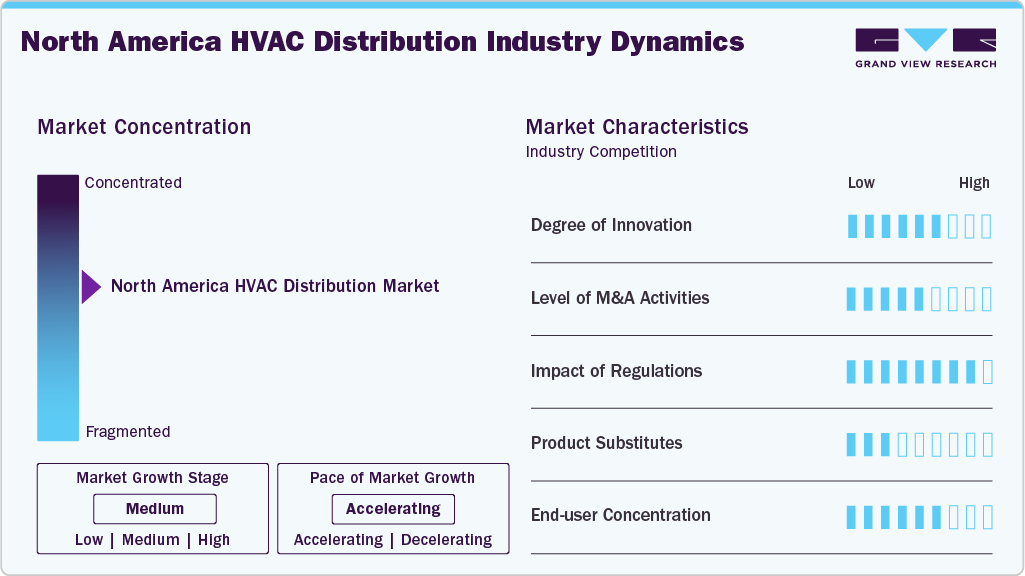
The North American HVAC distribution market is moderately fragmented, characterized by a mix of well-established global players and a growing number of regional and specialized distributors. Major companies such as Carrier Global Corporation, Johnson Controls, Trane Technologies, Daikin Industries, and Lennox International maintain strong positions with their extensive product portfolios, advanced technologies, and expansive distribution networks. At the same time, country players and independent distributors are crucial in serving local markets, offering tailored solutions that cater to specific regional climate conditions, building codes, and customer preferences.
Environmental regulations and energy efficiency standards play a significant role in shaping the dynamics of the North American HVAC Distribution Market. Government bodies and regulatory agencies are enforcing building efficiency codes and sustainability mandates that drive the adoption of energy-efficient HVAC systems. As a result, distributors are increasingly focusing on stocking and promoting products that meet these stringent standards, leading to a shift toward environmentally friendly solutions. This regulatory push not only stimulates demand but also encourages manufacturers and distributors to invest in innovative, compliant technologies.
 To learn more about this report, Download Free Sample Report
 Technological advancements are continuously transforming the HVAC distribution landscape in North America. The integration of smart technologies, such as IoT-enabled HVAC systems and advanced building automation, is revolutionizing the delivery and maintenance of heating and cooling solutions. Features such as enhanced energy management, remote monitoring, and predictive maintenance are becoming standard, prompting distributors to offer products that incorporate these innovations. Moreover, the adoption of low-global-warming-potential (GWP) refrigerants and variable-speed compressors is gaining momentum, improving system efficiency and adaptability across varying climate zones and building types.
U.S. holds a dominant share of the North America HVAC distribution market, bolstered by strong construction activity, regulatory incentives for energy-efficient systems, and a well-established aftermarket service sector. The region's commitment to sustainable building practices and energy-efficient technologies further strengthens its position as a leader in the North America HVAC distribution market. These trends highlight North America's growing shift toward high-performance, sustainable HVAC solutions distributed through an increasingly sophisticated and diverse network of players.
Drivers, Opportunities & Restraints
The North American HVAC distribution market is primarily driven by the increasing demand for energy-efficient and environmentally friendly HVAC systems, spurred by stringent regulatory standards and government incentives. With growing awareness of climate change and the need for sustainability, consumers and businesses alike are prioritizing energy-saving technologies. Regulations such as stricter building codes and efficiency mandates are compelling both manufacturers and distributors to focus on high-performance systems, including those with IoT integration and low-global-warming-potential refrigerants, which are driving market growth.
One of the key restraints in the North American HVAC distribution market is the shortage of skilled labor, particularly technicians trained to install and maintain advanced HVAC systems. The complexity of newer, energy-efficient technologies and smart HVAC systems requires a highly trained workforce, and the industry is facing challenges in attracting and retaining skilled workers. This gap in the labor market can lead to delays in installation and service, impacting overall market growth and customer satisfaction.
The growing trend of smart home integration presents a significant opportunity for the North America HVAC distribution market. As consumers increasingly seek connected solutions, there is rising demand for smart HVAC systems that integrate with home automation platforms, offering enhanced control, remote monitoring, and predictive maintenance features. This technological shift provides distributors with the chance to expand their offerings to include innovative products that cater to tech-savvy homeowners and businesses, positioning them to capitalize on the expanding smart building and IoT-enabled HVAC sectors.
Equipment Insights
Heat pump equipment segment led the market and accounted for a share of 44.0% in 2024. The heat pump market is experiencing significant growth, driven by increasing demand for energy-efficient and sustainable heating and cooling solutions. Governments across North America are implementing policies and offering incentives to promote the adoption of heat pumps, aiming to reduce greenhouse gas emissions and enhance energy efficiency.
The air purifier segment within the North America HVAC distribution market is experiencing strong growth, driven by increasing concerns over air quality, health, and environmental factors. Rising awareness of indoor air pollution, particularly due to issues like allergens, volatile organic compounds (VOCs), and the ongoing concerns about airborne pathogens, has led both residential and commercial customers to prioritize air purification solutions.
Application Insights
The new construction segment accounted for a substantial share of the North America HVAC distribution market in 2024. This segment benefits from the ongoing expansion of residential, commercial, and industrial infrastructure across the region. With developers placing increased emphasis on energy efficiency, sustainability, and compliance with green building standards such as LEED and ENERGY STAR, there is a growing demand for advanced HVAC systems that align with modern building designs. HVAC distributors play a critical role by supplying high-efficiency units, smart climate control technologies, and customizable solutions tailored to the unique requirements of new construction projects.
The retrofit & renovation application segment is a crucial part of the North America HVAC distribution market, fueled by the need to upgrade aging infrastructure and improve the energy performance of existing buildings. Building owners are increasingly replacing outdated HVAC systems with more efficient, environmentally friendly alternatives to comply with evolving regulations and reduce operating costs. This segment presents opportunities for distributors to supply compact, adaptable systems designed for retrofitting without major structural changes.
End Use Insights
Residential end use segment held a significant share of the market and accounted for a share of 38.1% in 2024. In the residential North America HVAC distribution market, there is a notable shift towards energy-efficient and sustainable solutions. Homeowners are increasingly opting for systems that not only provide comfort but also contribute to environmental conservation. This trend is driven by rising energy costs and heightened environmental awareness. Distributors are responding by offering products that incorporate advanced technologies such as smart thermostats, variable refrigerant flow systems, and eco-friendly refrigerants.
The commercial application segment in the North America HVAC distribution market is experiencing a transformation with the integration of smart technologies and a focus on sustainability. Businesses are increasingly adopting HVAC systems equipped with IoT capabilities, enabling real-time monitoring and predictive maintenance. This shift enhances operational efficiency and reduces downtime. Moreover, there is a growing emphasis on energy-efficient solutions to comply with stringent environmental regulations and reduce operational costs. Distributors are expanding their offerings to include systems that support renewable energy integration and provide scalable solutions for diverse commercial applications, from office buildings to industrial facilities.
Distribution Channel Insights
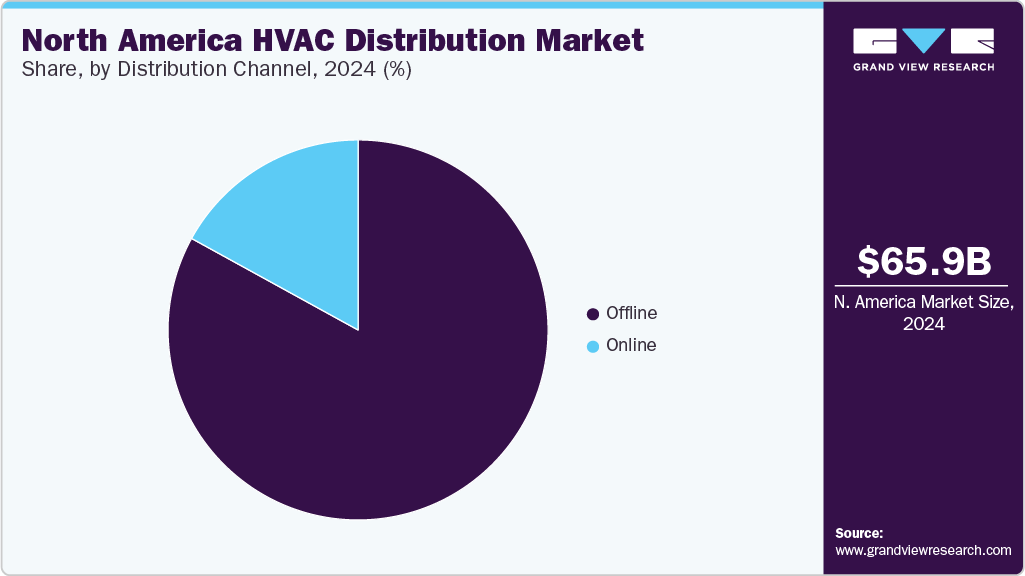
Offline distribution channel segment held a significant share of the market in 2024. The offline distribution channel remains a cornerstone of the North America HVAC distribution market. Traditional brick-and-mortar stores, authorized dealers, and HVAC contractors continue to play a crucial role, especially for complex installations and commercial projects. These channels provide personalized services, expert advice, and immediate product availability, which are essential for customers requiring tailored solutions and professional installation.
 To learn more about this report, Download Free Sample Report
 The online distribution channel in the North America HVAC distribution market is experiencing significant growth, driven by the increasing adoption of e-commerce platforms and changing consumer preferences. Customers now seek the convenience of browsing, comparing, and purchasing HVAC products from the comfort of their homes. Online platforms offer a wide range of products, detailed specifications, and customer reviews, empowering consumers to make informed decisions.
Country Insights
The U.S. HVAC distribution market is increasingly focused on sustainability and energy efficiency, driven by both regulatory pressures and consumer demand for greener solutions. Federal and state-level initiatives, such as stricter building codes and energy performance standards, are pushing distributors to offer high-efficiency HVAC systems that meet evolving requirements. In addition, there is growing interest in smart HVAC solutions, with IoT-enabled systems gaining traction for their ability to provide real-time monitoring, enhanced control, and predictive maintenance.
Canada HVAC distribution market is similarly shaped by sustainability initiatives and a robust regulatory framework aimed at reducing carbon emissions. Canada’s commitment to reducing greenhouse gases is influencing the HVAC sector, with a rise in the adoption of energy-efficient systems, particularly in residential and commercial buildings. Distributors are capitalizing on this shift by expanding their offerings to include solutions that align with Canada’s energy efficiency standards and environmental goals.
Key North America HVAC Distribution Company Insights
Some of the key players operating in the market include Watsco, Inc., Winsupply Inc. and Ferguson Enterprises.
-
Watsco, Inc. is the one of the largest distributor of air conditioning, heating, and refrigeration (HVAC/R) equipment and related parts and supplies in North America. Founded in 1956 and headquartered in Miami, Florida, Watsco operates over 670 locations across the United States, Canada, Mexico, and Puerto Rico. The company serves more than 350,000 contractors and technicians annually, offering a wide range of products, including residential and commercial HVAC systems, parts, and supplies. Watsco's business strategy focuses on acquiring businesses to build density in existing markets and expand its network into new geographic areas.
-
Winsupply Inc. is a supplier of residential and commercial construction and industrial supplies and equipment in the U.S. Established in 1956 and headquartered in Dayton, Ohio, Winsupply operates approximately 630 wholesaling locations across 45 states. The company offers a diverse range of products, including plumbing, HVAC, electrical, industrial pipe, valves and fittings, and waterworks supplies.
Key North America HVAC Distribution Companies:
- HVAC Distributors
- Watsco, Inc.
- Ferguson Enterprises
- Reece Group
- Winsupply Inc.
- Johnstone Supply
- United Refrigeration, Inc.
- Duncan Supply Co. Inc.
- Crescent Parts & Equipment
- Northeastern Supply Co.
Three ways to get this report
Buy it, customize it, or ask a question.Ask an Analyst
Analyst response in 1 business day
- AccessReport author, directly
- Reply timeWithin 1 working day
- No sales callDirect answer only
- FormatEmail reply
- CostFree, no cost
Get the Full Report
What the study covers
- FormatsPDF · Excel · Dashboard
- Timeline2025–2030 annual, 2024 base
- Coverage20+ countries, 5 regions
- Companies10+ key players profiled
Customize the Report
20% free customization
- IncludeCountries, segments, points
- TailorTo your product definition
- ExtendDeeper competitor detail
- OrA fully bespoke study
- Turnaround5–10 working days
Recent Developments
-
In May 2025, Watsco completed the acquisition of Southern Ice Equipment Distributors, alongside two other transactions earlier in the year. In January, Watsco acquired Lashley & Associates, a U.S. based distributor specializing in custom air movement products and commercial supplies. This was followed by the acquisition of Hawkins HVAC Distributors in April 2025, a supplier of HVAC supplies and equipment with locations in North Carolina, and South Carolina. The terms of these transactions were not disclosed.
-
In May 2025, Winsupply acquired Industrial Sales Co. which serves water, gas, telecom, geothermal, landscape and equipment customers throughout the Midwest.Terms of the deal were not disclosed.
North America HVAC Distribution Market Report Scope
Report Attribute
Details
Market size value in 2025
USD 69.12 billion
Revenue forecast in 2030
USD 93.50 billion
Growth rate
CAGR of 6.2% from 2025 to 2030
Historical data
2018 - 2024
Forecast period
2025 - 2030
Quantitative units
Revenue in USD million/billion and CAGR from 2025 to 2030
Report coverage
Revenue forecast, company ranking, competitive landscape, growth factors, and trends
Segments covered
Equipment, end use, distribution channel, application, region
Country scope
U.S.; Canada; Mexico
Key companies profiled
HVAC Distributors; Watsco, Inc.; Ferguson Enterprises; Reece Group; Winsupply Inc.; Johnstone Supply; United Refrigeration, Inc.; Duncan Supply Co. Inc.; Crescent Parts & Equipment; Northeastern Supply Co.
Customization scope
Free report customization (equivalent up to 8 analysts working days) with purchase. Addition or alteration to country, regional & segment scope.
Pricing and purchase options
Avail customized purchase options to meet your exact research needs. Explore purchase options
North America HVAC Distribution Market Segmentation
This report forecasts revenue growth at regional, and country levels and provides an analysis of the latest industry trends in each of the sub-segments from 2018 to 2030. For this study, Grand View Research has segmented the North America HVAC distribution market report based on equipment, end use, distribution channel, application, and country.
-
Equipment Outlook (Revenue, USD Billion, 2018 - 2030)
-
Heat Pump
-
Furnace
-
Unitary Heaters
-
Boilers
-
Air Purifier
-
Dehumidifier
-
Air Handling Units
-
Ventilation Fans
- Air Conditioning
-
Chillers
-
Others
-
-
End Use Outlook (Revenue, USD Billion, 2018 - 2030)
-
Commercial
-
Residential
-
Industrial
-
-
Distribution Channel Outlook (Revenue, USD Billion, 2018 - 2030)
-
Offline
-
B2B
-
B2C
-
-
Online
-
-
Application Outlook (Revenue, USD Billion, 2018 - 2030)
-
New Construction
-
Retrofit & Renovation
-
-
Country Outlook (Revenue, USD Billion, 2018 - 2030)
-
U.S.
-
Canada
-
Mexico
-
Frequently Asked Questions About This Report
The North America HVAC distribution market size was estimated at USD 65.93 billion in 2024 and is expected to be USD 69.12 billion in 2025.
The North America HVAC distribution market, in terms of revenue, is expected to grow at a compound annual growth rate of 6.2% from 2025 to 2030 to reach USD 93.50 billion by 2030.
Heat pump equipment segment led the market and accounted for a share of 44.0% in 2024. The heat pump market is experiencing significant growth, driven by increasing demand for energy-efficient and sustainable heating and cooling solutions.
Some of the key players operating in the North America HVAC distribution market include HVAC Distributors, Watsco, Inc., Ferguson Enterprises, Reece Group, Winsupply Inc., Johnstone Supply, United Refrigeration, Inc., Duncan Supply Co. Inc., Crescent Parts & Equipment, Northeastern Supply Co.
The market is influenced by technological advancements in energy efficiency, smart systems, and sustainability. As environmental concerns and energy regulations tighten, the demand for energy-efficient and eco-friendly HVAC solutions continues to grow, driving innovation and competition in the market.
About the Author(s)
Advanced Interior Materials Research Team
Advanced Materials · Advanced Interior MaterialsThis report was authored by the advanced interior materials research team at Grand View Research - comprising two research analysts, one senior research analyst, and one industry expert - with specialized expertise in the advanced interior materials segment of the advanced materials industry. All findings are based on proprietary advanced materials databases, executive interviews, and regulatory analysis, subject to internal peer review prior to publication.
Last Updated:
Speak to Analyst -

Customize this report to your needs - add regions, segments, or data points, with 20% free customization.
Or view our licence options:


ISO 9001:2015 & 27001:2022 Certified
We are GDPR and CCPA compliant! Your transaction & personal information is safe and secure. For more details, please read our privacy policy.


